Significant outcomes
∙ (−)-OSU6162 was well tolerated by the patients. No adverse reactions of the substance were observed.
∙ Significant improvements in HD patients were recorded for some non-motor variables, such as the SF-36 Vitality scale item ‘worn-out’ (VT3) and depressive symptoms as assessed by Beck Depression Inventory, following treatment with the monoaminergic stabilizer (−)-OSU6162.
Limitations
∙ The cross-over study design in itself implies potential limitations with respect to interpretation of the results, such as possible carry-over effects. If present, however, a pharmacological carry-over would lead to an underestimation of the therapeutic effects.
∙ The number of patients in this study is small and unevenly distributed between the two treatment groups.
∙ Patients in this study showed a wide variation in their symptoms and in their response to the test substance.
Introduction
Huntington’s disease (HD) is an autosomal dominant inherited neurodegenerative disorder, caused by an expanded CAG trinucleotide repeats in the HD gene and resulting in a mutant form of the protein huntingtin. Cell death occurs mainly in striatum and cerebral cortex, but also, for example, in the hypothalamus. The symptoms of the disease involve motor, behavioural/psychiatric, cognitive, wakefulness and endocrine disturbances (Reference Petersén and Björkqvist1). The mean age of onset in HD is ~40 years, but the disease may occasionally start at infancy or in old age up to the 9th decade. The prevalence of HD has been estimated to 5–7 per 100 000 individuals (Reference Walker2). The clinical diagnosis of HD is based on the development of extrapyramidal movement abnormalities such as chorea in the presence of a positive genetic test or family history of the disease.
Unfortunately, only symptomatic treatment is available for HD and it is only partly effective. The monoamine depleter tetrabenazine can alleviate chorea but may worsen other symptoms; depression is a common side effect (Reference Paleacu3). Antidepressants and antipsychotics are used fairly frequently in order to treat psychiatric symptoms.
Recently an alternative treatment principle has been tested in HD patients, using two chemically and pharmacologically closely related drugs acting on monoaminergic receptors rather than depleting the stores. These agents, called (−)-OSU6162 and pridopidine, respectively, have been shown to act on both dopaminergic and serotonergic receptor subpopulations in such a way as to enable them to both stimulate and inhibit behaviour, depending on whether the baseline level is low or high, respectively (Reference Rung, Rung and Helgeson4–Reference Burstein, Carlsson and Owens6). In an early small open study (−)-OSU6162 was given as single intravenous doses to HD patients, and a reduction of choreatic symptoms was noted (Reference Tedroff, Ekesbo, Sonesson, Waters and Carlsson7, and unpublished data). With pridopidine phase II and phase III studies have been reported, with promising results. In the phase III study, a European multicentre study (Reference de Yebenes, Landwehrmeyer and Squitieri8) the primary outcome criterion, comprising a modified motor scale, was not fully met (p=0.041 as compared with the predicted p=0.025), whereas a tertiary outcome criterion, including all the motor items recorded according to the Unified Huntington’s Disease Rating Scale (UHDRS) indicated a statistically significant, dose-dependent improvement, showing up following treatment for 26 weeks (p=0.004). These results were corroborated in a subsequent American/Canadian multicentre phase IIb study with pridopidine in HD (9). Moreover, a meta-analysis of data from the two studies reported a significant improvement in the UHDRS both at week 12 and week 26; even for the modified motor scale a significant improvement was found (Reference Landwehrmeyer, Marder and Biilmann-Ronn10).
With safety as our primary objective and efficacy as our secondary objective, the present study with (−)-OSU6162 was undertaken in view of previous promising observations in HD (Reference Tedroff, Ekesbo, Sonesson, Waters and Carlsson7) and preclinical data suggesting possible advantages of this compound in comparison with pridopidine regarding certain aspects of the HD symptomatology (see Discussion).
Materials and methods
Patients
Eighteen patients with HD were included in the study. Fifteen of these patients completed the study – three were excluded due to withdrawal of consent. These three patients withdrew from the study during the first 4-week period while on placebo treatment.
All patients in the study live in the Västra Götaland region of Sweden and all except two are participating in the Registry study, a multi-centre, multi-national observational study with no experimental treatment (11). All fulfilled the diagnostic criteria for HD stage 2 and 3 (Reference Shoulson, Kurlan and Rubin12). The number of CAG repeats on the long allele was 39 or more. Genetic tests were carried out at the Department of Clinical Genetics, Sahlgrenska University Hospital. The medical Ethics Committee at Sahlgrenska University Hospital approved the study, and written consent was obtained from all participants after written and verbal information had been given.
We excluded patients with significant co-morbidity such as major depression [according to Diagnostic and Statistical Manual of Mental Disorders, 4th. Edition (DSM IV)], heart disease or serious hypertension, serious liver disease, cancer, epilepsy, hyperthyroidism, alcohol or drug abuse, and patients with increased risk of suicide, as well as women of child-bearing age who were not on contraceptives, pregnant women, and patients treated with electroconvulsive therapy up to 90 days before inclusion in this study. Furthermore, we excluded patients who for various reasons were unable to follow given instructions.
Medications permitted were selective serotonin reuptake inhibitors, serotonin–norepinephrine reuptake inhibitors, other antidepressants such as noradrenergic and specific serotonergic antidepressants, antipsychotics, anxiolytics and hypnotics, provided that the medication was kept stable throughout the study and during the 3 months preceding study start.
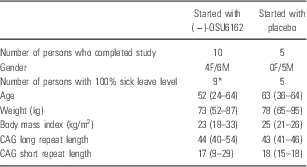
Demographic characteristics are shown in Table 1.
Demographic characteristics
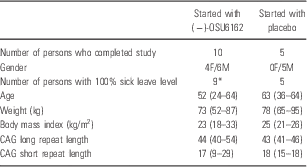
Shown are quantity or median (range).
*One participant was working 100%.
Study compound
(−)-OSU6162 [(3S)-3-[3-(methylsulfonyl)phenyl]-1-propylpiperidine hydrochloride] was prepared under GMP conditions at ‘Syntagon’ (Södertälje, Sweden) and ‘Galenica AB’ (Malmö, Sweden) as described previously (Reference Sonesson, Lin and Hansson13).
Description of study
According to the double-blind, cross-over-design patients were randomly divided into two groups with respect to order of treatment (Fig. 1). In one group (osu-plac), patients received (−)-OSU6162 for 4 weeks starting at assessment point B1 and ending at assessment point P1. The treatment was then switched to placebo for 4 weeks starting at assessment point P1 and ending at assessment point P2. In the other group (plac-osu), patients received placebo from B1 to P1 and (−)-OSU6162 from P1 to P2. During the first week of (−)-OSU6162 treatment, the dose of (−)-OSU6162 was 15 mg twice daily, during the second week 30 mg twice daily, and finally 45 mg twice daily during weeks 3 and 4. The dosage was individually flexible, meaning that if a person experienced alleviation of symptoms on a specific dose, but a dose increase resulted in decreased therapeutic effect and/or adverse reactions, the lower dose would be resumed and could be the final dose for that patient. Outcome measures were collected at assessment points B1, P1, P2 and B2. Information about adverse effects was collected continuously.
Presentation of the study design. The study was designed as a double-blind, cross-over study. Patients were randomly divided into two groups with respect to order of treatment. One group started with (−)-OSU6162 and the other with placebo, switching after 4 weeks of treatment. B1 is the first assessment point and the start of the study. P1 is the second assessment point following the first 4 weeks of treatment and the cross-over point in the study. P2 is the third assessment point following the next 4 weeks of treatment (week 4–8) and the endpoint of the treatments. The fourth and last assessment point is B2. During the first week of (−)-OSU6162 treatment, the dose of (−)-OSU6162 was 15 mg twice daily, during the second week 30 mg twice daily, and finally 45 mg twice daily during weeks 3 and 4. Patients were controlled for adverse effects every week during the consultation with the study nurse.

Description of outcome measures
Our primary outcome parameters concerning safety of (−)-OSU6162 were monitored by weekly registration of blood pressure and electrocardiography, together with consultations with the study nurse. At assessment points B1, P1, P2 and B2 physical examination by a neurologist, measurements of weight and height plus blood sampling for chemistry and hematology safety labs were added (Fig. 1). Blood variables studied were: haemoglobin (Hb), bilirubin, erythrocyte volume fraction, number of leucocytes, number of thrombocytes, serum-sodium, serum-potassium, creatinine, serum-alanine aminotransferase, serum-aspartate aminotransferase, serum-alkaline phosphatase, serum-thyroid stimulating hormone, serum-thyroxin, folate, B12, prolactin and B-cell counts (B-neutrophils, B-lymphocytes, B-monocytes, B-eosinophils, B-basophils).
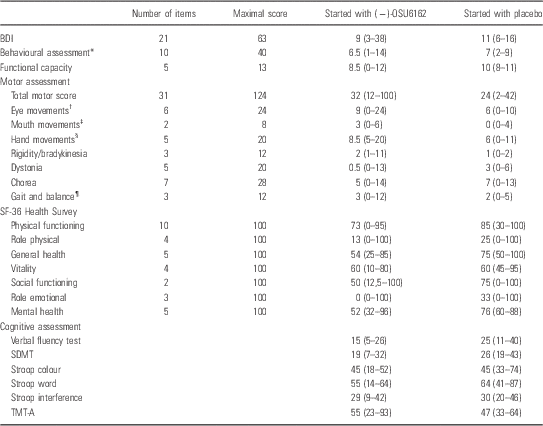
As our secondary outcome parameters we studied the therapeutic effects of (−)-OSU6162 on motor, cognitive, behavioural and functional capacity using protocols from Registry 2005, which is a modification from the UHDRS (14). Used tests and outcome measures are listed in Table 2. Processing of protocols used in Registry 2005 (UHDRS) was as follows: In the calculation of Behavioural Assessment, only the degree of severity was evaluated and is summarized as the total score (frequency was not determined). A total score was calculated for Functional Capacity. Motor assessment was summarized as a total score including the whole scale and divided into the sub-scales (with calculated sub-scores): Eye movements (ocular pursuit horizontal/vertical; saccade initiation horizontal/vertical; saccade velocity horizontal/vertical), mouth movements (dysarthria; tongue protrusion), hand movements (finger taps right/left; pronate/supinate-hands right/left; Luria), rigidity/bradykinesia, dystonia [trunk; right upper extremity (RUE); right lower extremity (RLE); left upper extremity (LUE); left lower extremity (LLE)], chorea [face; buccal-oral-lingual (BOL); trunk; RUE; RLE; LUE; LLE], gait and balance (gait; tandem walking; retropulsion pull test). The cognitive assessment consisted of several separate tests which were individually analysed (no scores were calculated) (for tests see Table 2).
Baseline characteristics
BDI, Beck depression inventory; SDMT, Symbol digit modalities test; TMT, trail making test.
Shown are median (range).
* Only degree of severity was evaluated and is summarized as the total score of Behavioural Assessment (frequency was not determined).
† Sum of items: Ocular Pursuit horizonal/vertical; Saccade initiation horizonal/vertical; Saccade velocity horizonal/vertical.
‡ Sum of items: Dysarthria; tongue protrusion.
§ Sum of items: Finger taps right/left; pronate/supinate-hands right/left; Luria.
¶ Sum of items: Gait; tandem walking; Retropulsion pull test.
The patients’ mental and physical conditions were also evaluated with BDI and the modified Short Form 36 (SF-36) Health Survey (Reference Ware, Snow and Kosinski15,16). For BDI the total score was analysed. Sub-scores were calculated for the SF-36 Health Survey sub-scales in accordance with the SF-36 manual (16), with the exception of the score for the scale bodily pain. (A score for the scale bodily pain was not calculated because the patients had misunderstood the questions concerning bodily pain). The code was broken after all data had been blindly collected.
Statistics
Outcome measures were subjected to crossover analyses according to Altman (Reference Altman17). Treatment effect was tested by comparing the individual difference between assessment points P1 and P2 for the two treatment groups (‘osu-plac’ and ‘plac-osu’). The analysis was performed with non-parametric Wilcoxon two-sample test (Mann–Whitney U-test). The Hodges–Lehmann method of location shift was used for construction of exact 95% confidence intervals for the treatment effect. The Hodges–Lehmann method is associated with the Wilcoxon linear rank statistic (Reference Hodges and Lehmann18,Reference Hollander and Wolfe19). Exact tests are appropriate when a data set is small, skewed, or heavily tied. Paired sign test was used to compare proportion of dichotomous outcome, that is the proportion of patients who improved and deteriorated, respectively. One-Sample Sign test was applied on data shown in Fig. 2 to evaluate the proportion of outcomes showing trends of improvement and deterioration respectively. ‘Motor assessment’ was not included in the analysis. SAS 9.3 was used for calculations.
Treatment effects of (–)-OSU6162. 95% confidence intervals for median treatment effect of (−)-OSU6162 on the studied scores and variables. There was an improvement in the Vitality score during (–)-OSU6162 treatment with a magnitude of 10 units, 95% CI 2.5–25; p=0.021. A One-Sample Sign test on the medians of all variables/scores (n=16), except those assembled under ‘Motor assessment’, showed 10 values above 0 and 1 below 0, indicating an overall change towards improvement (p=0.012). Among the variables and scores, ‘Physical functioning’ and ‘Role physical’ (assembled under the ‘SF-36’ scale) encompass variables rating predominantly motor functions, although not included in ‘Motor assessment’. However, in so far as the One-Sample Sign test is concerned, these variables have no impact, because their medians are 0 in both cases. Note the different scaling in the graphs.
To facilitate interpretation of graphs (in Fig. 2) the sign of the responses of some items were inverted so that a decreased value is always associated with a positive treatment effect. Thus, the signs of the responses of functional capacity, SF-36 and the cognitive tests [except for trail making test (TMT-A)] were inverted.
Results
No adverse effects of (−)-OSU6162 were observed during the study. Three patients withdrew at an early stage from the study due to adverse effects while on placebo treatment. Dose adjustment was only necessary in one case due to dizziness and fatigue. However, in this patient the dose was lowered during placebo treatment – the final dose was 60 mg (30 mg bid).
No significant body weight changes were observed.
Of all studied blood variables, only two showed a statistically significant change following (−)-OSU6162 treatment. The concentration of Hb and bilirubin increased significantly during (−)-OSU6162 treatment (both p=0.020 according to Mann–Whitney U-test). However, all values remained within the normal range for all studied patients.
Secondary outcome measures at baseline are shown in Table 2. There were no differences in outcome measures between the two groups before treatment start.
Figure 2 shows exact 95% confidence intervals for the treatment effects of all studied secondary outcome variables. The overall impression is that among the variables related to mental health, social functioning and cognition, a fairly high number of them indicate improvement, and applying One-Sample Sign test on the data of all variables, except those assembled under ‘Motor assessment’, gave a positive outcome (p=0.012). Among the variables in Fig. 2, ‘Physical functioning’ and ‘Role physical’ from SF-36 Health Survey encompass variables rating predominantly motor functions, although not included in ‘Motor assessment’. However, in so far as the One-Sample Sign test is concerned, these variables have no impact, because their medians are 0 in both cases.
Within the SF-36 Health Survey, the scales concerning mental health, that is Vitality, Social functioning and Mental Health seem to be most improved by (−)-OSU6162. Of these the score of the Vitality scale showed a significant treatment effect. The median improvement in Vitality score was 10 units with a 95% confidence interval ranging from 2.5 to 25 (p=0.021; Mann–Whitney U-test; Fig. 2). Figure 3 shows the individual change in Vitality score for each patient in the (a) ‘plac-osu’ group and (b) ‘osu-plac’ group, together with the median change in these groups (red line). Looking at the entire material, regardless of treatment sequence, 10 out of 14 patients got a higher Vitality score (improved) during the (−)-OSU6162 period, which is a statistically significant outcome according to Paired sign test, p=0.039.
Individual and median changes in SF-36 Health Survey Vitality (VT) score from assessment point P1 to assessment point P2 for: (a) group ‘plac-osu’ (n=5) and (b) group ‘osu-plac’ (n=9). A higher score value means an improvement of the symptoms. A statistically significant improvement in Vitality score was seen after (−)-OSU6162 treatment according to Mann–Whitney U-test, p=0.021. Red lines show the median change in VT score for each group. In the group ‘plac-osu’ (a) five out of five patients improved and in the group ‘osu-plac’ (b) five out of nine patients improved. Looking at the entire material, regardless of treatment sequence, 10 out of 14 were patients improved; this is a statistically significant change due to Paired sign test, p=0.039.
The SF-36 Vitality scale contains four items: ‘strength’, ‘full of energy’, ‘worn-out’ (VT3) and ‘fatigue’. We tested these four items separately to see how they contributed to the Vitality score. Of these four items, VT3 (worn-out) showed a statistically significant treatment effect after (−)-OSU6162 (p=0.027; Mann–Whitney U-test) and is thus the main contributor to the change in Vitality score after (−)-OSU6162 treatment. Figures 4a and b show the individual and the median changes in the item VT3 for the two treatment groups. Looking at the entire material, regardless of treatment sequence, treatment with (−)-OSU6162 made eight out of 14 patients feel less ‘worn-out’, p=0.11 with Paired sign test. It is evident from the figures that a higher proportion of patients in the group ‘plac-osu’ (Figs 3a and 4a) than in the group ‘osu-plac’ (Figs 3b and 4b) were improved.
Individual and median changes in the item ‘worn-out’ (VT3) from assessment point P1 to assessment point P2 for: (a) group ‘plac-osu’ (n=5) and (b) group ‘osu-plac’ (n=9). Red lines show the median change in VT3 for each group. A statistically significant improvement in the item ‘worn-out’ was seen after (−)-OSU6162 treatment according to Mann–Whitney U-test, p=0.027. In the group ‘plac-osu’ (a) four out of five patients improved, and in the group ‘osu-plac’ (b) four out of nine patients improved. Looking at the entire material, regardless of treatment sequence, eight out of 14 patients felt less ‘worn-out’; (Paired sign test, p=0.11).
The median difference in BDI score between treatments were 1.5 units with a 95% confidence interval from −1.5 to 5.0 (p=0.180; Mann–Whitney U-test; Fig. 2). Individual and median changes in BDI score are seen in Fig. 5. Looking at the entire material, regardless of treatment sequence, 10 out of 14 patients were improved (i.e. achieved a lower BDI score value) after (−)-OSU6162 treatment, which is a statistically significant change according to Paired sign test, p=0.039. If we remove all patients scoring under 10 for BDI (=minimal or no depression) we get a median score difference between treatments of 3.0 with a 95% confidence interval from −1.5 to 6.0 (p=0.050; Mann–Whitney U-test). In this situation 9 out of 10 patients were improved after treatment with (–)-OSU6162, which is a statistically significant change according to Paired sign test, p=0.022.
Individual and median changes in Beck depression inventory (BDI) score from assessment point P1 to assessment point P2 for: (a) group ‘plac-osu’ (n=5) and (b) group ‘osu-plac’ (n=9). A lower score value means an improvement of BDI symptoms. Red lines show the median change in BDI score for each group. In the group ‘plac-osu’ (a) three out of five patients improved and in the group ‘osu-plac’ (b) seven out of nine patients improved. Looking at the entire material, regardless of, treatment sequence 10 out of 14 patients were improved (i.e. achieved a lower BDI score value) after (−)-OSU6162 treatment, which is a statistically significant change according to Paired sign test, p=0.039.
There were trends towards improvement in some of the cognitive tests, but no statistically significant treatment effects (Fig. 2).
As to ‘Motor assessment’ and the two scores concerning motor function in the scale of SF-36 Health Survey, ‘Physical functioning’ and ‘Role physical’, there were small trends in both directions but no statistically significant treatment effects (Fig. 2). Interesting to note is that the patient showing the most severe motor symptoms was able to perform some of the tests, such as TMT-A and Stroop Interference, only after treatment with (–)-OSU6162 and not after placebo.
Discussion
The present study confirms a number of published and unpublished completed or still on-going clinical trials indicating that (−)-OSU6162 is a safe drug with remarkably mild adverse effects, in harmony with its stabilizer profile. Regarding therapeutic efficacy, the outcome of this study should be interpreted with some caution, mainly in view of the limited number of subjects investigated. Moreover, the use of a crossover design, despite its obvious advantages by enabling the use of each subject as its own control, has a number of limitations, partly of psychological nature (Reference Suchman and Ader20,Reference Faria, Fredrikson and Furumark21), partly due to the risk of pharmacological carry-over effects during the placebo period following upon exposure to an active test drug. In the present study we cannot exclude the possibility of such a pharmacological carry-over effect. However, in case of a therapeutically favourable outcome this kind of carry-over effect would only lead to an underestimation of the result, and will thus in the present case not be of any major concern (Reference Elbourne, Altman and Higgins22).
The beneficial results obtained in this study deal with variables such as improved vitality and feeling less worn-out. In addition an improvement in the BDI was noted. On the other hand there was no appreciable change in the ratings of motor functions. The present results seem to be in harmony with a recently published study by Johansson et al. (Reference Johansson, Carlsson and Carlsson23) in which (−)-OSU6162 was found to improve mental fatigue caused by head injury and stroke. The beneficial effects of the drug in the two studies would appear to be closely similar, if not identical.
As mentioned in the Introduction the compound pridopidine, which is chemically and pharmacologically similar to (−)-OSU6162, has already been shown to be therapeutically active in HD. However, in two large-scale studies the improvement was limited to motor symptoms, cognitive and mental symptoms being unaffected (Reference de Yebenes, Landwehrmeyer and Squitieri8,9). The beneficial effects of pridopidine developed slowly and reached statistical significance only after several months, in contrast to the effects of (−)-OSU6162 showing up already after 4 weeks.
This difference in clinical activity of two closely related compounds calls for an explanation. In preclinical studies both compounds exhibit a ‘stabilizing’ action, in the sense that they can activate rats with a low baseline motor activity and inhibit rats with a high baseline activity. However, (−)-OSU6162 seems to be superior to pridopidine regarding the activating effect (Reference Rung, Rung and Helgeson4). Moreover, the inhibitory action of (−)-OSU6162 could no longer be seen in D2-receptor knockout mice made hyperactive by amphetamine, but remained unchanged following pridopidine treatment, indicating the importance of (a) D2-independent mechanism(s) of action in the case of pridopidine in this model (Reference Svensson, Falcone and Johansson24). Regarding the ability of the compounds to displace a D2-receptor ligand from rat striatal binding sites, pridopidine was clearly less potent than (−)-OSU6162 (Reference Natesan, Svensson and Reckless25). In a positron emission tomography investigation, we found dose-dependent binding to striatal D2 receptors following single doses of (−)-OSU6162 to healthy volunteers (Reference Tolboom, Berendse and Leysen26) – no human binding data appear to be available in the case of pridopidine.
Taken together, the preclinical data quoted above indicate that (−)-OSU6162 has a stronger binding to D2 receptors and causes a more pronounced D2-receptor-mediated behavioural activation than pridopidine. This could explain why the vitalizing action of (−)-OSU6162 shown in the present study could not be demonstrated in the clinical studies so far performed with pridopidine in HD patients.
An interesting notion concerning the possible presence of a pharmacological carry-over effect mentioned earlier, is that (−)-OSU6162 may have beneficial effects on plasticity, given that the half-life of this compound is only about 4 h (Reference Rodriguez, Azie and Adams27). Apparently such an effect is exerted by pridopidine, given the slow development, during several months, of the action of that compound on motor functions. Thus prolonged treatment studies are strongly indicated also for (−)-OSU6162, maybe also actions on motor functions will then emerge. In fact, a neuroprotective action of (−)-OSU6162 has been demonstrated in in vitro experiments (Reference Ruiz, Casarejos and Rubio28).
The present study would appear to justify the conclusion that (−)-OSU6162 offers promise for the treatment of HD as a drug with good tolerability, capable of alleviating some hitherto treatment-resistant symptoms of great importance for the quality of life of these patients. Moreover, given that the effects of pridopidine required several months of treatment to become apparent, the possibility remains that significant beneficial effects of its, in some respects, more powerful congener (−)-OSU6162 will show up not only on energy and mood but also on motor and cognitive functions if treatment periods are extended beyond the present 28 days. Thus, an extended double-blind placebo-controlled study using a longer treatment period would be an interesting future project.
Acknowledgements
The authors gratefully acknowledge Carina Karlberg, Yvonne Jansson and Sirpa Cvijic for their important work with the patients. They also want to thank Kjell Pettersson, the University of Gothenburg, for his expert advice regarding statistics.
Financial Support
This study was supported by the Arvid Carlsson Foundation, The Foundation for Neuropharmacological Research and Education, and Västra Götalandsregionen.