Introduction
Bilateral tonsillectomy and/or adenoidectomy is the most frequently performed surgical procedure in otorhinolaryngology.Reference Blair, McKerrow, Carter and Fenton1 In terms of complexity, it is considered to be a minor surgical procedure, but due to possible complications it should be treated with special attention. The most serious complication is haemorrhage, either primary or secondary.
Primary post-tonsillectomy haemorrhage occurs in the first 24 hours following the surgical procedure. Secondary haemorrhage occurs between the second and 10th post-operative days. The literature on the subject reveals that the incidence of post-tonsillectomy haemorrhage varies from 0.1 to 9.3 per cent;Reference Wei, Beatty and Gustafson2 however, the majority of studies have reported an incidence of between 1 and 3 per cent.Reference Tami, Parker and Taylor3, Reference Maniglia, Kusher and Cozzi4
A number of studies have tried to evaluate possible risk factors, such as surgical technique, the surgeon's level of experience, the quantity of intrasurgical blood loss, haematological factors and post-operative blood pressure, but none of the reported factors have been shown to have any significant effect on the occurrence of post-tonsillectomy haemorrhage.Reference Wei, Beatty and Gustafson2, Reference Lee, Montague and Hussain5 Another possible risk factor may be the prevailing weather conditions, which have been associated with an increased tendency towards haemorrhage in patients with general and vascular conditions.Reference Ebi, Exuzides, Lau, Kelsh and Barnston6, Reference Eurowinter7 Meteorological stress has been known to cause a number of complex physiological responses, which have been neither completely identified nor explored.Reference Eurowinter7 One study found that different weather conditions were associated with specific metabolic changes, resulting in different cardiovascular diseases in the long term.Reference Keatinge, Coleshaw, Cotter, Mattock, Murphy and Chelliah8
Thus far, the relationship between weather conditions and hospital admission has been investigated using a variety of different approaches.
The first of these has been the use of a single meteorological variable (e.g. air temperature) when assessing cases of acute myocardial infarction or secondary post-tonsillectomy haemorrhage, thus treating weather as a univariate phenomenon.Reference Marchant, Ranjadayalan, Stevenson, Wilkinson and Timmis9–Reference Collinson and Mettler11 However, none of the studies using this approach have supported their findings with an analysis of weather data variables.Reference Roberts, Jayaramachandran and Raine10, Reference Collinson and Mettler11
The second approach is to consider the combined effects of several meteorological parameters – usually air temperature and relative humidity or wind speed – thus treating weather as a bivariate phenomenon. This has been done, using simple biometeorological indices, in the assessment of acute laryngitis, epistaxis and myocardial infarction.Reference Danielides, Nousia, Patrikakos, Bartzokas, Lolis and Milionis12–Reference Morabito and Gensini14
Only one study has taken a third approach, analysing the effect of several meteorological parameters on post-tonsillectomy haemorrhage.Reference Lee, Montague and Hussain15 A synoptic climatological approach was employed, considering either ‘weather types’ (i.e. synoptic events categorised by pressure patterns and wind fields) or ‘air masses’ (based on a wider variety of ground weather elements).
The first two approaches to examining the relationship between weather conditions and hospital admission are limited by considering only few ground meteorological parameters; thus, these approaches cannot be used to describe the simultaneous actions of a weather complex. On the other hand, the synoptic climatological approach allows the classification of weather patterns into categories that describe meteorological conditions at a particular location, and this can be used to evaluate the potential synergistic effects of a complex of weather elements on environmental and biological parameters sensitive to weather.Reference Morabito, Crisci, Grifoni, Orlandini, Cecchi and Bacci16, Reference Barry and Perry17
The aim of the present study was to investigate primary post-tonsillectomy haemorrhage by comparing daily weather conditions, classified by an air mass based, synoptic climatological approach, and by assessing their association with the incidence of primary post-tonsillectomy haemorrhage.
Materials and methods
This study involved 3377 patients who underwent surgery due to chronic tonsillitis and/or sleep-disordered breathing in the ENT department of the University Hospital Split from 1 January 2000 to 31 December 2004.
Data on all the operations were collected from the ENT department surgical records. Data on haemorrhages were collected from the patients' records by doctors while on 24-hour call within the ENT department. All tonsillectomy patients in the department stayed in hospital for a minimum of 24 hours.
Patients were included in the study on the basis of the following criteria: palatine and/or pharyngeal tonsil surgery, and primary post-operative haemorrhage within 24 hours of the surgical procedure. Primary post-operative haemorrhage was defined as any bleeding within the first 24 hours of tonsillectomy which required further treatment or which prolonged hospital stay.
To investigate whether human factors (e.g. surgeon fatigue) were involved in the haemorrhage, we divided the surgery days into two groups. The average number of tonsillectomy procedures per day in the department was 15, so this number was taken as the dividing point between ‘high volume’ and ‘low volume’ tonsillectomy days.
Thirty-eight patients' records were excluded from the air mass analysis due to renovation of the ENT department operating theatres. These patients were operated upon under special conditions (i.e. during the evening and not in the ENT operating theatres); thus, we considered these patients as missing data for this variable. Also, there were nine patients excluded for the number of surgeries that day.
Annual seasons were defined as Spring (starting 21 March), Summer (starting 21 June), Autumn (starting 23 September) and Winter (starting 21 December). Data on atmospheric pressure and barometric pressure systems (i.e. prevalence of cyclonic or anticyclonic air masses) were obtained from the Maritime and Weather Institute in Split, Croatia. Atomosphere pressure was measured three times a day (at 0700, 1400 and 2100 hours) using a mercury barometer, at the Marjan weather station (altitude 122 m, latitude 43°5′ north, longitude 16°5′ east). Atmospheric pressure values measured twice a day (at 0700 and 1400 hours) on the day prior to surgery, the day of surgery and the day following surgery, were used in this study.
An anticyclonic continental air mass was defined as a well developed anticyclonic system that dominates the central Mediterranean sea, having its centre on central Europe. It is the cold air mass, producing clear skies, high atmospheric pressures and very little wind.
Cyclonic air masses are associated with weather fronts which induce formation of a cyclonic system centred on the central Mediterranean sea. They produce cloudy days with low atmospheric pressure, high humidity levels, variable winds (predominantly from the south east) and mild air temperature.
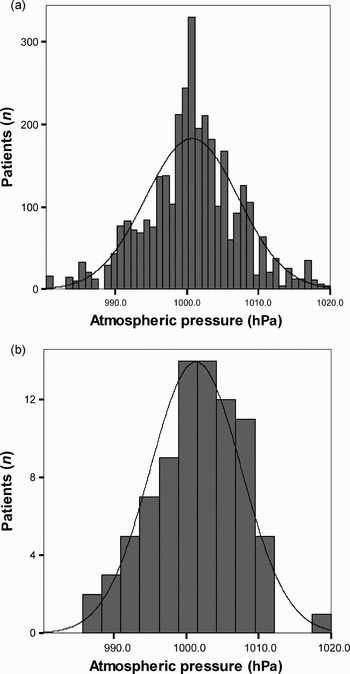
The correlation between post-tonsillectomy haemorrhage rate and different air mass types, seasons and tonsillectomy volumes was analysed. Atmospheric pressures distribution for patients without (a) and with (b) haemorrhage is shown in Figure 1. Haemorrhage events were compared with atmospheric pressures on the day of tonsillectomy as well as on the previous and following days. Changes in atmospheric pressure were calculated as the differences between measurements on these three days, and related to post-tonsillectomy haemorrhage occurrence.
Atmospheric pressure on patients' tonsillectomy day, for those (a) without and (b) with subsequent primary post-tonsillectomy haemorrhage.

Statistical data analysis was performed using the Statistic 7.0 (StatSoft, Chicago, Illinois, USA) software package for Windows. Categorical variables were compared using the chi-square test. The t-test for independent samples was used to test differences between patients with and without haemorrhage, for measured values of atmospheric pressure, and to compare mean atmospheric pressures with 95% confidence interval adjustment. The Mann–Whitney U test was used to compare daily atmospheric pressure changes for patients with and without haemorrhage. A value of p < 0.05 was considered significant.
Results and analysis
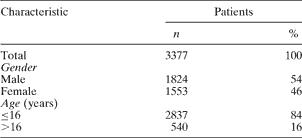
Of the 3377 patients (Table I) undergoing bilateral tonsillectomy during the five-year study period, 83 (2.5 per cent) suffered primary post-operative haemorrhage.
Study patients' demographic data
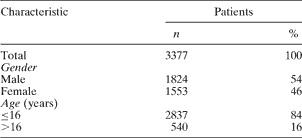
The age median (range) for patients ≤16 years was 6 (2–16) years, and that for patients >16 years was 29 (17–54 years).
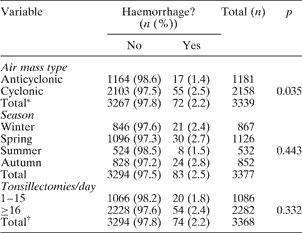
These haemorrhages occurred during anticyclonic air mass conditions in 17 (1.4 per cent) patients, and during cyclonic air mass conditions in 55 (2.5 per cent). For 38 patients (11 with and 27 without haemorrhage), no air mass data could be obtained. There was a significantly greater incidence of haemorrhage during cyclonic versus anticyclonic air mass conditions (p = 0.035). There were no significant differences in primary post-tonsillectomy haemorrhage incidences, comparing the four annual seasons: 2.7 per cent of patients suffered haemorrhages in Spring, 2.8 per cent in Autumn, 2.4 per cent in Winter and 1.5 per cent in Summer (p = 0.443). The haemorrhage rate was similar on high tonsillectomy volume days (i.e. over 15 tonsillectomies per day) and low tonsillectomy volume days (i.e. up to 15 tonsillectomies per day) (chi-square test, p = 0.332). For nine patients, no data could be obtained on the number of other tonsillectomies performed on the same day (Table II).
Occurrence of haemorrhage during different air mass conditions, seasons and daily tonsillectomy volumes
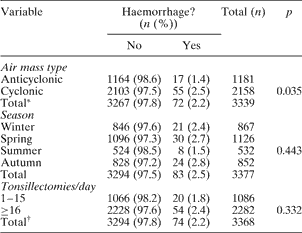
*For 38 patients (11 with and 27 without haemorrhage), there were no data on air mass type; †for 9 patients with haemorrhage, there were no data on tonsillectomy volume on the day of surgery.
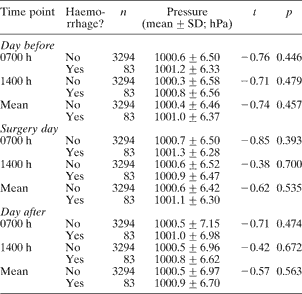
Table III shows the haemorrhage rates and atmospheric pressures on the day of surgery, the day before surgery and the day after surgery. No significant correlation was found between haemorrhage rates and atmospheric pressures measured on the observed days (p > 0.393).
Haemorrhage occurrence and atmospheric pressure* on day before, day of and day after tonsillectomy
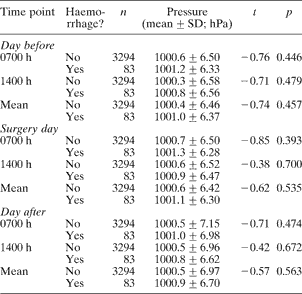
* Measured 122 m above sea level. SD = standard deviation
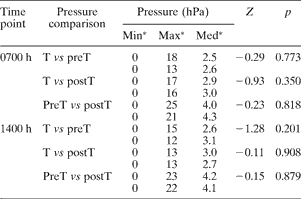
The incidence of post-tonsillectomy haemorrhage was compared with the change in atmospheric pressure (measured twice a day) during the day before tonsillectomy, the day of surgery and the day after surgery. There was no statistically significant association between haemorrhage rates and changes in atmospheric pressure (p > 0.201) (Table IV).
Haemorrhage occurrence and change in atmospheric pressure, comparing day before, day of and day after tonsillectomy
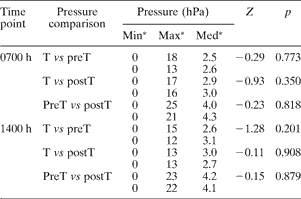
*Mean data are shown. Data were collected at 122 m above sea level. Over the 5-year study, a total of 83 patients suffered primary post-tonsillectomy haemorrhage and 3294 did not. Min = minimum; max = maximum; med = median; T = day of tonsillectomy; preT = day before tonsillectomy; postT = day after tonsillectomy
Discussion
According to the results of this study, a statistically significant difference in primary post-tonsillectomy haemorrhage rates was observed, comparing days with cyclonic air mass conditions versus days with anticyclonic air mass conditions. A higher post-tonsillectomy haemorrhage rate was observed during cyclonic air mass conditions, compared with anticyclonic conditions. The season in which the surgery was performed was not observed to have a statistically significant effect on the occurrence of post-operative haemorrhage. The volume of surgical procedures performed per day (i.e. greater or less than 15) did not appear to have a statistically significant impact on the post-operative haemorrhage incidence.
There was no statistically significant correlation between atmospheric pressures measured on the day before surgery, the day of surgery and the day after surgery, and the occurrence of post-tonsillectomy haemorrhage.
Since atmospheric pressures sometimes change very quickly, we also tested the possible influence of atmospheric pressure changes on primary post-tonsillectomy bleeding. Therefore, for each patient, we calculated the difference in atmospheric pressures, comparing the day of surgery with the day before surgery, the day of surgery with the day after surgery, and the day before surgery with the day after surgery (Table IV). However, we could not find any statistically significant effect of such atmospheric pressure changes on the occurrence of post-tonsillectomy haemorrhage.
• This retrospective study analysed the influence of daily weather conditions on the occurrence of primary post-tonsillectomy haemorrhage
• A significant correlation was found between increased primary post-tonsillectomy haemorrhage rate and cyclonic air mass conditions
• These results suggest that avoiding tonsillectomy during cyclonic air mass conditions may reduce the post-tonsillectomy haemorrhage rate
Primary post-tonsillectomy haemorrhage occurs in 0.1 to 9.3 per cent of patients.Reference Wei, Beatty and Gustafson2 This study found a 2.5 per cent post-operative haemorrhage rate; this rate does not significantly differ from the results of other studies.Reference Tami, Parker and Taylor3, Reference Maniglia, Kusher and Cozzi4 Although cyclonic conditions were associated with a significantly greater risk of haemorrhage (Table II), the absolute increase in risk was actually quite small (1.1 per cent) and had quite a wide 95 per cent confidence interval (0.2–2.1 per cent). The ‘number needed to harm’ would be about 90 (the reciprocal of the difference in risks) – that is, 90 patients would need to be treated in cyclonic conditions rather than anticyclonic conditions in order to yield one extra post-tonsillectomy haemorrhage. Inclusion of the 38 patients who were excluded from the air masses analysis due to renovation of the ENT department would not have removed the observed association between post-tonsillectomy haemorrhage and cyclonic versus anticyclonic weather patterns.
The causes of primary post-operative haemorrhage following tonsillectomy are still unknown.
Lee et al. observed that conducting tonsillectomy in warmer weather with higher water vapour pressure reduced the incidence of post-tonsillectomy haemorrhage.Reference Lee, Montague and Hussain15
In a study on possible risk factors for nose-bleeding, Jackons and Jacksons found that most haemorrhage events occurred in cold weather conditions at low humidity; two-thirds of the total number of bleeding incidents occurred during January and February, i.e. during the winter period.Reference Jackons and Jackons18
Danielides et al. reported the effect of weather variables, including water vapour pressure, temperature and relative humidity on epistaxis.Reference Danielidis, Kontogiannis, Bartzokas, Lolis and Skevas13
Kuegler reported specific mutual correlations between weather patterns and increased blood pressure, myocardial infarction, thrombosis, pulmonary embolism and asthma.Reference Kugler19
Dubs and Primault noted that post-operative haemorrhagic events primarily occurred when weather conditions began to improve (e.g. “clear weather approaching from the west”); such events occurred less frequently during periods of warm wind.Reference Dubs and Primault20 From their experience, they concluded that patients in an unstable vegetative condition, as well as, showed a tendency towards haemorrhage.
Reić reported a close relationship between cerebrovascular insults and unfavourable meteorological variables such as southerly winds, decreased air pressure and unstable meteorological conditions.Reference Reić21
Mirić, on the other hand, found a high correlation between weather patterns and acute myocardial infarction in the middle Dalmatian area of Croatia, suggesting a biometeorological approach to this problem for the purpose of preventing coronary incidents.Reference Mirić22
While conducting research on possible risk factors for post-tonsillectomy haemorrhage, Moreau et al. revealed that most cases occurred in autumn and winter. These authors stated that particular deviations from standard meteorological conditions may play a significant role in increasing the number of post-tonsillectomy haemorrhages.Reference Moreau, Morelle-Lafon and Bonhomme23
Finally, Roberts et al. explored the possible risk factors for post-operative tonsillar fossa haemorrhage, in a one-year, prospective study. They reported that the majority of such events occurred during the warmer months, i.e. in May and June.Reference Roberts, Jayaramachandran and Raine10
Conclusion
This study found a primary post-tonsillectomy haemorrhage rate of 2.5 per cent. There was no statistically significant correlation between the post-operative haemorrhage incidence and either atmospheric pressures or differences in atmospheric pressure. Atmospheric pressure was measured on the day before, the day of and the day after surgery. There was no significant association between the post-tonsillectomy haemorrhage incidence and the number of other tonsillectomy procedures performed on the same day. The post-tonsillectomy haemorrhage incidence did not vary significantly with the seasons.
The study's most important finding was a statistically significant increase in the post-tonsillectomy haemorrhage rate during cyclonic air mass conditions, compared with anticyclonic air mass conditions.
While this study was limited to one geographical area, this limitation should encourage further studies within larger localities, using the air mass based, synoptic climatological approach and taking into consideration the simultaneous effects of other environmental variables and of human factors such as age and gender.
Avoiding tonsillectomy when cyclonic air masses prevail may reduce the number of primary post-tonsillectomy haemorrhages.