The cleaning behaviours of small labrids (the cleaners) that remove ectoparasites, mucus and dead tissues from the body of generally larger client fishes, has been investigated widely (Gorlick et al., Reference Gorlick, Atkins and Losey1987; Poulin & Grutter, Reference Poulin and Grutter1996; Grutter, Reference Grutter1999). Cleaner fish may be specialized (ectoparasites representing most of their diet; Grutter, Reference Grutter1996) and obligate (cleaning throughout their lifespan; Grutter, Reference Grutter1997) or they may be non-specialized (feeding on benthic prey as well as the parasites, mucus and scales from the body surfaces of their clients; Sazima et al., Reference Sazima, Moura and Sazima1999) and facultative (cleaning only during specific stages of their life cycle; Brockmann & Hailman, Reference Brockmann and Hailman1976). Whilst there are numerous studies on the behaviour of tropical cleaner fishes, which are generally considered more specialized than temperate ones (Arnal & Morand, Reference Arnal and Morand2001a), there is less information on the cleaning behaviour of wrasse in more temperate seas (but see Henriques & Almada, Reference Henriques and Almada1997; Almada et al., Reference Almada, Henriques, Gonçalves, Almada, Oliveira and Gonçalves1999). In Mediterranean waters, the cleaner wrasse Symphodus melanocercus shows a high degree of specialization, as confirmed by behavioural observations and dietary analyses (Arnal & Morand, Reference Arnal and Morand2001a) and is considered one of the main cleaner fish in the Mediterranean Sea (Arnal & Morand, Reference Arnal and Morand2001b). Where S. melanocercus is absent, such as in the Azores, Thalassoma pavo and Coris julis play important roles as cleaners (Narvaez et al., Reference Narvaez, Furtado, Neto, Moniz, Azevedo and Soares2015).
Brown meagre Sciaena umbra is a demersal species which is distributed in the eastern Atlantic from the English Channel to Senegal, included the Canary Islands and the Mediterranean Basin. It occurs from inshore waters down to 180 m depth, living mainly in structural habitats, including rocky areas and Posidonia oceanica meadows (Chao, Reference Chao, Whitehead, Bauchot, Hureau, Nielsen and Tortonese1986).
Our observations were carried out in Cape Marino (42.348 N 10.925 E), a rocky promontory located on the south-east coast of Giglio Island, Central Tyrrhenian Sea. Near continuous daily observations for periods of 2 or 3 h were made by free diving (33 ± 6 dives per hour, average bottom time 1.15 ± 0.3 min) over a total study period of 2 weeks, with observations ranging between 06:00 and 20:00 h. Stationary point counts (Bannerot & Bohnsack, Reference Bannerot and Bohnsack1986) were performed during May 2016, without using breathing apparatus (the diver remained stationary on the bottom just holding his breath and recording the number of cleaning interactions and the area of cleaning on client fish). This method ensured minimal disturbance of the fish and allowed a closer approach to individuals without interfering with cleaning events. All data were recorded on plastic sheets and photographic records were made with a digital camera (Sony Alpha 6000 with underwater housing).
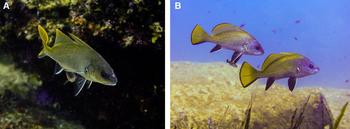
Two different habitats were recorded as cleaning stations, one near a boulder crevice surrounded by coarse sand and covered by semi-sciaphilous and sciaphilous algal communities (Figure 1A); and the other at the edge of P. oceanica meadow (Figure 1B). The observations also included two different cleaning behaviours. The first was characterized by the client S. umbra occurring close to the bottom (40–50 cm) in established cleaning stations. In the other cases, the cleaner, one or two female S. melanocercus, did not operate in cleaning stations, but followed the client fish for 3–8 min. No more than two clients were cleaned at the same time, and the duration of cleaning events ranged from 3–25 s.
Cleaning activity involving the cleaner wrasse Symphodus melanocercus and brown meagre Sciaena umbra. (A) Large boulder crevice with sciaphilous communities identifies the first cleaning station. (B) Two juvenile S. umbra are cleaned by a S. melanocercus female in the second cleaning station at the edge of Posidonia oceanica meadow. Photograph: D. Ventura.

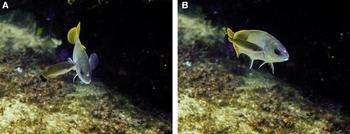
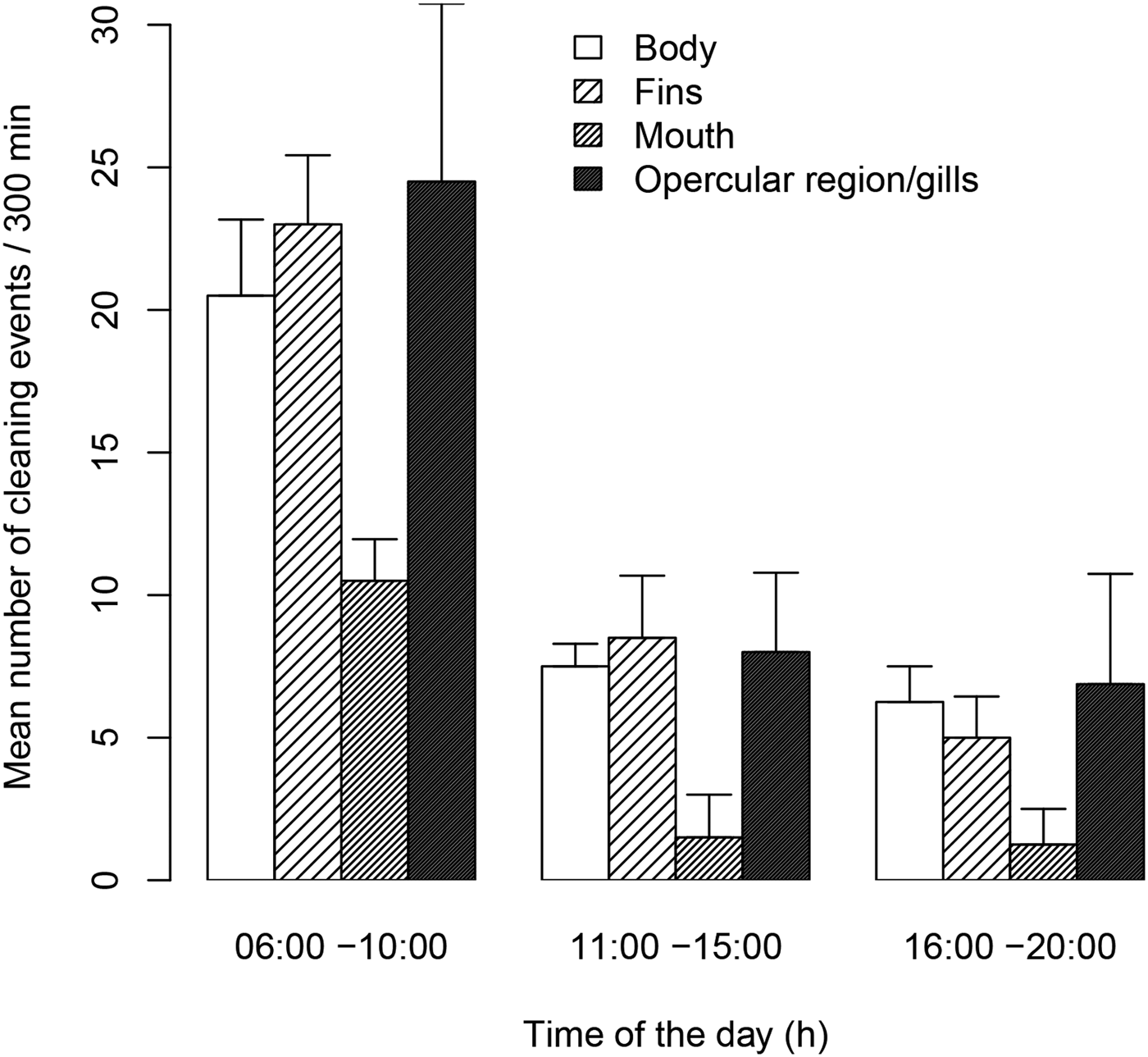
To test differences in intensity of cleaning interactions (mean number of inspections per 300 min observation) between time of the day non-parametric Kruskal–Wallis tests were performed for each area of cleaning (body region, fins, opercular region and mouth). When the non-parametric test showed significant differences, a post-hoc analysis (Dunn test) was used to determine which levels of the independent variable differ from each other level. The body regions of S. umbra in which the cleaner acted more frequently were the opercular region (33%), followed by fins (29%) and the dorso-ventral region (27%). Mouths were seldom (11%) cleaned (Figure 2A, B). The intensity of cleaning interactions significantly decreased towards the evening (Kruskal–Wallis χ2 = 26.49, d.f. = 2, P < 0.001). In fact, average intensities of cleaning events showed significant differences from 6.00–10.00 am to 16.00–20.00 pm (Dunn test, P < 0.05 in all cases, Figure 3). The decrease in cleaning interactions towards the hours with poor light conditions is a predictable outcome since, generally, the cleaning activity takes place during the day, as this type of association largely depends on visual signals (Helfman, Reference Helfman and Pitcher1986).
(A, B) Two phases of the cleaning activity of S. melanocercus focused on opercular region. Notice damaged tissue on the snout. Photograph: D. Ventura.

Mean number of inspections per 300 min observation period according to cleaning region by cleaner wrasse S. melanocercus toward S. umbra. Data pooled on several days over a 2 week period. Error bars show SE.

Symphodus melanocercus has been observed to clean many species (Arnal & Morand, Reference Arnal and Morand2001a) including sparids (Diplodus sargus, D. puntazzo, D. annularis, D. vulgaris, Boops boops, Oblada melanura, Sarpa salpa), labrids (Symphodus mediterraneus, S. ocellatus, S. tinca, Labrus merula, Coris julis, Crenilabrus rupestris), serranids (Serranus cabrilla, Epinephelus marginatus), Apogon imberbis, Mullus surmuletus, Chromis chromis and Chelon labrosus. However, this is the first published study documenting cleaning interactions between S. melanocercus and brown meagre. The importance of the cleaning behaviour of S. melanocercus is also supported by analyses of gut contents that have shown a high proportion of gnathiid isopod larvae and caligid copepods in the diet (see Arnal & Morand, Reference Arnal and Morand2001a, Reference Arnal and Morandb), with S. umbra reported to have high infestation by Gnathia sp. in Turkish waters (Alaş et al., Reference Alaş, Öktener and Yilmaz2009). Such high prevalence values may be related to the host–parasite habitat use. In fact, gnathiids show three larval stages with each stage having two forms, namely praniza and zuphea. The praniza is usually a replete, haematophagous phase while the zuphea is an unfed benthic dweller phase (Hadfield et al., Reference Hadfield, Smit and Avenant-Oldewage2008). Larval gnathiids utilize the benthic habitats as resting and moulting places after their ectoparasitism on the host (Tanaka, Reference Tanaka2007). After feeding, praniza larvae detached from their fish hosts and sought protection in sponges, tunicates and worm tubes (Tanaka, Reference Tanaka2007). Sciaena umbra inhabits sheltered cavities near the sea bottom, where the aforementioned sessile organisms are abundant and for this reason it would be more easily infected.
That S. melanocercus did not exclusively operate at cleaning stations, but would also accompany large fish, was also a notable observation. Such a behaviour has been reported rarely in the Mediterranean, although Fischer et al. (Reference Fischer, Patzner, Müller and Winkler2007) did report this type of behaviour when cleaning adult Epinephelus marginatus in waters off Ibiza.
ACKNOWLEDGEMENTS
We are indebted to Dr J. Ellis and two other anonymous referees for their valuable comments and suggestions that considerably improved the paper. We are also grateful to V. Lopetuso for providing advice and encouragement throughout this study and for her assistance in field sampling.