Introduction
Mahsa Jina Amini was killed in September 2022. Iranian authorities claimed her arrest was due to inadequate veiling, sparking widespread outrage from her hometown of Saqqez in Iran's Kurdish region to the Iranian diaspora. The song Barāye by Shervin Hajipour became the anthem of the protests, with the line “my sister, your sister, our sisters” resonating the sentiment that Mahsa could have been anyone's sister. These protests, the most significant in Iran since the 1979 revolution, were reinforced by global demonstrations, including acts by the Swedish Iranian community.
As two years have passed, it is relevant to ask, what did these acts of protest mean to the Iranian diaspora in Sweden? What were the collective ways of making meaning of the situation in Iran? The purpose of this article is to explore how representations of collective memory and identity were articulated by Swedish Iranians on Swedish platforms. During the year that followed Mahsa Jina Amini’s death, how were the protests, the subject position of Iranians in the diaspora, and their hopes and visions articulated? Furthermore, since diaspora communities “belong” neither to the host state nor the country of origin, this episode of Swedish Iranians’ collective history will not necessarily be archived, documented in the formal history writing of any state.Footnote 1 This article thus fills the functions of both documenting and providing a critical reflection of this collective experience.
The Iranian diaspora is internally diverse, shaped by the different circumstances of host countries as well as connections and contestations based on socioeconomic status before and after emigration, religion, ethnicity, generation, and time of settlement.Footnote 2 In research on the Iranian diaspora, communities in the United States have often been the main focus.Footnote 3 Sweden is an interesting case for many reasons. About 86,000 individuals born in Iran live in Sweden, making it one of the largest minority groups in the country and one of the main host countries for diaspora Iranians.Footnote 4 The demography and reasons for migration to Sweden align with the migration regime, as Swedish policy in the 1980’s enabled refugee migration.Footnote 5 After several changes in policy, labor and student migration from Iran increased around the turn of the 21st century and now represents a larger portion of immigrants from Iran.Footnote 6 In view of this, the Swedish Iranian diaspora represents a multitude of experiences of community building and fragmentation, compared to similar experiences of identity construction in the US and elsewhere.Footnote 7 While this article does not have a comparative approach, its results can be relevant to other experiences of the global Iranian diaspora and other diasporic communities in Sweden.
Literature on Iranian diaspora and activism
The concept of diaspora is relatively new to the Iranian identity, mainly constructed after the 1979 revolution, when approximately one million Iranians went into exile. One of the most influential scholars on the Iranian diaspora, Hamid Naficy, describes the concept of exile as a multitude of possible relations between the subject and key concepts of house, home, and homeland. One can be exiled via forced migration and longing for the lost home, but one can also experience internal exile while still physically at home. Some may be unable or unwilling to return, while others may return only to find their homeland not as they remembered. Exile can be voluntary, with individuals returning but never fully arriving, or choosing not to return while dreaming of a glorious homecoming.Footnote 8 These experiences are mediated by various forms of media: letters, phone calls, photos, films, and cyberspace.Footnote 9
Research on experiences within the global Iranian diaspora claim a shift in the diasporic identity, from being constructed around experiences of exile and loss to uniting around humanitarian choices for action, charity rather than revolutionary political struggle.Footnote 10 Such acts of diasporic solidarity can be perceived as both empowering and patronizing.Footnote 11 One example is the “the Feminist School,” an online workshop organized since 2008. Following the crackdown on dissidents after the 2009 presidential election, many of the workshop’s organizers left Iran and attempted to pursue activities in the diaspora. Despite the dedication of activists in the diaspora, however, the asymmetric power relation between Iran and “the West” – including both security concerns and the gap between domestic and diasporic activists – affected the situation and made it difficult for diaspora activists to remain relevant.Footnote 12 Although geographic distance and differentiated access to rights has often made activism complicated, political engagement in the diaspora has been continuous and, after a decline, Mahsa Amini’s death sparked unpreceded acts of solidarity, with activism functioning as spaces of both belonging and political agency.Footnote 13 While the protests in Iran had both a social and political dimension, demanding a dignified life and including workers unions, the diaspora protests saw a rise of the far-right.Footnote 14 At the same time, protests in both Iran and the diaspora were inspired by Black political strategies, using metaphors such as “I can’t breathe” and making reference to Martin Luther King, such as in Hamed Esmailion’s speech in Berlin.Footnote 15
Cultural identity in diaspora
The complexity and risk of exclusion that comes with an activist context in which a diversity of identities intersect and, at times, juxtapose should be taken into consideration when looking at the Swedish Iranian diaspora.Footnote 16 Research on Vietnamese-American activism highlights that solidarity within this fragmented community relies on complex yet powerful emotional connections. KT Tran refers to these connections as “queer diasporic praxis,” underscoring the bonds that unite individuals across different experiences and identities within the diaspora.Footnote 17 Such an approach must emphasize the hybridity and non-territorial characteristics of ethnic diasporas cultures.Footnote 18
Beyond the nation-state identity, how to define a common point of identification is a main issue. One way of understanding cultural identity is through shared experiences – oneness. In postcolonial and feminist activism, the rediscovery of such a shared essence has been crucial as a counter-image to oppressive stereotypes. Another conceptualization of cultural identity is the emphasis of difference: denouncing the possibility of a shared essence without ruptures and discontinuities.Footnote 19 As a diasporic Iranian, there are thus infinite ways to associate with Iran. A comparative interview study of second-generation immigrants in Sweden and the US found that Iranian Americans often developed a reactive identity, distancing themselves from the majority culture by embracing Persian pre-Islamic symbols. In contrast, Iranians in Sweden have not typically associated with these symbols, instead adopting a global, multicultural identity.Footnote 20As a consequence of political disconnection with the Islamic Republic, Iranian diasporic subjects may construct notions of home and homeland through an identity within the diasporic community and/or in relation to pre-Islamic symbols from Iran.Footnote 21 Nostalgic images of “modern,” pre-revolution Iran can be found in arts, media, and social media as elements of identity construction.Footnote 22 For second-generation Iranians in the diaspora, family stories and media images shape a hybrid identity in which nostalgia and loss is inherited.Footnote 23 Limited access to and experience of Iran is partly compensated for through emotional involvement in digital spaces.Footnote 24 While cyberspace appears to emancipate individuals from the constraints of homeland and nation, this freedom remains limited.Footnote 25 Nations still exert significant control over their citizens through economic and political structures. Moreover, it is noteworthy how active diasporic xenophobic nationalists are online, often advocating for nations of which they are no longer a part.Footnote 26
Arts and activism in cyberspace
The internet has, without a doubt, been a game-changer for the Iranian diaspora and its relationship to Iran. Nevertheless, state censorship has proven effective, making the internet also a space affected by regime control.Footnote 27 This experience is not unique to Iranians, however: across North Africa and the Middle East, the internet and social media platforms have played a pivotal role in fostering practices of art and social activism as been a site of censorship and state control.Footnote 28 The inherently political dimensions of art both online and offline are accentuated in the iranian context, because they engage with experiences in a given social order where many aspects of private experiences are politicized.Footnote 29 In the postcolonial relationship, art production is shaped by geopolitical and economic interests, as well as epistemic injustice.Footnote 30 Due to censorship, street art as a social commentary in Iran dates back to students’ expressive stencil art on the walls of universities in the 1970s.Footnote 31 Contemporary street artists create graffiti in public spaces – expressions that connect with the diaspora through online activities.Footnote 32 The aesthetics of Iranian diaspora art is driven by different logics, related to experiences of migration, discrimination, and exclusion in the host country.Footnote 33 Diasporic art can however provide a trajectory to transcend us-them or here-there dichotomies.Footnote 34 As subject positions such as citizen, immigrant, Iranian, and diaspora Iranian are not fixed, the contingency of their meanings allows artistic practices to shift from “representation” (political and aesthetic) to world-making, challenging exclusive and normative citizenship.Footnote 35 In this process, the (re)activation of language can become an act of self-positioning. The idea that identity is tightly linked to language dates back to 18th-century German philosophers, who argued for the absolute limitation between personality and language. More recent scholars, on the other hand, see language as one of multiple elements of identity construction, not the only element, viewing identity not as lost in the transition between languages but instead transformed by it.Footnote 36 It is within this line of thought that this article’s material has been selected among writings in Swedish.
Analyzing text as a proxy for experience
In the diasporic context, media and social media are central platforms of activism.Footnote 37 Having a media presence has been described as a form of “cultural brokerage,” as diaspora subjects present what is going on in their country of origin to bridge the gap between mainstream media and social media and translate events to an audience outside the country and language of origin.Footnote 38 Essential to any text-based analysis is the selection of empirical material. Questions about representation and validity arise: what material represents the Swedish Iranian diaspora? The question cannot be answered in a simple manner due to the diversity and complexity of diasporic communities. In Stockholm and Gothenburg, there are about thirty-five Iranian radio stations.Footnote 39 According to the national organization of Iranian associations (IRIS), there are eighty-two local associations under its umbrella.Footnote 40 Swedish public service broadcasting has a news podcast in Persian and Dari, which reported on the protests.Footnote 41 Unlike BBC Persian and other non-public service diaspora media platforms (e.g., Manoto and Iran International), Radio Sweden Farsi/Dari produces Swedish news in Persian, with no space for debate articles, columns, or essays. There is one text-based media platform for Iranians in Sweden, called Stockholmian. This blog/radio station is mainly produced by one person and community discussion takes place on the station’s Telegram channel. For the purpose of this article, personal reflections are the most relevant type of text material, not news or tweets with political arguments. Thus, the empirical body of this article consists of text material from two publications: Dagens Nyheter (DN) and the anthology Textur.
As the most read newspaper in Sweden, DN reaches readers across the country. In discourse theory, the media’s role in shaping public opinion is often addressed: what most people know of politics is based on the refracted picture constructed in the media.Footnote 42 What is published in DN can be considered relevant to shaping a collective understanding of the protests in Iran. From September 2022 and the winter that followed, DN published a series of personal essays by Swedish Iranians, most of whom were authors or otherwise established in the Swedish cultural sector. Such articles included: “When I think of Iran, I feel sorrow and longing at the same time,” an interview with Negar Naseh, Niko Erfani, and Sara Abdollahi; “Iran's rulers govern the country with violence and lies,” by Jila Mossaed; “It is an overwhelming joy to see the people's resistance in Iran,” interview with Negar Naseh; “In the nightmare, I am suddenly in Iran with my head uncovered,” by Golnaz Hashemzadeh Bonde; “That is why the fight against the veil is at the heart of the uprisings in Iran,” by Haideh Daraghi; “What does it mean that we did not become Iranian writers, but Swedish?,” by Khashayar Naderehvandi; “The helplessness and frustration are hammered into the head every day, every minute, every second,” by Pooneh Rohi; “The young women who were executed were first raped – it was a sin to kill virgins,” by Negar Naseh; and “Physically, I’m here, but mentally, I’m in the Iran of protests,” by Elnaz Baghlanian.Footnote 43
These essays and interviews include personal reflections on the ongoing events in Iran. Although other mainstream media also published material related to Woman, Life, Freedom, the series in DN was extensive, publishing multiple authors over a time period and creating not only individual and isolated anecdotes but also a collective narrative. However, this most established daily newspaper is a space of influence that not everybody can access, necessitating the combination of these texts with other material.
The anthology Textur consists of essays similar to the DN series, as the anthology’s texts provide personal reflections on experiences of the Women Life Freedom movement.Footnote 44 This was an activist, zero-budget production, however, with limited reach. Textur is relevant because it contains texts by authors, academics, and social activists without established platforms and participants who do not often publish. A call for submissions was made on social media and all entries were published: seventeen individually written texts, one collective work, and illustrations by two artists. Four participants chose to remain anonymous, all identified as female or non-binary, and all were first- or second-generation immigrants, whose time living in Sweden spanned between a few years to several decades. The participants’ ages varied, from twenty-three to seventy-three years old. Two of these contributions had first been published in DN, while the rest were only published in Textur. Eleven texts were written in Swedish, three in Persian, and one in English. The publication itself, alongside the launch event with public readings in April 2024, was part of the activism organized around the slogans of Woman, Life, Freedom. To include these texts was to give them the same weight as representatives of the Swedish Iranian diaspora; a deliberate act of methodologically challenging the dominance of mainstream media as more objective or true than activist practices.Footnote 45
It should be stated that, regardless of the number of texts or sources, no claims can be made of representing the entire Iranian diaspora in Sweden. Many conversations during this period took place on closed social media platforms, with texts published in Persian on websites I am unable to read and analyze due to language barriers. This shortcoming must be acknowledged. Nevertheless, language is one, but not the only, element of identity construction. As previously stated, this article takes the position that identity is not lost in transition between languages, but is instead transformed.Footnote 46 This point of view makes writings in Swedish neither more nor less relevant than writings in Persian as source material for exploring Swedish Iranian experiences.
Process of analysis
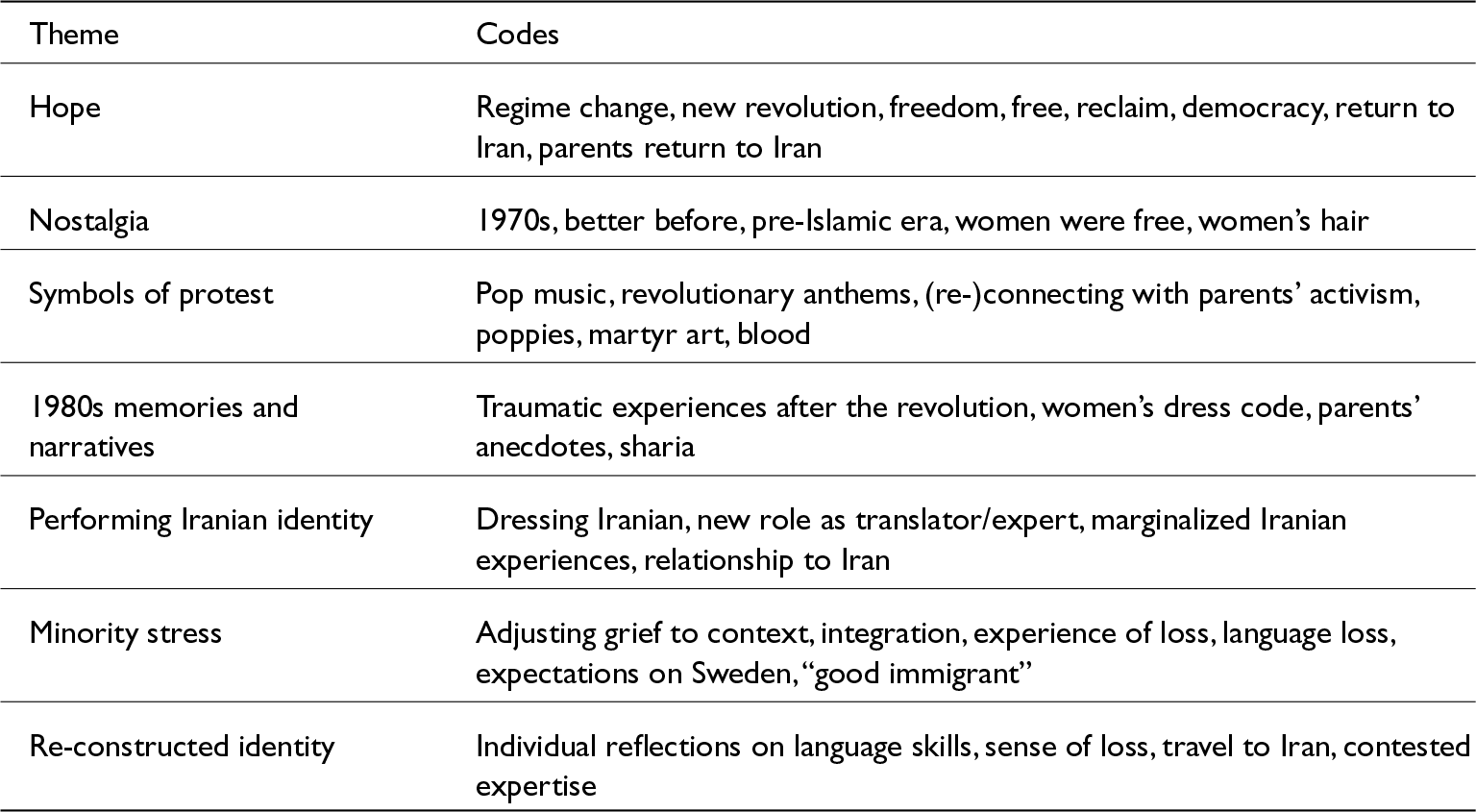
After first conducting a thematic analysis of these texts from DN and Textur, I decided to also include social media posts and auto-ethnographic anecdotes, because social media content is often more explicit and perhaps gives a different representation than edited mainstream media. These examples from social media are complementary to the main empirical body, furthering illustrating its case. This article thus employs a thematic analysis of Textur and articles from DN, twenty-five texts in total, which function as a proxy of experiences and a window into the personal process of meaning-making.Footnote 47 This analysis is inspired by discourse theory, identifying key words connecting a number of different elements in the construction of a discourse.Footnote 48 I used NVivo software to structure the process of coding and thematization (see Table A1 in Appendix). In the coding process, I organized similar quotes and expressions into themes: hope, nostalgia, performative activism and acts, survivor’s guilt, and minority stress. Some of the concepts stood out as more interconnected with other codes and themes in a way that could be described as “master nodes” or “master narratives,” including issues related to hope and nostalgia. These two themes are emphasized in this article.
Ethical considerations
Ethical considerations in using online materials, such as social media content, include maintaining confidentiality and anonymity. In the anthology, some participants opted to publish anonymously. As such, they are also quoted anonymously in this article, in alignment with the principles of netnography.Footnote 49 The confidentiality and anonymity of content creators and public figures speaking openly in the media or on social media is not an issue, however, as their position and words can be considered public in character. Such a practice is supported by research suggesting that netnography should follow the principles of other media and content analysis, with public data not requiring anonymization.Footnote 50
In the Iranian diaspora, there is ongoing debate about the role of the researcher and use of autobiographical material in representations of the Iranian community or collective experience.Footnote 51 This article’s analysis is centered on narratives of the protests and Iran, particularly how the protests interplayed with the collective construction of Swedish Iranian identity. It is not an autobiographical work. Certain elements of auto-ethnography are present here, notes and reflections on personal experiences of diasporic gatherings, but these sections are indicated in italics to set them apart. As a Swedish Iranian woman scholar and activist, I have spent my life as part of the Iranian diaspora and thus my personal ambivalence is reflected when analyzing these texts and expressions. With regards to bias, I do have opinions and I did participate in some, but not all, acts of protests. The absence of such experiences would equally reflect a different ideological stance. Thus, neither a neutral nor objective position is possible with regards to this type of data.
A discursive approach to diaspora
The logics of critical explanation
This article’s thematic analysis references theoretical concepts including hope, nostalgia, homing, and jouissance. Inspired by the Logics of critical explanation approach, my analysis does not stop at the descriptive level, which thematic analyses often do. Through this discursive approach, my aim is to explain and understand how certain articulations of discourse are made possible in a specific moment in time: the social logics through which discourse is normalized in day-to-day encounters (described in the auto-ethnographic sections), the political logics articulated as debate or contestation at moments of dislocation (described in the empirical body), and the fantasmatic logics – the affective dimensions (fears, hopes, and fantasies) – underpinning a discourse (described in the empirical body and complementary social media material).Footnote 52 A constructionist perspective on culture, which views culture as socially constructed and fluid, strengthens these concepts. Accordingly, individuals are assumed to have agency and be both shaped by and involved in actions that shape collective understandings of culture and identity.Footnote 53 Within the space of contingency, meanings and positions are never fixed, they remain open-ended.Footnote 54 This allows the subject to both challenge its own position and enable others to do the same. In other words, because the subject position “Swedish Iranian” is not predetermined, it can be renegotiated and reconstructed. I use the term “dislocation” to refer to a situation in which a subject position is challenged to the extent that repositioning becomes necessary.
Diaspora, exile and memory
Every idea of a nation builds on collectively imagined borders and communities.Footnote 55 Yet, we tend to think of the nation as a society moving through time in a uniform way, unaffected by time and events.Footnote 56 Stemming from the ancient Greek word for “scattered,” the meaning of diaspora is contested in academia.Footnote 57 A mainstream definition involves ideas of center and periphery: subjects dispersed from a specific center to which they remain connected through an idealized memory of the lost homeland.Footnote 58 While such definitions have been used by scholars in multiple fields, there has also been criticism that such definitions exclude individuals and communities; not all share the experience of one homeland, not all dream of returning, and not all are spread to multiple geographic sites.Footnote 59 Rather, ethnic diaspora cultures are characterized by hybridity and non-territoriality, where the concept of homeland becomes fluid and constantly changing.Footnote 60 As a result, the idea of returning to the original country becomes unattainable – it no longer exists. This shifting notion of identity challenges essentialist views that assume a fixed, unchanging essence.Footnote 61
Diaspora theorizing creates a space to explore numerous concepts: identity, desire for “homing,” nostalgia for the homeland, exile, and cultural belonging both within and beyond the nation state.Footnote 62 “Homing,” in this theoretical framework, is different from the desire for a homeland; it is a desire for “home” rather than return, with “home” as conceptually detached from the idea of homeland and holding multiple, fluid concepts of geography, including the private, public, and affective dimensions of being and living with others.Footnote 63
Within diaspora research, the concept of memory is essential to understanding identity and processes of meaning-making. Identification can be explored through individual and collective memories, the diversity of subjects producing memory narratives, the transmission and contestation of memory across spaces and generations, and the dynamics between different types of memories.Footnote 64 Exilic memory focuses on the traumatic conditions that led to dispersion from the homeland, maintaining a cohesive sense of belonging based on shared experiences of persecution and displacement, while diasporic memory emerges from the collective migratory trajectory and experiences of living as a minority in a host society, rather than from a single point of origin.Footnote 65
Hope and change in diaspora
The concept of hope, much like the concept of diaspora, dates back to the ancient Greeks and the history of philosophy.Footnote 66 Classical philosophers – such as Hobbes, Locke, and Hume – can be criticized for their understanding of hope as limited to individual affective dimensions, as more recent scholars argue that hope also has the capacity for collective struggle and change.Footnote 67 The concept of hope can be manifested through action and the creation of alternative visions for the future, in line with Paulo Freire’s discussion of hope as essential to any movement striving to change society.Footnote 68 In sociological traditions, hope is often depicted as an antidote to despair and apathy.Footnote 69 Other scholars, however, have been more critical, describing hope as an obstacle to change. A distinction can be made between hope and optimism, as hope requires a deep commitment to the possibility of change and optimism is a more superficial view of the world through pink binoculars, with everything skewed towards a positive light.Footnote 70 An optimist is not only a person with hope for the future, they are a person who, in their position or lifestyle, believes things will turn out well; a person with wishful thinking.
In response to the politics of crisis after 9/11 and the war on terror, scholars addressed the absence of hope or vision for the future in contemporary society.Footnote 71 Kleist and Jansen argued that, while uncertainty and crisis can cause affliction or a lack of direction, it is also a prerequisite to the formation of hope.Footnote 72 Historicity – the process through which subjects make meaning of the past while looking to the future – has also been defined as a condition for hope.Footnote 73 Such temporal reasonings can be practiced through acts of engagement with the future via particular understandings of the past. For hope to be operationalized as a projection of achievements, from the past/present to the future, it ought to be accompanied by a dialogue on social change and what constitutes that change.Footnote 74 Within diaspora studies, the concept of hope has been operationalized in this way, as a means of constructing identity and relation within a specific temporality and spatial context. Scholars have argued that the practice of collecting narratives of failure and loss can have a unifying effect on diasporic communities, producing redemptive hope for the future.Footnote 75 Hope for the future in relation to one’s country of origin affects the tendency to engage in charitable investments underpinned by a sense of altruism and family support, rather than a desire to return to live in that country.Footnote 76 This dynamic involves balancing the loss of hope with anticipation of a better future, even in the face of despair.Footnote 77
Hope for change through revolutionary fantasies and nostalgia
This analysis draws on nine articles from Dagens Nyheter and eighteen texts from the anthology Textur. The thematic analysis of this empirical body bring forward the concepts of hope and nostalgia as central to the ways in which the Swedish Iranian diaspora made sense of the Woman, Life, Freedom protests. The following three sections present examples of how this was articulated and the different subject positions that became possible during this process.
Hope for a new revolution
Political change was one of the more obvious ways in which hope was expressed in my empirical material. The Woman, Life, Freedom protests functioned as a moment of dislocation through which previously established understandings of Iran were destabilized, making it possible to think and feel in new ways in relation to being Iranian. In the texts, there are testimonies asserting that the protests in Iran infused Swedish Iranians with hope, making it easier to embrace the Iranian identity, as it became merged with aspirations of political change and a free, democratic Iran. As one of the Textur authors wrote:
Zan Zendegi Azadi gave me hope, that one day this brutal regime will sing its last tune. I am sure of that. The revolution is underway and the hope of one day going back to Iran, my motherland, lives on in me until I die.Footnote 78
The above quote contains the hope for regime change, revolution, and return to the (imagined) motherland. The last sentence above gives the sense that this hope had diminished prior to the protests. The anticipated revolution brought about new hope, emphasising a possibility of return from exile. The protests stirred an uncertainty about the future, which seem to have made it possible to articulate such hope.Footnote 79
When Jina Mahsa Amini was murdered by the Iranian regime in September this year, something broke out that can, for the first time since 1979, be called the beginning of a revolution. The difference compared to the protests of 2009 is enormous.Footnote 80
The comparison between the Woman, Life, Freedom protests and previous expressions of discontent in Iran led the above writer to conclude that this time was more akin to 1979. My interpretation of the above is that similarity to 1979 is seen as something positive, because that revolution was successful, insofar as it overthrew the shah’s regime. A process of historicity is taking place, with the contemporary situation being understood through past experiences.Footnote 81 Drawing parallels between the protests of 2022 and events of 1979 was thus a way to interpret the situation as revolutionary, which, in turn, was understood as hopeful. While labeling a situation as revolutionary or not based on political theory is (and became) relevant, it is also pivotal what this negotiation meant to the diasporic community in terms of identity and engagement.Footnote 82
An equivalence chain went from revolution, via hope, to a desire for return, and contained a number of assumptions: that returning to Iran is not possible for diaspora Iranians, the arriving revolution will change this fact, and, perhaps less explicitly, there is an existential necessity to return. The word “home” and different variations, such as “homeland,” are repeated thirty-four times in the Textur anthology, often connecting articulations of hope with concepts of homing. Author Khashayar Naderevandi wrote about being a Swedish author, as opposed to an Iranian author, linking geography with belonging and homing: “While this is happening, I am in Sweden – I am a Swedish writer from Iran. And I am far from alone. Just this autumn, four Swedish writers from Iran are publishing new books, and there are more.”Footnote 83 Here, Naderevandi makes a point of situating the Swedish Iranian diaspora in Sweden, disconnecting ideas of home from the geography of Iran. Physician and author Negar Naseh, who published a book about the 1979 revolution at this same moment, articulated her experience differently. When interviewed about her book, she expressed her longing to return:
Is it possible, will it finally happen? Is it now, perhaps, that my parents can go there? Can I go there? Negar Naseh has never been to Iran. Her parents came to Sweden before she was born, as guest students in 1976. Only the mother has traveled back, once.Footnote 84
Poet Niko Erfani articulated yet another expression of desire:
There have been so many protests over the years, and regardless of what they were about, the people have suffered immensely. At the same time, I am incredibly proud of everyone who is now taking to the streets, and I wish I could be there with them. They are incredibly brave to go out knowing there is a high price to pay.Footnote 85
Along these lines, author Elnaz Baghlanian wrote in her essay about texting her cousins in Iran and apologizing for not being there, but also describing return to contemporary Iran as “the worse of nightmares,” in reference to the ongoing violence.Footnote 86 This “I wish I could be there” pinpoints a collective experience of wanting to be part of the protests. How can this be understood? There was, to my knowledge, not a notable movement of diaspora Iranians actually traveling to Iran to participate in the protests. On the contrary, travel to Iran was described as support for the regime on social media.Footnote 87 Additionally, the Swedish Ministry of Foreign Affairs advised against travel to Iran.Footnote 88 The wish to be “there” should thus be understood as an expression of solidarity, a way to say “I wish I could share this pain,” an articulation of an emotion rooted in the diasporic experience of home outside the imagined homeland. It contains an unspoken continuation, “…but that is not possible” or “…but I cannot,” because going “there” is unimaginable. In this articulation, “home” is detached from the geography of Iran and the process of homing, the desire for a place to call home, is more connected to community building within the Swedish context. Golnaz Hashemzadeh Bonde reflects on this in her text:
I, one of the many refugee children of the Iranian Islamic revolution, can escape. I can hide behind the years, let the distances solidify. My parents’ struggle and loss, something of the past. The escape completed. Freedom a fact. And with my own children, everything becomes something else. The metamorphosis inevitable. Roots among the world’s freest people. Let the past remain the past.Footnote 89
In this text, the metamorphosis relates to constructing a concept of home elsewhere. While an earlier quote’s linking of the current protests to the 1979 revolution was rich with hope, in this narrative, the child of the revolution carries survivor’s guilt: freedom is associated with life in the diaspora, with loss and the past situated in Iran. The hope to and associated visions of return were thus both linked to understandings of the political situation in Iran after the 1979 revolution (we are in exile and cannot return) and sparked by the new protests (with a new revolution, can we return?). The hope for change/revolution and the hope to return were intertwined. These expressions often framed access to Iran's geography as a right unjustly denied to the diaspora by the current regime, a stolen jouissance. Alongside the sense of hope and desire for return, there existed a complexity of alternative narratives emphasizing distance and closure concerning Iran.
Haideh Daraghi’s text differs from this pattern, as she locates the Woman, Life, Freedom protests within a historical timeline stretching back to the turn of the previous century, to the movement for women’s rights and the Constitutional Revolution.Footnote 90 Although temporal reasoning takes place, there is a difference in how the subject distances herself from the content, as personal losses, traumas, or the freedom gained via migration are not highlighted. There is mention of neither hope nor return in this article, only a call for solidarity, but no definition of what this consists of or how it can be enacted:
In videos filmed with mobile phones, schoolgirls can be seen tearing pictures of the Islamic leaders Khomeini and Khamenei out of their textbooks. Boys who, by shouting “woman, life, freedom,” renounce gender privileges. Together students, national minorities, and oil workers who have joined the movement, they deserve the solidarity and admiration of progressive men and women across the world.Footnote 91
As a “media broker” attempting to explain the protests in Iran, Daraghi de-centers the diasporic and exilic experience by focusing on social movements in Iran. She positions her own lived experience as part of such movements, rather than as an exiled Iranian. If there are expressions of hope in this text, they are embedded between the lines, in defiance of different authoritarian regimes and momentary victories, such as the protests against compulsory hijab on International Women’s Day in 1979. This hope is more an articulation of political inquiry, hope as action rather than affective expression.Footnote 92
Autoethnographic anecdote 1
In December 2022, I attended a protest at Norra Bantorget in Stockholm, organized by Centrist Member of Pariliament Alireza Akhondi. Upon entering the space, my friends and I were handed flags, and when we declined, the functionaries went on to offer them to others. Participants displayed flags of the former regime, while Mr. Akhondi proclaimed the necessity of reclaiming Iran and returning there. He said something like “We will take back our country, city by city.” People chanted slogans and the song Ey Iran was sung spontaneously by a group in the crowd. I decided to leave the square, because to me, supporting Woman, Life, Freedom was not about the flags of the previous regime, nor taking back land for myself to return to.
The particular construction of hope around regime change was soon underpinned by political agents and logics.Footnote 93 There were uncertainties and a lack of direction regarding what was going on in Iran, creating the potential to imagine a different vision.Footnote 94 But how did vague articulations of hope for change connect the future to a past in which the Pahlavi regime ruled? To critically explore this, the Swedish Iranian community must be understood within the broader global diasporic context, where social media and diasporic channels have pushed a nostalgic narrative of pre-revolution Iran.Footnote 95 Subsequently, the process of expressing hopefulness in relation to the Woman, Life, Freedom protests was enacted through complex webs of expressions connecting revolutionary visions, hopes of return, and nostalgic memories that constructed Iran as a projection board for exilic loss rather than a geographic home or political project.
Hope filtered through exilic nostalgia and desire
Many young diaspora Iranians expressed how the Woman, Life, Freedom protests made them feel connected to Iran for the first time. In the Canada-based podcast Roque, this feeling was referred to as the “rebirth of Iranian pride.”Footnote 96 Such expressions of nostalgia join two nodes: a vaguely defined past before the Islamic Republic and another past before the introduction of Islam to the Persian Empire. The ambiguity of what these nodes signify leaves it up to the observer to imagine and desire this golden past – a strategy used in politics to emphasize a vague message as factual.Footnote 97 Nostalgia for pre-1979 Iran become a source of hopeful visions, portraying this time as one of freedom and happiness, which can be understood as an act of preserving memories when faced with the threat of the past reproducing itself only through loss.Footnote 98
Poet and Swedish academy member Jila Mossaed reflected on the long history of resistance against religious authority in Iran:
For more than 1,400 years, great uprisings against the religious power took place, and people fought fiercely to reclaim their original religion and ancient traditions. This repeatedly led to bloodshed, and the uprisings were silenced. We were emptied of our culture. We became Muslims under threat, with swords to our throats. In some cities, it took more than a hundred years before the people submitted to the religious power and became Muslims. What was saved and did not perish was the language. Great poets strove to write poetry in pure Persian, even though it was long forbidden to speak and write in Persian.Footnote 99
In this quote, Mossaed equates the Islamic Republic with the religion of Islam, drawing a connection between contemporary protests against the dictatorship and ancient resistance against Islam. She employs a fantasmatic logic to depict “Persian” as inherently pure, in contrast to the implicitly impure and violent nature of Islam. This quote exemplifies a double-binding of nostalgia, for the 1970s and the time before Islam, aligning with the Pahlavi-era ideology of revitalizing Persian nationalism.Footnote 100 The fantasies of a lost past could function as both an incentive of hope and a catalyst for uniting people around a collective cause. Nostalgia is relevant to understanding how the Woman, Life, Freedom protests gained meaning in Sweden, given that a dominant characteristic of the narratives were memories of loss, often articulated through inherited traumas or second-hand experiences.Footnote 101 The following three quotes exemplify this, from three different authors in Textur.
The women would go from short shorts and platform shoes to an Islamist dress code. The skin, hair growth, and femininity were going off the streets. The shawls should be black, the coats loose. Make-up was not allowed and the punishment for those who showed up with nail polish could be being forced to sit with your hands in a bucket of crawling cockroaches.Footnote 102
۞
We left our home in Shiraz in 1987 because my father refused to pray at work. He was an atheist and it went against all his principles to be forced into something he didn't believe in. At the oil refinery where he worked, he was reported and blacklisted.Footnote 103
۞
For me and my generation, born in the 1980s, we called ourselves the burnt generation. We were guinea pigs for the new the rule, our lives and our dreams were shaped by its rules and limitations. We lived in a world where our education was strictly Islamic and where we were taught to fit into one predetermined template. To me, it felt like being a colorful bird in a cage, trapped and forced to adapt to a lifestyle that did not suit my nature.Footnote 104
What these quotes share is that experiences in the 1980s were central to a process of making meaning for the protests in Iran in 2022. These are narratives written in Swedish, for a Swedish and/or Swedish Iranian reader. Similarly, some of the columns in DN included childhood anecdotes, often set in the 1980s or with a nostalgic longing for the 1970s.
I think of my memories, fragments of language, fragments of images, of the stories that seep through the screens. (…) To look at the pictures in the photo albums from your mother's youth, to see her free hair, to see her uncovered body, as if time were moving in the wrong direction.Footnote 105
The shared experiences of lost freedom, narrated through exilic memories from the early years of the Islamic Republic, centered the 1980s. Similar narratives were published in other media outlets.Footnote 106 Subsequently, in the empirical material for this article, two contrasting images of the past were presented: the golden era before Islam and the dark ages following the 1979 revolution. To refer to traumatizing events as nostalgia contradicts the idea of sentimental longing embedded in the term; nevertheless, exilic memories of loss and suffering functioned as a negative film in the construction of nostalgic images.
My mother used to tell me about what it was like when it all started. The hard rule came as if out of nowhere. They hadn't understood. For the women, the new Sharia laws contained unimaginable limitations in all areas. The right to their children, the right to inheritance, the right to move without permission from a man.Footnote 107
۞
On social media I frantically followed the reporting from sources inside the country and did my best to relay the content to my contact network in Sweden. Often, I had to explain the pictures’ context, such as what it means that someone dances in a public space, or that a woman sits in a cafe without a veil.Footnote 108
In the above quotes, the authors invoke specific acts that exemplify the link between protest in the past and present. The continuity of protest constructs a timeline in which the authors can position themselves and relate their situation to that of previous Iranians. As such, protest against the regime becomes not an isolated act, but an identity, a shared lived experience. Because the protests are understood through the filter of exile, loss, and memories of the 1980s, the images and videoclips evoke hope: “It's terrible, what's happening. I mean the killings, the brutal response to the protests. And at the same time, there's an overwhelming sense of joy and exhilaration in witnessing the people's resistance.”Footnote 109 As this quote illustrates, both sadness and joy co-existed within the Swedish Iranian diaspora; there was empathy for the pain and suffering the protesters in Iran were enduring, alongside a hope for change.
Autoethnographic anecdote 2
I have an Instagram account where I share posts about children’s literature for bilingual families. During the protests, I had many daily conversations with people, most of whom I didn’t know. After a few weeks, I temporarily closed the account due to the overwhelming number of messages and my personal emotional state, but I re-activated it again. Some wrote:
I’m so stressed about everything happening right now. I’m genuinely terrified that other powers will exploit the situation and hijack any potential revolution. There’s no reasonable opposition I feel I can support – no organized opposition, at least. I’m scared it will lead to anarchy if the regime falls, followed by war or something even worse than what we have now. And I’m so frustrated by those sharing some cheerful 70s montage of Iran, as if everything was perfect back then and that’s what we should aspire to. It’s so ignorant of history. And in case it wasn’t clear, I’m incredibly impressed by those brave enough to take to the streets. And so unbearably sad that they have to (sent in September 2022).
This is my issue. We are deeply divided, and many are also incredibly aggressive. I’ve seen people sharing videos by Zionists in Israel that are anti-regime, and I questioned how it can be okay to share their videos as truths about Iran. My enemy’s enemy is not always my friend, especially when they oppress others. And the response I got was that anything against the regime is fine and credible. Sorry, but I don’t want people like that leading this fight – people who don’t understand how different forms of oppression are interconnected. All of this makes me anxious. How can we achieve systemic change when we are so different? Do we even share the same definition of freedom? (sent in December 2022).
What the texts from DN and Textur show, and which is further illustrated in the anecdote above, is that the Swedish Iranian diaspora activated a collective storytelling in which exilic memories gave meaning to the Woman, Life, Freedom protests. This process saw the articulation of contrasting versions of how Iranian history unfolded: who were the heroes and who were antagonists? As the lines of this political map were redrawn, at times giving glimpses of what a unifying queer diasporic practice could be, new subject positions were defined.
I remember one of the demonstrations in the autumn of 2022. It was after an event where people had read out testimonies from Iran. I had no one to go with, but I started talking to some others around my age. I joined them on the way to the demonstration, and we chatted as we walked. I remember the excitement of finally being part of the resistance against the regime on my own terms. But again: the loneliness.Footnote 110
This quote exemplifies the experience alienation in the exilic context: the joy of constructing new political networks alongside the deep impact that established political organizations have on feelings of identification and belonging, the sense of disconnection from others as a consequence of coming from different (political) backgrounds.
While depicting contemporary Iran as a site of perpetual violence and death, in contrast to the nostalgia-drenched memories of a pre-revolutionary golden era, the royalist movement increasingly marginalized other positions during the winter of 2022, as noted by one of the chat messages above. The symbolic use of flags was one of the first acts with which the diasporic community grappled. The negotiation of what a flag was to represent shaped a particular political logic in which achain of equivalence linked ideas about pre-1979 “modernity” to the pre-Islamic civilization and Persian “purity”. This political logic and its vision of a bright future through return to the golden past was embodied in Reza Pahlavi; a figure previously quite remote to the Swedish Iranian community but now fore-fronted as a potential savior. Attempts at an inclusive approach, with different groups and flags being welcome under the Woman, Life, Freedom cause, were challenged by far-right groups, who accused ethnic minorities of causing division.Footnote 111 In some situations, it was not clear who was accusing or on what grounds, but researchers and journalists were labeled as agents of the regime and silenced.Footnote 112
Looking back at the landscape of political activism in the diaspora through the lens of the logics approach, taken-for-granted truths about the diaspora were destabilized (social logics). When contested, the exilic narratives that had shaped collective memories and personal identities were at stake. This made conversations about the current protests not (only) about the current situation, but also loaded with affective dimensions of personal trauma, (dis-)connectedness, and desire (fantasmatic logics). Ambivalence towards a new revolution was translated as support for the regime, marginalizing certain experiences and subject positions (political logics). In light of this, the chat messages I received can be interpreted as a way to have an alternative conversation and a strategy to construct a diaspora identity marginalized in public.
Acts of hope and hope production in arts and activism
One way of understanding articulations of Swedish Iranian identity during the Women Life Freedom protests is by contextualizing within an environment that, for so long, had deemed such identification as not feasible, but then suddenly was. The moment of dislocation enabled by the protests gave Swedish Iranian identity a new status, constructing a more attractive subject position than previously:
The Islamophobia of the Swedes was fed and strongly favored by this movement. Women who threw their veils into the air. Every white person's wet dream. The Sweden Democrats who didn’t help on site but engaged in our case. The context, for them so uncomplicated and untouched. There was glamor and glitziness on SVT and TV4. There were Iranian women and men everywhere who screamed, made themselves visible and begged and pleaded to the outside world to give them attention. And the world paid attention to them. We were everywhere. The generalization of us was suddenly beautiful. It was amazing to see.Footnote 113
In this quote, the author claims that explaining events in Iran to a Swedish audience was done in a skewed way, to satisfy a Nordic exceptionalist gaze and far-right anti-immigrant sentiments: resistance against oppression in Iran was understood in Sweden as resistance against Islam. This temporarily re-shaped the Swedish Iranian subject position from a discriminated immigrant minority to heroes of the women’s rights struggle – an issue weaponized by far-right agents to demonize migrants via orientalization.Footnote 114 Such narratives relate not only to orientalism but also stereotypes of “good migrants” and “fraudulent asylum seekers.”Footnote 115 As one of the anonymous contributors writes:
That was how my next awakening as an Iranian took shape. I realized that all the knowledge I had gained from being there actually held value (it sounds so obvious, but I feel that in Sweden, only certain types of traveling are considered formative, and trips to the “homeland” are not among them).Footnote 116
As the above quote illustrates, personal experiences took on new meaning and the status of “knowledge” was understood differently, challenging epistemic power dynamics between migrant Iranians and Swedes. In Textur, participants provided examples of how they were embodying their new roles:
Changing the background image on my mobile to one of the young schoolgirls facing away from the camera, with their long wavy curls of hair released. They have written slogans on the black board and point fuck you at a picture of Khomeini. I am strengthened every time I glance at the mobile phone.Footnote 117
۞
I felt it was my responsibility to witness everything, to see every injured person, to see every video of the extreme violence. I felt it was my responsibility to read about every person who was killed, to remember their names. If I couldn't be there, if I had no one real power, then I'd do this instead.Footnote 118
These quotes highlight how seemingly trivial acts, such as changing a mobile background or posting on social media, can be personally meaningful, as a way to both identify with a protest movement and communicate this position. This act of self-positioning with art and media can be understood as a strategy of constructing hope through symbols that bring people together. For a part of the Swedish Iranian diaspora, the protests and cultural events provided an opportunity to be among other Iranians, experiencing such expressions. Iranian American poet and novelist Kaveh Akbar uses the term “amongness” to describe this ambiguous co-experience of a particular event without necessarily interacting.Footnote 119 The formation of this new subject can be described, in line with Hamid Naficy, as an erasure within exposure – when a spark of contingency emerges, momentarily connecting “the social and the psychic, without letting them turn into a binary relation, or a unitary synthesis.”Footnote 120 For a moment, Swedish Iranians sensed a harmony between their own self-identification and their perception of the diasporic community, even if the two did not necessarily correspond.
While previous research describes Swedish Iranian identity construction as multicultural and less connected to typical Iranian symbols, the protests marked a shift.Footnote 121 The centrality of Iran in DN and venues such as the Swedish television gala night was distinct and different from ideas of multiculturalism in general.Footnote 122 These events became a stage to enact Iranian identity, show solidarity, and provide “cultural brokerage” as experts.Footnote 123 The stage was not limited to Iranians or Iranian languages, however, as the iconic Swedish pop-star Carola Häggqvist’s Swedish cover of Barāye showed, transferring the Iranian experience to the Swedish context:
On the TV, I heard Carola singing Baraye… In some way, it's both strange and sorrowful that it's Swedish and Carola's voice that bring me closer to Farsi and reduce my distance to a song that has become the emblem of the movement. But that’s how it was.Footnote 124
The author of the above quote had actively distanced herself from the Persian language, banished it from her home and chosen not to teach her children – not because of lack of consistency, but because she associated the language with a male-dominant culture. This connection between language, state politics, and domestic patriarchal violence reflects the process of meaning-making on an individual level, which cannot be separated from societal discourses. Carola’s singing of the song of the Iranian protests on national TV legitimized the new subject position, a way to be Iranian without representing the negative elements that had been, until then, associated with this identity.
At the same gala night, Swedish Iranian women shared personal stories, again reproducing the image of cockroaches as punishment for nail polish. This emphasis can be considered an example of exilic memory: collective narratives that spotlight past traumas in the construction of the homeland. In other cultural events, similar emphases on the exilic took different forms, with poppies and the aesthetics of martyrdom from the 1980s becoming gala dresses and social media content. For instance, actress Sepideh Moafi wore a dress to the Golden Globe Awards designed to emphasize the symbol of the poppy, as an analogy for the blood of martyrs, and a Sweden-based Instagram account with anonymous administrators posted cropped images of people killed during the protests against the background of a poppy field.Footnote 125 In Textur, there are illustrations of, for example, doves and drops of blood, as well as stencil art and pencil drawings of figures inspired by ancient Persian sculptures. This multitude of expressions creating a political convergence was characteristic of the Woman, Life, Freedom movement, both in the diaspora and Iran.Footnote 126 In line with previous research on the aesthetics of the Iranian diaspora, images of martyrs and mass graves were more associated with the diaspora Iranian identity than street dance and pop songs in English.Footnote 127, Footnote 128, Footnote 129 Music from past social movements, both the 1979 revolution and the 2009 Green Movement, was reproduced.Footnote 130 Protestors in Iran made use of contemporary cultural expressions: street dance and (western) pop songs. At the same time, students recorded remakes of anthems such as “Sar Omad Zemestoon” and “Bar Pa Khiz” (a translation of the Chilean socialist song “El Pueblo Unido Jamas Sera Vencido”) from the 1970s.Footnote 131 This resulted in an ironic turn of events in which symbols used in the 1979 revolution were revived within the Woman, Life, Freedom movement; songs that had brought the regime to power used as expressions of hope for its fall.
Auto-ethnographic anecdote 3
During the spring of 2023, my social media feed was flooded with commercials for Iranian artefacts and revolutionary merch. An unintentional effect of the protests was the creation of a market for entrepreneurs to produce and sell solidarity merchandise, including t-shirts, hoodies, flags and pins. Footnote 132A Google search reveals hundreds of such products, though most vendors lack transparency on whether proceeds support protesters in Iran. At the same time, I received personal messages from people in Sweden whose aunts or family friends were organizing fundraisers for different causes within Iran. I did not share these requests, because I knew how difficult money transactions to Iran are, and I was concerned both about getting caught up in an illegal process and that the receiving end was not clear enough. At the same time, there were discussions in Facebook groups for Iranians in Sweden about different restaurant owners, some of whom were pointed out as collaborating with the regime. Meanwhile, prominent Iranians posted pictures of themselves in the newly opened high-end dining establishment with framed photos of Farah Diba and a bust of Reza Shah as decoration. I sent a message to the restaurant’s Instagram, asking why their name was a synonym for overthrow. They answered that their concept was “a modern” Persian restaurant, to play with the idea of what Iranian cuisine would have been if the “development of the country” had not stopped due to the revolution. This answer, its emphasis on “modern” and “developed,” annoyed me for indistinct reasons that crystalized as more entrepreneurs took up the same rhetoric and through which objects became increasingly politicized and associated with or in opposition to the royalist movement.
What the examples in this section illustrate is that the art scene, social media, and entrepreneurs within the Swedish Iranian diaspora reused images of the past (nostalgia for the 70s, exilic loss of the 80s) to construct a new Swedish Iranian subject position. These acts were informed by fantasies of what would have happened in Iran had the 1979 revolution never occurred.Footnote 133 The commodification of protest symbols, loaded with nostalgic images reinforcing dichotomies of East/West, modern/traditional, and free/unfree, worked as clickbait to redirect focus from current events in Iran to promote and sell orientalist binaries.Footnote 134 The events and use of images and songs were intended to unify and re-enact hope, but instead were embedded in the symbolic language of specific ideological understandings of the protests. The (unintended) outcome was, thus, that the Woman, Life, Freedom movement in the diaspora had a different trajectory than the movement in Iran. This trajectory was not limited to aesthetics and economic interests, but such differentiations interrelated with the political logics underpinning the diaspora movement to diverge from those dominant in Iran.
Discussion
The aim of this article has been to explore processes of meaning-making within the Swedish Iranian diaspora around the Woman, Life, Freedom protests. The main findings show engagement in the protests as intertwined with articulations of hope. On a social level, this hope was expressed through gatherings, symbols such as social media posts, and artistic events. On an affective level, there was articulation of a fantasy of revolution, the hope to return, and the hope to take back and enjoy the imagined homeland. In some articulations, Islam was constructed as the antagonist in a fantasmatic struggle between good and evil. This was further emphasized at the level of political discourse, where ideological projects related to the royalist movement came to dominate the public conversation, intertwined with nostalgic images of Iran before Islam and Swedish anti-immigrant sentiments.
The Women Life Freedom protests produced a moment of dislocation in which previous meanings associated with the subject position “Swedish Iranian” were negotiated and redefined. Subjects not previously involved in Iranian diaspora activism found themselves in new networks, momentarily blurring fragmentations and giving hope, for change not only in Iran but also in the ways of interacting in the diaspora. This insurgent hope is in some ways comparable to other social movements of diasporic solidarity, from the Palestinian cause to the Zapatistas in Mexico.Footnote 135 The slogan “Woman, Life, Freedom” served as a floating signifier, adaptable to diverse interpretations but lacking specific measures or policies. The lack of leadership, doctrine, and direction seemed to function as a catalyst for engagement. However, the ambiguity of positions and demands functioned both as a vessel that could be filled with any vision and a source of doubt and insecurity, making some Swedish Iranians reluctant to join the protests.
While scholars have pointed to uncertainty and crisis as a prerequisite to the formation of hope, this void gave rise to an antagonistic struggle in the diaspora between different ideological positions.Footnote 136 A revolutionary position became hegemonic, in which hope for Iran’s future – as well as the wellbeing of the diaspora – was articulated as a strong belief in a coming regime change. This way of postponing hope to the future aligns with the conceptualization of freedom during the 1979 revolution.Footnote 137 The royalists’ nostalgia and the leftist nostalgia shared a rearview perspective, although emphasizing different symbols and elements from the past.Footnote 138 At moments, historic tensions blurred in these nostalgia and exilic narratives of loss, as crowds sang anthems associated with Marxist guerrillas under the flag of the royalist regime. The experience of exile and associated loss had a unifying impact on the Swedish Iranian community, although momentarily and within limitations, shaping an emotional landscape in which new identities took form: a unified diasporic subject position indicating redemptive hope for the future.Footnote 139
Making sense of the protests in Iran was one of the challenges for the Iranian diaspora, as many had limited or sometimes no experience of living in Iran. The essays in DN, with the exception of the Daraghi text, shared a common departure point for the diasporic experience, and a similar tendency to center the diaspora can also be seen in Textur, although the anthology showed a wider variation in perspectives and also included themes such as visa restrictions and criticism of the diaspora. When two discourses overlapped in the diasporic Woman, Life, Freedom movement (the royalist and the exilic), this affected what knowledge was considered true, who could speak, and who could be heard in a broad sense. The dominant discourse on how to understand the protests in Iran was, at times, so stable, as the same anecdotes echoed across newspapers, art, and protests – reinforced by social media.
The Woman, Life, Freedom protests in Sweden were born out of the movement in Iran but came to emphasize different issues, take on its own aesthetics, and be driven by the ideological logics of dominant diasporic opposition figures. The cultural identity rediscovered through nostalgia held an essentialist understanding, which was both conservative and reactionary. Compared with the Negritude movement in France or Black diaspora in the UK, this essentialist self-objectification did not brace itself against the host society and white supremacy, but instead against other possible Iranian identities.Footnote 140 Furthermore, Woman, Life, Freedom became a platform for private business interests and way to position oneself as a “diaspora broker,” an expert on Iran, generating airtime and attention for individuals. As such, the Woman, Life, Freedom protests distanced itself from the movement(s) in Iran. Nevertheless, the case of Woman, Life, Freedom in Sweden illustrates how, on a personal and group level, various forms of hope can emerge in a diasporic community. Even when most activities remain symbolic or confined to mere optimism, the exilic desire for profound change – even revolution – is deeply ingrained in how diaspora Iranians relate to Iran. This desire forms a central element of their affective construction of hope. It was merely latent, waiting for the moment to break out.
The hope for change, which initially had a unifying function, soon deflated. The dominance of the royalist ideology, in combination with a strong emphasis on exilic experiences, led to the silencing of other voices and marginalization of broader Iranian perspectives within diasporic activism, rendering this engagement increasingly irrelevant. This raises questions of representation, which have historically been discussed, particularly in the case of “the Feminist School.”Footnote 141 Can there be a diasporic solidarity movement that does not absorb the cause and overemphasize issues only relevant to the diaspora? Previous research in the field of arts has argued that artistic practices regarding diasporas can challenge the limits of exclusive and normative citizenship, bridging the gap between diaspora subjects and people in the country of origin.Footnote 142 It can nevertheless be concluded that diasporic activism, in arts and otherwise, can also embody fantasies and discursive formations that reinforce ethno-nationalist ideas. As this article has shown, if hope for change becomes linked to exilic paths of trauma and loss, there is an inherent risk of losing sight of movements in Iran and their possible visions for the future. While there were activist formations that, at moments, committed to the possibility of change, there seemed to be a need for the further exploration of emancipatory practices and distribution of power.Footnote 143 Without such involvement, diasporic activism risks appropriation by ideological and economic interests, reduced to a project to sell merchandise and gain status, with little reflection on development in Iran. Drawing on this observation, one conclusion is that a diasporic movement seeking to engage more deeply with hope as action ought to focus on activities that address epistemic injustice and shift power dynamics between the diaspora and the country of origin, rather than perpetuating purely symbolic acts.
Acknowledgements
I wish to thank Babak Parham, Maryam Omrani and Arash Mokhtari for their feedback on this article. My warmest gratitude to the writers network Simorgh and other authors and artists that contributed to the Textur anthology.
Financial support
This research received no specific grant funding from any funding agency, commercial or not-for-profit.
Competing interests
The author declares no competing interest.
Appendix
Codes and themes