On 22 May 1775, Kingston attorney Malcolm Laing wrote to an absentee planter and suggested that a seven-year prohibition on the slave trade to Jamaica would be “happy for this Country.”Footnote 1 Laing's extraordinary proposal came not from abolitionist sentiments, but concern for the standing of Jamaica's credit in Britain. In 1772, a credit crisis had struck the British Atlantic, dampening the demand for captive Africans in the recently acquired Windward Isles and consequently pushing slaving vessels downwind to Jamaica, where slave imports more than doubled between 1772 and 1775.Footnote 2 From the “great quantities of Negroes that has been sold for two years past,” Laing wrote, “the planters that purchased are now distressed” by American slave factors who were themselves trying “to make remittances to keep up their Credit in England.” In December 1775, Jamaica's Assembly tried to implement Laing's proposal by introducing a prohibitive duty on slaves brought to the island. British slave traders successfully petitioned against the duty by arguing that they were “deprived of any other markets in the West India Islands from the low state of credit there since the year 1772.”Footnote 3
The surge in Jamaica's slave imports in 1772–1776 illustrates the importance of credit to the operation of Britain's trans-Atlantic slave trade. British merchants purchased approximately one-half of their outward cargoes through a “chain of credit” that connected England's manufacturing regions to the major slaving ports of Liverpool, London, and Bristol (Pearson and Richardson Reference Pearson and Richardson2008, p. 769). On the African coast, slave ship captains “trusted” their goods to African brokers, who themselves advanced credit to inland slave sellers (Lovejoy and Richardson Reference Richardson, Anstey and Hair2001). African traders at Bonny and Old Calabar adopted particularly innovative credit arrangements, enabling them to sell larger numbers of captives to British slave ships (Behrendt et al. Reference Behrendt, Duke, Latham and Northrup2010; Lovejoy and Richardson Reference Lovejoy and Richardson2004, 1999). In the specie-poor Americas, slave factors extended credit to the planters, boosting demand for new slave imports (Morgan Reference Morgan2005; Price Reference Morgan1991). Credit underpinned every leg of a slave ship's voyage.
Historians have paid particular attention to the “Bills in the Bottom” trans-Atlantic credit mechanism, which Robin Pearson and David Richardson (Reference Pearson and Richardson2008) have recently attributed an important role in both the development of modern financial institutions, and the success of British slave traders in the late eighteenth century. First introduced by Liverpool merchants in the 1750s, slave traders received bills of exchange for the proceeds of their American slave sales, in the ship, or “bottom,” that had delivered the captives (Haggerty Reference Haggerty2009; Inikori Reference Inikori2002).Footnote 4 This arrangement departed from earlier credit mechanisms, which had only been between a captain and the planters or a factor, because the bills were drawn on a British banker (Sheridan Reference Sheridan1958; Davies Reference Davies1952). Bills in the bottom therefore moved the slave merchants, according to Pearson and Richardson (Reference Pearson and Richardson2008), away from personal business networks based on “family or kinship” (p. 771), to “less personal and more formal institutionalised arrangements for doing business” (p. 766), an important step toward modern systems of finance.
Bills in the bottom also “kept the Wheel in motion,” as the slave traders described it, because the bills could be used to finance slaving voyages, lowering the trade's entry costs, and enabling British merchants to ship more slaves and therefore outpace their foreign rivals.Footnote 5 Bills in the bottom, argue Pearson and Richardson (Reference Pearson and Richardson2008), “promoted the unprecedented expansion of [the British slave] trade between 1750 and 1807” (p. 765), and enabled British slavers to escape the pitfalls of colonial debt security, which had plagued the trade in the 1730s. French slave traders, by comparison, brought home a portion of their returns as tropical commodities, and the balance as credit extended directly to the planters. Debt-stricken Franco-American planters frequently failed to meet their obligations, making it difficult for French merchants to “complet[e] the triangle” (Stein Reference Stein1979, p.95). Dutch slave traders likewise never solved the problem of colonial debt security (Morgan Reference Morgan2005). British slave traders expanded the volume of the trans-Atlantic slave trade, and out-paced their European rivals during the second one-half of the eighteenth century, in part, because they used bills in the bottom, an innovative and relatively stable credit mechanism, to finance slave American sales.
This article contends that short-term shifts in the terms of credit issued for American slave sales should be considered as an important variable that helped to shape both the volume and direction of the slave trade to the British Americas during the last one-half of the eighteenth century. Using newly collected data on 330 voyages landing captives in the British-American colonies, c.1755–1807, it begins by describing the decision-making process that ship owners and captains used when selling slaves in the Americas, and then analyzes the lengths of credits issued for slave sales. It argues that credit terms and slave prices consistently differed between American colonies, resulting in noticeable changes in the direction of the British slave trade during periods of economic instability, as ship captains sought out the most financially secure markets in which to land their captive cargoes. Section two uses as case studies four such instances, which coincided with the opening and closing years of the American Revolutionary (1775–1783) and French Revolutionary (1793–1802) wars, to illustrate how a lack of credit availability contributed to shifts in the forced migration of captive Africans within the Americas.
SECTION 1
The British Americas comprised a number of individual slave markets, all of which depended on a common supply of imported captive Africans. Within each colony, Guinea factors—port-based agents who sold arriving captive Africans—attempted to draw ships to their markets by writing to British merchants and advertising potential sales.Footnote 6 The factors also issued written “guarantees” to the merchants, which gave the captains employed by the merchant the option to sell his captive cargo with the factor. The slave factor agreed in turn to draw bills of exchange for the proceeds of the sale on a third-party banker in Britain, who “guaranteed… to accept & pay whatever Bills” were brought to him by the captain, as one 1785 agreement stated.Footnote 7 British slave traders accepted a number of guarantees from across the Americas, and within individual colonies, which the merchant listed in written orders that were handed to the ship captain at the commencement of his voyage. These sometimes lengthy orders left most aspects of the voyage to the discretion of the captain, but were extremely specific with regards to the sale of the slaves, and instructed the captain to seek out a minimum “average” slave price and maximum length of credits at each American market, the captain's so called “limits.”Footnote 8
If a ship captain arrived in a colony and the factor agreed to meet the limits stipulated in the captain's orders, the two men arranged the sale by pricing the captives. The factor separated out the healthy “prime” slaves from the sickly, old, and young, whom they designated as “refuse.” As one Jamaican slave factor explained, the “prime” slaves were sold at prices “fixed in some measure” according to the price of crops; the season of the year; and the demand for captives prevailing at the time of the sale. These “prime” captives were sold at the beginning of the sale, usually for prices that were graduated according to the age and sex of the slaves. The slaves deemed not to be prime were then “disposed of at prices according to their goodness & the demand at the time of the sale,” as the Jamaican factor explained, sometimes in large lots at the end of the sale.Footnote 9 This sale procedure certainly occurred in Jamaica, Saint Kitts, Saint Vincent, and South Carolina, and probably throughout the remainder of the British Atlantic (Radburn Reference Radburn2015; Kelley Reference Kelley2013; Burnard and Morgan Reference Burnard and Morgan2001).Footnote 10 Once the sale had been completed the factor calculated the “average” slave price by dividing the gross proceeds of the sale by the number of slaves sold, a figure that the ship owners used to decide where to order their captains in future.
The Guinea factor also drew bills of exchange on his guarantee for the net proceeds of the sale at the lengths initially stipulated in his agreement with the captain. Guinea factors calculated the length of their bills, like slave prices, by taking into account a variety of local and international variables. They first assessed how long the bills would take to be covered by the planters' own remittances, and therefore considered the value of forthcoming crops, the season of the year when they could be shipped back to Britain, the length of bills given by competing factoring houses and, importantly, the price of slaves.Footnote 11 The factor needed to extend credit to planter purchasers, and could raise or lower slaves prices by either stretching or shortening the terms—or as South Carolinian slave factor Henry Laurens put it in 1764 “crimp[ing] the average merely for the sake of speedy payment.”Footnote 12 Factors issued their bills to the slave ship captain at dates longer than the credits extended to the planters, and in tranches to cover the staggered harvest of crops, typically at intervals of either three, six, or 12 months “sight,” which commenced when the slave trading merchant presented the bills to the payee for acceptance or “sight” in Britain (Morgan Reference Morgan2005; Price Reference Price and Solow1991). Both the length of credits and the prices of slaves were thus closely connected to the specific economic conditions of the American colony in which the sale took place.
British merchants considered the lengths of colonial credits when they decided whether to invest in the slave trade. Slave traders calculated the terms of credit issued for American slave sales by adding together the “sight” of each bill, and dividing the total by the number of equal tranches. If a set of bills were issued at three, six, and nine months' sight, the terms of credit would hence be six months.Footnote 13 Each tranche of bills could be held until maturity, at which point their full value could be redeemed, or immediately discounted for cash at a rate of 5 percent for every 12 months that the bills had left to run at specialist banking houses established in the major slaving ports of Liverpool, London, and Bristol (Haggerty Reference Haggerty2009; Inikori Reference Inikori2002; King Reference King1972).Footnote 14 B.L. Anderson (Reference Anderson, Chaloner and Ratcliffe1977) found that British merchants preferred not to discount bills drawn for American slave sales, even when they extended to several years length. The discount rate diminished profits, and slave traders considered both the profits to be earned from a voyage, and the speed at which those profits would be redeemed, when assessing the success of a venture. Annual profits averaged around 10 percent in the slave trade, and so merchants probably sought their American returns at no longer than two years sight, except when super profits could be earned (Inikori Reference Inikori1981; Richardson Reference Richardson, Anstey and Hair1976; Anstey Reference Anstey1975). Thus, the “ultimate yardstick of success or failure” in the slave trade was not, as Anderson (Reference Anderson, Chaloner and Ratcliffe1977, p. 80) found, the “achievement of a healthy rate of return,” but the “ability of the trader to realize his net profit quickly and easily on a regular basis” via colonial bills of exchange. The length of bills issued for slave sales was an important consideration for British merchants when deciding whether to invest their capital in the slave trade.
We can ascertain the actual lengths of credits issued for slave sales because merchants recorded remittances in their correspondence, ledgers, and ship accounts, from which a dataset of 330 sales undertaken between 1755 and 1807 has been produced. Other scholars have extrapolated credit terms when discussing credit mechanisms used in the slave trade, but have not produced a comparable annualized data series. Jacob Price (Reference Price and Solow1991) thought that credit terms averaged between three and nine months, and shot up to five years during two “slave glut[s]” (p. 314), the first in 1775–1777 and the second in the early 1790s, neither of which he explored.Footnote 15 Kenneth Morgan (Reference Morgan2005) found a linear extension of credit terms after 1770, with bills running to three years by the mid-1790s. David Eltis, Frank D. Lewis, and David Richardson's (2005) dataset of 1,066 slave prices drawn from all national carriers included credit terms in 141 instances for British sales in 1755–1807, which they used to discount prices to cash equivalents. Where credits could not be observed, they assumed a linear progression in terms from nine months in 1756–1775, to 12 months in 1776–1793, and 15 months in 1794–1807.Footnote 16 More recently, Pearson and Richardson (Reference Pearson and Richardson2008) found that credits ranged from six months in the mid-eighteenth century, to 18 months at the end of the century, and Sheryllynne Haggerty (Reference Haggerty2009) determined that bills extended from 12 months in 1770, to 24 months by 1787. Scholars have hence found that trans-Atlantic credit terms lengthened over the course of the second one-half of the eighteenth century in a linear fashion.
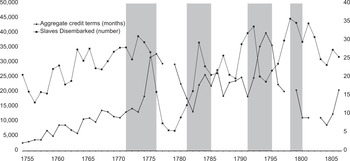
Our larger sample of 330 voyages confirms the broad lengthening of credit terms issued over time, but also reveals that they fluctuated considerably in the last quarter of the eighteenth century, before falling in the opening years of the nineteenth century (Figure 1). When bills in the bottom was introduced during the 1750s, slaving merchants took the majority of their receipts in produce, with a small balance in the form of bills of exchange drawn at just three to four months sight. Credit terms steadily crept up throughout the 1760s and early 1770s, almost doubling over the course of ten years, tracking the trade's steady expansion. In the same period, produce began to disappear from return cargoes, so that after 1765 the majority of vessels appear to have come home without produce as remittance, confirming that slave traders readily adopted bills in the bottom after the Seven Years' War. Credits shortened slightly in the first one-half of the 1770s, but spiraled with the onset of the American War, reaching their peak in 1777, when they averaged 26 months. At the same time, the trade plunged towards its lowest level in the entire eighteenth century, eventually bottoming out in 1780. From 1780 until 1783, credit terms actually decreased back to their pre-war levels, a result perhaps of a reduction in debts through a lack of slave sales. After the American Revolutionary War, slave factors lifted the terms of credit to 21 months, where they stayed with some variations until 1793, when they surged again and reached their highest recorded peak of 33 months in 1795. Although the sample for the period 1796–1807 (comprised of 21 voyages) does not allow for firm conclusions, the data available implies that credit terms may have plunged again. Considered over the entire period, 1755–1807, credit terms were relatively low and stable before 1775, and then highly variable thereafter.
CAPTIVE AFRICANS DISEMBARKED IN THE AMERICAS BY BRITISH FLAGGED VESSELS (NUMBER) VS. AGGREGATE LENGTH OF CREDIT TERMS ISSUED FOR SLAVE SALES (MONTHS), 1755–1807

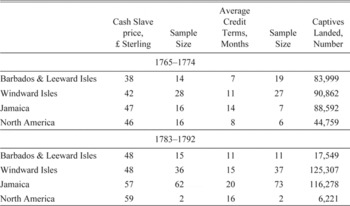
At the level of individual slaving markets, credit terms and slave prices were consistently higher in the productive frontiers of slavery than in the older, settled colonies. Consider, for example, the various credit terms and slave prices, adjusted to cash equivalents, offered for captive Africans in 1765–1774 and in 1783–1792, two relatively stable peacetime periods (Table 1). Slavers could obtain then £38 for a “prime” male captive at Barbados and the Leeward Islands and realize their returns within seven months. Alternatively, they could obtain £42 for a male slave at the recently acquired Windward Islands, albeit with an average four month longer wait for the proceeds. At Jamaica, captives sold for £47 a person, helped in part by a sizeable re-export market to nearby Cuba and Hispaniola, although offset by the longest credit terms in the Americas. The distinction between regions also applies within Jamaica: agents in the northwest frontier sold slaves for lengthier credit terms than those in the established Kingston market. This pattern repeats in 1783–1792, with higher slave prices at Jamaica, but credit terms much longer. In both periods, North America offered an inconsistent but sometimes lucrative market for enslaved Africans, as colonial and, later, U.S. legislatures frequently opened and closed it to slave ships.Footnote 17
AVERAGE SLAVE PRICES AND CREDIT TERMS ISSUED FOR SLAVE SALES IN BRITISH AMERICAN REGIONS, 1765–1774 AND 1783–1792

Sources and Methodology:
For credit terms, see Figure 1. In some instances, only slave prices or credit terms were observable, hence the disparity in the sample sizes. Adjusted slave prices are taken from the TASTD. The authors of the TASTD adjusted the prices to reflect the cash sale price for a “prime male” slave at Jamaica. That is, “for the price differential between the market in which the slave was actually sold and the price in Jamaica. Thus, if the captive was sold in one of the eastern Caribbean islands we would make a small adjustment upwards to reflect the ten extra days sailing time it would take to reach Jamaica.” The authors also adjusted prices to constant pounds sterling (that is adjusted for inflation), and deflated the prices for observable credit terms. The prices therefore allow a true comparison between regions and over time.
The number of captives landed is from TASTD, estimates section, British flagged vessels only. Barbados & Leeward Islands comprises Barbados, Antigua, Saint Kitts, and Montserrat/Nevis in the TASTD's “Disembarkation regions” field. Windward Islands includes Grenada, Dominica, St. Vincent, and Trinidad/Tobago in the same field. Jamaica and North America are the Jamaica and Mainland North America regions in the TASTD.
British slaving merchants considered the lengths of credit when seeking the most lucrative colony in which to land their captive cargoes. Liverpool merchant Robert Bostock instructed his slave ship captain in May 1792, for example, that “The Bills at Jamaica are longer sighted, so you must make your Calculations [where to land the slaves] accordingly.” London slaver Thomas Lumley directed another captain in 1806 to be “governed in your Average [slave price] by the time the Bills may have to run.”Footnote 18 Ship captains appear to have preferred, however, the eastern Caribbean markets to those in distant Jamaica and North America, forgoing higher slave prices, and saving on transportation costs (Eltis et al. Reference Eltis, Lewis and Richardson2005). Cash prices at the Windward Islands were five pounds lower than those to be earned in Jamaica in the period 1765–1774, and nine pounds lower in 1783–1792. Even so, the number of slaves landed in the Windward Islands exceeded those landed in Jamaica in both periods.Footnote 19
Slave ship captains disproportionately landed their captives in the eastern Caribbean, despite the lower slave prices there, because of the peculiar geography of the British Americas. After departing Africa, slave ships followed the Atlantic winds and currents, and arrived in the eastern Caribbean first, usually at Barbados (Behrendt Reference Behrendt, Bailyn and Denault2009). Captains then visited the markets stipulated in their orders seeking out a factor who could take them up at their limits, but, because of the Caribbean's winds and currents, had to visit them in sequence. Trading at the turn of the nineteenth century, for example, London slavers Thomas Lumley and Company ordered one of their captains to arrive first at Surinam, and then run through 11 other American markets “in succession.”Footnote 20 Captains also understood that the longer voyage to Jamaica or North America could have perilous consequences for the health of the slaves. In 1754, for example, John Newton landed his captive Africans in Saint Kitts because they would “drop fast had we another passage to make” (Newton Reference Newton, Martin and Spurrell1962, p. 81). When factors in the eastern Caribbean markets could meet a captain's limits, captains tended to land their slaves there rather than proceed to Jamaica or North America.
Captains also disproportionately landed slaves in the eastern Caribbean because they relied on incomplete information to guide them as they sought out markets. Captains did not sail completely blind in the Americas, as they received news from their owners whilst on the African Coast, and often upon their arrival at Barbados, where additional orders were lodged specifically to guide them in their sales.Footnote 21 This information was, however, rarely current; orders dispatched from Britain were at least four months out of date by the time they reached a slave ship captain. Neither was information exchanged between colonies necessarily up to date, because few ships plied a west-east route from Jamaica to the eastern Caribbean in the face of contrary winds and currents.Footnote 22
The lack of information did not necessarily cause problems for merchants and captains in periods of economic stability, when slave prices and credit terms were approximately the same upon a ship's arrival in the Americas as when it departed Britain. As Liverpool merchant Edgar Corrie explained to Lord Hawkesbury in August 1788, though, captains searching for safe markets during periods of economic instability could create gluts in the supply of slaves to certain colonies. If slave ships arrived in the eastern Caribbean when demand was falling, Corrie explained, they proceeded towards the “ultimate market[s],” as he termed them, of Jamaica or South Carolina, where they hoped to be taken up at the limits stipulated in their orders. These colonies, which slave traders did not conceive of as a single unit, were the final markets on the trans-Atlantic circuit because of their leeward position at the end of the chain of Caribbean Islands.Footnote 23 Slave ship captains' bargaining power was reduced in the “ultimate markets;” beating back upwind had dire consequences for the slaves' health, as the voyage could take up to a month, almost as long as the Middle Passage.Footnote 24 With other vessels following the same procedures, the “ultimate markets,” Corrie stated, were “frequently overdone with negroes.” The “effect,” he explained, was “very severe” for “African merchants” as factors often “refused to take up a slave ship” by issuing guaranteed bills of exchange. Factors agreed instead to sell “the slaves at the risque of the African Merchant,” and send him “the Planters bonds” as remittances upon the completion of the sale.Footnote 25
Planters' bonds were issued to British slave traders as remittances for slave sales throughout the seventeenth and early eighteenth century, but had been supplanted by bills in the bottom by the time Corrie penned his letter, except as payments made by planters to factors (Davies Reference Davies1957). The planters' bonds were, like bills of exchange, drawn at stipulated periods, and had legal standing against the planter's property after the passage of the Colonial Debts Act of 1732 (Morgan Reference Morgan2005; Price Reference Price and Solow1991). Slave traders could therefore sue planters who reneged on their debts, giving the bonds some standing as remittances for slave sales. However, slave traders disliked planters' bonds because they were drawn on distant property shielded by colonial legal systems, making suits difficult to prosecute, especially in Jamaica, where the Colonial Debts Act was loosely enforced (Long Reference Long1774, I). Moreover a single slave sale could return numerous assorted planters' bonds, all of which had to be kept track of and recovered piecemeal over time by the slave trader, an inconvenience compared to a small bundle of bills of exchange drawn on a single British banker.
Slaving merchants had similar problems with another type of remittance, not mentioned by Corrie: the factor's own promissory notes, which established a debt only between the factor and the slave trader. Although promissory notes had less legal protections than the planters' bonds, they tended to be more desirable to slave traders as a form of remittance because the merchant only had “one house to look to, instead of so many diff[eren]t people,” as one London slaver explained to his captain.Footnote 26 Moreover, British merchants could still circulate promissory notes; one Jamaican slave factor insisted on issuing his own promissory notes for slave sales he made during the late 1780s, enabling him to save the commission charged by a British guarantor.Footnote 27 Even so, British slaving merchants generally disliked remittances that lacked a guarantee—planters' bonds and factors' promissory notes—because they tended to be less reliable than guaranteed bills, especially when they were drawn at distant dates in uncertain times. The dangers of receiving unguaranteed credit instruments prompted Edgar Corrie to identify American remittances as the premier risk posed to British slaving merchants, ahead of the purchase of captives in Africa, slave mortality, and shifting slave prices in the West Indies. The latter three, Corrie argued, could reduce the profitability of a voyage, whereas unreliable remittances “involves the entire capital of the Merchant.”Footnote 28
Corrie's letter helps to explain the fluctuating lengths of credits we observed in our sample of 330 slave sales by connecting them to slave prices and the geography of the British Atlantic slave markets. The size of slave prices and the length of bills issued for American slave sales depended upon market conditions, with the eastern Caribbean typically offering lower prices and shorter credits, and Jamaica and North America higher prices and longer credits. Ship captains constrained by winds, currents, and their ship owner's orders, landed a disproportionate number of captives in the eastern Caribbean when demand was robust there, particularly during periods of economic stability. When demand fell in the eastern Caribbean, ship captains sailed downwind to the “ultimate markets,” resulting in an escalation in credit lengths and a fall in slave prices in both regions. When factors in the “ultimate markets” exhausted their available credit, slave trading merchants found it difficult to obtain the short and secure remittances they required to fit out their vessels, reducing the subsequent volume of the trade. Instability in trans-Atlantic credit terms thus help to shape the contours of Britain's slave trade in the last quarter of the eighteenth century.
SECTION 2
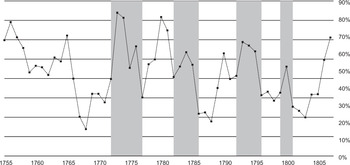
Corrie informed Hawkesbury that periods of instability occurred “frequently” in trans-Atlantic credit terms, but did not mention any specific occurrences. We can discover the periods in question, though, by cross-referencing our dataset to the TASTD, and identifying periods when surges and collapses in the volume of the slave trade to the “ultimate markets” coincided with lengthening terms of credit (Figures Figures 1 and 2). In 1755–1771, credit terms were sufficiently low that they do not seem to have caused major problems for slave traders. From 1802 until 1807, slave traders likewise had “little difficulty obtaining credit,” thanks to slave prices being driven up by planters fearful of the imminent abolition of the trade (Behrendt Reference Behrendt2001, p. 174).Footnote 29 In the intervening years, 1772–1801, three periods of instability are striking: the first in 1772–1777 and another in 1782–1786, both of which would have been within Corrie's memory, and a third after the date of Corrie's letter in 1792–1796. Although our sample is too thin to establish it with certainty, qualitative evidence points toward another period of instability in 1799–1801. By examining these four periods in detail, we will see how instability in trans-Atlantic credit terms impacted upon the volume and direction of the slave trade.
1772–1777; 1782–1786
The roots of the instability in trans-Atlantic credit terms in 1772–1777 can be traced to a rapid expansion in the Caribbean plantation economy after the Seven Years' War (1755–1763). With produce prices rising during the “silver age of sugar” (Pares 1956), planters were eager to expand their holdings and establish new estates, especially in the Windward Isles, which had been ceded by the French in 1763 (Quintanilla Reference Quintanilla2004; Murdoch Reference Murdoch1984; Niddrie Reference Niddrie1966). Planters took out mortgages from London banks to purchase property and an enslaved workforce, hoping to repay the principal with the proceeds from their crops (Smith Reference Smith2006). In the one to two years it took to make their first remittances, however, the planters borrowed further using the same mortgaged assets as collateral. The expansion in the plantation economy therefore rested on what Simon D. Smith (2006) calls a “debt pyramid” and, as a result, “instability was built into the expansion of the colonial trades during the third quarter of the eighteenth century” (p. 220). In June 1772, this speculative bubble burst when the Glasgow tobacco trade fell into crisis, precipitating a panic that quickly spread to the American colonies (Hoppit Reference Hoppit2002; Price Reference Price1980; Sheridan Reference Sheridan1960).
In January 1772, before the crisis had fully erupted, absentee planter Nathaniel Phillips wrote from London to inform his Jamaican attorney that “There's no doubt but we shall soon have as many Negroes sent down to our Island as may be wanted, for the Bills from the new Islands have not passed assent this year.”Footnote 30 In 1773, Jamaica's slave trade had almost doubled in volume compared to 1772 (Figure 2). In the same period, shipments of captives to Barbados and Virginia almost disappeared, and those to the Windward Islands halved.Footnote 31 According to Kingston slave factors Bright & Millward, in June 1773 Jamaica had not been “materially affected” by the credit crisis, “blest as it has been this & two years past with good crops” which would “keep the credit of its bills better than heretofore.”Footnote 32 By 1775, Jamaica's slave imports matched those of the rest of British Americas combined, a reversal from 1771, when Laing had complained that Jamaican planters would have to obtain captives by directly investing in slave ships.Footnote 33 South Carolina saw a similar expansion, with slave imports almost doubling between 1772 and 1773. A fall in demand in the eastern Caribbean stemming from the 1772 credit crisis thus pushed slavers into the “ultimate markets” of Jamaica and South Carolina, where they sought sustained planter demand and secure bills of exchange.
PERCENTAGE OF CAPTIVE AFRICANS DISEMBARKED IN THE “ULTIMATE MARKETS” OF JAMAICA AND NORTH AMERICA, 1755–1807.

Merchants and planters understood the risk posed to Jamaican and South Carolinian credit by a sudden increase in slave imports. In March 1773, Henry Laurens wrote to a Liverpool slave that if he would “be cautious this Year of sending Many Negroes to Carolina” because of the planters' substantial debts.Footnote 34 Regardless, Carolinian planters imported 8,189 captives in 1773 and 6,361 in 1774, before the Continental Congress closed Charleston to British shipping in December 1774.Footnote 35 In January 1775, Lowbridge Bright “dread[ed] the consequence of such numbers [of slave ships] going down to Jamaica, which island is greatly in debt by the number already sold there.”Footnote 36 Slave ship captain Peleg Clarke arrived in Montego Bay in March 1775 and found weak demand because “the planters are so Much in Debt from the grate quanty of Neagros that has bin imported that the Guine Factors Do not incline to take up Guinamen [sic].” When he completed his sale, Clarke had to accept bills at the “Monstrous” length of 17 months, terms matched in the other West India islands sampled in 1775.Footnote 37
The onset of the American War exacerbated the strain. Congress' embargo on exports to the West Indies doubled the price of provisions between 1775 and 1776, particularly in the more specialized Leeward and Windward Isles, eroding plantation profits (Carrington Reference Carrington2002, Reference Carrington1988; Sheridan Reference Sheridan1976; Ragatz Reference Ragatz1928). In July 1776, American privateers began operating in the Caribbean, capturing sugar ships carrying remittances back to England, driving up the cost of freight and insurance, and imperiling the over-stretched Guinea factors' standing with their metropolitan guarantees (Herzog Reference Herzog1995; Starkey Reference Starkey1990; Jamieson Reference Jamieson1983). A tenth of the slaving vessels arriving in the West Indies in 1776, and a quarter in 1777 were also taken and their Africans sold in Martinique for low prices.Footnote 38 The sale of prize slaves further depressed demand in the Windward Islands, which relied in part on visiting French buyers from Martinique and Guadeloupe to keep up its slave prices. By 1776, the onset of war had reduced slave prices throughout the British Caribbean by £6 compared to their 1775 level.Footnote 39
In 1776/77, factoring houses attempted to prop up slave prices by stretching the length of bills issued for sales, while some British bankers removed their guarantees from their colonial correspondents. In January 1776, a London slaving merchant complained that “Such is the difficualtys [sic] of the times at presant that no body will Engage here or give a Guarantee.”Footnote 40 In May of the same year, another London trader informed a merchant on the African coast that in light of the lengthening of credits, falling slave prices, and rapidly rising wartime operating costs, there would be “little trade after these [slave] ships that are already fitted out.”Footnote 41 Arriving in Kingston in July 1776, just as privateers began to take their toll, a slave ship captain received promissory notes from a Jamaican slave factor, “rather to take that than trust to Planters Bonds Witch seems to be the Present mode for the sale of slaves.”Footnote 42 A month later the Hibberts, a Jamaica factoring house whose bills were thought to be “as good as the Bank” in 1774, narrowly averted failure by accepting loans from prominent planters and resolved to “sell no more slaves at present except the Planter Bonds are taken in payment.”Footnote 43 At the turn of 1777, Jamaican factors Scerocold & Jackson stopped payment on its outstanding obligations causing a panic amongst the guarantees, who then refused to accept West Indian bills of exchange without “Value in hand,” immediate deliveries of produce to back the bills (O'Shaughnessy Reference O'Shaughnessy2000).Footnote 44 Five years later, two slave factors publicly brawled in Savanna-la-Mar, Jamaica, after the collapse of their firm, brought about by the protest of bills drawn for slave sales made in 1776/77.Footnote 45
These reports of failing West Indian credit are confirmed by our sample of 27 slave sales made between 1775 and 1777. In 1775, all 11 sampled ventures received their returns in guaranteed but lengthy bills of exchange. A year later, only four of eight ventures received guaranteed bills, one of which was protested when brought for acceptance, while two ventures received planters' bonds, another silver coin, and one promissory notes issued by the factor. In 1777, one-half of the eight sampled ventures received guaranteed bills, and the other one-half promissory notes. Seven of the eight vessels sampled in 1777 traded in the eastern Caribbean, so it is difficult to ascertain whether Jamaican factors were issuing planters' bonds, as the reports claimed. Those vessels returning from Kingston in 1776, however, failed to obtain guaranteed bills, implying that the terms of remittance had shifted there. Moreover, in April 1777, Peleg Clarke elected to trade at Montego Bay because Kingston factors, including the Hibberts, were mediating planters' bonds.Footnote 46 As Corrie had described, then, shifting market conditions in the Americas—particularly the loss of South Carolina as an “ultimate market” and falling demand stemming from the 1772 crisis and the American War—obliged slave factors to either stretch the length of bills of exchange, issue their own promissory notes, or mediate planters' bonds.
The experience of William Davenport, a Liverpool merchant who owned shares in 23 slaving voyages in 1774–1777, illuminates the manifest difficulties that failure to obtain short and secure remittances posed for British slaving merchants (Richardson Reference Richardson2004). In May 1777, Davenport's captain, Peter Potter sailed into Barbados with 397 captives in the ship Badger, but could not be taken up at his limits. Potter took his ship to Dominica instead and consigned his human cargo to slave factors Vance, Caldwell, & Vance (VC&V), who wrote to Davenport that they “never had so much trouble in a Sale” due to the ready availability of prize slaves at Martinique and low demand in the British islands. As a result, they managed “so low an average” of £26 sterling per slave, a significant drop from the £33 sterling Potter had received for each captive during the Badger's previous voyage to Dominica in November 1775.Footnote 47 More alarmingly, VC&V made their remittances with ungauranteed promissory notes at 30 months length, which, Davenport complained, made it “impossible to raise money to fit out ships.”Footnote 48 Davenport continued to wrangle for his money until May 1792, when he finally wrote off the Badger's account, along with the voyages of the Hector, Swift, and Dreadnaught, all of which had traded at Dominica during the war.Footnote 49 Sixteen years after his vessels had sailed, Davenport's ledger revealed that his personal liability from the four voyages was £1,600, a withering blow given that his profits from 22 voyages made in 1772–1774 had amounted to £1,700 (Richardson Reference Richardson, Anstey and Hair1976).
By 1779, Davenport had to request an extension on his obligations, because British bankers refused to discount bills of more than six months in length, and his remittances from slave sales were “at such long credit.”Footnote 50 However, a cache of stockpiled trade goods and the expectation of plummeting slave prices on the African coast drew Davenport back to the slave trade.Footnote 51 In March 1779, Davenport wrote to Guinea factors attempting to establish “the terms of payment” which was “the only objection we have in fitting out ships to Africa.”Footnote 52 Eventually, he secured a guarantee through a factoring firm based in Old Harbor, Jamaica, to whom he promised three slave ships. Upon the return of the vessels, Davenport was horrified to find that the bills had been issued at 30 months length, terms that he thought a “prohibition of the Trade,” given the restrictions it placed on the circulation of his capital.Footnote 53
Other British slaving merchants faced similar liquidity problems. While Davenport struggled to obtain his returns, a consortium of nine Liverpool merchants led by Thomas Foxcroft attempted to recover the proceeds from their slaver Laurel, which had also traded to Dominica in January 1777.Footnote 54 Sparling & Bolden, another Liverpool firm, had received guaranteed Jamaican bills for their vessel Juba in August 1774, which were subsequently protested when the guarantors Scerocold & Jackson failed, at which point Sparling & Bolden withdrew from the slave trade. After 18 years fruitlessly chasing down their returns, Sparling & Bolden managed to sell their debt at ten shillings on the pound, a reasonable return on bills they thought worthless.Footnote 55 George Burton, a London merchant, complained in 1783 that he could “do nothing” because his capital was “all locked up in Jamaica” by slaving voyages made in 1774.Footnote 56 These men's experiences were not exceptional: three-quarters of Liverpool's slaving merchants in 1776 had left the trade by 1784, whereas one-half the investors in slave ships in 1784 continued in the business in 1790.Footnote 57
In the immediate aftermath of the American Revolutionary War, 1782–1786, British merchants rapidly returned to the slave trade, but experienced similar problems of instability in colonial credits that had afflicted the trade in 1772–1777. In March 1784, planters, including those in South Carolina, which had been re-opened to slave imports, were, in one merchant's estimation, “in the utmost distress for [slaves], and disposed to give good Prices.”Footnote 58 Factoring firms briefly shortened their terms of credit and raised slave prices.Footnote 59 Slave traders were disappointed in 1785, however, when South Carolina was closed to slave imports, and credit terms raised to 24 months in the Caribbean, what one London slaver called “confounded long winded credits.”Footnote 60 The lengthening of credits deterred some merchants from investing in the trade. In October 1785, for example, textile suppliers Sargeant Chambers & Company commiserated with James Rogers, a Bristol slave trader, because “Bills extended to such unreasonable lengths,” which “is certainly a great disadvantage to the [slave] Trade.” Eight months later, the same firm wrote to lament the fact that Rogers had declined fitting out two slave ships because of the lengths of American bills.Footnote 61 Others followed Rogers in withdrawing their capital from the trade: between 1784 and 1786 the overall volume of the slave trade decreased by almost a third, almost all of which occurred in the “ultimate market” of Jamaica, where slave imports fell by a quarter in 1785, and then halved in 1786 (Figures 1 and 2).
Between 1772 and 1786, instability in trans-Atlantic credit terms thus shifted captive Africans into “ultimate markets” in the Americas on two occasions, and caused liquidity problems for British slave trading merchants. In the wake of the 1772 credit crisis, merchants diverted slaves to Jamaica and South Carolina away from the eastern Caribbean; in the immediate aftermath of the American War an almost identical but much smaller crisis also occurred, as merchants sent their vessels to Jamaica following the closure of South Carolina to the slave trade. In both instances, slave factors lengthened their bills of exchange and, during the American War, mediated the planters' bonds or issued their own promissory notes. By relying on the quick circulation of receipts above large capital stocks, British slaving merchant left themselves open to such swift changes in the terms of remittance, obliging many to withdraw their investment, and contributing to the trade's decline to its lowest level in the eighteenth century. As experienced Liverpool slaveship captain Robert Norris wrote in September 1777: “tis not ye American War, tis not the state of ye trade on ye Coast of Africa but merely the low ebb of W[e]st India Credit that occasions a temporary stagnation of ye [slave] Trade.”Footnote 62
1792–1796; 1799–1801
Jamaica's slave trade experienced another boom and bust in 1792–1796 that was fueled by shifts in trans-Atlantic credit terms. Concerned that the supply of Africans would be cut off by the abolitionist campaign in Parliament, and enjoying access to a larger market for their sugar in the wake of the 1791 Saint Domingue slave revolt, planter demand drove up the prices of enslaved Africans throughout the British Caribbean (Ryden Reference Ryden2009; Eltis and Richardson Reference Eltis, Richardson, Eltis, Lewis and Lee Sokoloff2004; Sheridan Reference Sheridan and Higman1983; Klein Reference Klein1978). Spurred by favorable American markets conditions, British slave traders landed 42,191 captive Africans in the Caribbean during 1793, the trade's largest level to date.Footnote 63 The onset of an Atlantic-wide credit crisis in February 1793 and the simultaneous outbreak of war with France dampened the planters' demand for captive Africans. In June 1793, when the credit crisis struck the West Indies, John Tailyour, an absentee Jamaican slave factor, heard from his company Taylor, Ballantine & Fairlie (TB&F) that “most of the guarantees are stopped to Windward[,] expect the bills [in Jamaica] will be still longer.”Footnote 64 Deliveries of captives to Jamaica—now the sole “ultimate market” for British ships given South Carolina's closure to slave imports in 1785—increased by 50 percent between 1792 and 1793, so that the island absorbed two-thirds of the enslaved Africans brought to the British Americas in 1793 (Figure 2). Marveling at the surge in slave imports, Tailyour opined that three-quarters of the vessels trading at Kingston in 1793 had been diverted from their original intended markets, including the north side of Jamaica where Simon Taylor, his sugar planting cousin informed him, “they give their [promissory] notes for the sale of the Cargoes, they have been glutted, and their credits are stopped.”Footnote 65 Kingston factors responded to the credit crisis and the influx of slaves by stretching the lengths of the bills they issued for slave sales from 15 to 24 months before and after June 1793.
British merchants found themselves strained by the credit crisis, and elected to withdraw their investment from the slave trade. Clearances from Liverpool, by far Britain's largest slaving port, plummeted from 128 vessels in 1792 to 49 in 1793, the majority dispatched either before the credit crisis or in the closing months of the year.Footnote 66 Liverpool slave traders Tarleton and Rigg, writing to Tailyour, attributed the fall to the parlous state of West India markets: “the slow sales, low averages, & above all no returns in Bills which took place in the course of [1793], have deterred some & disabled others from adventuring to Africa at present.”Footnote 67 One of those “deterred” from the trade was Liverpudlian Ralph Fisher, who notified Tailyour that he would dispatch one of his unemployed slave ships only if he could obtain “a sufficient guarantee in this country, for bills at a short period” for it was “impossible to carry on the trade for bills at the periods [the factors] have been giving.”Footnote 68 Liverpool merchant John Dawson, possibly the world's largest individual slave trader, verged on bankruptcy in 1793, and in the next year was seeking cash or short bills from American slave sales so as to maintain liquidity (Rawley Reference Rawley and Behrendt2005).Footnote 69 Bristol slaver James Rogers' business collapsed, leaving debts of £100,000, and substantially diminishing his town's tightly concentrated slave trade (Morgan Reference Morgan2003; Richardson Reference Richardson1987, p. 4). Writing to a British friend in May 1793, Simon Taylor thought that the lengthening terms of credits for slave sales in Jamaica, coupled with the failures of “5 of the most Capital African Houses” meant that “there will be very few [slave] ships fitted out during the Warr [sic].”Footnote 70
Although some British merchants were setback, others were lured back into the trade by the capture of several French islands, which promised lucrative new markets for enslaved Africans.Footnote 71 Edgar Corrie, now acting as Tailyour's Liverpool agent, wrote to him that “With new markets opening… I expect that every Negroe carried for sale in 1794 will be wanted And the factors will receive the most immediate & safest payment for the first supplies to the new markets.”Footnote 72 Slaving merchants anticipated a British capture of Saint Domingue—which had imported more slaves than the entirety of British Caribbean in 1790—coupled with the recent acquisition of Martinique, Guadeloupe, and Saint Lucia would provide an outlet for captives.Footnote 73 Moreover, in Liverpool the Common Council managed to curtail the deleterious effects of the credit crisis by the end of 1793 by injecting capital into the money markets (Hyde, et al. Reference Hyde, Parkinson and Mariner1951). In April 1794, Liverpool merchants fitted out vessels with “great spirit,” in anticipation of ready sales for captive Africans in the Americas.Footnote 74 Between July 1794 and March 1795, however, the re-capture of Guadeloupe by the French, insurrections in Saint Vincent, Dominica, and Grenada, and the British army's decimation by a yellow fever outbreak in Saint Domingue substantially reduced the markets available to slave ships arriving in the West Indies (Duffy Reference Duffy1987; Geggus Reference Geggus1979). Captains steered their slave ships to Jamaica instead, where factors pushed their credit terms to 30 months in September 1794.
Tailyour's correspondence details the tension that the extension of credit terms in 1793–1795 placed upon William Miles, his British guarantee (Morgan Reference Morgan and McGrath1985). In April 1794, Miles thought the West Indies to be in the worst danger he had seen in his 40 years engaged in trade: “I see nothing but Ruin attending the present appearance of things,” Miles wrote, suggesting Tailyour “make a Dead Stand in the African Line.”Footnote 75 A statement of account sent to Tailyour in September 1794 revealed a balance outstanding to Miles of £202,315 sterling for slave sales, a burden that had a “visible effect upon [Miles'] health and spirits.”Footnote 76 With the time lag in communications, and vessels continuing to arrive in Jamaica holding a guarantee for his company, TB&F took up another 14 slaving vessels in late 1794 and early 1795. In March 1795, Miles, beset by “constant nervous complaints” stemming from his large outstanding debts, ordered Tailyour to “put a final stop to all further Sales of African Ships.”Footnote 77 TB&F finally ceased drawing bills on Miles in the same month and instead issued their own promissory notes for slave sales, a procedure followed by some other Kingston firms.Footnote 78 In 1796, Jamaica's share of slave imports almost halved compared to the previous year, as captains stopped at more lucrative markets to windward, such as Demerara and Trinidad, which were captured in 1795 and 1796 respectively (Figure 2). Slave ship captains avoided the war-torn Windward Island, however, where Alexander Houston and Company, guarantee for Munro McFarlane & Company, Grenada's principal slave factoring firm, collapsed in 1795, shortly followed by the Baillie family company, who had sold large numbers of slaves in the eastern Caribbean in the early 1790s (Hamilton Reference Hamilton2005).Footnote 79
A smaller credit crisis also occurred in 1799–1801, briefly increasing the volume of Jamaica's slave trade. In September 1799, John Tailyour's brother Robert, a partner in the London West India house Taylor, Hughan & Renny, reported to him that there had been “several bankruptcies lately in London,” stemming from a panic in Hamburg, Germany.Footnote 80 The crisis soon spread to American markets: by November, there was “no sale for W[e]st Ind[ia] Produce almost at any price,” in London, and by February 1800 “hardly any bills from the W[e]st Indies were accepted.”Footnote 81 As in other periods of scarce credit, Jamaica's share of the slave trade spiked as slave ships bypassed markets in the eastern Caribbean. In 1799, 30 percent of the captives brought to the British Americas were landed in Jamaica, increasing to 50 percent in 1800. Taylor, Hughan & Renny had fitted out four slave ships in February 1799, before the onset of the crisis, with great hopes for profits.Footnote 82 By October 1800, when one of their ships reached Jamaica, they rued their investment: bills of exchange issued for slave sales had leapt in Kingston from an average 17 months at the beginning of the year, to 30 months. “It certainly would never answer,” Robert Tailyour told his brother, to be fitting out slave ships and “receiving Bills at 30 Months” for the remittances.Footnote 83 By 1802, several large Kingston slave factoring firms were reported to be suffering substantial losses from bad planter debts, some amounting to as much as £35,000 sterling.Footnote 84 In that year, Jamaica's share of the slave trade halved, to 25 percent of the British trade (Figure 2).
Examining four periods of instability in trans-Atlantic credit terms—1772–1777, 1782–1786, 1792–1796, and 1799–1801—thus shows why British merchants found it difficult to obtain short and secure remittances during periods of financial uncertainty. When large numbers of captives were carried to slaving markets, factors stretched the length of credits, hoping to prop up slave prices and draw reticent planters to slave sales. With lengthy bills drawn on them in uncertain times, metropolitan guarantors tried to limit their exposure to risk by withdrawing their guarantees from their colonial partners, and insisted on the rapid collection of outstanding debts, aiming to avoid paying slave-trading merchants out of their own funds. When guarantees withdrew their backing, factors either issued promissory notes or mediated planters' bonds. In response, British slave trading merchants dispatched their vessels to other markets, or abandoned the trade entirely, contributing to noticeable shifts in the volume and direction of the trans-Atlantic slave trade.
CONCLUSION
Our sample of 330 slave sales and our case studies indicate that historians have been right to attribute the innovative bills in the bottom credit mechanism an important role in shaping Britain's trans-Atlantic slave trade. In the long run, bills in the bottom was, as Pearson and Richardson (Reference Pearson and Richardson2008) have argued, a successful underpinning to the trade, enabling sustained growth over the course of the late eighteenth century, particularly into new areas of plantation agriculture, such as the Windward Islands and, later, Trinidad and Demerara. The long-term success of the arrangement masks, however, considerable short-term instability, which also helped to shape the geographic distribution of Britain's slave trade in the last quarter of the eighteenth century. During several economic and military crises, ship captains chose to land Africans in the “ultimate markets” of Jamaica and South Carolina, where factors stretched the lengths of credits, issued slave traders with promissory notes, or mediated the planters' bonds. British slave traders struggled to circulate these lengthy or unreliable credit instruments, making it difficult for them to cover their obligations to the tradesmen who supplied their cargoes, and therefore remain in the business. As Edgar Corrie summarized, British slave traders required a “choice of markets” to obtain short and secure remittances, and “to confine the [slave trade] strictly to limited markets must produce consequences more fatal to the African Merchant than the Abolition of the Trade.”Footnote 85 If British slave trading merchants relied on a “chain of credit” to finance their ventures, then that chain was frequently strained, and sometimes broken, in the last quarter of the eighteenth century.
Given the weakness of the relationship between slave trading merchants, factoring houses, and guarantees, we should hence be cautious of viewing the bills in the bottom credit as a particularly modern financial instrument. Bills in the bottom was certainly, as numerous historians have pointed out, an innovation on the remittance mechanisms used by Dutch and the French slave traders, as the guarantee provided a third-party security in Britain (Haggerty Reference Haggerty2009; Pearson and Richardson Reference Pearson and Richardson2008; Morgan Reference Morgan2007; Price Reference Price and Solow1991). As we have seen, though, guarantees frequently broke their connections with their American partners when they wanted to avoid risk during economic crises; as one author described in 1795, bills of exchange returned from slave sales were circulated in Liverpool solely on the “faith” that the guarantee would honor them (Wallace Reference Wallace1795, p. 232). Like most early-modern financial mechanisms, then, bills in the bottom relied upon fragile trans-Atlantic trust networks that broke down during periods of economic uncertainty. The British, like the French and the Dutch, therefore struggled to “complete the triangle” at certain key periods during the late-eighteenth century, shaping the forced-migration of captive Africans to individual colonies, and contributing to surges and collapses in the overall volume of the slave trade. Britain's trans-Atlantic slave trade was thus a “wheel” of commerce “kept in motion” by the supply of credit.