


According to the World Health Organization, neonatal infection causes over 550,000 neonatal deaths annually (World Health Organization, 2022), accounting for approximately 23% of the overall neonatal mortality worldwide. Among the 93,400 neonatal deaths in China during 2015, about 8.5% were due to infections such as pneumonia, sepsis, and meningitis (He et al., Reference He, Liu, Chu, Perin, Dai, Li, Miao, Kang, Li, Scherpbier, Guo, Rudan, Song, Chan, Guo, Black, Wang and Zhu2017). Many systems in neonates are still under development and maturation; the immature immune system, particularly, makes them highly vulnerable to pathogens, leading to infections (Cinicola et al., Reference Cinicola, Conti, Terrin, Sgrulletti, Elfeky, Carsetti, Fernandez Salinas, Piano Mortari, Brindisi, De Curtis, Zicari, Moschese and Duse2021).
Maternally acquired antibodies, such as immunoglobulin G transmitted through placenta and secretory immunoglobulin A in breast milk, are important resources in the immune system to fight against infections for neonates (Victora et al., Reference Victora, Bahl, Barros, França, Horton, Krasevec, Murch, Sankar, Walker and Rollins2016). In addition, proteins related to immune response, such as interleukins and cytokines, are associated with resistance to neonatal infection (Green et al., Reference Green, Garrick, Peterson, Berger, Galinsky, Hunt, Cho, Bourke, Nold and Nold-Petry2023). However, immune-response-related proteins in relation to neonatal infection have not been systematically investigated, primarily due to the limitations of traditional techniques to quantify levels of proteins (Pla-Roca et al., Reference Pla-Roca, Leulmi, Tourekhanova, Bergeron, Laforte, Moreau, Gosline, Bertos, Hallett, Park and Juncker2012). Insufficient consideration of confounding factors that may impact both protein levels and risk of infection in the neonatal period is another reason (Sly et al., Reference Sly, Trottier, Ikeda-Araki and Vilcins2022). The twin design could control for shared genetic and environmental confounding factors and thus may enhance the strength of causal evidence in omics research (Hasegawa et al., Reference Hasegawa, Taniguchi, Ueda and Watanabe2023).
By utilizing the dual recognition and DNA-coupled technique, the proximity extension assay (PEA) from Olink Proteomics platform could simultaneously measure a broad range of proteins with a small volume of sample (Coral & Franks, Reference Coral and Franks2023). It therefore serves as a high-throughput proteomic tool without the antibody cross-reactivity that would occur in conventional protein assays (Petrera et al., Reference Petrera, von Toerne, Behler, Huth, Thorand, Hilgendorff and Hauck2021).
In this nested case-control study, we aimed to investigate the associations of cord plasma levels of 92 immune-response-related proteins with risk of neonatal infection among twins. We also intended to assess the predictive performance of differentially abundant proteins (DAPs), as well as their potential function and pathways for neonatal infection.
Materials and Methods
Study Design and Participants
This is a nested case-control study embedded in the Shenzhen Baoan Birth and Twin (SZBBTwin) cohort, which was initiated in the Baoan Women’s and Children’s Hospital, Shenzhen, China, since May 5, 2020. In the SZBBTwin cohort, women who had their antenatal registration and delivered through the cesarean section at the Baoan Women’s and Children’s Hospital were invited, together with their neonates. Exclusion criteria were emergency deliveries, women with a history of infection with hepatitis B, human immunodeficiency virus, toxoplasma, rubella virus, cytomegalovirus, herpes simplex virus, and other infections, as well as women who delivered at a gestational age of less than 28 weeks. Informed consent was given by the mother before delivery.
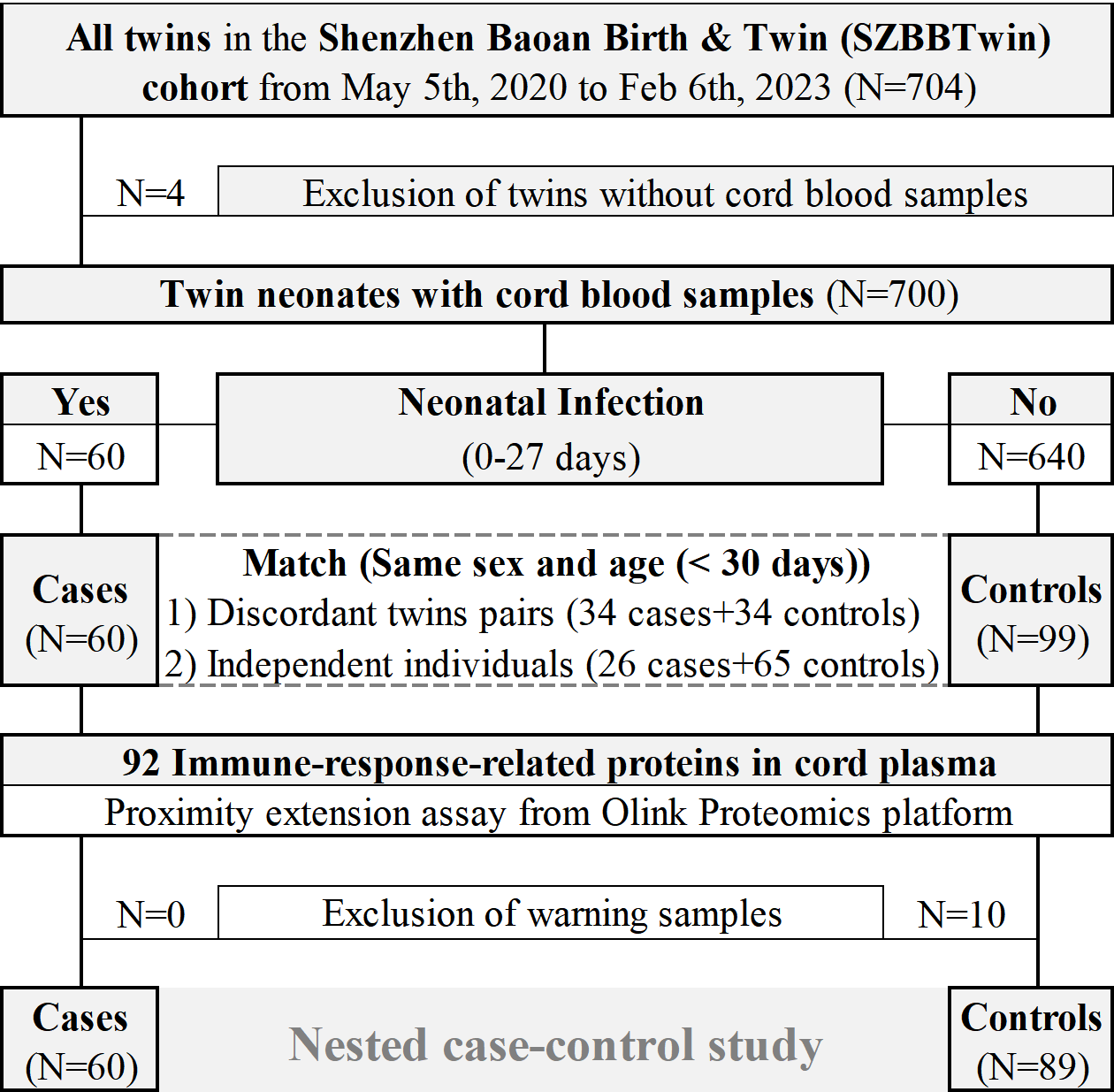
By February 6, 2023, 352 pairs of twin neonates (N = 704) had been recruited. Biological samples were collected at delivery, including maternal blood, cord blood, amniotic fluid, tissues of umbilical cord and placenta. Four neonates without cord blood samples were excluded from subsequent measurements and analyses (Figure 1). We followed the twin neonates until 27 days of age. This follow-up window encompasses the standard neonatal period and ensures that the identified infections are most closely linked to the intrauterine and immediate postnatal immune status reflected by cord blood biomarkers. During this period, we collected all medical records of hospitalizations, outpatient visits, and emergencies from the hospital information system (HIS) of Baoan Women’s and Children’s Hospital.
Flow chart of inclusion and exclusion of the study population.

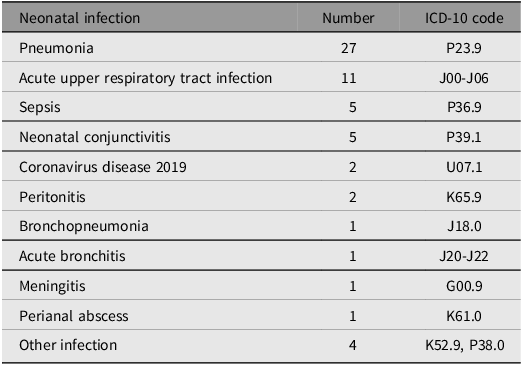
Cases were defined as twin neonates with a clinical diagnosis of infection during 0−27 days after birth. Clinical diagnosis of neonatal infection was determined using diagnostic records in HIS such as outpatient, emergency, and inpatient diagnoses and the International Classification of Diseases version 10 code, medication history, X-ray or computed tomography results, as well as medical and laboratory tests including complete blood count, inflammatory markers, testing of antigen or nucleic acid of pathogens, blood culture and sputum culture. Discordant twin pairs were defined as pairs in which one twin had neonatal infection, and the other twin had not. A total of 60 cases (including 34 from discordant twin pairs) were identified in the present study (Table 1), including pneumonia (n = 27), acute upper respiratory tract infection (n = 11), sepsis (n = 5), neonatal conjunctivitis (n = 5), coronavirus disease 2019 (n = 2), peritonitis (n = 2), bronchopneumonia (n = 1), acute bronchitis (n = 1), meningitis (n = 1), perianal abscess (n = 1), and other infections (n = 4).
Neonatal infection classification of cases and ICD-10 code

Note: ICD-10, International Classification of Diseases Version 10.
Controls were defined as twin neonates who had no infection during 0−27 days after birth. A total of 60 cases and 99 controls were included using two matching strategies (Figure 1): (1) Within-pair matching: 34 cases from discordant twin pairs were naturally matched to their unaffected co-twins (n = 34); (2) Individual-level matching: the remaining 26 cases — including those from concordant infected pairs or those whose co-twin had missing data — were matched to 65 unaffected controls from the overall cohort based on sex and the calendar date of birth (within a 30-day window).
Measurement of Immune-Response-Related Proteins
Ten milliliters of cord blood were collected with syringes and encapsulated into ethylenediaminetetraacetic acid vacuum tubes. After centrifugation (4000 g) for 15 minutes, the plasma was dispensed into cryotubes and stored at −80°C until measurements. The entire procedure was completed within 6 hours.
Using 1µL of each sample of cord plasma, the levels of 92 immune-response-related proteins were measured using the Olink Target 96 Immune Response panel (Olink Proteomics, Sweden), a predefined multiplex panel comprising 92 biomarkers selected and validated by the manufacturer to cover key immune pathways. The assay was performed according to the manufacturer’s instructions and protocol (Assarsson et al., Reference Assarsson, Lundberg, Holmquist, Björkesten, Bucht Thorsen, Ekman, Eriksson, Rennel Dickens, Ohlsson, Edfeldt, Andersson, Lindstedt, Stenvang, Gullberg and Fredriksson2014), which mainly included four steps: (1) Immuno-reaction: pairs of antibody probes labeled by oligonucleotide bind to the targeted protein; (2) Extension: the oligonucleotides hybridize in pairwise when the two probes are in close proximity; (3) Preamplification: a proximity-dependent DNA polymerization reaction produces a unique target sequence; and (4) Quantification: the resulting DNA sequences are quantified with a microfluidic real-time polymerase chain reaction instrument (Signature Q100).
The protein levels measured from PEA were presented as normalized protein expression (NPX) values on a log2-scale, with a higher value corresponding to a higher protein expression. Since the NPX values were generated from the continuous signal readings, they were biologically meaningful if they were abundant differently between groups even though some of the NPX were lower than the limit of detection (LOD) (Olink, 2018). Therefore, we decided not to remove NPX below LOD nor remove the protein in which more than 20% of the samples were below the LOD. The names, Uniprot ID, LOD, and LOD ratio (i.e., proportion of samples with NPX values below LOD), of the 92 immune-response-related proteins are reported in Table S1.
Two batches of PEA were performed in our study, in which 10 bridge samples (plasma from 5 cases and 5 controls) were randomly selected from the first batch and measured again in the second batch of PEA. Data from two batches were merged and normalized using the R package OlinkAnalyze (version 2.0.6). Specifically, data from the second batch was adjusted by the reference (e.g., data from the first batch) using the median of the pairwise difference for each protein between the bridge samples (Christensen et al., Reference Christensen, Maag, Madsen, Lindgaard, Nielsen and Johansen2022). Principal component analysis (PCA) was performed before and after merging and normalization. Prior to merging and normalization, samples showed a tendency to cluster according to batch, indicating the presence of batch effects. After merging and normalization using bridge samples, the separation between batches was substantially reduced, with samples from different batches largely overlapping in the PCA space (Figure S1). This suggests that the applied merging and normalization effectively mitigated batch-related technical variation while preserving biological variability. The NPX values of the 10 bridge samples are presented in Table S2. According to the protocol of OlinkAnalyze, a warning sample was defined if its principal component (PC) value was 2.5 SDs away from the mean of PC1 and 4 SDs away from the mean of PC2 (Method S1). Finally, 10 warning samples were excluded, resulting in 60 cases and 89 controls in our final analysis (Figure 1).
Covariates
Maternal and neonatal characteristics might serve as potential confounding factors for the studied associations. We therefore collected information from the HIS, including maternal age at child’s birth (Attali & Yogev, Reference Attali and Yogev2021), gravidity (Lao & Sahota, Reference Lao and Sahota2017), educational level (Noghanibehambari et al., Reference Noghanibehambari, Salari and Tavassoli2022), gestational age (Miller et al., Reference Miller, Hammond, Strunk, Moore, Leonard, Carter, Bhutta, Stanley, de Klerk and Burgner2016), vaginal bleeding in early pregnancy (McPherson et al., Reference McPherson, Odibo, Shanks, Roehl, Macones and Cahill2013), prepregnancy BMI (Rajappan et al., Reference Rajappan, Pearce, Inskip, Baird, Crozier, Cooper and Pike2017), mode of conception (Fauser et al., Reference Fauser, Devroey, Diedrich, Balaban, Bonduelle, Waal, Estella, Ezcurra, Geraedts, Howles, Lerner-Geva, Serna and Wells2014), complications included diabetes, hypertension and autoimmune diseases (Bello et al., Reference Bello, Zhou, Cheetham, Miller, Getahun, Fassett and Reynolds2021; de Carolis et al., Reference De Carolis, Moresi, Rizzo, Monteleone, Tabacco, Salvi, Garufi and Lanzone2019; Ye et al., Reference Ye, Luo, Huang, Li, Liu and Liu2022), as well as sex (Baines & West, Reference Baines and West2023), zygosity (Spiegler et al., Reference Spiegler, Härtel, Schulz, Wurmb-Schwark, Hoehn, Kribs, Küster, Siegel, Wieg, Weichert, Herting and Göpel2012) and birth weight (Sahu et al., Reference Sahu, Raj Stanly, Simon Lewis, Prabhu, Rao and Kunhikatta2022) of the neonates.
Statistical Analysis
Continuous variables of maternal and neonatal characteristics were shown as mean and SD, and differences between groups were compared using independent samples t test or paired samples t test. Categorical variables were shown as frequencies and proportions, and differences between groups were analyzed using Pearson’s chi-squared test or Fisher’s exact test. Correlation and cluster heatmaps were used to assess the correlations between different immune-response-related proteins in all twins.
Levels of the immune-response-related proteins between cases and controls were compared using Wilcoxon rank-sum test for all twins, and Wilcoxon signed-rank test for discordant twin pairs. Proteins with statistically different measuring levels (p < .05) between cases and controls among all twins were considered as DAPs. We performed Benjamini-Hochberg false discovery rate procedure to adjust for potential multiple testing problems. The fold change (FC) values were calculated as the ratio of the means of the NPX values between cases and controls, and the negative log-transformed FC and the p values from Wilcoxon rank-sum test were used to draw the volcano plot. The R package pROC was used to plot the receiver operating characteristic (ROC) curves and calculate the area under the curve (AUC), and the accuracy of DAPs in diagnosing neonatal infection was assessed based on AUC (Robin et al., Reference Robin, Turck, Hainard, Tiberti, Lisacek, Sanchez and Müller2011).
Multivariable unconditional logistic regression (adjusted for maternal age at child’s birth, gravidity, educational level, gestational age, vaginal bleeding in early pregnancy, prepregnancy BMI, mode of conception, complications, sex and birth weight of the neonates) was used to assess the associations between proteins and risk of neonatal infection in all twins; multivariable conditional logistic regression (adjusted for sex and birth weight of the neonates) was used to assessed the association in discordant twin pairs (Method S2). We also explored the association between levels of proteins and neonatal infection diagnosed at 0−6 days and 7−27 days of age among all twins by multinomial logistic regression.
SAS version 9.4 (SAS Institute, Cary, NC, USA) was used for data management, and R version 4.2.2 (R Foundation for Statistical Computing, Vienna, Austria) was used for statistical analysis and plotting.
Enrichment Analysis
Metascape was used to perform the enrichment analysis (Zhou et al., Reference Zhou, Zhou, Pache, Chang, Khodabakhshi, Tanaseichuk, Benner and Chanda2019), which annotates potential functions, pathways, and interactions for the DAPs, by integrating Gene Ontology (GO) and Kyoto Encyclopedia of Genes and Genomes (KEGG). Terms of enrichment associated with more proteins have smaller p values. Term pairs with kappa similarity exceeding 0.3 were shown as network plots, enabling the visualization of relationships between terms of enrichment. The total set of proteins that could be detected by the Olink immune response panels was selected as the background for enrichment analysis.
Results
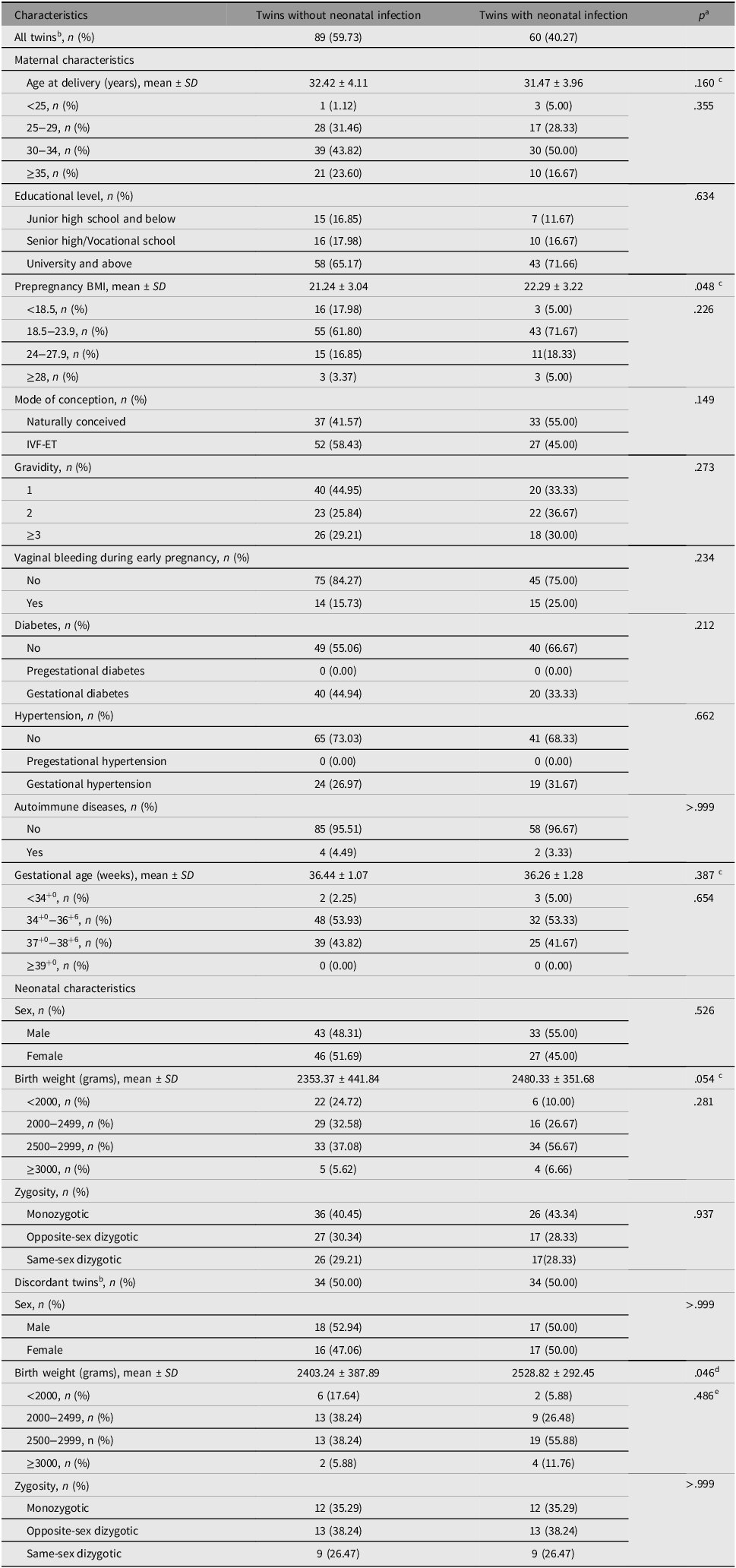
Among all twins in the nested case-control study (N = 149), the baseline characteristics showed no difference between cases and controls, except that maternal pre-pregnancy BMI was higher in cases than in controls. Within 34 pairs of discordant twins, cases had higher birth weights than controls (Table 2). The baseline characteristics were not different between all twins and discordant twin pairs (Table S3).
Maternal and neonatal characteristics comparing between twins with and without neonatal infection (in 149 twins, including 34 pairs of discordant twins)

Note: IVF-ET, in vitro fertilization and embryo transfer. aPearson’s chi-squared test or Fisher’s exact test unless stated otherwise; bRow percentage; cIndependent sample t-test; dPaired sample t test; eWilcoxon signed-rank test.
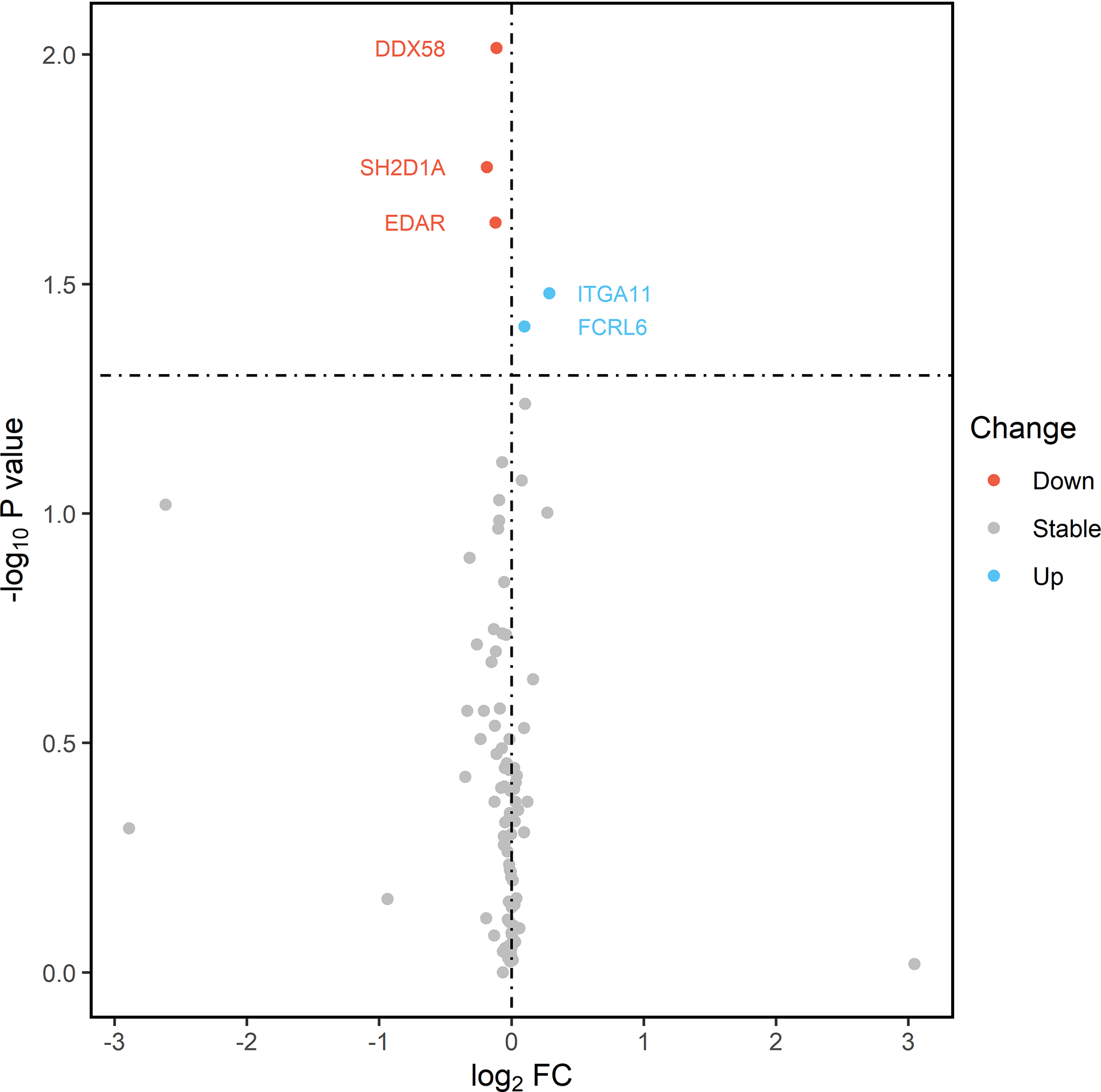
In the analysis of all twins (N = 149), cases had higher levels of integrin alpha-11 (ITGA11) and Fc receptor-like 6 (FCRL6), and lower levels of DEAD (Asp-Glu-Ala-Asp) box polypeptide 58 (DDX58), SH2 domain-containing 1A (SH2D1A) and ectodysplasin-A receptor (EDAR), than controls (Figure 2, Figure S2a). As shown in Figure S3, SH2D1A and DDX58 were close to each other on the cluster branches. The correlation heatmap (Figure S4) showed significant correlations between SH2D1A and EDAR (r = .649), DDX58 and SH2D1A (r = .738), DDX58 and EDAR (r = .790), as well as ITGA11 and FCRL6 (r = .477). The group differences in the levels of the five DAPs in maternal and neonatal characteristics are shown in Figure S5. In the analysis of 34 pairs of discordant twins, cases had lower levels of N-acetylgalactosaminyltransferase 3 (GALNT3), lymphocyte-activation gene 3 (LAG3), and parathyroid hormone receptor (PTH1R) than their co-twins without infection (Table S4, Figure S2b). However, after correction for multiple testing, the adjusted p values for the aforementioned proteins were all greater than .05.
Differentially abundant proteins between neonates with and without infection.
Note: FC: fold change values, calculated as the ratio of the means of the normalized protein expression values (case/control). Volcano plot was used to present the results, in which between-group comparison of levels of proteins showing a p < .05 (−log10P>1.30) from Wilcoxon rank-sum test were defined as differentially abundant proteins.

The five DAPs (ITGA11, FCRL6, DDX58, SH2D1A, and EDAR) were included to plot ROC curves. As shown in Figure 3, the cord plasma levels of the five DAPs could predict the probability of neonatal infection, with the AUC between 0.780 and 0.809 (AUCITGA11 = 0.792, AUCFCRL6 = 0.790, AUCDDX58 = 0.780, AUCSH2D1A= 0.809, AUCEDAR = 0.785, all p < .001). The corresponding sensitivity and specificity at the optimal cutoff (Youden index) were 53.3% and 92.1% for ITGA11, 80.0% and 67.4% for FCRL6, 68.3% and 76.4% for DDX58, 75.0% and 82.0% for SH2D1A, and 68.3% and 80.9% for EDAR, respectively. Furthermore, when the five DAPS were included simultaneously, the ROC curve showed a sensitivity of 73.3% and a specificity of 79.8% (AUC = 0.838, p < .001).
Prediction of differentially abundant proteins for neonatal infection.
Note: DAPs, Differentially abundant proteins.

As shown in the GO enrichment analysis, the five DAPs were mainly enriched in the regulation of leukocyte mediated immunity, integrin alpha11-beta1 complex, regulation of type III interferon production, tube lumen cavitation, and major histocompatibility complex (MHC) class II protein binding (Figure 4a). The network plot (Figure 4b) showed that SH2D1A was associated with DDX58, and ITGA11 was associated with FCRL6 (kappa similarity > 0.3). The KEGG enrichment analysis indicated that the DAPs were mainly associated with the nuclear factor kappa-B (NF-κB) signaling pathway (Figure 4c).
Enrichment analyses for the differentially abundant proteins.
Note: (a) Bar plot of the Gene Ontology (GO) enrichment; (b) Network plot of the GO enrichment; (c) Bar plot of the Kyoto Encyclopedia of Genes and Genomes (KEGG) enrichment. In bar plots, terms of enrichment associated with more proteins have smaller P values.

After multivariable adjustment in all twins (Figure 5a, Table S5), higher levels of ITGA11 (OR 3.00; 95% CI [1.33, 6.78]), FCRL6 (OR 5.41; 95% CI [1.37, 21.38]), were associated with a higher risk of neonatal infection, whereas inverse associations were observed for SH2D1A (OR 0.28; 95% CI [0.12, 0.63]). In the 34 pairs of discordant twins, higher levels of ITGA11 (OR 5.50; 95% CI [1.20, 25.23]) was associated with a higher risk of neonatal infection (Figure 5b, Table S5). In both analyses of all twins (N = 149) and discordant twin pairs (n = 68), higher level of ITGA11 was associated with an increased risk of neonatal infection.
Associations between multiple immune-response-related proteins and neonatal infection.
Note: (a) In all twins (N = 149); (b) In discordant twin pairs (n = 68). Forest plot was used to present OR and 95% CI from multivariable logistic regression (a) and multivariable conditional logistic regression (b).

In the analysis of multinomial logistic regression adjusted for confounding factors (Table S6), we found that lower levels of DDX58 (OR 0.40; 95% CI [0.17, 0.94]), SH2D1A (OR 0.19; 95% CI [0.07, 0.54]), and EDAR (OR 0.23; 95% CI [0.07, 0.71]), as well as higher level of FCRL6 (OR 10.29; 95% CI [1.82, 58.21]) were associated with an increased risk of neonatal infection diagnosed within 0−6 days after birth; while higher level of ITGA11 (OR 8.86; 95% CI [2.20, 35.76]) was associated with an increased risk of neonatal infection diagnosed within 7−27 days after birth.
Discussion
In this nested case-control study of twins, we found that five immune-response-related proteins in cord plasma, particularly ITGA11, may be related to the risk of neonatal infection. These five proteins are mainly involved in immune regulation and protein binding, and most of them are enriched in the NF-κB pathway.
Although several immune-response-related proteins have been reported in relation to infection in cell experiments or animal studies (Leomil Coelho et al., Reference Leomil Coelho, Mota, Sales, Marques, de Oliveira, Bonjardim, Peregrino Ferreira and Kroon2006; Liu et al., Reference Liu, Lu, Thulasi Raman, Xu, Wu, Li, Brownlie, Liu and Zhou2018), studies in human neonates are scarce (Miao et al., Reference Miao, Chen and Ding2021), let alone twins (Stewart et al., Reference Stewart, Nelson, Treumann, Skeath, Cummings, Embleton and Berrington2016). In our study, cord plasma levels of DDX58, SH2D1A and EDAR were lower in cases than controls in the analysis of all twins. DDX58, an innate immune receptor, has been connected to virus recognition (Sharma et al., Reference Sharma, Kontodimas and Bosmann2021) and the initiation of innate immunity, as well as inflammatory responses (Loo & Gale, Reference Loo and Gale2011). It has been reported that DDX58 is also important for enhancing the antiviral host response among children to influenza infection (Lee et al., Reference Lee, Zhang, Newhams, Novak, Thomas, Mourani, Hall, Loftis, Cvijanovich, Tarquinio, Schwarz, Weiss, Thomas, Markovitz, Cullimore, Sanders, Zinter, Sullivan, Halasa and Randolph2022), which supports our results. Previous studies showed that deficiency in SH2D1A was associated with immunodeficiency and might lead to hypogammaglobulinemia and B-cell lymphoma (Baxter et al., Reference Baxter, Walsh, Casadei, Eckert, Allenspach, Hagin, Segundo, Lee, Gulsuner, Shirts, Sullivan, Keller, Torgerson and King2022; Tangye, Reference Tangye2014), corroborating our finding that a lower level of SH2D1A was associated with a higher risk of neonatal infection in the analysis of all twins. Our study also indicates that DDX58 and SH2D1A have similar expression patterns in cluster and enrichment analysis. We also found that lower level of EDAR was associated with an increased risk of neonatal infection diagnosed within 0-6 days after birth. As a member of the tumor necrosis factor receptor super-family, EDAR may resist infection and promote inflammation responses by mediating the activation of the NF-κB pathway (Kumar et al., Reference Kumar, Eby, Sinha, Jasmin and Chaudhary2001; Sisto et al., Reference Sisto, Barca, Lofrumento and Lisi2016). We also observed that a higher level of FCRL6 was associated with a higher risk of neonatal infection. As a receptor for MHC Ⅱ, FCRL6 could regulate humoral responses and may act as a biomarker for chronic immune-related diseases (Schreeder et al., Reference Schreeder, Cannon, Wu, Li, Shakhmatov and Davis2010). FCRL6 might also be associated with the reactivation of cytomegalovirus (Alexandersson et al., Reference Alexandersson, Venäläinen, Heikkilä, Huang, Taskinen, Huttunen, Elo, Koskenvuo and Kekäläinen2023).
The DAPs identified for neonatal infection are mainly enriched in the NF-κB pathway, which may also be one of the main pathways associated with neonatal infection. DDX58 is stimulated during the activation of the non-canonical NF-κB pathway related to RNA viruses infection (Sun, Reference Sun2017). SH2D1A can activate NF-κB, which may be important for the host to properly defend against Epstein-Barr virus invasion (Sylla et al., Reference Sylla, Murphy, Cahir-McFarland, Lane, Mosialos and Kieff2000). The NF-κB pathway is a key transcriptional regulator that integrates signals from multiple upstream immune pathways, including pathogen recognition and cytokine signaling, and controls the expression of genes involved in inflammation, immune defense, and cell survival (Queiro et al., Reference Queiro, Coto, González-Lara and Coto2021). Additionally, the NF-κB pathway participates in the development of various systems in the embryo, and abnormalities in the function of NF-κB pathway can disrupt normal developmental processes or host immune defenses (Liu et al., Reference Liu, Li, Wang, Bai, Jia, Yuan and Yang2022). Taken together, these findings suggest that the observed protein alterations may reflect a coordinated immune response mediated by NF-κB pathway rather than independent effects of individual proteins. This pathway-level convergence provides a biologically plausible mechanism linking early immune activation to neonatal infection susceptibility.
In the present study, a higher level of ITGA11 was associated with a higher risk of neonatal infection in both the analyses of all twins and discordant twin pairs. ITGA11 is a member of the integrin receptor family, which are dimers composed of α and β subunits and involve in cell-cell or cell-extracellular matrix adhesion. Some studies have reported an association of ITGA11 with infections. In an animal study, ITGA11 was associated with coinfection of avian leukosis virus subgroup J and reticuloendotheliosis virus in chicken embryos, and the study also suggested that ITGA11 was enriched in the pathways of virus-vector interaction, bio-adhesion, and immune responses at the protein level (Cui et al., Reference Cui, Zhang, Xue, Yao, Zhou and Cheng2022). Similarly, our results of enrichment analysis also indicated that ITGA11 was relevant to protein binding. Binding to cells via integrins might be the infection mechanism employed by many pathogens. For instance, the Arg-Gly-Asp (RGD) tripeptide motif on the envelope of adenoviruses and herpesviruses, which plays a pivotal role in viral infection, acts as a recognition motif for integrins, including ITGA11 (Hussein et al., Reference Hussein, Walker, Abdel-Raouf, Desouky, Montasser and Akula2015).
Notably, cord blood proteomic profiles represent the neonatal immune status at birth, shaped by intrauterine exposures, maternal factors, and genetic background. Since the infections occurred within the first 27 days of life, these identified proteins likely reflect baseline immune programming and host susceptibility rather than active infection processes. Therefore, these biomarkers may indicate a pre-existing vulnerability that predisposes neonates to infection during early life, offering potential for risk stratification shortly after birth.
Our study revealed several potential protein markers for understanding the immunity to infections among neonates. Pair design of discordant twins was used to control for the effect of shared environmental and genetic confounders, improving the validity of the results, which might also explain the inconsistency in the results of multivariable logistic regressions between all twins and discordant twins (McGue et al., Reference McGue, Osler and Christensen2010). Nested case-control study with a clear chronological order also provides good control of selection and recall bias. In addition, a powerful proteomics technique, that is, PEA with high-throughput, high-precision, and low-interference, allowed a comprehensive protein analysis.
Our study also has several limitations. First, regarding study design and sample size, the limited number of discordant twin pairs restricted our ability to perform stratified analyses by infection type (e.g., bacterial vs. viral). Consequently, some estimates exhibited relatively wide confidence intervals, and we could not fully disentangle the relative contributions of genetic versus environmental factors to the observed proteomic associations. Furthermore, while our model demonstrated strong predictive potential, the current sample size precluded the development of a formal weighted protein risk score or the systematic exploration of synergistic interactions between proteins. Future studies with larger, independent cohorts are warranted to validate these associations and refine multiprotein combination scores to further optimize risk stratification. Second, our cohort consisted exclusively of twins delivered via elective cesarean section. This mode bypasses labor-induced physiological stress and maternal microbiota exposure, both of which are critical for neonatal immune priming. Since labor can modulate cytokine levels, our findings may primarily reflect the immune status of elective cesarean births and may not be fully generalizable to neonates born via vaginal or emergency cesarean delivery. Furthermore, due to the scarcity of cord blood samples, we did not perform functional validation; thus, external validation in independent, diverse cohorts is essential to confirm the reproducibility and transportability of these associations before clinical translation. Furthermore, while detailed postnatal data such as breastfeeding and antibiotic use were not collected, adjusting for these postbirth factors could have introduced overadjustment as they likely act as mediators rather than confounders in the causal pathway between the cord blood proteome and infection risk. Finally, several technical aspects of the proteomic platform should be noted. We utilized a fixed panel of 92 immune-response-related proteins, which may have excluded other relevant biomarkers. Additionally, as the PEA provides relative quantification (NPX), these values might not be directly comparable to absolute protein measures, although PEA results have been shown to correlate highly with traditional methods (Skau et al., Reference Skau, Wagner, Leppert, Ärnlöv and Hedberg2023). Regarding data processing, we retained NPX values below the LOD. While measurements below the LOD are subject to increased background noise, potentially attenuating associations toward the null, this approach preserves biological signals from low-abundance proteins and ensures a comprehensive exploration of the neonatal proteomic landscape.
Conclusion
Five immune-response-related proteins were identified as DAPs for neonatal infection, which were mainly enriched in the NF-κB pathway. A higher level of ITGA11 was associated with an increased risk of neonatal infection in all twins and discordant twin pairs.
Supplementary material
To view supplementary material for this article, please visit https://doi.org/10.1017/thg.2026.10076.
Data, material and code availability
The raw data and the interpreted data associated with this manuscript have been submitted and deposited to Figshare repository (Tan, Weiri (2025). Data_SZBBTwin-Proteomics-2025. figshare. Dataset. https://doi.org/10.6084/m9.figshare.28348019). The datasets and analysis codes are available from the corresponding author on reasonable request.
Acknowledgments
The authors would like to thank Dr Likuan Xiong, Dr Xuri Chen, Dr. Bin Liu, Dr Yuanfang Zhu, and D. Xu Chen (Former president) in Shenzhen Baoan Women’s and Children’s Hospital for the construction of the SZBBTwin cohort.
Authors’ contributions
Conceptualization: Ruoqing Chen, Xu Chen; Data curation: Weiri Tan, Yeqi Zheng, Feng Wu, Xiaomin Ye; Formal analysis: Weiri Tan; Funding acquisition: Ruoqing Chen, Xu Chen; Investigation: Ruoqing Chen, Xu Chen, Weiri Tan; Methodology: Weiri Tan, Hui Liang; Project administration: Rui Zhang, Quanfu Zhang; Validation: Weiri Tan, Yeqi Zheng; Resources: Youmei Chen, Xian Liu; Software: Weiri Tan; Supervision: Ruoqing Chen, Xu Chen; Visualization: Weiri Tan; Writing - Original Draft: Weiri Tan; Writing — Review and Editing: Ruoqing Chen, Xu Chen, Weiri Tan. All authors reviewed the manuscript.
Funding
This work was supported by the Fundamental Research Funds for the Central Universities, Sun Yat-sen University (Ruoqing Chen, Grant No.: 22qntd4311), the 100 Talents Plan Foundation of Sun Yat-sen University (Ruoqing Chen, Grant No.: 58000-12230022), the Basic and Applied Basic Research Foundation of Guangdong Province (Ruoqing Chen, Grant No.: 2022A1515110417), the Science, Technology and Innovation Commission of Shenzhen Municipality (Xu Chen, Grant No.: JCYJ20190809152801661), and the National Natural Science Foundation of China (Xu Chen, Grant No.: 82001652).
Ethics approval
The Ethics Committee of Baoan Women’s and Children’s Hospital has approved this study (LLSC-2021-04-01-12-KS) and the SZBBTwin cohort (LLSC2019-02-18).
Competing interests
All authors declare no conflicts of interest.
Consent to participate
Informed consent was obtained from all participants included in the study.