Lithic studies play a prominent role in reconstructions of ancient Mesoamerican domestic and ritual economies. Experimental replication studies (Clark Reference Clark1982, Reference Clark1985; Crabtree Reference Crabtree1968) and refinements to technological frameworks for lithic analysis (Clark and Bryant Reference Clark and Bryant1997; Clark and Lee Reference Clark and Lee1979; Hirth and Flenniken Reference Hirth, Flenniken and Hirth2006; Sheets Reference Sheets1972) have enabled Mesoamerican archaeologists to produce and analyze large lithic datasets through objective and independently verifiable measures. The application of high-power microscopic use-wear analysis to lithic assemblages can discern tool motions and materials worked on individual tool edges, which relate directly to tool consumption or use (Aldenderfer et al. Reference Aldenderfer, Kimball and Sievert1989; Aoyama Reference Aoyama1995, Reference Aoyama1999, Reference Aoyama2009). Although analyses commonly employ data recovered from a particular site to evaluate macroregional trade and political economy models, site-based lithic assemblages are also of significant value in the analysis of intra-community dynamics (e.g., Hirth Reference Hirth2006). Analysis of lithic assemblages at the community level permits assessment of variability in household activities; the organization, technology, and sequencing of production; and the use of space within sites and particular structures (Carballo Reference Carballo2011a; Feinman et al. Reference Feinman, Nicholas and Haines2006; Haines et al. Reference Haines, Feinman and Nicholas2004; Healan Reference Healan2012; Hirth and Andrews Reference Hirth and Andrews2002; Hruby Reference Hruby2007; Levine and Carballo Reference Levine and Carballo2014; Pastrana and Domínguez Reference Pastrana and Domínguez2009).
In this study we present an assemblage-based analysis of stone tool production and consumption at the site of La Laguna, Tlaxcala. We detect the emergence of new tool forms suggestive of new social activities during the later Formative period (ca. 600 b.c.–a.d.150). The characteristics of assemblages grouped by structures and excavation areas permit us to identify Terminal Formative period (ca. 100 b.c.–a.d. 150) blade production zones and variability in consumption patterns suggestive of various domestic, communal, and ceremonial activities. From basic subsistence tasks such as maguey processing to highly ritualized events involving the ceremonial caching of obsidian eccentrics, La Laguna's lithic assemblage is illustrative of varied facets of community organization and changes associated with urbanization and political evolution within Mexico's central highlands.
FORMATIVE LITHIC ECONOMIES IN THE CENTRAL HIGHLANDS
From a macroregional perspective Plunket and Uruñuela (Reference Plunket and Uruñuela2012) define the central highlands as a “cultural seam” or physical interface where Formative-period cultural traditions of both eastern and western Mesoamerica comingled for centuries. Concentrated centers of population emerged during the Middle Formative period and became more integrated culturally and economically during the Late (500–100 b.c.) and Terminal Formative (100 b.c.–a.d. 100) periods. The Basin of Mexico and Puebla-Tlaxcala region experienced explosive population growth in particular, and a number of competing communities constructed monumental architecture and residential districts consistent with urban or proto-urban settlement systems.
Stone tools across the Formative central highlands were made primarily from obsidian—which can be sourced chemically to various geologically discrete quarries in the region—and secondarily from local and more compositionally heterogeneous microcrystalline (i.e., chert), basaltic, and felsic stones. Major obsidian sources include the Mesa Central sources northeast of Mexico City (Paredón, Tulancingo, Otumba, and the distinctive Pachuca or Sierra de Las Navajas green obsidian); Sierra Madre Oriental sources in eastern Puebla and western Veracruz (Oyameles/Zaragoza, Guadalupe Victoria, and Orizaba); and the Ucareo-Zinapecuaro source area in Michoacan (Cobean Reference Cobean2002) (Figure 1). There is no clear evidence for exclusive elite or state control of any obsidian source in the central highlands, yet changes in source utilization correlated with changes in geopolitical landscapes in certain cases (Charlton et al. Reference Charlton, Grove and Hopke1978; Darras Reference Darras and Hirth2009; García Cook et al. Reference García Cook, Tenorio, Jiménez-Reyes, Monroy-Guzmán and López-Reyes2010; Hirth Reference Hirth2006; Millhauser et al. Reference Millhauser, Fargher, Espinoza and Blanton2015; Pastrana and Domínguez Reference Pastrana and Domínguez2009). Formative period regional obsidian trade networks have been proposed to have developed due to growing elite control associated with the rise of chiefly centers (Clark Reference Clark, Johnson and Morrow1987), but more recent work suggests a stronger role for independent consumer demand (Hirth et al. Reference Hirth, Cyphers, Cobean, De León and Glascock2013).
Central Mexican highlands with select archaeological sites and obsidian sources mentioned in the text.

The trade of obsidian prismatic blades began during the Archaic period (ca. 4000 b.c.) (Macneish et al. Reference Macneish, Nelken-Terner and Johnson1967:22; Niederberger Reference Niederberger1976) and expanded during the Early Formative period, connecting the central highlands to the Gulf Coast (Cobean Reference Cobean2002; Hirth et al. Reference Hirth, Cyphers, Cobean, De León and Glascock2013) and the Valley of Oaxaca (Parry Reference Parry1987). Prismatic blade cores began to be traded extensively across the central highlands during the Late Formative period. Distance to obsidian sources and access to blade-producing sites were important variables influencing the form in which blade exchange took place, such as processed or whole-blade trade (De León et al. Reference De León, Hirth and Carballo2009:115–118).
Social differentiation generally increased in the region during the Formative period, though its manifestations could vary from site to site (Carballo Reference Carballo2009, Reference Carballo2011b; Plunket and Uruñuela Reference Plunket and Uruñuela2012; Serra Puche and Lazcano Arce Reference Puche, Carmen and Arce2011). The possibility of elite sponsorship of prismatic blade production and trade remains a central topic to inquiries into the emergence of social hierarchies (Clark Reference Clark, Johnson and Morrow1987). Key lines of evidence for evaluating this issue include the distribution of ritual or status related items (e.g., green obsidian, bloodletters, and eccentrics) and the identification of production loci within sites. A model of elite sponsorship would be supported by intensive scales of obsidian tool production associated with institutional buildings (e.g., temples, palaces, or elite houses); higher knapper skill levels in institutional compared to non-elite domestic workshops measured by error rates and standardized tool sizes; little evidence for frugality in raw material use; and uneven distributions of finished products by type, size, and/or raw material sources. The currently earliest well-documented blade workshop deposit (T-37) in the central highlands is located near a Middle Formative period residence at Chalcatzingo, where part-time production is variously characterized as either an elite (Grove Reference Grove1987:75–76) or communal (Hirth Reference Hirth2008) activity based on differently interpreted spatial associations with the deposit to one or multiple dispersed residences, respectively. A contemporaneous or only slightly later blade workshop attached to Xochitecatl's Edificio del Serpiente may be indicative of politically sponsored production within the monumental center of the site (Blanco Reference Blanco1998), perhaps undertaken as a form of labor tribute. Household blade production was the norm at the small Tlaxcalan villages of Tetel and Mesitas, which lacked elite residences and formalized public spaces during the late Middle Formative and early Late Formative periods (De León et al. Reference De León, Hirth and Carballo2009). Santley (Reference Santley, Santley and Hirth1993) argued for a shift at the Late Formative period site of Loma Torremote, in the Basin of Mexico, whereby earlier blade production took place within densely nucleated corporate house compounds and later became increasingly associated with only one dwelling interpreted as an emerging chief's residence. As we detail in the sections to follow, the model of elite sponsorship of obsidian production does not translate well to La Laguna's lithic dataset. In contrast, we see patterned variability consistent with the operation of several independent procurement and production networks associated with different activities undertaken in public and domestic spaces across the social status spectrum.
LA LAGUNA AND ITS EXCAVATION CONTEXTS
The archaeological site of La Laguna is located in north-central Tlaxcala, adjacent to the Tlaxcala Corridor that connects the Basin of Mexico with the Gulf Coast to the east and the Maya region to the south (Figure 1) (Carballo and Pluckhahn Reference Carballo and Pluckhahn2007). Prior research at La Laguna includes its documentation in regional surveys (García Cook Reference García Cook and Sabloff1981; Merino Carrión Reference Carrión and Leonor1989; Snow Reference Snow1969), initial exploratory excavations (Lesure et al. Reference Lesure, Borejsza, Carballo, Frederick, Popper and Wake2006), and the detailed reconstruction of its history of land use (Borejsza Reference Borejsza2006; Borejsza et al. Reference Borejsza, López, Frederick and Bateman2008, Reference Borejsza, Frederick and Lesure2011). The Proyecto Arqueológico La Laguna (PALL) investigated domestic areas of the site and its central precinct of temple platforms, plazas, and ball court (Carballo Reference Carballo2007, Reference Carballo2009, Reference Carballo2012; Carballo et al. Reference Carballo, Barba, Ortíz, Blancas, Barrera and Cingolani2011, Reference Carballo, Barba, Ortíz, Blancas, Cingolani, Barrera, Walton, López and Couoh2014a). The site had an initial occupation during the late Middle and early Late Formative periods ca. 600–400 b.c., followed by a significant population contraction ca. 400–100 b.c., and finally a second major occupation during the Terminal Formative period ca. 100 b.c.–a.d.150. During periods with the greatest population the settlement extended over approximately one square kilometer.
Due to lower precipitation, higher elevation, and fewer lacustrine resources, northern Tlaxcala was less optimal for prehispanic subsistence than the Basin of Mexico and southern Puebla-Tlaxcala. Along with similarly sized sites such as Guadalupita las Dalias in northeastern Puebla (García Cook and Rodríguez Reference García Cook and Rodríguez1975) and Xochiltenango in central Puebla (Castanzo and Sheehy Reference Castanzo and Sheehy2004), La Laguna represents a town in an intermediate tier in the regional settlement hierarchies of the later Formative-period central highlands. The largest sites in the central highlands included Amalucan (Fowler Reference Fowler1987), Tlalancaleca (Kabata and Murakami Reference Kabata and Murakami2013), Cholula (Plunket and Uruñuela Reference Plunket and Uruñuela2005), Totimehuacan (Spranz Reference Spranz1970), and Xochitecatl (Serra Puche Reference Puche and Carmen1998) in southern Puebla-Tlaxcala and Cuicuilco and Tlapacoya in the Basin of Mexico (Barba de Piña Chán Reference Barba de Piña Chán1956; Niederberger Reference Niederberger, Clark and Pye2000; Sanders et al. Reference Sanders, Parsons and Santley1979). Tetimpa is representative of a large village in southern Puebla-Tlaxcala (Plunket and Uruñuela Reference Plunket, Uruñuela and Plunket2002, Reference Plunket, Uruñuela, Inomata and Webb2003, Reference Plunket and Uruñuela2005, Reference Plunket and Uruñuela2006). Surrounded by what developed into the three largest Classic-period cities—Teotihuacan to the west, Cholula to the south, and Cantona to the east—La Laguna offers a complementary perspective on the macroregional processes of urbanization and state formation, viewed from a town within a more rural landscape.
Stone tools at La Laguna were made primarily from obsidian imported from Mesa Central sources a minimum of 58 km away and secondarily from locally available sources of chert and basalt. The Paredón source was the closest quarry for residents of La Laguna calculated through both linear distance and least-cost path analysis (Carballo Reference Carballo, Levine and Carballo2014:205). In a sample of 50 obsidian artifacts sourced by LA-ICP-MS, 88 percent were grouped to three Mesa Central sources (Paredón = 68 percent, Pachuca = 16 percent, Otumba = 4 percent) and the remaining 12 percent was grouped to the Oyameles source area, in the Sierra Madre Oriental (Carballo Reference Carballo, Levine and Carballo2014: Table 7.1). We should note that the sampling strategy included preferentially selecting more ambiguous gray obsidian in order to refine our visual classifications of gray sources, as well as more green obsidian than is representative of the total collection, resulting in the overrepresentation of material from the Oyameles and Pachuca sources at the expense of the Paredón source, which visually appears to constitute over 80 percent of the assemblage. Lithic assemblages at Middle Formative period Chalcatzingo used Paredón and Otumba obsidian sources exclusively (Grove Reference Grove1987:380–383). In contrast, Zaragoza-Oyameles obsidian began to dominate the lithic assemblages of sites in the southern Gulf lowlands during the late Middle and Late Formative periods (Knight and Glascock Reference Knight and Glascock2009:515).
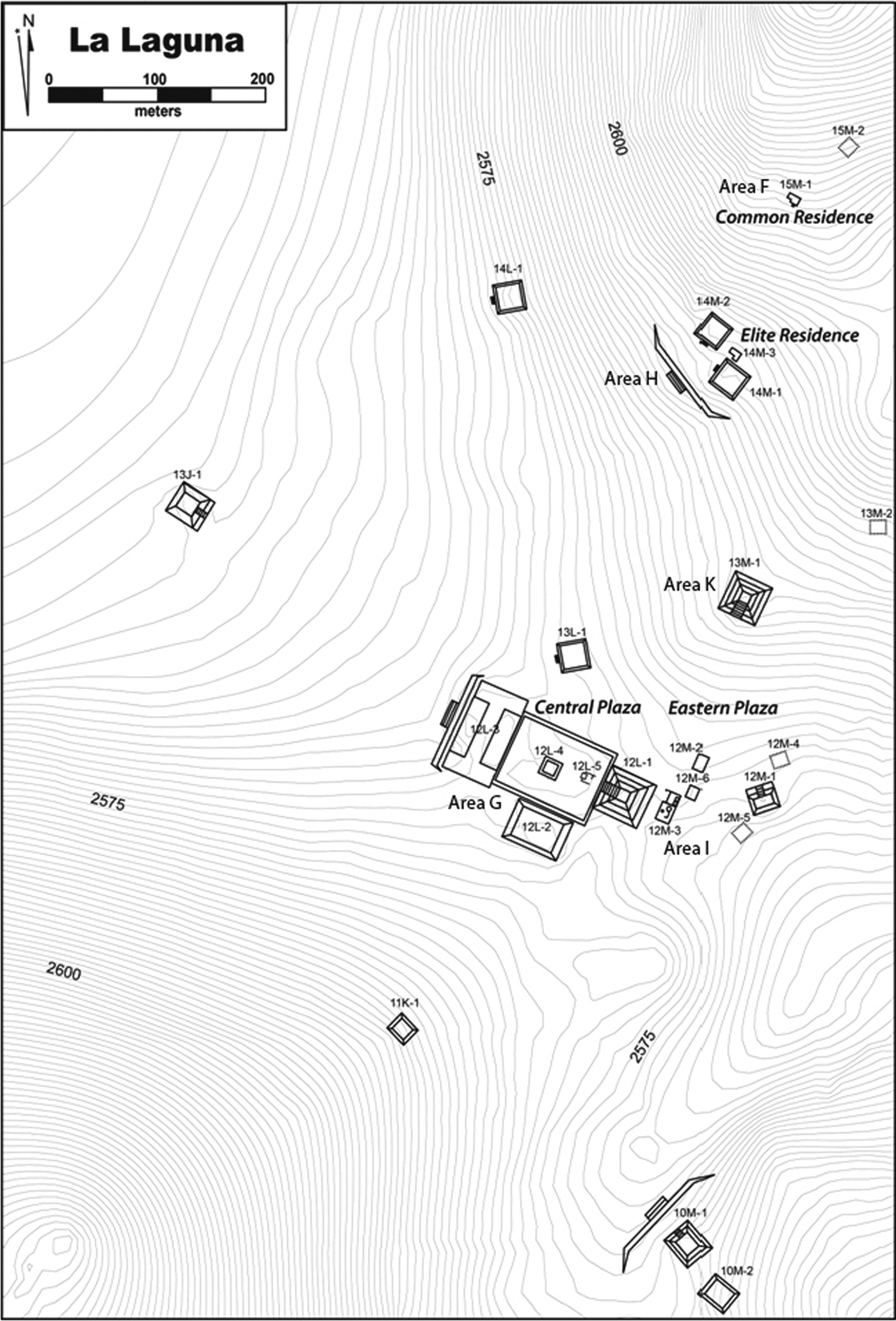
We discuss two primary sample sets in this study: a diachronic sample that includes only securely dated excavation lots (e.g., occupation floors) from the first and second occupations to ensure the greatest chronological control; and a synchronic spatial sample that combines securely dated second occupation (Terminal Formative period) contexts with other closely associated contexts such as construction fill, platform fill, and structural collapse. La Laguna's five zones of excavation were designated alphabetically as areas and they span the site center to its periphery (Figure 2).
Map of La Laguna showing the locations of excavated areas and structures discussed in the text.
La Laguna's central core (Area G) includes Structures 12L-1, 12L-3, 12L-4, 12L-5 and the central plaza. Structure 12L-1 is the site's primary temple platform. Structure 12L-3 is an I-shaped ball court located at the northwest end of the central plaza. Structure 12L-4 is a small altar located along the central plaza's centerline shared with altar 12L-5 and mound 12L-1. Radiocarbon dates for these structures are presented in Carballo (Reference Carballo2012: Table 1).
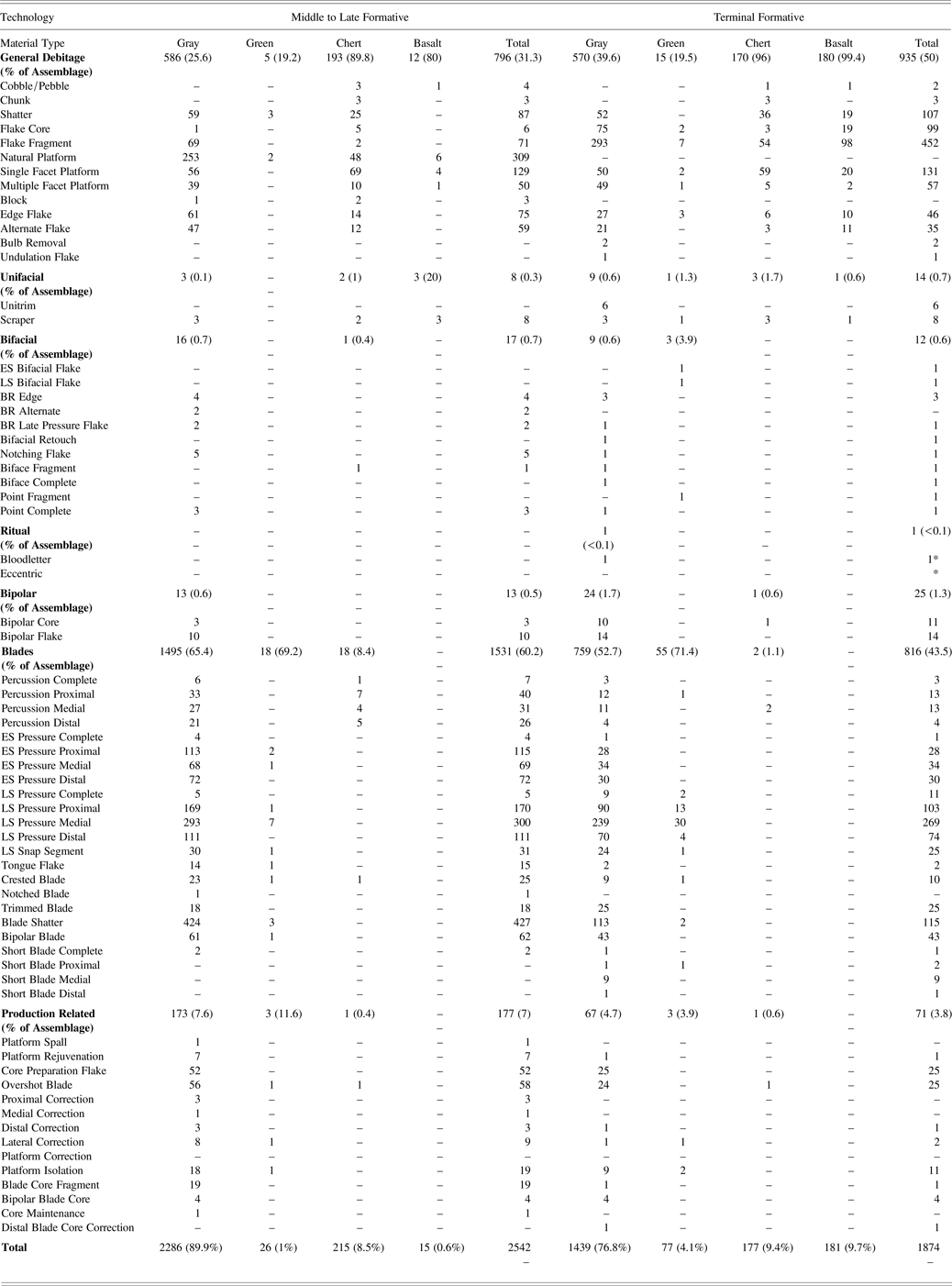
Middle to Late Formative (600–400 b.c.) and Terminal Formative (100 b.c.–a.d. 150) stone tool assemblages
*Twenty bloodletters and two eccentrics were found associated with structures.
The eastern plaza (Area I) includes Structures 12M-1, 12M-2, and 12M-3. Structure 12M-1 is a platform with evidence of three phases of expansion interspersed with seven flooring episodes. Its original construction in the mid first millennium b.c. began as a low platform containing a cremated mortuary bundle in its center, leading us to propose that Structure 12M-1 began as a residence, perhaps corresponding to a higher-status family, and later became a temple or shrine. Structure 12M-2 and deposits underneath Structure12M-3 are consistent with having been parts of a house and outdoor domestic space during the site's first occupation. During the Terminal Formative period Structure 12M-3 was used for both residential and communal purposes involving suprahousehold rituals and food storage, production, and consumption (Carballo et al. Reference Carballo, Barba, Ortíz, Blancas, Cingolani, Barrera, Walton, López and Couoh2014a).
Area K consists of Structure 13M-1, one of the site's three temple platforms similar in size to Structure 12L-1. Structure 13M-1 lacks its final occupation floor due to its highly elevated position at the site and subsequent erosion over the centuries, but excavations uncovered its penultimate floor, which dates to the Terminal Formative period.
Area H is a Terminal Formative period elite residential compound containing the residential platforms of Structures 14M-1, 14M-2, and a likely kitchen and storage facility designated Structure14M-3. Area F is located in the northeastern periphery of the site and includes both Formative-period occupation levels, with the later common residence designated Structure 15M-1 (Carballo Reference Carballo2009).
ANALYTICAL METHODS
The full PALL lithic collection (n = 36,546) was analyzed using a technological framework that mixes elements of those developed by Clark and Bryant (Reference Clark and Bryant1997) and Hirth and Flenniken (Reference Hirth, Flenniken and Hirth2006). Analyzing lithics through a technological framework requires the archaeologist to carefully categorize each individual piece of chipped stone through a defined set of macroscopically visible characteristics that have been determined by replication studies (e.g., Crabtree Reference Crabtree1968) and ethnoarchaeology. This approach contrasts more generalized analytical techniques such as mass analysis, which often involves the interpretation of lithic production activities only by size-grading the debitage. As noted by Odell (Reference Odell2000), technological approaches to lithic analysis have the advantage of creating more objective and independently verifiable means of discriminating the variables involved with lithic acquisition, production, and consumption. Technological analyses (e.g., Clark and Lee Reference Clark and Lee1979) are useful in discerning types and scales of lithic industries, knapper skill level, the local or non-local origins of tools, and other activities involving lithic distribution and consumption.
Bags of lithic artifacts grouped by excavation lots were first separated by material type and then classified based on technology. Other salient attributes such as proportions of cortex and visible use-wear were also recorded. Specific technological categories were grouped together into broader categories that represent specific industries: blades, unifaces, bifaces, bipolar, and items of likely ritual use (i.e., needles or “bloodletters” and eccentrics). General debitage includes small pieces and flake cores that did not demonstrate characteristics to warrant categorization within specific tool industries. The following analyses compare these general categories diachronically between the first and second occupations and spatially across La Laguna during the second occupation only. We refer to the first occupation as the Middle to Late Formative period assemblage and the second occupation as the Terminal Formative period assemblage.
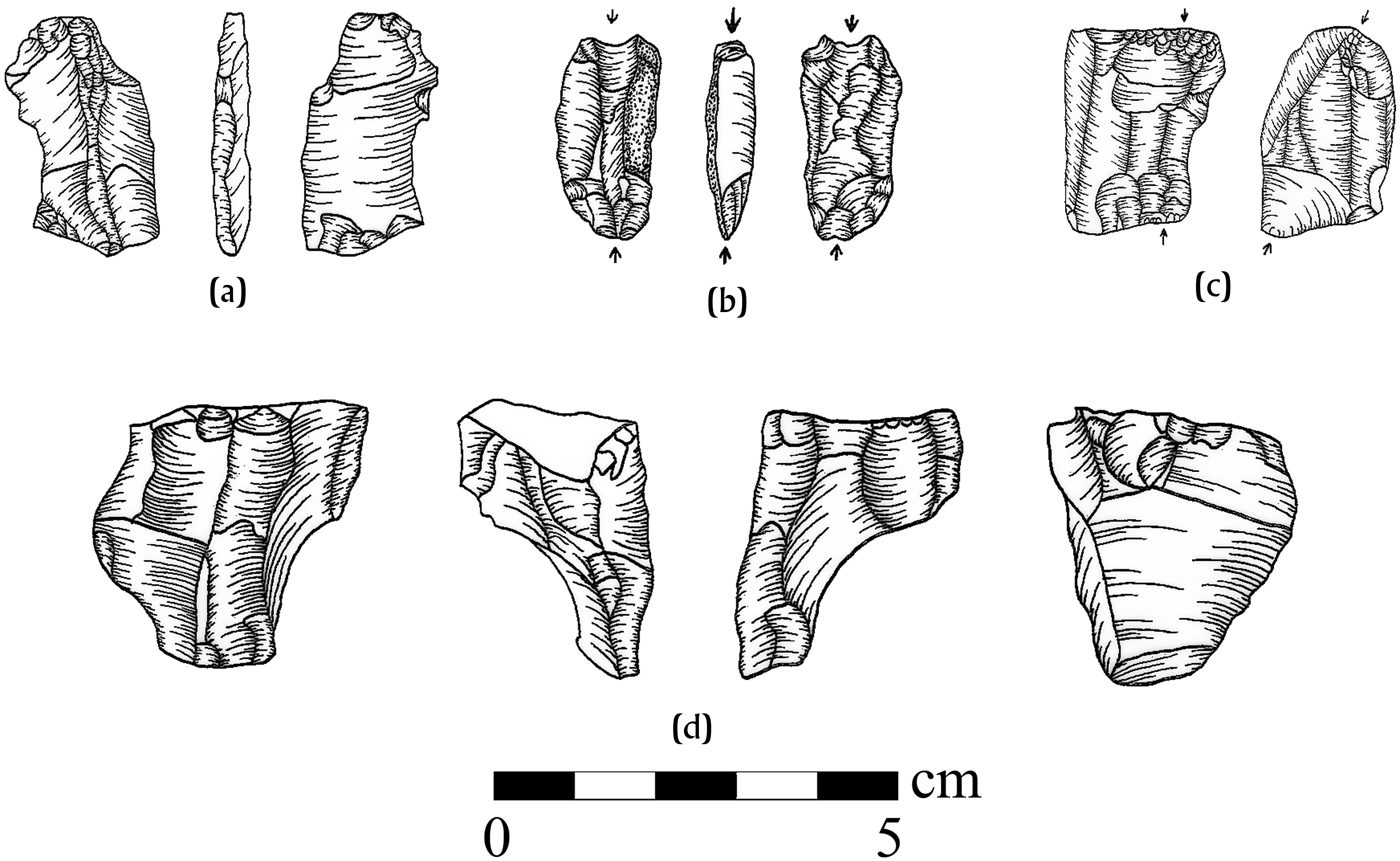
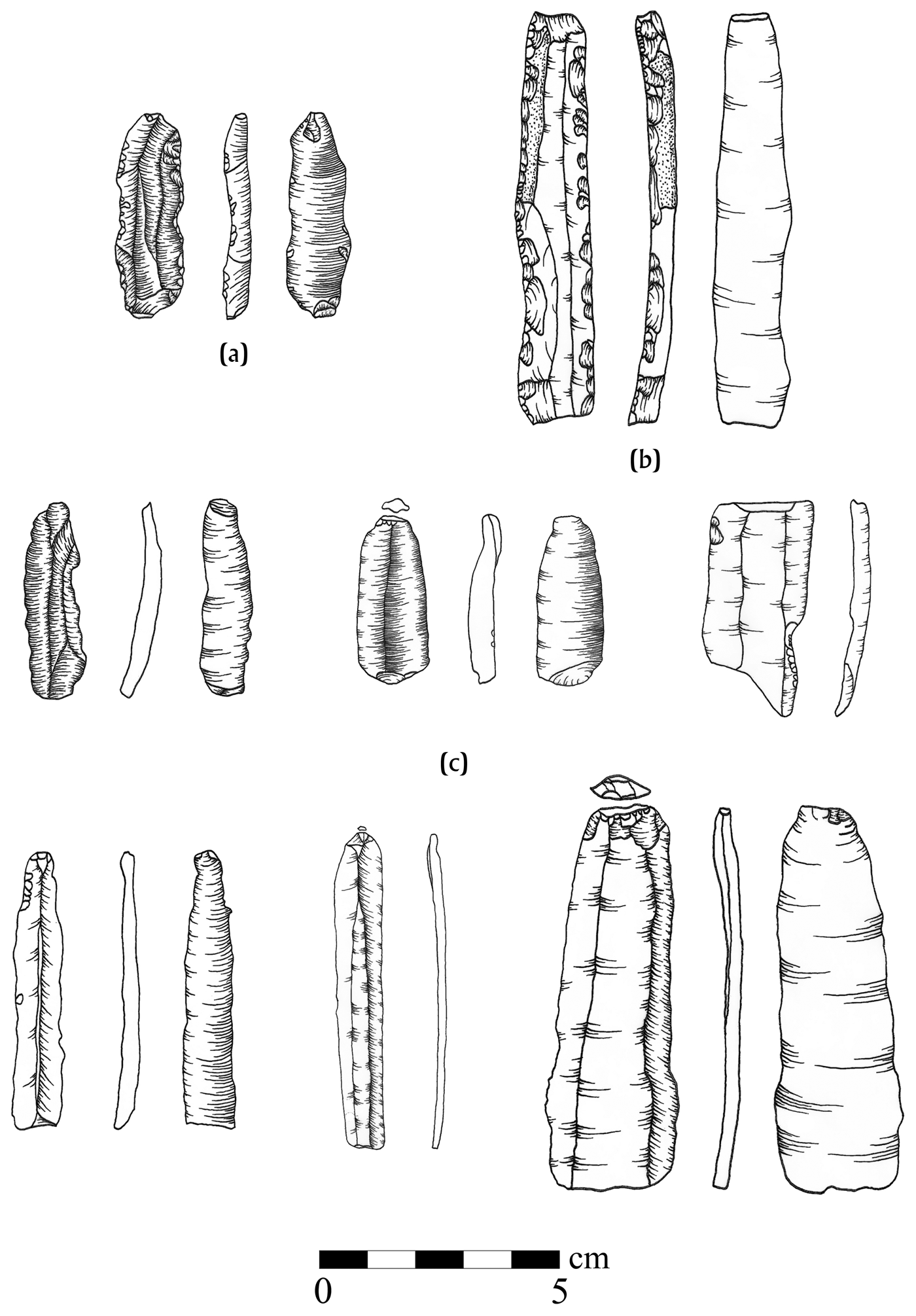
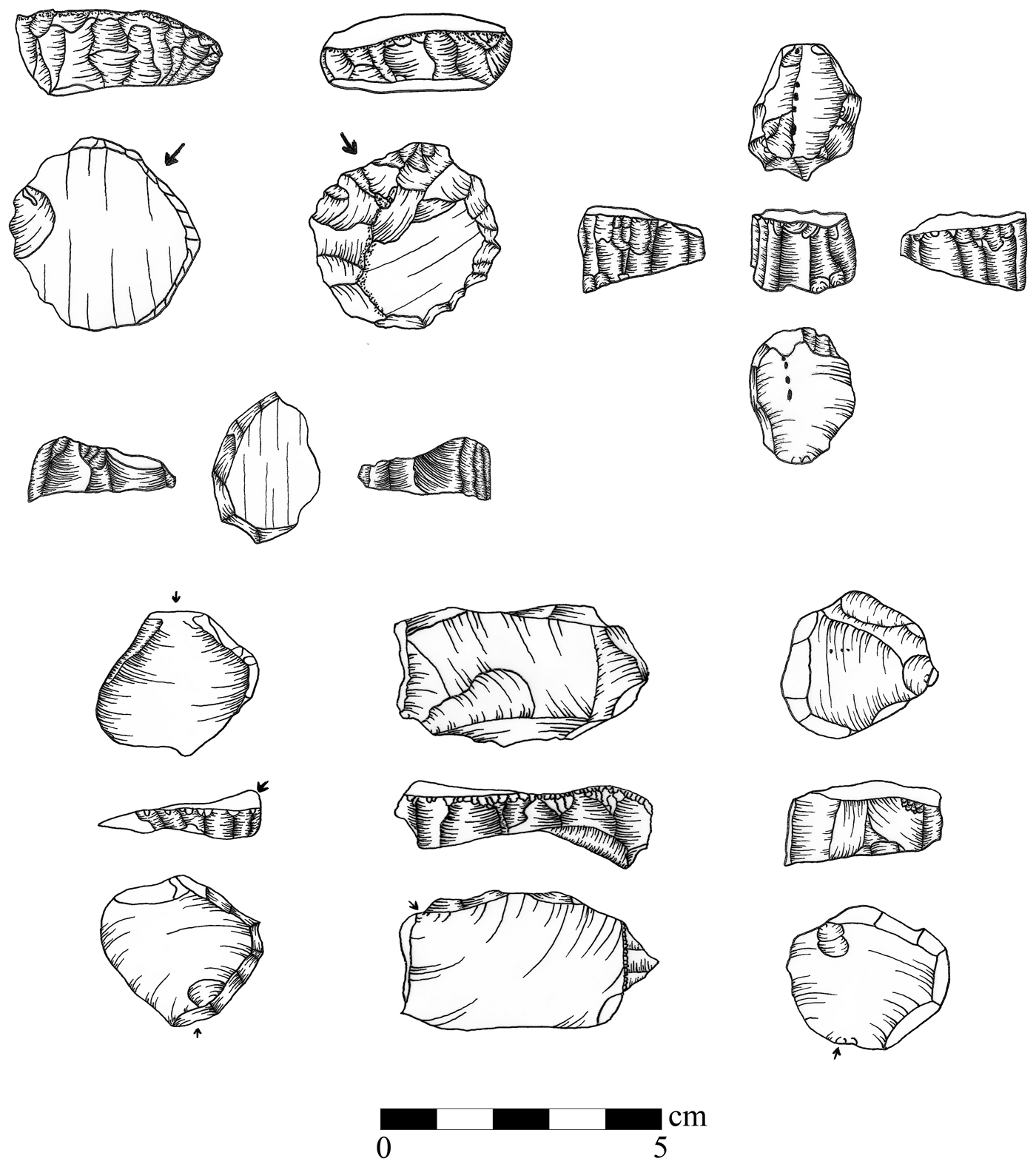
The terminology used in this article follows conventions for the Mesoamerican lithics literature (e.g., Clark and Bryant Reference Clark and Bryant1997; Hirth Reference Hirth2006). Bipolar flaking refers to the smashing of either small irregular pebbles/cobbles (Boksenbaum Reference Boksenbaum1980:20–23) or spent blade cores on anvils to recover flat flakes and angular chunks (Figure 3). In this study the bipolar industry includes pebble/cobble cores subjected to bipolar smashing as well as the resulting flakes. Blades and blade cores subjected to bipolar smashing are included in blade consumption and blade production groups, respectively.
Examples of (a-b) bipolar blades and (c-d) bipolar blade cores from Terminal Formative contexts.
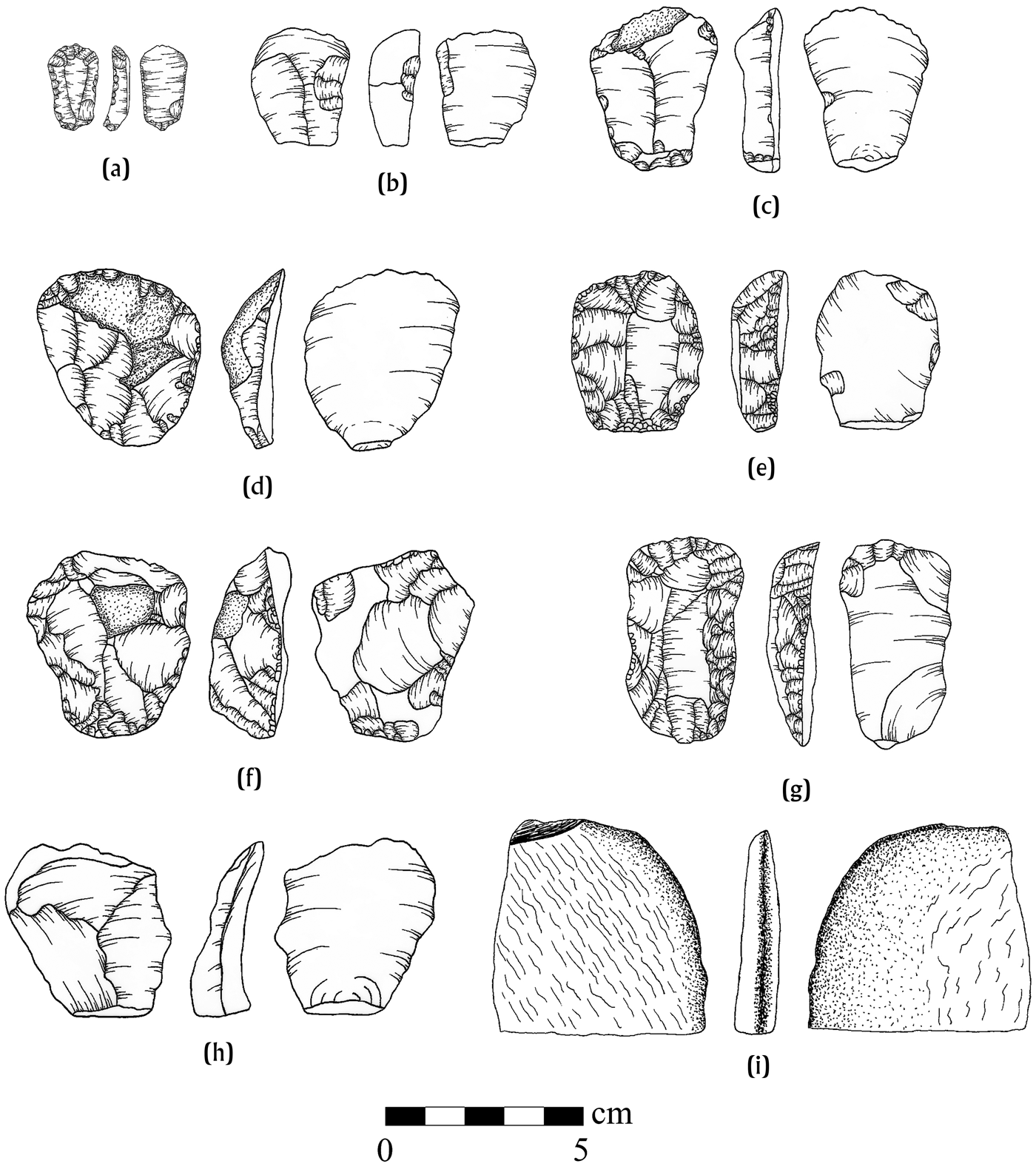
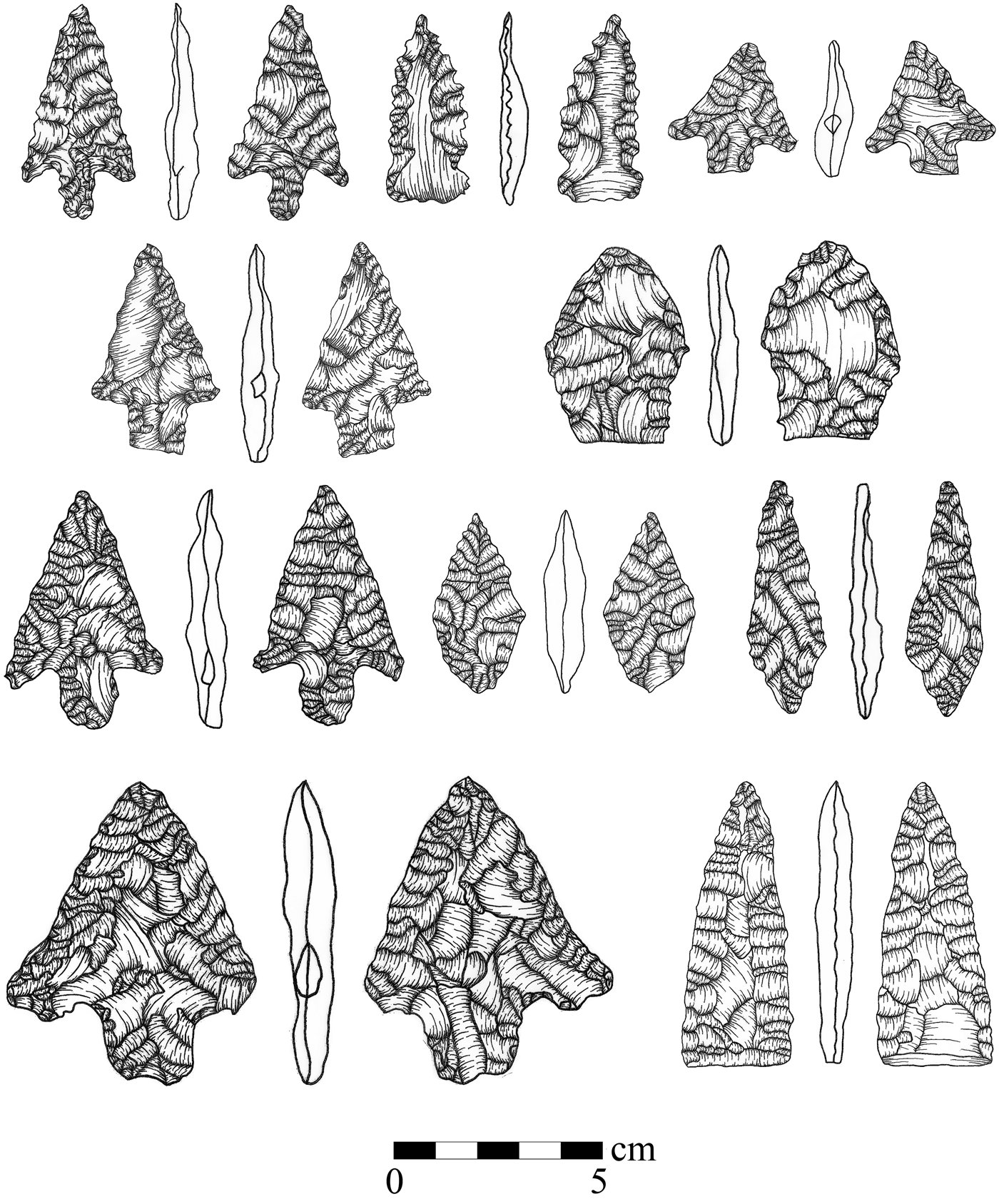
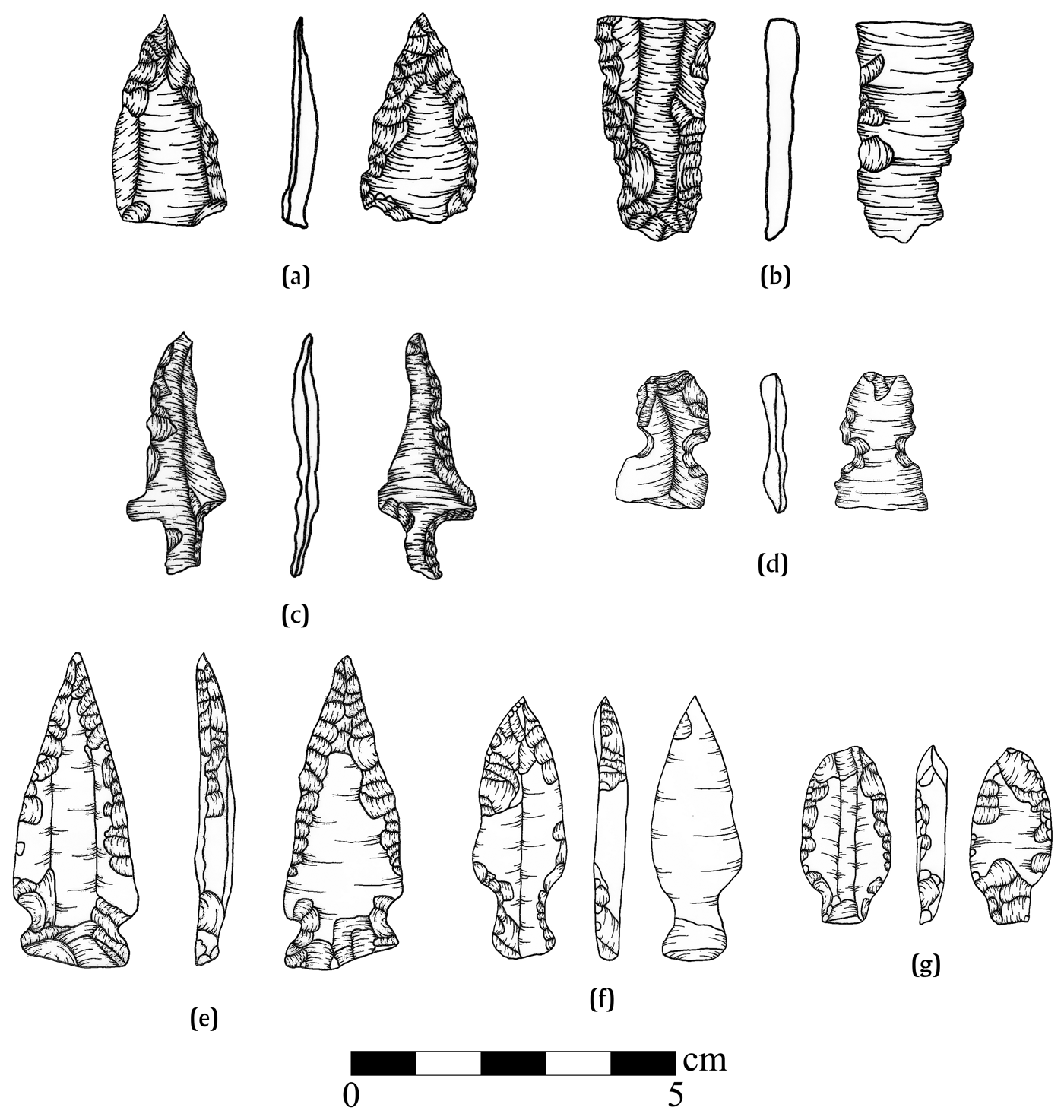
Unifacial tools include two technological categories. Scrapers at La Laguna were created from percussion flake or blade blanks using percussion trimming along one or more edges along one face or side of the material and used in a transverse motion (Figure 4). The unitrim category includes variously shaped pieces with percussion and/or pressure trimming along one side or face of the material that do not fit within established scraper types (e.g., Tolstoy Reference Tolstoy, Ekholm and Bernal1971). Bifacial tool categories include knives and complete and fragmented spear or atlatl dart points (Figure 5). Stages of bifacial tool reduction and the technical categories used in this study are outlined in Carballo (Reference Carballo2011a:87–111).
Examples of scrapers from Terminal Formative contexts including (a) a blade distal with retouch, (b-h) unifacial scrapers, (i) a fragment or trapezoidal scraper with ground edge.
Dart points and bifaces from Terminal Formative contexts.
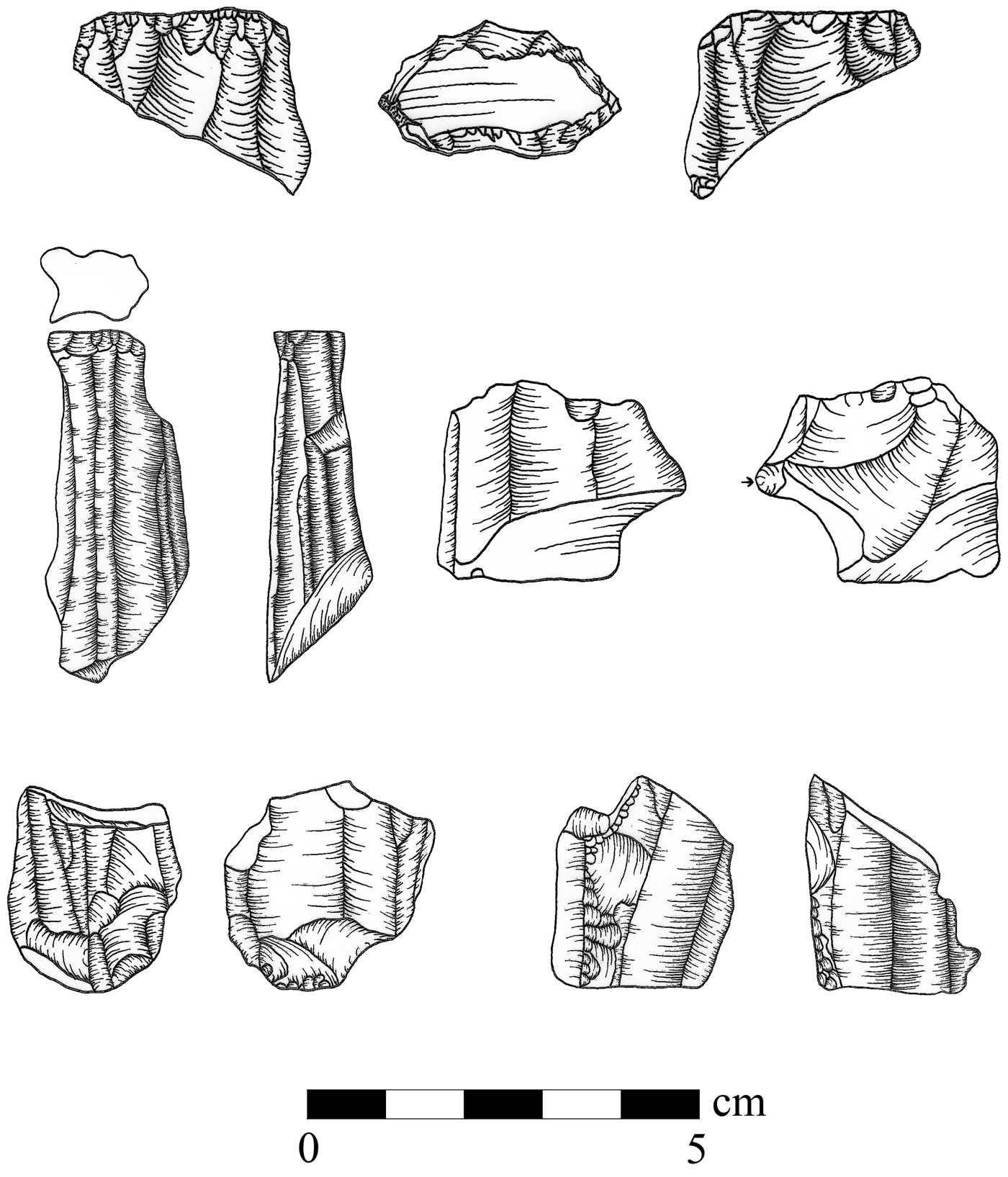
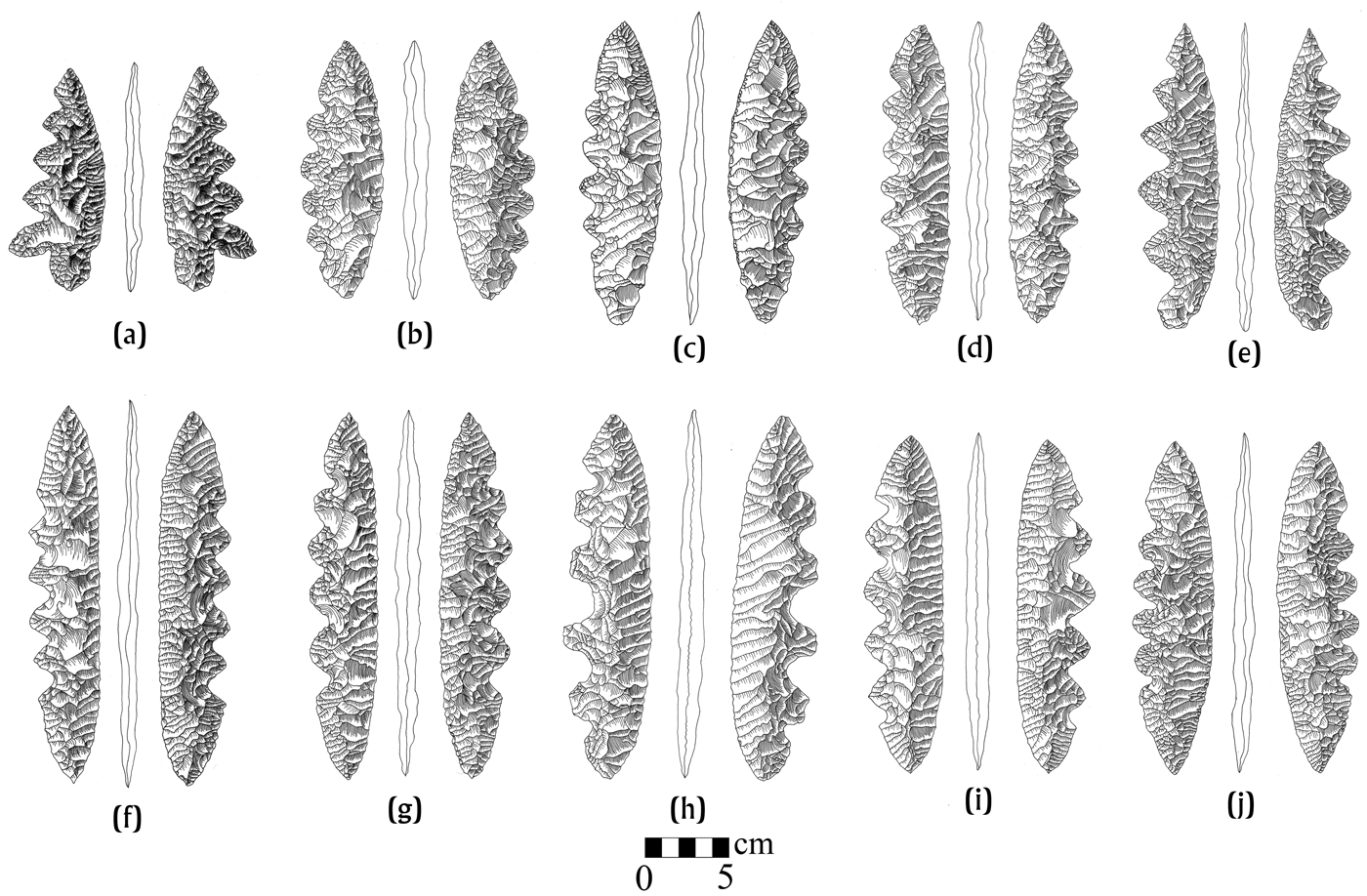
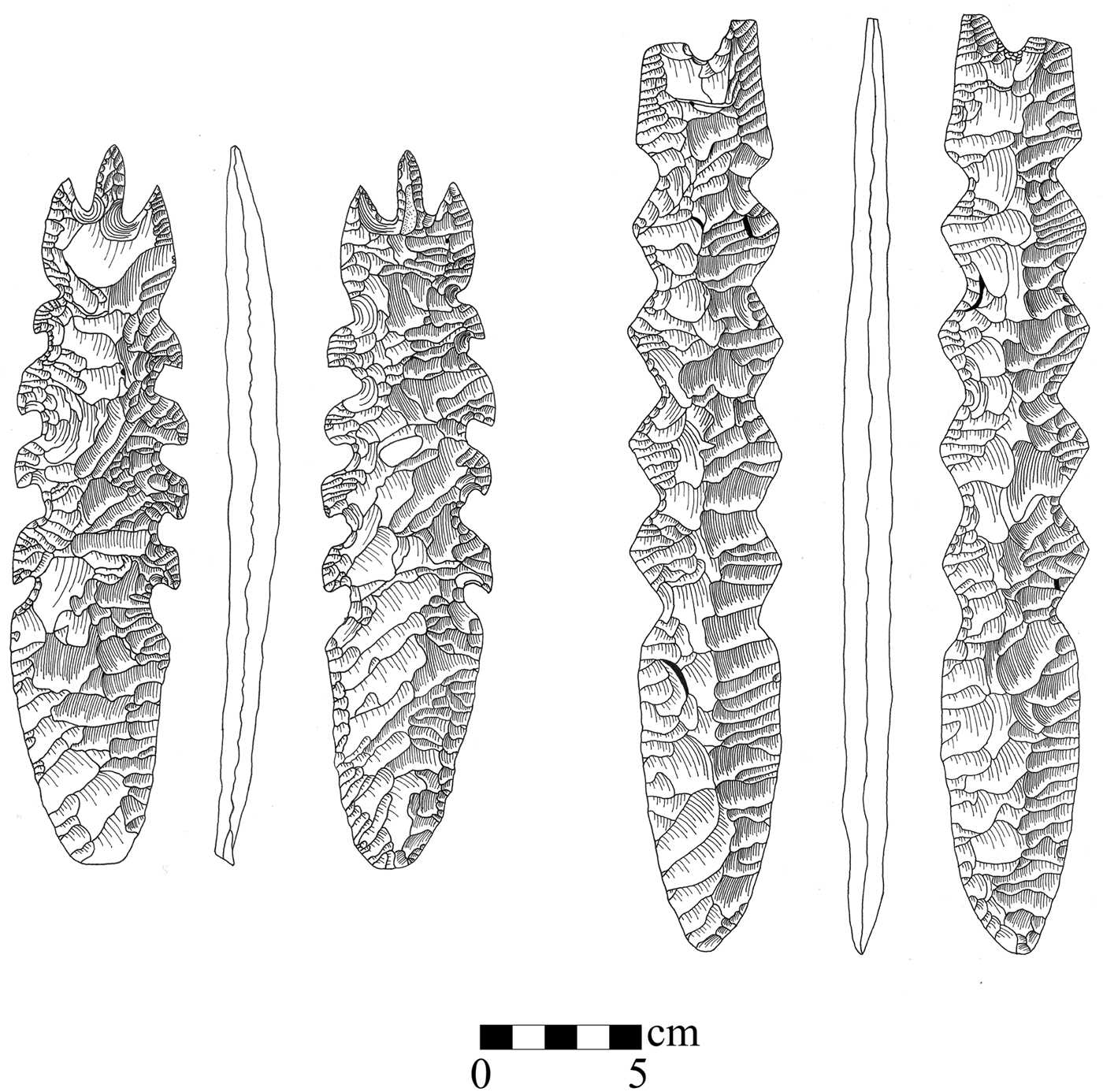
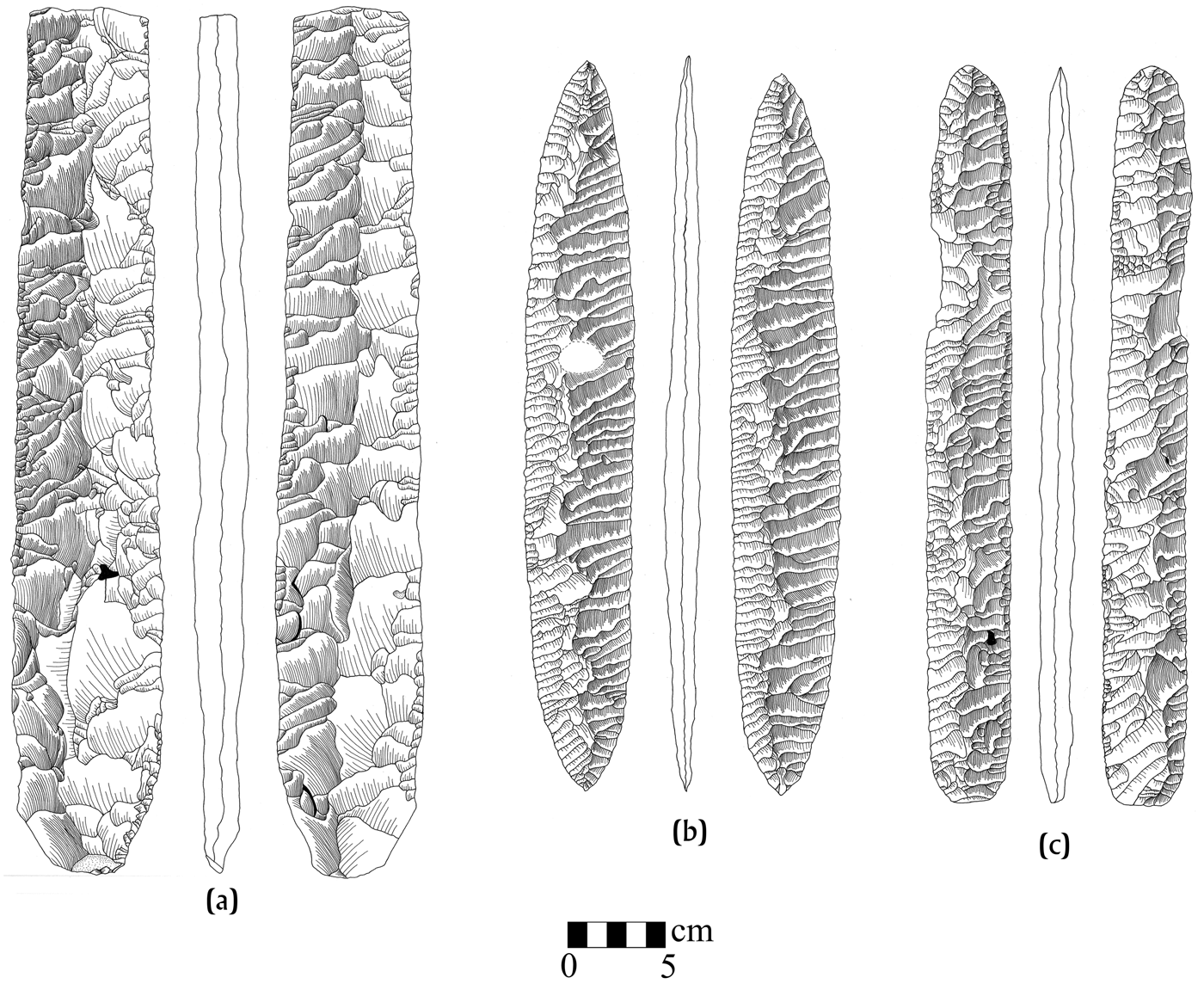
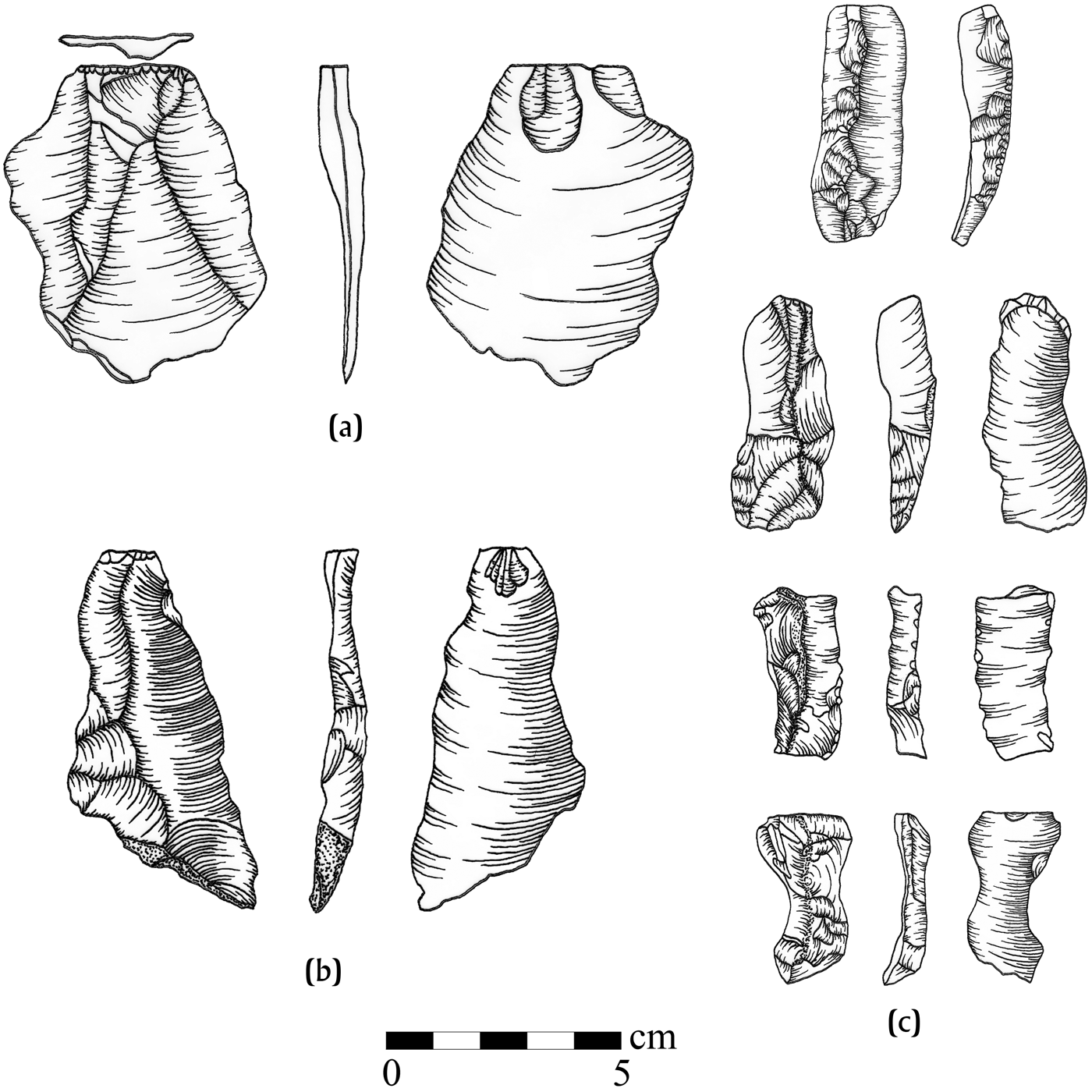
Blades are defined as sequential percussion and pressure removals, often called prismatic blades yet also including triangular detachments from cores that were occasionally worked on all sides but often only on about 60–75 percent (Figure 6 and Figure 7). Implements we interpret as bloodletters (Figure 8) are distinguished from blades in two forms: (1) fine needles with bifacial pressure retouch, and (2) fine, long, and narrow late-series pressure blades. Eccentrics are exquisitely knapped bifaces shaped into symbolic geometric, anthropomorphic, serrated (Figure 9), and zoomorphic forms (Figure 10), among others, and may be large in size (Figure 11).
Finished blade products from Terminal Formative contexts including (a) an early-series pressure blade with use-wear, (b) an early-series pressure blade with retouch and cortex, (c) six late-series pressure blades.
Blade core fragments from Terminal Formative contexts.
Fine needles, or bloodletters, with bifacial pressure retouch from Terminal Formative contexts.
The (a) serrated point and (b-j) nine serrated knives from Feature 173 at Structure 12L-1.
Zoomorphic eccentrics from Feature 173 at Structure 12L-1.
The (a, c) large bifaces and (b) bipointed knife from Feature 173 at Structure 12L-1.
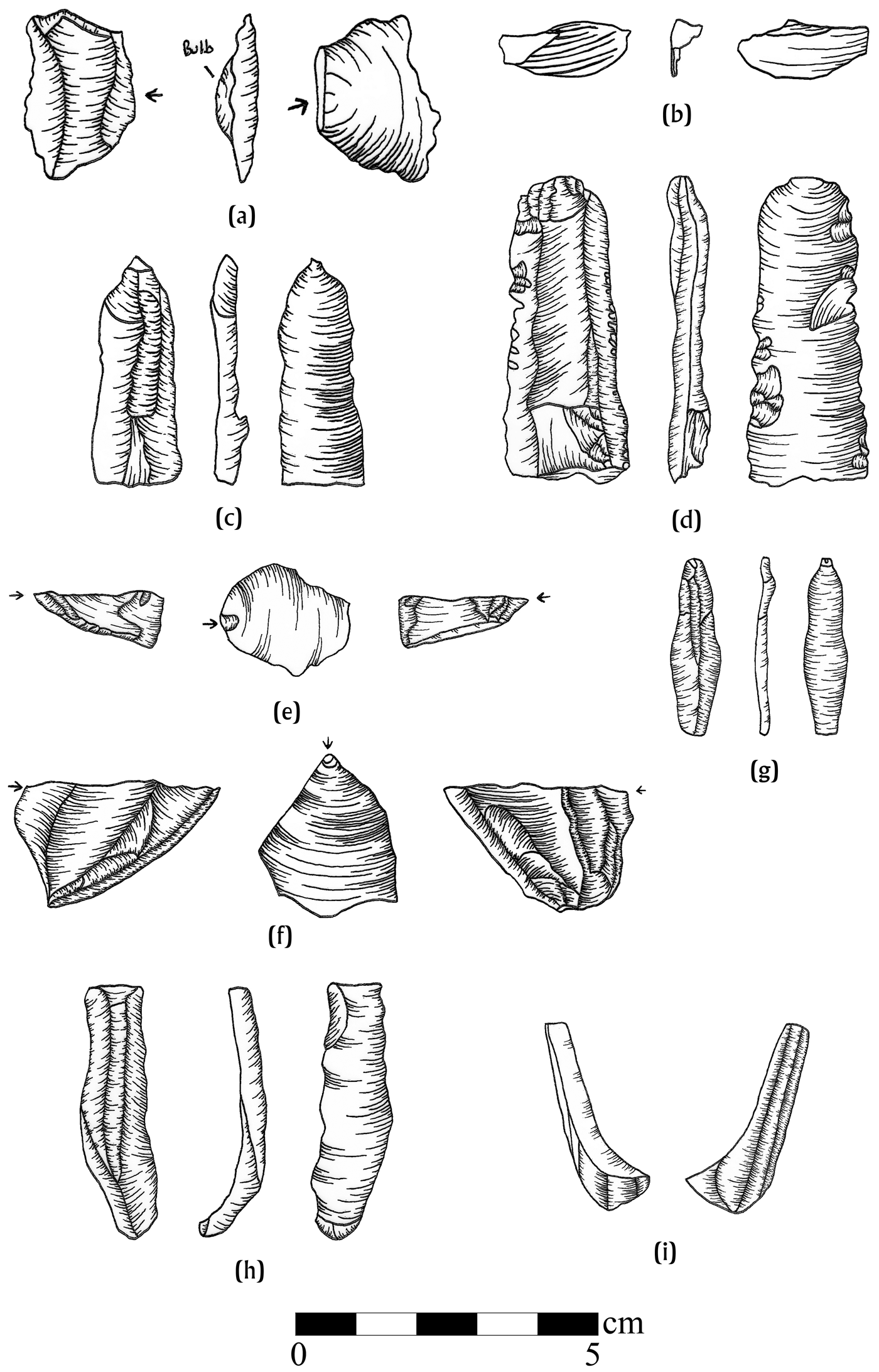
Knappers performed specific strikes or maneuvers to maintain functional blade cores and compensate for errors in the blade making process (Figure 12). The blade production industry in this study includes blade cores as well as these types of core shaping and maintenance maneuvers. One of the most common forms of core maintenance was platform rejuvenation, which entails the lateral removal of a core's platform and the simultaneous production of a new platform on the core designed to maintain a proper platform-to-core face angle (Figure 13). Platform isolation elements created with pressure tools helped to maintain a core's platform by keeping the edge flush with the face of the core (Figure 12g). A distal blade core correction refers to a lateral strike on a core's distal end in order to rejuvenate a core from the negative effects of overshot blades (Figure 12f).
Evidence for local blade production from Terminal Formative contexts including (a) a lateral rejuvenation flake, (b) a tongue flake (or languette flake), (c) a proximal rejuvenation blade, (d) an early-series pressure blade with evidence of lateral rejuvenation, (e) a distal rejuvenation flake, (f) a core distal rejuvenation flake, (g) a platform isolation element, (h-i) overshot blades.
Examples of platform rejuvenations from Terminal Formative contexts.
Two types of errors in the blade-making process included overshot blades and hinge fractures on cores. Overshot blades, also called plunging blades, were distal sections that continued beyond their intended point of termination and removed part of the distal end of the core (Figure 12h and 12i). Hinges on cores were removed in different ways. A lateral rejuvenation refers to a flake designed to remove a hinge that has dorsal surfaces perpendicular to its own line of force visible on its ventral surface (Figure 12a and 12d). A proximal rejuvenation refers to a flake or blade with evidence of a hinge fracture on its dorsal surface removed by percussion from a prismatic core (Figure 12c). A medial rejuvenation flake is produced when a pressure tool is placed directly on a hinge—making the hinge a platform—and used to remove the remainder of the intended blade, which produces a new bulb of pressure on the flake. A direct rejuvenation technique refers to hinge removal by pecking and abrading. Distal rejuvenation can be a one or two-step process where a flake or blade is driven from the distal end of the core designed to intersect and remove a hinge (Figure 12e).
DIACHRONIC VARIABILITY
La Laguna's Middle to Late Formative period (600–400 b.c.) assemblage contains gray (89.9 percent) and green (1 percent) obsidian, chert (8.5 percent), and basalt (0.6 percent) (Table 1). Gray obsidian is prevalent in general debitage categories and it was used to make blades, unifacial scrapers, bipolar tools, and bifaces. The extremely scarce green obsidian is primarily present in the form of finished blades. La Laguna's chert artifacts constitute about the same percentage as non-obsidian artifacts in the Tlatilco refuse, which is about half of the percentages of quartz family artifacts at El Arbolillo and Zacatenco during the Middle Formative period (ca. 850–400 b.c.) (Tolstoy Reference Tolstoy, Ekholm and Bernal1971:272). Chert at La Laguna is common in general debitage yet low in blade production-related categories. Complete chert tools include blades and unifacial scrapers. Basalt was worked exclusively to produce unifacial scrapers, evidenced in finished trapezoidal tools and edge-preparation flakes. Expedient bipolar tools, dart points, and other bifacial tools appear to have been very minor industries during the first occupation. The Middle to Late Formative assemblage also lacks distinguishable tool forms likely used in ritual activities such as bloodletters and eccentrics. Overall, the assemblage exhibits a wide variety of tool forms, high counts of blade production debris, and finished blades. Compared to the Terminal Formative assemblage, the Middle to Late Formative assemblage contains slightly higher proportions of crested blades, percussion blades (Figure 14), and early-series pressure blades relative to late-series pressure blades, while the Terminal Formative assemblage has a slightly higher proportion of late-series pressure blades.
Evidence for local blade production from Terminal Formative contexts including (a) a core shaping macroflake, (b) a percussion blade with cortex, and (c) four crested blades.
De León et al. (Reference De León, Hirth and Carballo2009:119) present models for identifying whole-blade trade, processed-blade trade, or local on-site blade production in lithic analysis by comparing ratios of late-series pressure blade proximal to distal segments and late-series pressure blade medial to distal segments. The Middle to Late Formative late-series blade proximal-distal ratio is 1.5:1, and the late-series medial-distal ratio is 2.7:1. These models also consider the presence or absence of primary and/or secondary production evidence (De León et al. Reference De León, Hirth and Carballo2009:114), which together comprise the technological categories included in the blade production industry group for this study. Therefore, the Middle to Late Formative assemblage fits their expected model for local on-site blade production.
La Laguna's Terminal Formative period assemblage, representing the second occupation, also contains gray (76.8 percent) and green (4.1 percent) obsidian, chert (9.4 percent), and basalt (9.7 percent), though in different proportions from the early occupation (Table 1). Gray obsidian is prevalent in general and blade production debitage categories and it was used to manufacture blades, unifacial tools and scrapers, bifacial implements such as dart points, bipolar tools, and bloodletters and knives used in ritual activities. Green obsidian is scarce in general debitage and in blade production debitage categories and it is primarily present in the form of finished products. During the Terminal Formative period green obsidian was also used for unifacial scrapers and dart points. The higher percentage of green obsidian is mostly the result of increased complete blade importing of Pachuca source material, and these blades may have been manufactured at the quarry or at an intermediate site. Chert is most common in general debitage categories, but compared to the Middle to Late Formative assemblage it was used less for blades and more for unifacial scrapers, along with basalt, during the Terminal Formative.
Overall, the Terminal Formative assemblage contains more tool forms than the Middle to Late Formative assemblage. New tool forms include bloodletters and eccentrics. The Terminal Formative assemblage indicates slight increases in bipolar tool quantity and unifacial tool form variety. The technological range of percussion and pressure blade products, blade cores, and core shaping and maintenance debris is observable, but there are slight decreases in the percentages of blades and production debitage in the Terminal Formative assemblage. However, these decreases are exaggerated by the way in which the data were aggregated, since we exclude excavation lots from construction fill, in order to maintain chronological control, and such contexts are where production debris and exhausted blades were often disposed. Late-series pressure blades are more prominent than percussion and early-series pressure blades. Bifacial tools remained a relatively minor industry during Terminal Formative occupation as they were during the Middle to Late Formative occupation.
The Terminal Formative late-series blade proximal-distal ratio is 1.4:1, and the late-series blade medial-distal ratio is 3.6:1. Combining these ratios with the presence of whole blades and primary and secondary production evidence, the Terminal Formative assemblage fits the expected model for local on-site blade production with the caveat that green obsidian was imported as whole blades. Knapper skill levels can be measured by several ratios including overshot blade to distal segment occurrence (Hirth and Andrews Reference Hirth, Andrews and Hirth2006). The error rate for overshot blade occurrence is lower in the Terminal Formative assemblage (34 percent) compared to the Middle to Late Formative assemblage (52 percent), which may indicate the improvement of blade removal techniques over time.
SYNCHRONIC VARIABILITY AND USAGE
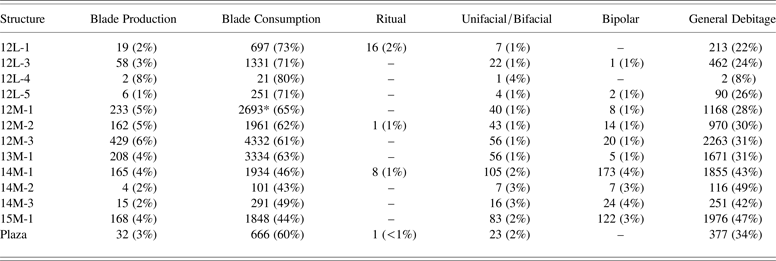
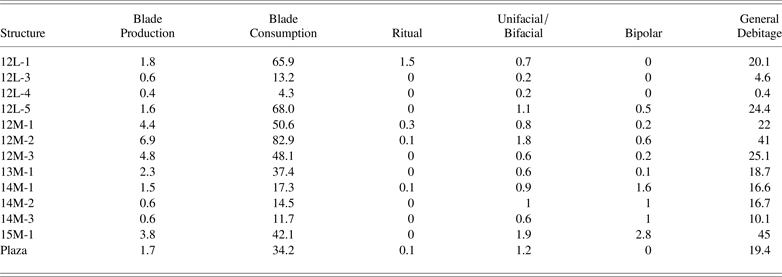
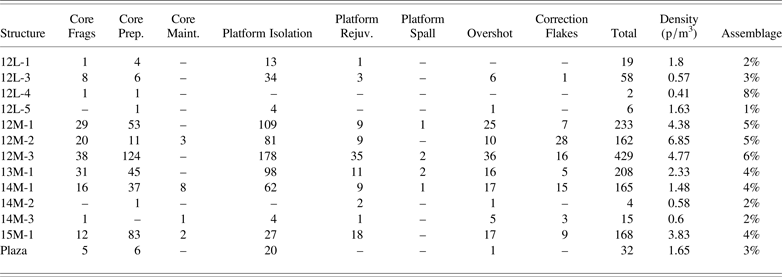
The PALL dataset speaks best to the production and use of stone tools during the Terminal Formative occupation at La Laguna because this later occupation resulted in more accessible, superficial deposits that can be more confidently associated with structures. The lithic assemblages from a variety of structures enable us to identify production zones, areas of use and consumption, and locations of ritual activity. Table 2 presents the assemblage of each structure divided into the categories of blade production, blade consumption, ritual use, unifacial/bifacial production and consumption, bipolar production and consumption, and general debitage. Table 3 displays the density (piece per m3 of excavated sediment) for each technological category.
Terminal Formative (100 b.c.–a.d. 150) stone tool technological counts and assemblage percentages organized by structures
*Includes 14 possible bloodletters
Terminal Formative (100 b.c.–a.d. 150) stone tool densities (piece per m3) organized by structure and technological category
Production Zones
Blade production densities and raw counts (Table 4) indicate a primary blade production zone in the eastern plaza associated particularly with Structure 12M-3. Debris from this production zone may have also been included in construction and platform fill at the nearby temple mounds (Structures 12M-1 and 13M-1). Structure 12M-3 has the most blade core fragments, core preparation and maintenance flakes, platform isolation elements, platform rejuvenations, and overshot blades of any structure at La Laguna (Table 4). Structure 12M-2 has the most specialized correction flakes designed to compensate for errors in the blade-making process. Intensive blade production within the eastern plaza was accompanied by less intensive bipolar and bifacial tool production. The presence of a gray obsidian bloodletter fragment with fine pressure retouch along one edge at Structure 12M-2 may indicate that the eastern plaza was an area at which the production of tools used in rituals primarily elsewhere across the site was undertaken (we will return to this point). Large gray and green obsidian macrocore fragments similar in size to the ceremonial bifaces (discussed below) were found in small quantities exclusively at Structure 12M-3, which may indicate that Structure 12M-3 residents or knappers acquired macrocores by either independent procurement or through greater purchasing power in the regional exchange system. Structure 12M-3 distinctively lacks a comparably high density of greenstone (Carballo et al. Reference Carballo, Carballo and Lesure2014b:471) and architectural investments or embellishments that characterize the elite residence at Area H (Carballo Reference Carballo2009:494–496), which favors the interpretation of independent procurement over greater purchasing power.
Terminal Formative (100 b.c.–a.d. 150) blade production evidence organized by structure
Secondary blade production zones are suggested at the elite residence in Area H (Structures 14M-1, 14M-2, and 14M-3) and at the commoner residence in Area F (Structure 15M-1). The quantities of blade production debris from Areas F and H are quite similar with a few small differences. Area F contains fewer cores but slightly more platform rejuvenations and over twice the core preparation flakes as Area H, which has over twice the platform isolation elements and specialized correction flakes as Area F. The implications are that the inhabitants of Area F undertook more initial core preparation work than the inhabitants of Area H. Inhabitants of both areas had access to some green obsidian, and the elite household has only a marginally higher density than the commoner household. Sufficient blade production evidence exists at both areas to suggest that each household produced its own stone tools, however production may have been linked between households (e.g., Feinman et al. Reference Feinman, Nicholas and Haines2002). Another notable feature of stone tool production at Areas H and F is a larger focus on the production of bipolar tools compared to the eastern plaza. Structures 14M-1 and 15M-1 have the highest counts and percentages of bipolar tools in their assemblages by a large margin (Table 2). Structures 14M-1 and 15M-1 also have slightly higher counts and percentages of unifacial and bifacial production debris and finished tools compared to the rest of the site. Overall, the assemblages suggest decentralized, domestic production with one example of centralized, communal production focused primarily on blades.
Areas of Use and Consumption
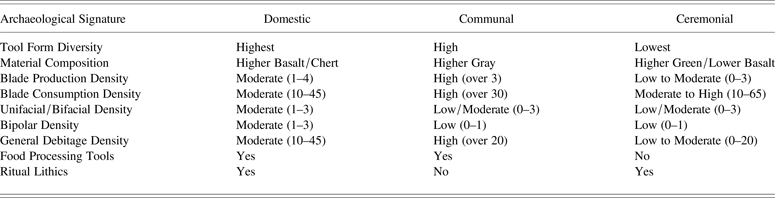
Determining how people used and consumed stone tools is just as important as identifying production areas for enhancing our overall understanding of ancient economies. Walton was recently awarded funding for a diachronic high power use-wear study, and the results from this project will provide clarity on the versatile or specific applications of obsidian tool forms in central Mexico over time. Here we outline how the residents of Terminal Formative period La Laguna used stone tools in domestic, communal, and ceremonial contexts based only on distributions of tool forms. We identify prevailing domestic, communal, and ceremonial consumption patterns (Table 5) based on the comparison of lithic assemblages grouped by structures (Tables 2 and 3). The lithic dataset on its own suggests intrasite variability, but distributions of other artifact types such as lapidary and personal adornment items also reflect these variable activity patterns (Carballo et al. Reference Carballo, Carballo and Lesure2014b).
Archaeological signatures for domestic, communal, and ceremonial consumption patterns based on Terminal Formative (100 b.c.–a.d. 150) lithic assemblages. Densities are measured in pieces per m3
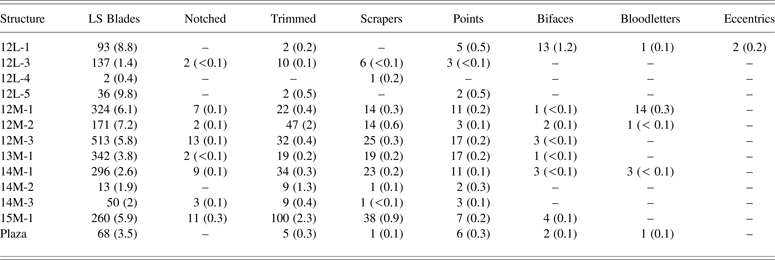
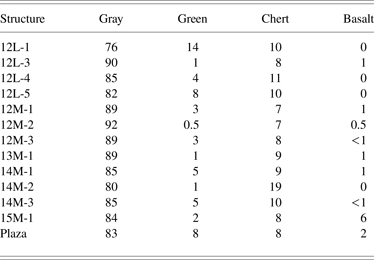
Locations where domestic consumption patterns prevail include Area H (Structures 14M-1, 14M-2, and 14M-3) and Area F (Structure 15M-1). Domestic patterns are distinguished by moderate densities of blade production (1–4 per m3), blade consumption (from 10–45 per m3), general debitage (from 10–45 per m3), bipolar (1–3 per m3), and bifacial/unifacial production and use (1–3 per m3) (Table 3). Domestic patterns contain a wide range of tool forms and types of production debris, which characterize the prevalent Mesoamerican household economic strategy of multicrafting (Hirth Reference Hirth2009). Domestic patterns have ample evidence for tools used in food processing (e.g., blades, notched and trimmed blades, unifacially trimmed tools, and scrapers) and expedient bipolar tools used for utilitarian tasks. At La Laguna one of the most diagnostic tools used in food processing is the unifacial scraper. Chipped obsidian and chert scrapers were likely used to scrape maguey hearts to extract sap for pulque production, and rectangular basaltic scrapers were likely used to scrape leaves to extract fibers (Figure 9) (Parsons and Parsons Reference Parsons and Parsons1990; Smith Reference Smith2011). Structure 15M-1 has the most scrapers (n = 38) and highest density of scrapers (0.9 per m3) of any structure at La Laguna. Other domestic contexts have densities of scrapers ranging from 0.2–0.6 pieces per m3 (Table 6). Structure 15M-1 also has the highest densities of notched (0.3 per m3) and trimmed (2.3 per m3) blades of any structure at the site. The presence of bloodletters in Area H likely relates to the higher status of the occupants and their different ritual practices (Table 6). The proportions of materials used in domestic contexts (Table 7) generally reflect La Laguna's overall pattern: around 85 percent gray obsidian, 5 percent or less green obsidian, less than 10 percent chert, and 1 percent basalt. However, Structure 15M-1 has the largest percentage of basalt (6 percent) of any structure at the site. Basalt was used primarily for making unifacial scrapers and grinding tools for maize processing.
Terminal Formative (100 b.c.–a.d. 150) finished tool counts and densities (piece per m3) organized by structure
Terminal Formative (100 b.c.–a.d. 150) material percentages for assemblages organized by structure
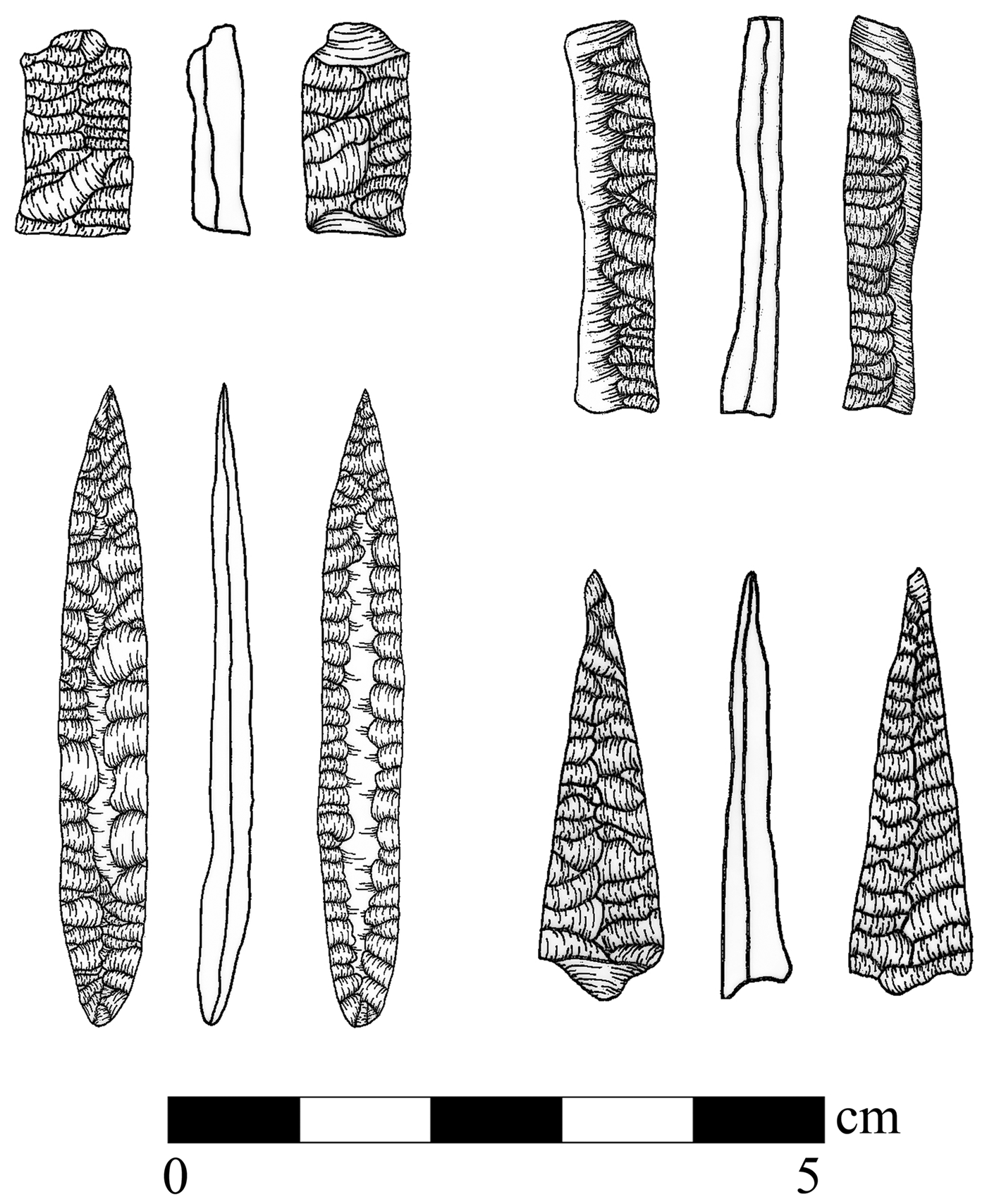
Communally focused activities of food production and consumption took place at Structure 12M-3 (outlined in Carballo et al. Reference Carballo, Barba, Ortíz, Blancas, Cingolani, Barrera, Walton, López and Couoh2014a). The eastern plaza as a whole is distinguished by: (1) high densities of blade production (over 3 per m3), blade consumption (over 30 per m3), and general debitage (over 20 per m3); (2) low (0–1 per m3) to moderate (1–3 per m3) densities of unifacial and bifacial production; (3) low densities of bipolar production and use (0–1 per m3); and (4) a general absence of lithics of suspected ritual use (Table 3). Activity patterns we are designating communal resulted in higher percentages of blade production and consumption and more tool forms compared to activity patterns we identify as ceremonial, but less tool forms compared to those patterns that are clearly the result of domestic activities (Table 2). Structure 12M-2 has the highest blade consumption density (82.9 per m3) and Structure 12M-3 also has a high density (48.1 per m3) (Table 3). The assemblage from the eastern plaza contains various types of tools used for food production. For example, Structure 12M-3 has 25 scrapers and Structure 12M-2 (with an excavation volume less than one-third of Structure 12M-3) has 14 scrapers (Table 6). The densities of notched and trimmed blades for both structures are also comparable to domestic activity patterns indicating at the very least equal levels of stone tool use related to food processing. Higher amounts of complete and fragmented dart points (Table 6 and Figure 10) without evidence of burning or rapid destruction at the time of abandonment (as we see in Area H) may suggest that dart points were stored in the eastern plaza. The production of miniature dart points from late-series blades involving notching and trimming is also observable from the eastern plaza assemblage (Figure 15). Overall, the predominant activities reflected in La Laguna's communal pattern seen in the eastern plaza were blade production and consumption. The prominent use of gray (90 percent) and green (2 percent) obsidian compared to the lower use of chert (8 percent) and basalt (less than 1 percent), which were used in higher percentages in domestic contexts, reflects a technological focus on blade production in the eastern plaza because the internal structure of obsidian is more conducive than either chert or basalt to systematic pressure blade removal.
Terminal Formative (a-b) trimmed blades, (c-d) notched blades, (e-g) blades worked into miniature points.
Locations with ceremonially focused activities at La Laguna include Area G (the central precinct), Structure 13M-1, and Structure 12M-1. Ceremonially focused activities are distinguished by the following characteristics in the lithic assemblage: (1) low percentages of blade production and general debitage categories (Table 2); (2) low (0–1 per m3) to moderate (1–3 per m3) densities of blade production and unifacial/bifacial production debris and finished tools; (3) primarily low (0–10 per m3) but occasionally moderate (due to construction fill contexts at temple platforms, 10–20 per m3) densities of general debitage; (4) low (0–1 per m3) densities of bipolar production and consumption; and (5) the presence of lithic implements likely used in rituals. Construction fill contexts for structures in close proximity to blade production and crafting zones and variability in ritual activities are factors that may create variability in blade production and consumption densities for structures within locations of ceremonial activities. For example, Structure 12L-1 is proximate to the eastern plaza production areas, lithic implements were used in rituals at this structure (we discuss the details in the following section), and it has a blade consumption density of 65.9 per m3. In contrast, Structure 12L-3 (ball court) is located at the opposite end of the central precinct farther away from blade production and commercial zones and it has a blade consumption density of 13.2 per m3. It is therefore important to not isolate lithic density analyses alone for reconstructing community economies. Lithic assemblages in locations consistent with ceremonial activities, based on other lines of evidence, have the lowest variety of tool forms and an overall prevalence of finished products (e.g., blades, bloodletters, eccentrics, bifaces, and dart points). For example, the central precinct contained few notched blades, trimmed blades, and scrapers compared to other locations of the site where they designate food processing areas (Table 6). Another archaeological signature for ceremonial activity is a relatively high percentage of green obsidian and a low percentage of basalt compared to other consumption patterns across the site. For example, Structure 12L-1 lacks basalt and has the highest percentage of green obsidian (14 percent) followed by the nearby altar at Structure 12L-5 and the central plaza (both 8 percent) (Table 7). Yet the best line of evidence that La Laguna's dataset offers for the distinguishing of ceremonial activities and ritual economies is the distribution of finished implements used in rituals.
Locations of Ritual Activities
The distribution of bloodletters (n = 20) and of large bifaces and eccentrics (n = 15) is suggestive of ritual activities involving obsidian at Structures 12L-1, 12M-1, 12M-2, 14M-1, and the central plaza. One of the purposes of bloodletting in ancient Mesoamerica was as part of rituals intended to communicate with ancestors and supernatural entities (Plunket Reference Plunket2002). This may explain the fact that the largest concentration of fine-blade type bloodletters was found at Structure 12M-1, which contained the cremated burial placed within the first occupation floor. In the realm of the living, bloodletting was more associated with elite domestic spaces, such as Structure 14M-1 which has the largest concentration of fine-retouch type bloodletters, and public ceremonial spaces, such as Structure 12L-1 and the central plaza which both have one fine-retouch type bloodletter.
The most dramatic example of the ritual use of lithics at La Laguna is Feature 173 from Structure 12L-1, which dates to the mid second century a.d. (Carballo Reference Carballo2012, Reference Carballo, Levine and Carballo2014) (Figure 9, 10, and 11). Feature 173 is unique for currently excavated contexts at La Laguna and represents a termination offering with similarities to those found at the major pyramids of Teotihuacan (e.g., Sugiyama and López Luján Reference Sugiyama and Luján2007). This offering included pyrite mirrors, greenstone, shell, and 15 obsidian bifaces (10 green and 5 gray). More specifically the bifaces included one stemmed point with large serrations on one edge (Figure 9a); one large bipointed knife similar to those found in offerings at Teotihuacan (Figure 11b); one large biface with a rounded base and tip (11c); one very large biface with a rounded base and broken tip that was likely pointed (Figure 11a); two zoomorphic eccentrics (Figure 10); and nine serrated knives (Figure 9). The serrated knives, zoomorphic eccentrics, and large bifaces have similar sizes and forms, suggesting that they are examples of three distinct artifact classes. The serrated knives, zoomorphic eccentrics, and large bifaces share similar lengths in three separate ranges: the serrated knives average 19.2 cm with a range of 14.9–22.2 cm; the zoomorphic eccentrics range from 22.5–29.3 cm; and the large bifaces range from 37–44 cm. The serrated knives all have four large teeth on one edge, giving them a comb shape. The bifaces exhibit varied skill levels of transverse parallel pressure flaking, but all of them high, and finer examples tended to be made with green Pachuca obsidian. It is likely that the bifaces were made outside of La Laguna and imported to the site based on the absence of long bifacial thinning flakes and preforms within currently excavated contexts, generally low frequencies of bifacial reduction debitage, and the exceedingly higher knapping quality demonstrated on several of the bifaces that does not appear elsewhere on tools across the site. We propose that this sudden introduction of ceremonial eccentrics and bifacial knives to La Laguna's ritual program at the time of the site's abandonment, which included the burning of temples and elite houses, reflects increasingly militaristic symbolism in the central highlands associated with Teotihuacano urbanization and state expansion.
DISCUSSION
La Laguna's transitional temporality in the central highlands during the processes of urbanization in several regions is particularly useful for examining the development of regional lithic economies and technological variability in relation to a changing social landscape. The lithic production and consumption patterns from La Laguna illustrate how activities spanning the quotidian to the spectacular—such as maguey processing, the production and exchange of finished tools, food production, ritual bloodletting, and cache offerings at temples—were realized within this early Mexican town's domestic, communal, and ceremonial spaces. Using both diachronic and spatially variable lithic datasets permits a more comprehensive understanding of La Laguna's community organization and economies.
Lithic production contexts at La Laguna do not exhibit evidence of having been primarily elite sponsored. Bloodletters, large bifaces, and eccentrics are the only artifact types with restricted distributions at the site, appearing mainly at temples and an elite residence. For other lithic products, obsidian sources and tool types were not restricted to certain areas or households. During the Terminal Formative period changes in lithic economies at La Laguna reflect a greater underlying current of regional economic interaction and integration that may also be seen at contemporaneous Tetimpa. Terminal Formative period households at both sites exhibit more diversified obsidian provisioning patterns; households at Tetimpa began to use more Paredón and Pachuca rather than Otumba obsidian (Plunket et al. Reference Plunket, Uruñuela, Glascock, Neff and Powis2005), and households at La Laguna began to use imported green Pachuca obsidian mostly as finished late-series pressure blades.
Starting with its initial occupation during the Middle to Late Formative period, tool production at La Laguna was primarily organized and conducted by households independently of each other and/or a higher political power (e.g., elite class or institution). The absence of specialized implements used during rituals, the presence of substantial evidence for local blade production, and a lower frequency of more distant green obsidian in La Laguna's Middle to Late Formative period assemblage suggests that households provisioned themselves independently.
The Terminal Formative assemblage from La Laguna shows more efficient local blade production and an increase in the importation of green Pachuca obsidian, particularly in the form of complete blades. The shift away from expedient bipolar tools to blade technologies and basalt unifacial scrapers represents a greater formalization of tools used in food processing that takes place across central and western highland Mexico during the Late Formative to Classic periods. The new additions of bloodletters, elaborately chipped bifacial knives, and zoomorphic eccentrics may indicate the emergence of higher statuses, new social roles, and symbolism linked to growing participation in the economic and cultural network connected to the urban nodes surrounding the site in three directions. It is important to note that amidst these social developments all of La Laguna's residents had access to ample quantities of obsidian, including the valued green variety.
We identify the most intensive blade production at the center of the site in the eastern plaza, between the three major temple mounds. This area appears to have served a mix of domestic suprahousehold functions, the latter based on several lines of evidence: the presence of modest architecture inconsistent with elite dwelling in a very central part of the site; an abundance of food preparation and storage artifacts and features; and the presence of effigy vessels depicting deities suggestive of ritual activities (Carballo et al. Reference Carballo, Barba, Ortíz, Blancas, Cingolani, Barrera, Walton, López and Couoh2014a). Low quantities of large obsidian macroblades and macroflakes found in the eastern plaza may indicate that it was the first point of entrance for macrocores that were initially shaped elsewhere, but this limited available evidence prevents any substantial conclusion on core provisioning for the site.
While marketplaces or areas of general commercial activity are usually thought to have taken place in and around formalized central plazas, La Laguna's central production zone was the less bounded eastern plaza, located behind the primary temple and central plaza. In contrast, the central plaza contains the lowest density of artifacts at the site, indicating that it was kept clean for use primarily in formalized ceremonial activities (Carballo et al. Reference Carballo, Barba, Ortíz, Blancas, Cingolani, Barrera, Walton, López and Couoh2014a). The martially themed knives and eccentrics from Feature 173 evoke contemporary and subsequent forms and styles found in ritual offerings at the major monuments of Teotihuacan.
Results of our analysis of over 36,000 lithic artifacts and debitage from La Laguna suggest variation in production and consumption patterns for this early town in the central highlands. The introduction of new lithic technologies, subtle changes to existing lithic technologies, and spatial variability in the production and use of stone tools during the Terminal Formative period, in particular, indicate new ritual and ceremonial activities and increasingly formalized methods of food production and processing that evoke broader regional domestic economic patterns across the central highlands.
RESUMEN
Análisis líticos basados en conjuntos completos de sitios permiten la consideración de dinámicas comunitarias como variabilidad en economías domésticas, competencia y decisiones tecnológicas, redes de intercambio y prácticas rituales. En este estudio se presentan los resultados de un análisis de más de 36,000 artefactos líticos del sitio de La Laguna, Tlaxcala, ubicado en el altiplano central mexicano. Comparamos depósitos del periodo formativo medio/tardío (ca. 600–400 a.C.) y el período formativo terminal (ca. 100 a.C–150 d.C.) con el fin de examinar las transformaciones asociadas a la urbanización y la formación del Estado durante este intervalo. Los habitantes del sitio tuvieron relativamente parejo su acceso a amplias cantidades de obsidiana, y la talla se organizó por mayor parte de forma independiente por unidades domésticas. Identificamos zonas de producción de las navajillas prismáticas y registramos variabilidad en los patrones de consumo cuales sugieren distintas actividades domésticas, comunitarias y ceremoniales. La introducción de implementos para el auto-sacrificio, cuchillos bifaciales de mayor tamaño y excéntricos zoomorfas a la asamblea formativo terminal puede indicar la apariencia de los estatus sociales elevados, nuevos roles sociales y el surgimiento de simbolismo bélica durante este período.
ACKNOWLEDGMENTS
The research at La Laguna was supported by grants to Carballo from the National Science Foundation (BCS–0941278), National Geographic Society (CRE–8634–09), and University of California Institute for Mexico and the United States/Consejo Nacional de Ciencia y Technología Collaborative Grant (awarded jointly with Luis Barba). Additional funding to Walton from Boston University's Latin American Studies Program Summer Research Grant supported analysis. We are grateful to these institutions as well as to the Consejo de Arqueología, Instituto Nacional de Antropología e Historia, and the de Haro Gonzalez family for permission to work at La Laguna. We thank the three anonymous reviewers who provided significant contributions that improved this article.