Introduction
Solar radiation is the primary and practically inexhaustible source of energy on Earth, while photosynthesis has been one of the most important processes in the biosphere since its origin, as it involves the conversion of solar energy to organic compounds. The evolutionary photobiology of Earth has been subjected of considerable interest because solar ultraviolet (UV) radiation has a range of important effects on exposed life (Cockell Reference Cockell, Horneck and Baumstark-Khan2002).
Photosynthetic life on Earth can be dated back to approximately 3.2–3.5 billion years (Ga) ago, i.e. to the Archean eon (Blankenship Reference Blankenship2010). Though less productive than today's biosphere, it has been argued that the Archaean biosphere was capable of governing the atmosphere and climate (Nisbet Reference Nisbet, Coward and Rtes1995). Cyanobacteria were the only organisms capable of oxygenic photosynthesis, therefore being responsible for the rapid oxygenation of the Earth's atmosphere and hydrosphere during an episode referred to as the Great Oxidation Event (GOE) in the Early Proterozoic (Schirrmeister et al. Reference Schirrmeister, Gugger and Donoghue2015). They enabled the evolution of complex life based on aerobic respiration (Schirrmeister et al. Reference Schirrmeister, Sanchez-Baracaldo and Wacey2016).
The first photosynthetic organisms probably used the infrared radiation (IR) from hydrothermal sources at great depths (Nisbet et al. Reference Nisbet, Cann and van Dover1995) and this fact could have been a selective advantage of those organisms containing bacteriochlorophyll, as a supplement to chemotrophic metabolisms in these places (Nisbet et al. Reference Nisbet, Cann and van Dover1995). Through the course of evolution, organisms started using the visible light from the solar spectrum. Chlorophyll (Chl) molecules were developed to absorb more energetic wavelengths from the visible spectrum. At the same time, this absorption led to the dissociation of water molecules and the consequent release of oxygen in these environments (Xiong & Bauer Reference Xiong and Bauer2002). This drove the migration of phototrophs from the ocean bottom towards the shallower coastal waters and the ocean surface. Thus, these environments became new Archean biomes that were characterized by a dominant picoplankton community thriving on cyanobacterial photosynthesis (Nisbet Reference Nisbet, Coward and Rtes1995; Kulasooriya Reference Kulasooriya2011).
The first photosynthetic organisms faced the challenge of using photons from the visible spectrum, and survive at the same time the harmful UV radiation penetrating the ozoneless Archean atmosphere (Hessen Reference Hessen and Bjertness2008). Although much of the photic zone of many aquatic environments might have been little turbid during the Early Archean and almost certainly by the Late Archean, the upper mixed layer could have been inhabited by a few UV-resistant species that could have been numerically abundant (Cockell Reference Cockell2000). A deep chlorophyll maximum (DCM), defined as a region of high photosynthetic activity and microbial abundance at great depth (Kirk Reference Kirk2011), could have existed during the Archean too (Cockell Reference Cockell2000).
Given that UV radiation is absorbed more effectively by water than in visible radiation, photosynthesizing organisms in the Archean ocean could have been protected from UV radiation, even at shallow depths. However, incomplete shielding of ocean's surface from UV radiation probably restricted severely the number of viable habitats on the Archean (Lunine Reference Lunine2013). According to Fairchild et al. (Reference Fairchild, Sanchez, Pacheco and de Moraes Leme2016) (citing many scientists) the search for life in the Cosmos depends on our understanding of modern and ancient life forms as well as past and present factors that affect the distribution of life and its interaction with the planet. Thus, assessing the photosynthetic potential of phytoplanktonic organisms in the Archean allows us to understand how this ancient biota could have occupied different aquatic ecosystems and it enables us to estimate primary productivity in the Archean eon.
In the absence of direct evidence, the effects of the Archean photobiological environment on the photosynthetic potential of primitive cyanobacteria can be assessed using radiative transfer models that quantify UV fluxes (Cockell Reference Cockell2000). This issue has been addressed in the previous works (Cockell Reference Cockell2000; Martín et al. Reference Martín, Peñate, Cárdenas, Horvath and Seckbach2012; Avila et al. Reference Avila, Cardenas and Martin2013). In this paper, some refinements are made to an existing photosynthesis model (Avila et al. Reference Avila, Cardenas and Martin2013), and we investigate more scenarios inhabited by ancient cyanobacteria. Our main objective is to quantify the effect of UV on the photosynthetic potential of the first phytoplanktonic cyanobacteria in Archean marine environments, considering ferrous ions (Fe2+) as UV blockers during the Early Archean, and assuming that Chl a was the photosynthetic pigment in primitive cyanobacteria.
Materials and methods
Cases
We considered two periods (Early and Late Archean) and two biomes (namely coastal and ocean environments). According to the Global Standard Stratigraphic Age (Cohen et al. Reference Cohen, Finney, Gibbard and Fan2013), we identified the Early Archean period with the Paleoarchean Era (3.6–3.2 Ga ago) and the Late Archean period was identified with the Neoarchean Era (2.8–2.5 Ga ago). The oldest ascertained life form dates from the former period (Noffke et al. Reference Noffke, Christian, Wacey and Hazen2013), which was characterized by a non-oxidative atmosphere and a high concentration of Fe2+ ions (Johnson et al. Reference Johnson, Beard and Roden2008). The Late Archean was characterized by voluminous banded iron formations (BIFs). Given the rise in free oxygen due to oxygenic photosynthesis, Fe2+ got oxidized to ferric iron (Fe3+), which is insoluble and finally deposited in BIFs (Klein Reference Klein2005).
The presence of upwelled ferrous iron in the water column during the Early Archean could have provided additional UV attenuation in the oceans (Cockell Reference Cockell, Cockell and Blaustein2001). Although particularly Fe3+ ions have an absorption coefficient that is an order of magnitude larger than that of Fe2+ (Olson & Pierson Reference Olson and Pierson1986), still the latter shows a high UV absorption, mainly in the UVC spectrum (~200–280 nm) (Olson & Pierson Reference Olson and Pierson1986). This waveband reached the ocean surface during the Archean eon and encloses the wavelengths at which the maximum absorption of important biomolecules, such as DNA and proteins (i.e. ~260 and 280 nm, respectively), occurs (Bishop et al. Reference Bishop, Louris, Rogoff and Rothschild2006).
In the Early Archean, the area of the land above the sea level might have constituted only 5% of the current one (Lowe Reference Lowe and Bengtson1994), while at least 60% of continental crust had emerged by the Late Archaean (ca. 2.7 Ga ago) (Taylor & McLennan Reference Taylor and McLennan1995, Reference Taylor and McLennan1997; Hawkesworth & Kemp Reference Hawkesworth and Kemp2006). In contrast, Santosh (Reference Santosh2013) reports that the volume of the current continental crust should have been established 2–3 Ga ago (Hawkesworth et al. Reference Hawkesworth, Dhuime, Pietranik, Cawood, Kemp and Storey2012), taking into account the crust generation and destruction rates along modern subduction zones (Stern Reference Stern2011). In any case, the oceans covered most of the planet during the Archean (Heubeck & Arndt Reference Heubeck, Arndt and Gardaud2015).
During this eon, the normal cycle of erosion, transport and sediment deposition in marine environments was already in place, but the rivers flowed through a landscape that was very different from the one of today (Heubeck & Arndt Reference Heubeck, Arndt and Gardaud2015). Erosion was likely enhanced by the lack of terrestrial vegetation, and thus lack of stable river banks, but in general relatively restrained modest average elevation of continent (Heubeck & Arndt Reference Heubeck, Arndt and Gardaud2015). Thus, continents were only a limited resource of nutrients through erosion and runoff for marine waters (Lowe Reference Lowe and Bengtson1994), which could have resulted in oligotrophic photic zones in many Archean waterbodies (Cockell Reference Cockell, Cockell and Blaustein2001).
Besides, since chemical weathering was probably less important than physical weathering during the Archean eon, the gravel/sand and sand/mud ratios would have been somewhat higher than todays (Frazier & Schwimmer Reference Frazier and Schwimmer1987). So, most of the sediments should have remained at the sea bottom, while only a tiny fraction was suspended in the water column, allowing a high transparency of marine waters.
Model
We extended the photosynthesis model presented by Avila et al. (Reference Avila, Cardenas and Martin2013) and we used basically the same methodology. Solar spectral irradiances at ground level, both during the Early and Late Archean, were considered similar to those in Cockell (Reference Cockell2000). Besides, it was assumed that the Sun was 25% less luminous for all wavelengths than in the current era, and that there were no UV blockers in the atmosphere (Cockell Reference Cockell2000). Furthermore, cloudless skies were assumed, and spectral irradiances were obtained for solar zenith angles of zero degrees.
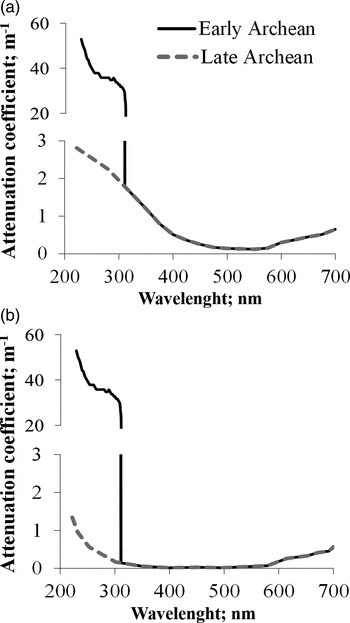
For both biomes in the Early Archean, we assumed that Fe2+ ions were present at concentrations mentioned in Crowe et al. (Reference Crowe2008), i.e. Fe2+ concentration of 0.1 mol m−3. The attenuation coefficients of this era were inferred from Cleaves & Miller (Reference Cleaves and Miller1998) for wavelengths between 210 and 310 nm, while values from Smith & Baker (Reference Smith and Baker1981) and Jerlov (Reference Jerlov1976) were taken for wavelengths between 311 and 700 nm for the clearest ocean and coastal waters, respectively.
Given the fact that the Late Archean waters were already stripped from Fe2+ ions, we used the values reported by Smith & Baker (Reference Smith and Baker1981) and Jerlov (Reference Jerlov1976) for the ocean and coastal, respectively, irrespective of the wavelength (210–700 nm) (Fig. 1).
Attenuation coefficients of radiation in the coastal (a) and ocean (b) water column during the Early and Late Archean.

We determined the photosynthetic potential for the illuminated layers of the ocean and coastal areas, which were assumed to extend up to depths of 200 and 50 m, respectively. These depths were derived from the current depth of the photic zone in the clearest ocean waters (Kirk Reference Kirk2011), and the global average depth of the coastal zone (Agardy et al. Reference Agardy, Hassan, Scholes and Ash2005), respectively.
Depth-integrated models of phytoplankton primary production have been used to estimate water column photosynthesis as a function of photosynthetically active radiation (PAR, waveband of solar radiation from 400 to 700 nm) (Cullen et al. Reference Cullen, Davis and Huot2012). However, these models cannot account for spectral effects of PAR on photosynthesis (Cullen et al. Reference Cullen, Davis and Huot2012). As photons must be absorbed by the phytoplankton pigments in order to ensure the efficiency of the photosynthetic process, the fraction of absorbed PAR (i.e. the photosynthetic usable radiation PUR) is more relevant as a measure of the amount of the used irradiance for photosynthesis (Morel Reference Morel1978).
For that reason, we used the following model of phytoplankton photosynthesis (Cullen et al. Reference Cullen, Neale and Lesser1992), where PUR was used instead of PAR:
 $$\displaystyle{{P(z)} \over {P_{\rm S}}} = \displaystyle{{1 - \exp \left[ { - {{E_{{\rm PUR}}(z)} / {E_{\rm S}}}} \right]} \over {1 + E_{{\rm UV}}^{\ast} (z)}},$$
where P(z)/P S is the photosynthetic potential, i.e. the photosynthesis rate P at depth z, normalized with respect to the saturation rate P S and E S is the efficiency with which the species uses light. In the remainder of this paper, we consider two model species, one with a high light use efficiency (E S = 2 W m−2) and another one with a low light use efficiency (E S = 100 W m−2). E*UV(z) is the irradiance of UV radiation (210–399 nm) weighted with a biological action spectrum, and E PUR(z) is the irradiance of PUR at depth z. Hence, as opposed to the model of Avila et al. (Reference Avila, Cardenas and Martin2013), the absorption spectrum is not constant, and E PUR(z) is given by:
 $$E_{{\rm PUR}}(z) = \sum\limits_{{\rm \lambda} \,=\, 400\,{\rm nm}}^{700\,{\rm nm}} {A({\rm \lambda} )} E\left( {{\rm \lambda}, z} \right)\Delta {\rm \lambda}, $$
where ∆λ = 1 nm (in the remainder), E(λ, z) are spectral irradiances at depth z, which were calculated using Lambert–Beer's law of optics, in the same way of Avila et al. (Reference Avila, Cardenas and Martin2013), and A(λ) is the absorptance parameter, given by:
 $$A({\rm \lambda} ) = \displaystyle{{\Phi _{\rm a}({\rm \lambda} )} \over {\Phi _0({\rm \lambda} )}},$$
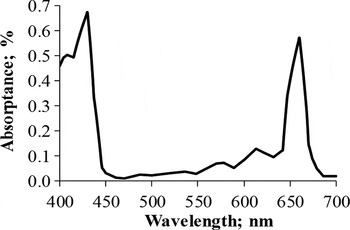
with Φa the absorbed radiant flux and Φ0 the incident flux (Kirk Reference Kirk2011). Larkum (Reference Larkum, Grimm, Porra, Rüdiger and Scheer2006) suggests that the earliest photosynthetic organisms probably used effective photosynthetic pigments, such as Mg protochlorophyllide a, which was replaced by Chl a (for an overview why Chl a ultimately remained in oxygenic photosynthetic organisms see Björn et al. (Reference Björn, Papageorgiou and Blankenship2009)). Besides, given evidence from microfossils, stromatolites and chemical biomarkers, we assumed that Archean cyanobacteria containing Chl a were capable of O2 photosynthesis (Olson Reference Olson2006). Therefore, A(λ) (Fig. 2) in equation (2) was determined from absorbance (D(λ)) data of Chl a (Comar & Zscheile Reference Comar and Zscheile1941) using:
 $$D({\rm \lambda} ) = - \log _{10}\left( {1 - A({\rm \lambda} )} \right).$$
Absorption spectrum of Chl a.

Biological weighing function (BWF) can be used to assess the effect of UV fluxes on organisms. There is convincing evidence that the basic structure of DNA and photosystem II has not changed since the Archean (Cockell Reference Cockell, Horneck and Baumstark-Khan2002). It has been argued that the photic zones of the Archean ocean and coastal zones could have been colonized by a UV resistant biota (Cockell Reference Cockell2000). Besides, Schirrmeister et al. (Reference Schirrmeister, Gugger and Donoghue2015) provide firm support of the origin of multicellular cyanobacteria prior to the GOE. Multicellularity may have been advantageous in an Archean environment, allowing high UV resistance (Schirrmeister et al. Reference Schirrmeister, Gugger and Donoghue2015).
We used the same BWF (ε (λ) in equation (5)) as the one used in Avila et al. (Reference Avila, Cardenas and Martin2013) (see Fig. 1 in this paper), which represent an average BWF determined on the basis of published BWFs (Neale & Kieber Reference Neale, Kieber, Hester and Harrison2000; Litchman et al. Reference Litchman, Neale and Banaszak2002) from temperate phytoplankton natural assemblages, since these species show a high UV tolerance. The BWF accounts for photosynthesis UV inhibition and gives more weight to more inhibitory wavelengths of the UV spectrum. So, the irradiance of UV was quantified as follows:
 $$E_{{\rm UV}}^{\ast} (z) = \sum\limits_{{\rm \lambda} \,=\, 210\,{\rm nm}}^{399\,{\rm nm}} {{\rm \varepsilon} ({\rm \lambda} )} E\left( {{\rm \lambda}, z} \right)\Delta {\rm \lambda} {\rm.} $$
UV effects in aquatic ecosystems are characterized by distinct vertical gradients in the sense that most effects occur in a ‘photoactive zone’ between the surface and a depth that is reached by 10% of the UVB that reaches the surface (Neale et al. Reference Neale, Helbling, Zagarese and Helbling2003) under the environmental conditions of the current era. Yet, in the Archean eon, the UV flux was higher than today (Singh et al. Reference Singh, Kumari, Rastogi, Singh and Sinha2008), while the ocean and coastal waters were more transparent. For such conditions, and considering a UV sensitivity of phytoplankton similar to the current one, the depth of the Archean ‘photoactive zone’ was estimated. The 10% of the annual average UVB (107.473 W m−2) that reaches the water surface in the current era was determined using irradiance data from (ASTMG173–03e1 2012). Given the total UVB irradiance reaching the water surface in the Archean eon (7380.43 W m−2), we determined the per cent represented by 107.473 W m−2 and we found that the lower boundary of the photoactive zone in that eon was located at a depth where 1.46% of incident UVB remained.
Results
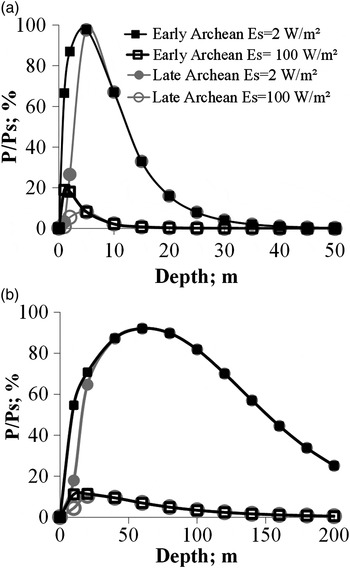
The photosynthetic potential of marine phytoplanctonic cyanobacteria in the Archean eon could have been affected by UV radiation, which probably resulted in photoinhibition (P(z)/P s ≈ 0) at the water surface (Fig. 3). According to our simulated results, the photosynthetic activity across the whole water column was similar during the entire duration of the Archean eon. Significant differences between the Early and Late Archean might have occurred for what concerns the first metres of the water column. The species with the highest light use efficiency (Es = 2 W m−2) showed a higher photosynthetic potential than its counterpart with the lowest light use efficiency (E s = 100 W m−2) (Fig. 3), which is agreement with the results of Martín et al. (Reference Martín, Peñate, Cárdenas, Horvath and Seckbach2012) and Avila et al. (Reference Avila, Cardenas and Martin2013). However, the photosynthetic activity in the ocean was almost two and four times lower for the species with the highest and lowest light use efficiency, respectively, as compared with the results presented by Avila et al. (Reference Avila, Cardenas and Martin2013).
Calculated photosynthetic potential profiles of the Archean phytoplancktonic cyanobacteria in coastal (a) and ocean (b) environments.

The former species reached its highest photosynthetic activity – in both Early and Late periods – approximately at a depth of 5 and 60 m in coastal and ocean waters, respectively. On the other hand, the species with the lowest light use efficiency reached its maximum potential in the different periods at different depths, as dictated by the optical properties of the water column in the concerning period. In the Early Archean, the maximum potential occurred at 1 and 10 m in coastal and ocean waters, respectively, whereas it occurred respectively at 5 and 20 m in the Late Archean. The coastal environment was characterized by higher maxima of photosynthetic potential than the oceans, though the latter could maintain significant photosynthetic activity at larger depths.
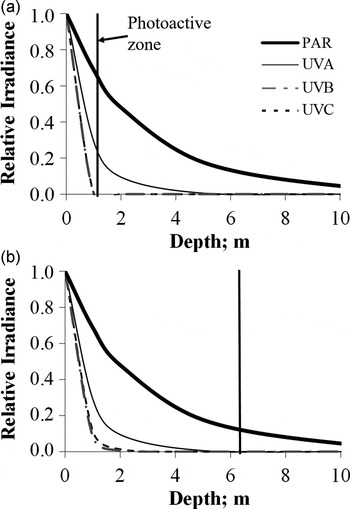
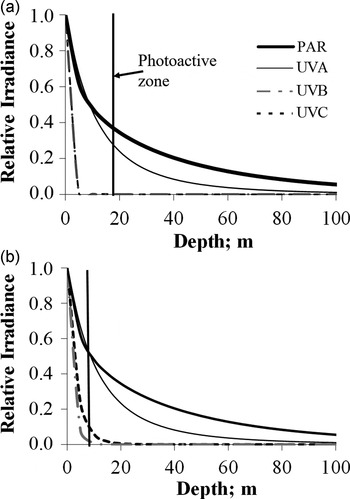
Figures 4 and 5 display the photoactive zone, where the most deleterious effects of the UV radiation occur and the irradiance profiles that were obtained using equations (2) and (5). We can see that the UVB and UVC fluxes in marine environments of the Early Archean (Figs 4(a) and 5(a)) were more strongly attenuated than in the Late Archean (Figs 4(b) and 5(b)). Coastal environments in the Early Archean showed the shallowest photoactive zone, whereas the deepest one occurred in the Late Archean ocean. The maximum photosynthetic potential of the species with the highest light use efficiency is reached far beyond the photoactive zone, while the least efficient one shows its maximum activity near the boundary of the photoactive zone (Figs 3–5).
Profiles of relative irradiances in coastal waters in the Early (a) and Late (b) Archean. The vertical line shows the boundary of the ‘photoactive zone’.

Profiles of relative irradiances in the ocean waters in the Early (a) and Late (b) Archean. The vertical line shows the boundary of the ‘photoactive zone’.

Table 1 lists the average photosynthetic potential across the photic zone and the entire water column. It indicates that the oceanic water column showed a higher average photosynthetic potential than the coastal one. Moreover, considering the average potential across the entire water column, it can be seen that they were similar for both investigated periods, though they were slightly higher in the Early Archean. On the other hand, considering the average photosynthesis potential in the photoactive zone, we observe large differences between the Early and Late Archean, which reflects the positive effect of Fe2+ ions as UV blockers.
Average photosynthetic potential (%) in the entire water column and the photoactive zone in Archean marine environments for species with the highest (2 W m−2) and lowest (100 W m−2) light use efficiency

Discussion
Iron is essential to the metabolism and growth of organisms and is especially important in the case of phytoplankton because of its presence in the proteins involved in the photosynthetic electron transport (Raven Reference Raven1990). In the current era, iron limits phytoplankton growth in oceans due to the very low solubility of Fe3+ in oxygenated ocean waters (Sunda & Huntsman Reference Sunda and Huntsman2015). High iron concentrations are, however, required by some phytoplanktonic species, such as the coastal cyanobacterium Synechococcus bacillaris (CCMP1333). This could also be vestigial and constitute an adaptation to the much higher iron concentrations in Early Archean marine environments (Sunda & Huntsman Reference Sunda and Huntsman2015).
Synechococcus is a genus of cyanobacteria that is of evolutionary interest because it is a direct descendant of the earliest oxygenic phototrophs, which evolved approximately 3 Ga ago (Dvořák et al. Reference Dvořák, Casamatta, Paulickova, Hasler, Ondrej and Sanges2014), when the chemical composition of the ocean was completely different than in the current era (Blankenship et al. Reference Blankenship, Sadekar, Raymond, Falkowski and Knol2007). It has been shown experimentally, using the marine planktonic cyanobacterium Synechococcus sp. 7002 as model organism, that the possible toxic effects of high iron concentrations in the Archean ocean could have been cancelled by the high silica concentrations that were present in this ocean too (Mloszewska et al. Reference Mloszewska, Owttrim, Whitford, Lalonde, Kappler and Konhauser2015). This fact could have facilitated the adaptation of early cyanobacteria to ferruginous conditions by reducing toxic levels of bioavailable iron.
The presence of Fe2+ ions in Early Archean marine environments is illustrated by our results. More specifically, the calculated photosynthetic potential near the water surface is higher (Fig. 3) and likewise the average photosynthetic potential in the photoactive zone (Table 1) in this era. Since Fe2+ ions strongly attenuate UVC and UVB (Fig. 1), these wavelengths decrease rapidly in the first metres of the water column (Figs 4 and 5) and similarly their effects on marine phytoplankton. Consequently, we may conclude that there was a shallower photoactive zone in Early Archean marine environments compared with the Late Archean.
The simulation results are in agreement with the experiments presented in Mloszewska et al. (Reference Mloszewska, Lalonde, Whitford, Owttrim and Konhauser2014), who performed UV irradiation tests in order to examine the growth of the planktonic cyanobacterium Synechococcus sp. PCC 7002 in Fe-and Si-rich media, thereby mimicking Archean oceanic conditions. These authors report that cultures supplemented with both Fe and Si, and at the same time exposed to high-intensity UVC radiation (254 nm), suffered less genetic damage than cultures that were not exposed to these elements. Furthermore, media containing both Fe and Si were more effective at attenuating UV than media containing only Si. Mloszewska et al. (Reference Mloszewska, Lalonde, Whitford, Owttrim and Konhauser2014, Reference Mloszewska, Owttrim, Whitford, Lalonde, Kappler and Konhauser2015) suggest that such suspended polymers and colloids may have played an important role in the protection of ancient free-floating bacteria from high-intensity UV radiation, and might have supported the phototrophic colonization of coastal and ocean photic zones in the Early Archean period.
Our results show that Fe2+ ions may have provided an effective UV screen in marine environments in the Early Archean. Alternative mechanisms involving photoprotection of iron compounds have also been reported (Bishop et al. Reference Bishop, Louris, Rogoff and Rothschild2006; Gauger et al. Reference Gauger, Konhauser and Kappler2015). Given the high UV flux reaching the Archean sea surface, there might have been a strong selective pressure among photosynthetic organisms in the upper regions of the photic zone (Cockell Reference Cockell1998), which forced photosynthesizers to protect themselves (Bishop et al. Reference Bishop, Louris, Rogoff and Rothschild2006). Therefore, UV-screening compounds could have been a potential mitigation strategy to UV damage (Cockell & Knowland Reference Cockell and Knowland1999). It has been demonstrated that through biomineralization of environmental iron, photosynthetic organisms (both oxygenic and anoxygenic) might have formed clusters or layers of iron minerals around them (Phoenix et al. Reference Phoenix, Konhauser, Adams and Bottrell2001; Gauger et al. Reference Gauger, Konhauser and Kappler2015). These biosynthesized shields allow for an effective UV absorption, while reflecting, scattering or transmitting the higher wavelengths (i.e. PAR and IR), leaving it available for photosynthesis (Bishop et al. Reference Bishop, Louris, Rogoff and Rothschild2006).
Nowadays, cyanobacteria that inhabit habitats near the sea surface synthesize the most widespread and extensively characterized cyanobacterial sunscreen, i.e. scytonemin, an extracellular pigment that shows its maximum absorption in the UV waveband (Proteau et al. Reference Proteau, Gerwick, Garcia-Pichel and Castenholz1993). Dillon & Castenholz (Reference Dillon and Castenholz1999) found that cyanobacteria cultures containing scytonemin were protected against UVC damage. The absorption of these energetic wavelength results in a decreased UVC inhibition of the photosynthetic carbon uptake. Therefore, Dillon & Castenholz (Reference Dillon and Castenholz1999) suggest that scytonemin may have evolved during the Precambrian, allowing colonization of shallow waters by cyanobacteria.
The high turbidity of coastal waters also increased the attenuation of UVC and UVB in the Early and Late Archean. Thus, the photoactive zone in this biome was shallower than in the ocean (Fig. 4). Therefore, the maxima of photosynthetic potentials were higher in coastal waters than in the ocean. In coastal waters, the availability of visible light for photosynthesis appears to have been the main limiting factor of primary productivity of phytoplankton, resulting in a very low average photosynthetic potential (Table 1). Therefore, the photosynthetic life in coastal habitats was probably limited to the first 5 m of the water column, where the maxima photosynthetic activity occurred for the model species covered in this work.
The higher transparency of ocean waters allowed for a deeper photoactive zone. Furthermore, these waters could have been densely populated in the first 25 m depth, both by species with low and high light use efficiency. Species with relatively high light use efficiency could have inhabited ocean waters up to a depth of 200 m and show a DCM near 60 m depth. Thus, there was a higher average photosynthetic potential in Archean oceans than in coastal waters.
Species with the lowest light use efficiency are strongly affected by the UV flux. They need high doses of PUR to reach their maximum photosynthetic potential. For this reason, such species could thrive and reach high photosynthetic activity near the surface, where the PUR irradiance (Figs 4 and 5) was high. Yet, there were also high doses of UV radiation at the surface (Figs 4 and 5), which makes that their potential was still relatively low (~8–18%) and that they were sensitive to the effects of Fe2+ ions as blockers of UV. They reached their maximum activity at greater depths in the Late Archean than in the Early Archean, when this blocker was present. In contrast, the species with the highest light use efficiency could photosynthesize at depths below the photoactive zone, where there were no harmful UV effects. Thus, they reached higher maxima of photosynthetic potential in the coastal and ocean biome (97 and 92%, respectively) than the less efficient species.
The lower obtained photosynthetic potential as compared to that obtained by Avila et al. (Reference Avila, Cardenas and Martin2013) follows from adding PUR to our model through the use of the Chl a absorption spectrum (Fig. 1). It is assumed that organisms evolving to photoautotrophy might initially have contained diversely coloured substances in their tissues (Evstigneev Reference Evstigneev1973), and as such could have absorbed light at other wavelengths, in addition to those obtained with chlorophyll. Carotenoids, for instance, absorb light between 380 and 520 nm (violet-blue), and could have protected organisms in shallow Archean waters from this energetic radiation (Nisbet Reference Nisbet, Coward and Rtes1995).
After the Archean eon, an adaptive diversification of photosynthetic organisms to optimize their oxygenic photosynthesis has led to the evolution of a variety of photosynthetic pigments (i.e. Chl b, c and d and phycobiliproteins) (Larkum Reference Larkum, Grimm, Porra, Rüdiger and Scheer2006).
Nowadays, phycobilisomes containing phycobiliproteins are the major light-harvesting complex of cyanobacteria (Grossman et al. Reference Grossman, Bhaya, Apt and Kehoe1995), while the IR-absorbing Chl d has been isolated from several existing cyanobacteria strains (Miyashita et al. Reference Miyashita, Ikemoto, Kurano, Miyachi and Chihara2003; Mohr et al. Reference Mohr, Björn, Schliep, Kurz, Maldener, Adams, Larkum, Chen and Hess2010; Larkum et al. Reference Larkum, Chen, Li, Schliep, Trampe, West, Salih and Kühl2012) and is widespread in surface oceanic and lacustrine sediments (Kashiyama et al. Reference Kashiyama2008). Concentration of Chl d and its derivates versus the one of Chl a and its derivates reach up to 4% (Kashiyama et al. Reference Kashiyama2008). However, Larkum (Reference Larkum, Grimm, Porra, Rüdiger and Scheer2006) argues that phycobilisomes and Chl d evolved more recently than Chl b and c.
More recently, a cyanobacterium from Shark Bay stromatolites (Western Australia) containing the novel Chl f was isolated, which is the most red-shifted chlorophyll discovered to date, having a maximum absorption at about 706 nm and enabling light harvesting up to ~740 nm (Chen et al. Reference Chen, Schliep, Willows, Cai, Neilan and Scheer2010, Reference Chen, Li, Birch and Willows2012). Wong et al. (Reference Wong, Smith, Visscher and Burns2015) consider that, given the fact that IF can penetrate deeper into microbial mats (Jørgensen et al. Reference Jørgensen, Cohen and Des Marais1987), it is possible that current cyanobacteria living in the deepest smooth mats of stromatolites could possess these (or other) novel chlorophyll molecules.
Stromatolites offer an important evidence for the earliest life in the Archean eon (Awramik & Sprinkle Reference Awramik and Sprinkle1999), and they have been considered as a community strategy to avoid UV damage, because their upper layers of dead cells could have attenuated the UV wavelengths (Dolan & Margulis Reference Dolan and Margulis2002). Thus, it could be hypothesized that the absorption of IR by an ancient photosynthetic pigment similar to Chl f, allowed for the growth of photosynthetic cyanobacteria in supratidal environments where stromatolites were present (Awramik & Sprinkle Reference Awramik and Sprinkle1999), but not in well-lit water columns, analysed in this work, where IR is strongly attenuated (Kirk Reference Kirk2011).
The modelling approach presented here takes into account photobiological parameters that are essential to obtain a reliable quantitative assessment of the photosynthesis for the current phytoplankton assemblages (Cullen et al. Reference Cullen, Davis and Huot2012). Still, it has been argued that the productivity and distribution of microbial populations in Archean marine environments could have depended on the availability of nutrients, such as phosphorus (P) and nitrogen (N) (Nisbet Reference Nisbet, Coward and Rtes1995; Falkowski Reference Falkowski1997). Bjerrum & Canfield (Reference Bjerrum and Canfield2002) suggested significantly low rates of photosynthesis during the Late Archean and Early Proterozoic due to low availability of phosphate in the ocean, while Falkowski (Reference Falkowski1997) considered that N would have been the nutrient most critical for the widespread proliferation of cyanobacteria on geological timescales.
In contrast, Pasek et al. (Reference Pasek, Harnmeijer, Buick, Gull and Atlas2013) demonstrated the availability of reduced P species as a source of soluble reactive P on the early Earth, enabling origin of life reactions. Besides, Grula (Reference Grula2005) concluded that Precambrian cyanobacteria would not have been able to oxygenate Earth's biosphere if their emergence had not been preceded by the evolution of N fixation at the beginning of their history. A brief period of genetic innovation from 2.8 to 3.3 Ga ago (Archean expansion of gene families), gave rise to 27% of major modern gene families, including those involved in energy production (photosynthesis and respiration) and coenzyme metabolism. For example, the abundance of enzymes using oxidized forms of nitrogen (N2O and NO3), grows significantly over time (David & Alm Reference David and Alm2011).
Currently, the oligotrophic euphotic zones of intertropical gyres of the oceans are often dominated by the genus Prochlorococcus (García-Fernández et al. Reference García-Fernández, de Marsac and Diez2004). Its abundance and distribution are strongly related to light intensity, while the nutrient concentration seems to have a limited influence on its biogeography (Flombaum et al. Reference Flombaum, Gallegos, Gordillo, Rincón, Zabala and Jiao2013). The small size of Prochlorococcus cells (0.5–0.8 µm diameter) confers a selective advantage of small organisms in this environment. It has been suggested that, as smaller cells typically increase the cell surface-to-volume ratio, they have an enhanced nutrient uptake (Chisholm Reference Chisholm, Falkowski and Woodhead1992). Besides, the very small size lowers the demand of energy and nutrients (Dufresne et al. Reference Dufresne, Garczarek and Partensky2005).
The biological communities in Archean marine environments were mainly prokaryotic (Nisbet Reference Nisbet, Coward and Rtes1995). Eukaryotic organisms radiated in Proterozoic oceans with oxygenated surface waters (Knoll Reference Knoll2014). Prokaryotic cells are smaller than eukaryotic ones, which indicate that the increased surface-to-volume ratio could have favoured nutrient uptake. Consequently, taking into account the discussion above and our results presented here, it is reasonable to consider that the Archean phytoplanktonic biota could have required low nutrient concentrations, and that their abundance and vertical distribution in ocean and coastal environments probably was governed by light availability and inhibitory effects of UV fluxes.
During the Early Proterozoic, UV stress was reduced as ozone concentrations increased, giving way to the development of a great diversity of organisms (Cockell Reference Cockell2000), such as eukaryotes ones (Knoll Reference Knoll2014). In addition, multicellularity could have enabled cyanobacterial diversification and adaptation to oxygenated habitats (Schirrmeister et al. Reference Schirrmeister, Gugger and Donoghue2015). Eukaryotic cells are usually larger than prokaryote and the same holds for the size of their genomes (Lane & Martin Reference Lane and Martin2010; Lane Reference Lane, Keeling and Koonin2014). The eukaryotic genome is more complex than the one of prokaryotes, giving the former three to five orders of magnitude more energy per gene than the latter. All this reflects a higher mean metabolic rate per cell, as well as higher-energy consumption in eukaryotic organisms than in prokaryotic organisms (Lane Reference Lane, Keeling and Koonin2014). For these reasons, nutrient upwelling from emerging continental crusts in Early Proterozoic could have been more important in increasing the total planktonic abundance and diversity in marine environments than photobiological factors (Cockell Reference Cockell2000).
Conclusions
UV could have been an environmental stressor in the ocean and coastal surface, causing photoinhibition. Its effects played a role up to a depth of 20 and 25 m, in the Early and Late Archean oceans, respectively, while visible light could have limited the photosynthetic process in coastal zones, due to high turbidity. Fe2+ could have played an important role in the protection of ancient free-floating bacteria in the photoactive zone from high-intensity UV radiation as blocker of UV present during the Early Archean. We have modelled how the solar radiation, both UV and visible light, could have strongly influenced the vertical distribution and therefore the metabolic activity of the Archean cyanobacteria.
Acknowledgements
We appreciate the valuable comments on earlier versions of this manuscript from anonymous reviewers. This work was supported by the Special Research Fund (BOF) of Ghent University, Belgium; Grant Code 01W03715.