


Weak states have been linked to pervasive violence and poor development outcomes, while capable ones—those with the ability to implement basic policies, such as taxation—can spur economic development (e.g., Evans Reference Evans1995; Dincecco and Katz Reference Dincecco and Katz2014; Acemoglu, Garcia-Jimeno, and Robinson Reference Acemoglu, Garcia-Jimeno and Robinson2015). High-capacity states have, nonetheless, been historically rare, and ineffective administrations are still prevalent in much of the world. Existing scholarship on the development of state capacity focuses on the role of international conflict; however, such theories cannot fully account for the development of state capacity in the absence of intense international conflict (as has historically been true in Africa and Latin America), nor can they explain the differences in state capacity at the subnational level.
This article offers an alternative explanation for state capacity development grounded in domestic conflict, and provides supportive evidence from Mexico. Building on recent theoretical work on social conflict (e.g., Acemoglu and Robinson Reference Acemoglu and Robinson2008; Besley and Persson Reference Besley and Persson2009, Reference Besley and Persson2011), I focus on two factions: an elite that owns the productive assets in the economy and a political ruler with military dominance over a low-capacity state. When these factions are engaged in distributive conflict, the economic elite can use their resources to threaten to seize power and deter the ruler from expropriating their assets. Moreover, the economic elite can also deter the ruler from investing in future state capacity, which eventually could be used against them. I argue that a temporary disruption to this balance of power that weakens the economic elite, such as a negative shock, has two simultaneous effects. First, it may enable rulers to expropriate the economic elite’s assets and consolidate their political authority. Second, by increasing the expected benefits of future state capacity, the shock also makes rulers more likely to invest in expanding capacity.
The implications of this argument—in particular, the introduction of a shock that temporarily weakens the economic elite—guide the empirical analysis. I study post-revolutionary Mexico, where regional warlords and revolutionary caciques (local political bosses) had recently risen to political power at the local level, but sill faced a powerful economic (landed) elite. I use a research design that exploits the differential impact of price shocks following the Great Depression across municipios to identify the effect of temporary landowner weakness on land expropriation and subsequent investment in state capacity. The identification strategy exploits the exogenous changes to agricultural commodity prices brought about by the Great Depression and uses differential crop suitability as a measure of exposure to the shock. The effects of the shock are also assessed over the long term.
To operationalize state capacity, I adopt the notion of infrastructural power: the ability of states to penetrate their territories and logistically implement decisions (Mann Reference Mann1986). This approach to capacity focuses on the state’s ability to implement policy rather than on the specific policies—welfare-enhancing or predatory—that are selected. While the applications of this concept have been diverse, I concentrate on the resources available to the local state to implement policy: in particular, I use the presence of government officials in the regions as a measure of capacity. This allows me to examine local variation in state capacity over time using disaggregated historical census data. When assessing the persistent effects of the commodity price shock, I also use present-day local tax revenue as a complementary outcome.
The results provide support for the theory. Places where Great Depression commodity price shocks led to larger declines in the production potential of the landed elite (i.e., exposed or treated places), experienced more intense expropriation and redistribution of land. Moreover, a stronger negative shock also induced a substantially larger increase in the number of bureaucrats. The interpretation of these findings as supportive of the theory is bolstered by the absence of a relationship between shocks and the number of bureaucrats in places without a landed elite. Furthermore, the available evidence supports the validity of the research design: areas that were most and least affected by the shocks display pre-Depression parallel trends in both land redistribution and in the number of bureaucrats, and falsification tests that use future price changes reveal no effect on either outcome. Finally, these early effects on local capacity are long lasting. Negative shocks following the Great Depression lead to higher long-term state capacity outcomes: present-day number of bureaucrats and local tax revenue.
This article contributes to our understanding of state capacity by first identifying one set of conditions that enable its development and, second, by presenting supportive quasi-experimental empirical evidence. Past scholarship has proposed explanations of the development of state capacity that emphasize the role of external war (e.g., Tilly Reference Tilly1992; Dincecco Reference Dincecco2011; Scheve and Stasavage Reference Scheve and Stasavage2012). In Charles Tilly’s formulation of the bellicist theory of the state, for instance, the constant threat or occurrence of interstate war in early modern Europe provided the incentives to develop state institutions capable of extracting resources from their societies at the same time as social constraints on rulers were loosened by the imminent threat of foreign invasion. The European trajectory, however, has not been observed in other regions, including Africa and Latin America, where total interstate wars have been rare (e.g., Herbst Reference Herbst2000; Centeno Reference Centeno2003).Footnote 1
In contrast to these accounts, which rely on the looming threat of international war as the main force behind the development of capacity, the theory I propose in this article is driven by domestic conflict.Footnote 2 It builds on the idea put forward by Besley and Persson (Reference Besley and Persson2009, Reference Besley and Persson2011) and North, Wallis, and Weingast (Reference North, Wallis and Weingast2009) that underinvestments in capacity are the result of intra-elite conflict. For North, Wallis, and Weingast, ineffective administrations are a characteristic of “natural states”: political equilibria in which elites restrain from violence as long as the expected rents in the current political arrangement are greater than the expected value of fighting. These peaceful arrangements, however, are volatile, and small disruptions can lead to the outbreak of violence. States remain weak even when stability is temporarily attained, because building state capacity risks the breakdown of the political equilibrium by shifting the expected balance of power in favor of the incumbent.
This framework is useful for understanding the underlying logic of low-capacity states, but it does not provide a satisfactory account of how change comes about. This article attempts to fill that gap by not only characterizing low-capacity traps, but also by examining how states can escape them even in the absence of interstate war. I argue that, under the right conditions, a large shift in the balance of power that strengthens one elite faction at the expense of another can generate the incentives for capacity-enhancing investments. Furthermore, by employing a quasi-experimental design, I can improve upon past evidence of state capacity development, which is based on detailed case studies or cross-national correlations.
The findings presented here also inform existing theories of redistribution, specifically those that seek to explain the determinants of land reform. Past work has attributed instances of land reform to ongoing processes of democratization, with newly empowered masses demanding redistribution (e.g., Lapp Reference Lapp2004).Footnote 3 Explanations centered on Mexico—an autocracy throughout the period of land redistribution—have highlighted the effects of post civil-war pacification (e.g., Sanderson Reference Sanderson1984; Dell Reference Dell2012), historic grievances (e.g., Saffon Reference Saffon2015) and changing opportunities for emigration (e.g., Sellars Reference Sellars2017). I complement these accounts’ focus on the interaction between peasants and elites by highlighting the role of conflicts among the elite in explaining land redistribution (see also Albertus and Menaldo Reference Albertus and Menaldo2012; Albertus Reference Albertus2015).
ELITE CONFLICT AND STATE CAPACITY
In this section, I present a theory that explains the pervasiveness of low state capacity and its possible development as the outcome of a conflictive relationship between a ruler and a nonruling economic elite.
The argument centers on two actors. A political ruler, whose power emerges from military dominance, decides whether to expropriate an enemy economic elite and whether to invest to expand future capacity. The ruler strives to maximize the spoils from office, which can be achieved by holding on to power for as long as possible and by increasing the state’s ability to tax. Thus, state capacity, conceptualized as the state’s ability to implement policy, is realized here as its ability to raise taxes. The ruler expands capacity through costly investments, and decides whether to invest based on the private returns to those investments. The nonruling economic elite, in turn, control some productive asset and can use part of their income to resist the ruler and potentially gain power. The elite seek to maximize profits from their economic assets, which entails avoiding expropriation as well as minimizing their future tax burden.
These opposing distributive preferences between the ruler and economic elite result in a situation of latent conflict.Footnote 4 Such distributive conflict erupts in the absence of institutions that can generate credible bargains among them, such as institutions of limited government, and when no actor is overpowering—if the latter were the case, fighting would be futile, and the weaker faction would prefer not to incur its cost.
The argument takes as its starting point a common phenomenon throughout history: the low-capacity trap. When the ruler coexists with a strong economic elite in the conditions outlined above, he has few incentives to undertake the necessary investments to increase state capacity. This is because he fears that these investments generate backlash by prompting the economic elite to attempt to seize power and then use the enhanced capacity to their own advantage and against the ruler. It therefore makes little sense for the ruler to invest in enhancing capacity—doing so would reduce the likelihood that he survives in power to reap the benefits of the investment. The ruler can attempt to deplete the economic elite’s own source of power by expropriating their assets, but a strong elite can successfully fight back, wrestle power away from the ruler, and reverse the expropriation.
Thus, a sufficiently strong economic elite, by credibly threatening to seize political power, can deter both the expropriation attempts and the investments in capacity by the ruler, leading to a low-capacity equilibrium. Furthermore, marginal changes to the economic elite’s resources are not enough to escape this situation. This is because the elite can compensate for a small decline in their overall resources by increasing the fraction they dedicate to trying to seize power.
This characterization of low-capacity equilibria helps explain why the emergence of capable states is a relatively rare occurrence. In contrast to stationary bandits that effectively monopolize theft in their domains and have incentives to invest in the future, rulers who face continuous challenges from domestic elite groups have to spend their energy and resources trying to hold on to power. Features of this low-capacity equilibrium can be found in late-medieval and early-modern European states, such as Britain under the first Tudors; in nineteenth-century and early twentieth-century Latin America, such as Chile and the Dominican Republic, and in some present-day states, such as Afghanistan, Haiti, and the Democratic Republic of Congo (North, Wallis, and Weingast Reference North, Wallis and Weingast2009; Pincus and Robinson Reference Pincus and Robinson2011; North et al. Reference North, Wallis, Webb and Weingast2012).
An escape from this low-capacity equilibrium can be achieved by a large disruption to the existing balance of power: for example, by a negative shock that temporarily weakens the economic elite relative to the ruler and clears the way for political consolidation and investments in state capacity. The shock reduces the elite’s ability to resist the ruler, who, undeterred, uses this window of opportunity to permanently destroy the elite’s source of power through the expropriation of their productive asset. By facilitating the political consolidation of the ruler and lengthening his time horizon, temporary ruler strength enables investments in state capacity that would have been prohibitively costly otherwise.Footnote 5
Temporary ruler strength can emerge from many sources, and shocks that weaken the nonruling elite are one example. More generally, a way out of low-capacity equilibria can be achieved by substantial, temporary changes to the relative balance of power that favor the ruler. Positive shocks to the ruler include, for example, asymmetric access to a new military technology or support from an external power. Negative shocks to the elite include episodes that reduce their ability to generate profits, such as the introduction of new technologies that make existing systems of production obsolete or adverse weather events.
In this article, I focus on economic shocks that severely impact the economic elite. These can come in the form of a negative price shock, which asymmetrically affects the economic elite when the ruler can still call on other resources—such as mobilizing landless peasants vying for the elite’s land—to support his cause.
In short, when facing low enough prices that temporarily weaken a nonruling economic elite, the ruler has an incentive to expropriate them and consolidate his power. Investments in future capacity and, with them, the foundations of a capable state, are more likely to take place.
Thus, under the scope conditions of the theory—evenly matched elite factions with competing distributive preferences interacting in the absence of institutions that can sustain a credible bargain between them, and asset expropriation as a way in which rulers can weaken their opponents—two key hypotheses that can be brought to the data emerge:
1. When the nonruling economic elite faces low enough prices, rulers are more likely to expropriate the elite’s assets.
2. When the nonruling economic elite faces low enough prices, rulers are also more likely to invest in expanding state capacity.
BACKGROUND
Ideally, these hypotheses would be evaluated by randomly assigning prices to a sample of ruler-elite pairs in conflict. As an approximation to this ideal design, I use a large economic shock—the Great Depression—as an exogenous change in agricultural commodity prices in Mexico, and take local political rulers and the local economic (landed) elite as the relevant actors. Mexico in the aftermath of the revolution—which lasted from 1910 to roughly 1919—is an attractive case to examine; it satisfies the scope conditions of the theory and, because of its political situation, offers a sizeable number of subnational units, which allows for meaningful quantitative analysis.
Local hacendados—the owners of large estates—had developed credible rent-sharing arrangements with the political elite during the pre-revolutionary period (e.g., Haber, Maurer, and Razo Reference Haber, Maurer and Razo2003). However, after the revolution, the Mexican state collapsed. The incipient national institutions of the old regime disappeared during the turmoil of the civil war, and the power vacuum was filled at the local level by a confederation of regional warlords, as well as other caciques (political bosses), with local power bases (e.g., Brading Reference Brading1980; Knight Reference Knight2005).
The old pre-revolutionary bosses, members of large landowning families, were completely discredited politically after the revolution and stopped holding public office. They nonetheless “wielded unseen but surely felt power, [and] had the means of coercion or could easily purchase them” (Wasserman Reference Wasserman1993, 128).Footnote 6 In some places, the old landed elite staged a comeback after several years of political retreat, while in others they lost influence definitively.
Local politics during the period proceeded largely independent of national politics, as municipal factions wrestled control of the available economic resources: land and taxes. During the period, municipios relied on their own resources to run the local government, with little support from state and federal resources. They retained the prerogative of taxing land, services, and the production and sale of some commodities. The local bureaucracy staffed tax collection offices, public safety forces (e.g., municipal guards), and sometimes provided basic public services, such as water provision, public sanitation, and the administration of local public markets, slaughterhouses, and burial grounds (Wasserman Reference Wasserman1993; Aboites Reference Aboites2003).
The conflict over local power—and its associated rents—often turned violent as the pre-revolutionary elites struggled to preserve their position and the new bosses sought to establish themselves locally. The outcome of these conflicts hinged on the resources that these groups were able to mobilize in their favor; while the old elite could turn to their estates to support their bid for power, the rising notables could rally land-hungry peasants (e.g., Wasserman Reference Wasserman1993; Knight Reference Knight2005).Footnote 7
Despite their retreat from local political life after the outbreak of the revolution, hacendados were largely able to secure their properties during the years of civil war (1910–19), even in the face of limited land redistribution implemented by the various armed factions as part of their recruiting strategies. In the 1920s, with agrarian legislation already in place, land reform was used as a political instrument to demobilize peasants in conflictive regions, but it was largely limited to claims of past dispossession and by villages outside of haciendas (e.g., Sanderson Reference Sanderson1984; Gaona Reference Gaona1991; Dell Reference Dell2012; Saffon Reference Saffon2015).
Thus, by the 1930s, local landowners still retained the main source of wealth in rural municipios. The period of mass land redistribution only came, as Figure 1 shows, after the Great Depression, and particularly after 1934. The revival of the land reform program was supported at the national level by President Lázaro Cárdenas (1936–1940), but its implementation had a very local dynamic, and could only happen with support from local authorities.Footnote 8 Local political leaders could (and did) encourage land redistribution by coordinating land invasions that effectively expropriated the hacendados’ estates and increased the likelihood of a petition’s formal approval. At the same time, they were also able to stop the process at various stages, if it was in their interest.
Land Redistribution in Mexico (1916–1960)

Modern ejidos, the communities formed from redistributed land, are exempt from property taxes. However, during the period of analysis, and well into the 1950s, redistributed land was taxable, and was one of the most important sources of local revenue (Aboites Reference Aboites2003).Footnote 9 Local rulers could therefore benefit from an increased capacity to tax land. Whether the struggle between hacendados and the new local political leaders determined the expansion of local state capacity, perhaps mediated by land reform, remains an open question in the literature.
In the Mexican post-revolutionary context, the argument developed above suggests that, in the areas that were badly hit by a negative price shock and landowners’ resources were diminished, the new political bosses should have been more likely to expropriate land (Hypothesis 1), and to invest to increase state capacity (Hypothesis 2). Furthermore, these effects should arise specifically where a competing elite—the landowners—were present.
Illustrative cases. A number of cases exemplify this pattern of landlord domination that persisted through the revolution, followed by agrarian unrest that culminated in land reform, and the final consolidation of the new local political leadership—often military caudillos or local caciques—that instigated expropriation (e.g., Singer Reference Singer1988; Harper Reference Harper2009). The available record also suggests that, in these cases, political consolidation was also accompanied by an expansion in local state capacity. To illustrate the theory, in this section I contrast two badly hit regions that experienced political consolidation, land expropriation, and rapid growth of capacity (Cañada and San Felipe), with a region that was only mildly exposed to the price shock (Naolinco), and where political instability persisted, land expropriation was limited, and state capacity increased at a much slower pace.
The local ruler and cacique Ernesto Prado from Michoacán’s region Cañada de los Once Pueblos, which was badly hit by the Great Depression, provides a good example of a path that was conducive to state capacity development:
[T]he second half of the nineteenth century saw an intense process of privatization of communal lands in the Cañada. During the Porfiriato [the pre-revolutionary period], the municipality’s political oligarchy was made up of just three families. Later, during the Mexican Revolution, many inhabitants began to demand land. During Francisco Múgica’s term as governor (1920–22), Prado began a formidable agrarian campaign in which he visited several towns, [. . .] while at the same time winning control of the municipal presidency of Chilchota by means of his relatives and friends. During Cárdenas’ presidency [in the late 1930s], Prado succeeded in redistributing land in Tanaquillo, his hometown: ‘the rural defence [forces] were led by him, as were the communal authorities and those in charge of the municipal administration, [all of whom] were installed and unseated at Prados’ whim’. Later governors [. . .] tried to remove Prado, but despite their best efforts, his influence lasted for several more years (Calderón Reference Calderón, Knight and Pansters2005, 134).
San Felipe del Progreso, in the state of Mexico, also suffered a negative price shock in the aftermath of the Great Depression. In her ethnographic study of the municipio, Margolies (Reference Margolies1975) describes a similar process to the one in the Cañada. A handful of hacienda owners prospered in the late nineteenth century by expanding both their export-oriented production and, given the proximity to mines and its workers, domestic-oriented grain production. They dominated local political life—at least one of them directly served as municipal president during the pre-revolutionary period—and had a considerable degree of authority not only within their estates but in the surrounding towns. “In short, [the hacendado] sought a comfortably mutualistic relationship with townsfolk and a toadyish receptivity which permitted him to do whatever he wanted in any contingency. [He could] satisfy both insignificant whims [. . .] and regulatory demands” (Margolies Reference Margolies1975, 32).
Hacendados, the economic elite, were able to successfully resist the revolutionary turmoil (1910–19) through self-financed armed defense groups, and the newer local revolutionary political leadership, the local ruler, saw them as a threat. By the 1930s, these local authorities reacted with a “deliberately calculated” indifference to illegal land invasions on the haciendas, and “repeatedly denounced the landlords as ‘provocators’ and ‘subverters’ whose only aim was to create problems for the government” (Margolies Reference Margolies1975, 43). Macario Durán, a local agrarian leader from the 1930s that rose to the municipal presidency in the early 1940s, “exercised absolute power from 1940 to 1957” (Torres-Mazuera Reference Torres-Mazuera2012, 51), which allowed him to profit from lands formally held in common property and monopolize local trade.
In both cases, the available data, described in more detail below, suggest that the price shock hit these regions negatively, and that, as the theory implies, both expropriation of assets from the landed elite and one measure of local state capacity, the number of bureaucrats, increased substantially. The Cañada region roughly corresponds to the municipio of Chilchota, which saw its commodity potential—the gross income that could be potentially generated given the local agro-climatic conditions and commodity prices—fall by 30% from 1930 to 1940. Over the same period, land was redistributed for the first time, and the total number of bureaucrats rose from four to 35. In San Felipe, commodity potential fell by 20%. Land redistribution, though already underway by 1930, increased by a factor of eight over the next decade, while the total number of bureaucrats tripled from 15 to 45. Relative to national trends in the number of bureaucrats, which on average increased by a factor of 1.5 during the period (or ten bureaucrats per municipio, in absolute terms), these were large increases.Footnote 10
Naolinco, in the central region of the state of Veracruz, provides an example of failed expropriation and continued conflict. In the aftermath of the revolution, a radical agrarista movement, led by governor Adalberto Tejada, took momentum regionally. Armed peasants organized into rural defense forces and successfully took over local governments across the state (Fowler-Salamini Reference Fowler-Salamini1978). While a sizeable number of provisional land redistributive grants were approved, in places like Naolinco, hacendados were able to continuously avoid their implementation through violence, by employing (costly) hired guns to intimidate peasants and the new local rulers. The most prominent armed group that sold protection was the Mano Negra, led by the hacendado and representative of the local economic elite Manuel Parra, who took over local administrations in the region and reportedly killed thousands of peasants in the region during the period (Santoyo Reference Santoyo1995). After Parra’s death in 1943, agrarian unrest continued. His hacienda was eventually expropriated and redistributed in the 1950s under the leadership of Guillermo Cedeño, who nonetheless had to flee the municipio himself after several attempts on his life.
Contrary to the previous cases, in Naolinco, commodity potential only fell by 10% (close to the mildest possible decline across the country), which could help explain the landowners’ ability to resist far-reaching land reform and challenge the agrarian leadership. In the 1930s, there was only one definitive redistributive grant with expropriated high-quality land, which amounted to less than 1% of the municipio’s surface area. While the number of bureaucrats increased—following a nationwide upward trend—it did so at a slower rate than the other cases, from 23 to 30 public officials (a 30% increase).Footnote 11
RESEARCH DESIGN
These cases highlight patterns that are consistent with the observable implications of the argument. However, opportunities for a definitive consolidation of the local political leaders that emerged from the revolution, as well as the hypothesized expansion of state capacity, likely varied from region to region in unobserved ways. This makes a systematic evaluation of the proposed theory challenging. To overcome these difficulties, I rely on one source of exogenous variation to the landed elite’s available resources, and thus to their ability to resist and challenge the rising local political leaders. Price shocks induced by the Great Depression affected crop values differentially and were largely unexpected (e.g., Hamilton Reference Hamilton1992). They can thus provide credibly exogenous variation in the economic resources available to the landed elite between regions suitable to produce different crops.
As the theory suggests, a large negative shock to the economic power of elites can increase investments in state capacity—potentially with long-term consequences. In Mexico, these price shocks came during a period of political reorganization following the turmoil of the revolution. If local leaders successfully consolidated power after a large shock that depleted the landed elite’s resources, and their regional political machines were in turn integrated into the national political system under the Partido Revolucionario Institucional (PRI) regime, these initial increases in local capacity could have persisted.
Figure 2 illustrates this component of the identification strategy with two selected commodities. After 1929, some internationally traded agricultural commodities, such as coffee, display a sharp decline in their prices, while others remain relatively stable (rice) or even slightly increase (bananas).Footnote 12
Commodity Prices Before and After the Great Depression

Given the availability of historical data, I implement two estimation strategies: a difference-in-differences approach that uses two periods (1930 and 1940) and compares differential changes in state capacity and land redistribution, and a cross-sectional estimation that compares these outcomes' levels after the shock was realized.
Difference-in-differences design. The main results are obtained through a difference-in-differences approach that compares changes in outcome y it, a municipal-level measure of local state capacity or land redistribution, in differentially shocked places (e.g., Topalova Reference Topalova2010; Dube and Vargas Reference Dube and Vargas2013):
 $$\begin{equation}
lny_{it}=\alpha + \beta _1 ln\bar{V}_{it} + \lambda _t \times X_{i,1930} + \lambda _t + \gamma _i + \varepsilon _{it,}
\end{equation}$$
where  $\bar{V}_{it}$ is a measure of commodity potential in time t for municipio i, X i, 1930 is a vector of time invariant pre-shock controls that are interacted with the time fixed effect λt, γi are municipio fixed effects, and εit is an error term. Commodity potential, the main variable of interest, aggregates the value of the potential production of a municipio’s crops at a given point in time, relative to the rest of the country. It is defined as
 $$\begin{equation*}
\bar{V}_{it}=\sum _{g=1}^G \frac{\bar{P}_{gt} \times Suitability_{ig}}{Avg.\;Suitability_{g}},
\end{equation*}$$
where  $\bar{P}_{gt}$ is the average price of crop g in time t ∈ {1920s, 1930s}, Suitability ig is a municipio-specific crop suitability measure (in metric tonnes) determined by agroclimatic conditions, and
 $Avg.\;Suitability_{g}=\frac{1}{N}\sum _{i=1}^N Suitability_{ig}$ is a national average.
 $\bar{V}_{it}$ captures the relative availability of resources for the landed elite, who produce commodities for the market.Footnote 13 Parameter β1 in the equation can quantify the effect of the price shock through the channel that the theory suggests: the temporary weakening of the landed elite, associated with a decline in commodity prices, leads to the expropriation of land, along with an increase in the incentives to invest in local capacity by local rulers.
With exogenous controls, the key identification assumption is  $E(\varepsilon _{it} | \lambda _t, \gamma _i, ln\bar{V}_{it})=0$. That is, a shocked municipio should have to maintain the same difference to an unexposed control municipio had it not been shocked by the Great Depression. Figure 4 and Table C.5 (in Section C.3 of the Online Appendix) present evidence that supports the plausibility of this assumption, using pre-Depression data on state capacity and land redistribution.
Cross-sectional design. For a cross-section one decade after the shock, I estimate the following equation:Footnote 14
 $$\begin{equation}
y_{i,1940}=\alpha +\beta _0 ln\bar{V}^{1920s}_i + \beta _1 S^{1920s-30s}_i + \delta X_i + \varepsilon _i,
\end{equation}$$
where y i, 1940 is a municipio-level outcome of local state capacity or land redistribution for 1940.  $\bar{V}^{1920s}_i$ is the initial commodity potential (using the 1920–1929 price average) prior to the price shocks, S 1920s − 30si is the percentage shock to the commodity potential attributable to the Great Depression, X i is a vector of covariates, and εi is an error term.
The percentage shock to commodity potential is given by
 $$\begin{equation*}
S^{1920s-30s}_i =\frac{\bar{V}^{1930s}_i - \bar{V}^{1920s}_i}{\bar{V}^{1920s}_i} \times 100.
\end{equation*}$$
Here, the identification assumption is  $E(\epsilon _i| \bar{V}^{1920s}_i, S^{1920s-30s}_i,X_i)=0$, which is a relatively stringent condition. It requires, for instance, that unobservables related to state capacity/land redistribution not be correlated with the initial crop suitability in each municipio, nor with its change induced by international price fluctuations. However, to the extent that one can regard these variables as exogenous—they are constructed from geographic features, along with internationally determined prices—the estimate for β1 should be similar to the difference-in-differences approach.
For long-term outcomes, I estimate a similar version to Equation (2):
 $$\begin{equation}
y_{i,2000}=\alpha +\beta _1 ln\bar{V}^{1920s}_i + \beta _2 S^{1920s-30s}_i + \delta X_i + \varepsilon _i,
\end{equation}$$
where y i, 2000 is a present-day outcome.
MEASURES AND DATA
To characterize capacity, I draw from the notion of infrastructural power—“the capacity to actually penetrate society and to implement logistically political decisions” (Mann Reference Mann1986, 170). I operationalize this concept by assessing the available resources of the state to implement policy, focusing on a key component: the presence of government officials in municipios (e.g., Acemoglu, Garcia-Jimeno and Robinson Reference Acemoglu, Garcia-Jimeno and Robinson2015; Soifer Reference Soifer2008). Almost any governmental action requires implementing agents. Bureaucrats gather information and enforce decisions, and keeping them on the payroll requires resources. For this reason, the number of bureaucrats at any given time (absent outside funds) reflects the realization of costly investments in expanding the capacity of the local government.
Adopting this resource-based approach to capacity, however, requires distinguishing between the ability of state actors to implement political decisions—such as extracting information and resources or maintaining order—and their incentives to do so. In the context of post-revolutionary Mexico, where constant government presence was concentrated in a few places and nonexistent in most of the territory, this challenge can be partially addressed. The decision to set up a minimum number of bureaucrats is a precondition to implementing subsequent policies; it is necessary for the operation of local government.
Archival evidence suggests that bureaucrats during the period indeed filled essential roles in local governments, and were unlikely appointed solely for patronage purposes.Footnote 15 Local expenditure budgets from the period indicate that policing and tax collecting positions were, respectively, the most common functions; together they account for almost half of all bureaucrats in the municipios with available information. The positions that follow are basic administration (mostly city hall members), the local judiciary, and municipio representatives in smaller towns. Other functions, including local prison keeping, sanitation, and market and cemetery administration, employ a negligible number of people. Together, these secondary functions account on average for less than 10% of public employees.Footnote 16
The total number of bureaucrats is available by municipio from the 1930 and 1940 population censuses, as reported by the respondent’s main occupation, and was entered from historical census reports for this project.Footnote 17 For 1940, but not 1930, these data are disaggregated in a way that allows to distinguish between federal, state, and municipal bureaucrats.
As a measure of the second main dependent variable, asset expropriation, I rely on land redistribution microdata at the agricultural unit (ejido) level from Sanderson (Reference Sanderson1984), which includes the outcome of petitions at the national level (including denied grants), date of redistribution, and basic characteristics of the landholding. I focus on redistributions that include land with access to water, the most valuable landholding type, and the productive core of large agricultural estates. Expropriation of marginal land would not have substantially affected hacendados’ resources, and thus their ability to resist local political leaders.Footnote 18
For long-term outcomes, a similar measure of capacity—number of bureaucrats—is available from the 2000 population census. I use this outcome to keep a consistent measure over time, though there are reasons to think that it might not be an ideal measure of capacity in present-day Mexico.Footnote 19 To complement this outcome, I also use local taxes as a proportion of local GDP.Footnote 20 This measure partially reflects the realized extractive capacity of local governments, given past investments in capacity.
Crop suitability is available as total production capacity (ton/ha) for low-input-level rainfed crops (1961–1990), from FAO’s Global Agro-Ecological Zones. The suitability measure is calculated using information about local climate, soil types, slope, and rainfall. These data are spatially merged with municipios to obtain a local-level suitability measure.Footnote 21 Present-day municipio maps were individually modified for this project to follow 1940 borders when possible, using georeferenced period maps from the 1940 population census. Price data for a number of internationally traded crops come from the Global Financial Data repository.Footnote 22
The theory presented above suggests that negative economic shocks affect state capacity through the weakening of a nonruling economic elite. As a measure of the presence of a nonruling economic elite—in this case, the older landowning elite—I use the existence of large estates in a municipio. I turn to the classification of settlements in the 1930 population census and restrict the analysis to places with at least one ranch, hacienda, or finca (estate).Footnote 23 Unsurprisingly, large estates are present in a large majority of municipios in 1930. Of course, powerful landowners in post-revolutionary Mexico were not restricted to traditional hacendados, and during the revolutionary period some post-revolutionary local leaders became hacienda owners themselves;Footnote 24 however, given available sources, hacienda presence meaningfully captures the presence of a traditional elite whose wealth was based primarily on the exploitation of agricultural commodities.
Additional covariates used in the analysis include total population, the proportion of people working in agriculture, the proportion of people living in cities, and dispersion of settlements (number of localities per hectare), from the 1930 and 1940 population censuses.
RESULTS
What was the effect of the large negative economic shock brought about by the Great Depression on local state capacity in Mexico? The argument developed in this article suggests that places experiencing a large negative shock should have undergone, on average, a greater increase in land redistribution and state capacity than places with a milder one.
Figure 3 provides initial supporting evidence. It presents the bivariate relationship at the municipio level between changes in the commodity potential in the 1920s–1930s period and changes in the number of bureaucrats (left panel), or the intensity of high-quality land redistribution (right panel). Even as the number of bureaucrats increases overall between 1930 and 1940, there is a strong monotonic relationship between the intensity of the commodity price shock and bureaucratic growth. Places that suffer the strongest negative shocks to their commodity potential experience the highest increases in capacity, as measured by the number of bureaucrats. For land redistribution, the same pattern is observed; amidst a general rise in redistributive grants, its increase is largest where commodity potential drops the most. These patterns foreshadow what I find when estimating Equations (1) and (2).
Bureaucrats, Land Redistribution, and Commodity Potential (1930–40) Negative commodity shocks increase bureaucrats and land redistribution.

Difference-in-differences design. Table 1 shows the difference-in-differences estimates from Equation (1), for the number of bureaucrats per 1,000 people.Footnote 25 The estimated effect of the commodity potential on state capacity is, as expected, negative, large, and precisely estimated. Interpreted causally, it suggests a substantial effect: a one standard deviation decrease in the within-municipio potential induces almost one within-municipio standard deviation increase in the number of bureaucrats per 1,000 people. For a municipio at the 25th percentile of population and state capacity in 1930 (roughly 2,500 people and two bureaucrats), the implied effect of a negative shock of one within-municipio standard deviation is more than a twofold increase in the number of public officials, to six. In a larger municipio with average population and state capacity in 1930 (7,700 people with 29 bureaucrats), the effect of a similarly large shock is an increase of 18 agents of the local government.
Commodity Shocks and Bureaucrats

OLS estimations. See Equation (1) for the econometric specification. The unit-of-analysis is the municipio year. Standard errors (clustered at the municipio level) in parentheses.
p < 0.10, ** p < 0.05, *** p < 0.01.
These estimated magnitudes are large but plausible, and comparable to the observed changes in the cases presented above, Chilchota and San Felipe del Progreso. Furthermore, local expenditure budgets from the state of Chihuahua support the interpretation that changes in the number of bureaucrats prioritize order-keeping or extractive activities.Footnote 26 For instance, in Balleza, where the number of local bureaucrats more than doubled from five in 1925 to eleven in 1935–38, personnel in the local treasury increased from one to three tax collectors, in policing from one to two agents, and the geographical range of local government expanded from having no municipality representative in smaller towns to having three. In Ascención, where the number of bureaucrats actually declined from eight to seven from 1925 to 1937, a city hall administration post was repurposed into a policing position.
Also consistent with the argument, the effect of the negative shock on commodity potential is only found in places with a landed elite in 1930; places without haciendas have a coefficient that is much smaller and is not statistically significant (column 3). A placebo test, reported in column 4, replaces commodity potential with its value one decade into the future. Any strong association between this placebo and state capacity could indicate the presence of an underlying differential trend potentially driving the main results. It is reassuring to find that this is not the case; the coefficient on the placebo commodity potential is small and not statistically significant.
The mechanism that connects price shocks to investments in state capacity in the theory is the permanent elimination of the threat posed by the nonruling economic elite through the expropriation of their productive asset. In the Mexican context, however, this did not primarily entail a simple transfer of the asset—here, land—to the new ruling elite (although this often happened).Footnote 27 Expropriating land and redistributing it with limited property rights to peasants allowed incumbent leaders to rely on a noneconomic source of power in their struggle with the landed elite, and to build a network of political clients with an entrenched interest in the survival of their patron (García-Treviño Reference García-Treviño1953).
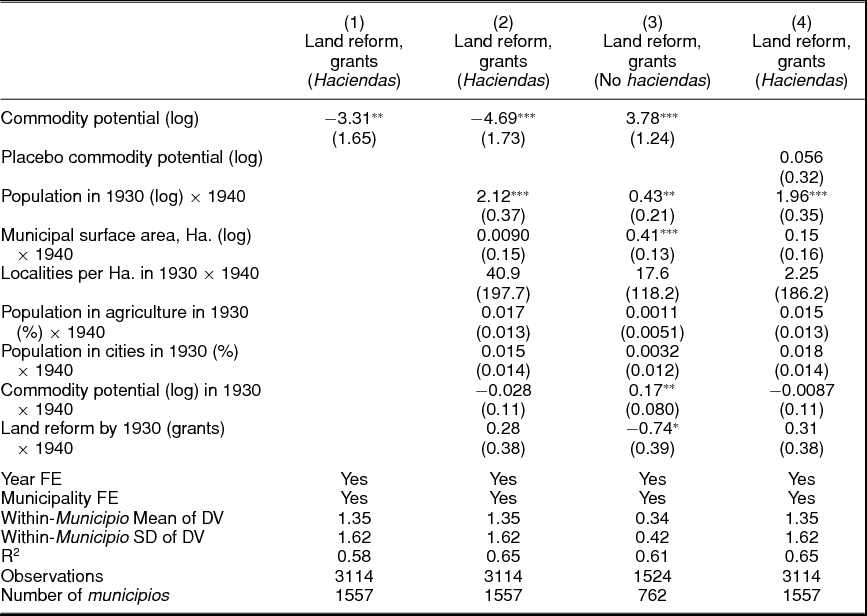
Changes in the municipio-specific commodity potential have the predicted effect on the trajectory of redistributive land grants, as Table 2 indicates. The effect is also large, negative, and statistically significant. A causal interpretation of the coefficient indicates that a one standard deviation decrease in within-municipio commodity potential leads to one additional land redistribution grant—an increase of almost 80% of a within-municipio standard deviation in the number of redistribution land grants. Again, the effect of the shock is not found in the placebo specification (when replacing commodity potential with its value ten years into the future, in column 4).
Commodity Shocks and Land Redistribution

OLS estimations. See Equation (1) for the econometric specification. The unit-of-analysis is the municipio year. Standard errors (clustered at the municipio level) in parentheses.
p < 0.10, ** p < 0.05, *** p < 0.01.
In places without estates, the shock does have an effect, but in the opposite direction: badly hit places redistribute less land. The theory presented here cannot account for this finding—it applies only to cases with a landed elite—but the absence of a similar effect to that estimated in places with estates helps increase the confidence in the interpretation of the results as supportive of the theory. In any case, the positive effect of shocks on land redistribution in the absence of a landed elite is not entirely surprising. A decline in the value of production would make the petitioning process, a costly affair for landless peasants without a powerful local sponsor, less attractive. This would lead to a lower likelihood of land redistribution in places without a landed elite, as the estimates in fact indicate. This finding, then, highlights the complementarity between the elite-driven account of land redistribution in Mexico presented in this article and demand-driven explanations, in which the dissatisfied and dispossessed peasants are at the center of land-redistributive outcomes (e.g., Saffon Reference Saffon2015; Sellars Reference Sellars2017).
Evidence of pre-Depression parallel trends. A key assumption required to interpret these estimates causally is that, in the absence of the shock, the trajectory of bureaucrats and land redistribution in places that were negatively shocked would have followed a parallel trend to that in relatively less affected places. This assumption, while untestable, implies that, prior to the shock, trends should be parallel between relatively affected and unaffected regions.
Figure 4 shows that this is the case for both land redistribution and bureaucrats. In both panels, I divide jurisdictions into groups of above- and below-average exposure to the shock. The lower panel shows that the trajectory of the number of land grants is parallel and almost identical between affected and unaffected municipios prior to the Great Depression. After the Depression, this trajectory markedly diverges, with most-shocked places experiencing more intense land redistribution than least-shocked municipios. For the case of bureaucrats, in the upper panel, I expand the post-revolutionary data with information from the 1900 Census—the only prior source of disaggregated information on public officials.Footnote 28 Similar to land redistribution, the trend in public officials per 1,000 people between most- and least-shocked jurisdictions is parallel—almost identical—prior to 1930. After the Great Depression, however, they diverge: bureaucrats substantially increase in negatively shocked jurisdictions, while they remain flat in relatively unaffected ones.
Parallel Trends in Bureaucrats and Land Redistribution Trends are parallel prior to the Great Depression.

In Section C.3 of the Online Appendix, I directly assess whether there are differential trends in local bureaucratic expansion prior to the Great Depression. I find that shocks on commodity potential during the Depression do not predict the pre-Depression trend in bureaucrats, which supports the plausibility of the parallel-trends assumption.
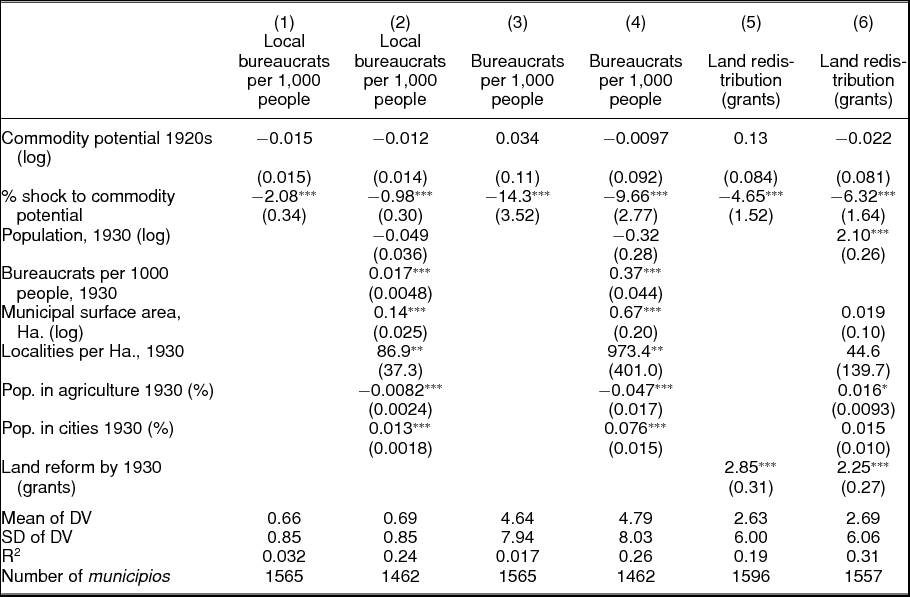
Cross-sectional design. So far, the analysis has focused on all types of bureaucrats. Does this pattern also hold when focusing only on local bureaucracy? Estimating the difference-in-differences Equation (1) for local bureaucrats requires disaggregated data for 1930, which are not available. For this reason, the cross-sectional empirical approach described above is implemented using only 1940 data. Table 3 presents the results; they suggest that the same pattern holds for local bureaucrats.
Commodity Shocks and Local Bureaucrats (1940)

OLS estimations. See Equation (2) for the econometric specification. The unit-of-analysis is the municipio. Municipios with haciendas. Robust standard errors in parentheses.
p < 0.10, ** p < 0.05, *** p < 0.01.
The first two columns present the estimation of the cross-sectional specification—Equation (2)—using local (municipal) bureaucrats. Using the model with controls, the relative magnitude is similar to using all bureaucrats (columns 3 and 4), but smaller than when using the difference-in-differences approach. The mean percentage shock to the commodity potential from the 1920s to the 1930s is associated with an increase of 13% of the cross-sectional standard deviation in the number of local bureaucrats per 1,000 people. The models for land redistribution (models 5 and 6) display the same pattern, with a negative and statistically significant effect of smaller magnitude than with the difference-in-differences estimation.
Summing up, both empirical strategies—a difference-in-differences approach that compares places differentially affected by the Great Depression price shocks and a cross-sectional design in 1940—suggest that negative price shocks generate substantial increases in the expropriation of the productive assets of a nonruling economic elite (through land redistribution), and in state capacity investments (through the number of bureaucrats).
Alternative interpretations. I have presented supportive evidence of the theory’s predictions, and provided three ways of increasing confidence in the interpretation of the results. First, by assessing the relationship between commodity shocks and state capacity/land redistribution in the absence of a landed elite; second, through a falsification test, using future commodity shocks. Both strategies provide results supportive of my interpretation. The placebo tests are estimated to be close to zero and insignificant in all cases, as is the effect of commodity shocks on state capacity in places without a landed elite. Finally, pre-Depression trends between most- and least-shocked jurisdictions are visibly parallel, and shocks on commodity potential during the Depression do not predict pre-Depression outcome trends, which supports the plausibility of the parallel trends assumption.Footnote 29
Yet, a competing interpretation that could be compatible with the results presented thus far is one in which the federal government directly attempted to create a broader political coalition that included the peasantry (e.g., Knight Reference Knight1992). According to this narrative, a coalition-building effort was launched by the federal government during this period that was successful enough to provide stability to the national PRI regime for decades to come. One implication stemming from this top-down account is that federal land redistribution efforts should have been focused in places with the highest likelihood of success: those where landowners were most weakened and thus least able to resist land redistribution.
When a land petition reached its final stage, at the national level, the president had the ability to definitively reject it. Thus, a strategic president seeking to incorporate peasants into his coalition without incurring high political costs should have approved incoming petitions at a higher rate in the worst-hit regions, where the landed elite was weakened. Using the difference-in-differences design from Equation (1), however, I find no relationship between shocks and presidential petition approval rates; a land petition was as likely to be approved by the president in badly hit regions as it was in unaffected ones (Table C.15 in the Online Appendix). That is, I find no evidence linking federal government actions to the differential commodity shocks after the Great Depression, as this top-down alternative explanation would have it. These results also rule out a second alternative interpretation, in which the federal government reacted to the Great Depression by redistributing land to prevent peasant rebellion (as the worst-hit areas might have been particularly prone to peasant unrest.)
Another alternative interpretation of the results highlights the role of peasant grievances. Negative commodity shocks might have intensified preexisting grievances, leading to increased peasant demand for land redistribution. On its own, however, a grievances-based explanation cannot fully account for the results for two reasons. First, grievances cannot explain the effect of negative shocks on capacity, as measured by the number of bureaucrats.Footnote 30 Second, the effect of the commodity shock—driven by international price changes—on material grievances depends on the structure of the labor market. In competitive labor markets, declining commodity prices should lead to lower wages, and thus to intensified grievances. In coercive labor markets, by contrast, negative price shocks increase wages, since they reduce the landed elite’s ability to enforce coercive institutions (Dippel, Greif, and Trefler Reference Dippel, Greif and Trefler2015). However, it is precisely in the places where one should expect labor-coercive arrangements to be present—in municipios with haciendas—where the negative shock leads to land redistribution. Even so, if in fact the commodity shock negatively affected peasants, this explanation can still be complementary to the theory presented here: grievances would increase peasant support available for local leaders to mobilize against the landed elite.Footnote 31
Persistence of early capacity. These results from Mexico provide support for the theory, but also raise additional questions about the long-run significance of early investments in local capacity. The evidence suggests that the patterns described above—more pronounced increases in capacity in places that were negatively hit by the commodity shock—endure over the long term.
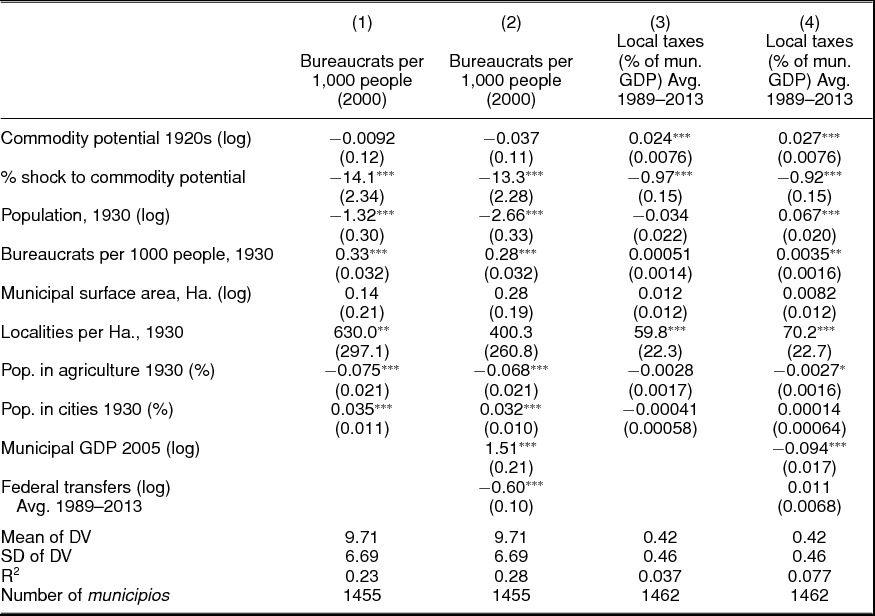
Table 4 provides suggestive evidence of this persistence. Using the cross-sectional empirical strategy, I find that two present-day outcomes—the number of bureaucrats per 1,000 people and local tax collection as a share of local GDP—are correlated with the Great Depression price shocks in the expected way. In addition to estimating models similar to those used for the shorter-term effects, columns 2 and 4 include, for reference, present-day controls (if the estimation were to be interpreted causally, however, their inclusion could induce post-treatment bias.) The magnitude of the effects relative to variation in state capacity outcomes is comparable to the shorter term effects presented in the last section (in Tables 1 and 3). This suggests that the shock might have set differentially exposed regions on distinct trajectories over the long-term. Early investments in capacity were important enough to differentiate the affected from the unaffected municipios for decades, amidst a process of national convergence in local state capacity.Footnote 32
Commodity Shocks and Long Term Local State Capacity

OLS estimations. See Equation (2) for the econometric specification. The unit-of-analysis is the municipio. Municipios with haciendas. Robust standard errors in parentheses.
p < 0.10, ** p < 0.05, *** p < 0.01.
One way to rationalize these findings is by considering the role that local political leaders played in the consolidation of the hegemonic party regime in Mexico. Stronger political bosses, with no landed elite to challenge their local authority, would have been in a better position to negotiate with the emerging national regime, securing the benefits of increased local capacity and enhancing their access to higher office. In Section A of the Online Appendix, I provide suggestive evidence on the geographical origins of national-level politicians in the intervening decades that supports this mechanism of persistence.
While the evidence in Table 4 suggests subnational persistence of early investments in local capacity, it is less informative about the long-term implications for national-level capacity in Mexico. Still, the proposed mechanism of persistence allows for some speculation about the less-than-stellar capacity of the central Mexican state today. As the federal government moved toward centralization in the decades after the revolution, it faced a host of consolidated local political leaders. To bring them into the PRI coalition, the national leadership had to make concessions that ran against its centralizing project, and, as a result, fell short of implementing a more thorough state-building program across the territory. Thus, despite political stability and the steady development of national-level capacity over most of the twentieth century—a remarkable feat, especially considering a markedly low initial capacity—the regional political configuration that emerged from the revolution limited the potential for higher capacity.
DISCUSSION
The argument presented in this article describes a low-capacity equilibrium, common throughout history, which emerges in contexts of intra-elite conflict unmediated by political institutions. Features of this equilibrium are present in late-medieval and early-modern European states, in nineteenth-century and early twentieth-century Latin America, and in some present-day states such as Afghanistan, Haiti, and the Democratic Republic of Congo (North, Wallis, and Weingast Reference North, Wallis and Weingast2009; Pincus and Robinson Reference Pincus and Robinson2011; North et al. Reference North, Wallis, Webb and Weingast2012).
Under these conditions, a disruption to the existing balance of power that temporarily strengthens rulers relative to their enemies can open a window of opportunity for rulers to consolidate their advantage. Political consolidation, by extending rulers’ time horizon, can create incentives to invest in future state capacity. While I focus my attention to local elite conflict in Mexico, these ideas can be useful to explain why capacity developed in other states trapped in low-capacity equilibria.
A case in point is the Dominican Republic, where the Great Depression plausibly played a similarly disruptive role. After close to a decade of U.S. occupation and six years of a fragile democratic spell, Rafael Leonidas Trujillo, the commander-in-chief of the National Guard, violently seized power. Regional caudillos, who had fueled political instability for half a century before the occupation, took to the hills in open rebellion against Trujillo. The Great Depression, however, reduced their available resources—acquired through the export of cacao and tobacco, as well as regional import duties—at a time that Trujillo had the support of the autonomous National Guard, established by the U.S. during the occupation (Cordero Michel Reference Cordero Michel2009; San Miguel Reference San Miguel2012). The rebels were swiftly defeated, and Trujillo moved to consolidate his power by eliminating the remaining caudillos, and initiating a limited land redistribution program in the 1930s (Turits Reference Turits2003).
Trujillo’s political consolidation brought venality and ruthlessness, but also important investments in capacity. A national identity card, issued for every citizen in 1932, laid the foundation for the introduction of personal income and property taxes, and, along with the first population census financed by a Dominican government in 1935, helped make its citizens visible to the state (Turits Reference Turits2003; Khan Reference Khan2010; Frankema and Masé Reference Frankema and Masé2014).
Mid-nineteenth-century Chile offers another example of opportunistic consolidation from a situation of intra-elite conflict, and ensuing investments in state capacity. The ruling coalition, composed of wheat-producing landlords in the northern central valley and merchants in Valparaiso, faced disgruntled agriculturalists in the southern central valley and copper miners in the northern desert, excluded from the distributive benefits of power (Saylor Reference Saylor2014). As international demand for copper expanded as a result of electrification, the increasingly wealthy northern miners and their southern agriculturalist partners launched two civil wars against the ruling coalition, led by President Manuel Montt, in 1851 and 1859.Footnote 33 Montt’s administration defeated the rebels in each of these episodes. These wars were preceded by sharp declines in the international price of copper, which may have limited the mining elite’s ability to sustain longer campaigns (see Figure B.5 in the Online Appendix.)
To consolidate their dominance in the face of temporary elite weakness, the ruling coalition wrestled regional political control from local elites through the Law of Municipalities, which expanded the ruling coalition’s power to control local affairs, elections, and the National Guard in rebel areas. Similarly, a repressive Civil Responsibility Law made the organizers of protests or rebellions personally liable to property damages (Ortega Martínez and Rubio Apiolaza Reference Ortega Martínez and Apiolaza2006; Saylor Reference Saylor2014). The central state also launched an aggressive expansion of primary education in rebel regions, aimed at asserting social control and expanding state capacity (Paglayan Reference Paglayan2017). Political consolidation was accompanied by investments in capacity in other areas. First, the central state sought to strengthen its presence in the regions by increasing the number and quality of bureaucrats deployed. Second, tax farming of a colonial-era agricultural tithe was replaced by a tax on agricultural production enforced directly by agents of the central state (Saylor Reference Saylor2014). Finally, political consolidation of the ruling coalition over the next decades facilitated the introduction of Chile’s first income tax, the mobiliaria, as the country faced economic crisis and the prospect of war in 1879 (Collier and Sater Reference Collier and Sater1996).
CONCLUSION
Large disruptions to the existing balance of power between elite groups can be conducive to the development of state capacity. Specifically, in contexts of intra-elite conflict, shocks may bring about political stability by disproportionately favoring the incumbent ruler, and opening a window of opportunity during which this short-lived strength can be consolidated. One such way is the expropriation of assets, like land, from the temporarily weak elite. By making it advantageous to expropriate a nonruling economic elite and extending the time horizon of rulers, these shocks can simultaneously induce higher investments in capacity, such as staffing bureaucracies and deploying public employees or introducing costly tax systems.
In this article, I develop this argument and empirically evaluate its observable implications with a research design that uses the Great Depression as a shock to post-revolutionary Mexico. By focusing on local political bosses that emerged from the revolution across the country, and using region-specific agro-climatic commodity potential in combination with commodity price shocks, I assess the effect of the Great Depression on both expropriation (land redistribution) and on a capacity-enhancing investment, the expansion of local bureaucracy. Negative shocks induce more land redistribution in places with a landed elite, as well as a substantial increase in the number of bureaucrats. These effects persist over the long term, suggesting that the Great Depression played an important role in the expansion of local state capacity for the case of Mexico. While this empirical evidence is subnational, the argument can help explain why capacity develops at the national level in states that are trapped in low-capacity equilibria, as the cases of the Dominican Republic and Chile illustrate.
The question of how capacity emerges is pressing. Underdevelopment is usually accompanied by ineffective states, and there is growing evidence that capacity can have a sizeable effect on long-term economic development. Though high capacity does not on its own guarantee that the right policies will be chosen, it expands the range of available government action, and opens the possibility for good governance. It has long been recognized that international conflict can promote the development of state capacity. However, uneven capacity in regions that have not experienced intense interstate conflict suggests that other factors are at play. This article offers an explanation, rooted in domestic conflict, for why states remain in low-capacity traps and how they escape them.
SUPPLEMENTARY MATERIAL
To view supplementary material for this article, please visit https://doi.org/10.1017/S0003055417000715.
Replication materials can be found on Dataverse at: https://doi.org/10.7910/DVN/KZIXI0.







Comments
No Comments have been published for this article.