Telephone quitlines are an easily accessible and effective means for delivering smoking cessation services and permit smokers to receive tailored behavioural counselling either alone or in combination with approved pharmacotherapy (CDC, 2004; Stead, Hartmann-Boyce, Perera, & Lancaster, Reference Stead, Hartmann-Boyce, Perera and Lancaster2013). Proactive telephone counselling, wherein one or more calls are initiated by a counsellor to provide support to participants, has proven to be particularly beneficial. A recent review found that compared to smokers only having a single contact with the quitline, those who receive one or more additional proactive calls have a 25% to 50% higher chance of quitting (Stead et al., Reference Stead, Hartmann-Boyce, Perera and Lancaster2013). Further, convincing evidence from multiple studies demonstrates that the addition of nicotine replacement therapy (NRT) to a quitline counselling service boosts registration and quit rates (An et al., Reference An, Schillo, Kavanaugh, Lachter, Luxenberg and Wendling2006; Cummings et al., Reference Cummings, Hyland, Fix, Bauer, Celestino and Carlin-Menter2006; Hollis et al., Reference Hollis, McAfee, Fellows, Zbikowski, Stark and Riedlinger2007; Miller et al., Reference Miller, Frieden, Liu, Matte, Mostashari and Deitcher2005). For instance, in a study of callers receiving 6 weeks of NRT, a random subsample of those receiving NRT and a non-random subsample of callers who, because of mailing errors, did not receive NRT were assessed. At a 6-month follow-up, callers who received NRT were significantly more likely to report smoking cessation (33% vs. 6%, p < 0.0001; Miller et al., Reference Miller, Frieden, Liu, Matte, Mostashari and Deitcher2005).
Importantly, overall smoking cessation rates achieved by quitlines still permit ample room for improvement. One study reports abstinence rates of 24% for participants receiving intensive phone counselling plus NRT (Hollis et al., Reference Hollis, McAfee, Fellows, Zbikowski, Stark and Riedlinger2007), whereas varenicline (VAR) has shown quit rates approaching 50% in clinical trials (Eisenberg et al., Reference Eisenberg, Filion, Yavin, Bélisle, Mottillo and Joseph2008; Gonzales et al., Reference Gonzales, Rennard, Nides, Oncken, Azoulay and Billing2006; Jorenby et al., Reference Jorenby, Hays, Rigotti, Azoulay, Watsky and Williams2006). VAR may show superior quit rates to the NRT routinely delivered by quitlines (Aubin et al., Reference Aubin, Bobak, Britton, Oncken, Billing and Gong2008; Kralikova et al., Reference Kralikova, Kmetova, Stepankova, Zvolska, Davis and West2013; Walker et al., Reference Walker, Gainforth, Kiparoglou, Robinson, van Woerden and West2017); however, this pharmacotherapy option has not been routinely investigated in the context of a quitline (Biazzo et al., Reference Biazzo, Froshaug, Harwell, Beck, Haugland and Campbell2010). One retrospective study of Montana Tobacco Quitline enrollees evaluated self-reported 7-day point prevalence abstinence at 3 and 6 months after programme completion; enrollees were able to self-select either VAR or NRT (Biazzo et al., Reference Biazzo, Froshaug, Harwell, Beck, Haugland and Campbell2010). Participants selecting VAR paid three $25.00 copays to the quitline over the course of 12 weeks of treatment, and were required to have their physician fax a prescription to a central pharmacy. Participants choosing NRT received 4 weeks of NRT (including patches, gum, or lozenges) for free and without a prescription through the quitline. VAR users were 28% more likely to be abstinent from smoking at 3 months compared to NRT users. While this study did not employ a randomised design, it did suggest that VAR may be a viable and effective option for distribution via a quitline.
The primary aims of the present study were to assess the feasibility of distributing VAR through the New York State Smokers’ Quitline (NYSSQL), and to compare cessation behaviours between those receiving mail-delivered VAR compared to mail-delivered NRT in a randomised active controlled pilot clinical trial.
Methods
This study was approved by the Roswell Park Cancer Institute Institutional Review Board. The study was conducted from June 4, 2013 through February 9, 2014. The CONSORT diagram depicting the flow of participants through the trial is presented in Figure 1.
CONSORT diagram.

Screening and Consent
All callers were screened for eligibility criteria using the established procedures of the NYSSQL. Quitline coaches conducted a verbal assessment of eligibility requirements using the NYSSQL's computerised baseline questionnaire. Each caller's score on the eligibility items was automatically tallied, and consent language was generated for the coach to read to the participant if they achieved an eligible score. Study participants had to meet the following eligibility criteria: (1) 18 years of age or older, (2) current cigarette smoker (defined as smoking ≥10 cigarettes per day), (3) calling the NYSSQL requesting assistance with quitting smoking, (4) currently under the care of a primary care physician (PCP), (5) eligible for receipt of pharmacotherapy by mail using the standard NRT criteria, (6) speak English, (7) not diagnosed with or treated for a mental health problem (e.g., major depression, bipolar disorder, dysthymia, or schizoaffective disorder), (7) no current or past suicidal ideation, (8) no history of allergic reaction to VAR, (9) not currently on hemodialysis, and (10) no current drug allergies. We excluded potential participants without a PCP to ensure that everyone randomised to the VAR Arm would have the same likelihood of being able to obtain a prescription for VAR. Participants who elected not to participate (or who dropped out during the study) were offered the opportunity to participate in the standard NYSSQL treatment, if eligible.
Randomisation
Callers who consented to participate in the study were enrolled and assigned the next sequential subject number that designated their allocation to study condition (VAR Arm, n = 200; or standard care NRT, n = 100). Randomisation was conducted in a 2:1 ratio due to the fact that we anticipated a higher rate of attrition in the VAR Arm given the extra steps needed in this condition to obtain the study medication. The randomisation method was programmed into the quitline's online data collection system. This centralised system allowed for randomisation on a per participant basis as callers phoned in to the quitline.
Procedures
At intake, the caller received general smoking cessation counselling as part of the standard quitline procedures and the medication protocol was initiated according to their study condition.
NRT arm
Participants in the NRT Arm were mailed three packages each containing 4 weeks of NRT patches per the standard quitline protocol for NRT delivery (Fiore et al., Reference Fiore, Jaen, Baker, Bailey, Benowitz and Curry2008). NRT was provided at no cost to the participant.
VAR arm
Participants in the VAR Arm were asked to contact their PCP as soon as possible to have a prescription for VAR sent electronically or by fax to the Research Pharmacy at The University at Buffalo School of Pharmacy and Pharmaceutical Sciences (UBSPPS). Depending on the PCP's policies, the PCP may have required an office visit with the patient prior to issuing a prescription. All participants were mailed a form, which contained information about VAR and pharmacy contact information, with explicit instructions that participants could access a pharmacist for additional information if necessary. The participant's PCP's name and contact information was also collected by the quitline coach and an information letter was faxed to the participant's physician to help facilitate the prescribing process. The quitline followed-up with participants about the status of their prescription 7–10 days from the date of initial enrolment, and attempted to reach them up to four times. Upon receipt of a valid prescription, participants in the VAR Arm received three mailings each containing 4 weeks of VAR at no cost to the participant.
A quitline coach also made proactive telephone calls to all participants two times to provide additional counselling and to verify that they wanted each additional 4-week supply of medication. Follow-up interviews were conducted by phone at 4 months after the participant's initial enrolment call to evaluate treatment effects. The coaches inquired about smoking status at this time point. Seven-day point prevalence abstinence was defined as no smoking (not even a puff) in the past 7 days. Counselling provided to participants in both arms of the study during these calls was based on the standard NYSSQL protocol. This counselling, delivered during two phone calls, focuses on coping with cravings, identifying triggers, and seeking support, among other coping skills-based strategies.
Data Analysis
Feasibility was assessed by calculating the proportion of enrollees who submitted a prescription, counting the number of kits successfully dispensed for each prescription, and evaluating self-reported reasons for not filling a prescription. Logistic regression analyses were conducted to evaluate the effects of treatment condition on 7-day point prevalence abstinence at the 4-month follow-up. For the intent-to-treat (ITT) analysis, the entire sample was included, and participants who did not respond at the 4-month follow-up were coded as smokers. We also conducted a per-protocol analysis, and that analysis included those participants who were mailed a supply of medication (for the VAR Arm, this required that they submit a prescription) and were successfully contacted at the 4-month follow-up. Among those who were contacted at the 4-month follow-up, we also evaluated participant-reported use of the medication between the two study arms. Further, a post-hoc exploratory analysis of the effect of insurance status on VAR prescription submission was conducted using logistic regression.
Results
Participant Demographics
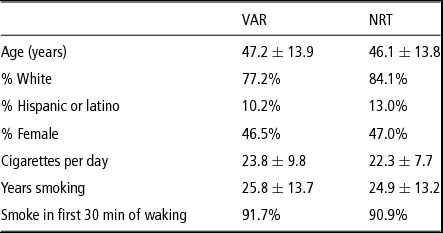
Participant demographics are presented in Table 1. There were no significant differences in demographics between treatment arms.
Participant demographics

Note. No significant differences in demographics between treatment arms. VAR refers to the varenicline arm; NRT refers to the nicotine replacement arm.
Feasibility
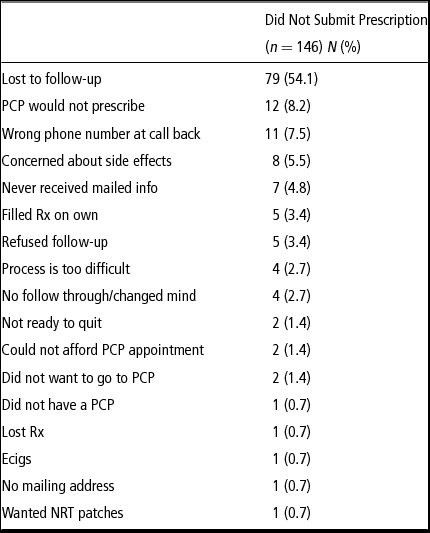
Within the VAR Arm, 27% (54/200) of participants submitted a prescription. Refills were requested by 36 (67%) participants at Month 2, and 18 (33%) participants at Month 3. Table 2 presents the reasons for not submitting a prescription, 54.1% of participants were lost to follow-up (54.1%) and 8.2% reported that their doctor would not prescribe. Only a small proportion reported that they had concerns about side effects from the medication (5.5%), or did not want to go to their PCP (1.4%). Hundred percent of the prescriptions and requested refills were filled by the Research Pharmacy at UBSPPS.
Disposition of participants and self-reported reasons for not submitting a varenicline prescription

Treatment Outcome
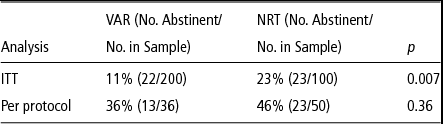
Treatment outcome data are presented in Table 3. An ITT analysis of the complete sample revealed those in the NRT Arm were more likely to be abstinent at the 4-month follow-up than those in the VAR Arm [23% (23/100) vs. 11% (22/200); Odds Ratio (OR), 2.42; 95% Confidence Interval (CI), 1.27 – 4.60; p < 0.01]. There were no differences in quit rates observed between the NRT and VAR Arms in the per protocol analysis [46% (23/50) vs. 36% (13/36), respectively; p > 0.05]. There were also no differences in self-reported use of the medication between the NRT and VAR arms [100% (47/47) vs. 93% (37/40), respectively; p > 0.05].
Self-reported 7-day point prevalence abstinence at the 4-month follow-up

Note. VAR refers to the varenicline arm; NRT refers to the nicotine replacement arm.
Role of Insurance Status
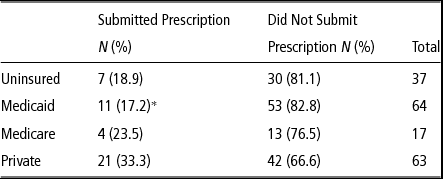
We conducted a post-hoc analysis to determine if insurance status was associated with whether participants submitted a VAR prescription. Participants in the VAR Arm who reported their insurance status at baseline were included in the analysis (n = 181 participants). As shown in Table 4, 17.2% of Medicaid, 18.9% of Uninsured, 23.5% of Medicare, and 33.3% of privately insured participants submitted a prescription for VAR. When compared to Private Insurance, Medicaid participants submitted fewer prescriptions (OR, 0.42; 95% CI, 0.18-0.96; p < 0.05).
Varenicline group insurance status and number of prescriptions submitted

Note. The * indicates p < 0.05 when compared to private insurance in a logistic model.
Discussion
This is the first study to evaluate VAR distribution through a quitline using a randomised design. The research pharmacy successfully received prescriptions and dispensed VAR through the quitline. However, only 27% of participants in the VAR Arm submitted a prescription, suggesting that although this approach is potentially feasible, it does not seem to be the most promising method for encouraging utilisation of this medication, as it did not lead to a high number of submitted prescriptions. The ITT analysis revealed that those in the VAR Arm were less likely to be abstinent at the 4-month follow-up than those in the NRT Arm, perhaps due to the dropout rates observed in the VAR Arm leading to fewer potential quit attempts without the support of pharmacotherapy. In contrast, there was no statistically significant difference in quit rates observed between the NRT and VAR Arms in the per protocol analysis. Further, insurance status may have contributed to the attrition in the VAR Arm.
The results in the present study are contradictory to prior research which reported that VAR may be more effective than NRT in reducing smoking rates in the context of a quitline (Biazzo et al., Reference Biazzo, Froshaug, Harwell, Beck, Haugland and Campbell2010). This may be due to the fact that participants in the study by Biazzo et al. (Reference Biazzo, Froshaug, Harwell, Beck, Haugland and Campbell2010) were able to select their own medication, instead of being randomised to a treatment condition. The methods with respect to submitting a prescription were similar in both studies. Interestingly, VAR was provided free of charge in the present study, while in Biazzo et al., a $25 monthly co-payment was required. Those who elected to take VAR and were willing to make the monthly co-payment may have resulted in a group of smokers more motivated and committed to taking VAR and therefore more likely to quit smoking. Random assignment to VAR in the present study may have attributed to a low rate of prescription submissions among persons assigned to VAR with lower levels of interest in using that prescriptive medication versus NRT. Further, insurance status may have played a role in the participant's ability to see a PCP if an office visit was required for a prescription, as those with Medicaid submitted fewer prescriptions than those with private insurance.
There are several limitations of the present study. First, this study was developmental in nature. We were evaluating a pilot study of this medication delivery model and only recruited 300 participants. In addition, approximately half of our sample was lost at the final, 4-month follow-up period. While this is not an unusual follow-up rate for quitline trials (An et al., Reference An, Schillo, Kavanaugh, Lachter, Luxenberg and Wendling2006; Cummings et al., Reference Cummings, Hyland, Fix, Bauer, Celestino and Carlin-Menter2006; Toll et al., Reference Toll, Martino, O'Malley, Fucito, McKee and Kahler2015), the results should be evaluated in the context of participant attrition. The 2:1 (VAR:NRT) randomisation plan was based upon an anticipated higher rate of attrition in the VAR Arm due to the imbalance of effort required to receive the medication. The VAR Arm had to take additional steps to receive the medication (e.g., calling or visiting their PCP), but the NRT group only had to place a call to the quitline. However, attrition was approximately 50% in both groups, which is consistent with prior studies but a higher than expected rate of retention for VAR. An additional limitation is the lack of blinding for participants and outcome assessors. With respect to generalisability of the findings, the demographics of the sample are representative of the general population of people who smoke and who call the quitline for assistance. However, this study excluded those who did not have a PCP which prevented nearly 50% of the screened sample from qualifying for participation. This may limit the generalisability of the present study to a larger population, and make the present methods for dispensing VAR through the quitline more challenging as a prescription from a PCP is needed for VAR prescribing.
While we developed a protocol for delivering VAR through the quitline, our data indicated that a sizable proportion of our pilot study sample did not submit a prescription. Although we queried participants regarding reasons for not submitting a VAR prescription, the responses were variable and did not suggest a major, readily addressable barrier which might be addressed in order to facilitate access to VAR. Some of the reported barriers included the participant being unable (or not wanting) to contact their PCP to obtain a prescription, and concerns regarding potential side effects. Future studies should try to reduce the burden of contacting a PCP, or helping the participant to identify a PCP in their area that they could visit. Alternatively, efforts could include direct contact with PCPs to educate them on the benefits of cessation, encouraging them to submit prescriptions for their participants who are interested in this medication, or directly faxing the prescription to the PCP to sign and return. Only a small percentage of PCPs would not submit a prescription to the research pharmacy used in our study, but they were willing to have the participant fill the prescription on their own (3.4%). This study may have encouraged a dialogue between participants and PCPs regarding smoking cessation and VAR that may not have happened otherwise. Pursuing strategies to build on the present study protocol, improving participant engagement with their PCP, or alternative methods for increasing access to VAR should be examined in future research.
Acknowledgements
None.
Financial Support
This research was supported by an Investigator Initiated Research Grant from Pfizer, Inc. The content is solely the responsibility of the authors and does not necessarily represent the official views of Pfizer, Inc. The senior author (BAT) had full access to all data in this study and had final responsibility for the decision to submit the paper for publication. Scientific and grant personnel from Pfizer, Inc. were permitted to read the manuscript before we submitted the paper, but no changes were made to the paper after it was read by personnel from Pfizer, Inc.
Conflicts of Interest
Dr Toll was the recipient of a grant for medicine only from Pfizer, Inc. that was used for this study. Pfizer, Inc. provided the 12 weeks of varenicline and 12 weeks of NRT administered in this study. He also receives funding as an expert witness in litigation filed against the tobacco industry.
Ethical Standards
The authors assert that all procedures contributing to this work comply with the ethical standards of the relevant national and institutional committees on human experimentation and with the Helsinki Declaration of 1975, as revised in 2008.