When Japanese sociologists have their articles published in journals or their books published, the focus is usually their own society. It is the case for Japanese sociologists. Therefore, ‘to discuss sociological analyses of Japanese society in Japan’ almost pertains ‘to discuss sociological analyses in Japan’. This task, however, is much too broad and too ambitious because it would cover thousands of books and journal articles. Needless to say, it is impossible to cover all the literature by Japanese sociologists, and who those ‘sociologists’ are is not even clear. We need to set clear foci on this ‘sociological analyses of Japanese society in Japan’.
To make this seemingly unmanageable task manageable, I need to focus this analysis upon a relatively small number of ‘representative’ articles by Japanese sociologists on Japanese society. A logical choice is to pick the top sociological journal in Japan, Shakaigaku Hyoron (Japanese Sociological Review, JSR hereinafter) which is published by the Japan Sociological Society. This publication is commonly regarded as the premiere outlet among Japanese sociologists. Probably not as prestigious as its American or British counterparts (American Sociological Review, American Journal of Sociology, or British Journal of Sociology), JSR is by far the most prestigious sociological journal in Japan. In fact, JSR is the only well-known general sociological journal in that country. Other journals are either more specific, oriented toward sub-areas of sociology or circulate in a particular region in Japan. What has been published in this particular journal in recent years represents the core work of Japanese sociologists during the period. Therefore, the present paper is a critical review of papers (and books reviewed) in this publication.
Sociological analyses of Japanese society can be examined from many different angles: from macro-micro perspectives, quantitative–qualitative perspectives, contemporary–historical perspectives, and theoretical–empirical perspectives. In addition, these analyses may be categorized by the subject they deal with, such as the type of social institution. In the following section, I present how and which articles and books are chosen, how they are classified, and what we can learn from these articles and books.
Methods
The first part of this study is a review of all peer-reviewed, published articles in JSR that analyze Japanese society. This analysis has been made possible only recently, as the Japan Sociological Society did not make the full text of volumes 58 (2007) and 59 (2008) available online until April 2010. Articles from the older issues (prior to 2007) were made available online in October, 2009. Articles from volumes 60–62 (published 30 September 2009) onward have not been made available due to their one-year embargo policy; our analysis of these 12 articles is solely based on the title and three key words provided for each article.
Excluded from this analysis are articles focusing on countries other than Japan and purely theoretical articles that do not discuss Japanese society. Although book reviews are excluded in the first part of the analysis, they are later analyzed in a separate section. We covered the five most recent completed volumes (issues 56(1) through 60(4)), or 20 issues with their published dates ranging from 30 June 2005 through 31 March 2010. While we could have covered for a longer period of time, say ten years, it was determined that the past five years provide us with a broad enough coverage of articles representing Japanese sociologists’ work on Japanese society.
The number of articles covered is 98. For 20 issues, this number appears small, and it is. The main reason for this is there are many purely theoretical articles that do not specifically examine Japanese society. This ‘theory-driven’ approach is particularly common when a special issue is published (typically three issues out of the four per year). While there are some articles specifically focusing on a non-Japanese society (Germany, Australia, the US, etc.), there are many more theoretical (i.e. non-empirical) articles in the journal not dealing with Japanese society in particular. Again, both types of articles are excluded from the present analysis.
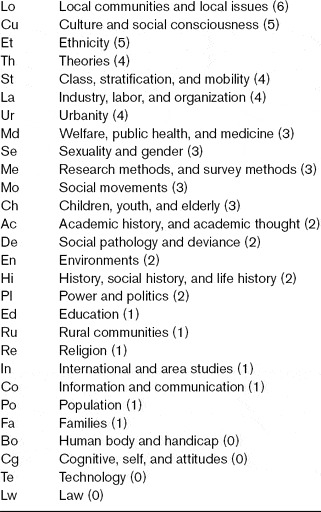
Each article has been read and categorized by two criteria. The first is their substantive focus. The classification is based on the sections in the Japan Sociological Society. The following has been extracted from the program for their Annual Meetings in November, 2010. Table 1 represents all substantive areas classified that have regular sessions plus four areas added for the present analysis. The list itself is interesting and somewhat indicative of what sociologists in Japan are interested in studying. We will see the distribution of the 98 articles according to this classification later.
Classifications by substantive areas

Notes: Numbers in parentheses represent how many regular sessions are held for each topic in the annual meetings of the Japan Sociological Society, 2010.
To classify each article based on these 28 categories, the choice was not always clear. Many articles covered multiple areas and identifying a single area for each was often arbitrary. The overall picture, nevertheless, represents a good summary of sociological work in Japan on Japanese society.
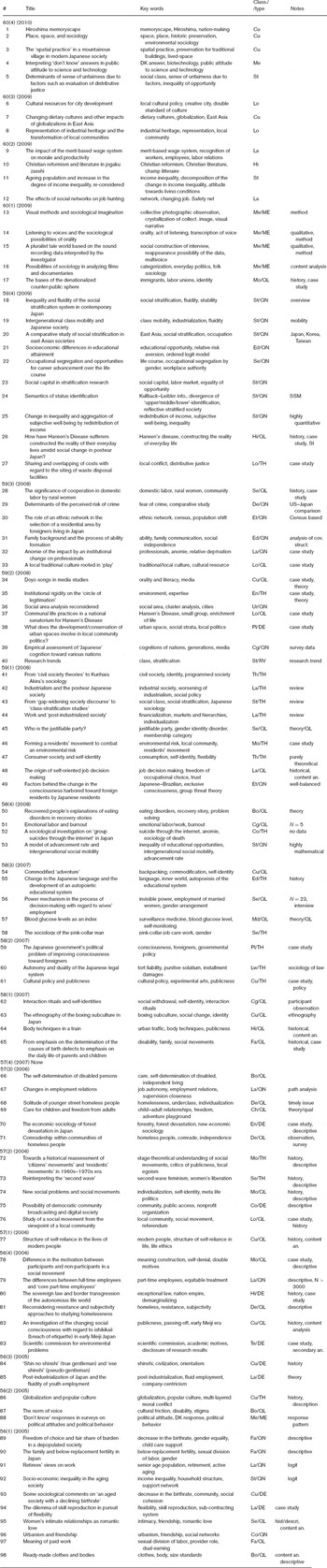
In addition to its substantive area of focus, each article is classified by the characteristics of its analytical nature. I tried to classify each of the 98 articles into several categories. Some articles have a theoretical (TH) focus, while others may mostly use quantitative (QN) or qualitative (QL) techniques for their investigation of a topic. There are mostly methodological (ME) inquiries of social phenomena in Japanese society, and there are articles that mostly described (DE) a certain (usually historical) event. Finally, there was one article that was primarily a review article (RV) on a particular topic, called ‘research trend’.
For each article, usually three key words are given to describe it in a concise manner. These key words are supplied by the authors in English in most cases, but I changed them in some instances to clarify the content of each article. In addition, my own notes, usually a couple of words, are added to each article to briefly describe it. They are based on my reading of each article, although I tried to make them as concise as possible to make the data manageable.
Table 2 lists each article's title, key words, classification/type, and notes. The titles were obtained from the English summary for each article.
Summary of JSR articles examining Japanese society, 2005–2010

Since this analysis utilizing JSR articles is based only on a collection of journal articles published in Japan examining Japanese society, it does not cover another critical medium of Japanese sociologists’ analyses on Japanese society, published books. It is, however, next to impossible to analyze all sociological books on Japanese society published recently. Reading all of them is out of question, but even collecting a representative group of books is not easy. For one thing, we don't know which books are written by ‘sociologists’. There are numerous books entitled, ‘Sociology of . . .’ in Japan, but many of them have little, if anything at all, to do with academic sociology. Worse yet, most sociological books published in Japan (or in the US, for that matter) do not carry ‘sociology’ in their titles. Therefore, compiling a list of sociological books about Japanese society is a very difficult task.
I decided to use JSR again; this time, its Book Reviews section. Just like the American Journal of Sociology and the British Journal of Sociology, JSR publishes book reviews in many, if not all, issues. The reviewed books are mostly selected by the editorial board and therefore deemed important in the field of sociology in Japan. Since our journal article collection was from 30 June 2005 through 31 March 2010, I tried to gather book reviews from the same period. For some reason, however, JSR did not publish any book reviews from issue 55(3) (31 December 2004) until issue 58(2) (30 September 2007). Therefore, we limited our book reviews to issue 58(2) through to issue 60(4) (31 March 2010).
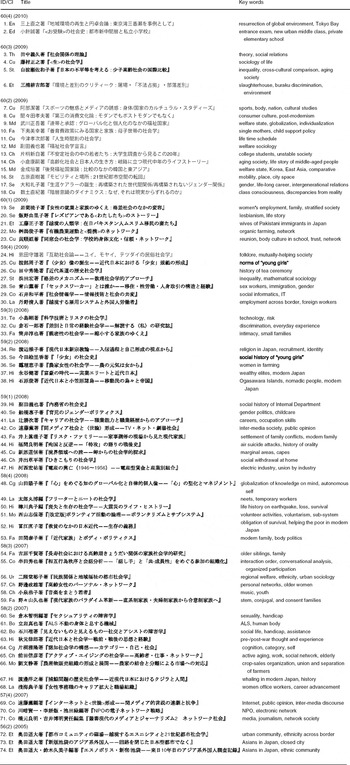
The selection criteria of the books were the same as those for articles; I kept only books that appear to discuss Japanese society. Excluded from our collection were purely theoretical books that do not examine Japanese society (e.g. social theory of G. H. Mead) and books dealing specifically with a society outside Japan (e.g. deafness in Africa and Buddhist monks in Northeast Thailand). In addition, we utilized three ‘thematic research trends’ or extended book reviews (usually dealing with two to five books) from issues 58(2), 57(4), and 56(2) (nine articles altogether). A total of 74 books were collected with this procedure (see Table 3 for the complete list). Since I tried to come up with key words in English mostly from the title of each book, these titles were not translated into English.
Summary of JSR book reviews examining Japanese society, 2005–2010

For the books reviewed in JSR, the only information shown in the table is classification (area of interest) and key words (mostly from the title) because these books are not all available. For that matter, the analysis based on books cited is not as strong/thorough as that based on articles.
Based on Tables 2 and 3, an extensive review is conducted to describe what and how sociologists in Japan analyze Japanese society. For each area of investigation and type of analysis, we will discuss some articles to represent a general trend in sociological analyses of Japanese society.
Findings
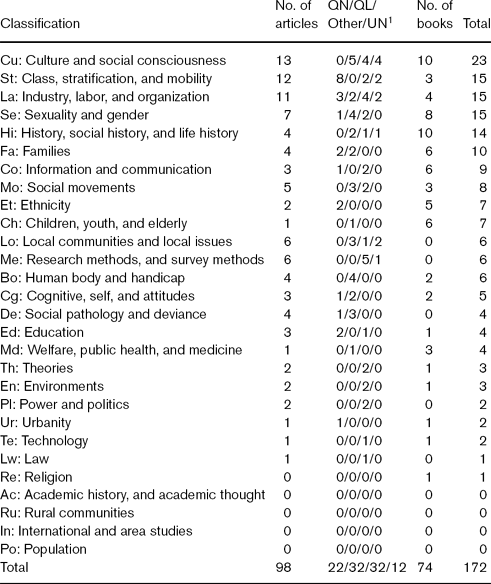
From Table 2, we can classify the 98 articles based on their foci, sub-areas, and types of investigation. As stated earlier, the three most recent issues (60(2), (3), and (4) are not yet available online; therefore, I excluded the first 12 articles from some of my analyses. From Table 3, we can classify the 74 books based on their foci and sub-areas. The findings on the sub-areas are presented in Table 4. Below, I will discuss observations on some major interest areas in sociological studies of Japanese society.
The distribution of articles and books reviewed by their substantive areas
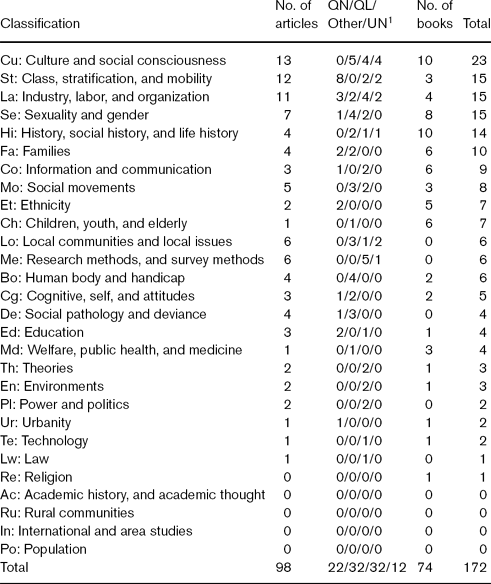
Note: 1. For the articles only, I counted the numbers of quantitative research article (QN), qualitative research articles (QL), other articles including purely theoretical, descriptive, methodological, and review articles (Other), and unknown (UN) for the 12 new articles embargoed online.
The area called ‘culture and social consciousness’ has the largest number of articles and books. One of the examples, Article 54 (A-54, Ohno, Reference Ohno2007), ‘Commodified “adventure”’ discusses how young Japanese ‘backpackers’ traveling in foreign countries became more ‘commodified’ or ‘packaged’ with the disguise of these travelers making their own individualized trips. This is an excellent article to describe ‘controlled freedom’, a type of deviant culture, enjoyed by youth in Japan in a larger context of capitalism. The same framework has been adopted in music, fashion, and youth culture in general. In fact, this recent boom of ‘backpacking’ itself was facilitated by a popular TV program in 1996 so that this ‘youth culture’ was a result of the main stream culture to begin with. Moreover, this commodification of ‘adventure’ involves not only Japanese travel industries (e.g. guidebooks) but also tour operators in such host countries as Thailand, Laos, and Vietnam, according to Ohno. The author also interviewed Japanese backpackers (citing five in the article), and this allows the readers to see the same phenomenon from the two opposite sides.
The article by Ikemoto (A-63, Reference Ikemoto2007), ‘The ethnography of the boxing subculture in Japan’ is another good example of an article on the area of ‘culture and social consciousness’. Through an ethnographical investigation, Ikemoto describes not only those who were interested in boxing, but also how teenagers are placed into different tracks and how they come to terms with these decisions. Boxing is used as a medium to describe a stifling reality in schools. These two articles are considered to be typical in Japanese sociology in two aspects: methods and subject areas. As stated above, the area of ‘culture and social consciousness’ boasts the largest number of articles published and books reviewed in JSR. As will be stated later, a large number of JSR articles are of qualitative in nature. For these two reasons, the two articles cited here are considered to be mainstream and typical articles. There are, however, other types of articles in JSR: descriptive/historical, theoretical, and quantitative articles. We will discuss these types of articles as we encounter them in the following sections.
Culture and social consciousness is a broad area that is central to sociology in Japan. No other discipline deals with them as well as sociology. These articles cover various subjects, including the analyses of collaboration between an art-related nonprofit organization (NPO) and Osaka City (A-61), how the idea of self-reliance was cultivated in pre-war Japan (A-77), and how the idea of ‘gentlemanship’ in modern Japan reflects the struggle to create a national identity (A-84). They represent another major type of sociological article on Japanese society in Japan. These studies are all historical or descriptive studies, and therefore, they are based on inductive, rather than deductive, reasoning. Instead of testing hypotheses or even generating them, they are concerned with particular cases of current or historical incidents.
The area of culture and social consciousness is the most common topic among the reviewed books also. Sociologists in Japan examine to only a somewhat small extent broader topics in their books, such as class reunion and social network (book review 23 (B-23)), the relationship between sports and media (B-7), the discrepancy between class consciousness and objective class position (B-18), and social history of the modern tea ceremony (B-26).
One potential issue of the subject matter (culture and social consciousness) is a lack of scientific rigor. For example, out of nine Cu articles for which the full text is available, none is a quantitative analysis, five are qualitative (including A-54 and A-63), two descriptive, and two others purely theoretical (see Tables 2 and 4). If we use a mixed method for this particular subject area, it may be possible to involve more sociologists and other scholars. Nevertheless, the fact remains that ‘culture and social consciousness’ is a bread-and-butter area in sociology of Japanese society in Japan.
‘Industry, labor, and organization’ has been a stronghold among sociologists in Japan, coined as ‘industrial sociology’, ‘sociology of labor’, or ‘sociology of organization’. This is an area somewhat intersecting with the field of economics, along with the next subject area in Table 4, ‘Class, stratification, and mobility’. Emile Durkheim examined the sociological consequences of an inherently economical concept of ‘division of labor’ for the first time in the history of social science (A-42, Tominaga, 2007), and, therefore, the affinity between sociology and economics is only expected. Recent examinations in this subject include such contemporary issues as effects of social networks on job hunting (A-12), fluidity and instability of youth labor (A-85, B-49), foreign workers in the employment system (B-30), consequences of the merit-based wage system (A-9), impacts of institutional changes on professionals (A-32), differences among types of employees (full- vs. part-time employees in A-79 and career- vs. non-career jobs in B-68), and retirees’ views of work (A-91), among others.
While Durkheim utilized the concept of ‘division of labor’, which originated in economics, for his sociological analysis of social cohesion and solidarity, Karl Marx tackled another fundamental issue of economics: redistribution of wealth. Many sociologists in Japan and elsewhere have been interested in this issue of the redistribution of wealth, usually labeled as research on social class and/or social stratification. Social mobility derived from these concepts focus upon changes in the social strata either across or within generation. Even though Japanese society is known to be less stratified than most other countries, this notion of social stratification/social class has been one of the core issues among sociologists in Japan. The analyses in this area are naturally quantitative in nature and Japan is no exception. The Social Stratification and Social Mobility (SSM) project has been collecting large-scale data on this subject every ten years since 1955 (Tanaka, Reference Tanaka2010). This data set has played a decisive role in the analysis of stratification and mobility in Japan. Many stratification specialists have been trained using this data set in Japan, though they may have ‘graduated’ from this data set in the later courses of their academic careers.
Accordingly, of the ten articles on ‘class, stratification, and mobility’ for which the full text is available, as many as eight are quantitative inquiries, leaving a theoretical piece (A-43) and a review (A-40). This heavy dependence on quantitative analyses is a unique characteristic of this area of research. Of all other areas listed in Table 4, only three more areas, ethnicity, education, and urban sociology have majorities of their articles utilizing quantitative analyses. SSM is the most popular data set in JSR articles, and all but one (A-92) quantitative analyses in the area of ‘class, stratification, and mobility’ reported their findings from this data set. While this is partly due to a special issue on stratification (issue 59(4)), with a collection of six quantitative articles which all used SSM data, the fundamental feature of this research area (dependence on quantitative inquiries) should remain the same if these articles are removed from our analysis and/or more issues are added to the present analysis.
Then, what type of research has been conducted in class, stratification, and mobility? Sato (A-18, Reference Sato2008) provides a concise and superb overview of stratification in contemporary Japan. According to him, stratification of initial job types by educational achievement has been strengthened; college graduates are much more likely to obtain regular, full-time jobs and tend to keep them longer than those without college degrees. Among those with only high school degrees, high-school-based recruitment has become much less prominent in the past couple of decades, pushing more high school graduates to irregular, often part-time jobs. In other words, he argues that while the systematic job stratification by education has been stable, the mechanism to provide jobs to high school graduates has become less stable. The weakening high school-based recruitment system results in emergence of ‘freeter’ and ‘neet’, which will be examined later.
Sato also shows that the effect of stratification on job changes has worsened in the last couple of decades. The mean decrease in earnings percentage upon job changes was larger among the well educated earlier, but it is now larger among the less educated. Moreover, the proportion of job changes due to positive reasons is getting smaller, indicating that many people are forced out of their jobs rather than have left for greener pastures. Finally, Sato shows that the intergenerational associations regarding income became a little stronger between 1995 and 2005 among both the top and bottom quarters in income strata. Overall, his argument indicates that there is a dualism in stratification in Japan; employment and income structure has been quite stable among the upper strata, while it has shown many signs of deterioration among the lower strata. It, therefore, could lead us to a wrong conclusion if we try to describe ‘the’ social stratification and/or mobility in Japan. This excellent article can be considered to be a ‘typical’ one for its combination between a popular subject area (stratification) and its quantitative nature (which is common in this particular area).
In the meantime, as one of the leading scholars on stratification research in Japan, Hashimoto (A-43, Reference Hashimoto2008) admits that, upon facing an apparently sudden widening inequality, conventional stratification research in Japan has not met public demand for sociology. Particularly imminent is the recent phenomena of ‘freeter’ (usually part-time workers in unstable jobs) and ‘neet’ (not in education, employment or training), which many agree are two of the most serious social issues in contemporary Japan. While they are separate issues, they share something in common: unproductive potential labor force among young people. These issues are often discussed in the context of not only stratification but also economic downturn, family, and even crimes. Sadly, no article tackling this issue was found in JSR. A review, however, was published in 2008 for a book appropriately called, ‘Sociology of Freeters and Neets’ (B-49, reviewed by Miyamoto, Reference Miyamoto2008). This is one of the few sociological books from the viewpoint of social stratification, edited by Hiroshi Taromaru, a well-known stratification specialist. Given how critical the issues of freeters and neets are for Japanese society in general this topic should be explored by Japanese sociologists specializing in stratification to a much greater extent.
While inequality has been the key concept of sociology from the onset of the discipline, socio-economic status is not the only source of inequality. Gender and ethnicity are two well-known additional sources of stratification, and, as such, these concepts have been extensively studied by sociologists in Japan regarding Japanese society. Japan has not been known to treat women on an equal footage as men. Women, particularly married women with jobs, have had hard times to juggle their domestic and work-related responsibilities. A couple of articles and some books examine this issue: A-22, A-56, B-17, B-19, and B-40. Here, I will discuss the two articles for which the full text is available.
Nakai (A-22, Reference Nakai2009) examined gender segregations in continuous labor force participation and career advancement over the life course. She showed that unlike many other countries, the positive effect of women's educational attainment on continuous full-time employment was not found in Japan. If women stay in full-time employment (not necessarily the same job), they are more likely to be in blue-collar or expert job sectors. Women in blue-collar or expert-job sectors, however, are less likely to be promoted to managerial or supervisory positions. While the educational achievement and the length of tenure in the same organization are the most critical factors for promotion among men, none of these factors is related to women's promotion to managerial/supervisory positions. Rather, for women, type of job (white-collar, male-dominated, or female-dominated jobs) is critical for whether they are promoted or not. While individualistic characteristics should determine workers’ promotion possibilities, for women organizational characteristics determine their promotion possibilities.
Sangu (A-56, Reference Sangu2007), on the other hand, focused on the decision of young married women who were expecting their first children on their employment. Of the 23 couples she interviewed, none disagreed on the decision between the spouses, negating the notion of ‘manifest power’ conceptualized by Komter (Reference Komter1989). Many couples did not even discuss the wife's employment plan between the spouses, and, for some couples, even discussing issues like this was out of question. Rather, some spouses (both husbands and wives) reconciled themselves to the wives quitting their jobs due to the lack of child-care facilities and/or working conditions, supporting Komter's idea of ‘latent power’. It is interesting to note here that the sources of this latent power are in the macro structure, contrary to the assumption made by Komter (belonging to one of the spouses or to the interpersonal relationship). Sangu also found that the idea of Komter's ‘invisible power’ was well represented in the decision of new mothers’ exit from the labor force. In addition to Komter's assumed source of invisible power (gender ideology), however, many wives decided to exit the labor force due to rational calculation involving gender differences in income and poor housework skills by husbands. While Sangu's findings generally support Komter's conceptualization of marital power, two modifications have to be made: macro-structural sources of latent power and rational calculation regarding invisible power.
The other thing I would like to add is what's not included (or underrepresented) in this table. For example, we have no articles or books dealing with the Japanese economy or economic sociology. Though we have a large number of articles and/or books related to stratification/mobility or labor/industry, we have no counterparts regarding the Japanese economy per se. While we can certainly imagine the sociological and/or social structural mechanism which led to the economic downturn in Japan in the past decade, we failed to find this type of ambitious analysis either in articles or books reviewed in JSR.
Just as sociologists in Japan are not much concerned about the economy, they rarely study politics. These disciplines outside sociology have their own methods, theory, and history, and I failed to see any trace of collaboration between sociologists and scholars in adjacent disciplines in Japan. Related to this point, there is little, if any, trace of interdisciplinary research involving Japanese sociologists. The only possible exception is history. Articles or books labeled ‘Hi’ in Tables 2 to 4 are often a cross between sociology and history. This observation is quite different from the sociological scene in the United States and many other countries. As a matter of fact, even co-authorships among two or more sociologists are extremely rare in Japan. Given an emphasis on group work in that country, this may be an interesting research topic to study by itself.
Sociologists and other social science scholars have been often criticized as having lost touch with social reality. We discussed how sociologists in Japan have (not) been dealing with the issue of freeters and neets, but it is just one example of a social phenomenon which needs to be analyzed within a sociological framework. After all, the discipline has a vast accumulation of sociological knowledge obtained over the past several decades, if not longer. We find some JSR articles in which the author tries to shed light on a contemporary issue. For example, there are three articles (A-68, A-71, A-81) examining homeless people, which is a growing concern in Japan as the employment structure for those with little human capital became less stable. This issue of homeless population is closely related to the issue of freeters and neets.
In A-68, Hayashi (Reference Hayashi2006) follows the paths of three young homeless people focusing upon how they move back and forth between the state of homelessness and attempts to become independent, and how they come to terms with their identity of ‘the homeless’. In A-81, Maruyama's (Reference Maruyama2006) interests are on homeless women and how they try to maintain their autonomy by resisting violence and other threats, clearly showing an interaction between economic and gender stratifications. Yamakita's (A-71, Reference Yamakita2006) analysis focuses on group dynamics among homeless people in a certain park. He pays attention to their use of the term, ‘comrade’ and the conflicts among these comrades. Many homeless leave the park due to conflicts (e.g. who prepares foods for others), but eventually come back to their ‘comrades’. As the author writes, homeless people in this park assured themselves that they ‘were embedded in social relationships with others, maintain social norms, and above all practice social life’ (p. 596).
Another gloomy phenomenon over the past decade in Japan is ‘mass suicide’. Several unrelated people meet each other through the Internet, get together usually in an automobile or a small room, light charcoal briquettes, and commit suicide through carbon monoxide poisoning. According to Sadakane (A-52, Reference Sadakane2008), 204 people committed/tried suicide in 69 incidents between February 2003 and the end of 2005. Sadakane claimed that these incidents were not a result of random acts and rather shared ‘an identical form’. Those who killed themselves were usually in their twenties or thirties, they almost always used charcoal briquettes, and the incidents occurred in two peak periods (around June 2003 and April 2005). Sadakane argued that this type of mass suicide could not be explained by any typology of suicides by Durkheim. Though they committed suicide together, they did so only because it was more effective, not because they looked for comrades in the last activity of their lives. Mass suicides were seen as a very private and even positive endeavor to the victims, somewhat similar to playing games. This analysis provides an excellent example to incorporate the sociological theories of Durkheim, Foucault, and Baudrillard to the contemporary issue of mass suicide in Japan.
Also not shown in this table are a large number of articles deemed purely theoretical without even mentioning Japanese society. Since the present review focuses on Japanese sociologists’ analyses of Japanese society, we excluded articles/books in which the authors did not mention Japanese society as their target. Many of these ‘theoretical’ pieces have little, if anything, to do with the social reality we face in contemporary society. Another problem of Japanese sociologists’ studies of Japanese society is their specificity or lack of generalizability. Many articles are detailed accounts of a specific case, including some historical accounts. These ‘case studies’, particularly non-generalizable ones, draw the attention of a small circle of scholars but may not appeal to a general audience, particularly those outside Japan. While the fact that all of JSR articles are printed in Japanese limits its attraction among foreign scholars, many abstracts written in English may not have appeal to scholars or other readers outside Japan.
It might be added that the articles examined in this analysis are likely to be highly theoretical or quantitative rather than being combinations of theoretical, qualitative, and/or quantitative analyses. One of the reasons is the restriction on their length. Probably for an editorial reason, all articles are restricted to around twenty published pages. This limit in JSR prohibits any hybrid articles of quantitative and qualitative analyses and/or empirical and theoretical examinations from being published there. Without other appropriate outlets for sociological articles to a general audience, it has been very difficult for Japanese sociologists to publish middle-length articles (say, those between 20 and 50 pages) on Japanese society.
In the United States, on the other hand, the American Journal of Sociology has been known to publish middle-length articles, oftentimes around 50 to 60 pages long. Though the leading sociological journal in the United States, American Sociological Review, rarely publishes articles over 30 pages long, the leading American sociologists can often choose other outlets for their articles. In other words, the leeway for writing sociological articles of length (and complication) seems to be limited in Japan. Books are often the only medium for long analyses, and at least one book reviewed here was originally an MA thesis (B-46), which is rarely published as a book in other countries.
Closing remarks
Needless to say, this is not a complete collection of sociological studies of Japanese society since 2005, but it is not too far-fetched to state that this collection of articles on Japanese society represents a core of the sociological examination by Japanese sociologists of Japanese society. While it may be difficult to underline key characteristics of sociological studies of Japanese society in Japan, several can be identified here. First of all, the majority of articles are either qualitative, theoretical, historical, or descriptive, rather than quantitative in nature. This is in stark contrast to sociological articles in the United States. Related to this characteristic, many sociological articles on Japanese society deal with abstract concepts instead of the more concrete, measurable aspects of society. In the present article, emphasized are articles on more concrete issues. Omitted are many articles full of jargon, which would attract few specialists in the subject. At the same time, however, there are quite a few articles dealing with such journalistic issues as neets, backpacking, youth culture, childcare, etc. This wide range of coverage can be considered as one of the characteristics of the sociological studies of Japanese society in Japan.
Going through JSR, however, we cover only about 170 sociologists (authors of the articles and books reviewed) for this period. The Japan Sociological Society boasts of more than 3,000 members as of this writing (October 2010). Therefore, we need to expand the scope of this analysis. One way to do so is to go back to, say, 2001. Another way to expand our focus is to include other journals (e.g. International Journal of Japanese Sociology, sponsored by the Japan Sociological Society). We may look into this possibility in the future.
About the author
Yoshinori Kamois an associate professor of sociology at Louisiana State University and lecturer at Keio University in Tokyo, Japan. His research interests include marriage and family in comparative perspectives (including division of labor, marital satisfaction/stability, living arrangements), inequality based on race, gender, and class, and aging issues. One of his recent publications is ‘The Aftermath of Hurricane Katrina: Aging Adults’ Psychological Well-being’ in Journal of Family Issues (Tammy Henderson and Karen Roberto as coauthors, 2011).