Ethnic conflict and secessionism pose a major threat to peace and stability in the twenty-first century. Together they are responsible for the death of millions of people around the globe, as well as the rape, torture, and impoverishment of millions of others. An estimated fifty-eight ethnic conflicts have occurred in the world from 1945 to 2000,1
Fearon and Laitin 2003.
Marshall and Gurr 2003.
Political decentralization is commonly believed, however, to reduce ethnic conflict and secessionism in the world today. Conventionally, decentralization is thought to reduce ethnic conflict and secessionism in democracies by bringing the government closer to the people, increasing opportunities to participate in government, and giving groups control over their political, social, and economic affairs.3
See Ornstein and Coursen 1992; Kaufman 1996; Lijphart 1977 and 1996; Lustik, Miodownik, and Eidelson 2004; Tsebelis 1990; Horowitz 1991; Gurr 2000; and Stepan 1999.
The goal of this article is to explain why political decentralization is more successful in reducing ethnic conflict and secessionism in some democracies than in others. This study focuses on democracies because decentralization is only genuine in democracies. Although some nondemocracies, such as Ethiopia, Serbia, and Montenegro, and the United Arab Emigrates, assign decision-making powers to regional legislatures in principle, in practice these nondemocracies infringe on the jurisdiction of these legislatures, flout the legislation they produce, and install regional politicians that do not challenge the national government's authority.4
I consider countries democracies if they score a 5 or higher on the Polity IV (0–10) index of democracy.
A growing number of scholars suggest, however, that political decentralization does not reduce ethnic conflict and secessionism, rather, it intensifies it by reinforcing regionally based ethnic identities,5
producing legislation that discriminates against certain ethnic or religious groups in a country,6 and supplying groups at the regional level of government with the resources to engage in ethnic conflict and secessionism.7 These works identify important ways in which decentralization may increase ethnic conflict and secessionism. These scholars cannot explain, however, why decentralization is more successful in reducing ethnic conflict and secessionism in some countries than in others, because their works imply that all decentralized systems of government always increase ethnic conflict and secessionism. My study builds on the work of these scholars by identifying the conditions under which decentralization generates ethnic conflict and demands for independence in the ways these scholars describe. In this article I demonstrate that the strength of regional parties is the key factor determining the ability of decentralization to reduce ethnic conflict and secessionism. Decentralization increases the strength of regional parties in countries through the opportunities it provides regional parties to win elections in regional legislatures and influence policy.8See Chhibber and Kollman 1998 and 2002; and Brancati forthcoming.
Regional parties, in turn, increase ethnic conflict and secessionism by reinforcing regionally based ethnic identities, producing legislation that favors certain groups over others, and mobilizing groups to engage in ethnic conflict and secessionism or by supporting terrorist organizations that participate in these activities. Several scholars have noted how particular regional parties may produce these effects.9
But only a few scholars have made claims about regional parties more generally and only in terms of their effect on ethnic identities.10 None of these scholars, moreover, have recognized the link between decentralization and regional parties.The methodological approach of this article advances previous studies of decentralization and regional parties. Most studies of decentralization explore the effect of decentralization on ethnic conflict and secessionism using either illustrations of different countries to demonstrate their arguments or qualitative case study analysis.11
See Horowitz 1991; Kymlicka 1998; Nordlinger 1972; Ornstein and Coursen 1992; Snyder 2000; Brubaker 1996; Bunce 1999; Leff 1999; and Roeder 1991.
Most analysis of regional parties are similarly limited because they are based on either certain regional parties, such as the Scottish National Party in the United Kingdom or the Northern League in Italy,14
or on certain regions of countries, such as the Basque Country and Catalonia in Spain or the Northeast region in India.15See Alkartasuna 1998; Llera 1993; Marcet and Argelaguet 1998; Banerjee 1984; Bhatnagar and Kumar 1998; Gassah 1992; and Kumar 1986.
Rocca 1999.
In this analysis I try to theorize more generally about the effects of decentralization and regional parties on ethnic conflict and secessionism and to rigorously test these claims through a large-N statistical analysis of thirty countries around the world from 1985 to 2000. This analysis is based on an original data set of constituency-level election results, which allows me to measure the strength of regional parties in countries, as well as the Minorities at Risk (MAR) project,18
CIDCM 2002.
Definitions
Ethnic conflict refers to a very specific phenomenon. Ethnic conflict encompasses all forms of small- and large-scale acts of violence between and among different ethnic groups.19
Horowitz 1985. Some definitions of ethnic conflict argue that ethnicity must also play a causal role in the conflict—something difficult to determine in practice. See Sambanis 2001; and Lake and Rothchild 1996.
Hechter 1992.
Political decentralization is a system of government in which there is a vertical division of power among multiple levels of government that have independent decision-making power over at least one issue area.21
See Riker 1964; and Rodden 2004. Political decentralization, as it is defined here, is sometimes known by different names, including federalism, see Riker 1964; policy decentralization, see Rodden 2004; or decision-making decentralization, see Treisman 2002. Increasingly, scholars are replacing the term federalism with the term decentralization for various reasons, including the desire to consider countries that do not describe themselves as federal, such as Spain or Italy, but which have subnational governments with independent decision-making powers, as decentralized.
Finally, regional parties, narrowly defined, are parties that compete and win votes in one region of a country. Regions are conceptualized in this article as the political regions of a country, which represent the level of government directly below the national level of government. In the United States, these regions are the states, such as New York, New Jersey, and Massachusetts. I define regions in this way because the political regions of a country largely coincide with the boundaries of regional legislatures. This is important because decentralization increases the strength of regional parties through regional legislatures, which in turn reduce ethnic conflict and secessionism by giving groups control over their political, social, and economic affairs. Besides competing in only certain regions of countries, regional parties tend to focus their agendas on issues affecting particular regions of countries. Regional parties stand in stark contrast to statewide parties, which compete and win votes in every region of a country and tend to focus their agendas on national issues. Parties, such as the Quebec Party in Canada, the Basque National Party in Spain (PNV), or the Dravida Munnetra Kazagham (DMK) in India, are all examples of regional parties.
Regional parties are not necessarily ethnic parties. An ethnic party “represents itself as the champion of the cause of one particular ethnic category or set of categories to the exclusion of others, and makes such a representation central to its mobilizing strategy.”22
Chandra 2004, 3. Unfortunately, it is not possible to separate out the effects of regional parties from ethnoregional parties because cross-national data on ethnic parties for this whole time period is not available.
The Contrasting Effects of Political Decentralization
Decentralization is supposed to reduce ethnic conflict and secessionism by bringing the government closer to the people, increasing opportunities to participate in government, and ultimately giving groups control over their political, social, and economic affairs.23
See Ornstein and Coursen 1992; Kaufman 1996; Lijphart 1977 and 1996; Tsebelis 1990; Horowitz 1991; Gurr 2000; Stepan 1999; and Lustik, Miodownik, and Eidelson 2004.
A number of scholars suggest that decentralization increases ethnic conflict and secessionism and offers various reasons for this effect. Some scholars suggest that decentralization increases ethnic conflict and secessionism because it reinforces ethnic identities by recognizing certain ethnic groups in countries and giving them a sense of legitimacy.24
Other scholars argue that decentralization increases ethnic conflict and secessionism by enabling groups to produce legislation that discriminates against regional minorities,25 while a third group of scholars suggests that decentralization encourages ethnic conflict and secessionism by providing regions with certain resources that make engaging in ethnic conflict and secessionism easier to do, such as regional legislatures, regional forms of media, and regional police forces.26See Bunce 1999; Kymlicka 1998; Leff 1999; Snyder 2000; O'Leary and McGarry 1995; Riker 1964; and Snyder and Ballentine 1996.
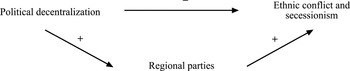
These two contrasting arguments can be reconciled, however, by looking at the intervening effect of regional parties. While political decentralization may reduce ethnic conflict and secessionism directly, as other scholars have observed, by bringing the government closer to the people and increasing opportunities to participate in government, it increases ethnic conflict and secessionism indirectly by increasing the strength of regional parties in countries. Regional parties intensify ethnic conflict and secessionism by reinforcing ethnic and regional identities, producing legislation that causes certain groups to feel threatened in a country, and mobilizing groups to engage in ethnic conflict and secessionism or supporting terrorist organizations that participate in these activities.27
See Riker 1964; and Filippov, Ordeshook, and Shvetsova 2004, for a discussion of the importance of national party systems in the maintenance of federal systems.
Decentralization encourages the growth of regional parties, as scholars have noted, through the opportunities it provides regional parties to win elections at the regional level of government and influence policy.28
See Brancati forthcoming; and Chhibber and Kollman 1998 and 2002.
Chhibber and Kollman do not measure the effect of decentralization on regional parties in particular. Their measurement of parties includes statewide parties that do not compete in every constituency of a country, as well as regional parties.
Brancati forthcoming.

Path analysis
In this study I also show that political decentralization promotes regional parties more in some countries than in others, depending on different features of decentralization. This fact is the key reason for decentralized systems of government being more successful in reducing ethnic conflict and secessionism in some countries than in others. These features of decentralization include the size of regions, the number of regional legislatures in a country, the method used to elect upper houses of government, and the sequencing of national and regional elections. Having large regions, many regional legislatures, upper houses of government elected or appointed by regional legislatures and noncurrent national and regional elections increases the strength of regional parties in countries.31
In related work, Gary Cox (1997) shows that nonconcurrent executive and legislative elections decrease the overall number of parties in national legislative elections.
In this article, however, the focus is not on the effect of decentralization on regional parties, but on the effect of decentralization and regional parties on ethnic conflict and secessionism. Regional parties increase ethnic conflict and secessionism by reinforcing ethnic identities, passing legislation that is harmful to regional minorities, and mobilizing groups to engage in ethnic conflict while using the resources decentralization provides them to do so. Several scholars have noted how particular regional parties may produce some of these effects.32
Some scholars have even recognized how regional parties, in general, may reinforce ethnic identities,33 but none has recognized the link between decentralization and regional parties.Regional parties reinforce regional and ethnic identities by making people who possess certain physical characteristics or live in certain locales think of themselves as a group with shared needs and goals.34
Ibid. Regional parties reinforce ethnic identities only when ethnic and regional boundaries coincide.
The Northern League, a regional party in Italy, has successfully reinforced regional identities in this way. In order to make people living in Northern Italy think of themselves as Northern Italians, the Northern League produced and distributed special identification cards for residents of the “Free Republic of Padania,” published paper focusing on issues affecting only Northern Italy, and invented a flag of a green sunset against a white field to represent Padania. The Northern League even formed a human chain in one demonstration along the Po River to delineate the physical boundaries of Padania from the rest of the country. The Northern League did not invent the term Padania. The term describes the plain area surrounding the River Po and is derived from the name of the river. The Northern League did, however, appropriate the word to describe the people of Northern Italy as a nation.
Statewide parties, in contrast, do not reinforce regional identities, because they strive to make people living in a whole country feel united in a common fate.36
Statewide parties may reinforce ethnic identities when ethnic groups are not territorially concentrated. Decentralized systems of government have no effect, however, on ethnic conflict when ethnic groups are not territorially concentrated in the first place.
Regional parties also promote ethnic conflict and secessionism by producing policies at the regional level of government that threaten regional minorities. In 1977, the Quebec Party, a regional party in Canada, adopted a law that threatened English speakers in Quebec by allowing only children whose parents attended English schools in Canada to attend English-language schools in Quebec. The law also prohibited all languages other than French on public and commercial signs.37
The Supreme Court of Canada declared the latter part of this law unconstitutional ten years later.
If the minority groups do not have a presence in any other region of a country, both statewide parties and regional parties may produce legislation that is harmful to minority groups in these regions.
The Congress Party, a statewide party in India, did not support legislation advocated by the People's Democratic Party (PDP), a regional party in Jammu and Kashmir, for this reason. The legislation, known commonly as the Daughter's Bill (2004), prevents a woman who marries a non-Kashmiri man from passing on immovable property to her husband or children upon her death. The law was intended to prevent an influx of immigrants into the Muslim majority region of Jammu and Kashmir and to preserve Muslim culture. The Congress Party did not vote for the bill, however, because it drew considerable support from non-Muslims and women outside the region, who were either directly harmed by the law or who viewed the law as discriminatory against their people. Statewide parties are also unlikely to pass legislation heavily favoring one region of a country over another at the national level of government because they risk losing the electoral support of the neglected region by doing so. Whether statewide parties do or not, depends of course on the electoral importance of a region, as well as the particular ethnic groups within a region.
Finally, regional parties may increase ethnic conflict and secessionism by mobilizing groups to engage in ethnic conflict and secessionism, while using the resources decentralization provides them to achieve these goals, such as regional legislatures, regional forms of media and regional police and militia forces. In the former Yugoslavia, regional parties in Croatia and Slovenia used regional militia forces to fight for independence in the 1990s. Regional parties have also supported terrorist organizations that engage in these activities as well. In Northern Ireland and Spain regional parties, such as Sinn Féin and Herri Batasuna, have bolstered terrorist organizations, such as the Irish Republic Army (IRA) and Euskadi Ta Azkatasuna (ETA) respectively. Batasuna has supported ETA financially by collecting the proceeds of ETA's “revolutionary tax,” a local tax that businesses must pay if they do not want ETA to attack them. Batasuna also uses the Basque media to support ETA and its goals and even uses its offices to store guns and ammunition for ETA.
Causal Direction
An alternative explanation, however, for the argument presented in this article is that the presence of ethnic conflict and secessionism causes countries to adopt decentralized systems of government, not vice versa. According to this view, countries that are more prone to experience ethnic conflict and secessionism, not only have deeper regional cleavages and stronger regional parties, but are also more likely to adopt decentralized systems of government than countries less prone to experience ethnic conflict and secessionism. While the potential for conflict and secessionism as well as the presence of regional parties in a country may contribute to decentralization, they cannot account for why countries adopt decentralized systems of government in the first place.
Decentralized systems of government do not have higher levels of ethnic conflict and secessionism than centralized systems of government, as this alternative explanation suggests, and then do not necessarily have stronger regional cleavages than centralized systems of government either. While many decentralized systems of government have strong regional cleavages, decentralization cannot be completely attributed to strong regional cleavages. Many decentralized systems of government have weak regional cleavages, including Australia, the former Czechoslovakia, and the United States, while many centralized systems of government have strong regional cleavages, including Bolivia, Romania, and Sri Lanka.39
Regional cleavages are strong when the political, social, and economic differences between regions are significant. Conversely, regional cleavages are weak when these differences are small.
Many countries with strong regional cleavages are not decentralized because national leaders are unwilling to relinquish power to decentralize, or because national leaders fear that decentralization will increase ethnic conflict and secessionism, not decrease it.40
Sri Lanka, Madagascar, and Uganda are all examples of countries that have been reluctant to adopt decentralization because of its potentially negative consequences on conflict and secessionism.Many countries, moreover, have adopted decentralization for reasons other than the need to manage ethnic conflict and secessionism. Some countries, such as the United States and Canada, have adopted decentralized systems of government to unite different territories into a single country, protect themselves against external military threats,41
and achieve economies of scale.42 Some countries also have decentralized systems of government because they are large and cannot be easily managed from a single central government located far away from most of its constituents.43Other countries, such as Nigeria and South Africa, have decentralized systems of government because they are former colonies of the United Kingdom. The United Kingdom used decentralization to maintain control over its colonies and extract taxes from its territories. Many of these colonies have continued to use decentralization after gaining independence because decentralization entrenched regional elites who were unwilling to relinquish power once their colonies gained independence.44
Other colonial powers, including France and Spain, did not use this system of government to maintain control over their colonies, even though their colonies were diverse ethnically and religiously.Finally, even if decentralized systems of government experience higher levels of ethnic conflict and secessionism than countries with centralized systems of government, decentralization can still diminish the intensity of ethnic conflict and secessionism once it has been adopted. In the United Kingdom, intercommunal conflict decreased according to the MAR project from “sporadic violent attacks” to “political agitation” after this country decentralized by extending autonomy to Northern Ireland in 1998 and Scotland and Wales in 1999.45
CIDCM 2002.
A second possible alternative explanation for the argument presented in this article suggests that regional parties do not have an intervening effect on ethnic conflict and secessionism, but that regional parties cause decentralization in the first place. Decentralization is not attributable to regional parties, however. As already mentioned, countries decentralize (and do not decentralize) for many reasons unrelated to regional parties, resulting in some decentralized countries, including Australia, the United States, and India (pre-1990s), having weak regional parties and some centralized countries, such as Mauritius or Trinidad and Tobago, having strong regional parties.
While regional parties may pressure countries to decentralize,46
they usually do not have the political power to force countries to decentralize and are often unable to credibly threaten to secede. For decades, regional parties in Northern Ireland, Scotland, and Wales adamantly demanded either autonomy or independence from the United Kingdom—demands that successive Labour and Conservative governments ignored, that is, until the late 1990s, when the Labour Party embraced decentralization, suggesting that pressure from regional parties is not enough to cause a country to decentralize. The Labour Party also suspended Northern Ireland's legislature in 2001 despite pressure from regional parties, suggesting that pressure from regional parties is not enough to prevent a country from centralizing either.In most, if not all countries, statewide parties are responsible for adopting decentralization. In India, the Congress Party adopted decentralization. In Eastern Europe, communist parties in the former Czechoslovakia, Yugoslavia, and the Soviet Union instituted decentralization, although decentralization was not genuine until after these countries democratized. More recently, in Latin America, various statewide parties have initiated decentralization reforms, believing that their electoral prospects are greater at the regional level of government than at the national level of government.47
Even if it were the case that countries decentralize because of pressure from regional parties, certain characteristics of decentralization increase the strength of regional parties more than others.48
Brancati forthcoming.
Finally, a third possible alternative explanation for the argument presented in this article is that ethnic conflict and secessionism cause regional parties, not vice versa. Ethnic conflict and secessionism are unlikely to foster the rise of regional parties, however, because neither phenomenon arises spontaneously.49
Rather, groups must be organized to engage in ethnic conflict and secessionism even if they have clear grievances against the government or each other. Regional parties play precisely this role by helping groups to overcome their collective action problem. Moreover, rather than produce regional parties, ethnic conflict and secessionism are more likely to dampen support for regional parties because as conflicts drag on, citizens often grow weary of violence as well as those parties that helped incite the violence.To further explore the possibility of endogeneity in this study, I conduct an instrumental variable regression analysis (not shown).50
The results of this analysis are available from the author on request.
My instruments for decentralization are UK colonial legacies, physical size of a country, and territorial contiguity. My instruments for regional party strength are two indicator variables representing the sequencing of executive and legislative elections.
Data and Measurements
In order to evaluate the effect of decentralization and regional parties on ethnic conflict and secessionism, I conduct a statistical analysis of thirty countries around the world drawing on two major data sets for this analysis. The first is an original data set of constituency-level election results for fifty democracies around the world from 1945–2002.52
I collected this data by contacting every country in the world that met the following two requirements: (1) its elections are democratic, scoring a five or higher on the Polity Index (0–10); and (2) it held at least two consecutive elections under the first requirement so that there is a potential for a turnover in power. Seventy-five countries met this requirement, and I was able to acquire data for fifty of them.
Of these fifty countries it is only possible to measure regional party strength in thirty-seven countries because the constituency-level of government is larger than the regional level of government in thirteen countries. I do not expect, however, the exclusion of these countries to bias the results because the size of an electoral constituency is not related to decentralization or ethnic conflict and secessionism.
The second is the MAR data set, which provides data on ethnic conflict and secessionism for “at-risk” groups within countries on a yearly basis from 1985 to 2000.54
CIDCM 2002.
Ibid.
The analysis borrowing from these two data sets includes the following thirty countries from 1985 to 2000: Argentina, Belgium, Bolivia, Bosnia-Herzegovina,56
Some scholars may object to the inclusion of Bosnia-Herzegovina in this analysis since it was under the control of the North Atlantic Treaty Organization (NATO) in the 1990s. The substantive conclusions, however, one draws from the analyses to follow are the same whether or not Bosnia-Herzegovina is included.
All of these countries are not represented every year of the period because some countries did not exist for this entire period (Bosnia-Herzegovina), and because some countries did not democratize until the early 1990s (Niger, Romania, and South Africa) or the late 1990s (Indonesia and Mexico).
I determine the regional concentration of each group in the MAR data set using MAR's group concentration index. The group concentration index places ethnolinguistic groups into four different categories: (1) widely dispersed; (2) minority in one region or primarily urban; (3) majority in one region and dispersed in others; and (4) concentrated in one region. Using various different resources, I divide the second category of this index into two different categories—one representing groups that are primarily urban and one representing groups that are a minority in one region. This distinguishes groups such as the Irish, who form a minority in Northern Ireland, from Asians and Afro-Caribbeans in the United Kingdom, who live primarily in urban areas of the country. I then eliminate from this study all groups that are either widely dispersed or primarily urban, and all countries containing only these types of groups.
These countries include Belgium, the former Czechoslovakia, Finland, Norway, Poland, Slovenia, and Sweden. I determine the level of intercommunal conflict and antiregime rebellion in these countries based on newspaper accounts available from Lexis-Nexis, Human Watch reports, and other resources.
Dependent Variables
I measure the intensity of ethnic conflict and secessionism in this study using two variables from the MAR data set—antiregime rebellion and intercommunal conflict. Antiregime rebellion refers to “all conflicts between minority groups and states and between minority groups and dominant groups exercising state power.”60
CIDCM 2002.
The MAR data set provides data on antiregime rebellion for “at-risk” groups on a yearly basis from 1985 to 2000, recording the highest form of antiregime rebellion experienced by a group in a country per year. Antiregime rebellion is divided into seven categories, ranging from low to high levels of rebellion (see Table 1).
Antiregime rebellion and intercommunal conflict measures

The level of antiregime rebellion varies considerably within and across countries in this study. The most intense forms of antiregime rebellion have occurred in India and Turkey. In Turkey, the Kurds were involved in a “protracted civil war” against the government for most of the 1990s, while in India, the Assamese, Kashmiris, and the Sikhs were involved in “large-scale forms of guerrilla activity” throughout this period.61
Ibid.
Intercommunal conflict, meanwhile, includes “any and all incidences of open conflict among minority groups and between minority and majority groups.”62
Ibid.
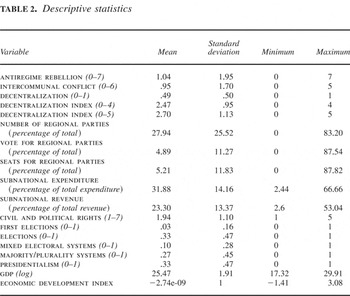
The level of intercommunal conflict varies considerably within countries, but the most intense forms of intercommunal conflict in this study have occurred in Bosnia-Herzegovina, India, and Indonesia. Each of these countries has experienced “large-scale intergroup violence.” In Bosnia-Herzegovina, the violence involved all three of the country's major ethnic groups—the Croats, Muslims, and Serbs. In India and Indonesia, the violence involved only Muslim and Chinese ethnic groups, respectively. The least intense forms of intercommunal conflict in this study have occurred in Bolivia, Botswana, Estonia, and Turkey. These countries have not experienced any forms of intercommunal conflict. The average level of intercommunal conflict in this study is presented in Table 2, along with the summary statistics for the remaining variables in this study.
Descriptive statistics

Independent Variables
Political decentralization is measured in several different ways in this study. The first is with a dichotomous variable in which countries are coded 1 for decentralized if they have regional legislatures with independent decision-making power over at least one issue area, and 0 for centralized if they do not. The coding is based on how countries distribute powers between national and regional legislatures according to their constitutions, and is consistent with other coding schemes.63
The decentralized countries in this study are Argentina, Belgium, Bosnia-Herzegovina, Canada, the former Czechoslovakia, Finland, India, Malaysia, Mexico, South Africa, Spain, Switzerland, the United Kingdom, the United States, and Venezuela.I also measure decentralization in this study according to the level of decentralization in a country. To do this, I created a four-point index based on whether or not regional legislatures are elected and the types of issues over which regional legislatures have control. I carefully selected these issues—tax authority, education, and public order/police—for three different reasons. First, these powers reflect powers that are central to all governments. Second, these powers are also very general and likely to be included in a country's constitution instead of determined by subsequent legislation. Third, these issues address the three major types of issues over which ethnic conflict and secessionism erupt—economic issues, political/social issues, and security issues—and because subnational control over these issues may be effective in reducing ethnic conflict and secessionism in countries. Control over education allows groups to protect and promote their languages, culture, and histories. Control over taxes allows groups to finance all types of legislation they adopt, while control over public order and police allow groups to protect themselves against threats to their physical security.64
Each of these powers are included in the only other index of decentralization that I am aware of which measures decentralization in terms of types of policies that are decentralized to regional legislatures. See Henderson 2000.
According to this index, countries receive one point if they have regional legislatures that are democratically elected. They receive a second point if these regional legislatures can raise or levy their own taxes. Countries receive a third point if regional legislatures have either joint or exclusive control over education. Finally, they receive a fourth point if regional legislatures have either joint or exclusive control over public order or police in their country.
I also created a second version of this index by adding a fifth factor to the index for whether regions must approve constitutions or constitutional amendments in order for them to become law in a country. This arrangement not only increases the degree of decentralization in a country but also increases the overall power and influence of regional parties in a country. I include this measure in a separate index because this power should only be important in certain periods of a country's history. In the former Czechoslovakia, for example, regional parties thwarted the adoption of a new constitution, which led to the dissolution of the country, because regional parties controlled the former Czechoslovakia's regional legislatures, which had veto power over the national constitution.
The strength of regional parties is also measured in several different ways in this study. I first define regional parties narrowly as parties that compete in only one region of a country. This definition of regional parties does not include information about the programs or agendas of parties. With more than 5,000 political parties in this data set and with limited information on all but the largest parties of them, it is impossible to code parties based on their programs and agendas. Coding parties in this way also introduces a significant amount of subjectivity into the analysis.
I operationalize regions in this study as the political regions of a country, which represent the level of government directly below the national level of government. This operationalization best fits my argument. I claim that decentralization increases the strength of regional parties by means of regional legislatures and that decentralization reduces ethnic conflict and secessionism through regional legislatures, which coincide with the political regions of a country. In order to test the robustness of my findings, however, I also operationalize regions according to the geographic regions of a country. I identify the political and geographic regions in each country of this study based on national census data and the Federal Information Processing Standards (FIPS) region codes. Geographic regions are areas of usually contiguous land considered to be a unit based on common physical characteristics, such as mountain ranges, plains, bodies of water, and so forth.
Having defined regional parties and operationalized regions, I evaluate the strength of regional parties in this study in three different ways: (1) the percentage of parties competing in an election that are regional parties; (2) the percentage of votes received by regional parties in an election; and (3) the percentage of seats won by regional parties in an election. Each of these measures ranges between 0 and 100 percent.65
In an election where there are four parties competing and only one of these parties is a regional party, the value of the first measure is 25 percent. If this party wins 10,000 votes out of a possible 40,000 votes and ten out of a possible forty seats, the values of the second and third measures are also 25 percent.
Control Variables
I also include a number of control variables in this analysis to take into account other factors that may affect ethnic conflict and secessionism. The first set of controls represents socioeconomic factors that influence ethnic conflict and secessionism, such as gross domestic product (GDP), economic development, and ethnolinguistic heterogeneity. Ethnolinguistic heterogeneity is one of the most basic elements of ethnic conflict. That is, countries must have more than one ethnic group for ethnic conflict to occur within them. Beyond this, however, it is not clear that increasing heterogeneity will increase or decrease ethnic conflict and secessionism. Previous studies of civil war have not found a significant relationship between heterogeneity and conflict.66
Fearon and Laitin 2003.
Economic development, in contrast, may reduce ethnic conflict by increasing the capacity of states to suppress insurgencies.67
It may also reduce ethnic conflict by improving education and social welfare, which makes people less vulnerable to extremist ideologies.68Lipset 1963.
Herrera 2005.
I measure economic development in this study using two different measures. The first is the log of a country's GDP (current U.S. dollars).72
Unfortunately, I am unable to directly test the hypothesis that inequality among ethnic or regional groups increases ethnic conflict and secessionism directly because cross-national data on this subject is not available. Cross-national data on economic inequality overall is also inadequate.
This index is not logged because the index takes on negative values.
I obtained this data from the World Bank's World Development Indicators Online with the idea that the economic development is higher in countries that have a more advanced telecommunications sector.74
World Bank 2002.
Fiscal decentralization is thought to reduce secessionism in developed regions of countries because it allows these regions to raise their own revenue and to minimize their financial contributions to the national government.75
Fiscal decentralization, though, may not reduce secessionism in poor regions that lack the ability to raise many taxes on their own. In weak democracies, moreover, such as Nigeria, ordinary citizens may not benefit from fiscal decentralization because regional governments do not distribute their funds to the general population. I measure fiscal decentralization in two different ways in this study using the International Monetary Fund's Government Finance Statistics covering 1972–2000.76IMF 1972–2000.
The second set of controls in this study relates to different aspects of a country's political system. Ethnic conflict and secessionism should be less intense in countries where democracy is extensive and political and civil rights are well protected. In these countries groups should have fewer grievances with the government.77
Fearon and Laitin 2003.
I do not control for democracy using the Polity IV index, which measures the existence of free and fair elections, because this analysis is already restricted to democracies scoring a 5 or higher on the Polity Index.
In addition to the degree of democracy, the type of executive system and the type of electoral system in a country may also affect the likelihood of ethnic conflict and secessionism in countries and help explain why increasing social and economic heterogeneity does not necessarily produce ethnic conflict. Presidentialism, which is a system of government in which voters directly elect the chief executive as opposed to parliamentary systems of government in which the national legislature elects the chief executive, is thought to increase ethnic conflict and secessionism because executives in presidential systems of government are less likely to represent multiple ethnic groups than executives in parliamentary systems of government.79
Linz and Valenzuela 1994.
The effect of presidentialism is much more nuanced than this, however. Presidents can belong to more than one ethnic group. They may also appeal to different ethnic groups by wearing clothing or symbols of these different groups, as President Hamid Karzai has done in Afghanistan. They can also appoint people of different ethnic groups to their cabinets. In Bosnia-Herzegovina the presidency itself rotates among three different presidents that (de facto) represent the three major ethnic groups in the country. Presidents can also reach out to different ethnic groups through the policies they produce. At the same time, however, presidents can also antagonize certain groups by producing policies that harm their interests. I measure presidentialism in this study with an indicator variable coded 1 if citizens directly elect the chief executive of a country and 0 otherwise.
Proportional representation systems, in contrast, are thought to reduce ethnic conflict and secessionism more than plurality or majority systems, because proportional representation systems are more inclusive of small parties representing different ethnic or religious groups than majoritarian or plurality systems.80
At the same time, however, proportional representation systems are more open to regional parties, which may increase ethnic conflict and secessionism. In this study I represent the type of electoral system in a country using two indicator variables representing mixed electoral systems and majority/plurality systems. Proportional representation systems are the base category.Elections in general, however, whether they occur under a proportional representation system or a majoritarian system of government, may increase ethnic conflict and secessionism.81
Some groups engaged in ethnic conflict or supportive of secessionism may increase their activities during election times to extract concessions from political parties. Some groups may also increase their activities before an election to prevent elections from taking place at all, as insurgents tried to do in Iraq. Parties, for their part, may ignore the violence perpetrated against certain groups unless political competition is intense and the support of certain groups is needed to control the government.82Wilkinson 2004.
Democratization may also encourage ethnic conflict and secessionism because democratization weakens national governments, making it difficult for governments to prevent ethnic conflict and secessionism militarily, while creating power vacuums where competition among politicians is intense and temptations to resort to ethnic appeals are profound.83
I measure democratization as the first elections in a country although democratic transitions may extend beyond the first democratic elections in some countries. This variable is coded 1 if an election is the first democratic election in a country and 0 otherwise. Elections that are not the first-ever democratic elections in a country, but are the first democratic elections in a country after a prolonged period of nondemocratic rule are also coded 1. The 1990 elections in the former Czechoslovakia are coded 1, for example, even though the former Czechoslovakia held democratic elections between World War I and Word War II, because these elections were the first elections following communism's almost fifty-year rule in the country.Results of the Analysis
The analysis presented in this article is an ordered logit analysis since the dependent variables in this study are categories of conflict and rebellion ordered from low to high forms of conflict and rebellion.84
In separate models (not shown), I include fixed effects for years and regions of the world. One draws the same substantive conclusions about decentralization and regional parties from these models as those without fixed effects. In other models (not shown), I condition on decentralization—that is, I split the data set into decentralized systems of government and test the effect of regional party vote on conflict and rebellion. In these analyses, regional party vote increases conflict and rebellion in decentralized systems of government, and either decreases or has no effect on conflict and rebellion in centralized systems of government.
It is necessary to aggregate the group-level data in this study to the national level because none of the variables in this analysis vary at the group level and because groups and regions do not coincide perfectly. In separate models (not shown), I also aggregate the data according to the median level of conflict or rebellion in a country and according to whether there is any form of conflict or rebellion in a country (using a logit model). One also draws the same substantive conclusions from these analyses as those presented in this article.
I aggregate the data to the national level using the maximum value of conflict or rebellion in a country per year because this method of aggregation overcomes group-based selection bias in the MAR data set. Since the MAR data set does not measure antiregime rebellion and intercommunal conflict for all groups in a country but only “at risk” groups, any measure that aggregates across groups, such as the median level of conflict or rebellion in a country, is biased by the absence of groups not deemed “at risk.” Using the maximum level of conflict or rebellion in a country overcomes this problem because it does not aggregate across groups. The absence of groups from this study considered not “at risk” does not bias this measure because groups that are not “at risk” have not experienced conflict or rebellion to a greater degree than that of “at-risk” groups in this study.86
Most groups, excluded from the analysis because they are not “at risk” are not violent at all, including French and Dutch speakers in Belgium, French and Italian speakers in Switzerland, and the Samis in the Nordic countries among others. Only a few of the groups excluded from the MAR data set, including the Galicians in Spain and the Toubous in Niger, have experienced conflict or rebellion, but the level of conflict involving these groups is lower than that of groups included in the MAR data set.
Antiregime Rebellion
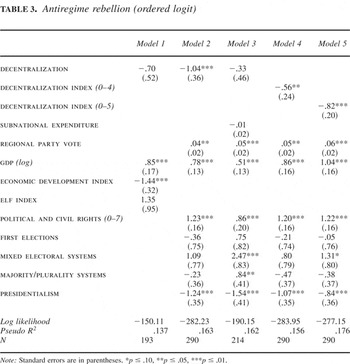
The ordered logit results for antiregime rebellion are presented in Table 3. In Model 1, I test the effect of decentralization on antiregime rebellion controlling for different social and economic variables. According to this model, GDP and the ELF index both increase antiregime rebellion while the economic development index decreases antiregime rebellion.87
In separate models (not shown), I find evidence of a nonlinear relationship between the ELF and rebellion, where both low and high degrees of heterogeneity reduce rebellion and moderate levels of heterogeneity increase rebellion. The R-squared is slightly higher in the nonlinear model suggesting a better fit.
Antiregime rebellion (ordered logit)

In Model 2, I introduce controls for different political factors that may also affect antiregime rebellion including regional party vote.88
I exclude the ELF index from this and all other models due to collinearity between it and certain control variables included in Model 2. One draws, however, the same substantive conclusions about decentralization and regional parties if the ELF index is included, and these control variables are excluded.
To explore the robustness of my findings on regional parties, I replace regional party vote with two variables—one representing the percentage of parties that are regional parties in an election, and the other representing the percentage of seats received by regional parties in an election. The coefficients of these variables are both positive and statistically significant at the .01 level. In other models (not shown), I measure the strength of regional parties, according to the geographic, not the political regions, of a country. In these models, regional parties measured in terms of the percentage of regional parties competing in an election, as well as the percentage of votes and seats they receive antiregime rebellion at the .10 level or better.
In separate models (not shown), where I substitute elections in general for the first elections in a country, elections in general have no effect on antiregime rebellion.
In separate models (not shown), I add a lag of rebellion to the model. The magnitude of the coefficients for decentralization and regional party vote are nearly the same as they are in Model 2, although only the effect of regional party vote is significant.91
The coefficient for decentralization is −.98 (.63) and the coefficient for regional party vote is .04 (.02) in the lagged model. I also averaged the data across years for each country and redid the analysis on the country averages. The coefficients for decentralization and regional party vote are in the same direction and significant at the .10 level in these models.
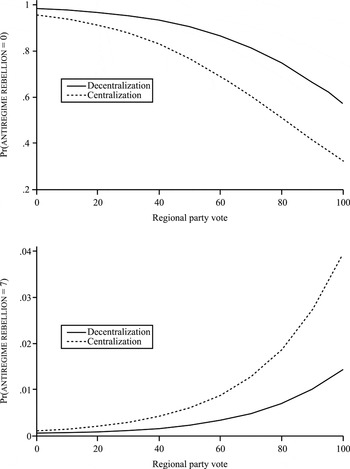
The graphs in Figure 2 illustrate the results from Model 2. The graphs indicate the predicted probabilities that antiregime will equal either 0 (no incidences of antiregime rebellion) or 7 (protracted civil war). These values represent the lowest and highest values of antiregime rebellion in this study. In these graphs political and civil rights, majority/plurality systems, first elections and presidentialism are set to 1, mixed electoral systems are set to 0, while GDP is set to its mean. The solid line represents the change in the predicted probabilities for decentralization when regional party vote is varied from 0 to 100 percent. The dashed line represents the change in the predicted probabilities for centralization when regional party vote is varied from 0 to 100 percent. In these graphs political and civil rights, majority/plurality systems, first elections and presidentialism are set to one, while mixed electoral systems are set at 0, and GDP is set to its mean.

Predicted probabilities for antiregime rebellion
According to the first graph, countries with decentralized systems of government are less likely to experience antiregime rebellion than countries with centralized systems of government. The likelihood of countries with either decentralized systems of government or centralized systems of government not experiencing antiregime rebellion declines, however, sharply as regional party vote increases.
The second graph depicts a similar relationship between decentralization and regional party vote. According to this graph, the likelihood of countries experiencing “protracted civil war” is lower for decentralized systems of government than for centralized systems of government, and the likelihood of either centralized systems of government or decentralized systems of government experiencing “protracted civil war” increases as regional party vote increases, more so for centralized systems of government than decentralized systems of government.
In Model 3, I add a control for fiscal decentralization measured in terms of total subnational expenditure (as a percent of total expenditure). In this model, fiscal decentralization decreases antiregime rebellion but is not significant. In separate models (not shown), I measure fiscal decentralization in terms of subnational revenue (as a percent of total revenue). Fiscal decentralization decreases antiregime rebellion in this model and is significant at the .01 level.
In Model 4, I measure decentralization as a four-point index. Decentralization decreases antiregime rebellion in this model as in the previous models, while regional party vote increases antiregime rebellion, suggesting that more decentralization decreases antiregime rebellion over less decentralization. In Model 5, I replace the four-point measure of decentralization with the five-point measure of decentralization, the effect of which is negative and significant confirming the results of the previous model.
Intercommunal Conflict
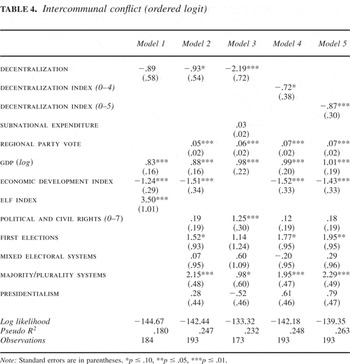
The ordered logit results for intercommunal conflict are presented in Table 4. In Model 1 of this table, I explore the effect of decentralization on intercommunal conflict while controlling for different social and economic variables that may also affect intercommunal conflict. In this model—where I do not control for the effect of regional parties on intercommunal conflict—the effect of political decentralization is negative but not significant. The effect of the economic development index, meanwhile, is negative and significant, as expected, while the effect of GDP is positive and significant, in contrast. The ELF index is also positive and significant in this model, indicating that heterogeneous countries are more likely to experience intercommunal conflict than less heterogeneous countries.92
In separate models (not shown), I also find evidence of nonlinear relationship, however, between the ELF and conflict where both low and high degrees of heterogeneity reduce conflict and moderate levels of heterogeneity increase conflict. The R-squared is slightly higher in the nonlinear model suggesting a better fit.
Intercommunal conflict (ordered logit)

In Model 2, I introduce control variables for different political factors that may affect intercommunal conflict, including regional party vote.93
I exclude the ELF index from this and all other models due to collinearity between it and certain control variables included in Model 2. One draws, however, the same substantive conclusions about decentralization and regional parties if the ELF index is included, and these control variables are excluded.
In separate models (not shown), I also replace regional party vote with two variables—one representing the percentage of parties that are regional parties in an election, and the other representing the percentage of seats received by regional parties in an election. In these models, only the seats variable is positive and significant at the .01 level, suggesting that the effect of regional parties on intercommunal conflict operates more through parties in government than those outside of government. In still other models (not shown), I measure the strength of regional parties according to the geographic, not the political regions, of a country. The effect of regional parties on intercommunal conflict is not significant in these models.
In separate models (not shown), I include a control variable for all elections rather than the first elections in a country. This variable is not significant.
In separate models (not shown), I include a lag of conflict in the analysis. The size of the coefficients for decentralization and regional party vote are the same as they are in Model 2, although they are not all significant.96
The coefficient for decentralization is −.82 (.81) while the coefficient for regional party vote is .01 (.03) in the lagged model. I also averaged the data across years for each country and redid the analysis on the country averages. The coefficients for decentralization and regional party vote are in the same direction in these models, although their effects are not significant given the small-N.
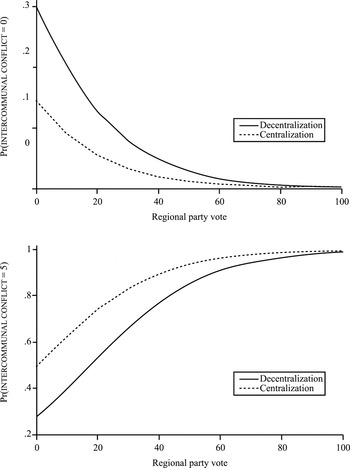
The graphs in Figure 2 illustrate the results of Model 2. The graphs show the predicted probabilities that intercommunal will equal either 0 (no incidences of intercommunal conflict) or 5 (communal rioting and armed attacks). These values represent the lowest and highest values of intercommunal conflict in this study.97
No country in this study experienced the highest possible level of intercommunal conflict, large-scale intergroup violence.

Predicted probabilities for intercommunal conflict
According to the first graph, countries with decentralized systems of government are less likely to experience intercommunal conflict than countries with centralized systems of government. Both decentralized systems of government and centralized systems of government, however, are more likely to experience intercommunal conflict as regional party vote increases. The change in the likelihood of a country experiencing intercommunal conflict as regional party vote increases is more dramatic in decentralized systems of government than in centralized systems of government.
The second graph shows a similar relationship between decentralization and regional party vote in terms of a country's likelihood of experiencing “large-scale intergroup violence.” In this graph, the probability of a country experiencing this type of violence is lower for decentralized systems of government than for centralized systems of government. The probability of experiencing “large-scale intergroup violence” increases, however, for both centralized and decentralized systems of government as regional party vote increases.
In the next three models, I measure decentralization in terms of degrees of decentralization. In Model 3, I include a variable for fiscal decentralization in terms of total subnational expenditures (as percentage of total expenditures). This variable is not significant. In separate models (not shown), I measure fiscal decentralization in terms of subnational revenue (as a percent of total revenue). This variable is negative and significant, suggesting that increasing levels of fiscal decentralization decrease intercommunal conflict.
In Model 4, I measure decentralization as a four-point index. This index is negative and statistically significant, indicating that an increase in the degree of decentralization in a country reduces intercommunal conflict. In Model 5, I measure decentralization as a five-point index, the effect of which is also negative and significant.
Conclusion
Decentralization is viewed by many as, at best, an ineffective tool in reducing ethnic conflict and secessionism and, as, at worst, an encouraging factor behind both. This article shows, however, that decentralization is neither and in fact is a useful mechanism in reducing both ethnic conflict and secessionism. According to the statistical analysis, decentralized systems of government are less likely to experience intercommunal conflict and antiregime rebellion than centralized systems of government. The presence of regional parties, however, undermines the effect of decentralization on ethnic conflict and secessionism, as the statistical analysis also shows. For this reason the strength of regional parties must be regulated in countries through different features of decentralization or alternative institutional mechanisms, such as the type of electoral system in a country.
Some of these institutions have competing effects on regional parties and ethnic conflict and secessionism, including majority and plurality systems. That is, while certain institutions decrease the strength of regional parties in countries directly, they also increase the strength of ethnic conflict and secessionism. Some of these institutions are also easier to manipulate than others. Changing the sequencing of national and regional elections is much easier, for example, and much less controversial to accomplish than changing the internal borders of countries. Many of these institutions, however, are not controversial and can be practically implemented. Policymakers must be very careful, therefore, in designing their political systems to take into account both the direct and indirect consequences of these alternative institutions, as well as the unexpected costs involved in them. The choice of just how to do this remains an open question for countries.