Methicillin-resistant Staphylococcus aureus (MRSA) is associated with significant morbidity and mortality in healthcare settings.Reference Klein, Smith and Laxminarayan 1 , Reference Klevens, Morrison and Nadle 2 It is a frequent cause of severe infections in the bloodstream, respiratory tract, and skin and has been associated with higher healthcare costs and longer hospital lengths-of-stay than infection with methicillin-susceptible strains.Reference Huang and Platt 3 , Reference Cosgrove, Qi, Kaye, Harbarth, Karchmer and Carmeli 4 The National Healthcare Safety Network estimated that MRSA accounted for 8.5% of healthcare-associated infections in the United States from 2009 to 2010.Reference Sievert, Ricks and Edwards 5
Recurrence of infection is a significant complication associated with MRSA infection. It causes additional morbidity and mortality and creates a need for further antibiotic therapy. MRSA recurrence may also increase the rate of hospital readmission, which can affect hospital ratings and funding.Reference Joynt and Jha 6 The estimated rate of recurrence of S. aureus bacteremia varies and depends on the follow-up time, but it is generally thought to be 5%–12%.Reference Welsh, Skrobarcek and Abbott 7 – Reference Chang, Peacock and Musher 9 However, many recurrence rate estimates include all S. aureus (both MRSA and methicillin-susceptible S. aureus), and infections specifically with MRSA may increase recurrence rates.Reference Kreisel, Boyd, Langenberg and Roghmann 10 Patients infected with MRSA may be more likely to have a compromised immune system than those infected with methicillin-susceptible S. aureus, and vancomycin, the antibiotic recommended for treating MRSA, has been linked to prolonged bacteremia and recurrence.Reference Fowler, Kong and Corey 8 – Reference Walker, Bowler and Bejon 13
Recurrence of S. aureus may be due to relapse (the emergence of the original infecting organism) or reinfection (infection with a different strain) and is usually deduced by molecular subtyping or antibiotic susceptibilities.Reference Fowler, Kong and Corey 8 , Reference Chang, Peacock and Musher 9 , Reference Wendt, Messer, Hollis, Pfaller, Wenzel and Herwaldt 14 Relapse occurs far more often than reinfection, accounting for 80% to 90% of recurrence, and usually takes less time to present.Reference Welsh, Skrobarcek and Abbott 7 – Reference Kreisel, Boyd, Langenberg and Roghmann 10 Chang et alReference Chang, Peacock and Musher 9 found that relapse followed S. aureus bacteremia after a median of 36 days, and reinfection followed after a median of 99 days.
Few studies have addressed risk factors for the development of recurrent S. aureus bacteremia, and almost no studies have focused specifically on patients with MRSA, even though the effects of these organisms can be quite different from those of methicillin-susceptible S. aureus.Reference Shurland, Zhan, Bradham and Roghmann 15 , Reference Cosgrove, Sakoulas, Perencevich, Schwaber, Karchmer and Carmeli 16 The objective of this study was to determine risk factors for the development of recurrent MRSA bacteremia in a large, multicenter cohort. Our aim was to identify high-risk patients at discharge from the index hospitalization so that they could be targeted for quality improvement interventions including additional source control, continued surveillance, and more frequent follow-up.
METHODS
Study Design and Patient Population
This was a retrospective cohort study that included veterans admitted to 122 acute-care Veterans Affairs (VA) medical facilities from January 1, 2003, through December 31, 2010. Patients in the cohort had MRSA bacteremia during their index hospitalization, defined as a MRSA-positive culture of a specimen collected from the blood. Patients were followed up through their electronic healthcare record for 180 days with the observation time beginning at discharge from the healthcare facility.
Patients who died during the index hospitalization or on the same day as discharge were excluded. This cohort did not include patients who had a MRSA infection without bacteremia and did not include patients who were infected with methicillin-susceptible Staphylococcus aureus during the initial infection or the recurrent infection.
Demographic, clinical, and pharmaceutical variables were extracted from the VA Corporate Data Warehouse and the VA Patient Care System microbiology database and were examined for associations with recurrent MRSA bacteremia. All variables excluding recurrence, outpatient immunosuppressant therapy, and outpatient corticosteroid therapy were measured during the index hospitalization. These data were last updated in February 2014. This study received approval from the University of Iowa Institutional Review Board and the Iowa City VA Research and Development Committee.
Definition of Variables
Recurrence was defined as a positive MRSA blood culture of a specimen collected from 2 to 180 days after the index hospital discharge and documented in the electronic healthcare record. Recurrence was not subdivided into relapse and reinfection because the available data did not provide strain information or genotyping patterns; however, a subset analysis of early-onset (2–60 days after discharge) and late-onset (61–180 days after discharge) recurrence was performed. Positive MRSA blood culture results occurring within 2 days of hospital discharge were considered to be the original infection and were not counted as a recurrence. Duration of bacteremia was defined as the number of days between the first positive culture and the final positive culture. Community-acquired infection was defined as an initial positive blood culture of a specimen collected less than 48 hours after hospital admission. Patients were considered to have received a MRSA-active antibiotic if at least one of the following antibiotics was given to the patient during hospitalization: vancomycin, daptomycin, linezolid, clindamycin, ceftaroline, tigecycline, dalfopristin with quinupristin, and trimethoprim with sulfamethoxazole. Patients were considered to have received immunosuppressants or corticosteroids if therapy was administered within 60 days prior to discharge from the index hospitalization, or if an outpatient prescription overlapped the 60 days prior to discharge.
The International Statistical Classification of Disease, Ninth Revision, Clinical Modification (ICD-9-CM) coding system was used to assess Elixhauser comorbidities as presented by Quan et al.Reference Quan, Sundararajan and Halfon 17 All comorbidities were measured at discharge from the index hospital admission. Cancer was defined by combining lymphoma, metastatic cancer, and solid tumor without metastasis. Hypertension and diabetes were defined by combining the complicated and uncomplicated components. A modified Acute Physiology and Chronic Health Evaluation (APACHE) III score was used to evaluate severity of illness at index hospital admission.Reference Knaus, Wagner and Draper 18 The urine output and Glasgow coma score components of the APACHE score were not present in the VA Informatics and Computing Infrastructure database and thus are not included in the modified APACHE score. Since arterial pH levels, partial pressure of oxygen, and the alveolar-arterial gradient are measured on intensive care unit admission and some patients not admitted to the intensive care unit were included in this study, these components were not included in the modified APACHE score owing to many missing values. ICD-9-CM codes were used to identify endocarditis and osteomyelitis. Postdischarge death was defined as death occurring in any setting (in hospital or outside the hospital) according to the VA vital status record. Age and severity of illness categories were divided approximately by quartiles. Geographic region was first classified into the 21 Veterans Integrated Service Networks, then combined into 4 census regions—Northeast, South, Midwest, and West.
Statistical Analysis
Unadjusted and adjusted hazard ratios and 95% CIs were calculated using Cox proportional hazards regression. Variables that were not significant in the multivariable models (P>.05) using stepwise selection and backward elimination were excluded from the final models. To control for age and location, patient age at admission and geographic region of facility were kept in final models regardless of significance. The proportional hazards assumption was tested for each variable in the final model to verify that the effect of each variable was constant over time. Patients were followed up from index hospitalization discharge until recurrent infection, death, or the end of the study period (180 days after discharge). Patients were censored upon death. Effect modification was measured using both the Cochran-Mantel-Haenszel statistic and by creating interaction terms in the Cox proportional hazards model.
Three subset analyses were performed. First, to ensure the definition of recurrence was not capturing unresolved index infections in addition to recurrent infections, a model was created defining a recurrence time frame of 7 to 180 days after discharge. Then, models were created to identify risk factors for early-onset and late-onset recurrence separately, using only patients who did not have a recurrent infection as the control group. All statistical analyses were performed using SAS Enterprise Guide, version 5.1 (SAS Institute).
RESULTS
A total of 22,958 patients developed MRSA bacteremia from January 1, 2003, through December 31, 2010. Of these patients, 4,533 were excluded owing to death before discharge, leaving 18,425 patients in the cohort. Age ranged from 19 to 107 years (mean, 65.8; median, 64.0 years) and 97.3% of patients were men. Of the 18,425 eligible patients, 1,159 (6.3%) had a recurrent infection within 180 days of discharge. The median number of days to recurrence was 63. Death was more likely in patients with recurrence (45.8% died; median time to death, 83 days) than in those without recurrence (28.6% died; median time to death, 39 days).
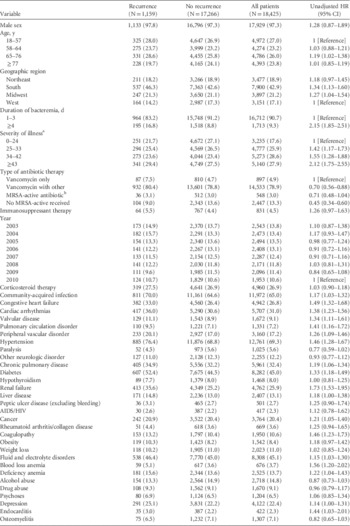
Table 1 shows the bivariable comparisons of patients with and without recurrent bacteremia. Patients with recurrence were more likely to live in the southern or midwestern United States, had a longer duration of index bacteremia, were more severely ill on index admission, were more likely to be in the age category of 65–76 years, and were more likely to have received only vancomycin for their antibiotic therapy. Patients with recurrence were also significantly more likely to have experienced congestive heart failure, cardiac arrhythmias, valvular disease, pulmonary circulation disorders, peripheral vascular disorders, hypertension, diabetes, renal failure, coagulopathy, obesity, blood loss anemia, and depression.
Comparison of Patients With and Without Recurrent Methicillin-Resistant Staphylococcus aureus (MRSA) Bacteremia

NOTE. Data are number (percentage), unless otherwise indicated. HIV, human immunodeficiency virus; HR, hazard ratio.
a Modified Acute Physiology and Chronic Health Evaluation III score.
b Excluding vancomycin.
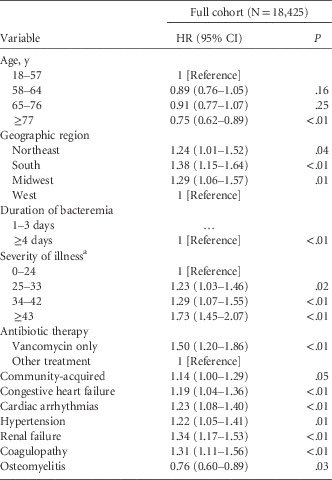
Twelve variables were included in the final multivariable model predicting 180-day MRSA recurrence (Table 2). Facility location in the southern or midwestern United States, duration of index bacteremia of more than 3 days, increasing severity of illness, receipt of only vancomycin, community-acquired infection, congestive heart failure, cardiac arrhythmias, hypertension, renal failure, and coagulopathy were risk factors for recurrence. Age older than 76 years and osteomyelitis were significantly associated with a decreased hazard of recurrence.
Multivariable Analysis of Risk Factors for Recurrent Methicillin-Resistant Staphylococcus aureus Bacteremia Within 180 Days of Discharge

NOTE. HR, hazard ratio.
a Modified Acute Physiology and Chronic Health Evaluation III score.
In the effect modification analysis, 2 associations were found. First, among younger patients, cancer was a risk factor for recurrence (hazard ratio, 1.26; 95% CI, 1.08–1.49), but among older patients, cancer was slightly protective against recurrence (0.94; 0.68–1.30). Second, if the duration of the initial bacteremia was short, there was a positive association between blood loss anemia and recurrence (hazard ratio, 1.48; 95% CI, 1.13–1.95), but if the duration of the initial bacteremia was longer, blood loss anemia was protective against recurrence (0.49; 0.16–1.55). Thus, cancer and blood loss anemia were not included in the final model.
Subset Analyses
When the definition of recurrence was narrowed to the time frame of 7 to 180 days after index hospital admission, the number of patients who experienced a recurrence decreased from 1,159 (6.3%) to 1,111 (6.0%). The model created for this subset included all of the risk factors that were found in the initial final model (Table 2).
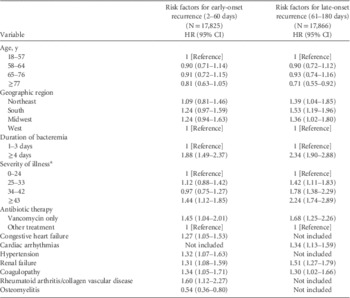
To examine whether risk factors for early recurrence were different from risk factors for late recurrence we estimated 2 separate multivariable models with the following outcomes: early-onset recurrence (2–60 days after discharge) versus no recurrence, and late-onset recurrence (61–180 days after discharge) versus no recurrence. Of 1,159 patients with recurrence, 559 (48.2%) had early-onset and 600 (51.8%) had late-onset recurrence. Eleven variables were included in the early-onset recurrence final model (Table 3). Duration of index bacteremia greater than 3 days, the highest severity-of-illness quartile, receipt of only vancomycin, congestive heart failure, hypertension, renal failure, rheumatoid arthritis/collagen disease, and coagulopathy were risk factors for early-onset recurrence. Osteomyelitis was significantly associated with a decreased hazard of early-onset recurrence. Age and geographic region were not significantly associated with early-onset recurrence.
Multivariable Analysis of Risk Factors for Early-Onset and Late-Onset Recurrence of Methicillin-Resistant Staphylococcus aureus Bacteremia

NOTE. HR, hazard ratio.
a Modified Acute Physiology and Chronic Health Evaluation III score.
Eight variables were included in the late-onset recurrence final model (Table 3). Facility location in the northeastern, southern, or midwestern United States, duration of index bacteremia greater than 3 days, increasing severity of illness, receipt of only vancomycin, cardiac arrhythmias, renal failure, and coagulopathy were risk factors for late-onset recurrence. Age older than 76 years was significantly associated with a decreased hazard of late-onset recurrence.
DISCUSSION
We evaluated a large database of veterans with MRSA bacteremia and found multiple risk factors for recurrent MRSA bacteremia. Our comparison of early-onset and late-onset recurrence identified differing risk factors and differing strengths of association between the 2 groups. Congestive heart failure, hypertension, and rheumatoid arthritis/collagen disease were risk factors only for early-onset recurrence. Geographic region of facility and cardiac arrhythmias showed significant associations only with late-onset recurrence. Risk factors such as duration of bacteremia, modified APACHE III score, and receipt of only vancomycin were present in both groups but had much higher hazard ratios in the late-onset recurrence group. This is similar to other studies that differentiated relapse from reinfection using pulsed-field gel electrophoresis and found that the risk factors for relapse were different from the risk factors for reinfection.Reference Fowler, Kong and Corey 8 , Reference Chang, Peacock and Musher 9 Healthcare providers should be aware of the risk factors changing as time after discharge increases in order to implement appropriate follow-up with their patients.We found a 180-day recurrence rate of 6.3%, which was lower than expected given that these were MRSA infections in a veteran population. It is possible that this rate was affected by the relatively high age and overall poor health of our population. Almost 30% of patients without a recurrence died before the completion of the follow-up period, and a median time to death of 39 days suggests that the chance of developing recurrence before death was relatively low for many of these patients. Another factor that may contribute to differing recurrence rates is the population follow-up time. Recurrence rates may differ between populations that are followed up for 12 weeks,Reference Fowler, Kong and Corey 8 180 days,Reference Chang, Peacock and Musher 9 or 1 year.Reference Kreisel, Boyd, Langenberg and Roghmann 10 Consistent recurrence definitions and population follow-up times are needed to adequately compare recurrence rates across different reports.
Some risk factors found by other studies were not present in our final model. Human immunodeficiency virus and diabetes have been shown to be risk factors for recurrence, although these were found in a small veteran populationReference Kreisel, Boyd, Langenberg and Roghmann 10 or in studies with very different populations and a very different definition of recurrence.Reference Wiese, Mejer and Schønheyder 19 , Reference Jaliff, Dahl-Knudsen, Petersen, Skov and Benfield 20 These risk factors could also indicate high severity of illness on index admission, which we accounted for in the modified APACHE III score. Another risk factor for S. aureus recurrence that has been identified is the infection of an indwelling device,Reference Fowler, Kong and Corey 8 , Reference Johnson, Almoujahed, Ilg, Maolood and Khatib 12 , Reference Walker, Bowler and Bejon 13 which was not present in our retrospective data. However, risk factors from our study such as congestive heart failure, cardiac arrhythmias, renal failure, and coagulopathy point to infected indwelling devices such as intravenous catheters, dialysis ports, or pacemakers.
Interestingly, we found 2 patient characteristics, older age and osteomyelitis, that were protective against recurrence. The protective effect of osteomyelitis was also seen in a study by Chang et al,Reference Chang, Peacock and Musher 9 in which they found a lower relapse rate in patients with bacteremia from a source that was amenable to definitive cure (ie, osteomyelitis) compared with bloodstream infections where the focus could not be cured or removed. That study argues that osteomyelitis is amenable to cure because infected bone could be resected.Reference Chang, Peacock and Musher 9 A recent study by Wiese et alReference Wiese, Mejer and Schønheyder 19 found that older age was a nonsignificant risk factor for recurrence. This is most likely due to older patients dying during the follow-up period before they have a chance for recurrence. Similarly, the effect modification between cancer and older age seen in our analysis may also be due to older patients with cancer being more likely to die before they had the chance to have a recurrent infection.
The receipt of vancomycin without other antibiotics was consistently associated with higher recurrence rates, especially for late-onset recurrence. This may be explained by the nature of recommended vancomycin therapy. Guidelines suggest that patients with MRSA bacteremia receive vancomycin for 2 to 6 weeksReference Liu, Bayer and Cosgrove 21 (depending on whether the bacteremia is complicated or uncomplicated). There may be a risk for nonadherance or a shortened course of therapy because of the inconvenience of vancomycin administration, and it is possible that when therapy ceases, the risk for recurrence increases. There is also support for vancomycin treatment failure being more likely as vancomycin minimum inhibitory concentrations increase.Reference Sakoulas, Moise-Broder, Schentag, Forrest, Moellering and Eliopoulos 22 , Reference Soriano, Marco and Martínez 23 Perhaps patients infected with MRSA strains with a high minimum inhibitory concentration were more susceptible to recurrence if they received vancomycin alone, whereas if these patients received another antibiotic in addition to vancomycin, the dual effect could completely eliminate the infection.
This study had limitations. The results may not be generalizable to other patient populations since our study focused on an older, predominatly male veteran population. Additionally, cases of MRSA recurrence may have been missed if veterans were seen outside of the VA healthcare system for their recurrent infection. Important variables such as presence of an indwelling device, antibiotic minimum inhibitory concentrations, and molecular typing were not available owing to the nature of our database. However, our data set allowed the inclusion of more than 18,000 patients, whereas most other studies on recurrent S. aureus bacteremia have cohorts from 100 to 400 patients.Reference Welsh, Skrobarcek and Abbott 7 – Reference Johnson, Almoujahed, Ilg, Maolood and Khatib 12 , Reference Jaliff, Dahl-Knudsen, Petersen, Skov and Benfield 20 This difference in sample size gives us greater statistical power, which may have contributed to the identification of risk factors that have not previously been seen in the literature.
In conclusion, our findings identified several risk factors for recurrent MRSA bacteremia, which could assist in clinician decision-making in regard to aggressiveness of follow-up after a patient’s initial MRSA bacteremia. Future studies should focus on validating these results in different populations and interventions that target risk factors for recurrent MRSA bacteremia with the goal of preventing recurrence.
Acknowledgments
Financial support. VA Health Services Research and Development Career Development Award (CDA 11-215 to J.A., L.J., and M.L.S.); Cubist Pharmaceuticals (grant to J.S.M.).
Potential conflicts of interest. All authors report no conflicts of interest relevant to this article.
Role of the sponsor: The VA Office of Research and Development had no role in the design and conduct of the study; collection, management, analysis, and interpretation of the data; or preparation of the manuscript.
Disclaimer: The opinions expressed are those of the authors and not necessarily those of the Department of Veterans Affairs or the United States Government