Introduction
Adolescence is a phase of vulnerability in which the majority of mental disorders begin: Paus and colleagues summarized this circumstance with the expression ‘moving parts get broken’, meaning that, in a phase of dynamic development, when not adequately overcame, the plurality of presenting challenges can increase the risk of the emergence of mental disorders (Paus, Keshavan, & Giedd, Reference Paus, Keshavan and Giedd2008).
A growing body of literature supports the hypothesis that adolescent and adult mental disorders are on a continuum (Canino, Reference Canino2007; Christie et al., Reference Christie, Burke, Regier, Rae, Boyd and Locke1988; Kessler et al., Reference Kessler, Angermeyer, Anthony, Demyttenaere, Gasquet and Ustun2007), with 50% of psychiatric disorders beginning during adolescence and 75% by the age of 24 (Kim-Cohen et al., Reference Kim-Cohen, Caspi, Moffitt, Harrington, Milne and Poulton2003), making early interventions extremely important.
According to WHO, at least one in six adolescents aged between 10 and 19 suffers from mental health problems, with suicide being the second cause of death for boys and girls aged between 15 and 19 years (Hawton, Saunders, & O'Connor, Reference Hawton, Saunders and O'Connor2012). A European community-based study conducted across 11 countries reported a prevalence of 29% for depression and 32% for anxiety among adolescents (Balazs et al., Reference Balazs, Miklosi, Kereszteny, Hoven, Carli, Wasserman and Wasserman2013). More recently, a large meta-analysis on 41 studies conducted in 27 countries estimated a worldwide-pooled prevalence of mental disorders in children and adolescents of 13.4%. More specifically, the worldwide prevalence of any anxiety disorder is 6.5%, 2.6% for any depressive disorder is 3.4% for attention-deficit hyperactivity disorder and 5.7% for any disruptive disorder is (Polanczyk, Salum, Sugaya, Caye, & Rohde, Reference Polanczyk, Salum, Sugaya, Caye and Rohde2015).
Adolescents' mental disorders are associated with high rates of both alcohol (10.3%) and illicit drug (14.9%) abuse. In particular, alcohol and drug abuse were more frequent in those with a diagnosis of anxiety disorders (17.3% and 20%, respectively) or behavior disorders (15.6% and 24%, respectively) (Conway, Swendsen, Husky, He, & Merikangas, Reference Conway, Swendsen, Husky, He and Merikangas2016). Moreover, non-suicidal behaviors are frequent among adolescents, as reported in both community and clinical samples, with lifetime prevalence rates between 17 and 60% according to different studies (Brown & Plener, Reference Brown and Plener2017).
Authors that evaluated psychopathology using self-reported Behavioral and Emotional Problems (BeEPs) in adolescence (Heyerdahl, Kvernmo, & Wichstrom, Reference Heyerdahl, Kvernmo and Wichstrom2004; Kapi, Veltsista, Sovio, Jarvelin, & Bakoula, Reference Kapi, Veltsista, Sovio, Jarvelin and Bakoula2007; Konowalek & Wolanczyk, Reference Konowalek and Wolanczyk2018; Lee, Park, Cloninger, & Chae, Reference Lee, Park, Cloninger and Chae2018; Philipp et al., Reference Philipp, Zeiler, Waldherr, Truttmann, Dur, Karwautz and Wagner2018; Rescorla et al., Reference Rescorla, Achenbach, Ivanova, Dumenci, Almqvist, Bilenberg and Verhulst2007; Tick, van der Ende, & Verhulst, Reference Tick, van der Ende and Verhulst2008) highlighted an impact of a set of variables on the psychopathological dimensions examined. In particular, male gender was associated with externalizing problems, while female gender was associated with internalizing problems. The prevalence of mental disorders increases with age, involving about 10.2% (range 3.6%–24%) of children younger than 6, 13.2% of preadolescents (range 1.4%–30.7%) and 16.5% of adolescents (range 6.2%–41.3%) (Roberts, Attkisson, & Rosenblatt, Reference Roberts, Attkisson and Rosenblatt1998), low socioeconomic status has been associated with increased risk for externalizing problems, while urbanicity has been linked to a higher risk of developing thought disorders (Fett, Lemmers-Jansen, & Krabbendam, Reference Fett, Lemmers-Jansen and Krabbendam2019).
According to the Italian National Institute of Statistics (ISTAT), in Italy 10% of young people aged between 12 and 25, report being globally dissatisfied about life, friendship, family and health (Statistica, 2018). Concerning risk factors for mental disorders, Italy is the European country with the highest percentage of adolescents who smoke (37%), with one of the largest percentage of adolescents with ‘episodes of excessive consumption of alcohol (34% in 2015, fourth place in the EU) and with the second-largest share of teenagers who use cannabis (15% behind 17% in France) (Statistica, 2018).
Despite the presence of general information on Italian adolescents' mental health, provided by periodic epidemiological studies, researches conducted with standardized assessment tools are scarce in the scientific literature.
The Italian Preadolescent Mental Health Project (PrISMA) conducted an analysis on 3418 preadolescent subjects (10–14 years old) living in urban areas. The authors reported a prevalence of 9.8% (CI 8.8%–10,8%) of mental disorders using the child behavior checklist/6–18 (CBCL) and prevalence of 8.2% (CI 4.2%–12.3%) using the Development and Wellbeing Assessment diagnostic interview (DAWBA) (Frigerio et al., Reference Frigerio, Vanzin, Pastore, Nobile, Giorda, Marino and De Girolamo2006, Reference Frigerio, Rucci, Goodman, Ammaniti, Carlet, Cavolina and Molteni2009). DSM-IV Emotional disorders were more common (6.5%) than externalizing disorders (1.2%) (Frigerio et al., Reference Frigerio, Rucci, Goodman, Ammaniti, Carlet, Cavolina and Molteni2009).
In 2012 Rescorla and colleagues reported in their paper on 44 countries a regional school-based Italian data about self-reported emotional and behavioral problems on 1224 students aged between 11 and 16 (Rescorla et al., Reference Rescorla, Ivanova, Achenbach, Begovac, Chahed, Drugli and Zhang2012). In this study, the Youth Self Report Achenbach scale was used, and the Total Problem mean score was the highest (49.3) for Italian students when compared to other adolescents from different countries (Rescorla et al., Reference Rescorla, Ivanova, Achenbach, Begovac, Chahed, Drugli and Zhang2012).
To our knowledge, no other Italian data on this topic is available and most epidemiological studies conducted in the USA (Achenbach et al., Reference Achenbach, Bird, Canino, Phares, Gould and Rubio-Stipec1990; Achenbach, McConaughy, & Howell, Reference Achenbach, McConaughy and Howell1987; Achenbach, Verhulst, Baron, & Althaus, Reference Achenbach, Verhulst, Baron and Althaus1987), and in many other countries (Heyerdahl et al., Reference Heyerdahl, Kvernmo and Wichstrom2004; Kapi et al., Reference Kapi, Veltsista, Sovio, Jarvelin and Bakoula2007; Konowalek & Wolanczyk, Reference Konowalek and Wolanczyk2018; Lee et al., Reference Lee, Park, Cloninger and Chae2018; Philipp et al., Reference Philipp, Zeiler, Waldherr, Truttmann, Dur, Karwautz and Wagner2018; Rescorla et al., Reference Rescorla, Achenbach, Ivanova, Dumenci, Almqvist, Bilenberg and Verhulst2007, Reference Rescorla, Ginzburg, Achenbach, Ivanova, Almqvist, Begovac and Verhulst2013; Tick et al., Reference Tick, van der Ende and Verhulst2008) are difficult to generalize as often based on convenience samples. The aim of this study is to evaluate self-reported BeEPs in a sample of Italian adolescents and to examine their association with important socio-demographical variables as gender, age, SES and urbanicity. In particular, we aim at testing the difference in terms of explanatory power of a socio-demographical model on different psychopathological outcomes.
Methods
Ten randomly chosen schools from the urban areas of Rome (n = 5) and Latina (n = 5) were invited to participate. Of these, eight schools provided consent to participate, three schools from Rome and five from Latina. For each school, a group of classes was randomly selected, according to the headmaster availability. A copy of the written informed consent was sent to the families of the students with the instruction to return this signed within 7–10 days. The students who joined the study were asked to complete a self-report questionnaire (1 h).
Sample
A sample of 1400 students aged 14–18 was recruited
We included:
• Subjects aged between 14 and 18 years old
• Subjects able to understand the purpose and procedures of the study and to give their consent to participation by signing the written consent statement
• Subjects for whom both parents could understand the purpose and procedures of the study and could give their consent to the participation of their son or daughter by signing the informed written consent statement.
Students who did not return after a week the informed consent signed by both parents were excluded from the study. This study was approved by our ethics committee in Policlinico Tor Vergata, Rome.
Procedure
In order to study different types of urban areas, we decided to randomly select a pool of schools from the areas of Rome (2 856 133 inhabitants) and Latina (126 746 inhabitants), a town located near Rome, whose schools also include boys and girls who live in small neighboring villages (<50 000 inhabitants).
Measures
Youth self-report (YSR)
Participants completed the Italian version of YSR investigating the presence and intensity of BeEPs in the sample (Achenbach & Rescorla, Reference Achenbach and Rescorla2001). The Italian version of YSR contains 112 first-person items describing typical BeEPs; each item is assigned a score from 0 to 2. Subjects were asked to formulate their judgment considering the 6 months prior the assessment. YSR (Achenbach & Rescorla, Reference Achenbach and Rescorla2001) evaluates eight narrow-band scales (Anxiety/Depression, Withdrawal/Depression, Somatic Complaints, Social Disorders, Thought Disorders, Attention Disorders, Delinquent Behavior, Aggressive Behavior) and three broadband scales (Internalizing Disorders; Externalizing Disorders; Total Problem scale) as described by Achenbach and colleagues in the version published in 2001. In the original scoring system, YSR (Achenbach & Rescorla, Reference Achenbach and Rescorla2001) variables are categorized in three levels (non-clinical, borderline and clinical), according to normative cut-off scores. For the present study, YSR scores were categorized as a binary variable merging ‘non-clinical’ with ‘borderline’ categories in order to compare individuals with definite psychological problems against individuals with uncertain or absent psychological problems.
Socio-demographic variables
Age and gender were recorded for each participant. Age was categorized as <16 years old and >16 years old. School type was categorized in three levels: technical and professional institutes; ‘Liceo Aritstico’ (Art Lyceum) and ‘Liceo Psicopedagogico’ (Human sciences Lyceum); Liceo Classico (Grammar school) and Liceo Scientifico (Science Lyceum). Parental social class was defined by the highest parental occupation according to National Statistics Socio-economic Classification (NSSEC) and coded as follows: Lower, intermediate and managerial/professional occupations. Urbanicity was encoded considering hometown population, split into three categories: <50.000, between 50.000 and 500.000, and >500.000, the latter including the urban area of Rome.
Analysis
Descriptive statistics with mean and standard deviations or count and percentage were performed on YSR (Achenbach & Rescorla, Reference Achenbach and Rescorla2001) narrow and broadband variables and socio-demographic variables. Univariable Logistic Regression was used to explore the association of individual socio-demographical characteristics on YSR (Achenbach & Rescorla, Reference Achenbach and Rescorla2001) outcomes. Subsequently, a multivariable logistic regression model was fit for each YSR (Achenbach & Rescorla, Reference Achenbach and Rescorla2001) outcome including all potential risk factor, in order to test the explanatory performance of each model using Pseudo R2 and Akaike Information Criteria (AIC). For ordinal independent variables, the odds ratios are per category increase. Analyses were conducted using Stata, version 13 (StataCorp, College Station, Tex.).
Sensitivity analysis
In order for unmeasured sources of bias or systematic error, a probabilistic Sensitivity Analysis (pSA) was carried out on the univariable and multivariable regression models. There are two main types of SA. pSA allows to specify probability densities for the bias parameters and use these densities to obtain simulation limits for the bias-adjusted exposure–disease relative risk, as opposite to deterministic SA that provides an external adjustment of the observed relative risk upon the specification of a list of hypothetical values for the bias parameters.
pSA was performed using the Stata command episens. With this command, the user needs to declare the probability distribution function (pdf) for the bias parameter rather than the actual value of the bias, as in the case of deterministic SA. Prior probability distributions for the bias parameters capture the uncertainty about those parameters and then use these distributions in a probabilistic SA.
Results
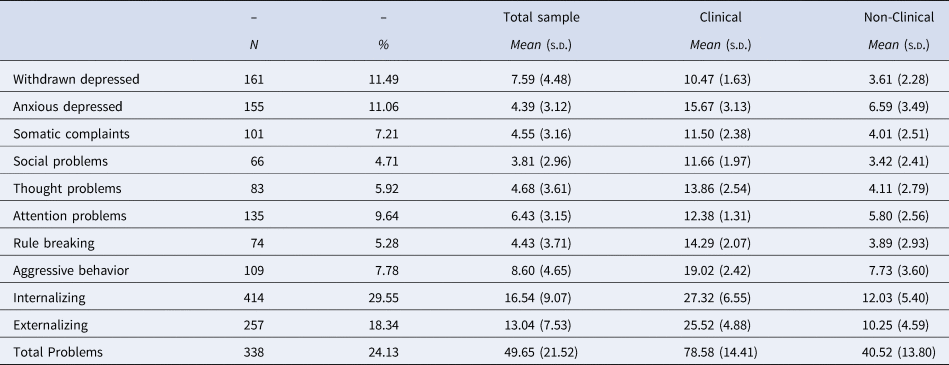
Descriptive statistics are reported in Table 1. Our final sample consisted of 1400 adolescents, of which 536 (38.61%) were male. Mean age was 16.00 years (s.d. 1.42). In our sample, 803 (57.32%) adolescents attended Science Lyceum or Grammar School, 398 (28.41%) attended Art or Human Sciences Lyceum, 199 (14.20%) attended technical or professional institutes. A total of 596 (42.54%) adolescents had a high parental social class, 415 (29.62%) had intermediate social class and 360 (25.70%) had lower social class.
Mean and s.d. of raw scores in YSR variables of interest, in total sample, clinical and non-clinical subsample for each variable

The absolute number and percentage of the total sample of participants meeting the clinical criteria for clinical threshold are reported for each problem.
Prevalence of clinical-rated psychological problems in our sample were as follows: Withdrawn-Depressed, 161 (11.49%); Anxious Depressed, 155 (11.06%); Somatic Complaints, 101 (7.21%); Social Problems, 66 (4.71%); Thought Problems, 83 (5.92%); Attention Problems, 135 (9.64%); Rule-Breaking, 74 (5.28%) Aggressive Behavior, 109 (7.78%). Internalizing Problems were present in 414 (29.55%) individuals, Externalizing problems in 257 (18.34%). Total Problems were rated ‘clinical’ in 338 (24.13%).
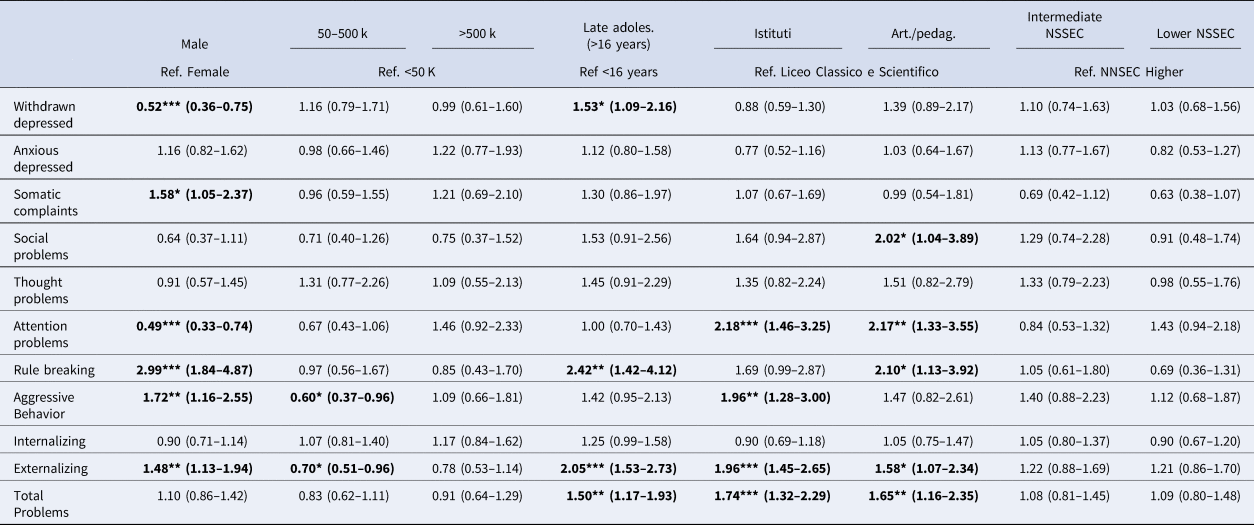
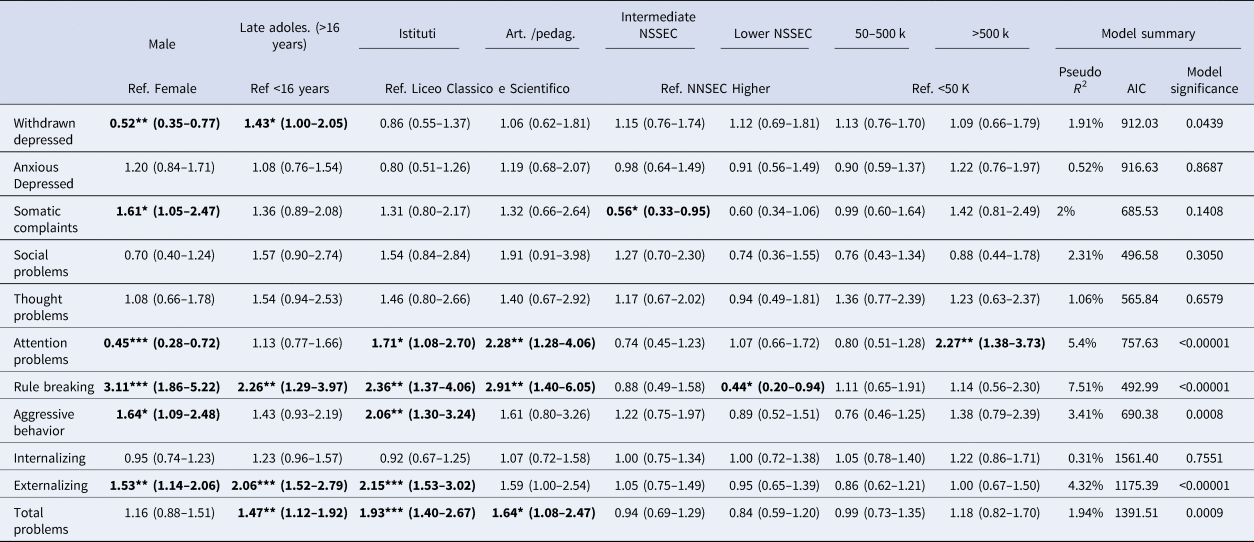
Logistic regression ORs and 95% CIs are reported in Tables 2 and 3.
ORs and 95% CIs of univariate logistic regression models of socio-demographic variables on clinical variables of interest
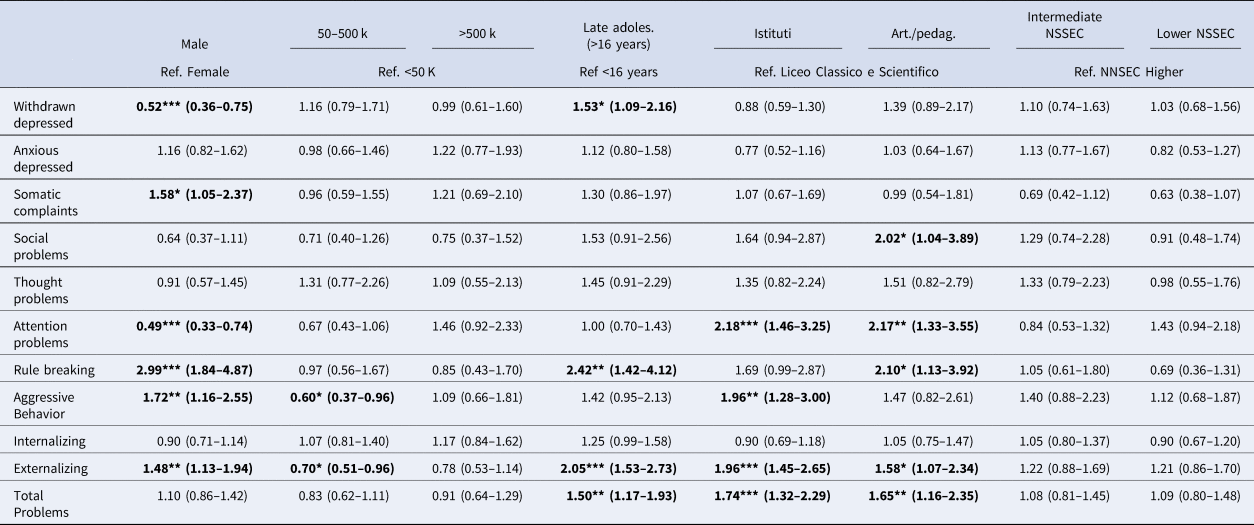
Significant results are indicated in bold. OR, odds ratio; CI, confidence interval.
* p < 0.05 ** p < 0.01 *** p < 0.001.
ORs and 95% CIs of multivariable logistic regression models of socio-demographic variables on clinical variables of interest
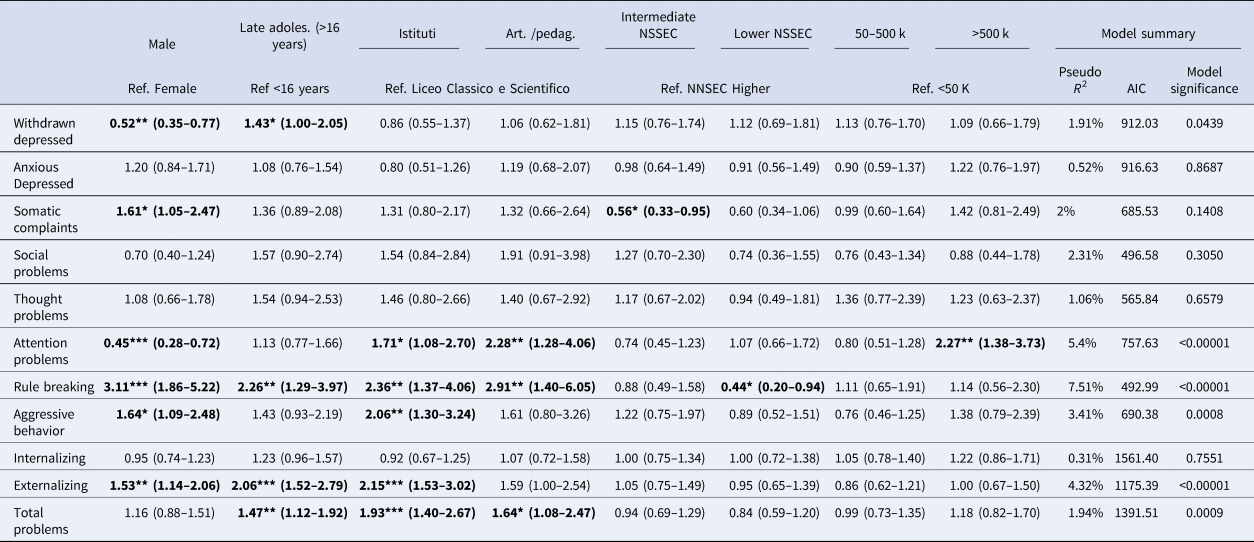
All the analyses were performed on the total sample (N = 1275). Significant results are indicated in bold. OR, odds ratio; CI, confidence interval; AIC, Akaike Information Criteria.
* p < 0.05 ** p < 0.01 *** p < 0.001.
Univariable logistic regression
Male gender was negatively associated with Withdrawn-Depressed Problems [OR = 0.52 (0.36–0.75)] and Attention Problems [OR = 0.49 (0.33–0.74)], and positively associated with Somatic Complaints [OR = 1.58 (1.05–2.37)], Rule Breaking [OR = 2.99 (1.84–4.87)], Aggressive Behavior [OR = 1.72 (1.16–2.55)] and Externalizing Problems [OR = 1.48 (1.13–1.94)]. Compared to early adolescence (<16 years old), late adolescence (⩾16 years old) was associated with Withdrawn-Depressed Problems [OR = 1.53 (1.09–2.16)] Rule Breaking [OR = 2.42 (1.42–4.12)], Externalizing [OR = 2.05 (1.53–2.73)] and Total problems [OR = 1.50 (1.17–1.93)]. Compared to smaller towns (<50.000 inhabitants) mid-sized urban areas (50.000–500.000 inhabitants) were negatively associated with Aggressive Behaviors [OR = 0.60 (0.37–.96)] and Externalizing Problems [OR = 0.70 (0.51–0.96)]. Compared to Grammar School and Science Lyceum, Art and Humanities Lyceum had higher odds of Social Problems [OR = 2.02 (1.04–3.89)], Attention Problems [OR = 2.17 (1.33–3.55)], Rule Breaking [OR = 2.10 (1.13–3.92)], Externalizing and Total Problems [respectively OR = 1.58 (1.07–2.34) and OR = 1.65 (1.16–2.35)]. Technical and Professional Institutes had higher Attention Problems [OR = 2.18 (1.46–3.25)], Aggressive Behaviors [OR = 1.96 (1.28–3.00)], Externalizing and Total Problems [respectively OR = 1.96 (1.45–2.65) and OR = 1.74 (1.32–2.29)]. Parental social class did not show any significant association with YSR (Achenbach & Rescorla, Reference Achenbach and Rescorla2001) scores.
Multivariable logistic regression
In our Multivariable Logistic Regression Models, Withdrawn-depressed Symptoms were associated with gender [OR for male = 0.52 (0.35–0.77)] and Age [OR for late adolescence = 1.43 (1.00–2.05)], with an adjusted R 2 = 1.91%. Anxious-depressed symptoms were not explained by our model, with an R 2 = 0.52%. Somatic Complaints were associated with Gender [OR for male = 1.61 (1.05–2.47)] and Intermediate Parental Social Class [OR = 0.56 (0.33–0.95)], adjusted R 2 = 2%. Social Problems and Thought Problems were not explained by our model, adjusted R 2 respectively, 2.31% and 1.06%. Attention Problems were associated with Gender [OR for male = 0.45 (0.28–0.72)], >500.000 Urban Area Population [OR = 2.27 (1.38–3.73)] and School Type [Technical and Professional Institutes and Art and Humanities VS Grammar and Science School OR respectively, 1.71 (1.08–2.70) and 2.28 (1.28–4.06)], adjusted R 2 = 5.40%. Rule Breaking was associated with Gender [OR for male = 3.11 (1.86–2.48)], Late adolescence [OR = 2.26 (1.29–3.97)] School Type [Technical and Professional Institutes and Art and Humanities v. Grammar and Science School OR respectively, 2.36 (1.37–4.06) and 2.91 (1.40–6.05)] and Lower Parental social Class [OR = 0.44 (0.20–0.94)], adjusted R 2 = 7.51%. Aggressive behavior was associated with Gender [OR for Male = 1.64% (1.09– 2.48)] and school type [OR for Technical and Professional Institutes v. Grammar and Science School = 2.36 (1.30–3.24)], adjusted R 2 = 3.41%. Finally, Internalizing Symptoms altogether were not explained by our model (adjusted R 2 = 0.31%), while Externalizing Symptoms were associated as a whole with Male Gender, older age and Technical and professional Institutes [OR respectively, 1.53 (1.14–2.06); 2.06 (1.52–2.79) and 2.15 (1.53–3.02)], with an Adjusted R 2 = 4.32%. Total Problems were associated with School Type [Technical and Professional Institutes and Art and Humanities v. Grammar and Science School OR respectively, 1.93 (1.40–2.67) and 1.64 (1.08–2.47)], adjusted R 2 = 1.94.
Sensitivity analysis
SA was performed specifying uniform independent distributions of unobserved confounders, running a 20.000 replications simulation. pSA did not yield to materially different results, with 97.5/2.5 percentile ratios including random and systematic errors being greater than conventional 97.5/2.5 percentile (i.e. standard 95% CI) by no more than 0.25.
Discussion
The purpose of our study was to determine the prevalence of self-reported BeEPs in a group of Italian adolescents and to study their associated sociodemographic correlates in order to bring relevant information about adolescents' mental health in Italy. Our main finding is a relatively higher prevalence of psychological problems compared to previous reports. Secondly, we found that socio-demographical determinants of mental health have a higher impact on externalizing than internalizing symptoms. These aspects are discussed more in detail below.
Prevalence of BeEPs
Our main finding is a higher than expected rate of mental health problems: approximately one in four adolescents (24.13%) report a clinically relevant BeEP. Internalizing problems were more frequent (29.55%) than Externalizing problems (18.34%).
To the best of our knowledge, this is the first report on the prevalence of mental health problems in a general population sample aged 14–18 in Italy. Compared to previous international research that reports a prevalence of clinical Total Problems between 11% and 27% (Philipp et al., Reference Philipp, Zeiler, Waldherr, Truttmann, Dur, Karwautz and Wagner2018; Robinson et al., Reference Robinson, Doherty, Cannon, Hickey, Rosenthal, Marino and Skinner2018), our findings provide evidence of a higher prevalence of mental health problems in adolescence, with, in particular, a high prevalence of Internalizing Problems. The only previous Italian report is the PrISMA study, reporting a prevalence of 9.8% of mental disorders assessed with the child behavior checklist (CBCL/6–18) on 3418 pre-adolescents (10–14 years old) (Frigerio et al., Reference Frigerio, Rucci, Goodman, Ammaniti, Carlet, Cavolina and Molteni2009). Compared to this study, we report on different age groups, namely on high school students, while pupils aged 10–14 in Italy are attending what is commonly known as ‘middle school’. Because ‘Middle School’ is a quite different environment compared to ‘High School’, and so are pupils attending to middle and high schools, our work adds an important piece of information about the prevalence of mental disorders and BeEPs in adolescence.
The reason for the higher prevalence of Total Problems in our sample may be due to an age effect at an individual level (see below for age-effect) and/or to macro-characteristics of the sampled population. Our results could moreover be due to an increasing trend in the prevalence of mental disorders in adolescents. Data on the same population at an earlier time are not available, but evidence of an increasing trend in the prevalence of mental health problems in adolescence worldwide is growing. For example, a Polish study on 259 students aged 16 in 2000 reported a 14.4% prevalence of clinical Total Problem scale; 11 years later, in 2011 this percentage rose to 27.02% in an independent sample of the same age (N = 185) (Konowalek & Wolanczyk, Reference Konowalek and Wolanczyk2018). Again, in the USA and in the UK, mental health problems in teens have been reported to be rising in the last 20 years (Collishaw, Maughan, Natarajan, & Pickles, Reference Collishaw, Maughan, Natarajan and Pickles2010; Keyes, Gary, O'Malley, Hamilton, & Schulenberg, Reference Keyes, Gary, O'Malley, Hamilton and Schulenberg2019; Mojtabai, Olfson, & Han, Reference Mojtabai, Olfson and Han2016). The YSR (Achenbach & Rescorla, Reference Achenbach and Rescorla2001) mean Total problem score of this study is in the mid-range compared to mean scores observed in other European societies with mainly northern countries reporting lower mean scores compared to southern countries (Philipp et al., Reference Philipp, Zeiler, Waldherr, Truttmann, Dur, Karwautz and Wagner2018). However, these data only allow an approximate comparison as the methodology of the studies varies regarding the included age range and the sampling frame.
Socio-demographic determinants of BeEPs
In this study, we selected a ‘socio-demographic’ explanatory model of BeEPs. As a whole, our model fits the data poorly, with R 2 values below 10% on each scale. However, our extended socio-demographic model has some explanatory power on externalizing scales. This evidence suggests that while internalizing dimensions may be better explained by different variables, socio-demographical factors could be considered as specific determinants of externalizing problems. In the following section, we will discuss such factors in detail.
Gender
Consistent with literature (Hicks et al., Reference Hicks, Blonigen, Kramer, Krueger, Patrick, Iacono and Mcgue2007) boys reported higher scores in Externalizing Problems showing, in particular, elevated scores in Rule-breaking behaviors and Aggressive behaviors, as well as higher scores on Somatic complaints. Consistently with previous research (Whiteford et al., Reference Whiteford, Degenhardt, Rehm, Baxter, Ferrari, Erskine and Vos2013) girls had higher Withdrawn/Depressed problems and Attention Problems. No gender difference was observed in Internalizing Problems as a whole, as girls scored higher on Withdrawn/Depressed symptoms, and boys scored higher on Somatic Complaints, while Anxious/Depressed symptoms were equally distributed across genders. In our sample, boys scored higher than girls on somatic and externalizing problems: these two symptoms' group may have a common underpinning in males based on alexithymia, that may help to explain such association. Alexithymia has been shown to be associated with somatic complaints in clinical and non-clinical samples (Bach & Bach, Reference Bach and Bach1996; Kusevic et al., Reference Kusevic, Civljak, Rukavina, Babic, Loncar, Cusa and Gregurek2013; Lundh & Simonsson-Sarnecki, Reference Lundh and Simonsson-Sarnecki2001; Taycan, Ozdemir, & Erdogan Taycan, Reference Taycan, Ozdemir and Erdogan Taycan2017; Taylor, Parker, Bagby, & Acklin, Reference Taylor, Parker, Bagby and Acklin1992). Because of the inability to communicate their feelings, people with high alexithymia are prone to communicate through their bodily sensations. A number of authors assume the existence of normative male alexithymia which consists in a subclinical version of alexithymia, highly associated with masculinity and commonly reported in boys (Levant & Parent, Reference Levant and Parent2019; Sullivan, Camic, & Brown, Reference Sullivan, Camic and Brown2015). Moreover, alexithymia was found to be more common among adolescents with severe behavioral problems (Gatta, Del Col, Testa, Svanellini, & Battistella, Reference Gatta M, Del Col, Testa, Svanellini and Battistella2012; Manninen et al., Reference Manninen, Therman, Suvisaari, Ebeling, Moilanen, Huttunen and Joukamaa2011) and among adolescents with disruptive and delinquent behaviors (Manninen et al., Reference Manninen, Therman, Suvisaari, Ebeling, Moilanen, Huttunen and Joukamaa2011; Zimmermann, Reference Zimmermann2006), possibly as a result of a deficit in cognitive processing and regulation of emotional states (Luminet, Rime, Bagby, & Taylor, Reference Luminet, Rime, Bagby and Taylor2004).
Age
In our sample, Total Problem scale scores were higher for subjects aged more than 16 years with a 50% higher probability of having a mental health problem compared to younger participants. In particular, in our sample, boys and girls older than 16 years old resulted to have higher scores in the narrow band syndromic scales Withdrawn/Depressed and Rule-breaking behavior and in the broadband scale Externalizing behaviors.
According to literature, the prevalence of mental disorders increases during the transition into adulthood (Kessler et al., Reference Kessler, Angermeyer, Anthony, Demyttenaere, Gasquet and Ustun2007) with a twofold increase in mood disorders' prevalence from early to late adolescence (Merikangas et al., Reference Merikangas, He, Burstein, Swanson, Avenevoli, Cui and Swendsen2010).
Late adolescence is often described as a turbulent phase (Burnett & Blakemore, Reference Burnett and Blakemore2009), however, previous studies report conflicting results concerning age effects on YSR (Achenbach & Rescorla, Reference Achenbach and Rescorla2001) scores. Verhulst and colleagues (Verhulst, Prince, Vervuurt-Poot, & de Jong, Reference Verhulst, Prince, Vervuurt-Poot and de Jong1989) found a small age effect on Total Problem score with girls scoring higher with increasing age. In an Australian sample (N = 1754), the prevalence of clinical Total Problem raised between age 14 and 17 from 11.7% in boys and 13.0% in girls to 13.0% and 19.3%, respectively (Robinson et al., Reference Robinson, Doherty, Cannon, Hickey, Rosenthal, Marino and Skinner2018). Achenbach et al. (Reference Achenbach, McConaughy and Howell1987), Fitzpatrick & Deehan (Reference Fitzpatrick and Deehan1999) and Verhulst et al. (Reference Verhulst, Prince, Vervuurt-Poot and de Jong1989) found no age effect on Total problems. Differences concerning age effects may depend on which ages are studied and if subjects are compared separately for each age or in age groups. Frigerio and colleagues in 2006 highlighted, in an Italian sample of preadolescents an increase of psychopathology in the older groups of subjects (13–14 years old girls) (Frigerio et al., Reference Frigerio, Rucci, Goodman, Ammaniti, Carlet, Cavolina and Molteni2009). However, these results are not fully comparable with ours as Frigerio and colleagues recruited preadolescents, subjects facing a much different period of life.
SES and school type
In contrast with previous literature, SES did not affect self-reported problems in our sample. This may be due to at least two different factors. Firstly, SES was assessed in our study taking into account the highest parental occupation, not considering other important SES-associated variables, such as parental education level or explicit questions about the actual income (Bowles & Gintis, Reference Bowles and Gintis2002; Galobardes, Shaw, Lawlor, Lynch, & Smith, Reference Galobardes, Shaw, Lawlor, Lynch and Smith2006; Smith, Reference Smith2011). As a matter of fact, the distribution is skewed towards the upper class. The occupational category per se may not be a suitable proxy for SES as it may include heterogeneous jobs associated with different incomes. For example, a large portion of our sample's parental occupation belonged to the area of trade, that implies large differences in individual incomes, depending on the commercial area considered.
According to literature, a lower social position can represent a risk factor for developing depression, anxiety and psychological stress (Freeman et al., Reference Freeman, Tyrovolas, Koyanagi, Chatterji, Leonardi, Ayuso-Mateos and Haro2016; Lund & Cois, Reference Lund and Cois2018). Moreover, an association between low SES and health status in young people has been described (Schreier & Chen, Reference Schreier and Chen2013). Finally, low SES, along with contextual familial co-factors, is a very strong risk factor for externalizing problems and poor global functioning (for a review, see Ackerman & Brown, Reference Ackerman and Brown2006).
PrISMA study reported that low parental education (<10 years) was associated with a higher likelihood of CBCL caseness and DSM-IV disorders. Secondary analyses indicated that the father's education was positively correlated with SES and annual household income, both were also associated with psychopathology (Frigerio et al., Reference Frigerio, Rucci, Goodman, Ammaniti, Carlet, Cavolina and Molteni2009). Further data are needed to understand to what extent parental occupation can be considered a fairly valid measure of SES in the Italian context. Although the logical sequence would be that to a low-skilled occupation corresponds a poor education and a low income (Lahelma, Martikainen, Laaksonen, & Aittomaki, Reference Lahelma, Martikainen, Laaksonen and Aittomaki2004), recent important documented changes in our society altered this order: according to ISTAT although in Italy the employment advantages deriving from higher levels of education are similar to those recorded in the EU average, employment rates remain lower than in Europe. Families with a high-skilled occupation do not necessarily correspond to high educated families.
A precise comparison with other countries is not, therefore, completely possible considering the profoundly different economic context and the divergent social texture characterizing each country involved.
Although parental occupation did not show the expected association with BeEPs, the effect expected from SES was indeed carried by school type, that could be considered a better proxy for global SES in our sample. As also found in other countries characterized by tracked education systems (Dustmann, Reference Dustmann2004; Kerckhoff, Reference Kerckhoff2001), in Italy members of lower social classes are systematically under-represented in the academic-oriented school tracks (i.e. ‘Licei’) (Azzolini & Vergolini, Reference Azzolini and V2014; Schizzerotto & Barone, Reference Schizzerotto and Barone2006). Reports from ISTAT indeed (Ballarino, Bernardi, Requena, & Schadee, Reference Ballarino, Bernardi, Requena and Schadee2008) confirm an inequality in education access across different SES levels in Italy. The reasons for the strong co-segregation of school type and SES, and inequalities in education levels in Italy is beyond the scope of this paper. However, in our sample school type may be considered the best proxy indicator for SES, and in fact, it is associated with BeEPs typically associated with low SES in other studies (for a detailed investigation on education inequality in Italy, see Ballarino et al., Reference Ballarino, Bernardi, Requena and Schadee2008). Differences in prevalence of externalizing behaviors across schools is a finding of particular concern, as it may boost further inequality between social classes both in economic and morbidity terms.
Urbanicity
Urbanicity is a risk factor for mortality (House et al., Reference House, Lepkowski, Williams, Mero, Lanz, Robert and Chen2000) and severe mental illness (van Os, Hanssen, Bijl, & Vollebergh, Reference van Os, Hanssen, Bijl and Vollebergh2001). Previous researchers have noted that both lifetime and 12-month mood and anxiety disorders, as well as measures of psychological distress, were higher in urban v. rural areas (Dhingra, Strine, Holt, Berry, & Mokdad, Reference Dhingra, Strine, Holt, Berry and Mokdad2009; Peen et al., Reference Peen, Dekker, Schoevers, ten Have, de Graaf and Beekman2007; Peen, Schoevers, Beekman, & Dekker, Reference Peen, Schoevers, Beekman and Dekker2010).
However, rural individuals are also at risk for poorer mental health in part due to the increasing rates of drug use and distance from social and health services (Smalley, Warren, & Klibert, Reference Smalley, Warren and Klibert2012; Weaver, Himle, Taylor, Matusko, & Abelson, Reference Weaver, Himle, Taylor, Matusko and Abelson2015; Young, Havens, & Leukefeld, Reference Young, Havens and Leukefeld2012).
According to univariate logistic regression analysis, adolescents in our sample who declared to live in a town inhabited by <50 k people scored higher in the narrow band scale evaluating Aggressive behavior and in the broadband scale evaluating Externalizing problems. When a multivariable logistic regression was performed, instead, these previously cited small effects disappeared and a strong correlation emerged: in contrast with previous literature, adolescents in our sample who declared to live in a town inhabited by more than 500 k people did not report higher scores in the scale evaluating Thought problems, but they scored higher in the narrow band scale evaluating Attention problems. In this regard most of the studies in the literature that show an increase in the rate of schizophrenia in the urban population is conducted on adults, with therefore very different clinical manifestations from a teenage population. From a clinical point of view, psychopathological manifestations are much less defined in adolescence than in adulthood. It would also be advisable to use in the future a more in-depth evaluation that more thoroughly characterizes these symptoms of inattention that may be present transversely in different clinical pictures.
Limitations and strengths
Our study presents some limitations. Firstly, self-report measures were not confronted with the teacher- or parent-report measures, potentially introducing a reporting bias, especially for externalizing problems. Secondly, the need to have the informed consent signed by both parents represented a constraint that could have introduced a selection bias, as well as the voluntary participation basis. Further analysis will ascertain whether participation was predicted by other variables of interest. Thirdly, SES was assessed without taking into account a number of variables that may have helped to detail important effects, such as household income, local community average income or parental education. However, school type helped to compensate this lack of information, because, as discussed above, school type is closely linked to parental SES. Skewness of the SES distribution towards upper SES may have indeed hindered the generalizability of the results. Lastly, although substance abuse is screened by a single item of YSR (Achenbach & Rescorla, Reference Achenbach and Rescorla2001), a more extensive assessment of substance abuse could have helped to ascertain any potential confounding effect in our results.
The main strength of our study is in its sample size that allowed a rather robust estimate of the prevalence of BeEPs in the target population and allowed us to partially mitigate any sampling bias. Concerning sampling, our study is of importance in epidemiological research as it allows a direct comparison of different urban/rural settings. Finally, our paper adds an important piece of information on the prevalence of BeEPs in the adolescent population in central Italy.
Conclusions
In conclusion, our study provides for the first time, an estimate of the prevalence of self-reported BeEPs in a large sample of Italian adolescents. The socio-demographic factors we explored are relevant in explaining externalizing symptoms more than internalizing dimensions, that may be better explained by different variables. The findings of the present study emphasize the urgent need for targeted prevention and the significance of implementing prevention strategies for adolescents in order to improve well-being and to reduce symptom progression.
Acknowledgements
The authors would like to thank all the staff of ‘Associazione Volontari per Policlinico Tor Vergata’ for the logistic support given to this study.
Conflict of interest
All authors report no conflicts of interest.
Ethical standards
The authors assert that all procedures contributing to this work comply with the ethical standards of the relevant national and institutional committees on human experimentation and with the Helsinki Declaration of 1975, as revised in 2008