Introduction
Percutaneous pulmonary valve implantation has developed as an alternative for open-heart surgical valve replacement.Reference Ansari, Cardoso and Garcia1 Initially, balloon expandable stent-valves were implanted in dysfunctional homograft or xenograft valves following repair of various CHDs. Meanwhile, pre-stenting with large calibre stents is the procedure of choice, even for preparing large native right ventricular outflow tracts. By this means the incidence of stent fractures could significantly be reduced and the safety and efficacy dramatically improved.Reference Cardoso, Ansari and Garcia2 Different designed stents and balloons are used worldwide for percutaneous pulmonary valve implantation. The Cheatham platinum stent (CP Stent®, NuMED, Hopkinton, New York, United States of America) with a closed-cell design is predominantly used in the United States. In Europe also the Polytetrafluoroethylene (PTFE)-covered variant of the CP Stent® is commonly available. Other utilised large calibre stents are the semi-open cell designed MaxLD® (Ev3 Inc., Plymouth, Minnesota, United States of America) stent and the AndraStent® (Andramed, Reutlingen, Germany) as a mixed open-cell, closed-cell stent.Reference Eicken, Ewert and Hager3–Reference Esmaeili, Bollmann and Khalil5
We report potentially fatal complications utilising AndraStents® for pre-stenting of the right ventricular outflow tract in six patients from five different institutions. A “diabolo”-shaped misconfiguration was observed, when the AndraStent® was expanded within the right ventricular outflow tract.
Methods and results
A retrospective case series obtained from five European tertiary medical centres is reported. All patients were scheduled for percutaneous pulmonary valve implantation with written informed consent of the patients or their legal guardians. This study complies with the ethical rules of the institutions, and a formal ethical vote was waived.
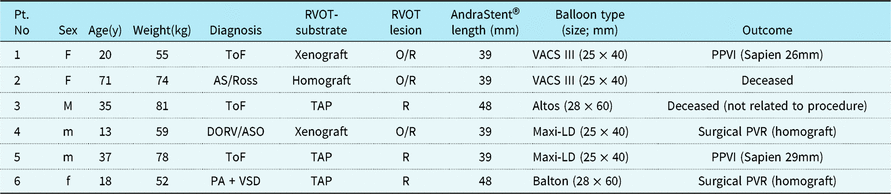
Relevant demographic and catheter-related data as well as the final outcome are summarised in Table 1. All patients were found suitable for percutaneous pulmonary valve implantation after interdisciplinary discussion. In addition, the decision for percutaneous pulmonary valve implantation was made after balloon interrogation and negative testing for coronary compression. In all patients the main indication for percutaneous valve replacement was pulmonary valve regurgitation, in two combined with a significant obstruction. Valveless trans-annular patch repair was present in three, and the other three patients had a reconstructed outflow tract with a homograft or xenograft valve. Pre-stenting of the right ventricular outflow tract was provided by an AndraStent® in all six patients.
Summary of demographic and catheter-related data.

AS/Ross = aortic stenosis followed by Ross operation; ASO = arterial switch operation; DORV = double outlet right ventricle; f= female; m = male; O = obstruction; PA+VSD = pulmonary atresia with VSD; PPVI = percutaneous pulmonary valve implantation; PVR = pulmonary valve replacement; R = regurgitation; RVOT = right ventricular outflow tract; TAP = Transannular Patch; ToF = tetralogy of Fallot; VSD = ventricular septal defect.
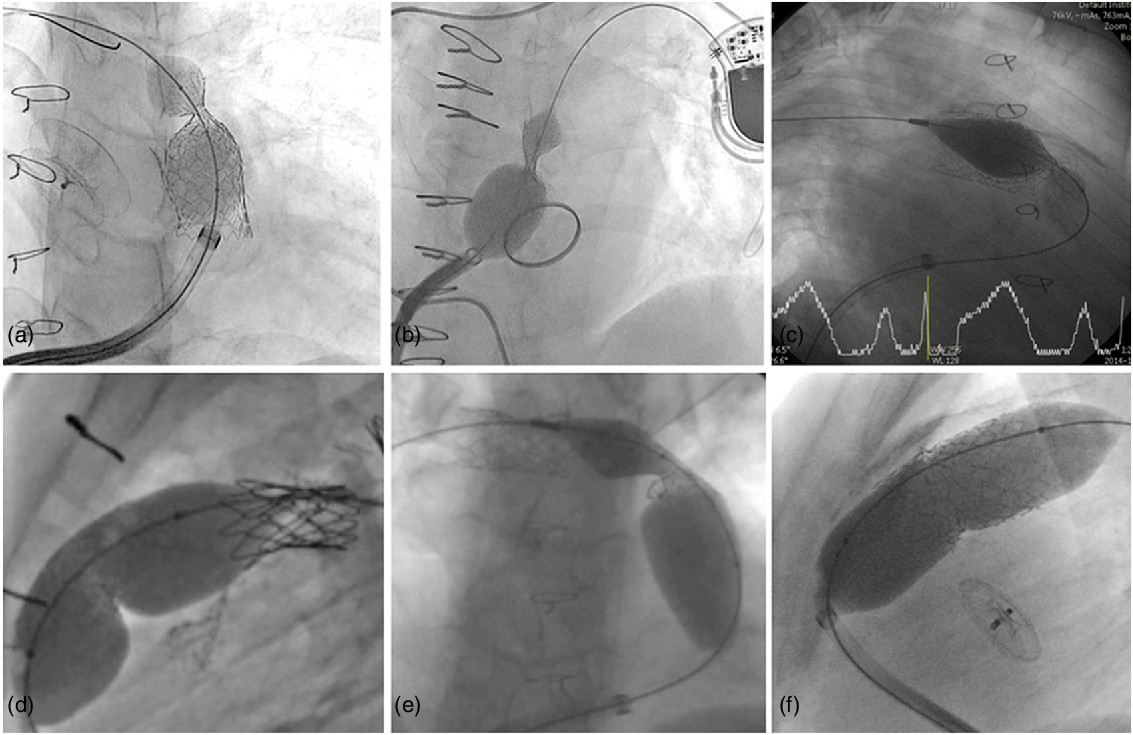
We reviewed the cardiac catheterisation laboratory books of the five centres in the time period from 2013 to 2018 and counted all stents implanted in the right ventricular outflow tact. In total we counted 292 stents implanted in the right ventricular outflow tract, 127 AndraStents® (Andramed), 75 CP-Stents® (uncovered; NuMED, Hopkinton, NY, USA), 64 covered CP-Stents® (NuMED), 11 IntraStents® (ev3 Inc.), 4 Optimus® stents (AndraTec, Koblenz, Germany), 1 Palmaz® (P4014) stent (Cordis, Milpitas, California, United States of America), 1 Palmaz Gensis XD stent (Cordis), 1 Advanta® V12 stent (Maquet, Rastatt, Germany). Of those 127 AndraStents® 6 formed a diabolo shape upon inflation of the balloon (all cases presented below, summarized in Figure 1). None of the other implanted stents showed this behaviour.
Patient 1 was admitted with right ventricular dilatation based on a severe pulmonary regurgitation of a bovine xenograft. In preparation for percutaneous pulmonary valve implantation, an AndraStent® XL with a length of 39 mm was hand-crimped mounted on a 25 × 40 mm VACS III® balloon (Osypka, Rheinfelden, Germany) and uneventfully implanted within the right ventricular outflow tract. Considering significant stent recoil, the decision was made to implant a second 39 mm AndraStent® XL also mounted on a 25 × 40 mm VACS III® balloon. On inflation of the balloon to 4atms the stent formed a diabolo-shape and the balloon ruptured. The fragmented balloon was almost fully retrieved, and only a small part of the balloon’s tip was torn apart. Utilising the still-positioned ultra-stiff guiding wire the diabolo-shaped stent was sequentially dilated to the desired size at the intended site. Gradual ballooning of the stent was performed with a 20 × 20 mm Atlas® (Bard, Tempe, California, United States of America), 26 × 20 mm Zelos® (Optimed, Ettlingen, Germany) and finally with a further 24 × 20 mm Atlas® (Bard) balloon. Two weeks later, a 26 mm Edwards-Sapien valve (Edwards, Irvine, California, United States of America) was uneventfully implanted within the pre-stented right ventricular outflow tract, with an uneventful further follow-up.
Patient 2 was referred for percutaneous pulmonary valve implantation due to a severe homograft regurgitation following Ross operation for aortic stenosis, mechanical mitral valve replacement and right coronary artery bypass surgery. A 39 mm AndraStent® XXL mounted on a 25 × 40 mm VACS III® developed a diabolo-shaped stent during expansion and the balloon burst. During the retrieval manoeuvre of the ruptured balloon, the guiding wire position was lost. The mal-configured stent embolised into the peripheral pulmonary artery. Efforts to re-enter the stent aiming for an implantation in a stable position failed. Following surgical consultation, the decision was made to retrieve the embolised stent. The stent was snared and pulled into the inferior vena cava but could not be retrieved through a 24 F sheath. These manoeuvres eventually caused a perforation of the left pulmonary artery by a guide wire with subsequent hematothorax, which was drained, as well as to an injury of the inferior caval vein that was sealed with two covered stents (CP Stents®, 45 mm and 39 mm, respectively). Two days later, the patient became hemodynamically unstable because of significant re-bleeding. A rapid re-catheterisation and subsequent high urgency operation could not stabilise the patient’s condition and she died.
Patient 3 was admitted in NYHA class III-IV following right heart failure. Initial diagnosis was tetralogy of Fallot, which was palliated by a shunt first and later repaired with closure of the ventricular septal defect and pulmonary augmentation by a transannular patch. In preparation for percutaneous pulmonary valve implantation a 57 mm AndraStent® XXL was mounted on a 30 × 60 mm Altos® balloon (AndraTec, Koblenz, Germany) and uneventfully implanted in the right ventricular outflow tract. Considering a recoil phenomenon of the first stent, placement of a second 47 mm AndraStent® XXL again mounted on a 28 × 60 mm Altos® balloon (AndraTec) was attempted. During balloon inflation to 4atm the balloon ruptured when dog-boning of the stent occurred. The ruptured balloon could not be retrieved. Thus, a second 0.0035” wire was positioned through the misconfigured stent. Utilising this second wire, gradual ballooning was performed with Evercross® (ev3 Inc.) balloons of 6 × 20 mm, 10 × 30 mm and 12 × 20 mm, respectively. Finally, a 28 × 40 mm Altos® balloon was crossed through the waist of the misconfigured stent and allowed stent expansion at the correct position in the right ventricular outflow tract and subsequent retrieval of the ruptured Altos® balloon. During the last part of the catheter procedure, the patient became hemodynamically instable and required brief resuscitation. The procedure was aborted, and valve implantation was scheduled in a second catheterisation session. The patient recovered with no neurological sequelae or other complications. However, the patient deceased one and a half month before scheduled valve implantation due to pneumonia and consecutive right heart failure.
Patient 4 was admitted for percutaneous pulmonary valve implantation because of right heart dilatation due to free pulmonary regurgitation and mild obstruction of the pulmonary xenograft. The patient had a history of neonatal arterial switch operation and ventricular septal defect patch repair of a Taussig-Bing complex together with an aortic coarctation repair of the aorta. Interventional procedures were performed for right and left pulmonary artery stenosis as well as aortic isthmus stenting and re-operation for implantation of a bovine xenograft (18 mm) in pulmonic position. In preparation for percutaneous pulmonary valve implantation a 39 mm long AndraStent® XL, 39 mm was mounted on a 25 × 40 mm MaxiLD® balloon (Cordis). Balloon dilatation of the stent created a diabolo-shape misconfiguration of the stent and upon further inflation the balloon burst. The ruptured balloon was not safely retrievable; therefore, by a second venous access, a high-pressure balloon (Atlas®, 24 × 20 mm) was advanced through the insufficiently expanded stent and conduit. After balloon dilation the ruptured balloon was easily retrieved. However, the Andra stent remained still mobile in the right ventricular outflow tract. A second stent (CP Stent®, 39 mm; mounted on a 25 × 40 mm MaxiLD® balloon) was implanted to fix both stents within right ventricular outflow tract and pulmonary artery walls. However, the configuration of both stents remained unfavourable as a landing zone for percutaneous pulmonary valve implantation with too much bending and a small inner right ventricular outflow tract. Therefore, the decision was made for surgical removal of the ensemble of xenograft and stents, and instead a pulmonary homograft was implanted.
Patient 5 was admitted with severe pulmonary regurgitation and enlargement of the right ventricle (right ventricular enddiastolic volume index 184 ccm/m2 on MRI) and moderate to severe impaired right ventricular function following transanular patch augmentation following a Tetralogy of Fallot repair at the age of 3 years. In a first procedure stenting of severe right pulmonary artery stenosis by an AndraStent® XL of 34 mm mounted on a MaxiLD® balloon (Cordis, 16 × 40 mm) was performed. During a second catheterisation, in preparation for percutaneous pulmonary valve implantation, a 39 mm AndraStent® XXL mounted on a 25 × 40 mm Maxi-LD® balloon (Cordis) was prepared, but during inflation of the balloon the stent misconfigured and developed a diabolo-shape; in addition the stent did not provide sufficient contact to the right ventricular outflow tract. The balloon was deflated and easily retrieved, leaving the stent rocking between the partially stented bifurcation and the right ventricular outflow tract. A second 43 mm AndraStent® XXL mounted on a 20 × 60MaxiLD® balloon was advanced to fix the rocking, diabolo-shaped stent in kissing position of the previously implanted right pulmonary artery stent. After this successful manoeuvre, the misconfigured stent was dilated with an Atlas Gold® balloon (26 × 20 mm); adequate wall contact and stability of the stent were achieved. Four month later, the jailed left pulmonary artery was “de-jailed” using a 12 mm balloon to achieve better blood flow into the left pulmonary artery. Subsequently the stent package was re-dilated to 26 mm by an Atlas Gold® balloon (26 × 20 mm, expanded by 10atm). Because of a significant recoil a further 39 mm AndraStent® XXL mounted on a 28 × 40 mm Altos® Balloon was uneventful implanted. Thereafter, a 29 mm Edward-Sapiens XT® valve (Edwards) was delivered and placed with a good angiographic and hemodynamic result.
Patient 6 was admitted with a severe right ventricular outflow tract regurgitation after transannular patch repair of pulmonary atresia with ventricular septal defect together with unifocalisation of major aorto-pulmonary collateral vessels. A 48 mm long AndraStent® XXL mounted on a 28 × 60 mm angioplasty balloon (Balton) mal-configured during balloon inflation. After deflation and retrieval of the balloon the stent dislocated in the right ventricle. Any attempt to advance the stent back into the right ventricular outflow tract failed and the patient was taken to theatres. She underwent an uneventful surgical removal of the stent, and a 25 mm homograft valve was placed in pulmonic position without any complication.
In all six patients reported in this article, a diabolo-shaped mal-configuration of AndraStents® occurred during pre-stenting of the right ventricular outflow tract for percutaneous pulmonary valve implantation. Misconfigured AndraStents® which remained in the right ventricular outflow tract could finally be expanded in four patients by sequential balloon dilatation. The attempt of percutaneous retrieval of a mal-configured, embolised stent led to fatal bleeding complication in one patient, and in another patient the embolised stent was surgically removed from the right ventricle.
In the follow-up two patients received a transcatheter Edwards-Sapien valve (26 and 29 mm, respectively) during a subsequent catheter procedure, 14 and 4 months later, respectively. One patient died after a follow-up period of 6 weeks of pneumonia and right heart failure before scheduled percutaneous pulmonary valve implantation. Two patients received surgical pulmonary valve replacements by homografts, one immediately as a rescue procedure because of the embolised stent, and one as an elective surgical approach.
Discussion
Percutaneous pulmonary valve implantation is established as the less-invasive alternative to open-heart pulmonary valve replacement in well-selected patients. However, the transcatheter approach is not without risk. Known complications include rupture of the right ventricular outflow tract, coronary compression, device migration or embolisation and in the longer run endocarditis, malfunction of the implanted valve or stent fractures, even with a fatal outcome.Reference Ansari, Cardoso and Garcia1 Noteworthy, percutaneous pulmonary valve implantation with balloon-expandable stent-valves need in most patients pre-stenting to overcome complications such as valve stent fractures in order to achieve a safer valve implantation and a longer life-time of the valve.Reference Cardoso, Ansari and Garcia2 However, pre-stenting of the right ventricular outflow tract is the most challenging part of balloon-expandable percutaneous pulmonary valve implantation, consecutively with its own risk factors. Reporting our case series has the intention to sensitise interventionists concerning the use of open-cell designed stents, in particular the AndraStent®. The potential diabolo-shape misconfiguration during balloon inflation and expansion of the stent as an extreme form of the known dog-boning effect should be carefully anticipated. It has to be noticed that a diabolo-shaped stent configuration might be intended in some special conditions and is the goal of the procedure, for instance, in preserving communications between Fontan-tunnel and atrium.Reference Stümper, Gewillig and Vettukattil6, Reference Rupp, Schieke and Kerst7 However, in our case series, this diabolo or extreme “dog-bone” configuration was not intended. It seems that stent and balloon design together with balloon-stent length ratio and balloon inflation-deflation behaviour interacts in conjunction with the right ventricular outflow tract anatomy. In any case, they become the crucial determinants for the success of the procedure – or the eventual fatal outcome.
AndraStents® are bare metal, cobalt chromium stents made by laser cutting in a mixed open-cell, closed-cell design. This design allows expansion up to a diameter of 32 mm. In addition, this design has the hypothetical advantage of a better grip in a wide, non-obstructed, little calcified right ventricular outflow tract compared to closed-cell stents with a smooth profile, thus reducing the risk of stent dislodgement after expansion. These postulated advantages seem also to be the weakness of the AndraStent®.
The mixed open-cell, closed-cell design favours stent fixation by its non-harmonic strut expansion within the right ventricular outflow tract, but might also increase the balloon’s perforation risk. During inflation of the balloon stent expansion occurs earlier at the ends of the stent; this phenomenon is called “dog-boning” and has been studied in computational models, although for coronary stent-balloon ensembles and not for large calibre stents.Reference Bukala, Kwiatkowski and Malachowski8 The effect of “dog-boning” in the mixed open-cell, closed-cell AndraStent® might lead to exposure of sharp stent edges during expansion and eventually cause burst of the balloon.
In addition, computational models suggest that an increase in balloon-to-stent-length ratio leads to a higher degree of “dog-boning”.Reference Mortier, De Beule and Carlier9, Reference Cui, Lee, Lu and Chai10 To favour that, in our case series in two cases the balloon-to-stent-length ratio was increased to approximately 1.3:1 (60:47 mm). This should be considered as one risk factor for stent’s misconfiguration as well as balloon perforation. Nevertheless, the other four presented cases with a balloon-to-stent-length ratio of approximately 1:1(40:39 mm) suggest that this is not the sole factor for extreme “dog-boning”. Another factor might be the compliance of the balloon, as also suggested by computational models: “dog-boning” could be avoided by less compliant balloons.Reference Cui, Lee, Lu and Chai10 The manufacturers of Altos® (Andramed) and VACS III® balloons (Osypka) in our case series describe these balloons as non-compliant, but with manually crimped stents on the balloon, the stent-balloon-ensembles frequently show a relevant degree of “dog-boning”. Thus, we conclude that only “ultra non-compliant” balloons (e.g. Atlas®, Bard, Tempe, CA, USA), which – according to manufacturer’s information – show “virtually no balloon growth” might prevent the extreme variant of “dog-boning” and can resolve diabolo-shaped misconfigured stents. Finally, our theory is that the ratio of non-inflated-diameter to inflated-diameter of the balloon might play a role for the probability of diabolo-shape misconfiguration; unfortunately however, we are not aware of any computational studies on this phenomenon. Balloon-in-balloon (BiB®, NuMED) catheters could mitigate this problem since these balloons are now available up to 30 mm diameter. To our knowledge, currently no case of an AndraStent® crimped on a BiB® is reported forming a diabolo-shape.
The incidence of misconfiguration of AndraStents® is difficult to determine, as a rough estimate serves the ratio of misconfigured stents to implanted AndraStents® in our study (6/127), whereas no such misconfiguration was seen in 165 stents of other types. Limiting to these numbers is the fact that we do not know in all successfully implanted stents which balloon was used for implantation.
We acknowledge that we do not fully understand the nature of misconfiguration of the stents and might only begin to understand the factors that are important. So, if we cannot prevent diabolo misconfiguration in all cases, we would like to discuss how to best solve this serious condition.
If the balloon is not easily retrievable after a diabolo misconfiguration appears, we cannot recommend using an excess amount of force to pull the balloon out of the stent (in the presented case [patient 1] the balloon ruptured and a small fragment of the balloon could not be retrieved). Instead it seems advisable to establish a second vascular access, pass a second wire through the stent and open the stent with sequential balloon dilatation, starting with smaller high pressure, non-compliant balloons (e.g. Evercross®, Atlas®). Whenever possible, this can be done at the desired implantation site of the stent. This was done successfully in the presented cases (patients 1, 3–5).
Finally, attempts to retrieve an already-partially expanded AndraStent® by snaring cannot be recommended. Misconfiguration of the stent might be aggravated, making stent retrieval in even large scale sheaths impossible. Exposed sharp edges may lead to fatal perforations and bleeding complications (as shown in patient 2). Based on our experiences, surgical removal of an embolised stent (as done in the presented case [6]) might be the treatment of choice.
Conclusion
Misconfiguration of AndraStents® can be associated with fatal complications. Sequential dilatation of an already-diabolo-shaped stent with high-pressure balloons is one option. Surgery is an alternative to retrieve misconfigured stents if sequential dilatation fails. Snaring of AndraStents® cannot be advised. If an AndraStent® has to be implanted, balloon-in-balloon catheters might be the balloon of choice if right ventricular outflow tract diameter allows their application.
Summary of the misconfigured AndraStents® during inflation of the balloon in the RVOT. (a) attempted implantation of a 39 mm AndraStent® XL with a VACS III® balloon (Osypka, Rheinfelden, Germany) with 25 × 40 mm forming a diabolo misconfiguration of the stent and burst of the balloon; (b) attempted implantation of a 39 mm AndraStent® XXL with a VACS III® balloon (Osypka, Rheinfelden, Germany) with 25 × 40 mm forming a diabolo misconfiguration of the stent and burst of the balloon; (c) attempted implantation of a 47 mm AndraStent® XXL with an Altos® balloon (AndraTec, Koblenz, Germany) with 28 × 60 mm forming a diabolo misconfiguration of the stent and burst of the balloon; (d) attempted implantation of a 39 mm AndraStent® XL with a MaxiLD® balloon (Cordis, Milpitas, CA, USA) with 25 × 40 mm forming a diabolo misconfiguration of the stent and burst of the balloon; (e) attempted implantation of a 39 mm AndraStent® XXL with a MaxiLD® balloon (Cordis, Milpitas, CA, USA) with 25 × 40 mm forming a diabolo misconfiguration of the stent, no burst of the balloon; (f) attempted implantation of a 47 mm AndraStent® XXL with an angioplasty balloon (Balton) with 28 × 60 mm leaving a slight indentation of the stent, no burst of the balloon.

Author ORCIDs
Christoph Happel 0000-0002-1010-4327
Acknowledgements
Thanks to Peter Ewert for discussions on the subject presented in this paper. Thanks to Elmar Klusmeier for revising the cath-lab book in Bad Oeynhausen and to Bernadette Brent for critically reading the manuscript.
Financial Support
This work was supported by institutional funds only. This research received no specific grant from any external funding agency, commercial or not-for-profit sectors.
Conflict of Interest
All authors declare no conflict of interest.
Authors Statement
All authors take responsibility for all aspects of the reliability and freedom from bias of the data presented and their discussed interpretation.
Ethical Standards
This research does not include human experimentation and describes cases from routine clinical practice.