

During the past half-century, states have concluded a large number of international trade agreements. Some of these agreements have been multilateral in scope, particularly the General Agreement on Tariffs and Trade (GATT) and its successor, the World Trade Organization (WTO). Others have been bilateral or regional, most notably the preferential trading arrangements (PTAs) that have proliferated with striking speed in recent years. What do such trade institutions accomplish, and why do states form them? The existing research on this topic emphasizes that trade agreements enhance market access for goods, services, and investment. In this view, they are chiefly designed to liberalize and increase the flow of overseas commerce.
Yet such institutions have another function that has been largely ignored by researchers. Specifically, in this article we argue that trade institutions are designed as much to stabilize and reduce volatility in trade policy and trade flows as they are to liberalize and expand foreign commerce. Exposure to global markets increases the vulnerability of a country's economic output to terms of trade shocks, and governments seek to insulate their economies from such instability. Various domestic institutions can serve this purpose, as recent studies underscore. However, international trade institutions—particularly the GATT/WTO and PTAs—can also reduce the volatility of overseas commerce. These institutions constrain member-states from introducing new trade barriers; they foster policy transparency and convergence in expectations, standards, and policy instruments; and they shift the structure of markets in ways that promote greater stability in commercial transactions over time.
Furthermore, by reducing the volatility of international trade, commercial agreements help stabilize the price of traded goods. Firms and other market actors have a strong preference for price stability. As such, they are likely to respond to lower trade variability between the country in which they are located and another state by expanding overseas commerce and investment with that state. If trade agreements do indeed reduce volatility, then they should correspondingly increase the amount of trade conducted among the contracting parties as well. This indirect effect of trade agreements on the flow of overseas commerce stands apart from any direct effect of the agreements on trade flows stemming from member-states' expanded access to foreign markets. In fact, this indirect effect is likely to be important even if agreements lock in rather than cut members' trade barriers. Studies of the relationship between trade institutions and trade flows that ignore their influence on the volatility of foreign commerce therefore risk arriving at misleading conclusions.
In this article, we conduct the first large-scale, multivariate statistical tests of these two hypotheses using annual data on exports for all pairs of countries from 1951 through 2001. The tests, which are based on four different measures of trade volatility, provide strong support for our arguments. Specifically, PTAs and the GATT/WTO significantly reduce export volatility. What is more, a part of the impact of trade agreements on trade levels stems from their tendency to dampen commercial volatility, rather than from their expansion of market access alone. Our results therefore indicate that a critical function of preferential and multilateral trade agreements is to make trade policy and trade flows more predictable.
Our study makes several important contributions to the literature on international institutions and the international political economy. First, a number of analyses of international regimes and institutions argue that these arrangements reduce the variance of international outcomes.Footnote 1 Ours is one of the first studies to test this argument. Second, our analysis helps to clarify limitations of prior empirical research on the links between trade institutions and trade flows. This research has been marked by stark disagreement about whether membership in the GATT/WTO, if not PTAs, promotes overseas trade.Footnote 2 These debates reflect the existing literature's predominant focus on the level—and its inattention to the volatility—of trade flows and policies. Once the volatility of trade is taken into account, there is clear evidence that trade agreements are beneficial. Finally, our analysis highlights an underappreciated function of international institutions of any stripe. Whereas many observers have argued that such institutions improve the status quo policies of member-states, their chief role may be to lock in and enhance the predictability of these policies.
Theory
It is widely accepted that exposure to global markets increases the vulnerability of a country's business cycle, and thus its cross-border commercial and investment flows, to volatility in the terms of trade.Footnote 3 For workers, employment and wages become less secure.Footnote 4 For firms, profits and competitiveness in key markets are threatened.Footnote 5 Hence, as Frieden notes, private-market actors “with substantial cross-border contractual interests” prefer predictability in these flows.Footnote 6 Central to such predictability are government policies concerning trade, investment, and currencies, all of which affect relative international prices. “Business planners,” Abbott observes, “generally prefer to operate under stable economic conditions under which the rules applicable to transactions are known in advance.”Footnote 7 In an open economy, governments will thus face substantial pressure to insulate workers and firms from the vagaries of volatile global markets.
Recent studies have suggested a variety of domestic institutions and policies that states can use to reduce the volatility transmitted by increased exposure to the international economy.Footnote 8 Our argument is that international institutions can play a similar role, reducing the extent to which openness heightens the vulnerability of a country's output to terms of trade shocks. More specifically, trade institutions help stabilize trade policy and trade flows. Indeed, they help states lock in access to overseas markets even if they do not always lead member-countries to decrease trade barriers. This argument is hardly new, although it has been largely ignored in the empirical literature on international institutions and regimes. For example, Keohane points out that various international regimes—including the GATT—are explicitly designed to promote “orderly patterns of behavior among members,” implying that they should enhance stability and reduce volatility in interactions among members.Footnote 9 For Martin and Simmons, international institutions “lock in a particular equilibrium, providing stability.”Footnote 10 Abbott argues that trade agreements, at least those with “hard law,” are adopted to reduce risk premia for private traders and investors.Footnote 11 Perroni and Whalley maintain that “countries see it in their interests to form insurance-based regional blocs, even if the barrier changes relative to the … status quo are small.”Footnote 12
Governments themselves place considerable emphasis on the ability of trade institutions to reduce commercial volatility. As New Zealand argued in its third-party submission during Canada's 1984 Newsprint complaint against the European Community (EC), “the [GATT] disciplines and rules … [should] be used in a way which would foster the stability and security of international trade.”Footnote 13 Going further, Brazil's WTO representative pointed out that the Uruguay Round had done little to improve Brazil's access to foreign markets, but that WTO membership was nonetheless beneficial because the “rules-based multilateral trading system ensured predictability, stability, and security to its economic agents.”Footnote 14 Indeed, this function is emphasized in the WTO treaty itself: Article 3.2 of the Dispute Settlement Understanding (DSU) defines its primary purpose as “providing security and predictability.”Footnote 15
PTAs also aim to reduce the volatility of trade policies and the flow of overseas commerce between members. These institutions include agreements that partially liberalize commerce, free trade areas (FTAs), customs unions, common markets, and economic unions. All PTAs vest each member with preferential access to the markets of the other participants.Footnote 16 Members also recognize, however, that such arrangements can reduce the volatility of international trade. For example, two chief objectives of the 2003 Singapore-Australia FTA, as stated in its Article 1, were to “create a predictable … trading environment” and to “establish a framework of transparent rules to govern trade and investment.”Footnote 17 The preamble to the 2001 Mexico-European Free Trade Area states that its goals are “to create an expanded and secure market for goods and services” and “to ensure a stable and predictable environment for investment.”Footnote 18 Similarly, the Chile-European Union (EU) Association Agreement strives to enhance the transparency of trade and customs “procedures … in order to reduce costs and increase predictability for economic operators.”Footnote 19
Despite its prima facie grounding in existing trade agreements, this volatility-reducing function has received little attention in studies of trade institutions. Bagwell and Staiger, for instance, maintain that the purpose of trade agreements is to allow states with market power to reach more efficient market access exchanges.Footnote 20 In their view, reciprocity and nondiscrimination—key features of institutions such as the GATT/WTO—promote such exchanges. Other scholars have emphasized different institutional features that also serve to increase market access. For example, Davis points to an institution's ability to facilitate linkage bargaining.Footnote 21
This perspective, however, is at odds with recent evidence that many PTAs and the WTO itself do not actually induce members to lower their trade barriers.Footnote 22 Various post-Communist countries, for example, liberalized trade unilaterally prior to the implementation of the WTO's Uruguay Round agreements; their WTO bindings remain far higher than their applied tariff levels.Footnote 23 Furthermore, Japan left its heavily protected rice market entirely off the table in its 2005 FTA talks with Thailand and Malaysia, leading critics to claim that these FTAs “fall well short of promoting real free trade.”Footnote 24 Indeed, most trade accords include exceptions designed to maintain protection for politically sensitive sectors that, if liberalized, would generate especially sizable gains from trade. To be sure, swapping market access in areas of complementary comparative advantage is a defining objective of trade agreements. But, as the preceding examples illustrate, some agreements do not make much headway in that direction. This suggests that trade agreements are designed for other purposes as well, including the reduction of volatility in trade policy and trade flows. With that in mind, our study makes one of the first efforts to determine whether international institutions designed to regulate trade actually dampen the volatility of overseas commerce.
Three Mechanisms
We argue that trade institutions reduce the variability of trade flows in three complementary ways. First, institutions help enforce existing market-access commitments and deter the erection of new protectionist barriers that could otherwise precipitate fluctuations in trade. Second, trade institutions foster transparency and policy convergence among member-states. Third, such institutions change certain characteristics of markets, stimulating responses by private traders that reduce the volatility of cross-border transactions.
One of the most important functions of trade agreements is to constrain member-states from introducing new protectionist policies. As long as members view the costs of violating the agreement as fairly high, locking in trade policies through this sort of external mechanism can help governments to “tie their hands” and resist protectionist pressures from domestic groups.Footnote 25
In addition, trade institutions serve as informational clearinghouses, sometimes even autonomously monitoring members' trade policies. Such information helps focus reputational or retaliation costs on members that abrogate their treaty commitments by introducing trade barriers. These costs may arise domestically if the institution reveals that a government has imposed such barriers or other rent-seeking policies and citizens punish the government as a result.Footnote 26 These costs may also arise internationally if, for instance, member-states bring grievances against participants that violate their treaty obligations. The WTO's highly legalized dispute settlement procedures have long been considered the gold standard in this regard, but most PTAs also contain such provisions.Footnote 27 If one member introduces a protectionist policy, the affected member-state can initiate a dispute settlement proceeding to collect damages.
How much does the threat of these proceedings prevent the introduction of protection by parties to a trade agreement? Little research has been conducted on this issue. However, there is evidence that even a country with as much market power as the United States is deterred from imposing antidumping (AD) duties against WTO members, regardless of the target's countervailing market power.Footnote 28 That such procedures weigh heavily on states tempted to introduce protection is also implied by the outcomes of GATT/WTO disputes. For example, economically powerful states often settle disputes prior to official rulings, and small countries have frequently succeeded in using dispute settlement procedures to induce large countries to remove protectionist barriers.Footnote 29 Further, Desai and Hines show that the stock prices of protected firms drop after a WTO complaint is filed against the barriers shielding them from foreign competition.Footnote 30 Hence, market actors seem to believe that this enforcement mechanism is politically credible. More generally, trade agreements can help states commit to a given level of market access, decreasing the chances they will take actions that degrade that access over time. By reducing the probability of new protectionist barriers, trade institutions reduce the volatility of trade flows.
Anecdotal evidence in support of this proposition is easy to locate. Australia's trade minister acknowledged in 2001 that a chief motivation for establishing the U.S.-Australian FTA was to create an “insurance policy” that limited the possibility of increases in U.S. trade barriers.Footnote 31 Facing a proliferation of unfair trade actions initiated by the United States, Canada had a similar objective in forming its free trade agreement with the United States.Footnote 32 Chile's agreement with Mercosur was also designed to secure its existing level of market access in the Southern Cone.Footnote 33 Likewise, a central reason for China's desire to join the WTO was to guarantee access to the U.S. market; heretofore, the extent of this access had been subject to annual and highly politicized congressional reviews.Footnote 34 States thus view trade institutions as devices to secure their existing access to their partners' markets, even if additional access is not forthcoming.
The second way that trade agreements reduce volatility is by fostering transparency and policy convergence among contracting parties. Trade agreements increase transparency—that is, the ease with which governments and private actors can monitor policy developments—by clarifying the obligations of each participant (for example, by establishing precise schedules of tariff bindings). Equally, these agreements create clearinghouses for members' notifications about policy developments, and they specify procedures for addressing disputes. “Transparency,” as one GATT committee chairman emphasized, “is not an end in itself. It is a means to build confidence in and provide security and stability to the multilateral trading system, to minimize trade restriction and distortion, to assist private market operators to adjust to changing trade policies… .”Footnote 35 For this reason, Canada insisted on increasing the precision of the rules of origin regarding automobiles and auto parts during negotiations over the North American Free Trade Agreement (NAFTA). The prior rules had been vague and susceptible to reinterpretation by the U.S. government, thereby deterring foreign firms from locating investments in Canada for the purpose of producing finished goods for sale in the United States.Footnote 36
Convergence occurs as regulatory instruments, practices, and procedures grow increasingly similar across member-states. Trade agreements circumscribe the range of protectionist policies that participants can impose, thereby channeling protection to a common set of instruments, the domestic implementation of which draws on harmonized international standards and regulations. As such, trade agreements cause signatories to protect their markets in similar and more transparent ways.Footnote 37 A classic example is the Uruguay Round's effort to convert diverse trade protection schemes into tariff equivalents. International institutions and their bureaucrats may “teach norms” or act as “purveyor[s] of global policy knowledge.”Footnote 38 The transparency they provide helps members emulate one another's apparently successful practices.Footnote 39 For instance, the widely observed spread of AD actions is partly attributable to their acceptability (under tightly defined conditions) based on WTO law.Footnote 40 As Martin and Simmons put it, “once policy is delegated to an international institution, state behavior will converge: members will tend to adopt similar monetary, trade, or defense policies.”Footnote 41 Blackhurst, Finlayson, and Zacher, and others, concur with this assessment, maintaining that the reduction of policy-related uncertainty through the establishment of rules and procedures guiding trade relations has been the GATT/WTO's chief accomplishment.Footnote 42
Transparency and convergence in policy instruments reduce the volatility of trade flows by stabilizing the expectations of private traders. With trade institutions in place, private actors have less difficulty obtaining information about trade policy and monitoring the behavior of member governments. Private actors also have clearer avenues of recourse in disputes over members' regulatory actions. In an environment of greater and more reliable information, private actors are thus less likely to exhibit herd behavior, overreacting to the inevitable vicissitudes in global markets. By fostering transparency and convergence, international trade institutions should dampen boom-and-bust cycles in international commercial and investment flows.
The third mechanism through which trade institutions reduce trade volatility is by restructuring investment and commerce in ways that promote greater long-term predictability. A trade agreement invites greater foreign direct investment (FDI) in member-states where firms might otherwise rely on arms-length trade to serve these markets, since the agreement bolsters investors' confidence that member-governments will not engage in predatory activities that jeopardize their assets.Footnote 43 Commerce driven by such fixed-cost investments tied to a global production network is less variable than that resulting from a continual search for the lowest-cost foreign supplier.
Besides increasing FDI, trade institutions also shift the nature of the investment a country attracts. Specifically, trade agreements promote export-platform and vertical FDI to a greater extent than FDI aimed at increasing sales in the host market.Footnote 44 The latter type of investment is often designed to circumvent a host country's trade barriers. Once firms make such investments, they then have a stake in supporting that country's protectionist policies, which place them at an advantage over their competitors located abroad. Firms engaged in vertical or export-platform FDI, in contrast, should lobby the host to forego increased protectionism that would raise transaction costs within their global production network. Through this domestic mechanism, a trade agreement's impact on the type of investment a country attracts reinforces the institution's ability to provide secure market access, thereby stabilizing commercial flows.
Finally, by increasing the range of products that are granted preferential market access, trade agreements generally help countries diversify their portfolio of exports. There is evidence that greater concentration of exports heightens the volatility of a country's terms of trade.Footnote 45 Conversely, export diversification is likely to decrease terms-of-trade volatility and accordingly the volatility of commercial flows.Footnote 46 Thus, by changing characteristics of the market itself, trade agreements are likely to reduce trade volatility.
Hypotheses
The three mechanisms described above form the basis for our primary hypothesis:
H1:
Joint membership in a reciprocal trade agreement—a PTA or the GATT/WTO—should decrease the volatility of a country's exports to a trade partner.
From a theoretical standpoint, we are agnostic about whether PTAs will have a larger or smaller effect on volatility than the GATT/WTO. One possibility is that, since PTAs have many fewer members and less diffuse trade structures than the multilateral regime, participants in PTAs might more easily detect protectionist policies and might have a greater incentive to punish states that enact such measures.Footnote 47 If so, PTAs might be better able than the GATT/WTO to deter spikes in protectionism by members and thereby dampen trade volatility. On the other hand, PTAs are a diverse group of organizations. Some are highly institutionalized and should be especially effective at performing the functions described in the previous section. Others are poorly institutionalized and have far less ability to perform these functions. It is difficult to predict whether, on average, PTAs will perform these functions more or less effectively than the GATT/WTO.
Our argument has an important corollary concerning the level of trade. It is widely argued that volatility in relative prices reduces the profitability of cross-border commerce and thus dampens trade.Footnote 48 As noted earlier, cross-border contracting arrangements are more costly for firms if they are uncertain about prices. By reducing this uncertainty and promoting predictability in economic relations, trade agreements should indirectly increase the volume of trade. Moreover, this effect should be realized even if the trade agreement does not significantly lower protectionist barriers. Increasing the stability of economic actors' expectations may prompt them to engage in more foreign commerce, regardless of whether trade barriers change. This argument gives rise to a secondary hypothesis:
H2:
Greater expected volatility of exports from a given country to a trade partner should decrease the level of those bilateral exports.
Figure 1 shows the theoretical relationships among trade agreements, volatility, and flows. The arrows at the top show the “direct” effect of a trade agreement on commerce, which stems from reciprocal trade barrier reductions among members. Our argument is not based on this topmost causal path. Instead, we focus on the “indirect” effect of trade agreements on trade flows. This indirect effect is represented by the thick causal arrows in the lower portion of the figure, which correspond to our hypotheses H1 and H2, on the left and right, respectively. Together, these two hypotheses imply that, even without expanding market access, trade agreements can promote heightened foreign commerce by reducing volatility. Our argument is silent on the relative weights of the direct (protection-reducing) versus indirect (volatility-reducing) effects of trade agreements on trade levels. We suspect, however, that the substantive impact of volatility is considerable. As far as we are aware, the following results are the first to bear directly on this important issue.
Diagram of the theoretical relationships

Research Design
To test our hypotheses, we construct a data set with one observation per ordered pair (“directed dyad”) of states, i and j, for each year, t, from 1951 to 2001. We include Hong Kong and Macao, in addition to all country-years on the Correlates of War (COW) interstate system membership list, version 2002.1.Footnote 49 This yields a total of 1,082,652 possible directed-dyad-years; however, gaps in trade data for some countries reduce the sample that is actually analyzed below to about half of this size, or 527,883 observations.Footnote 50 This sample includes 162 countries and a panel of 21,167 unique ordered pairs, for an average of 24.9 years each.
Dependent Variable: Volatility
There is no universally accepted measure of volatility and little precedent in the existing literature for scoring volatility in trade. Studies of the impact of exchange rate volatility on trade tend to operationalize volatility as the variance within a time series of yearly observations of trade for a given country or pair of countries.Footnote 51 This technique, however, conflates predictable changes in trade with unexpected shocks.Footnote 52 It is also unable to furnish time-specific values of volatility within, not merely across, series.
We consider four different measures of volatility, none of which suffer from these limitations. Our measures are applied to the goods exports of state i to state j in year t (X i,j,t), expressed in constant 1995 U.S. dollars.Footnote 53 The last of these is the most direct indicator of volatility used in this study. However, we first present three somewhat simpler and more intuitive measures. Analyzing all four variables should increase confidence in the robustness of our results.
Our first measure, used in Model A, is the absolute value of the change in the logged value of real exports from state i to state j, between years t − 1 and t.Footnote 54

One advantage of this measure is that it varies from year to year within the export series for each country-pair. As a result, we can control for time-varying factors affecting the level of trade, thereby enhancing our ability to isolate the effects of trade agreements. Larger values of this measure represent wider fluctuations from year to year and thus greater trade volatility. Of course, analyzing the logarithm of exports compresses high values, so that the same real deviations would appear smaller at higher levels of trade than at lower ones. We address this issue by controlling for the prior level of exports (ln X i,j,t−1).
Our second measure of volatility, used in Model B, is the absolute value of the change in the supplier's export share in the importer's market, expressed as a percentage.

This measure scales exports by the importing country's gross domestic product (GDP).Footnote 55
Our third measure, export dropi,j,t, used in Model C, is dichotomous. It equals 1 if state i's real exports to state j drop by 50 percent or more from year t − 1 to year t, that is, if [100 × (X i,j,t − X i,j,t−1)/X i,j,t−1] ≤ −50. It equals zero otherwise. Fifteen percent of the observations in our sample experience such a dip. (We can alternatively draw the cutoff at 10 or 25 percent with no consequence for the following results.) Unlike the previous two measures of volatility, this variable taps the direction of trade volatility. Doing so is important because we expect trade institutions to reduce the probability of year-to-year collapses in the flow of exports.
Our final technique for assessing the links between trade agreements and export volatility is the most direct. We begin by assuming that the level of exports from one state to another in year t is given by:

where Z is a vector of control variables with ϕ as their coefficients, μi,j is a directed-dyad-specific fixed effect, δt is a year-specific fixed effect, and ptai,j,t−1 and wtoi,j,t−1 are dummy variables indicating whether countries i and j are, respectively, members of the same PTA or the GATT/WTO in year t − 1. We also assume that the error term, ɛi,j,t, follows a normal distribution with mean zero and, crucially, observation-specific variance, σi,j,t2. Higher error variance in a given case indicates that the deviations in the actual levels of exports are greater. This error variance, then, is the embodiment of observation-specific volatility.
To capture the impact of trade agreements on volatility, we estimate a heteroskedastic regression, Model D, which parameterizes the variance function as:

where W is a vector of control variables and τt is a year-specific fixed effect. Our argument will be supported if α2,α3 < 0, indicating that trade agreements reduce the variance in export levels. As with the first measure of volatility, this procedure uses a logarithmic scale; accordingly, to correct for the compression at high values, we control in the variance equation for the level of exports from country i to country j in year t − 1.
Estimating the Direct and Indirect Effects of Trade Agreements on Export Levels
Model D does not differentiate between the direct and indirect impact of trade agreements on export levels, which are merged into single coefficients in equation (3)—β1 or β2, the coefficients of wtoi,j,t−1 and ptai,j,t−1, respectively. Indirectly, trade institutions can boost export flows by stabilizing policies even if they do not directly increase market access, since economic actors are expected to engage in more cross-border trade when relative prices are less volatile. To separate these direct and indirect effects of trade agreements on export levels, we estimate an ARCH-in-mean model. Model E generalizes the heteroskedastic regression framework by adding the observation-specific conditional error variance term, σi,j,t2, as a causal variable in our model of the level of exports (arch.m) and by allowing for first-order autoregressive-conditional heteroskedasticity (arch.1) in the variance equation. Specifically, underlining what has been added to equations (3) and (4),

and

Model E further allows for first-order autocorrelation (ar.1), such that Cov(ɛi,j,t,ɛi,j,t−1) ≠ 0. A simpler version of this modeling technique was devised by Engle, Lilien, and Robins to analyze volatility in financial markets.Footnote 56 To our knowledge, it has not been used in studies of international trade, although it is ideally suited to our purposes. It is important to recognize, however, that our version explicitly adapts to the panel data context by including directed-dyad-specific fixed effects (μi,j) in equation (5).Footnote 57
Trade agreements have a positive indirect impact on export levels to the extent that, simultaneously, α2,α3 < 0 in equation (3) and β3 < 0 in equation (5). Trade agreements have a positive direct effect on exports to the extent that β1, β2 > 0 in equation (5).Footnote 58
Independent Variables: Trade Agreements
Our two primary explanatory variables are ptai,j,t−1 and wtoi,j,t−1. These dummy variables indicate, respectively, that the pair of countries, i and j, are members of the same PTA or of the GATT/WTO, at some point in year t − 1. For convenience, subsequent references to these variables often omit subscripts, but note that they are always lagged by one year. pta takes account of partial scope accords, FTAs, customs unions, common markets, and economic unions, but not general cooperation agreements unless they include a schedule of trade-liberalizing commitments with specific products, amounts, and timetables. This variable is restricted to agreements that are reciprocal in nature; accordingly, the Generalized System of Preferences and the EC's Lome Convention are not included. For hub-and-spoke agreements (such as the EC's Arusha II accord with Kenya, Tanzania, and Uganda), pta is coded as 1 only for those bilateral relationships covered by the agreement, not for the relations among the “spokes” (unless, of course, they were covered by a separate PTA).Footnote 59 This variable equals 1 in 9 percent of the sample's observations, reflecting about 250 distinct PTA treaties, depending on how one counts successor or extension treaties. wto equals 1 in 47 percent of our sample.
Control Variables
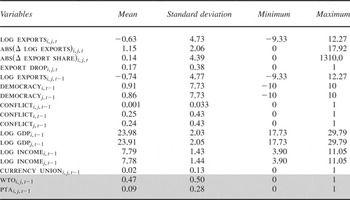
To adequately assess the effects of these explanatory variables, it is important to control for various other factors that previous studies have identified as likely influences on bilateral trade flows and on membership in trade agreements.Footnote 60 All of these variables are measured in year t − 1. Gravity models emphasize that trade flows between states i and j are influenced by each state's GDP and per capita GDP (or equivalently, national population).Footnote 61 We also control for the existence of a currency union between states i and j.Footnote 62 In addition, we include three dummy variables measuring political-military conflict. The first indicates whether state i was the site of an armed conflict (either civil or international); the second indicates whether state j was such a site; and the third indicates whether i and j were antagonists in an armed conflict.Footnote 63 Finally, we include a 21-point measure of each state's regime type based on the Polity IV data set that ranges from −10 for the most autocratic countries to 10 for the most democratic ones.Footnote 64Table 1 provides descriptive statistics on all of our independent variables, as well as our measures of trade volatility.Footnote 65
Descriptive statistics

Notes:
N = 527,883 (the sample used in Models A, B, D, and E). N = 473,797 for export drop, which is used only in Model C. Number of countries = 162. Number of country-pairs (dyads) = 11,194. Number of ordered country-pairs (directed dyads) = 21,167. Average number of years per directed dyad = 24.9.
All five models incorporate fixed effects specific to each ordered pair of countries, i and j, as well as year-specific fixed effects. The latter capture system-wide trade shocks felt by all pairs of states. The former control for unobserved sources of pairwise heterogeneity. We include such fixed effects because a number of recent studies have argued that omitting them can dramatically bias coefficient estimates in models of international trade.Footnote 66 As a consequence of using this method, however, we cannot estimate the impact of factors that are constant over time within an ordered pair of countries. Some factors of this sort—especially bilateral distance, border contiguity, and past colonial relationships—are often included in gravity models that omit pairwise fixed effects. Similarly, such a tiny fraction of country pairs change their alliance status over our sample period that we are not able to control for that variable either. However, excluding these covariates does not introduce bias since their effects are fully absorbed into the cross-sectional fixed effects.Footnote 67
The Models
Models A, B, and C include ptai,j,t−1, wtoi,j,t−1, the control variables described above, and the lagged export level, ln X i,j,t−1. Models D and E—the heteroskedastic regression and ARCH-in-mean model—include ptai,j,t−1, wtoi,j,t−1, all the control variables, and ln X i,j,t−1 in their export levels equations (3 and 5, above).Footnote 68 Their variance equations (4) and (6) incorporate ptai,j,t−1, wtoi,j,t−1, ln X i,j,t−1, year-specific fixed effects, and currency unioni,j,t−1. We add the latter variable because participation in a currency union is likely to stabilize prices.
Results
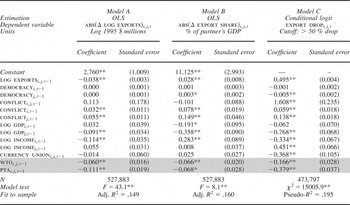
The regression estimates for Models A to C (the three different year-on-year change measures), Model D (heteroskedastic regression), and Model E (ARCH-in-mean) are shown in Tables 2, 3, and 4, respectively. All five models provide strong and consistent support for our hypotheses. Both PTAs and the GATT/WTO reduce the volatility of exports in a substantively meaningful and statistically significant fashion. This finding does not depend on which measure of volatility is analyzed, and it is quite robust statistically, as we describe below. Moreover, the Model E results—which parse out the direct and indirect effects of trade agreements on export levels—show that some of the beneficial impact these agreements have on export levels stems from their ability to reduce volatility rather than from increased market access alone.
Trade volatility models

Notes:
All tests of statistical significance are two-tailed. Robust standard errors clustered by dyad are in parentheses. All models include year-specific as well as directed-dyad-specific fixed effects. OLS = ordinary least squares.
* p < .05;
** p < .01.
Models A to D
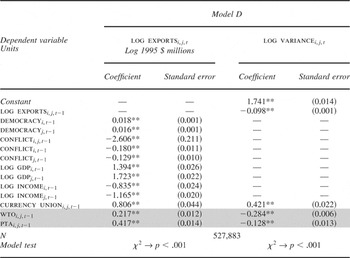
Models A to D provide a good overall fit.Footnote 69 Moreover, in Models A, B, and C, and in Model D's variance equation, the estimated coefficients of pta and wto are negative and statistically significant, as we expected. Trade agreements reduce absolute changes in exports, whether logged or as a share of the partner's market, and they decrease the chances of a collapse in bilateral exports. They also reduce the instantaneous variance of export flows, as evidenced in Model D's variance function.
The volatility-reducing impact of PTA and GATT/WTO membership is substantively as well as statistically significant. Figure 2 compares the predicted values of the volatility measures, based on the estimates of Models A to E, given the absence and presence of PTA and GATT/WTO membership, respectively, holding all other variables at their sample means. In combination, these institutions reduce volatility by about a third, though that value ranges from 14 to 76 percent, depending on the measure used.Footnote 70 As shown in the figure, whether membership in GATT/WTO or the average PTA has a greater effect in reducing the volatility of trade likewise varies across the models.Footnote 71 Note that this comparison is with the average PTA; the difference may be attenuated when comparing the GATT/WTO to, say, the EU, or the handful of other PTAs with comparably strong institutions and dispute settlement regimes.
Estimated impact of trade institutions on trade volatility

What is the impact of PTAs and WTO membership on trade levels in Model D? As shown in the first column of Table 3, both PTAs and the GATT/WTO strongly boost the level of bilateral exports, while simultaneously reducing trade volatility (see the table's third column).
Heteroskedastic regression model of trade levels and volatility

Notes:
All tests of statistical significance are two-tailed. Robust standard errors are in parentheses. Both equations include year-specific fixed effects, and the export levels equation includes directed-dyad-specific fixed effects.
* p < .05;
** p < .01.
The volatility-reducing effects of PTAs and the GATT/WTO in Models A to D are robust to a wide variety of statistical challenges. First, the effects hold for all four measures of export volatility. Second, these effects persist even after dropping observations where the value of the dependent variable is extremely large.Footnote 72 Third, the results are unchanged if we add three variables indicating whether the exporter, the importer, or the pair are members of the EC; or if we add the GDP growth rate of each country to the models. Fourth, the coefficient estimates of pta and wto remain negative and statistically significant in Model C, even if we reduce the threshold at which export drop equals 1 from 50 percent to 25 percent or 10 percent. Fifth, the results are also unchanged if we employ Newey-West standard errors that are robust to first-order autocorrelation as well as heteroskedasticity. Sixth, the two trade institution variables retain their effects if we recode the conflict variables using a higher threshold of violence (“war”) or if we add a variable indicating whether either state in the dyad had a contiguous neighbor participating in a war in year t − 1. Seventh, the results are robust to the inclusion of a variable measuring the past year's bilateral exchange rate variability.Footnote 73
Two other sensitivity tests deserve special attention. First, some recent studies have argued that only the most powerful states in the global system benefit from the protections afforded by trade agreements.Footnote 74 Gowa and Kim, in particular, find that GATT membership boosts trade flows only among pairs of industrial nations.Footnote 75 Could our findings about the trade-stabilizing effects of trade agreements likewise be driven by patterns unique to dyads of powerful states? To find out, we re-estimated Models A, B, and C, after excluding all industrial country pairs (20,288 observations), based on Gowa and Kim's list of industrial states.Footnote 76 The resulting coefficient estimates of pta and wto are virtually identical to those in Table 2: they remain negative, statistically significant, and sizable. Trade agreements decrease the volatility of commerce for all types of member-states, not just for the most powerful countries.
Second, it is useful to address the possibility that the effects of trade agreements vary over time. Could a trade agreement actually raise the volatility of trade when it is initially implemented, as the market adjusts to recent trade barrier reductions? In fact, there is reason to expect that this will not be the case. Most PTAs and most cases in which states accede to the GATT/WTO involve prolonged negotiations over at least a few years, with every development being widely reported. Then there is usually a delay for ratification and for the ratified deal to take effect. Consequently, the impact of the ensuing changes in trade barriers among members should be widely foreseen. Firms and other economic actors, in turn, are likely to start adjusting to these changes well in advance of the trade agreement's implementation, thereby limiting any increase in volatility during its initial stages.
To address this issue further, we re-estimated Models A to C after adding two dichotomous variables. The first indicated whether the country-pair had recently established a PTA; the second indicated whether the pair had recently become joint parties to the GATT/WTO. For each variable, we coded recent membership in three different ways: as less than one year in duration, as less than three years, and as less than five years. Regardless of how we coded these variables, however, none of the associated coefficient estimates were positive and statistically significant. Furthermore, including these variables had no bearing on the remaining results. Trade agreements therefore reduce the volatility of bilateral trade when they are new as well as when they have matured.
Model E: ARCH-in-Mean
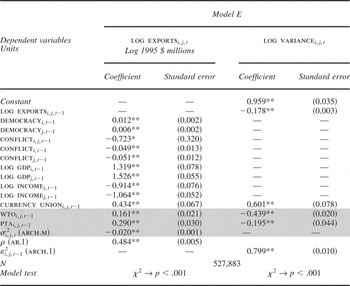
As shown in Table 4, Model E also provides a good fit to the data. Moreover, the parameters that distinguish it from Model D—the ARCH-in-mean (arch.m), arch.1, and ar.1 terms—are statistically significant, indicating that this is an appropriate generalization of heteroskedastic regression with which to analyze our data.Footnote 77 It is therefore particularly noteworthy that this model yields the same basic results as the earlier models: PTA membership and GATT/WTO membership both decrease the instantaneous variance in real exports. These findings are statistically and substantively significant. Figure 2 shows the variance as estimated in Model E, holding all other variables at their sample means, and including the average arch.1 component of the variance, for different combinations of PTA and GATT/WTO membership. Compared to a baseline predicted variance if no agreements were in place, a PTA reduces variability by 6.1 [3.6, 8.5] percent; the GATT/WTO reduces variability by 12.3 [11.2, 13.4] percent; and both agreements together reduce variability by 16.2 [14.3, 18.1] percent (where the figures in brackets form a 95 percent confidence interval around these point predictions). That this is the weakest substantive effect among our five models probably stems from the apparent arch.1 process at work. Volatility spills over from one year to the next, a dynamic that should not be attributed to the impact of trade institutions.
ARCH-in-mean model of trade levels and volatility

Notes:
All tests of statistical significance are two-tailed. Robust standard errors are in parentheses. Both equations include year-specific fixed effects, and the export levels equation includes directed-dyad-specific fixed effects.
* p < .05;
** p < .01.
However, as we mentioned earlier, the ARCH-in-mean model allows us to parse out the direct and indirect impact of trade agreements on the level of exports. The results are striking. First, the negative and statistically significant coefficient of the arch.m term in the export levels model indicates that heightened volatility itself reduces exports. This is consistent with the argument that private traders and investors respond rapidly to expected volatility by decreasing their commerce with the affected market.
Second, by reducing volatility, trade agreements indirectly boost export levels. Of course, since the estimated coefficients of wto and pta are positive and statistically significant in the export levels equation, both kinds of agreements directly increase the volume of bilateral trade. Compared to an otherwise-average reference point with no agreements in place, and ignoring the impact of reduced variance, joint membership in the GATT/WTO, a PTA, or both types of agreements directly boosts export levels by 17 [13, 22], 34 [26, 42], or 57 [45, 69] percent, respectively. Going beyond this direct effect, because trade agreements reduce the variance of trade, they also increase commercial flows indirectly, when the predicted variance is multiplied by the arch.m term in the levels equation. Specifically, through this channel, joint membership in the GATT/WTO, a PTA, or both types of agreements enhances exports by another 1.5 [1.3, 1.8], 0.9 [0.5, 1.2], and 2.7 [2.2, 3.2] percent, respectively.
Although these are relatively modest additions, they are nonetheless substantively meaningful, especially for the GATT/WTO. We can see this more clearly by expressing the findings somewhat differently. Absent a trade agreement, high volatility acts as a substantial “tax” on commerce, reducing the expected value of exports by an estimated 9.9 [8.6, 11.2] percent. With the GATT/WTO and a PTA in place, this volatility tax on the average pair's exports shrinks to 8.4 [7.3, 9.5] percent. Consequently, the gain in exports from the two agreements working together to reduce volatility is comparable to the gain achieved by cutting the average nominal tariff by 1.5 percent. That is equal to about half of the tariff cut (3.2 percent) made by high-income countries in the Uruguay Round for all merchandise products, and the Uruguay Round tariff reductions corresponded to a 35 percent, 1.2 trillion dollar, real increase in goods imports by those countries (comparing 1990 imports with those in 2000).Footnote 78 A volatility tax cut of 1.5 percent should thus affect the volume of foreign trade very substantially indeed.
Control Variables
Before concluding, we should also summarize the effects of the control variables. While these factors are not central to our analysis, little empirical work has been conducted on the political economy of trade volatility, so the results should be of interest. A few variables exert a strong and a fairly uniform influence, regardless of which measure of volatility is analyzed. Military conflict is associated with greater volatility in overseas commerce and exports to countries with large markets are less volatile. However, the remaining variables do not have a consistent impact on trade volatility.Footnote 79
In addition, there is some evidence that currency unions increase export volatility (at least in Models D and E). Very little research has been accumulated on this issue, but Rose finds that monetary unions have no systemic effect on trade volatility.Footnote 80 As shown by our Models D and E, however, a number of related studies conclude that currency unions promote the flow of trade among members.Footnote 81 How can these findings be reconciled? One insight with venerable roots is that countries in currency unions generally have higher output volatility; conversely, more flexible exchange rate arrangements help insulate a country against terms-of-trade shocks. Trade volatility is a likely byproduct of output volatility and macroeconomic fluctuations, which affect production and demand for traded goods. Consistent with this point, Edwards and Levy-Yeyati and Broda report that terms-of-trade shocks have a significantly greater impact on real GDP in countries with a nominally fixed exchange rate regime.Footnote 82 Edwards and Magendzo, and Levy-Yeyati and Sturzenegger also find that countries with fixed currencies experience more volatility in the rate of economic growth.Footnote 83 Glick and Rose's measure of currency unions focuses only on the nominal currency regime, and only on the most extreme form of regime.Footnote 84 More recent work on exchange rates has emphasized de facto exchange rate regime classifications, with a wider range of types represented.Footnote 85 Perhaps this distinction between de jure and de facto currency regimes is empirically significant for trade. Future studies might address this puzzle by examining the relationships among the exchange rate regime, trade volatility, and trade levels with these richer data on currency policies.
Discussion
Our results offer strong evidence that PTAs and the GATT/WTO reduce the volatility of exports. Moreover, there is ample reason to be confident in this finding. We have analyzed the largest possible sample of cases, indeed, the entire population of independent countries since World War II. We have measured trade volatility using a number of different indices and techniques. Our findings are robust with respect to a range of statistical challenges and estimation methods.
Not only do trade agreements reduce the volatility of exports, lower export volatility itself increases the level of exports. By addressing this issue, we have been able to identify the direct and the indirect influence of such agreements on export levels. Our findings indicate that indirect effects are indeed at work: the boost in export levels associated with PTA and GATT/WTO membership stems in part from the tendency for these institutions to reduce trade volatility, rather than solely from their ability to increase market access. These results accord with the conventional wisdom that private traders and investors prefer stability in (cross-border) relative prices. Moreover, private-market actors seem to respond to the assurance of such stability, which is promoted by trade agreements, by increasing their overseas commerce and investment.
Nevertheless, another possibility is that our results reflect a tendency to form commercial agreements on the part of states that, for whatever reason, already have stable trade relations. If so, then the effect of PTAs would be spurious to a pre-existing harmony of interests.Footnote 86 However, further analysis, based on our earlier study of PTA formation among GATT/WTO members, allows us to refute this possibility.Footnote 87 We add (one at a time) the various volatility measures from our current article, lagged by one year, to the three models of PTA formation reported in Table 2 of our earlier study.Footnote 88 Model A's and Model B's measures of volatility have no impact on the establishment of PTAs. Model C's measure is inversely related to PTA formation, whereas the observation-specific variance estimated from Models D and E is positively associated with the formation of PTAs. Taken together, these results provide no evidence that trade volatility has a clear, systematic influence on preferential arrangements. Furthermore, to the extent that volatility does affect these arrangements, the results based on the measures in Models D and E indicate that country-pairs experiencing extensive trade volatility are especially likely to enter PTAs—no doubt for the reasons we have advanced in this article. These findings suggest that the estimates of Models D and E in Tables 3 and 4 actually may underestimate the impact of PTAs on trade volatility.
Consider the example of Germany's exports to Finland, Sweden, and Austria in the wake of their accession to the EU in 1995. Not surprisingly, the level of German exports to those three countries increased after accession. The volatility of its exports to them decreased considerably at the same time. Specifically, the average absolute percentage change in the real value of exports to these three countries dropped from 12.1 to 5.7, comparing the five years before and after 1995. Alternatively, Germany's comparable figure averaged over all other developed GATT/WTO member-states actually rose from 15.5 to 17.4 over the same two periods. This case illustrates the independent role that PTAs play in reducing trade volatility.
Our results also bear on an interesting and important debate over whether the GATT/WTO promotes international trade. This debate was stimulated in large measure by a series of studies in which Rose found that GATT/WTO membership does not increase the volume of trade conducted by country-pairs.Footnote 89 As shown in the first column of Tables 3 and 4, our results point in the opposite direction since the GATT/WTO directly increases bilateral trade flows. Of greater importance for present purposes, however, is the divergence between Rose's conclusion that the GATT/WTO does not dampen trade volatility and our finding that this institution markedly reduces such volatility.Footnote 90
In part, this divergence stems from how trade volatility is measured. In contrast to our dependent variables, Rose measures volatility as the variation within a time series (of observations of X i,j,t) for a given country measured over 25-year periods. However, as we have argued, his approach ignores period-to-period variation and conflates predictable changes in trade with unexpected fluctuations. Our measures of volatility, though rough in some ways, do not suffer from these limitations.
Furthermore, our results cast doubt on his conclusion that the multilateral trade regime has little overall bearing on international trade. Rose does not account for the effect of trade volatility on trade flows. We do so and find that the GATT/WTO regime does indeed boost trade levels indirectly, by reducing volatility. This could be the case even if it did not do so directly by expanding market access.
As Rose argues, the GATT/WTO has not done as much as might be expected to reduce trade barriers.Footnote 91 After all, the Generalized System of Preferences and other nonreciprocal schemes undermine the multilateral regime's applicability.Footnote 92 Likewise, many countries have far higher Uruguay Round bindings than applied tariffs, suggesting that the GATT/WTO does not universally operate to reduce trade barriers reciprocally.Footnote 93 Nonetheless, the GATT/WTO's impact on exports is not trivial. Apart from reducing trade barriers, this institution secures and binds policies, locking them in place at their status quo level, whatever that may be. Such stability and security reduces the “volatility tax” that otherwise dampens international commerce, thereby promoting trade among the contracting parties to the multilateral trade regime.
The issues addressed in this article raise various questions for future research. For instance, we have argued that trade institutions reduce volatility in relative international prices and, consequently, variability in trade flows. Whereas we have focused attention on the volatility of trade, it would be useful to analyze more directly whether participation in such institutions reduces terms-of-trade volatility. Similarly, we have argued that trade institutions deter members from introducing new protectionist barriers on the products of other participants. As with most of the studies in this area, however, we do not measure trade policy directly since reliable data of this sort are in very short supply. There is a pressing need for more and better data on trade policy, as well as for samples that include new instances of trade protection and “noncases” where protection is merely contemplated but not imposed.Footnote 94 Furthermore, not all trade agreements are alike. Do differences across agreements in the breadth and depth of market access concessions, dispute settlement institutions, heterogeneity of membership, and organizational development condition how much they reduce trade volatility? There is reason to think so, based on the argument presented here, and future research could usefully explore this issue. Finally, we have argued that trade institutions reduce volatility by stabilizing the expectations of private traders and investors. It would be useful to analyze this micro-causal mechanism more directly in a study cast at the level of individual firms' responses to trade agreement formation.
Conclusions
In this article, we have presented some of the first systemic evidence that international institutions stabilize and reduce the volatility in international outcomes. Despite the voluminous literature that has been generated on international institutions, remarkably little emphasis has been placed on exactly how they operate to affect state behavior and what sorts of behavior they influence. The studies that have addressed this issue place virtually no emphasis on the ability of such institutions to reduce the volatility of outcomes, focusing instead on whether the level of a given outcome rises in the presence of an international institution. We have shown, however, that ignoring the volatility-reducing effects of international institutions and regimes risks both significantly underestimating their impact on global outcomes and presenting a distorted picture of how these institutions affect international relations.
Our analysis also helps to clarify why recent empirical research has been characterized by such heated debate about the effect of the GATT/WTO on trade. These debates stem partly from the emphasis that existing studies place on the level of trade without also considering its volatility. Once we take trade volatility into account, the beneficial impact of trade agreements becomes particularly apparent. Finally, our results show that international institutions can benefit members as much by locking in the status quo as by improving it. Such institutions have an important effect on the international economy, but for reasons quite different than those advanced in most of the existing literature on this topic.