Implications
This study explores how various preventive measures against mastitis influence the whole-farm economic outcome of dairy farms. Some preventive measures, if adapted by inefficient farms, were found to increase the probability of becoming fully efficient, whereas other measures were found to have no significant effect on the economic outcome of the farm. This is a positive finding, as these measures are known to reduce the incidence of mastitis and increase the welfare of dairy cows. The findings may serve as a basis for developing farm advisory services, especially if they are confirmed in future studies.
Introduction
Profitable farms are a precondition for maintaining a sound dairy industry, but economic margins of dairy herds are slim; therefore, optimisation of economic results is necessary. A dairy farm’s technical efficiency is a measure of the farmer’s ability to use production inputs as intensively as possible, and is a necessary condition for profitable farms. During the last few years, several studies (Lawson et al., Reference Lawson, Agger, Lund and Coelli2004; Stokes et al., Reference Stokes, Tozer and Hyde2007; Hansson and Öhlmér, Reference Hansson and Öhlmér2008) on dairy farms’ technical efficiency present unequivocal results: average performing farms could become more efficient by adjusting to the practices used by the most efficient, best-practice farms. Thus, farms can reduce their use of production inputs and consequently reduce their current production costs, leading to more profitable and long-term sustainable farms.
Disease among cows interferes with the economic outcome of dairy farms, due to an increase in the need of production inputs and a reduction of milk yield. Mastitis is a disease with severe economic consequences for farmers because of its high incidence and the extensive costs associated with the disease: it is considered the most costly disease in dairy production (Degraves and Fetrow, Reference Degraves and Fetrow1993; Kossaibati and Esslemont, Reference Kossaibati and Esslemont1997; Seegers et al., Reference Seegers, Fourichon and Beaudeau2003). Several European studies report cost estimates per case of clinical mastitis in the range of €210 to 428 (Østergaard et al., Reference Østergaard, Chagunda, Friggens, Bennedsgaard and Klaas2005; Huijps et al., Reference Huijps, Lam and Hogeveen2008; Hagnestam-Nielsen and Østergaard, Reference Hagnestam-Nielsen and Østergaard2009). Mastitis significantly reduces the probability of a farm being fully economically efficient (Hansson, Reference Hansson2007) and hampers efficiency by causing several direct and indirect costs: yield loss, veterinary costs, drugs, discarded milk, reduced payments due to increased somatic cell count (SCC), extra labour, increased risk of subsequent disorders, culling and costs related to impaired animal welfare. Thus, reducing the incidence of mastitis is a way for dairy farms to reduce the cost of production and become efficient and profitable.
The incidence of mastitis in a herd is influenced by managerial and environmental factors, such as housing system, cleanliness of cows, feeding regime, hygienic quality of feed and water, milking equipment and general practices related to, for instance, drying-off (Elbers et al., Reference Elbers, Miltenburg, De Lange, Crauwels, Barkema and Schukken1998; Barkema et al., Reference Barkema, Schukken, Lam, Beiboer, Benedictus and Brand1999; Peeler et al., Reference Peeler, Green, Fitzpatrick, Morgan and Green2000; Schreiner and Ruegg, Reference Schreiner and Ruegg2003; Nyman et al., Reference Nyman, Ekman, Emanuelson, Gustafsson, Holtenius, Waller and Sandgren2007). The incidence of mastitis and the impact of the disease can be reduced by mastitis control, that is, various preventive measures. These include frequent cleaning of stalls, proper milking routines and high milking hygiene, milking cows in a specific order based on their SCC (milking order), post-milking teat disinfection and regularly checking milking equipment. Antibiotic treatment protocols, dry-cow therapy and strict culling regimes are examples of measures that limit the impact of mastitis in a dairy herd.
The implementation of mastitis control induces a higher need of production inputs, especially in terms of labour, and is costly. The profitability of a preventive measure is determined by the cost of its implementation and the value of the reduction in mastitis incidence that it can achieve. Not all preventive measures are expected to be equally economically effective. Evaluation of the herd-level effects of the implementation of various preventive measures has indicated that post-milking teat disinfection, regular controls on the milking equipment and dry-cow therapy were cost-effective means of reducing the incidence of mastitis (Gill et al., Reference Gill, Howard, Leslie and Lissemore1990; Yalcin et al., Reference Yalcin, Stott, Logue and Gunn1999), whereas a sanitiser in the washing solution when preparing the udder for milking and having a service company change the cluster inflations were not cost-effective (Gill et al., Reference Gill, Howard, Leslie and Lissemore1990). Considering the whole-farm economic consequences of mastitis control, preventive measures might have a negative impact if they cause non-optimal division of production inputs between the different enterprises at the farm. The whole-farm economic impact of mastitis control should be important to the farmer, but such effects are not well known.
The aim of this paper was to explore if, and in that case how, various preventive measures against mastitis influence the whole-farm economic outcome, measured as technical efficiency, of specialised dairy farms. In particular, the paper aimed at exploring whether changing to the preventive measures applied by fully efficient farms could increase the probability of inefficient farms becoming fully efficient. The study contributes to the literature by taking into consideration the whole-farm economic consequences of preventive measures against mastitis, in an explorative approach. The findings can serve as a basis for further research on whole-farm economic consequences of mastitis control and in the continuation to better-targeted advisory services aiming at assisting farmers to become efficient.
Material and methods
Data sources
Data were pooled from different sources to obtain a data set containing all necessary information: economic figures, mastitis incidence and status as regards applied preventive measures.
Farm accounting data
To construct the variables needed to obtain the technical efficiency scores (explained later), detailed farm level accounting data were used. These data were obtained from Statistics Sweden and were originally collected to constitute the basis of Sweden’s part in the Farm Accounting Data Network (FADN) in Europe. The data set was a rotating panel stratified according to geographic region and farm size, and covered the years 1998 to 2002. Thus, the data set represented major aspects of Swedish farming. In this study, each farm was represented by its 5-year average of production inputs and outputs. In this way, possible stochastic variation due to variation in farming conditions, and thus in the production inputs and outputs, was corrected.
To ensure that the farms participating in the study were specialised in dairy production, all farms obtaining less than two-thirds of their total farm revenue from milk production were excluded, resulting in a sample of 361 farms. The data set records all costs and revenues of the entire farm business, but does not separate common expenses into different farm enterprises and services in return for farm allowances. Hence, to base the exclusion of farms on their agricultural production, allowances and revenues from non-traditional farming were excluded in the calculation of total farm revenue. In the sample, the average revenue originating from milk, in comparison to total farm revenue, was 84.9%.
To construct the efficiency scores, production inputs were aggregated into four major inputs: purchased feed, labour, capital (fixed equipment, production rights and buildings) and other expenses (veterinary services, fertiliser, seed and energy). Total outputs were aggregated into a single measure, total farm business revenue, which is a common practice in efficiency studies (Oude Lansink et al., Reference Oude Lansink, Pietola and Bäckman2002; Iráizoz et al., Reference Iráizoz, Rapún and Zabaleta2003). The measure of total farm business revenue included allowances and revenue from non-traditional farming, as the recorded inputs were also used to create these revenues. On average, 77.5% of total farm business revenue originated from milk.
Udder health data
The farm-level accounting data were supplemented with information on the average incidence of veterinary-treated clinical mastitis, defined as the number of veterinary-treated cases in relation to the total number of dairy cows in the herd, during the study period. These data were obtained from the Swedish official milk-recording scheme. As in the case of the accounting data, each farm is represented by its 5-year average of mastitis incidence. In so doing, a more stable figure of the mastitis incidence was obtained, compared to using a 1-year figure.
Applied preventive measures
Data on the farm’s status as regards applied preventive measures against mastitis were collected via a questionnaire sent to the participating farmers in early 2005. The questionnaire was used to collect data for a larger study, from which a subset of specialised dairy farms were selected for this study. During the development of the questionnaire, it was tested in three focus group settings, one at the start of the development and two at the end. The final questionnaire had a response rate of 67%. In the sub-sample of specialised dairy farms included in this study, the response rate was 71%, although some questionnaires contained missing answers. An analysis of differences between non-respondents and respondents yielded no differences with respect to the test variables technical efficiency, total farm revenue, average herd size or milk yield per cow.
A pooling of the accounting data and the data on mastitis incidences with the questionnaire implied matching information on economic outcome and mastitis incidence with information about farm status of risk factors and preventive measures at a shortly later stage in time. Since all data have not been collected in exactly the same period of time and the hypothesised causes were collected after the effects, the results may be biased. However, as the status at risk factors and preventive measures is the result of human and organisational behaviour, which is usually persistent over time (e.g. Mullins, Reference Mullins1999), it was believed that this short time lag would not have had any serious influence on the results.
Method for assessing technical efficiency
Farm-level technical efficiency was considered according to the framework developed by Farrell (Reference Farrell1957). Technical efficiency is a measure in the 0 to 1 region, where 1 indicates full efficiency. Technical inefficiency is measured by reducing the technical efficiency score from one and considers how much input can be radially reduced given the observed level of production. Thus, the technical efficiency score indicates the farmer’s ability to transform inputs into outputs. A farmer who is fully efficient cannot reduce the inputs he or she is using to produce the same output with smaller input use. However, an inefficient farmer is able to produce his or her observed output by using less of the production inputs.
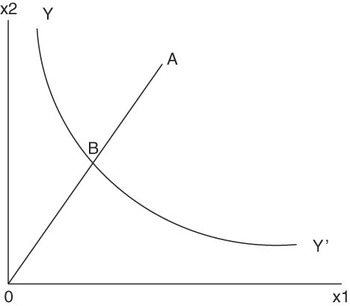
Determination of the technical efficiency score for each farm involves two steps. First, the ‘efficient frontier’, that is, the production function describing the efficient use of inputs at a certain level of production, is determined. Second, the distance between each farm and the efficient frontier is measured, generating an efficiency score for each farm. A conceptual situation of a technically inefficient farm and how its efficiency score can be determined is presented in Figure 1. The situation depicted involves two inputs and one output, but the idea can easily be extended to realistic situations with more inputs and outputs. The isoquant YY′ shows an efficient way of producing a given level of output with different combinations of inputs; thus, a farm situated at point A would need to reduce its input use to point B in order to become efficient. The level of efficiency can be measured as 0B/0A.
Technical inefficiency. A farm using inputs x1 and x2 to produce output at YY′, but situated at A is inefficient. If situated at B, it would be efficient. Source: adapted from Coelli et al. (Reference Coelli, Rao, O’Donnell and Battese2005).

A conceptualisation of the economic outcome of a farm in terms of efficiency measurement has advantages over simpler key ratios, such as milk produced per hour, or costs per cow, etc., in that it considers all inputs and outputs simultaneously (Coelli, Reference Coelli1995). The technical efficiency score suggests how much all inputs can be reduced while maintaining the observed level of production output. Thus, the technical efficiency score evaluates the economic impact of an action on the whole farm, and as farmers would be more interested in the overall economic outcome of their farms rather than specific key ratios, evaluating technical efficiency is logical.
To determine technical efficiency scores, the unknown production technology needs to be estimated. There are two main approaches: the stochastic frontier approach (SFA; Aigner et al., Reference Aigner, Lovell and Schmidt1977; Meeusen and van den Broeck, Reference Meeusen and van den Broeck1977), which uses econometric methods to estimate the efficient frontier, and data envelopment analysis (DEA; Charnes et al., Reference Charnes, Cooper and Rhodes1978), which is a non-parametric approach that uses mathematical programming. Both have advantages and disadvantages. The disadvantage of the SFA is that it requires specification of the functional form of the production function, and the disadvantage of the DEA is that it does not consider noise in the data. However, DEA has the advantage of not requiring a pre-specified functional form and is therefore more flexible than the SFA. Empirical comparisons in different settings indicate that the two methods assess efficiency similarly (Coelli and Perelman, Reference Coelli and Perelman1999; Sharma et al., Reference Sharma, Leung and Zaleski1999; Iráizoz et al., Reference Iráizoz, Rapún and Zabaleta2003). In this study, DEA was used, as characteristics such as not requiring specification of the functional form of the production function were considered advantageous. Using DEA implies the use of linear programming to form a surface, or frontier over the data. With DEA, the technical efficiency of each farm was determined with equation (1) for each of the n farms in the sample:
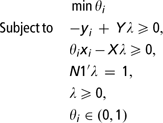
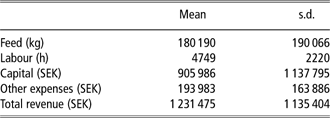
where θi is the technical efficiency score of farm i; yi is the output produced by farm i; xi is the production input used by farm i; and X and Y are the input and output matrices of all farms. As constraints on production, such as shortage of financing, imperfect competition and governmental regulations, may cause the economic assumption of constant returns to scale to be unrealistic (Coelli et al. Reference Coelli, Rao, O’Donnell and Battese2005), the constraint N1′λ = 1 was added to ensure a less rigid assumption of variable returns to scale. The descriptive statistics on the input and output variables used to calculate the efficiency scores are presented in Table 1: the standard deviations are large, implying that the sample is heterogeneous with respect to input use and the output produced.
Descriptive statistics on inputs and outputsFootnote 1
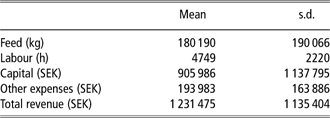
1 Monetary measures were deflated to price level in 1998, the base year. In 1998, one USD was equal to approximately eight SEK.
The assessment of technical efficiency was based on the whole sample of 361 farms, thus including also the non-respondents to the questionnaire. The reason is that a larger data set is desirable in the assessment of efficiency scores as a smaller data set may introduce bias towards full efficiency (Coelli et al., Reference Coelli, Rao, O’Donnell and Battese2005).
Statistical methods
The associations between technical efficiency and various preventive measures were estimated with logistic regressions. Logistic models were used to analyse the impact of hypothesised determinants of efficiency in previous empirical settings (e.g. Diaz-Balteiro et al., Reference Diaz-Balteiro, Herruzo, Martinez and González-Pachón2006; Hansson, Reference Hansson2007). Although regression models such as the tobit model are also used for assessing hypothesised determinants of technical efficiency, the logistic model was considered more suitable, as the aim of this study was to analyse whether changing to the preventive measures applied on fully efficient farms can increase the probability of inefficient farms becoming fully efficient.
Some determinants, such as housing system and milking routines, affect the incidence of mastitis, whereas others, such as contacting a veterinarian and regrouping cows, are affected by the incidence of mastitis. The former can thus be considered risk factors of mastitis and the latter preventive measures applied to prevent new infections. Therefore, two separate models were applied to investigate the impact of preventive measures on technical efficiency.
Model 1, covering the risk factors of mastitis, included measures assumed to affect both technical efficiency and mastitis incidence in the herd: mastitis incidence was considered an intervening variable and therefore excluded. The explanatory variables in Model 1 were: Holstein ratio, housing system, sawdust as bedding material, cleaning of stalls, clean bedding during milking, manual udder stimulation, pre-milking, post-milking teat disinfection, applying milking order and high-SCC cows milked with separate cluster. Holstein ratio was introduced as a continuous variable, indicating the proportion of Holstein cows in the herd, as Holstein cows are more prone to mastitis than, for example, Swedish Red cows (Nyman et al., Reference Nyman, Ekman, Emanuelson, Gustafsson, Holtenius, Waller and Sandgren2007; Swedish Dairy Association, 2008; Persson Waller et al., Reference Persson Waller, Bengtsson, Lindberg, Nyman and Ericsson Unnerstad2009). The remaining explanatory variables were selected on the grounds that they reflect general farming practices and recommendations from advisory services in Sweden to reduce the incidence of mastitis. Cleaning of stalls was an ordinal variable with four levels: at every milking, once a day, 2 to 4 times a week, and more seldom than 2 to 4 times a week. The remaining variables were dichotomous. In the case of housing system, 1 represented tie-stalls and 0 represented loose housing. As for the other variables, 1 and 0 indicated the presence and absence of each measure.
Model 2 included preventive measures applied when the bulk-tank SCC was considered by the farmer to be too high. The explanatory variables in Model 2 were: mastitis incidence, contact with a veterinarian, check feed quality, check overall hygiene routines, check milking equipment, regroup cows and cull cows with high SCC. Mastitis incidence, introduced as a continuous variable, was considered a confounder and therefore included. An alternative to including mastitis incidence was to include the risk factors in Model 1, as they are hypothesised to influence the incidence of mastitis. However, that would have yielded a more complicated model with more explanatory variables, and thus, having mastitis incidence as a confounder was preferred. All other explanatory variables were dichotomous variables, where 1 indicated presence and 0 indicated absence of each measure. These measures too were selected on the grounds that they reflect general farming practices and advisory recommendations of measures to be undertaken when the farmer considers the SCC as too high.
In both models, variables with P < 0.1 were considered to be statistically significant. Non-significant variables were removed by manual backwards elimination. The Hosmer and Lemeshow goodness-of-fit test was conducted to test the model fit and both models were satisfactory according to this test.
The question of possible interactions is important in both models, and therefore the effects of interactions were tested. The influence of the risk factors considered in Model 1 may depend on the housing system; thus, interactions between the housing system and risk factors were tested but no significant interaction variables were found. Likewise, as farmers with higher mastitis incidence may be likely to use the measures considered in Model 2, interactions between these measures and mastitis incidence were tested. No significant influence of the interaction variables were found in Model 2.
Results
Technical efficiency
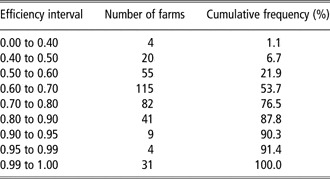
The mean level of technical efficiency was 0.71 (s.d. 0.147), suggesting that inefficient farms could on average reduce input use by almost 30% if the practices were adjusted to those applied by the most efficient farms. Farm-level efficiency scores were obtained in the range 1.00 to 0.33. The skewness of the efficiency score was slightly negative (−0.31), indicating a distribution with a longer ‘left tail’ and a slight bias towards the higher efficiency scores. Thirty-one farms (8.6% of the sample) were identified as fully technically efficient and were the best-practice farms against which the remaining farms were benchmarked (Table 2). Farms were clustered around the average efficiency score, with the three largest fractions of farms in the efficiency intervals 0.60 to 0.70, 0.70 to 0.80 and 0.50 to 0.60. Consequently, there was a gap between the most efficient farms and those clustered around the average efficiency score.
Frequency table of the efficiency score

Impact of preventive measures
Descriptive statistics
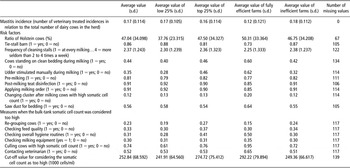
Before presenting the logistic regression results of the impact of preventive measures on technical efficiency, descriptive statistics on mastitis incidence, risk factors and applied preventive measures once the farmer considers the SCC to be too high, based on the entire sample and on the 25% least efficient farms and the 25% most efficient farms, the group identified as fully efficient and the group identified as inefficient are presented (Table 3). There was a lower incidence of mastitis on fully efficient farms than on the remainder of the farms (P = 0.003). Fully efficient farms had a higher proportion of Holstein cows and less frequently housed their cows in tie-stall systems.
Descriptive statistics on mastitis incidence and preventive measures on farms with different technical efficiency

Several preventive measures differed between fully efficient farms and the rest of the farms (Table 3): the use of sawdust for bedding, having cows standing on clean bedding during milking, manual stimulation of the udder during milking and changing cluster after milking cows with high SCC more frequently occurred in the group of fully efficient farms. Other preventive measures, such as pre-milking, post-milking teat disinfection and applying a milking order, were less frequent on the fully efficient farms.
Culling of cows with high SCC was the most common measure undertaken when the bulk-tank SCC was considered to be too high. Contacting a veterinarian was the second most common measure. Checking feed quality, hygiene routines and milking equipment were less common measures. Regrouping of cows was the least popular measure. Descriptive statistics suggested that regrouping of cows and checking feed quality were negatively associated with technical efficiency, as the fully efficient farms undertook these measures less frequently than did inefficient farms. However, checking hygiene routines, milking equipment, culling cows with high SCC and contacting a veterinarian were more frequent in the fully efficient farms than in the inefficient farms. On average, the farms engaged in 2.44 measures (s.d. 1.558) when the bulk-tank SCC was perceived to be too high (not shown). Fifteen farmers did not engage in any of the considered measures when the bulk-tank SCC was perceived to be too high (not shown).
The cut-off value for when the farmers perceive the SCC to be too high is included also in Table 3. The cut-off value is higher in the fully efficient group, compared with the rest of the farms. Thus, the fully efficient farmers are less sensitive to high SCC than the inefficient farms.
Logistic regressions
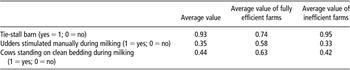
The results of Model 1 indicated that housing cows in a tie-stall barn was significantly negatively associated with being fully technically efficient (Table 4). Applying manual stimulation of the udder during milking and having cows standing on clean bedding during milking were positively associated with being fully technically efficient. Missing values caused the analysis to be based on a smaller sample compared to the samples in Tables 2 and 3. For comparison, descriptive statistics of the significant variables of the farms included in the analysis of Model 1 are presented in Table 5. The average value of technical efficiency among these farms was 0.71 (s.d. 0.147), which is the same as the figures obtained in the whole sample.
Logistic regression results of Model 1: risk factorsFootnote 1

1 P < 0.1 was considered statistically significant.
Descriptive statistics on significant variables in Model 1 (n = 224)

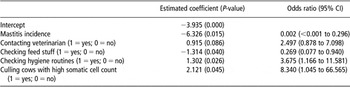
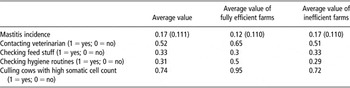
Model 2 estimated the effects of various measures undertaken when the bulk-tank SCC was considered to be too high (Table 6). Checking the feed quality was negatively associated with being fully technically efficient. Checking the overall hygiene routines, contacting a veterinarian and culling cows with high SCC were positively associated with being fully technically efficient. Mastitis incidence was negatively associated with being fully efficient. Also in this analysis, missing values caused it to be based on a smaller sample compared to the samples in Tables 2 and 3. Descriptive statistics of the significant variables of the farms included in the analysis of Model 2 are presented in Table 7. The average value of technical efficiency among these farms was 0.70 (s.d. 0.147), which is not statistically different from the figures obtained in the whole sample. Furthermore, these farmers were no different from the original sample when it comes to the number of measures they engaged in (not shown).
Logistic regression results of Model 2: measures undertaken when the somatic cell count in the bulk-tank milk was judged as too highFootnote 1

1 P < 0.1 was considered statistically significant.
Descriptive statistics on significant variables in Model 2 (n = 244)

Discussion
The descriptive statistics and results of Model 2 indicated that the fully efficient farms were characterised by a lower incidence of mastitis and confirmed the importance of reducing the incidence of mastitis to increase the technical efficiency of dairy farms. These results support previous findings of the substantial cost associated with mastitis (Kossaibati and Esslemont, Reference Kossaibati and Esslemont1997; Seegers et al., Reference Seegers, Fourichon and Beaudeau2003; Hagnestam-Nielsen and Østergaard, Reference Hagnestam-Nielsen and Østergaard2009) and the hampering effects mastitis has on the economic outcome of the farm (Hansson, Reference Hansson2007).
Impact of preventive measures
The study found that several preventive measures did not influence the probability of a farm being fully efficient, especially factors that were expected to affect the incidence of mastitis, that is, the determinants considered in Model 1 had only a few significant cases. According to these findings, adjusting to the preventive measures considered in Model 1 would thus not be a practical way for inefficient farms to become efficient. One reason for this statistical insignificance may be that the extra use of production inputs, such as labour, required to implement the preventive measures was balanced by the benefits associated with taking the measures. The preventive measures considered are commonly used to reduce the incidence of mastitis and the results suggested that implementation may not be at the expense of the economic performance of the farm. Another possible explanation of the insignificant results is that the studied farms apply similar preventive measures against mastitis and might be a reflection of all the studied farms having access to similar animal husbandry advisory services, regardless of the level of their technical efficiency: similar ideas are presented by Hansson (Reference Hansson2007) and Hansson and Öhlmér (Reference Hansson and Öhlmér2008). Instead, managerial factors other than the risk factors considered in Model 1 are likely to explain differences in economic outcome. However, the results should not be interpreted as saying that insignificant measures are meaningless. From the non-economic aspects, such as animal welfare, these preventive measures are still of value.
The preventive measures considered in Model 2, that is, those taken once the farmer considered the bulk-tank SCC to be too high, presented more statistically significant outcomes. Consequently, the results suggest that several of the measures considered in Model 2 could be adapted by the inefficient farms as a means of becoming efficient. In Model 2, the largest increase in the probability of being fully efficient was obtained by culling cows with high SCC, thus highlighting the importance of continuously optimising the herd by keeping only cows with good udder health status.
Contacting a veterinarian was positively associated with the farm being fully efficient, which may reflect the underlying reasons for contacting a veterinarian, such as these farmers being more careful and therefore fully efficient. In combination with the positive association between checking overall hygiene routines and being fully efficient, the results also highlight the importance of herd hygiene and health.
Checking feedstuff was negatively associated with the probability of being fully efficient. This finding was counter-intuitive, but one explanation is that the farmers who check feed quality might be more inclined to discard feed with poor quality and therefore have to use more production inputs to maintain their current level of production. Other aspects related to feed, which have not been considered in this study, may be more important for increasing the probability of being fully efficient. Examples include the farmers’ skills in producing high-quality feed and the possibilities of properly storing feed. Future research aimed at evaluating the consequences of preventive measures against mastitis on the economic outcome of the farm could benefit from considering the effects of the nutritional and hygienic quality of feed in more detail to fully understand the impact of feed-related issues.
Both models show very high or very low odds ratios for some of the significant variables. This is likely to be due to the fact that odds ratios can capture the effects of other variables related to production and farming practices, which are not considered in the models. Thus, the high odds ratios should be interpreted in light of this.
Methodological considerations
The method used to assess farm-level economic outcome in terms of technical efficiency presents a convenient way of summarising the effect of a complicated production system into a single figure. In comparison with other studies evaluating the economic consequences of preventive measures against mastitis (i.e. Gill et al., Reference Gill, Howard, Leslie and Lissemore1990; Yalcin et al., Reference Yalcin, Stott, Logue and Gunn1999), this study has the advantage that it is based on a whole-farm approach. Thus, the possible spillover effects on other farm enterprises were implicitly evaluated; this would be of value to the farmers, who are mainly concerned about whole-farm economic outcome.
The reported average efficiency score of 0.71 was low compared with previous studies on technical efficiency in dairy farms (e.g. Bravo-Ureta and Rieger, Reference Bravo-Ureta and Rieger1991; Heshmati and Kumbhakar, Reference Heshmati and Kumbhakar1994; Lawson et al., Reference Lawson, Agger, Lund and Coelli2004). However, absolute comparisons between the average efficiency scores obtained in different studies should be restrictive because efficiency scores are sensitive to the method used for estimation, the number of variables in the specification of the production technology and the number of observations in the sample (Coelli et al., Reference Coelli, Rao, O’Donnell and Battese2005). Comparisons between the average efficiency scores obtained in different studies provide information about the homogeneity of the sample (Hansson and Öhlmér, Reference Hansson and Öhlmér2008); a high average efficiency score signals a homogeneous sample where the difference between the best-practice farms and the rest of the farms is small. Consequently, in this study, the sample analysed was more heterogeneous than the samples analysed in other studies. However, a maximal technical efficiency score of 1.00 and a reported average efficiency score of 0.71 revealed considerable possibilities for improvements if all farms in the sample were to become as efficient as the best-practice farms. The average efficiency score indicated that costs would decrease, on average, by almost 30% if best-practice farming was applied by all farms: an important finding considering the slim economic margins of dairy farms.
In future research, the economic impact of disease control, in general, and mastitis control, in particular, requires further attention. As this study has taken an explorative approach to evaluate if, and in that case how, various preventive measures against mastitis influence the whole-farm economic outcome, future research needs to re-evaluate the findings before more general causal conclusions can be drawn. A further natural step for future research would be to explicitly analyse the individual costs and revenues associated with each of the preventive measures considered in this study. Ultimately, such studies would be based on a whole-farm approach, evaluating both the economic consequences in the dairy herd and detailed tracing of the spillover effects to other farm enterprises. A good starting point would be to conduct a detailed study at the herd level.
Conclusions
This study was explorative and suggested that having a loose-housing system, stimulating udders manually during milking and having cows standing on clean bedding during milking may significantly increase the probability of a farm being fully efficient. Once the farmer considered the bulk-tank SCC to be too high, undertaking measures such as contacting a veterinarian, checking the overall hygiene routines and culling cows with high SCC were suggested to significantly increase the probability of a farm being fully efficient. Thus, these measures may be plausible targets for advisory services aimed at assisting farmers in becoming fully efficient, but need to be further evaluated in future research. The study also suggested that several common preventive measures had no statistically significant effects on farm economic outcome: among the preventive measures defined as risk factors, only a few significant cases occurred. However, it should be emphasised that insignificant measures may still be worthwhile for non-economic goals, such as increased animal welfare, and the results suggested that they can be implemented without negative impact on the economic performance of the farm.
Acknowledgements
The data collection was financed by the Swedish Farmers’ Foundation for Agricultural Research (SLF), which is gratefully acknowledged. The paper was written while the first author was on a research scholarship awarded by the Swedish bank Handelsbanken (the so-called Wallanderstipendium), which is also gratefully acknowledged.