Introduction
Which child elder parents prefer as care-givers (i.e. parental favouritism in care-giver selection) is an understudied area of research (Pillemer and Suitor Reference Pillemer and Suitor2006; Suitor and Pillemer Reference Suitor and Pillemer2007). In rural China, it is especially important to know parental favouritism, because adult children are regarded as the best care-givers in times of need due to strong filial piety norms, lack of resources and insufficient long-term care facilities (Zimmer Reference Zimmer2005). In addition, an average elder in rural China has four children (China Research Center on Aging 2003), which makes the favouritism relevant and vital in the care-giving process. Guided by theories of intergenerational transfers and previous studies on parents' favouritism (Pillemer and Suitor Reference Pillemer and Suitor2006; Suitor and Pillemer Reference Suitor and Pillemer2007), this paper examines how intergenerational exchanges affect elders' choice of preferred care-givers in rural China against the backdrop of fast social changes such as daughters' increased contributions to their parents and rural to urban migration. In particular, we investigate how intergenerational exchanges may explain the effects of children's gender and buffer the negative effects of distance between elder parents and their children on parental favouritism.
Background
Parental favouritism: preferred care-givers
Parents' favouritism varies, e.g. different children will be named when parents are asked to indicate which children are most emotionally close and which children parents are most likely to turn to for help (Suitor and Pillemer Reference Suitor and Pillemer2007). In this investigation, we examine parents' pick of children to provide care in case of parents' sickness, which indicates parents' preferences at a time when care-giving is not necessarily needed.
Although only a few studies have directly addressed elders' favouritism in care-giver selection, elders' favouritism may be influential for the care-giving process and outcomes (Pillemer and Suitor Reference Pillemer and Suitor2006; Suitor and Pillemer Reference Suitor and Pillemer2007). Elders' own preference could affect the care-giver selection process, even though the preference may deviate from the actual arrangements (Pillemer and Suitor Reference Pillemer and Suitor2006). In addition, parent's hierarchy of preferences may substantially affect care-giving outcomes because preferences are closely related to how parents appraise the support they have received; the appraisal of support is more consequential than actual support (Cantor Reference Cantor1991; Krause Reference Krause, Binstock and George2001; Lee, Czaja and Schulz Reference Lee, Czaja and Schulz2010; Litwak et al. Reference Litwak, Silverstein, Bengtson, Hirst, Bengtson and Lowenstein2003).
Studies have shown that parents' and children’ gender, previous intergenerational exchanges and children's availability may explain parental favouritism (Pillemer and Suitor Reference Pillemer and Suitor2006). Moreover, we are guided by literature that regards care-giver selection as the result of a family negotiation process, in which the availability, resources and constraints of potential care-givers are weighted toward a balanced solution (Checkovich and Stern Reference Checkovich and Stern2002; Pezzin, Pollak and Schone Reference Pezzin, Pollak and Schone2007); consequently, we examine influences of intergenerational exchanges on parental favouritism within the social changes and family contexts in rural China.
Elders in rural China: filial piety and children's gender
In Chinese culture, adult children are primary providers of support for their parents; rural elders are especially more likely to rely on children as care-givers when needs arise because of Confucian norms of filial piety, elders' disadvantages in resources and their limited access to a formal support system (Lee and Xiao Reference Lee and Xiao1998; Shi Reference Shi1993; Sung Reference Sung1995; Zimmer Reference Zimmer2005). Confucian norms of filial piety believe that children have strong obligations to provide for their parents (Sung Reference Sung1995). These norms are echoed and reinforced by policies and laws in China that articulate and stipulate adult children's obligations to care for their parents; the neglect of filial obligations to older parents may result in severe penalties (Chou Reference Chou2011; Yan Reference Yan2003). Because of the old-age security function of children, the never married rates and childless rates are very low for Chinese elders (Chou and Chi Reference Chou and Chi2004; Tsuya, Choe and Wang Reference Tsuya, Choe and Wang2009). In addition, many rural elders have financial strains because of the unavailability of pensions, lifelong poverty and the depletion of resources in the form of ‘serial division of the family’, i.e. the practice by which parents transfer assets to sons one by one when they get married (China Research Center on Aging 2003; Lee and Xiao Reference Lee and Xiao1998; Yan Reference Yan2003). Even urban elders have difficulties paying for medical expenses; rural elders struggle even more because of their disadvantaged economic status, let alone seek paid care-givers (Sun Reference Sun2004; Zimmer and Kwong Reference Zimmer and Kwong2003). Under this situation, the reliance on adult children may become the only choice for many rural elders. Furthermore, the development of long-term care services is at the very beginning with minimal coverage, even when rural elders' access to medical treatments has been improved with the New Cooperative Medical System (Brown and Theoharides Reference Brown and Theoharides2009; Chou Reference Chou2010; Zimmer et al. Reference Zimmer, Kaneda, Tang and Fang2010). Consequently, adult children typically are the most reliable and expected providers for elder parents in rural China, especially when care is needed.
Adult children are differentiated by their gender in regards to their roles in elder parents' support networks. Under the overarching filial norms is the preference for sons and their families as the primary providers of support and care (Whyte and Xu Reference Whyte, Xu and Whyte2003). In contrast, daughters are regarded as belonging to other families after getting married; thus their support to parents is more voluntary and more likely to be out of love rather than obligations in patrilineal families (Antonucci, Akiyama and Birditt Reference Antonucci, Akiyama, Birditt, Silverstein and Schaie2004). However, with fast social changes, daughters have taken more and more responsibilities in caring for their elder parents (Zhang Reference Zhang2007). How will this affect parents' preference for care-givers? One focus of this investigation is to examine the effect of intergenerational exchanges on parents' favouritism within the gender context and to explain the effect of children's gender on parents' favouritism.
Intergenerational exchanges and preferred care-givers
The history of intergenerational relations and exchanges helps set the tone for late-stage family life and probably affects parents' favouritism (Krause Reference Krause, Binstock and George2001; Lee, Czaja and Schulz Reference Lee, Czaja and Schulz2010; Silverstein et al. Reference Silverstein, Conroy, Wang, Giarrusso and Bengtson2002). Exchange and equity theory argues that the intergenerational exchanges are intended to be balanced and reciprocal (Antonucci, Akiyama and Birditt Reference Antonucci, Akiyama, Birditt, Silverstein and Schaie2004; Dowd Reference Dowd1975; Litwin Reference Litwin2004). Exchanges are profuse within Chinese families (Cheng and Chan Reference Cheng and Chan2006; Sun Reference Sun2002). Care of grandchildren is an especially valuable resource that elder parents provide for their children (Secondi Reference Secondi1997; Sun Reference Sun2002; Yang Reference Yang1996). Studies have shown that elders who provide grandchildren care to facilitate adult children's job-related migration receive more help in money, household work or farm labour help (Liu and Reilly Reference Liu and Reilly2004; Shi Reference Shi1993; Yang Reference Yang1996). Thus, we hypothesise that:
• H1 (reciprocity hypothesis): An adult child is more likely to be named by the parent as the preferred care-giver if the parent provided more grandchildren care for this child.
In addition to elders' assistance to their adult children, current help from adult children may also be an important factor to consider, because currently receiving care is associated with the possibilities of receiving care in the future and thus higher expectations of care (Eggebeen and Davey Reference Eggebeen and Davey1998; Pillemer and Suitor Reference Pillemer and Suitor2006). We therefore hypothesise that:
• H2 (expectation hypothesis: support from a child): An adult child's hands-on (instrumental) support to a parent will increase that child's likelihood of being named the preferred care-giver.
The expectation hypothesis may also be applicable to support from children-in-law. When married children provide care, their spouses are also players in the process either positively by providing assistance or negatively by being uncooperative and grudging (Henz Reference Henz2010; Willson, Shuey and Elder Reference Willson, Shuey and Elder2003). It is likely for elder parents to choose those children whose spouses are supportive, as suggested by a study that relationships with daughters-in-law are important considerations for parents to decide whether to co-reside with their sons (Zhang and Wang Reference Zhang and Wang2010). Daughters-in-law and sons-in-law have different status in the patrilinear family system. In rural China, women married into their husband's family according to the practice of patrilocal marriage, and bear the explicit expectations and responsibilities to take care of their husbands' parents instead of their own parents (Cohen Reference Cohen1998; Cong and Silverstein Reference Cong and Silverstein2008a; Lin et al. Reference Lin, Goldman, Weinstein, Lin, Gorrindo and Seeman2003). Under this situation, a daughter-in-law's services are counted as the son's services to their parents. In contrast, it is quite rare for sons-in-law to provide care for their parents-in-law. Admitting that, once those sons-in-law do provide support, it is still likely to be counted as daughters' contributions to parents; anyway, children-in-law are tied to the family because of their spouses. The favourable interactions with sons-in-law may stimulate elder parents' preference for those daughters as preferred care-givers as well. In this sense, both support from daughters-in-law and sons-in-law has the potential to affect elder parents' choice of these children-in-law's spouses as the preferred care-givers, even if sons-in-law only provide very limited support. Thus, we hypothesise:
• H3 (expectation hypothesis: support from a child's spouse): Instrumental support from an adult child's spouse will increase that child's likelihood of being named the preferred care-giver.
Migration and the preferred care-giver
The large-scale rural to urban migration has taken many working-age adults away from their home and from their older parents, raising concerns about whether adult children will continue to be reliable providers of support (Giles and Mu Reference Giles and Mu2007). This may also influence elders' care-giver preferences. Children who do not live close by are less likely to be chosen as preferred care-givers (Pillemer and Suitor Reference Pillemer and Suitor2006), because they are less likely to provide care (Szinovacz and Davey Reference Szinovacz and Davey2007). Furthermore, geographical distance may also contribute to emotional alienation making it also less likely for elders to choose a child living far away (Pillemer and Suitor Reference Pillemer and Suitor2006). We hypothesise, therefore, that:
• H4 (migration hypothesis): A migrant adult child will be less likely to be named as the preferred care-giver.
Even though migration increases physical distance between elder parents and their children and reduces potential support to elder parents, it can also strengthen the intergenerational relationships (Silverstein, Cong and Li Reference Silverstein, Cong and Li2006). Migrant adult children usually cannot bring their own children with them as a result of higher living, educating and child-care expenses, as well as the Hukou system that separates rural and urban areas and imposes institutional barriers for migrants to stay permanently in cities (Bai and Song Reference Bai and Song2002). Elders may receive higher remittances when taking care of their migrant children's children than taking care of non-migrant children's children, because migrant children have higher demands for child care that often involves grandparents' full-time custody, such as in skipped-generation households, and are faced with higher expenses to have alternative arrangements (Cong and Silverstein Reference Cong and Silverstein2011b; Silverstein, Cong and Lee Reference Silverstein, Cong and Li2006). This may be associated with higher bargaining power elder parents enjoy when migrant children are more desperate for help than non-migrant children (Cong and Silverstein Reference Cong and Silverstein2011b; Lucas and Stark Reference Lucas and Stark1985). Similarly, it is possible that providing grandchild care for their migrant children will buffer the reduced likelihood of naming migrant children as preferred care-givers. Therefore, we hypothesise that:
• H5 (moderation hypothesis): Effects of children's migration on parents' favouritism will be buffered by parents' help with care for grandchildren.
Gender and the preferred care-giver
Gender has been one focus of previous studies on favouritism. Daughters are usually the preferred and designated care-givers in the United States of America (USA), especially for elder mothers (Rossi and Rossi Reference Rossi and Rossi1990; Suitor and Pillemer Reference Suitor and Pillemer2006). This is partly due to the fact that care-giving is stereotypically regarded as a women's job and partly due to the taboo of cross-gender personal care, particularly for male care-givers caring for women (Calasanti Reference Calasanti2004; Lawrence et al. Reference Lawrence, Goodnow, Woods and Karantzas2002; Szinovacz and Davey Reference Szinovacz and Davey2008). Moreover, mothers may prefer daughters because of shared values and gender-specific similarities (Pillemer and Suitor Reference Pillemer and Suitor2006; Suitor and Pillemer Reference Suitor and Pillemer2006).
In contrast, we may expect preference for sons in rural China because of gendered filial norms deeply rooted in the culture (Cong and Silverstein Reference Cong and Silverstein2012). The gendered filial norms developed with social conditions that have been challenged by fast social changes. These conditions include patrilocal residence and a strong patrilineal tradition, which have limited daughters' capabilities of providing for their parents. Because of the patrilocal residence, daughters usually marry into places other than their natal village (which is also a kind of migration) and thus will be geographically distant from their parents and even less likely to co-reside with them (Li, Feldman and Jin Reference Li, Feldman and Jin2004). Co-residing with adult children facilitates intergenerational support exchanges, fulfils cultural expectations and thus is the most desired living arrangement for elder parents (Davis-Friedmann Reference Davis-Friedmann1991; Silverstein, Cong and Lee Reference Silverstein, Cong and Li2006). Moreover, daughters' subordinate status in their new family and financial dependence due to the lack of opportunities and their disadvantages with regard to entitlement to farming land have further deterred them from providing support and care for their parents (Bélanger and Li Reference Bélanger and Li2009; Li, Feldman and Jin Reference Li, Feldman and Jin2004). On the other hand, parents are also much less likely to provide support to their daughters. Especially concerning taking care of grandchildren, grandchildren are almost entitled to be taken care of by their paternal grandparents; whereas only a few grandparents will take care of their daughters' children, and when they provide support, typically much more reward is expected from daughters (Cong and Silverstein Reference Cong, Silverstein, Mehta and Thang2011a; Yang Reference Yang1996). Thus, we hypothesise:
• H6 (gender hypothesis): Parents will prefer sons over daughters.
• H7 (mediation hypothesis): The favouritism based on children's gender could be explained by proximity (migration and co-residence) and intergenerational support exchanges with children.
We examined fathers and mothers' favouritism separately. Fathers and mothers may be different concerning favouritism owing to their different social roles and positions, especially in the patrilineal family (Cong and Silverstein Reference Cong and Silverstein2012). In addition, previous studies have focused on mothers' favouritism (Pillemer and Suitor Reference Pillemer and Suitor2006; Suitor and Pillemer Reference Suitor and Pillemer2007). Thus, it is important to conduct separate analyses of mothers and fathers for comparison. We did not propose any hypothesis for the differences because of the lack of knowledge with respect to how fathers and mothers may differ in parental favouritism.
Method
Sample
The sample for this investigation was derived from the Anhui Province of China, a mostly rural and fifth most populous province in China (State Council of the People's Republic of China 2000). This region was chosen specifically for its relatively high density of older adults and high levels of out-migration of working-age adults. Data were collected from a sample of adults aged 60 and over living in rural townships within Chaohu, a city of 4.5 million people located on the north bank of the Yangtze River in the central part of Anhui Province (Chaohu Statistical Bureau 2001). The sample was identified using a stratified multistage method to randomly select 1,800 potential respondents and 1,715 completed the survey (see details in Cong and Silverstein Reference Cong and Silverstein2011b). Follow-up surveys were conducted in October 2003 with 1,368 elders, in December 2006 with 1,067 elders, and in June 2009 with 808 original respondents and 416 replenished new respondents. Mortality is the major reason for attrition, with 239, 234 and 173 respondents reported to be dead in 2003, 2006 and 2009, corresponding to mortality rates of 14, 17 and 16 per cent, respectively. A small proportion of respondents, i.e. 76 in 2003 (4%), 57 in 2006 (4%) and 33 in 2009 (3%), moved out of the area and were no longer accessible; others, i.e. 32 in 2003 (2%), 10 in 2006 (1%) and 53 in 2009 (5%) refused to be interviewed at follow-up.
Based on four waves of data, we constructed up to three longitudinal transition intervals (i.e. 2001–2003, 2003–2006, 2006–2009) for each eligible parent–child dyad, resulting in 11,953 observations representing 5,281 unique children sired by 1,319 elderly parents who gave valid answer to their preferred care-givers at follow-up, with 601 fathers and 718 mothers. Based on these observations, we conducted Multiple Imputation with 20 datasets imputed using all relevant variables in the analysis, except the outcome variable for the purpose of avoiding biases associated with missing values. Among the independent variables, the change in grandchildren care suffered most missing values (11.5%). We imputed for fathers and mothers separately and did analyses for fathers and mothers accordingly (Allison Reference Allison2001; Feng, Cong and Silverstein Reference Feng, Cong, Silverstein, Newsom, Jones and Hofer2011).
Model and working sample
We used STATA to fit fixed-effects logistic models examining children's likelihood of being selected as preferred care-givers in case of sickness of their parents. The fixed-effects model controls for all family-level contextual variables and focuses on within-family variations (Henretta et al. Reference Henretta, Hill, Li, Soldo and Wolf1997). Family-level contextual variables, such as parents' age, marital status and other socio-demographic variables, would quite likely affect their filial expectations and consequently the choice of preferred care-givers (Peek et al. Reference Peek, Coward, Peek and Lee1998). Thus, the fixed-effects model is preferable in examining favouritism, when the focus is on within-family choice of the preferred care-giver with a nested data structure, i.e. for each parent there are several children and one child is named as the preferred care-giver (Henretta et al. Reference Henretta, Hill, Li, Soldo and Wolf1997; Pillemer and Suitor Reference Pillemer and Suitor2006).
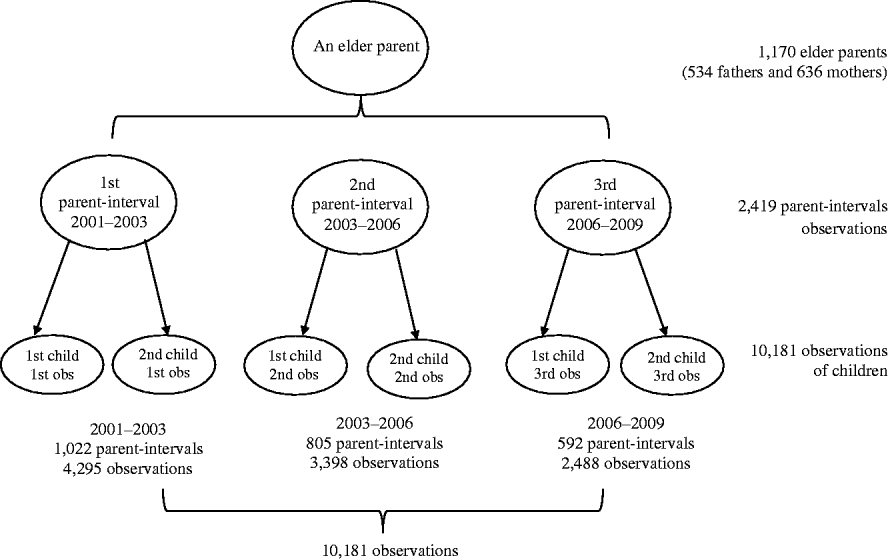
This model only allows including families with variation in the dependent variable. In other words, families with only one child or with no child chosen as the preferred care-giver were excluded from the analysis. Therefore, our working sample was reduced to include 4,927 unique children with 1,170 elderly parents (534 fathers and 636 mothers). Because each family may repeatedly appear in different transitions for up to three times, our working sample included 10,181 observations of children including 4,295, 3,398 and 2,488 observations from the first, second and third interval, respectively. These observations were nested within 2,419 parent-intervals, including 1,022, 805 and 592 parent-intervals from the first, second and third interval, respectively. We used the term observations of children to emphasise that children may appear repeatedly in the data and the term parent-interval to emphasise that parents may appear repeatedly in the data. Because each family may repeatedly appear in different transitions for up to three times, we used robust estimation to accommodate this additional nesting. Figure 1 further explains the data structure with a hypothetical family, in which an elder parent appeared three times in the data and the parent had two children and each child had three observations during three time intervals.
Sample size and data structure explanation. Note: obs: observations.

Dependent variable
Favouritism
The dependent variable was favouritism measured at the follow-up for each interval. We asked: In case of sickness, which child do you prefer to take care of you? This is constructed as a dummy variable (1 = the child was chosen as the preferred care-giver, 0 = the child was not chosen). We controlled for baseline favouritism, thus, coefficients of independent variables in the model indicated their effects on residualised change in favouritism.
Independent variables
Grandchildren care
The variable measuring the frequency of providing care for grandchildren at baseline ranged from 0 to 6. The values of these variables were defined as follows: 0 = not taking care of grandchildren, 1 = seldom, 2 = about once a month, 3 = several times a month, 4 = at least once a week, 5 = a period of a day (not the whole day) and 6 = the whole day, from morning to evening. We used a difference score between two waves to assess the change in care for grandchildren between waves.
Instrumental support
We measured baseline instrumental support from each child with a dummy variable with 1 meaning that the parent received any help from this child during the previous 12 months in two areas: (a) household tasks, such as cleaning the house and washing clothes, and (b) personal care tasks such as bathing and dressing. We also used another dummy variable to indicate whether the elder parent received any instrumental support from the spouse of this child. We used the differences between two waves to indicate changes in instrumental support from each child and from the spouse of each child.
Migration
Migration was represented by three dummy variables. The reference group represented non-migrant children, defined as those children who stayed in the same village as their parents for both waves. The first dummy variable represented short-term migrants, defined as those who lived in the same village with parents at baseline but lived outside the village in the second wave. The second dummy variable represented long-term migrants, i.e. those who lived outside the village for both waves. The third dummy variable represented returned migrants, who were not in the village at baseline but returned for the follow-up. We also constructed interaction terms (change in grandchildren care × child's migration) to examine whether caring for grandchildren would buffer the effect of migration.
Gender
Children's gender was a dummy variable (1 = female, 0 = male).
Co-residence
We measured both baseline and follow-up co-residence (0 = the child co-resided with the parent, 1 = the child did not co-reside with the parent).
Control variables
We controlled for important children's characteristics and other aspects of intergenerational relationships, which may influence their chances of being chosen as preferred care-givers. Children's characteristics at baseline included their age, education and marital status. Age was represented as age in years. Marital status (1 = currently married, 0 = currently unmarried) was a particularly important variable to control because our discussion of intergenerational exchanges were within the context of children's family. Education was coded as 0 = no education, 1 = primary school, 2 = junior middle school and 3 = senior middle school, vocational training, college, university or above. We also controlled for whether the child had any children under 16 (0 = no children under 16, 1 = with children under 16) at baseline. We controlled for baseline and changes in emotional closeness between parents and children, measured with three questions adapted from the intergenerational solidarity inventory (Mangen, Bengtson and Landry Reference Mangen, Bengtson and Landry1988) that assesses emotional cohesion between generations. The questions are: (1) ‘Taking everything into consideration, how close do you feel to (this child)?’ (2) How much do you feel that this child would be willing to listen when you need to talk about your worries and problems? (3) ‘Overall, how well do you and (this child) get along together?’ The items were coded as follows: 0 = not at all close/not at all/not at all well, 1 = somewhat close/somewhat/somewhat well, 2 = very close/very much/very well. An additive scale was computed for each child, ranging from 0 to 6. The reliability coefficient for these items was 0.82. The change in emotional closeness over time was calculated as the difference between the follow-up and the baseline scores.
We also controlled for financial exchanges between parents and children. Baseline financial support from children was based on the total amount of money that the elder parent received from each child during the past 12 months. Elder parents were asked to provide the exact amount of money first, and if they could not give an exact number, they were asked to choose among the following categories based on Chinese RMB currency (100 RMB = US $14): 0 = none, 1 = <50, 2 = 50–99, 3 = 100–199, 4 = 200–499, 5 = 500–999, 6 = 1000–2999, 7 = 3000–4999, 8 = 5000–9999 and 9 = 10,000 + . We took the actual amount if it was available or used the median amount of the category if the exact amount was not supplied. A log transformation (ln + 1) was applied to adjust its distribution for a strong positive skew. The change in financial support from each child over time was measured by the difference in RMB amount across two waves divided by 1,000 to adjust the scale of regression coefficients. Similar to financial support from each child, we measured financial support to a child at baseline and its change between two waves.
Results
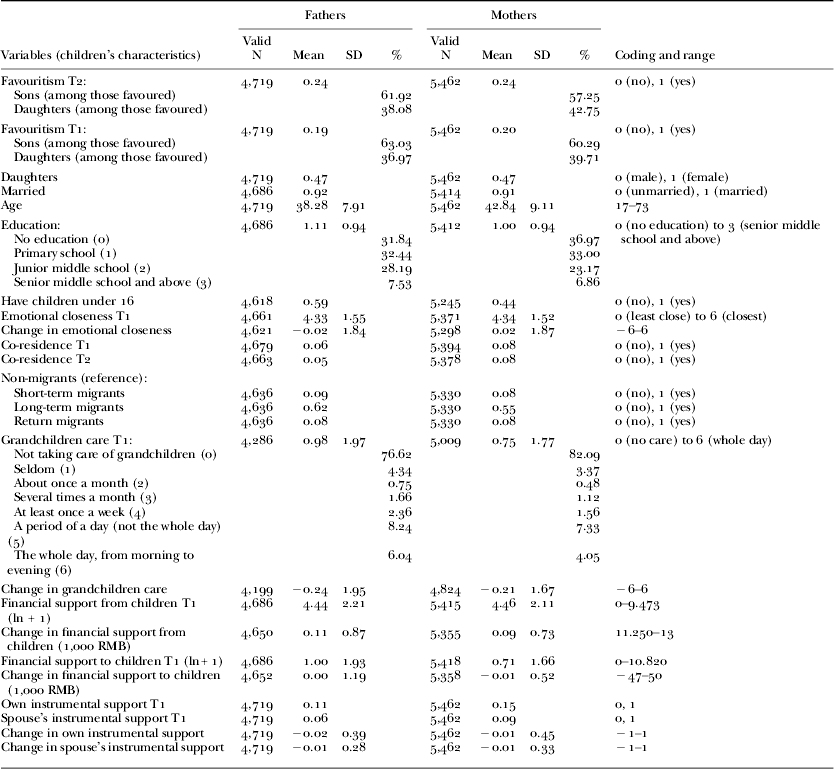
Table 1 shows descriptives of variables. The descriptives we presented were descriptives of observations which were actually used in the analysis. Because of the data structure, up to three observations might be from the same child. For simplicity, we reported those descriptives as children's characteristics. In addition, we discussed descriptives of fathers' sample and included those of mothers' sample in the subsequent square brackets if we did not specify whether the descriptives were from fathers or mothers' sample. The descriptives were only slightly different for mothers and fathers.
Description of analytic variables
Notes: SD: standard deviation. T1: Time 1. T2: Time 2.
Among those children who were selected as the preferred care providers, 61.92 per cent [57.25 per cent] were sons and 38.08 per cent [42.75 per cent] were daughters at follow-up. At baseline, among those favoured, sons accounted for a little bit higher percentage than that at follow-up. For fathers and mothers, respectively, children averaged 38.28 (standard deviation (SD) = 7.91) and 42.84 (SD = 9.11) years of age, and the large majority (92 and 91%) were married. Children's average education roughly corresponded to primary school level, with 31.84 per cent [36.97 per cent] of children not having any education. Fifty-nine per cent [44 per cent] of children had minor children under the age of 16. Emotional closeness with parents averaged 4.33 (SD = 1.55) for fathers and 4.34 (SD = 1.52) for mothers out of a possible 6, and barely changed during two waves. Six and five per cent of children co-resided with their fathers at baseline and follow-up, respectively, and 8 per cent of children co-resided with their mothers at baseline as well as at follow-up.
Nine per cent [8 per cent] of children were short-term migrants, 62 per cent [55 per cent] were long-term migrants, 8 per cent [8 per cent] were return migrants and 21 per cent [29 per cent] were non-migrants (reference group). On average, these children received 0.98 (SD = 1.97) and 0.75 (SD = 1.77) point in grandchildren care out of a possible 6 at baseline. Specifically, 76.62 per cent [82.09 per cent] of adult children did not receive help with grandchildren care from parents, a small proportion, i.e. 8.24 per cent [7.33 per cent], received help with grandchildren care for a period of the day, and 6 per cent [4.05 per cent] received whole day (from morning to evening) grandchildren care, which might represent the situation in custodian grandchildren care that typically happened because of adult children's labour force-related migration. Adult children in the fathers' sample received higher levels of parents' help with grandchildren care, possibly because adult children in the fathers' sample were a little bit younger (mean = 38.28) than those in the mothers' sample (mean = 42.84) and thus were more likely to have younger children to be taken care of. Children received less help with grandchildren care from parents over time. Children's average financial support to parents was 4.44 (SD = 2.21) for fathers and 4.46 (SD = 2.11) for mothers and increased between the two waves by about 100 RMB. Financial support from parents was 1.00 (SD = 1.93) for fathers and 0.71 (SD = 1.66) for mothers at baseline and had almost no change between the two waves. Eleven per cent [15 per cent] of children as well as 6 per cent [9 per cent] of spouses of children provided instrumental support for parents. Support declined slightly between the two waves for both.
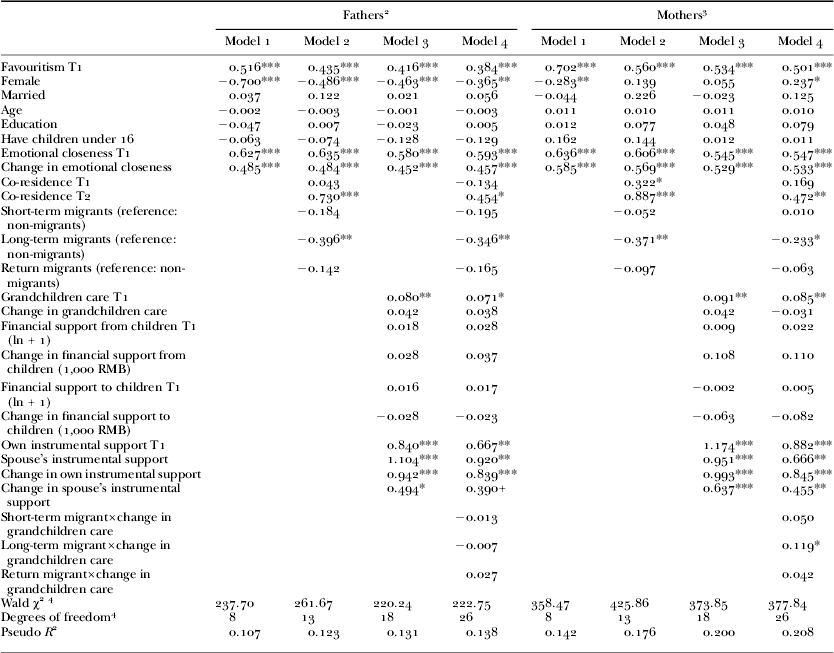
Table 2 presents regression coefficients of whether a specific child was selected as the preferred care-giver at follow-up in each of the three transition intervals. We did analysis for fathers and mothers separately. Main effects models were first estimated and then interactions were included hierarchically. For fathers and for mothers, the main effects equation in Model 1 revealed that both fathers and mothers preferred sons over daughters; fathers' disfavour of daughters (B = − 0.70) seems to be stronger than mothers (B = − 0.28), reflecting either the aversion of cross-gender care arrangements or men's stronger patrilineal ideology that sons should be the best providers in old age (Cong and Silverstein Reference Cong and Silverstein2012). Furthermore, baseline favouritism, emotional closeness and the positive change in emotional closeness over time significantly increased parents' favouritism.
Fixed-effects logistic regression of children's being chosen as the preferred care-givers at Time 2 (T2)1
Notes: 1. N = 10,181 observations/2,419 parent-intervals, representing 4,927 children/1,170 respondents. 2. N = 4,719 observations/1,116 parent-intervals, representing 2,270 children/534 fathers. 3. N = 5,462 observations/1,303 parent-intervals, representing 2,657 children/636 mothers. 4. Because estimation based on imputed datasets does not provide model fit information, model fitting is from corresponding analysis based on listwise deletion. T1: Time 1.
Significance levels: † p < 0.1, * p < 0.5, ** p < 0.01, *** p < 0.001.
In Model 2 for mothers, when variables measuring proximity, i.e. co-residence status at Time 1 (T1) and Time 2 (T2) as well as children's migration status, were added to the model, children's gender was no longer a significant predictor for mothers' favouritism. Both co-residing at T1 and T2 increased mothers' favouritism. Long-term migrants were less likely to be named as the preferred care-giver. To sum up, proximity completely mediated mothers' preference for sons.
In Model 3 for mothers, when intergenerational exchanges were added to variables in Model 1, we found that grandchildren care at T1 significantly increased mothers' favouritism; so did children's and their spouses' instrumental support at baseline and the increase in instrumental support over time. Gender of children was no longer a significant predictor for mothers' favouritism. Thus, intergenerational exchanges completely mediated the effect of children's gender on mothers' favouritism.
In Model 4, mothers even preferred daughters over sons after interaction terms were included. The interaction between being long-term migrants and receiving increased grandchildren care positively affected mothers' favouritism; whereas the main effect of being a long-term migrant reduced mothers' favouritism. This means that if long-term migrants did not receive increased grandchildren care from mothers, mothers were less likely to name them as the preferred care-givers. But, if these long-term migrants received increased grandchildren care over time, they were more likely to be named as the preferred care-givers by mothers; the increased likelihood accompanying increased grandchildren care was greater for long-term migrants than non-migrant children. In other words, receiving grandchildren care buffered the negative effect of being long-term migrants concerning being named as the preferred care-givers by mothers.
Similar to mothers, a co-residing child was more likely to be named as the preferred care-givers and a long-term migrant child was less likely to be named than a non-migrant child by fathers, as seen in Model 2; children who received increased grandchildren care were also more likely to be named, as seen in Model 3. Different from mothers, proximity and intergenerational exchanges only partially mediated fathers' preference for sons, as seen in Models 2 and 3 for fathers. In addition, we did not find a significant interaction effect between children's migration status and fathers' help with grandchildren care as in the case of mothers.
For all parents, baseline grandchildren care provided to a child, instrumental support received from that child and the spouse of that child, and changes in instrumental support from both sources, raised that child's likelihood of being named.
Pseudo R 2 gave us some clues on how much variance in parents' favouritism was explained in each model. Models for mothers had higher Pseudo R 2 (i.e. 0.142 in Model 1, 0.176 in Model 2, 0.200 in Model 3, 0.208 in Model 4) than corresponding models for fathers (i.e. 0.107 in Model 1, 0.123 in Model 2, 0.131 in Model 3, 0.138 in Model 4). This suggests that those predicting variables explained mothers' favouritism better than fathers'.
Discussion
This investigation addressed the influences of intergenerational exchanges on children's likelihood of being named preferred care-givers in rural China within the context of social changes related to increased contributions from daughters and the rural to urban migration. We found elder parents' help with grandchildren care would increase their adult children's likelihood of being named preferred care-giver, supporting the reciprocity hypothesis (H1). Parents' help with grandchildren care is not only accompanied by monetary transfers and actual care-giving behaviours of adult children, but also affects elder parents' choice of preferred care-givers (Cong and Silverstein Reference Cong and Silverstein2008b; Lee and Xiao Reference Lee and Xiao1998). However, parents' financial support did not influence parents' favouritism. This is to some extent consistent with Pillemer and Suitor's (Reference Pillemer and Suitor2006) finding that mothers' help to children such as providing money or assistance with chores does not increase the likelihood of naming these children preferred care-givers. These findings highlight that caring for grandchildren in rural China plays a pivotal role in strengthening and renegotiating family relationships (Cong and Silverstein Reference Cong, Silverstein, Mehta and Thang2011a, Reference Cong and Silverstein2011b).
Our hypotheses that both adult children's and their spouses' instrumental support would influence parents' favouritism (H2 and H3) were supported as children and children-in-law's instrumental support were significant predictors of parents' favouritism. In a supplemental analysis, we examined whether a child's gender interacted with the instrumental support from the spouse. This is based on the idea that daughters-in-law are more important for parents-in-law in patrilineal families. We did not find significant effects to indicate that daughters-in-law's instrumental help is more important than that of sons-in-law. This may be because of the rarity of help from sons-in-law in rural China (Cong and Silverstein Reference Cong and Silverstein2008a). We also suspect that contributions from sons-in-law affect elder parents' favouritism just like those from daughters-in-law, even though sons-in-law do not contribute as much as daughters-in-law do. Anyway, our findings emphasise the relevance of examining children-in-law's unique contributions in parents' support networks in rural China (Cong and Silverstein Reference Cong and Silverstein2008a; Zhan Reference Zhan2004).
Children's migration was an important consideration when elder parents named their preferred care-givers, supporting H4. Parents were less likely to select migrant children as preferred care-givers but the negative effects of migration might be mitigated when the migration patterns in China and intergenerational exchanges were considered. First, we found that only long-term migrants had a reduced likelihood of being selected. Elder parents did not exclude short-term migrants or those who returned from migration. A large proportion of rural to urban migration is short-term or cyclical in China and migrant children may choose to return to provide care in response to parents' health deterioration (Giles and Mu Reference Giles and Mu2007). Only when migrants become long-term migrants and their chances of returning become slim, will their likelihood of being chosen as the preferred care-givers diminish. Second, we found long-term migrants' reduced likelihood of being named by older mothers was buffered by receiving increased amounts of grandchildren care, which partly supports our hypothesis that receiving grandchildren care will buffer the negative effects of migration (H5). Even though the effect was not found for fathers' favouritism, this at least suggests that the negative effects of migration could be buffered by some social and family mechanisms accompanying migration itself (Cong and Silverstein Reference Cong and Silverstein2011b; Silverstein, Cong and Lee Reference Silverstein, Cong and Li2006).
This is consistent with other findings that the effect of migration has to be studied in a wider social and family context. As a consequence of modernisation, labour force migration has raised concerns for the family support system for elders in rural China (Secondi Reference Secondi1997). However, studies have shown that families are adjusting and adapting to social changes and still functioning to provide for elders and adult children in extended families (Hermalin Reference Hermalin2002). Migration has reduced contact and possible intergenerational assistance, but at the same time, it makes it necessary for families to work closely to maximise the benefits of the whole family (Brown and Poirine Reference Brown and Poirine2005; Poirine Reference Poirine1997). Taking care of grandchildren is one way that elder parents can contribute to their migrant children, and may result in strengthened intergenerational ties that benefit both generations. Adult migrant children's roles as potential providers for their parents are promoted by their reliance on their elder parents' services (Cong and Silverstein Reference Cong and Silverstein2011b). Moreover, migration status is closely intertwined with children's gender, because daughters become migrants as defined in the investigation once getting married and moving to other places. In a supplemental analysis, we included three-way interactions of children's gender × migration status × increases in grandchildren care, and found that the buffering effect of grandchildren care × long-term migrants was more obvious for sons, whose migration is likely motivated by job-related reasons and thus grandchildren care is of greater value for them (Cong and Silverstein Reference Cong and Silverstein2011b).
Our hypothesis that parents were more likely to name sons as preferred care-givers (H6) was supported. Our hypothesis that proximity and intergenerational exchanges explained why sons were preferred (H7) was also supported. For mothers, proximity and intergenerational exchanges completely explained why mothers preferred sons; whereas, these factors only partially explained fathers' preference for sons. This means that the only reason for mothers' preference for sons is related to practical concerns associated with the patrilineal tradition such as sons are more likely to co-reside with their parents and sons have higher levels of exchange with their parents. However, fathers' preference for sons may be more deeply rooted and might be attributed to their vested interests in maintaining the patrilineal system and their consequent stronger endorsement for traditional values (Cong and Silverstein Reference Cong and Silverstein2012). Consequently, fathers' preference for sons was not explained completely by co-residence and exchanges with sons. It could also be associated with the gender match between fathers and sons, as suggested by a study in the USA that gender match and other gender-specific similarities are major reasons why mothers favour daughters as preferred care-givers (Pillemer and Suitor Reference Pillemer and Suitor2006).
We found mothers favoured daughters over sons after introducing interactions between children's migration status and receiving help with grandchildren care. This echoes the findings in the USA that mothers prefer daughters over sons (Rossi and Rossi Reference Rossi and Rossi1990; Suitor and Pillemer Reference Suitor and Pillemer2006). Other things being equal, mothers also prefer daughters over sons even in rural China, as found in this study. But, sons and daughters are not equal concerning their proximity to and exchanges with parents in rural China, which results in elder mothers' preference for sons.
The findings that intergenerational support and proximity mediated parents', more notably mothers', preference for sons indicated that the favouritism is subject to change if daughters provide more support and are physically closer to their parents. In fact, rural Chinese society is changing rapidly; daughters' contributions to parents have increased to a level almost comparable to sons as a result of improved transportation that facilitates daughters' contact with their parents as well as daughters' economic independence gained through migration and work off the farm (Li, Feldman and Jin Reference Li, Feldman and Jin2004; Zhang Reference Zhang2007). Notably, in the face of parents' depressive symptoms, daughters provide more persistent support than sons (Cong and Silverstein Reference Cong and Silverstein2011c). When daughters play more and more active roles in their parents' support network, we expect that parents' preference for sons will diminish gradually.
In negotiating care-giving, elders' desire is only one factor that will contribute to the care-giving arrangements. Concerning actual care-givers, cultural and practical factors may compromise preferences; children's own status, constraints and normative beliefs are always important to consider in the decision-making process (Cicirelli Reference Cicirelli1993; Pezzin, Pollak and Schone Reference Pezzin, Pollak and Schone2007; Silverstein and Bengtson Reference Silverstein and Bengtson1997; Szinovacz and Davey Reference Szinovacz and Davey2007; Wolf, Freedman and Soldo Reference Wolf, Freedman and Soldo1997). Moreover, we only asked elders to name a child they most preferred to provide care for them, and did not offer children-in-law as viable choices. This limits our ability to directly measure to what extent children-in-law are chosen and why they are chosen as the preferred care-givers.
In spite of these limitations, this study addressed characteristics of preferred child care-givers with a unique rural Chinese elders' sample, which allowed us to study how intergenerational support exchanges contribute to elder parents' favouritism within the context of social changes. We extended previous work in this area by considering special characteristics of rural Chinese families, including gender-biased filial piety norms, importance of contributions from children-in-law and the large-scale migration from rural to urban China. Although elders' preferred care-givers may not always be the ones who actually provide support later, to identify elders' preferred care-givers and target them to actively build and manage care relationships will improve the care quality and eventually elders' wellbeing (Cox et al. Reference Cox, Green, Hobart, Jang and Seo2007). This is crucial for rural Chinese elders who mainly rely on children for care and support.
In addition, this study may also provide valuable implications for studies on other elder populations related to Chinese cultures such as Chinese immigrants. Studies have shown that Chinese immigrants endorse a combination of Chinese cultures and accepting countries' cultures, which form the basis for their attitudes, expectations and behaviours during the process of acculturation and adaption to local cultures (Chappell and Kusch Reference Chappell and Kusch2007; Pang et al. Reference Pang, Jordan-Marsh, Silverstein and Cody2003). Especially for those who immigrated during their adulthood, the influences of Chinese cultures may be long lasting because attitudes and expectations are likely to be formed in individuals' early years and will persist even with dramatic changes in social environment (Alwin Reference Alwin1996; Cong and Silverstein Reference Cong and Silverstein2012). To understand Chinese elders' preference for care-givers will help to serve and meet the needs of those immigrant elders.
Finally, global ageing has questioned many countries' capacities with respect to providing sustainable support for elders. Support from families has been shown to be important for elders' wellbeing in general (Silverstein and Giarrusso Reference Silverstein and Giarrusso2010). The understanding of family mechanisms in care-giving selection will lead to more comprehension and better utilisation of this important source of support.
Acknowledgements
This research was supported partly by Grant R03TW01060 from the Fogarty International Center of the National Institutes of Health and partly by internal grants from the University of Southern California and Xi'an Jiaotong University. We would like to thank Shuzhuo Li for his invaluable contributions to this project.