

INTRODUCTION
It would not raise any eyebrows to notice that the members of the competition law community, be they scholars, practitioners, enforcers, or judges, on both sides of the Atlantic, still disagree about the normative and conceptual foundations of competition law; its purpose, function, and proper implementation.Footnote 1 Such disagreements suggest that this legal field is relatively indeterminate, namely that the legal provisions and courts’ authoritative interpretations cannot fully guide (or determine) its future interpretations and applications. Such indeterminacy may derive from competition law's semantic ambiguity or vagueness, but it could also be the by-product of in-built normative uncertainty and complexity.Footnote 2 One way to view competition law's indeterminacy is as lack of expert legal or economic knowledge: the law is uncertain on a specific matter because the case law has not been sufficiently developed or because a conclusive economic study of the welfare implications of a particular practice is missing. From this perspective, law's indeterminacy is a ‘necessary evil’ that ought to be eliminated. Alternatively, indeterminacy could be perceived as the by-product of the fact that competition is a multifaceted ideal, and as a result, value judgments are inevitable in competition law cases.Footnote 3 In this case, the law is bound to remain uncertain or vague, to a certain extent, because value disagreements cannot be settled once and for all.
These two takes on the issue of indeterminacy can motivate two broad ways to conceptualise EU competition law.Footnote 4 Viewing law's indeterminacy as a lack of legal or economic technocracy relies on the premise that EU competition law is a form of ‘autonomous law’ (‘AL’), namely a closed normative system, a set of rules that simply prohibits undue restraints of trade and is insulated from value disagreements.Footnote 5 From this angle, indeterminacy is a shortcoming that ought to and will eventually be eliminated through legal and economic technocracy without having recourse to any type of moral reasoning or value choices. Hence, from an AL perspective, EU competition law is single-valued and insulated from value conflicts, and indeterminacy derives from the provisional failure of legal institutions to use legal hermeneutics and input from positive economics sufficiently well so as to settle every uncertainty in the law.
However, competition law's indeterminacy could be understood as the result of value disagreements, namely as the by-product of different interpretive attitudes towards the notion of competition and the values, purposes, interests, and principles encapsulated in competition rules.Footnote 6 In this case, EU competition law could be conceptualised as a ‘responsive law’ (‘RL’), namely as a relatively open normative system and an adaptive interpretive practice that oscillates between openness and integrity. Openness means normative flexibility, conceptual elasticity, and factual sensitivity, while integrity refers to principled, value-laden consistency and mission-realisation and demands that legal institutions realise law's principal purpose in a rule of law compatible manner.Footnote 7 If EU competition law is inherently open to value disagreements and not insulated or autonomous from them, it would inevitably give rise to interpretive struggles, namely to attempts to concretise its relatively indeterminate principal objective (ie the protection of market competition), and make it, provisionally, fully determinate.Footnote 8
Such interpretive struggles may allow for readjustments and recalibrations and enable the law to adapt to new knowledge and different market contexts, as well as to accommodate different values.Footnote 9 Nonetheless, such interpretive struggles can also blur the boundaries of the law and undermine its integrity. Excessive openness, thus, can destabilise the rule of law or incite EU competition law's instrumentalisation, and thereby diminish its integrity. Yet, integrity—ie rule of law-compliant mission-realisation—requires EU competition law to be and remain open so as to respond to new challenges and realise its open-ended goal. In other words, integrity demands a certain degree of openness, but excessive openness can undercut law's integrity. It is, thus, this interplay between openness and integrity what triggers EU competition law's indeterminacy. From an RL point of view, therefore, EU competition law's indeterminacy is Janus-faced: it creates uncertainty and unpredictability, but it also makes the law flexible and adaptive.
If EU competition law is viewed as RL, it becomes apparent that its indeterminacy is in-built, it manifests itself in cases that involve value disagreementsFootnote 10 and derives from the dynamic struggle between its openness and its integrity.Footnote 11 Nevertheless, this indeterminacy is ‘relative’. EU competition has boundaries, is not amorphous and not everything is ‘up for grabs’. The principal goal of the law, the various interpretive struggles and institutional practices that take place within its contours, and the rule of law set its boundaries and create its code of integrity. It is especially these interpretive struggles and institutional practices that make EU competition law a coherent field of law—to the extent that it is—and not pure legal reasoning coupled with positive economics and a monothematic focus on consumer or total welfare or some other single value, as the AL model advocates.
Considering, nonetheless, EU competition law as a form of RL, does not mean that it is always fully responsive. Its openness gives it the ability to be responsive. Whether it is really responsive depends on whether it actually manages to tame conflicts between its two endogenous, complementary, and antithetical forces (ie openness and integrity). Responsiveness, thus, is not a static state of affairs, but an adaptation process, a dynamic equilibrium between openness and integrity.Footnote 12 Such equilibria cannot be found under the AL model, since, under this framework, even though competition law can adapt to factual changes, it needs to remain insulated from value conflicts to retain its character as ‘law’ and not become ‘policy’. In other words the AL approach rejects the thesis that EU competition law can be a relatively open normative system and a purposive interpretive practice. As a result, AL is bound to ignore the dynamic interplay between openness and integrity. On the contrary, the RL approach accepts and welcomes EU competition law's openness, and proposes a modus operandi for calibrating it with its integrity. Three are the hallmarks of this modus operandi: (1) constructive interpretation;Footnote 13 (2) responsive enforcement;Footnote 14 and (3) catalytic adjudication.Footnote 15 The aim of this modus operandi is to tame EU competition law's openness so as to enable it to effectively materialise its purpose in a rule of law compliant manner.
Casting EU competition law as a form of RL has three main implications. First, the RL framework can function as a descriptive device allowing us to properly grasp certain key features of EU competition law; specifically its fuzzy mandate, conceptually elastic vocabulary, rules and standard mode of analysis, and use of economics. In this regard, the RL approach could offer a more accurate picture of how EU competition law functions and changes, and provide a diagnosis of a persistent phenomenon: its relative indeterminacy. Second, the RL framework, by considering EU competition law's indeterminacy as the by-product of value conflicts triggered by openness and integrity, puts forward a distinct modus operandi. European legal institutions might be better equipped to deal with EU competition law's indeterminacy by utilising this modus operandi instead of the AL modus operandi. Third, the competition law community could use the RL approach to reframe its discursive practises, and better understand the underlying reasons of disagreement in certain heated debates. By doing so, the various interlocutors might become more able to discern the underlying reasons of their agreements and disagreements and perhaps reach consensus positions.
Part I sets up the two different ways to conceptualise EU competition law. Part II explains why the RL model captures better than the AL model certain essential features of EU competition law suggesting, thereby, that this field of law could be better conceptualised as a form of RL. Part III shows how the European enforcers and adjudicators could improve law's interpretation and enforcement by using the RL modus operandi, while Part IV highlights how the members of the competition law epistemic community could use the RL model to reframe certain debates and identify the reasons behind their agreements and disagreements.
I. TWO POINTS OF VIEW
Given that the argument presented here draws on the work of Nonet and Selznick, some background information might help the reader to put things into perspective. Nonet and Selznick adopted a socio-legal, ‘integrative’ approach that sought to unite different legal theories and disciplinary fields, and came up with a typology of legal systems.Footnote 16 Their aim was to grasp the key features and functions of different forms of legal orderings in reference to their sociological, jurisprudential, and institutional aspects. For this purpose they developed three ideal-types: repressive, autonomous, and responsive law.Footnote 17 These three models purport to shed light on the different aspects of the same legal reality and are not mutually exclusive. As a result, elements of autonomous and responsive law may coexist. Furthermore, the appearance, say, of responsive law elements does not require a paradigm shift or a radical break with an autonomous law legal ordering, and nothing guarantees that the transition from autonomous to responsive law (if it takes place) is full or irreversible. It should be noted from the outset that the reason I employ the AL/RL divide here is to capture certain patterns of thought, modes of reasoning, hidden assumptions and interpretive attitudesFootnote 18 of various participants in EU competition law as a field.Footnote 19 In other words, I use this divide to engage in a form of a ‘conceptual sociology’ of EU competition law from the ‘internal point of view’.Footnote 20
A. EU Competition Law as Autonomous Law
According to Nonet and Selznick, in an autonomous legal ordering fidelity to the law or upholding the rule of law is the backbone of the law in general, while law is perceived as a normatively fixed set of rules which enforcers have some discretion to apply and adjudicators need to elaborate, without transgressing their role as ‘the mouthpieces of the law’.Footnote 21 Within this conceptual paradigm, law-making categorically differs from law-application,Footnote 22 and the existence of law is independent from its merits.Footnote 23 The rule of law defines the raison d’être of the legal system and every sub-system and sets their boundaries. Enforcers or policymakers are legitimate and unconstrained to make their decisions as long as they accept the supremacy of the law, while judges remain the supreme legal authority, as long as they do not enter the policy domain.Footnote 24 Otherwise, if, for instance, judges step into policymaking by going beyond their duty to state ‘what the law is’, they will lose their legitimacy and will be discredited as ‘doing politics’ or engaging in judicial activism.Footnote 25
What flows from such a point of view is the aspiration to frame EU competition rules as a normatively closed set of rules or as a technocratic deviceFootnote 26 aimed at improving market performance, understood in terms of total or consumer welfare maximisation.Footnote 27 This point of view does not mean that competition law is not grounded on certain values, as nobody would deny that wherever competition law is adopted the society has made a decision favouring markets, as a mechanism for allocating resources, and competition, as an organisation principle of this distributive mechanism. The AL model, therefore, does not make maximalist claims about competition law's value neutrality. It merely advocates that once competition law is adopted, its interpretation and implementation can be insulated from value disagreements and rely exclusively on legal reasoning and input from positive economics.Footnote 28 Virtually every approach that casts competition law as a single-value technocratic enterprise goes hand in hand with a desire to insulate it from any possible value disagreements and reflects AL thinking.Footnote 29
Consequently, for the proponents of the AL model, even though certain values lie at the foundations of EU competition law, its application can take place without recourse to any non-legal normative facts.Footnote 30 Such a line of thinking presupposes and puts forward a specific relationship between competition law and economics. Economics is considered as the realm where all uncertainties or ambiguities about competition law could be settled either by turning competition law into a branch of microeconomics (internalisation of economics) or by endowing economists with the power to decide competition law questions (externalisation of law).Footnote 31 When, for instance, certain scholars advocate in favour of the consumer welfare paradigm as ‘the one and only disciplined and objective framework for courts and enforcers to assess a challenged conduct's likelihood to harm competition’,Footnote 32 they also assume (or propose) that competition law is or can fully rely on economic technocracy. In this regard, the advocates of total or consumer welfare paradigmsFootnote 33 fall within the AL framework because (or if) they perceive EU competition law as normatively closed system, as a ‘monocentric’Footnote 34 legal field, the interpretation of which can be a non-evaluative exercise, guided solely by legal and economic technocracy.Footnote 35 Yet, as will be shown below, value neutrality is not an option in competition law.Footnote 36
The AL thinking could also be traced to the view that enforcers’ one and only task is to detect and punish violations that occurred in the past and apply the law in a ‘crime-tort fashion’.Footnote 37 According to this view, enforcers are pure technocrats who either enforce the law or exercise discretion which is essentially ‘non-law’. Furthermore, when they exercise discretion they should do so in a technocratic manner and refrain from making any value choices. Otherwise they would risk ‘delusions of grandeur giving succour to the idea that they are somehow designers of the modern economy and not simply its policy force’.Footnote 38 They can use non-legal input to determine the content of the law, as long as this input remains value neutral, ie non-normative and scientific. For example, they could rely on consensus positions of positive economics to concretise a vague EU competition law provision, but they could not identify as anticompetitive a commercial practice that restricts competition and harms sustainability or privacy without having any adverse effects on consumer welfare. If they were to make such a finding they would ‘politicise’ competition law; they would engage in an impermissible value choice which would undermine the autonomous character of law.
This AL line of thinking leads also to the inference that when enforcers use their discretion in such a technocratic manner and respect the confines of the rule of law they should expect to remain unchecked. This is the case because adjudicators’ task is either to elaborate the norms and ensure that enforcers exercise their discretion in a way compatible with the rule of law or to punish infringers and compensate the victims of competition law infringements. They should, thus, merely ‘uphold the rule of law’ by elaborating or discovering the content of the legal norms, but not make the rules.Footnote 39 They must also, at all costs, refrain from policymaking and rule-creation for they are not permitted to make any value choices, as this the task of the legislator. When they elaborate an unclear provision they should either use legal knowledge (eg case law) or non-normative extra-legal knowledge (eg expert opinions, econometric studies). In other words, when they determine ‘what the law is’ they should only employ the traditional methods of interpretation—ie legal technocracy—or objective, technocratic and scientific knowledge—ie economic technocracy.
This kind of AL reasoning lies behind the suggestion that that judges should adopt the consumer welfare standard in that any other standard or a ‘hodgepodge of social goals’ would necessarily require them to trade off some amount of consumer welfare for some other set of values, thereby opening the door to uncertainty and exploitative behaviour.Footnote 40 Hence, the view that courts are simply norm elaborators, namely that they merely receive input (eg evidence, arguments, or records on appeal) and produce output (eg judgments, sanctions for non-compliance, and damages to the victims of antitrust injuries) reflects AL thinking.Footnote 41 The same applies for the view that courts should only use legal and economic technocracy to deal with law's vagueness.
From such a point of view, law's indeterminacy is a shortcoming, and its cause is the lack of either sufficiently developed case law or adequate empirical economic research. For instance, an AL-minded proponent of the consumer welfare paradigm would argue that competition law's treatment of dual distribution agreements is currently ambiguous due to the lack of economic research on the impact of such agreements on consumer welfare. If and only if there is a sufficient number of economic studies demonstrating that such behaviour is likely to harm consumers, would competition law be warranted to intervene.Footnote 42 Therefore, indeterminacy is not triggered by the plurality of values that underlie the notion of competition and, subsequently, EU competition law, but from the absence of legal precedent in conjunction with a lack of neoclassical economic measuring of the effects of certain commercial practices on consumer or total welfare.
By understanding law's indeterminacy on those terms, the AL model arrives to a clear-cut modus operandi. When legal technocracy fails to fully determine the application of the law, it is the role of economic technocracy to provide mainstream economics positions so as to pin down law's vague concepts.Footnote 43 The traditional methods of interpretation (ie grammatical, historical, systematic, teleological interpretation) coupled with the potent input of positive economics are the only tools allowed in legal reasoning and the expectation is that these tools will lead to more precise, administrable, and clear legal pronouncements, and eventually bring EU competition law's indeterminacy to an end. In this setting, the enforcers' role is to apply the law in a crime-tort fashion and the adjudicators' task consists in elaborating the norms in formal adversarial proceedings (the AL modus operandi).
It is this conceptual canvass that makes EU competition law's indeterminacy appear as a detestable source of subjective value judgments and a cradle of arbitrary policymaking that should be eliminated.Footnote 44 For the AL thinkers competition law is primary ‘law’ as opposed to discretion or policy, and it is not ‘made’, but applied when the courts interpret the law in a technocratic essentially non-political manner.Footnote 45 In parallel, competition policy could be assessed only de lege ferenda, exclusively on the basis of a single, objective, quasi-scientific value, such as total or consumer welfare, and should remain unfettered as long as it falls within the confines of the rule of law.
B. EU Competition Law as Responsive Law
An alternative way to perceive competition law is as ‘responsive law’, namely as a relatively open normative system and a purposive interpretive practice facing constant conflicts between openness and integrity.Footnote 46 EU competition law's integrity depends on how well legal institutions manage to realise law's core objective in a rule of law compatible way. However, this core objective, namely the protection of market competition, is a multifaceted and elusive concept. Competition could be ‘interbrand’ or ‘intrabrand’, ‘in the market’ or ‘for the market’, ‘dynamic’ or ‘static’, ‘price’ or ‘non-price’, and a restriction of competition might have an impact not only on output and prices, but also on innovation, product quality, sustainability, income/wage inequalities, and employment.Footnote 47 Market players may compete not only in price or output, but also in brand positioning, choice, quality, or innovation.Footnote 48 They might even compete for better providing another ‘product’ that consumers value such as privacy, sustainability, environmental protection, and labour standards. To these it should be added that competition could be understood in consequentialist terms, namely as a device that maximises efficiency (defined for instance as total or consumer welfare)Footnote 49 or in deontological terms, namely as a process of rivalry,Footnote 50 as decentralised information processing,Footnote 51 or as a ‘plebiscitary’ coordination process for the allocation of resources resting upon the guarantee of freedom and equality of opportunity.Footnote 52 Hence, even though integrity requires that competition authorities and courts protect competition, such an ideal remains elusive and hard to pin down.
To ensure its integrity, EU competition law must be and remain open. Openness, namely normative flexibility, conceptual elasticity, and factual sensitivity, allows for readjustments and recalibrations of the law and enables it to adapt to new knowledge, different values, and market contexts.Footnote 53 In other words, openness enables EU competition law to adapt to conceptual, policy, and factual developments, and, thereby, secure its integrity. Without openness, EU competition law would become a less resilient legal tool; it would become fixed and unable to adapt to changing intellectual and factual circumstances. However, this normative and conceptual openness may blur the boundaries of the law and undermine its integrity. Excessive openness can destabilise the Rule of Law or incite competition law's instrumentalisation, ie its opportunistic use for the attainment of competition-unrelated policy objectives.Footnote 54 Integrity, therefore, requires openness, but if excessive the latter can diminish the former. Figure 1 below summarises this dynamic interplay between openness and integrity.
An evolutionary process of dynamic equilibria

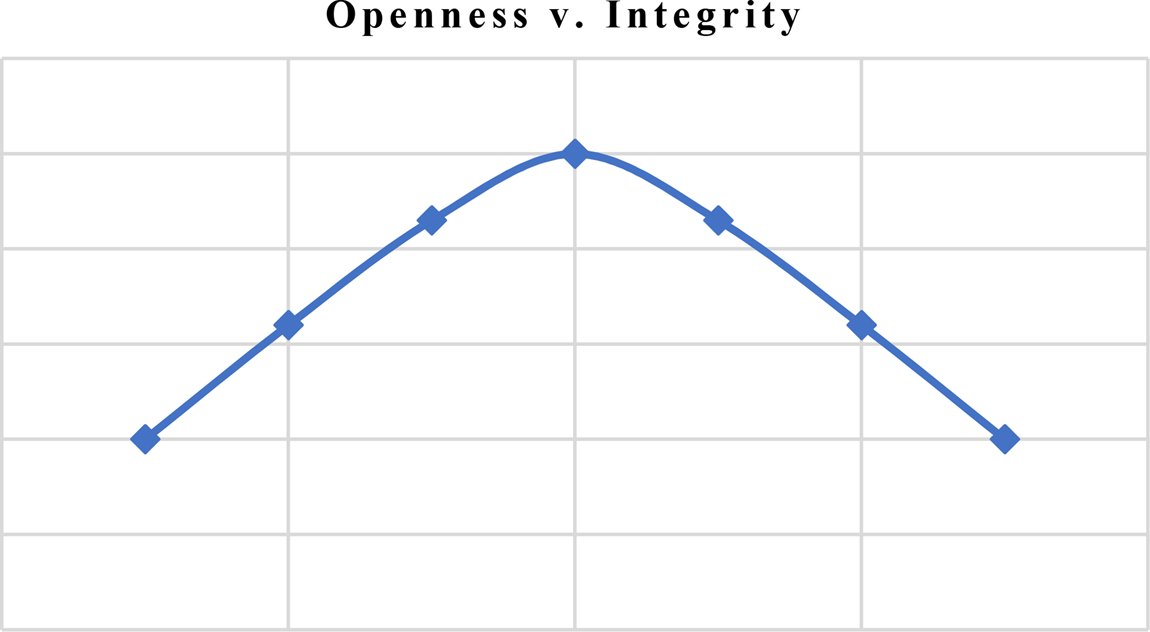
Openness and integrity could be perceived as communicating vessels. Openness ensures and promotes law's integrity when law's interpretation has become too narrow or rigid. On the other hand, openness could be inimical to law's integrity as it could undermine the rule of law or transform EU competition law into an unguided set of contradictory policy objectives and interests. Thus, openness and integrity are in a complementary and antithetical relationship. Complementary because up to a point the more open the law is, the more integrated it is likely to be, and antithetical because beyond or below a critical point, openness can clash with integrity. The relationship between openness and integrity could be represented as an inverted U-curve (see figure 2 below). Openness, represented in the horizontal axis, has up to a point ‘increasingly positive returns’ in terms integrity. Beyond this point it brings ‘decreasing positive returns’ to law's integrity (represented in the vertical axis).
A complementary and antithetical relationship

When legal institutions recognise EU competition law as a form of RL, they operate in a starkly different way from what AL prescribes. Instead of viewing it as a single-value technocratic tool, they consider it as a relatively open normative system and a purposive interpretive practice oscillating between openness and integrity. As a result and in order to realise its core objective they utilise a mixture of legal reasoning, technocratic non-legal knowledge (eg positive economics) and value-laden judgments (eg moral reasoning, normative economics analysis).Footnote 55 They understand the law not as a single-value scientific endeavour insulated from value judgments, but as a deliberative process where different actors give, assess and accept reasons for action or inaction and trace out their practical implications so as to reach practical judgments.Footnote 56 Hence, responsive legal institutions perceive EU competition law not merely as a set of legal propositions, but as a ‘practiced discipline of practical reasoning’ shaped by the need to align broad principles and previous case law with a refined understanding and appreciation of market affairs.Footnote 57
When this shift in perspective occurs legal institutions abandon the traditional methods of interpretation and engage in interpretive struggles so as to distil from prior cases a common logic that can extend to new circumstances.Footnote 58 Such struggles involve plaintiffs’, defendants’ and courts’ attempts to: (1) give purpose to the law by articulating a conception of competition; (2) operationalise the law by proposing analytical criteria for assessing whether a practice has led to harm to competition; and (3) choose among conflicting sets of logic on a well-reasoned basis. Furthermore, when such shift in perspective occurs, legal institutions instead of viewing the legal provisions as normatively closed binary switches, they perceive them as reasons for action, as tools for guiding behaviour and as a problem-solving device.Footnote 59
Consequently, considering that EU competition law is essentially an open-textured, problem-solving device has a direct impact on how legal institutions operate. Enforcers go beyond the narrow, crime-tort enforcement model and enforce the law ‘responsively’.Footnote 60 They utilise a bundle of different enforcement techniques and strategies and focus not only on sanctioning but also on persuading and guiding.Footnote 61 They also invest in epistemic authority, and put forward participatory, learning-based proceedings so as to tame law's openness for the sake of its integrity.Footnote 62 They also organise network-based institutional structures that allow for peer pressure, experimentation, and ‘regulatory conversations’.Footnote 63 In parallel, adjudicators stop operating simply as norm elaborators and become catalysts.Footnote 64 This means that courts function as platforms for interpretive struggles about the content of the law and become increasingly interested in institutional concerns so as to keep enforcers responsive.
Yet, recognising EU competition law's capacity to be a form of RL, does not mean that it is actually or fully responsive. Its openness gives it the ability to be responsive by adapting to changing circumstances, however, whether it is really responsive depends on whether the relevant legal institutions manage to tackle effectively conflicts between openness and integrity. Responsiveness, thus, is not a static state of affairs, but a process of bounded adaptation limited by the law's ‘code of integrity’, namely by its substantive mission goal, the fundamental rule of law principles, the pressure of the existing case law and the acceptance of its users.Footnote 65 This process of adaptation could be also perceived as a quest for finding dynamic equilibria between openness and integrity. Such equilibria could not be found under the AL model, since this model denies that EU competition law is a relatively open normative system and a purposive interpretive practice and, thereby, ignores the dynamic interplay between openness and integrity.
C. Comparing and Contrasting the Two Models
The AL and RL models mark two distinct ways to view and apply EU competition law. Essentially, AL and RL are two strategies for dealing with law's indeterminacy.Footnote 66 Autonomous EU competition law views such indeterminacy as a source of frictions and uncertainties and seeks to eliminate it through legal or economic technocracy; by internalising expert knowledge (ie positive economics) or by delegating legal questions to experts (ie economists).Footnote 67 In contrast, responsive EU competition law views indeterminacy as the by-product of value disagreements—ie conflicts between openness and integrity—and acknowledges that such disagreements are endogenous in this field of law and also that they can, despite their destabilising effects, serve as an important driver of change and adaptation.
AL thinking would consider that the more technocratic EU competition law is, the more sound or rational it would be. For instance, from an AL perspective injecting more legal technocracy to EU competition law can and will eventually eliminate any frictions and lead to substantively better outcomes.Footnote 68 Alternatively, such improvements could be achieved by introducing more economic technocracy into the law.Footnote 69 Such view is held for example by scholars who consider that introducing more economics will make EU competition law more rational or efficient.Footnote 70 On the contrary, from an RL point of view the fact that EU competition law is a field in constant epistemic change does not entail a process of perfecting what has gone before, but a process of adapting to the new.Footnote 71
Furthermore, if legal institutions conceptualise EU competition law within the contours of the AL model, they will operate in an utterly different manner compared to what the RL model suggests. Specifically, if the AL modus operandi is adopted: (1) both competition authorities and courts will use the traditional methods of interpretation coupled with input from positive economics to interpret the relevant prohibitions; (2) competition authorities will enforce the law in a crime-tort fashion; and (3) courts will only elaborate the legal provisions, punish infringers and compensate victims. On the contrary, if the RL modus operandi is adopted: (1) both competition authorities and courts will use constructive interpretation to interpret the norms; (2) competition authorities will behave as responsive enforcers; and (3) courts will operate as catalysts.Footnote 72
Thus, using the one or the other model has practical implications. For instance, AL enforcers would narrow their responsibilities and search for bureaucratic havens or outsource their decisionmaking to experts (eg economists), and AL adjudicators would deny the normative openness of EU competition law and shelter themselves within a technocratic and single-value interpretive paradigm.Footnote 73 In contrast, responsive enforcers and adjudicators would accept that EU competition law cannot remain hermeneutically autonomous or insulated from value conflicts and contextual changes without losing its integrity. As a result they would broaden the field of ‘what is competition law relevant’ so as to incorporate not only micro-economic insights, but also input from other economic schools (eg ecological economics) or even other domains of knowledge (eg environmental studies), and they will engage in normative evaluations about the purposes and effects of legal action.Footnote 74 Consequently, responsive legal institutions would recalibrate their understanding of the law's goal, revise their analytical framework to incorporate new knowledge and invest in their institutional and epistemic capacities so as to be sensitive to law's context and cope with new contingencies.Footnote 75
This shift in attitude and practices will be triggered by the fact that responsive enforcers and adjudicators, will set aside AL's traditional methods of interpretation and employ constructive interpretation to deal with law's indeterminacy. How does this method of interpretation differ from AL's hermeneutics? Constructive interpretation is a ‘matter of imposing purpose on an object or practice in order to make it the best possible example of the form of genre to which it is taken to belong’.Footnote 76 This method of interpretation suggests that legal institutions should recognise plaintiff's and defendant's argumentation as parts of interpretive theories about the law, namely as argumentative attempts to reconstruct the object of the law in virtue of its purpose. Then they should choose (or construct on their own) the interpretive theory that presents the law in its best light and generates legal outcomes that both fit and justify it.Footnote 77 The ‘fit’ element implies that the interpretive theory must account for the paradigmatic aspects of EU competition law. The ‘justification’ component consists in putting competition norms in their best light by taking into consideration their purpose, functions and effects.Footnote 78
Such a method of interpretation opens a dialogue about the purpose, the operational legal tests, the value and the effects of the law, and advocates in favour of a purposive, principle-based and results-oriented interpretive attitude.Footnote 79 What is considered as legally irrelevant or impermissible under AL (e.g. making value judgments) becomes relevant under this method of interpretation since interpretive theories involve a mixture of legal reasoning, technocratic non-legal knowledge and value-laden judgments, and reconstruct the purpose of the law in light of its effects.Footnote 80 Within this frame, the AL traditional methods of interpretation can still play out, yet not as tools to uncover some true or fixed meaning of certain rules, but as sources of inspiration for arguments which would fuel interpretive theories. A clarification is in order here. Constructive interpretation differs from the traditional teleological interpretation because instead of searching for some ‘true and fixed intent or objective’, it recognizes that legal interpreters often need to engage in value judgments, make normative choices, and (re)construct a conception of a rule's purpose to apply it.Footnote 81 In this regard, constructive interpretation without cancelling AL's traditional methods of interpretation reorganises them in a way that could tame EU competition law's openness to secure its integrity.
The table below summarises the key features of the two distinct conceptualisations of EU competition law discussed above.

II. THE RESPONSIVE LAW MODEL AS A DESCRIPTIVE DEVICE
It follows from the discussion above that a major reason to conceptualise EU competition law as RL instead of AL lies in the fact that the former can explain away law's indeterminacy. Instead of considering EU competition law's indeterminacy as a failure of legal or economic technocracy to deliver, the RL approach argues that it is a by-product of conflicts between openness and integrity, which are endogenous in this field of law and generate value disagreements. To demonstrate this point, I analyse here certain features of EU competition law which suggest that this corpus of norms is de facto and by design open and, thereby, bound to experience conflicts between openness and integrity. EU competition law relies on a fuzzy mandate, and is written in a conceptually elastic language. In addition, EU enforcers and adjudicators have always used a blend of rules and standards to interpret the laconic Treaty provisions. To these it should be added that the most important extra-legal input of EU competition law, economics, is an ‘ideological science’,Footnote 82 which is composed by a normative-ethical side and a positive-engineering side,Footnote 83 includes various schools of thought and experiences its own ‘scientific revolutions’.Footnote 84 Therefore, economics cannot eliminate conflicts between openness and integrity and transform competition law into AL. On this basis, I argue here that EU competition law is bound to be open and relatively indeterminate. If the RL model explains better than the AL model such a pervasive phenomenon as EU competition law's indeterminacy, it could be argued that it offers a better framework to describe how this field of law functions and changes.
A. Fuzzy Mandate
Arguing that EU competition law relies on a fuzzy mandate is hardly contentious.Footnote 85 Gerber argues that competition law's goal is to remove distortions of competition, while Schweitzer maintains that it consists in protecting the competitive process, and Behrens supports the view that ordoliberal ideas have accompanied the drafting as well as the interpretation and application of EU competition law since its inception.Footnote 86 On the contrary, Akman contends that the historical purpose of EU competition law was to increase efficiency.Footnote 87 In a similar vein, Nazzini argues that the goal of Article 102 of the Treaty on the Functioning of the European Union (‘TFEU’) is to maximise total social welfare through productivity growth.Footnote 88 Townley maintains that consumer welfare is the proper objective of EU competition law even though certain public policy considerations play out in its application,Footnote 89 and Odudu supports the view that modern EU competition law has endorsed the consumer welfare paradigm.Footnote 90 On the other hand, Lianos argues that EU competition law pursues a plurality of values and is situated between economic policy and social regulation,Footnote 91 and Monti argues that it promotes disjointed objectives such as efficiency, consumer welfare, economic freedom, market integration, and rivalry.Footnote 92 Along similar lines, Ezrachi contends that the goals of EU competition law are of ‘dynamic nature’Footnote 93 and include consumer well-being, effective competition structures, efficiency and innovation, fairness, economic freedom, plurality, democracy, and market integration.Footnote 94 On this basis, it is argued here that the objective of EU competition law is solely the protection and promotion of competition yet this objective is multifaceted and multi-layered and hosts a multiplicity of values, constituting this corpus of norms inevitably open.
In recent decades, the Commission appears to have endorsed a narrower reading of the purpose of the law. In several documents and decisions the Commission has casted EU competition law as a consumer welfare prescription.Footnote 95 In reality, though, policy concerns related to industrial policy, public health, social protection, consumer protection, sustainability, environmental protection, investment, transportation, and regional development have always found their way into the Commission's decisional practice.Footnote 96 As Stylianou and Iacovides observed, after a textual analysis of 1,015 Commission decisions, from the 1960s until today the Commission has pursued in varied degrees the goals of efficiency, welfare, economic freedom, market structure, fairness, European integration, and competitive process.Footnote 97 Hence, a careful examination of the Commission's decisional output reveals that its enforcement practices have ‘been guided by a multitude of aims, including individual economic freedom, fairness, the internal market, and a rather vague and generalised notion of economic welfare’.Footnote 98
In addition, the Court of Justice of the European Union has not endorsed an unequivocal position with regards to the purpose of the law. Illustrative in this respect is the dialogue between the General Court (‘GC’) and the European Court of Justice (‘ECJ’) in GlaxoSmithKline. In this case the GC seemed willing to embrace the Commission's consumer welfare approach holding that the objective of Article 101 TFEU was to prevent undertakings from reducing the welfare of the final consumer by restricting competition.Footnote 99 However, the ECJ disagreed with the GC and noted that ‘there is nothing in that provision to indicate that only those agreements which deprive consumers of certain advantages may have an anti-competitive object’.Footnote 100 More than this, the ECJ held that the objective of competition rules laid down in the Treaty is ‘to protect not only the interests of competitors or of consumers, but also the structure of the market and, in so doing, competition as such’ (emphasis added).Footnote 101
In light of the above, it is safe to say that the mandate of EU competition law is fuzzy.Footnote 102 This conclusion is also supported by the empirical investigation conducted by Stylianou and Iacovides who found that EU competition law as interpreted by the Court of Justice of the European Union is not monothematic, but pursues a multitude of values, while it prioritises the process of competition rather than certain outcomes.Footnote 103 On this basis, it is maintained here that EU competition is by design and de facto an open normative system.Footnote 104
B. Conceptually Elastic Vocabulary
The second element of EU competition law supporting the endogeneity of openness versus integrity clashes, lies on the conceptually elastic language of most of competition law terms. All core competition rules contain open-textured concepts.Footnote 105 For instance, concepts such as ‘undertaking’, ‘restriction by object or effect’, ‘effect on trade’, and ‘abuse of dominant position’ do not have clear-cut meaning and have been defined by the EU courts on many occasions in a functional or teleological way. Judicial definitions of even the word ‘competition’ have gone through an evolution.Footnote 106 Therefore, applying such ‘essentially contested concepts’ has always required significant interpretive efforts, involving attempts to define the semantic core and the penumbra of the concept as well as attempts to articulate and evaluate different conceptions of the concept at stake.Footnote 107 Hence, legal interpretation in EU competition law has always triggered argumentative struggles about the values, interests, purposes, and principles that competition law is supposed to ensure. Such argumentative struggles cannot but involve value judgments about what competition law is supposed to do.
C. Rules and Standards
The third reason supporting the endogeneity of conflicts between openness and integrity in EU competition law could be traced to the fact that this field of law regulates markets which are prone to constant change. To effectively do so, the Commission and the EU courts regularly interpret the key competition norms as including both rules and standards.Footnote 108 Rules ‘establish legal boundaries based on the presence or absence of well-specified triggering facts’, have formal realisability and, thus, maximise clarity by constraining discretion.Footnote 109 Rules, in addition, provide concrete guides for decisionmaking geared to narrow categories of behaviour and prescribe narrow patterns of conduct. An example of a rule could be: a dominant position cannot be found if an undertaking has market share below 40%. However, an undertaking with 60% market share may be unable to exercise substantial market power due to a maverick or an equally economically strong buyer, while on the other hand an undertaking with a market share as low as 38% could be dominant in an oligopolistic market with high barriers to entry and increased transparency when holding a bottleneck. Hence, even though rules can maximise legal clarity and certainty by eliminating discretion, they can also generate false positives (type I errors) and false negatives (type II errors).Footnote 110
Standards, on the other hand, require the decision-maker to engage in a wide-ranging inquiry and take into consideration the actual or potential effects of a specific practice. Standards could deliver more precise results and reduce type I and type II errors.Footnote 111 Yet, they cannot fully eliminate error costs, they could themselves be a source of error costs, and usually they bear higher administrative costs compared to rules.Footnote 112 Thus, in principle, rules should be chosen when the marginal benefits of assessing more case-specific evidence are lower than the marginal cost of additional information. For example, if past experience or economic knowledge suggests that a specific type of conduct is likely to be anticompetitive, innocuous, or procompetitive, it would be preferable to use a rule for dealing with such a conduct. In contrast, standards should be chosen when the marginal benefits of adding a layer of case-specific analysis outweigh the marginal costs associated with acquiring and assessing that information, or when the cost of implementing the standard is less than the error cost of a rule.Footnote 113 Notably, the difference between rules and standards lies in ‘how much we need to know’ before reaching a conclusion about a specific practice.
Given that certain commercial practices or competition problems could be better treated by a rule while others by a standard, it is not surprising that the Commission and the EU Courts have always sought to identify an optimal balance between rules and standards when interpreting the Treaty provisions. The debate on ‘restrictions by object v. restrictions by effect’, or the ‘forms v. effects’ dispute show that competition law analysis necessarily operates with rules and standards.Footnote 114 In fact, both EU enforcers and adjudicators have never endorsed an entirely effects-based or a fully formalistic approach. They have always relied—in varied degrees—on economically informed and outcome-sensitive legal forms.Footnote 115 In this respect, the ‘restrictions by object v. restrictions by effect’ and the ‘forms v. effects’ debates could be viewed as disputes on how far legal institutions should take account of the effects of a practice to sustain a legal inference.Footnote 116 Hence, such debates indicate that EU competition law is a conceptually open legal system and constantly seeking to ensure its integrity.
D. Economics: An Ideological Science
The last feature of EU competition law suggesting that conflicts between openness and integrity are inevitable could be traced to the fact that this field of law heavily relies on economics to pursue its mission. However, contrarily to what AL claims, economics cannot eliminate EU competition law's openness, first of all, due to its institutional constraints and juridical structure. As recognised by the Commission, requiring a full-fledged economic analysis of each restriction of competition in every individual case would make enforcement overly costly and unmanageable.Footnote 117 The reason behind this statement of the Commission is that ‘measurement, for all practical purposes, is impossible’.Footnote 118 Consequently, the Commission and the EU courts have used various legal constructions to avoid quantifying, measuring, and balancing competition gains and harms.Footnote 119
Nonetheless, there is a more crucial reason why economics cannot eradicate the dynamic interplay between openness and integrity that characterises (even when it is not explicitly recognised) EU competition law. Economics is a discipline composed of various paradigms, schools of thought, and methods, and an epistemic field that constantly changes and evolves as new knowledge is produced at a theoretical and empirical level.Footnote 120 Even though microeconomics comprise the backbone of modern economics, there are other paradigms within the discipline—such as behavioural, experimental, environmental, ecological, and complexity economics—that contest microeconomics’ omnipotence.Footnote 121 In addition, microeconomics cannot provide an answer to the question whether total or consumer welfare, rivalry, fairness, or some other value, should provide the litmus test for assessing whether a practice amounts to harm to competition. Therefore, the multiplicity of paradigms within economics and the absence of an economics meta-theory prevent economics from being a unified, single-value science capable of delivering axiological absolutes.Footnote 122
But, even if we ignore this complication and assume that microeconomics is the only valid scientific paradigm, still (micro)economics would not be able to provide enforcers and adjudicators with a definitive answer to the question whether competition rules should be read as protecting dynamic, static, perfect, workable, or effective competition. Even if only efficiency mattered in EU competition law, economists would still disagree on how, for instance, to identify the level of competitive prices, what should be the appropriate test for specific types of anticompetitive prices (eg predatory pricing) or what is the suitable price-cost test for defining anticompetitive foreclosure.Footnote 123 Therefore, even using exclusively microeconomics in EU competition law necessarily involves choosing between different normative orderings and making value judgments, not only at a certain initial point of adoption, but continuously as the law is interpreted and implemented.Footnote 124
Consequently, economics cannot postulate comprehensive criteria for eradicating EU competition law's normative openness. As Jacobs notes ‘far from having marginalised the role of value choice in antitrust, the ascendancy of economics underscores its enduring importance’.Footnote 125 Accordingly, instead of perceiving economics as technocracy, as the AL framework suggests, it might be more appropriate to view them as an ‘ideological or moral science’. This shift of perspective implies that instead of a homogenous discipline and a source of incontestable truths, economics are essentially a source of openness and a toolbox for shaping and testing interpretive theories about the law. From this angle, as long as EU competition law utilises economics is bound to remain open, because the use of economics necessitates making certain (often implicit) value judgments and choosing one economic school, paradigm or model over another.
III. THE RESPONSIVE LAW MODUS OPERANDI
The previous analysis suggested that, according to the RL model, EU competition law's indeterminacy is the by-product of the dynamic interplay between its openness and integrity, and due to this reason is inevitable. Contrarily to the AL, the RL approach considers that indeterminacy is what makes EU competition law on one hand an occasionally unclear and uncertain field of law, but on the other hand a flexible and effective tool for dealing with market problems. Against this background, this Section shows how the RL approach, by prescribing a specific modus operandi, could help legal institutions, not to eliminate, as the AL model falsely promises, but to deal with the problem of indeterminacy. This modus operandi consists in: (1) constructive interpretation; (2) enforcers behaving responsively; and (3) courts functioning as catalysts, namely as platforms for argumentation and as responsiveness motivators.Footnote 126 To show how the RL modus operandi could work, instead of engaging in an abstract normative discussion, I use some exemplar cases of constructive interpretation, responsive enforcement, and catalytic adjudication from EU competition law.
A. Constructive Interpretation
Consider the question whether a selective distribution agreement constitutes a restriction of competition. Let us assume that neither the letter of the relevant provision nor a historical investigation of some original intent can provide an answer to this question. Let us also assume that the courts have not dealt with a similar case, therefore a systematic treatment of the case law cannot provide a clear-cut solution by transposing another strand of case law to the present case. In such a case, if we follow AL's teleological interpretation, we would have to examine the objective purpose of Article 101 TFEU yet such an inquiry would be confined by the methodological commitmentsFootnote 127 of AL and would face perhaps insurmountable difficulties.
Then, AL's suggestion would be to utilise the best extra-legal, non-normative knowledge, but such a suggestion would not be of great help as we do not know under what criterion such knowledge should be selected.Footnote 128 Should we for example decide that case on the basis of the best political economy approach, the best neoclassical approach or the best behavioural economics approach? And, should the relevant criterion be the impact of a selective distribution agreement on consumer welfare, total welfare, freedom to compete or on the competitive process? Hence, if legal institutions operate within the AL framework and employ the traditional methods of interpretation, they are likely to not be able to tackle this ostensibly ordinary question.
However, when confronted with the said question in 1977, the European Court of Justice (‘ECJ’) held in Metro I that selective distribution agreements, even though they restrict a form of price competition, they could be compatible with Article 101(1) TFEU (at the time Article 85(1) of the European Economic Community Treaty) as long as the properties of the product necessitate a selective distribution system; resellers are chosen on the basis of objective criteria of a qualitative nature which are determined uniformly for all potential resellers and applied in a non-discriminatory manner; and the restrictions do not go beyond what is necessary.Footnote 129 Noticeably, the Court stated that ‘although price competition is so important that it can never be eliminated it does not constitute the only effective form of competition or that to which absolute priority must in all circumstances be accorded’ (emphasis added).Footnote 130 The Court also noted that the said Article protects ‘workable competition’, namely competition that is necessary to ensure the observance of the Treaty objectives and especially the creation of a single market, and that such workable competition may be reconciled with the safeguarding of objectives of a different nature.Footnote 131 On this basis, the Court observed that restrictions on competition are permissible, provided that they are ‘essential to the attainment of those objectives and do not result in the elimination of competition for a substantial part of the Common Market’.Footnote 132 Under this reasoning, the Court concluded, an agreement that restricts certain forms of inter-brand price competition could be compatible with Article 101(1) TFEU if it improves another dimension of competition (eg inter-brand, quality competition).Footnote 133
This core idea was reiterated in AEG-Telefunken (1983) where the Court held that if a selective distribution agreement is capable of improving competition in relation to factors other than prices, such as the maintenance of a specialist trade capable of providing services with regards to high quality and high technology products, it could escape the clutches of EU competition law.Footnote 134 Consequently, selective distribution agreements ‘in so far as they aim at the attainment of a legitimate goal capable of improving competition in relation to factors other than price, constitute an element of competition which is in conformity with Article 85 (1)’ (emphasis added).Footnote 135 In a similar vein, the Court held in Pierre Fabre (2011) that even though selective distribution agreements can restrict competition by object in the absence of objective justification, there may be legitimate requirements ‘which may justify a reduction of price competition in favour of competition relating to factors other than price’.Footnote 136 In the recent Coty (2017) case, the Court followed once more this line of reasoning and considered that if a selective distribution agreement is designed to preserve the luxury image of a product and meets the Metro criteria is compatible with Article 101(1) TFEU.Footnote 137
Such interpretive moves, which include value choices, are hard to explain from an AL point of view, as the latter conceives competition law as a neutral or a single-value technocratic enterprise insulated from value conflicts. Yet, they are understandable from an RL perspective. In these cases, the ECJ calibrated law's openness and integrity by engaging in constructive interpretation. Specifically, the Court examined what is the object of the agreement within its legal and economic context with the intention to assess whether such an agreement could reduce or enhance certain forms of competition in the market.Footnote 138 Simultaneously, the Court reconstructed the purpose of Article 101 TFEU and put forward its own understanding of competition as multifaceted ideal. This is evident by two common features of these decisions: first, the central question that the Court sought to answer was whether the agreements in question harm or improve certain dimensions of the competitive process, and, second, the Court did not explore (or ask the referring court to explore) via an economic impact assessment what would be the impact of the relevant agreements on total or consumer welfare; it merely asked whether the agreements in question improve some non-price related aspect of competition while restricting certain forms of price competition. Thus, these cases suggest that ECJ at least on certain occasions, treats EU competition law as a relatively open normative system and engages in value judgments emanating from its own understanding of what is meaningful competition in the market. In other words, these cases could be read as the Court's response to the question: what forms of competition deserve to be protected by competition law?
The jurisprudence of EU courts is abundant of such examples of constructive interpretation. When the ECJ was asked whether a restriction of competition derives from an ‘agreement’ or a ‘concerted practice’, it clarified that the two concepts overlap and noted that there is no need for a clear-cut distinction since Article 101 TFEU ‘is intended to apply to all collusion between undertakings, whatever the form it takes’ (emphasis added).Footnote 139 It is, thus, the purpose of Article 101 TFEU (as reconstructed by its interpreters) what guides how concepts such as ‘agreement’ or ‘concerted practice’ will be applied.
Similarly, when confronted with the question ‘what is an undertaking’ the ECJ noted that ‘the concept of an undertaking encompasses every entity engaged in an economic activity, regardless of the legal status of the entity or the way in which it is financed’.Footnote 140 Instead of focusing on the legal form of the entity, the Court investigated whether the nature, aims, and function of the entity's activity warrant the conclusion that it engages in an economic activity. The Court followed such an interpretive strategy because it was concerned about materialising the purpose of Article 101(1) TFEU. For this reason it implicitly advanced an understanding of what EU competition law ought to do and on this basis it gave a certain meaning to the concept of undertaking so as to not counteract, but instead promote, that purpose.Footnote 141
Another example is the concept of dominance. Even though the term ‘dominant’ will not be found in economic textbooks, from early on the Court relied on economics to interpret it.Footnote 142 It quickly accepted that dominance means some degree of market power, yet it did not clearly define the precise content of the latter. Nevertheless, the Court rejected the static definition according to which dominance is identified primarily or exclusively in virtue of an established market share threshold.Footnote 143 In some seminal cases, the Court conceptualised dominance as commercial power,Footnote 144 and as ‘a position of economic strength enjoyed by an undertaking which enables it to prevent effective competition being maintained on the relevant market by giving it the power to behave to an appreciable effect independently of its competitors, customers and ultimately of consumer’,Footnote 145 while in others it defined it as ‘substantial market power’, namely as ‘the ability to profitably raise prices above the competitive level for a significant period of time’.Footnote 146 Hence, dominance evolved from a static and structural conception, focused on market shares or commercial power, to a more behavioural and neoclassical, in economic terms, conception emphasising power over price and the ability to neglect the competitive pressure.Footnote 147
Accordingly, even though concepts such as ‘restriction of competition’, ‘agreement’, ‘undertaking’ and ‘dominance’ seem fairly ‘legal’ or ‘economic’, and ‘technical’, they have been interpreted by the ECJ in ways that cannot be explained away by the traditional methods of interpretation even when these are coupled with economic technocratic reasoning (ie the AL method of interpretation). The European judges did not determine the content of the law on these occasions by solely using the traditional methods of interpretation or ‘purely scientific’, non-legal input (eg positive economics). Instead they viewed EU competition law as a relatively open normative system, engaged in constructive interpretation and made value judgments.
B. Responsive Enforcement
The second element of the RL modus operandi is responsive enforcement. Responsive enforcement means that enforcers escalate or de-escalate their intervention depending on the market players’ response;Footnote 148 that they are not only preoccupied with punishing and deterring, but also with compliance, learning, and trust-building;Footnote 149 that they intervene after understanding the context and the motivations of those involved,Footnote 150 and that they re-visit their performance and understanding of the law. A legal framework that provides for a variety of compliance and enforcement tools and sets up a network-based structure that allows the various nodes to have access to localised knowledge, test different solutions, and learn from each other, sets the institutional preconditions for responsive enforcement.Footnote 151 But, of course, enforcers become really responsive when they use properly the various proscriptive and prescriptive, proactive and reactive enforcement tools and strategies enabled by the law, ‘learn by doing’ and ‘from difference’, and invest in epistemic competence.Footnote 152 Hence, responsive enforcement requires not only a certain institutional design but also a set of institutional practices.
A good example of what exactly responsive enforcement implies could be found in certain features and practices of the European Commission. In particular, the internal structure of the Commission, namely its division into problem-solving task forces, and the creation of the office of Chief Competition Economist in 2003 demonstrate its concern about epistemic capacity and delivering results.Footnote 153 Moreover, the Commission is primus inter pares in a decentralised yet hierarchical network of enforcers which relies on information exchanges, peer pressure, and coordination.Footnote 154 In addition, the Commission disposes of a wide range of enforcement tools of varied intensity. Therefore, the design of EU competition law's institutional structure and certain organisational principles adopted by the Commission provide a good example of responsive enforcer.
Equipped with such institutional tools, it is not surprising that the Commission regularly goes beyond the crime-tort enforcement style, and uses sector inquiries to explore the market context, and a wide array of tools—ranging from sunshine and soft to hard enforcement—to secure compliance.Footnote 155 There are also many occasions where the Commission has intervened in a continuous manner and with both a restorative (ie to repair harm to competition) and prophylactic (ie to eliminate practices that are likely to result in distortions of competition in the future) attitude.Footnote 156 Furthermore, the Commission on many occasions applies competition rules contextually and by taking into consideration the existing regulatory framework and other relevant policies.Footnote 157 In this sense, there are plenty of actual examples showing the Commission behaving responsively.
It is also common for the Commission to revisit its performance by conducting ex post surveys and to issue reports describing the actual consequences of its enforcement practices.Footnote 158 What is even more remarkable, though, is that the Commission on many occasions has adopted a reflective attitude. For instance, the Commission changed its attitude towards vertical restraintsFootnote 159 after taking into consideration certain criticisms related to the strictness of its previous approach, as well as the findings of economic analysis according to which vertical restraints on most occasions are procompetitive or competitively neutral.Footnote 160 Of course this reflective attitude is not a feature of the past; the Commission still remains open to improve or reconsider its analytical framework. For example, following many scholars’ key observation that digital markets may change the parameters of competition,Footnote 161 the Commission sought, and still seeks, to advance its knowledge on what is actually happening in digital markets and how it affects competition.Footnote 162 It explored the options for a ‘new competition tool’ and ex ante regulation of gatekeeper platforms while opened various investigations in digital markets, and it recently proposed a ground-breaking ‘Digital Markets Act’.Footnote 163
Another feature of the Commission's institutional practice that showcases what responsive enforcement means and can be a source of inspiration in this regard, is the following: the Commission regularly employs constructive interpretation and engages in interpretive struggles. For instance, in the late 1990s the Commission decided to orchestrate a wide-ranging programme for the substantive, procedural, and institutional reform of EU competition law that has been labelled as the More Economic Approach (‘MEA’). The clashes between the Commission and the US antitrust authorities in the 1990s and early 2000s, the annulment of three merger decisions in early 2000s by the EU Courts, and the influence of the International Competition Network pushed the Commission to rethink its understanding of the rules and redesign its competition policy.Footnote 164 On the substantive level the reform started with vertical restraints and progressively moved to horizontal restraints,Footnote 165 merger analysis,Footnote 166 and the abuse of dominance.Footnote 167 The official objective of this approach was to anchor Commission's analysis on sound economics.Footnote 168 Essentially, though—as will be shown in Part IV—the MEA approach was an interpretive theory about EU competition law presented in an AL disguise.
Besides the MEA, two recent decisions are quite suggestive of the Commission's institutional practice of harnessing law's openness and engaging in constructive interpretation so as to ensure its integrity. In Dow/Dupont and Bayer/Monsanto without contravening EU Merger RegulationFootnote 169 or departing from the Horizontal Merger Guidelines (‘HMG’), the Commission managed to go beyond a price/output analysis and developed a robust innovation-based theory of harm.Footnote 170 Even though some criticise the Commission as engaging in a ‘quantum leap’,Footnote 171 its analysis is anchored on the HMG's explicit statement that ‘increased market power’ is defined not only as the ability to profitably increase prices, but also as the ability to profitably diminish innovation or affect negatively other parameters of competition.Footnote 172 Based on such a brief statement and its previous practice, the Commission considered that the merging of two close competitors with significant overlaps in a number of innovation spaces in a structurally oligopolistic, innovation-driven industry could lead to a significant impediment of effective innovation competition.Footnote 173 The underlying idea was that in markets where innovation is an important competitive force, a merger between close competitors may decrease their ability and incentive to innovate, as well as the competitive pressure on rivals to innovate. To reach such a conclusion, the Commission reconstructed the goal of EU Merger Regulation, articulated its own understanding of (innovation) competition and spelled out a rather rich conception of innovation that includes innovation incentives, capabilities, and efforts in various innovation spaces.Footnote 174
In light of the above, it could be argued that the Commission regularly utilises EU competition law's openness and operates in a multifaceted way so as to secure its integrity. It invests in epistemic capacity to persuade the market players to comply, but also to signal to other competition authorities within or outside the EU that it applies competition law in a sound manner. The Commission also organises its intervention in a continuous and varied way; deliberates with national competition authorities, experts, and stakeholders; revisits its performance; employs constructive interpretation; and remains open to reconsider its understanding of competition rules. Had the Commission adopted the AL thinking or the AL-inspired crime-tort enforcement model it would not be up for such a task.Footnote 175
C. Courts as Catalysts
To conclude our analysis, a last example should be given of how the courts could behave as catalysts. One way to behave as catalysts is to orchestrate and participate in interpretive struggles by utilising constructive interpretation as described above in Section III.A. Another way courts could operate as catalysts is by facilitating or motivating responsive enforcement. An illustrative example in this respect could be traced in the way the ECJ progressively recalibrated its standard of review pushing the Commission to behave responsively.
The question ‘how can a judge tackle competition problems that are at least economic in nature?’ arose in the early years of EU competition law and led the EU Courts to formulate a doctrine of judicial deference.Footnote 176 According to this doctrine, EU courts would engage in a comprehensive review of a Commission decision, unless that decision contains a ‘complex economic assessment’.Footnote 177 This meant that in principle EU courts, in recognition of the existing institutional balance and the relevant division of labour, would apply two different standards when assessing Commission decisions. They would exercise marginal or limited review over technical economic issues, and full, comprehensive review over any other non-technical, general legal issues.Footnote 178
Yet, the establishment of the GC in 1988 (at that time called ‘Court of First Instance’) led to an intensification of judicial review.Footnote 179 Without dismissing the formulation of the doctrine, the GC went beyond what the doctrine implied and engaged in an increasingly more meticulous review of the Commission decisions. On many occasions the ECJ upheld this approach. Progressively, both courts departed from the initial doctrine and reviewed more thoroughly issues that in the past were considered as ‘complex economic assessments’. For instance, in Clearstream, the GC questioned Commission's market definition,Footnote 180 and in Airtours, Tetra Laval, Microsoft, and Ryanair, it reviewed new economic theories and detailed econometric studies.Footnote 181 In AstraZeneca, the ECJ recognised that Commission's assessments of technical matters are not immunised from judicial review due to their technical nature.Footnote 182 In Woodpulp, the ECJ reviewed a substantial body of complex economic arguments and it even appointed its own economic experts to assess whether the market structure and the characteristics of the product and the industry at issue would support the Commission's analysis that collusion was the only rational explanation for the observed parallel conduct.Footnote 183 In Deutsche Telekom, both Courts assessed the Commission's calculations for finding a margin squeeze.Footnote 184
These cases suggest that even though the shell of the doctrine survived, the functioning of judicial review gradually changed.Footnote 185 Both EU courts kept scrutinising more thoroughly the complex assessments of Commission decisions, while they did not hesitate to annul a decision if they remained unconvinced about the Commission's assessment of economic data. As economic analysis was becoming more and more prominent in EU competition law and the Commission was unfolding its MEA, the Courts increased their expectations and level of inquiry so as to ensure that the Commission instead of using economic expertise to shield its practices from scrutiny remained responsive and focused on safeguarding law's integrity.
IV. FRAMING DISCURSIVE PRACTICES
The previous two Parts touched upon the descriptive and prescriptive value of the RL model using examples from EU competition law. The purpose of this Part is to illustrate the discursive value of this model. In other words, this Part intends to show how the RL approach can recast the way the competition law community frames and debates over certain issues and, thereby, increase the likelihood of constructive debate, instead of polarisation. For this purpose, I focus here on a well-known discursive practice in the context of EU competition law to show how this debate could be reconfigured if the various interlocutors adopt the RL point of view.
As already mentioned, in the late 1990s, due to internal and external criticism, the Commission devised its MEA.Footnote 186 The key premise of this approach was that the aim of EU competition law is or should be to eliminate practices that could impair effective competition, thus having an adverse impact on consumer welfare.Footnote 187 Harm to competition was interpreted as meaning harm to consumer welfare and consumer welfare was defined in rather broad terms as including output, quality, innovation, and, to some extent, consumer choice, while the internal market aim remained relevant. Undoubtedly, the MEA constituted a significant departure from the Commission's previous interpretive practice, while it was also not fully in line with ECJ's case law.Footnote 188 Two were its organising ideas: (1) EU competition law's goal is or should be to promote rivalry as a means for enhancing consumer welfare;Footnote 189 and (2) neoclassical economics could provide all the necessary tools and methods for EU competition law analysis.Footnote 190
From an AL perspective, the MEA could be either a technocratic statement of the law or an inappropriate usurpation of legislative power. Note that within the AL framework value judgments are not permissible for enforcers. The law has a fixed goal which enforcers should simply enforce in a scientific and technocratic manner, while making value judgments would ‘politicise’ them and lead them to undertake tasks beyond their mandate and institutional legitimacy. Due to these reasons, the Commission introduced the MEA little by little over a period of ten years or more, and carefully framed it in value neutral and scientific terms. For instance, this new faith was called the ‘more economic’ and not the ‘consumer welfare’ approach. The Commission also sought for mainstream economic positions and expert opinionsFootnote 191 and engaged in wide ranging public consultations with all the stakeholders.Footnote 192 Furthermore, to articulate its MEA, the Commission used statements of the law (ie infringement decisions),Footnote 193 as well as softer enforcement mechanisms (ie commitments, settlements, sector inquiries), and most importantly soft law tools, such as non-binding Notices, Communications, Guidelines, and Guidance papers. Even the Commission's omissions (eg the Commission made it clear that it will not focus on exploitative pricing) contributed to setting out its new understanding of law.Footnote 194 The official narrative was that the MEA is merely a policy that injects modern scientific or technocratic economic thinking into the Commission's interpretation to rationalise it and does not prejudice the interpretation of the EU Courts.Footnote 195
However, in many of these documents, the Commission was torn between providing a restatement of the law on the one hand and offering innovative solutions on the other.Footnote 196 Certainly, the MEA is not merely a statement of the law, but an interpretation of it, and not an interpretation within the meaning of the AL model, but an RL-type of interpretation, an interpretive theory about the purpose of the law. Specifically, to articulate the MEA the Commission went beyond the traditional methods of interpretation and combined normative and positive legal and economic claims, reconstructed the goal of the law and proposed a way for understanding EU competition law that fit existing case law and presented it in its best light by justifying its function.
Accordingly, the Commission used the disguise of AL to earn legitimacy. This is the reason why it casted the MEA as a statement of the case law, as a way to prioritise cases or as the one and only means to bring EU competition law up to speed with mainstream economic thinking. Rhetorically it remained within the AL worldview, yet in reality it operated responsively as it sought to incorporate new learning and improve its capacity to tackle market problems. It could be thus argued that the Commission's underlying objective was to tame law's openness, so as to ensure its integrity. Such interpretive move was possible because of EU competition law's relative indeterminacy. If, nonetheless, the MEA is not seen through these favourable lenses, as an interpretive theory in AL disguise, it should be considered as a methodologically problematic and doomed-to-fail (for the reasons provided in Part II above) attempt to eliminate competition law's relative indeterminacy.
For some, the MEA was a ‘legal and cultural revolution’,Footnote 197 a ‘radical reform’ heralding the ‘dawn of a new era’,Footnote 198 the European equivalent of the US ‘antitrust revolution’, or a ‘Chicago-light’ approach.Footnote 199 For others, it was a scientific attempt to modernise competition law and bring it closer to modern economic thinking.Footnote 200 According to some more critical voices, the MEA was nothing but a neoliberal interpretation of the law leading to light-weighted enforcement.Footnote 201 Still today, the debate around the MEA is rarely about the merit or demerit of the MEA as an interpretive theory. On most occasions, its supporters present it as a neutral statement of the case law or as an economically technocratic restatement of it, whereas its opponents claim that it is incoherent with the case law or value laden.
However, this is far from a constructive debate. Indeed, the MEA is not ‘purely scientific’Footnote 202 or value neutral, but an articulation of the consumer welfare paradigm in the context of EU competition law.Footnote 203 Simply claiming that it is value-laden, though, does not qualify as a reason for its dismissal since—as the RL approach suggests—every interpretation in this area of law involves normative choices. Similarly, simply pointing to the fact that it deviates from the case law does not justify its dismissal as the case law might have become obsolete and unable to ensure law's integrity. Hence, both camps of this debate operate under the AL assumptions and sweep the real issue under the carpet. The key issue is not whether the MEA is a value-laden, creative interpretation of the case law, whether it disregards some strands of the case law or whether it has a juris-generative character, but whether it promotes or undermines law's integrity. This question becomes relevant only if we adopt the RL point of view.
Framed in this way, the proponents of the MEA would need to spell out what version of the consumer welfare paradigm has been adopted and practiced by the Commission, and whether there is any deviation between theory and practice.Footnote 204 They would also have to explain why consumer welfare should bear greater weight than the welfare of producers and why it should be considered as the sole and only way to conceptualise EU competition law's mission, marginalising or replacing other aspects of competition such as the promotion of freedom of opportunity or the protection of a decentralised process of rivalry. They would, additionally, need to explain whether consumer welfare should be interpreted in narrow price-centric terms, or more broadly so as to include, for example, innovation, privacy or even sustainability concerns.
Most importantly, though, the proponents of the consumer welfare centred MEA would have to clarify to what vision of the European economy their approach is conducive. Is the MEA an approach that orientates the economy towards growth, green growth or sustainable growth? In the last decades of the twentieth century we might have taken for granted that the sole purpose of the economy is growth, and such a fundamental assumption might have found its way in EU competition law and policy as a focus on allocative efficiency and consumer surplus.Footnote 205 Nonetheless, at the beginning of twenty-first century there is rising awareness that growth-focused economies might transgress planet's ecological ceiling and simultaneously fail to ensure the basics of life for the majority of the population.Footnote 206 Considering, thus, whether growth should be ‘sustained’, ‘balanced’, or ‘smart, sustainable and inclusive’, or whether our economies’ goal should be circularity and inclusivity or even de-growth has moved out from university classrooms to mainstream political forums and institutional venues.Footnote 207 The supporters of the consumer welfare paradigm, therefore, need to address the question ‘what should be the goal of our economies’ as this question finds its way to many theories of harm.Footnote 208
On the other hand, the opponents of the MEA would have to show what aspects or parameters of competition this approach leaves aside. They would have to show why the MEA should be dismissed or complemented with a ‘more behavioural economics’, ‘more democratic’,Footnote 209 a ‘greener’,Footnote 210 or a ‘holistic’ approach.Footnote 211 They would also have to show how these dimensions of competition could be translated into clear and operational legal rules and standards that respect rule of law and promote EU competition law's integrity. Furthermore, when they consider that competition is the problem and not the solution, they would have to articulate criteria and implementation techniques for competition law derogations and exemptions.Footnote 212 Of course, when necessary, they would have to show that the theory of harm they propose links up with a vision of economy's goal that is more compelling than the one proposed by their adversaries.
CONCLUSION
The purpose of this article was to articulate two ways of thinking about EU competition law. The AL and the RL frameworks were proposed as a way to uncover and bundle certain fundamental assumptions, patterns of thought and widespread views on what EU competition law is and how it operates. Contrarily to the AL model that considers competition law as a closed normative system and attempts to reduce competition to a single value (eg consumer or total welfare, freedom to compete, rivalry), the RL approach understands competition law as a relatively open normative field that strives to secure its integrity and considers competition as a multi-faceted and multi-layered concept which cannot be reduced to one single value.
A major conceptual advantage of the responsiveness approach lies to the fact that it can explain away law's indeterminacy as the by-product of conflicts between openness and integrity. Contrarily to the AL model that views such indeterminacy as temporary and eradicable, the RL model stresses that it is endogenous and plays a dual role in EU competition law: it may generate uncertainty and unpredictability, but it may also allow the law to be flexible, adaptive and effective in incorporating new knowledge and dealing with new market challenges.Footnote 213
Moreover, conceptualising EU competition law as RL does justice to certain key elements of this field of law. EU competition law disposes certain in-built flexibility traceable in its fuzzy mandate, conceptually elastic vocabulary, rules-and-standards mode of analysis, and reliance on both positive and normative economics. This in-built flexibility is hardly surprising as this field of law seeks to regulate a complex and constantly changing factual matrix, the European market.Footnote 214 If capitalism is ‘an evolutionary process’, ‘a form or a method of economic change’ then the law that operates as the residual regulator of this process cannot but be open.Footnote 215 Nevertheless, even though we cannot legitimately redesign or merely imagine EU competition law as a closed or rigid set of rules, its openness inevitably poses challenges to its integrity.
The RL approach, however, does not confine itself in simply conceptualising EU competition law as a field in constant epistemic evolution, open to value disagreements where legal and economic technocracy cannot answer every question. It proposes, additionally, a modus operandi to ensure that conflicts between openness and integrity will continue to be law's ‘combustion engine’ without any serious ‘side effects’. This modus operandi revolves around (1) constructive interpretation; (2) responsive enforcement; and (3) catalytic adjudication. Of course, EU competition law's actual responsiveness depends on how well legal institutions use this modus operandi.
The proponents of the AL model for EU competition law may object that the use of constructive interpretation could make the application of the law similar to policy and push enforcers and adjudicators to go beyond the confines of the rule of law by making value choices. Nonetheless, even though there is no scientific way for making value judgments, there are several methods to address value conflicts in legal reasoning.Footnote 216 Consequently, by openly recognising the inevitability of value judgments in legal interpretation, we do not turn EU competition law into a less technocratic or arbitrary field of law. We simply dismiss the pretence of scientific objectivity that does not even characterise modern science.Footnote 217
Modern philosophy of science has recognised that normative substrata underlie the foundation of scientific theories, and that any scientific theory hinges unconsciously, but to a significant degree, upon its correspondence with the value system of the theory-builder.Footnote 218 Yet, such an admission has not led to the end of empirical inquiry, nor does it counsel against the continued pursuit of objective knowledge.Footnote 219 Hence, the responsiveness approach by admitting the role of value judgments in EU competition law explains not only why indeterminacy persists, but also why it cannot be fully eradicated; why it can only be tamed by calibrating openness with integrity through economically informed, data-based, and value-laden legal hermeneutics.Footnote 220
This is why, the responsiveness approach suggests that value judgments, being inevitable, should not be swept under the carpet but brought out in the open air and stress tested through their proxies. In so doing, this approach avoids the uncertainty associated with encrypted policy discussions and could stimulate compliance. It also allows for endogenous legal change without undermining the integrity of the law. European enforcers or adjudicators can revisit a doctrine that relies on a misguided or ineffective interpretive theory, and, thereby, improve the state of the law. Moreover, this approach could lead to legitimate and effective normative elaborations and enable interactions between different legal institutions and other stakeholders.
If legal institutions view EU competition law as a form of RL, they might become more able to make value judgments, incorporate new knowledge and apply the law contextually without diminishing its integrity. Such an attitude could make EU competition law more responsive to intellectual and factual change. Apart from that, if the competition law community adopts the RL lenses it might become more able to avoid some of the of pitfalls of the AL patterns of thought, and engage in more constructive discursive practices.