


The surprise find of a portion of the lost Dialogue of Jason and Papiscus, to be presented below, was made inside another text discovery. In the course of searching for manuscripts containing works by Sophronius, the seventh-century patriarch of Jerusalem, one of the authors (JD) came across, in the collection of St. Catherine's monastery at Mt. Sinai, a book that consists exclusively of extracts from a variety of patristic, chronographic, and heresiological sources. The original purpose of this codex was, among other things, to gather evidence for the time and dating of important Christian events.Footnote 1 For example, the first extract discusses a method for calculating the date of Easter, and the second is concerned with identifying the years and days of the week on which Christ's birth, baptism, and passion occurred. Other extracts are focused on an assortment of different topics ranging from the nature of God to the origin and meaning of certain philosophical or theological concepts, such as “beginning”  and “eternity”
 .
It was this last type of interest that led the excerptor to Sophronius of Jerusalem, because he was looking for material on the origin of the term and special significance of “the Lord's Day”  , i.e., Sunday, in the Christian religion. For his purposes he was able to ferret out relevant matter from two works attributed to Sophronius, namely the well attested homily on the Nativity (from which a mere four to five lines are quoted)Footnote 2 and what for us is a hitherto unknown homily on the Feast of the Circumcision, from which the excerptor cites more than a page worth of text.
An earlier publication demonstrated beyond any reasonable doubt not only that the homily on the Circumcision is a genuine work of Sophronius, but also that it was delivered on Sunday, January 1 of the year 635 (i.e., early in his patriarchate, which lasted from 634 to 638).Footnote 3 It was from a full version of that now lost sermon that the excerptor of unknown date (or his source) copied out several extensive passages in which Sophronius expatiated both on the coincidence of these two feasts (Christmas and Circumcision) on a Sunday in 634 and 635, and on the background and deep meaning of the Christian term “Day of the Lord”  in relation to its Jewish predecessor “The First of the Sabbaths”
 In the course of his rather scholarly presentation the patriarch informs his Jerusalem congregation that, surprising as it might sound, the birth of Christ actually took place on a Sunday. At this point Sophronius, seeing the need to support such a novel statement, proceeds to adduce a proof from a very old and venerable source, none other than the apostle Luke himself. The document cited is known now (as it was to Sophronius) as the Dialogue of Jason and Papiscus.
Before proceeding to the Greek text itself it would be best to provide, as a minimal background, some basic facts about the Dialogue and its history over time.
The philosopher Celsus is the first chronological witness (176–180 c.e.) of the Dialogue of Jason and Papiscus (though he seems to have known the work as Papiscus and Jason). Not surprisingly, he shows little appreciation for this Christian document. More interesting, perhaps, is the fact that Origen, in his response to Celsus (249 c.e.), does not defend it with much energy. It can help the faith of the simple-minded believers, Origen says, but will be of little interest to the intellectual Christian elite.Footnote 4 According to a passage attributed to Maximus ConfessorFootnote 5 (which some recent scholars claim is the work of John of Scythopolis),Footnote 6 Clement of Alexandria knew the Dialogue and apparently believed that Luke the Evangelist was its author. This opinion was expressed in the sixth book of the lost Hypotyposeis.
It seems clear that the Dialogue was appreciated in the early centuries of the Church. A pseudo-Cyprian treatise preserves, in the form of a letter to a bishop Vigilius, an introduction to a Latin translation of the Dialogue. This letter, written by a Christian named Celsus, expresses frank admiration for the work.Footnote 7 But the Latin West kept its sympathy for the text longer than the East. Even though he must have had some reservations in doing so, Jerome quotes it twice: once in relation to the creation of the world, and again in connection with Jesus's crucifixion.Footnote 8
It is in Maximus Confessor's Scholia to Dionysius Areopagitus's De mystica theologia that we find the first attribution of the Dialogue to Ariston of Pella,Footnote 9 an ascription that comes despite the author's knowledge that Clement considered Luke the Evangelist to be the author of the disputation.
Eusebius of Caesarea refers to Ariston of Pella as a source of his information on the second Jewish revolt (132–135 c.e.) and Emperor Hadrian's rescript.Footnote 10 In all his works, however, Eusebius never mentions Ariston's Dialogue, implying that he must have had some reservations about it. Nor does Jerome, who quotes the Dialogue twice, give the author a seat at the table in De Viris Illustribus, implying a similar negative view. And though their historical accuracy is at times questioned, the Chronicon Paschale (likely written around 630 c.e.)Footnote 11 and the Armenian historian Moses of ChoreneFootnote 12 refer to Ariston of Pella. Both sources, however, are dependent on Eusebius of Caesarea.Footnote 13
In summary, the Dialogue of Jason and Papiscus is an early, if not the very first, example of polemical literature against the Jews. It was relatively popular in the second, third, and fourth centuries. Judging by the majority of Christian writers of that period, we presume that it was attributed to Ariston of Pella; Clement of Alexandria's theory of authorship represented a minority opinion, even though it is shared by Sophronius in our fragment. In the fourth century, two centuries after the Dialogue was written, doctrinal reservations against Ariston must have been raised. Was Ariston marked by excessive millenarianism? Did he perhaps use an incorrect method of biblical interpretation? It is hard to say.
In addition to the few quotations of the Dialogue and the rare mentions of the name of Ariston, one must consider finally the early examples of the genre that portrays disputes between a Christian and a Jew.Footnote 14 As Ariston's Dialogue seems to have been one of the first of such treatises, it must have influenced others that followed.Footnote 15 Therefore any of the following works may have preserved traces of Ariston's Dialogue: Justin's Dialogue with Trypho, the Dialogue of Timothy and Aquilas, the Dialogue of Athanasius and Zachaeus, the Dispute between Papiscus and Philo,Footnote 16 the Dispute between Simon and Theophilus, and Tertullian's Adversus Iudaeos. Apparently, however, none of these writings shows a literal dependence on the newly discovered quotation from Ariston's Dialogue of Jason and Papiscus. Justin's Dialogue with Trypho comes the closest, expressing a variety of similar concerns: the eighth day's relationship to the Sabbath,Footnote 17 the mystery of Jesus's birth,Footnote 18 divine gifts,Footnote 19 and first things becoming new.Footnote 20
In terms of modern scholarship,Footnote 21 what was previously at the disposal of scholars were a few witnesses either to Ariston or to the Dialogue: the Scholia attributed to Maximus Confessor was the only document bringing together Ariston of Pella and the Dialogue of Jason and Papiscus. The most important research on this whole subject was done by Otto, Harnack, and Külzer.Footnote 22
Text
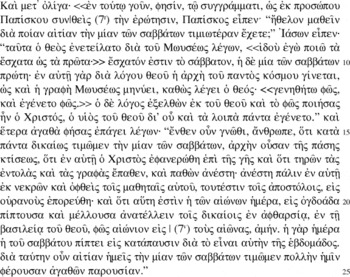
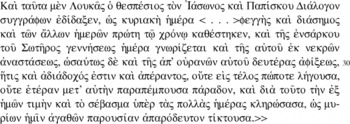
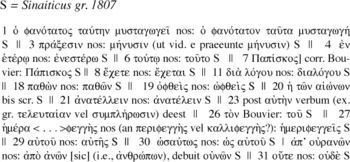
In the text that follows, the actual words from the Dialogue begin at line 7; at the beginning and end we have included the introductory and concluding phrases of Sophronius. The expressions  (1.1) and
 (1.6) are the remarks of the excerptor.

Translation
And later on: “The most illuminating Luke, then, reveals this splendid and welcome knowledge to us, not by putting down the information in his divine Gospel nor by writing it into the Acts of the Apostles, but by recording it in a different work of his, one that he composed in dialogue form and to which he gave the title Dialogue of Jason and Papiscus.”
And shortly thereafter: “So in this work, putting the question into the mouth of Papiscus, he has him say, ‘I would like to know why you (Christians) hold the first day of the week in greater honor.’ And Jason replies, ‘God ordained this through Moses, when he said, <<Behold I make the last things as the first.>> The Sabbath comes at the end, while the first of the week is the first; for it was on this day that the beginning of the whole world took place through the Word of God, as we are informed also by the book of Moses, when God says, <<“Let light come into being,” and light came into being.>> And the Word which proceeded from God and created the light was Christ, the son of God through whom all the other things as well came to be.’ And after making other good points he continues: ‘So you should know from this, sir, that we are completely justified in honoring the first of the week as the beginning of all creation, because on this day Christ was manifested on earth, where in obedience to the commands and the Scriptures he suffered, and following his Passion he arose from the dead; and he rose again on this day, and having appeared to his disciples, i.e., to the Apostles, he proceeded to heaven; and that this day is the day of the ages, falling on the eighth and destined to dawn for the just in incorruption, in the kingdom of God, as a light eternal for the ages, amen. For the Sabbath falls on a day of rest, since it is <the last day> of the week. It is for this reason, then, that we honor the first of the week, as the day that brings us a great wealth of good things.’
And this was the teaching of the inspired Luke when he composed the Dialogue of Jason and Papiscus, namely that the Day of the Lord is splendid, illustrious and the first in time of the rest of the days; it is acknowledged as the day of our Savior's nativity in the flesh and of his resurrection from the dead, and likewise of his second coming from the heavens; a day that is without a successor and without limit, since it neither ever comes to an end nor transmits after itself another transient day. That is why it receives from us, beyond the many other days, the honor and the reverence, as the day that brings forth for us an abiding presence of countless good things.”
Comments
It is surprising that, in his introduction to the quotation from the Dialogue, Sophronius expresses the same opinion as that aired by Clement of Alexandria: namely, that Luke is the author of the Dialogue of Jason and Papiscus. A rapid survey of the style and the vocabulary shows that this is impossible. The Dialogue was written in the middle of the second century, and it is probable that its author was Ariston of Pella.
From the first line, the quoted exchange between the Jew Papiscus and the Christian Jason takes an apologetical turn. Jason is asked to explain to Papiscus why for the Christian the first day of the week has gained in importance what the last day has lost. Under the influence of the Hebrew Bible and the Septuagint, John the prophet (Rev 1:10) had introduced the term “Day of the Lord”Footnote 23 to signify this first day of the week as a day to celebrate Jesus's resurrection. Jason, however, does not immediately use the historical argument of the date of Jesus's resurrection, but rather a scriptural argument of divine prophecy. He claims that God has promised through Moses's writings to make the last things as the first. Strangely, this divine utterance does not appear as such in the Scriptures, though some readers may claim several equivalents as examples in the book of Isaiah (Isa 41.4, 44.6, 48.12). It is preserved as an agraphon in the letter of Barnabas.Footnote 24
This brings the author of the Dialogue to the evident opinio communis: “Sunday,” the “Day of the Lord,”Footnote 25 has eclipsed in importance the Sabbath, the seventh and last day of the week. Jason's first argument is easy to understand, though not quite logical. In the divine quotation attributed to Moses's mediation, the “last things” do not refer to the last day of the weekly calendar, namely the Sabbath, but rather to the last event of salvation history, namely Jesus's resurrection. Once this event, being established as the last thing, is declared to have taken place on the first day of the week, the author concludes that the priority of the Sabbath has come to an end.
Similarly, Jason's second argument does not bring Jesus's resurrection on the first day of the week to center stage. It deals instead with the Creation story. On the first day of God's creation (Gen 1:3), Moses's first book says that light was called into being. This light is then declared by Ariston to be equivalent to Christ and the first day of the week gains in importance, since it is the beginning of creation.
The author of the Dialogue next offers a multivalent third argument in favor of the Lord's Day. He connects Sunday not only with the resurrection of Jesus Christ, but also with various stages of Jesus's life, beginning with his birth. Redemption starts on a Sunday since redemption starts with Jesus's birth. It is interesting to note that the first century c.e. kerygma on Jesus Christ's death and resurrection, as witnessed by Paul in 1 Corinthians 15, has been enlarged in the second century to also include Jesus's birth and life. A similar tendency is perceptible here: what happens on the first day is not only Jesus's resurrection, but Jesus's birth as well. Modern readers are used to thinking of Christmas as a feast on a fixed date, but it should be borne in mind that Christmas was first introduced as a fixed feast day in the second half of the fourth century c.e., more than two centuries after the Dialogue was written.Footnote 26
Besides Jesus's birth (the text says “Christ was manifested on earth”Footnote 27), the author mentions Jesus's resurrection without special emphasis; he adds Jesus's appearance to his disciples (does the author think of an appearance on the day of Easter [John 20:19–23] or, as in the Johannine episode of Thomas [John 20:24–29], the following Sunday?) and Jesus Christ's final ascension (here the author enters into conflict with Luke, since the Ascension occurs forty days after Easter [Acts 1:3]). It is Pentecost that falls on a Sunday (seven weeks after Easter, Acts 2:1).
The author of the Dialogue then expresses with enthusiasm the immense value of the first day of the week: for it is simultaneously the eighth day, or the first day of the last eschatological week, achieving the ogdoad.Footnote 28 It is the eternal day of the Lord, the time of the Kingdom of God that will fallFootnote 29 on a first day of the week. It is still expected  and will appear
 as the day of incorruptibility for the just and of eternal light. Here the author returns to the argument concerning the origin of light on the first day of Creation and considers the final light as the fulfillment of the first light.
We may assume that the author's reasoning appeared cumbersome and unskillful to Orthodox theologians of the fourth and fifth centuries and failed to inspire admiration for the doctrinal value of the Dialogue in late antiquity. But this lack of internal logic is an argument in favor of the high age of the text, a time in which Christian theology had not yet reached a firm shape. The author lives in his time (the second century) and is pleased by his arguments; therefore his reasoning can reach the “amen” of a full approval! He is also pleased to offer a summary of his position. First, the Sabbath falls on the last day of the week and is considered by both Jews and Christians as a day of rest  :Footnote 30 rest at the end of the week, at the end of the hebdomad. Second, the Christians are justified when they celebrate the first day of the week. This first day represents the completion of the ogdoad: it is not the day of rest, but the day of the delivery of divine gifts—“the good things”
 Footnote 31



