Introduction
An estimated 5 per cent of the world's population (466 million people) live with disabling hearing loss, defined as hearing thresholds greater than 40 dB in the better hearing ear in adults and greater than 30 dB in the better hearing ear in children.1 Unfortunately, most people with hearing loss live in the low-resource developing world, where audiology and otolaryngology services are limited.1, Reference Olusanya, Neumann and Saunders2 Furthermore, people with hearing loss who live in low-resource areas are the least likely to receive the services they need to minimise the effects of their disability (e.g. hearing screening, hearing aids, cochlear implants, speech therapy).Reference Olusanya, Neumann and Saunders2 These individuals lack access to otolaryngology and audiology care, and their communities lack access to basic hearing screening equipment.Reference Olusanya, Neumann and Saunders2, Reference Fagan and Jacobs3
Conventional threshold audiometry typically requires the use of a dedicated sound booth and desktop audiometric equipment, which are very expensive to purchase and instal. Unfortunately, these practices are not amenable to low- and middle-income countries, where sound booths and non-portable desktop audiometers are impractical due to cost and space constraints.Reference Fagan4 Despite these limitations, audiologists and otolaryngologists in low- and middle-income countries require appropriate audiometric equipment, personnel, and training to effectively diagnose and treat hearing loss.Reference Fagan and Jacobs3, Reference Isaacson and Melaku5, Reference Boston and Horlbeck6
Recent technological advancements have made audiometric testing equipment more accessible, portable, and easier to use in low- and middle-income countries.Reference Yeung, Javidnia, Heley, Beauregard, Champagne and Bromwich7–Reference Swanepoel, Clark, Koekemoer, Hall, Krumm and Ferrari10 Global access to the internet has grown by 1052 per cent since 2000, with regions such as Africa (9941 per cent), the Middle East (4893 per cent), and Latin America and Caribbean countries (2318 per cent) showing the most robust growth.11 As such, the use of internet-based technology has revolutionised healthcare delivery in low- and middle-income countries.Reference Obasola, Mabawonku and Lagunju12, Reference Lewis, Synowiec, Lagomarsino and Schweitzer13 In audiology and otolaryngology fields, tablet- and smartphone-based audiometry is transforming hearing screening in low-resource settings.Reference Rourke, Kong and Bromwich8, Reference Swanepoel, Clark, Koekemoer, Hall, Krumm and Ferrari10, Reference Jayawardena, Kahue, Cummins and Netterville14 Additionally, portable audiometers are becoming more mobile and less ‘connected’ to sound booths.
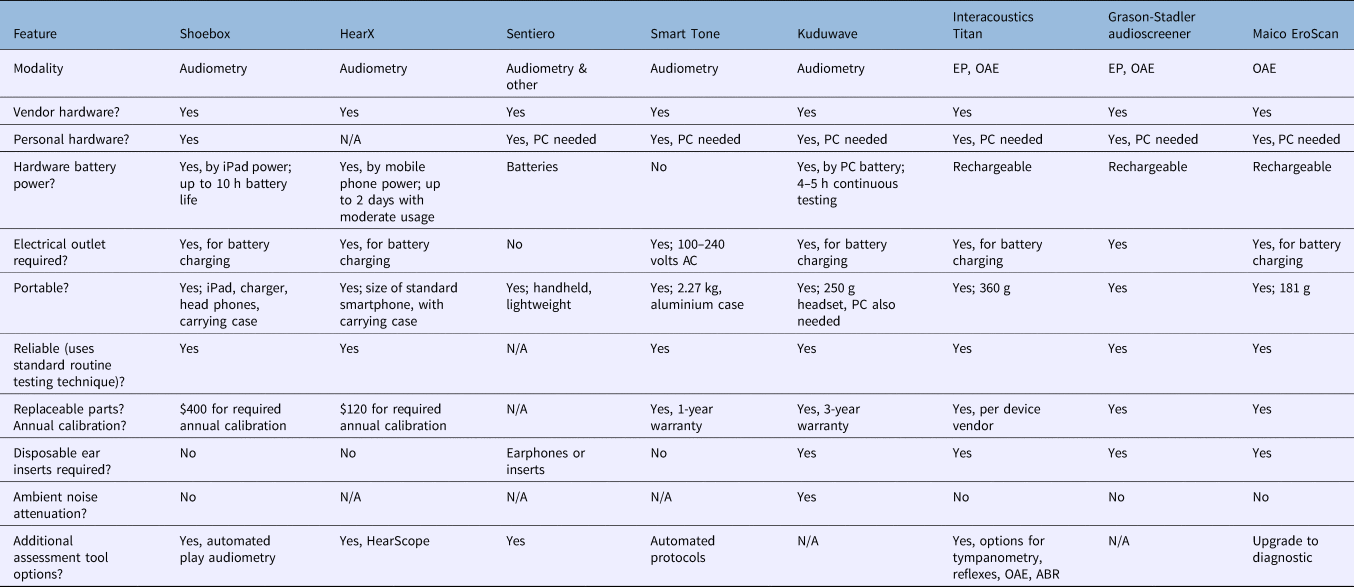
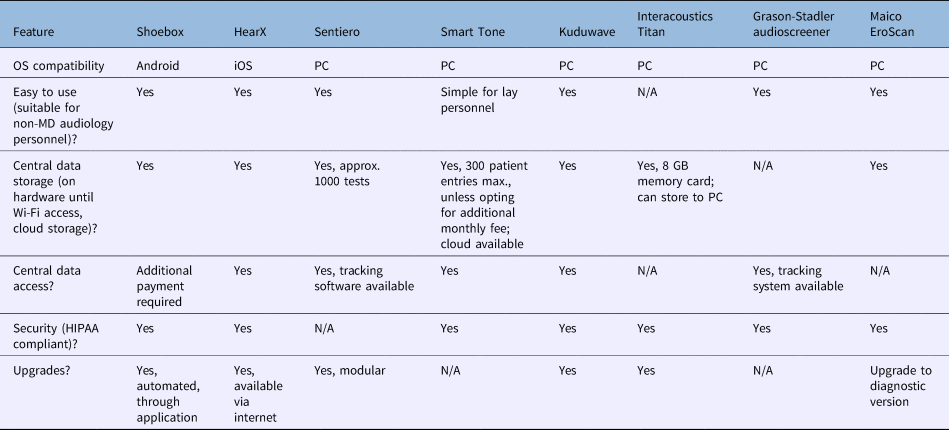
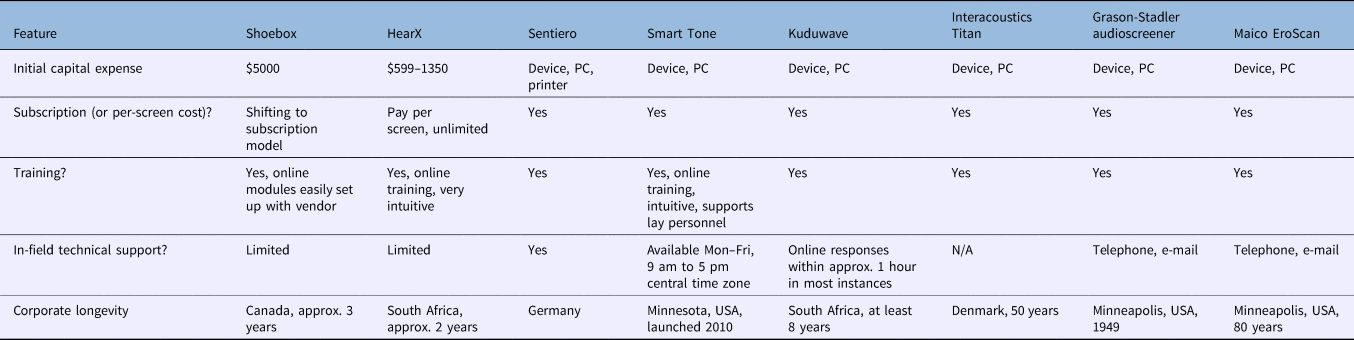
We evaluated eight different devices currently available for hearing screening, comparing: software and hardware characteristics, hardware mobility, ease of use and training requirements, data storage, technical support, and financial considerations (Tables 1–3).
Hardware checklist for mobile audiometric platforms

All monetary values are in US dollars. EP = evoked potentials; OAE = otoacoustic emissions; N/A = data not available; PC = personal computer; h = hours; AC = alternating current; ABR = auditory brainstem response
Software checklist for mobile audiometric platforms
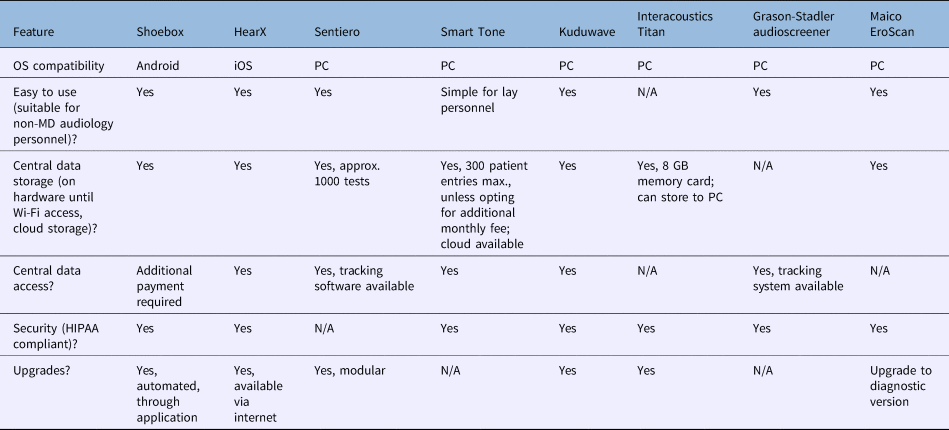
OS = operating system; PC = personal computer; MD = Doctor of Medicine; N/A = data not available; HIPAA = Health Insurance Portability and Accountability Act
Financing and support for mobile audiometric platforms

All monetary values are in US dollars. PC = personal computer; N/A = data not available
Although some of these devices are audiometers that can perform full hearing evaluations, and have the capability for bone-conduction testing and speech audiometry, the focus of this review is their usefulness for performing pure tone hearing screening. Information about selected devices that are necessary for newborn, infant and toddler hearing evaluations (e.g. conditions that require more objective assessment methods) is also provided. Importantly, a thorough hearing evaluation cannot be superseded by screening technology. However, basic screening tools are useful when referring individuals with suspected hearing impairment in situations where standard audiometry is not readily available.Reference Kelly, Stadler, Nelson, Runge and Friedland15
In this report, all monetary values are shown in US dollars. The costs listed within this review were current as of early 2018, and should not be used as quotes either from or to the device manufacturers.
Individual hearing screening platforms
Shoebox Audiometer
The Shoebox Audiometer is an iPad®-based audiometer, developed by the Clearwater Clinical group (Ottawa, Canada). The Shoebox Audiometer is marketed as an easy-to-use audiometer that can gather basic audiometric data outside of a sound booth by a non-audiologist aided by automated screening protocols. Each device comes in a small carrying case that includes calibrated headphones and a small stand for the iPad. The software can be downloaded to the user's iPad or via an iPad purchased through the company. As the software runs through the iPad interface, it has up to 10 hours of battery life making it extremely useful for all-day screenings. Furthermore, the software runs without internet connection and backs up all stored audiometric data once connected to Wi-Fi®.
The Shoebox Audiometer comes in either a ‘Standard’ or ‘Pro’ version. Each version is equipped with the company's automated ‘play audiometry’. This adaptive methodology presents sounds to children in a game format, allowing the child to interact with the iPad to indicate whether they heard a sound or not. The decibel level and frequency of the presented sounds are increased or decreased until the hearing threshold is determined (using the modified Hughson–Westlake method).
Notably, the play audiometry feature is not an effective screening tool for individuals suspected of having significant hearing loss; such individuals can find it difficult to understand the nature of play audiometry.
The ‘Pro’ version enables bone-conduction testing (masked and non-masked); however, masked bone-conduction testing is not automated, which significantly limits the collection of bone-conduction test data by untrained individuals. With either version, the screening or testing operator can control the presentation of test stimuli.
The standard version costs $2700 and the professional version costs $4700. Recalibration is required yearly and costs $400 (not including shipping). Notably, this service is not available outside of Canada and the USA, which can make shipping costs substantial.
Data collected from the Shoebox Audiometer can be retrieved using the company's basic data management system. This is a Health Insurance Portability and Accountability Act compliant cloud-based storage system. Unfortunately, extracting data from the basic system is extremely limiting because exporting patient data is not allowed without additional software. The company charges $510 per year for access to the Data Management Plus system, which allows the user to export patient results to a comma-separated values file, a critical feature for analysing and evaluating research data. This annual fee, in addition to the software cost, limits this product's longevity as a data collection tool in resource-poor settings.
Aside from cost, the main limitations of the Shoebox device are offending noise in the test location and a lack of active noise-cancellation software (limitations that also affect the other devices evaluated in this review). We have used the Shoebox Audiometer in Kenya and Ghana, and the inability to eliminate false-positive referrals in ambient noise greatly limits these devices in low-resource settings, where quiet places to test patients are particularly scarce. Furthermore, the manufacturer's over-the-ear headphones provided limited sound attenuation. In addition, having a single platform per iPad limits the capacity for multiple screeners to effectively screen numerous individuals in a short time.
Lastly, when using any portable paediatric hearing screening platform in the community, it is important to be aware of the prevalence and incidence of paediatric acute otitis media, which can be regularly encountered. When reviewing our experiences with portable hearing screenings in the field, we rarely encountered frank otorrhoea or acute otological infections. The hearing screening team included experienced audiologists and otolaryngologists, who examine children's ears daily at their respective clinics. Each child chosen for screening had an ear examination with a handheld otoscope prior to testing. Those found to have an active infection were not screened, and were referred to either their paediatrician or to the Hearing Assessment Center at Komfo Anokye Teaching Hospital (Kumasi, Ghana) for further evaluation and treatment.
HearX Group
Another mobile audiometry platform comes from the HearX Group (Pretoria, South Africa). HearX has developed a mobile phone based audiometer, a package that includes a mobile phone with built-in software, headphones and a carrying case that can be purchased from the HearX Group. Three hardware packages are available, which allow different software versions to be utilised based on the package purchased.
The first package is the basic version, which includes a Samsung® Galaxy J2 with built-in software, Sennheiser® HD280 Pro Headphones and a carrying case ($599). The second package is compatible with the HearScope (purchased separately), and includes a Samsung Galaxy A3 with built-in software, Sennheiser HD280 Pro Headphones and a carrying case ($899). The third package includes a Samsung Galaxy A3 with built-in software, Sennheiser HD300 Headphones and a carrying case ($1350). Unfortunately, the HearX Group does not allow users to apply their software to existing mobile phones or headphones. The cost for hardware recalibration is $120 annually.
Like the Shoebox device, the HearX mobile phone based platform enables great mobility, with device battery life lasting up to 2 days with moderate usage, making it amenable to all-day hearing screening. The HearX devices save data directly to the phone and upload these to the cloud once connected to Wi-Fi. All data are saved via a secure, Health Insurance Portability and Accountability Act compliant cloud-based platform called mHealth Studio. mHealth Studio is easy to use, and is included in the hardware and software costs. Software updates are available via the internet.
The HearX Group offers two software packages: HearScreen and HearTest. HearScreen is a simple, clinically validated automated test that runs a basic hearing screening at three programmable frequencies at specific programmable thresholds. This test takes less than a minute to administer and can easily be conducted by minimally trained non-audiology personnel. The HearScreen software is priced per test run, and varies from $6 per month for 30 screenings to $25 per month for unlimited screenings. The HearTest allows the user to administer a more comprehensive (yet still automated) hearing test that generates a formal audiogram. The HearTest cost varies from $8 per month for 30 screenings to $30 per month for unlimited screenings. Extended high-frequency hearing screening is available at additional cost. The package also offers a basic vision screening platform called Peek Acuity at additional cost ($6 per month for 30 screenings to $25 per month for unlimited screenings).
We have used the HearX platform in Haiti and Kenya. It is relatively inexpensive and runs on an Android platform, which is more accessible and therefore more easily understood in low- and middle-income countries. The limitations of the HearX platforms include the inability to limit false-positive referrals in high ambient noise settings and not allowing the user to test bone conduction.
Sentiero
The Sentiero device is a compact and portable screening platform developed by Path Medical (Germering, Germany). The device comes in three hardware packages: Sentiero Advanced, Sentiero Diagnostic and Screening, and Sentiero Tymp Diagnostic and Screening. Multiple testing modalities can be installed on one device using Path Medical software. The Sentiero Advanced package can be installed with the otoacoustic emission (OAE), automated auditory brainstem response (ABR) and pure tone audiometric tests. The Sentiero Diagnostic and Screening package contains the OAE and audiometric tests. The Sentiero Tymp Diagnostic and Screening package contains tympanometry, audiometry and OAE tests. Tympanometry features include multi-frequency probe tones, and assessment of Eustachian tube function, and ipsilateral and contralateral acoustic reflexes with reflex decay. For audiometric analysis, air, bone and speech audiometry that utilises high-frequency, live voice and/or recorded speech is included. Regarding OAE options, distortion-product OAEs, transient-evoked OAEs, pressurised OAEs and simultaneous binaural testing are included.
The Sentiero device has a large colour touch screen for ease of use and is battery operated to enhance portability. It is specifically designed for diagnostics and monitoring, including: follow up after newborn hearing screening; pre-school, school and adult hearing screening; and otolaryngology diagnostics including OAEs, tympanometry and acoustic reflexes (Sentiero desktop only), ABRs, and auditory steady-state responses (Sentiero Advanced only).
Additional accessories for the Sentiero device include headphones (e.g. Sennheiser HDA-280, Sennheiser HDA-300, Interacoustics DD 45, Holmco PD-81 or GN Otometrics ME-70), insert earphones, an ear coupler cable, a bone conductor (e.g. RadioEar B-71) and a free-field loudspeaker (e.g. JBL Control 2P). For the basic portable screening device, the software modules include DPOAE Quick, Audiometry Class 4 and PDF Quick Print. The hardware includes the instrument and a charger, one probe, and one headset with a carrying case. For an additional cost, the available upgrades include a label printer, a second probe for simultaneous testing of both ears, and Mira® personal computer (PC) software for download and data export. The price for a Sentiero OAE and Pure Tone Audiometer is approximately $4479. The Sentiero Advanced costs between $9500 and $12 000, depending on the additional features included.
The advantage of this device is that the OAE results are fast and immediately available after inserting the probe into the ear canal. For pure tone testing, the ear probe is changed to headphones, and the device can screen distortion-product OAEs at four frequencies, has unique multi-channel testing (two frequencies simultaneously) and is considered a class 4 pure tone screening audiometer. Other advantages include the colour touchscreen, storage of up to 1000 test results, battery life that lasts for a full day of testing, the ability to transfer data to a PC via a universal serial bus (USB), and software availability in English and Spanish languages. The disadvantage of the device is the cost of the disposal electrodes used for automated ABR testing.
We have evaluated the Sentiero Advanced device for both OAE and automated ABR testing in a large-scale newborn hearing screening programme in rural South Africa and on a smaller scale in semi-rural Kenya. It is easy to use, portable and has good battery life, which make it a good choice for an efficient, combined OAE and automated ABR screener. The platform is incredibly simple to use and was taught to two research nurses with no prior audiology background.
Smart Tone
The Smart Tone Automatic Audiometer (Smart Diagnostic Devices, Minnesota, USA; available since 2010) was selected for this comparison because it is marketed as a portable, automatic pure tone screener that requires minimal training to use.16 Considering the lack of trained audiology personnel in many low- and middle-income countries,Reference Olusanya, Neumann and Saunders2, Reference Fagan and Jacobs3 an easy-to-use automatic screening tool that does not require manual control could be the ideal starting point for data collection in low-resource areas. Program directions and steps are very clear, and data are easily uploaded to the SmartMove Cloud (available since 2016), which is Smart Diagnostic Devices’ secure database. At 2.27 kg, it is portable, with all necessary testing equipment contained in one case. Technical support is reliable: all issues were resolved within 1 hour (during normal business hours) by using the website's online chat facility or by e-mailing a technical representative from Smart Diagnostic Devices.
The most significant constraint of this device is that it cannot operate on a mobile power source. This makes in-country or community screenings, even in schools or administrative complexes (where the device is intended to be used), difficult in low- and middle-income countries, because the electricity service may be inconsistent or frequently interrupted. Moreover, the SmartMove Cloud Free subscription includes storage for only 300 patients; paying $19.95 or $59.95 per month (premium) provides storage for 2500 or 5000 patients, respectively. Once premium storage is purchased, additional storage can be purchased for $9.95 per month for every additional 5000 patients. Although the device itself is under $3000 for the initial purchase (which includes all necessary hardware plus the daily calibration device), the monthly costs for cloud storage could rise quickly in a growing community screening programme or significant data-gathering project. There is also an annual calibration fee of $245 if sent to Smart Diagnostic Devices in Minnesota, USA, or a different fee if sending for calibration in South Africa. We have not had any in-country experience with the Smart Tone platform.
Kuduwave
The Kuduwave system (Johannesburg, South Africa) was developed in the early 2000s and retains the benefit of not requiring an audiologist to perform the screening. A nurse or an audiometry technicianReference Bateman17 can be trained to use the device for testing, and an audiologist can later analyse the data for diagnosis and treatment as needed. In other cases, the device has been used for community screenings conducted by audiological personnel, after basic assessment from community health workers had identified the need for further testing.Reference Mulwafu, Kuper, Viste and Goplen18 The system is ideal for synchronous, asynchronous and hybrid telemedicine, which has become increasingly applicable to the field of audiology.Reference Swanepoel and Hall19
Finding a location with appropriate ambient noise levels for community screenings can be challenging. Three components of the Kuduwave system help overcome this concern: a sound-reflective ear cup, a circumaural ear seal and insert earphones. The Kuduwave device also allows for both automatic and manual testing. The components are lightweight, totalling 250 g, although a laptop computer is also needed (either a personal device or a Kuduwave-prepared laptop). Additionally, single-use, disposable ear insert tips must be purchased; these are less than $100 per bag of 200 inserts.
The basic initial cost for the version without the bone oscillator (Prime) is approximately $4500. The device with the bone oscillator (Plus) is approximately $4850; upgrading to extended high-frequency 16 kHz (the ‘Pro’ version) adds $1800 (Kuduwave representative, personal communication). Although this is one of the more expensive devices for initial capital investment reviewed here, it also has cloud storage and access with no additional fees, and the company will provide hardware and software upgrades when available. Online virtual support, including remote assistance, is available with a broadband internet connection,20 and one author experienced communication and support every day of the week (with a Kuduwave representative).
Although we have not utilised the Kuduwave device in the field, a recent report by Visagie et al. (2015)Reference Visagie, Swanepoel and Eikelboom21 demonstrated its effectiveness in a telemedicine study in South Africa. They showed that the test–retest threshold correspondence in the sound booth and natural environments was within ±5 dB in 96.7 per cent and 97.5 per cent of comparisons, respectively.
Interacoustics Titan and Grason-Stadler audioscreeners
Equipment choices for the initial screening of children who are unable to take an active role in play audiometry include devices that incorporate OAE technology, auditory evoked potentials and tympanometry. For example, the Interacoustics Titan and Grason-Stadler audioscreeners are each capable of conducting both evoked potential and emissions testing using their respective portable devices. Both can store many individual test results within the device, and each can send that information to a PC. Each system uses insert earphones to conduct testing, although they are not adequate to control potentially offending environmental noise levels. An inability to control the noise would clearly affect threshold testing outcomes, particularly in the case of OAE measurements. The Titan has optional modules or licenses that enable the user to include tympanometry and acoustic reflexes in an identification protocol. We have not used either of these platforms in the field, but we have trialled them in clinics: they would appear to have real potential for use in selected settings.
Maico EroScan
The Maico EroScan® is a lightweight and portable device, whereby tympanometry, distortion-product OAE and transient-evoked OAE testing are performed using a single probe for screening or full testing. The ‘Pro’ version offers printout options (Quick Print to PC printer and Quick Print to PDF). These options provide an easy-to-obtain printout and interface to electronic health record systems. The $4000 platform resembles an auditory canal thermometer or an otoscope. The probe is fitted into the ear canal after placement of a disposable (15 cent) cap. Pressing a single button results in an immediate hearing screen at 2, 3 and 4 kHz, and an option to pass or refer is given. The screener has a colour screen and can store up to 250 tests. The battery life allows approximately 15 hours of operational use. We have not used this platform in the field.
Conclusion
The ongoing need to screen adults and children for hearing loss in low- and middle-income countries continues to be a challenge. To meet those demands, affordable, sustainable and portable technologies need to flourish. The emerging and ever-changing portable audiometric platforms available for hearing screening provide many opportunities for outreach to low- and middle-income countries.
Acknowledgements
The authors would like to acknowledge the audiology and otolaryngology groups from Vanderbilt University, Dartmouth University, the University of Michigan, the University of KwaZulu-Natal in Durban, South Africa, and Komfo Anokye Teaching Hospital in Kumasi, Ghana, for the medical and educational outreach partnerships to improve hearing screening, identification and rehabilitation.
Competing interests
Drs Basura and Edwards (Shoebox) and Jayawardena (HearX), have received discounted pricing on the noted platforms for use in Ghana and Kenya, respectively.