Introduction
Adolescent risk for self-injurious thoughts and behavior (STBs) is thought to involve disrupted functioning across multiple systems, including affective valence and arousal regulatory (Franklin, Lee, Hanna, & Prinstein, Reference Franklin, Lee, Hanna and Prinstein2013; Miller & Prinstein, Reference Miller and Prinstein2019) as well as cognitive (Cha, Wilson, Tezanos, DiVasto, & Tolchin, Reference Cha, Wilson, Tezanos, DiVasto and Tolchin2019), behavioral (Hankin & Abela, Reference Hankin and Abela2011), and social processes (Beauchaine, Hinshaw, & Bridge, Reference Beauchaine, Hinshaw and Bridge2019; Crowell, Beauchaine, & Linehan, Reference Crowell, Beauchaine and Linehan2009). As these systems are often studied in isolation (Cha et al., Reference Cha, Franz, M. Guzmán, Glenn, Kleiman and Nock2018), an integrative understanding of how disturbance across multiple systems potentiates this risk is still empirically lacking. Person-centered approaches may allow for such integration (Bergman & Magnusson, Reference Bergman and Magnusson1997; Block, Reference Block1971). Spanning these levels of analysis (Cacioppo, Berntson, Sheridan, & McClintock, Reference Cacioppo, Berntson, Sheridan and McClintock2000) to identify psychobiological stress response profiles and those cognitive process and interpersonal behavior correlates associated with each may provide a more nuanced, comprehensive illustration of emerging risk. These associations are particularly important to examine in adolescent girls, given their elevated rates of psychosocial stress-related psychopathology (Zahn-Waxler, Shirtcliff, & Marceau, Reference Zahn-Waxler, Shirtcliff and Marceau2008), developmental differences in arousal regulatory functioning (Doom & Gunnar, Reference Doom and Gunnar2013), and reliance on close friendships for support (Spear, Reference Spear2009). Such work could be leveraged in the design of maximally effective intervention efforts that tailor content to girls’ profile-specific strengths and weaknesses. Using a multiple-levels-of-analysis approach (Cicchetti & Dawson, Reference Cicchetti and Dawson2002), this study explored how unique psychobiological stress response profiles and related cognitive processes and interpersonal behaviors contribute to adolescent girls’ prospective risk of STBs (e.g., nonsuicidal self-injury (NSSI), suicidal ideation (SI), suicide attempt (SA).
Affective valence and arousal regulatory functioning
Several theories and conceptual models hold that adolescent risk for STBs involves dysregulation of the affective valence and arousal regulatory systems. According to functionalist theory (Nock & Prinstein, Reference Nock and Prinstein2004), adolescent propensities toward NSSI can, in part, be understood as dysregulation of physiologic and affective stress response function that is modulated by NSSI's automatically reinforcing, self-regulatory properties (e.g., generation of desirable physiologic and emotional states, reduction of tension and negative affect [NA]). Developmentally sensitive extensions of biosocial theory hold that adolescent risk for STBs varies as a function of affective lability, difficulty leveraging executive processes in the service of regulating prepotent responses, and biological predispositions toward physiologic hyperreactivity under conditions of acute stress (Crowell et al., Reference Crowell, Beauchaine and Linehan2009). Still further, recent stress response models conceptualize adolescent risk for STBs as failure of biological responses (e.g., hypoactivation) to acute stress (Miller & Prinstein, Reference Miller and Prinstein2019). Taken together, these perspectives posit varied patterns of physiologic and affective system disturbance that may potentiate adolescent risk for STBs.
Evidence in support of these views continues to accumulate. The tendency to respond to potential threats and interpersonal stressors with acute NA predicts SI (Enns, Cox, & Inayatulla, Reference Enns, Cox and Inayatulla2003) as well as NSSI and SA (in the context of stressful life events) during adolescence (Fergusson, Woodward, & Horwood, Reference Fergusson, Woodward and Horwood2000). Recent empirical attention also has been paid to positive affect (PA) disturbance (Craske, Meuret, Ritz, Treanor, & Dour, Reference Craske, Meuret, Ritz, Treanor and Dour2016; Owens et al., Reference Owens, Helms, Rudolph, Hastings, Nock and Prinstein2019). Specifically, anhedonia and low hedonic capacity predict adolescents’ prospective risk for NSSI (Hankin & Abela, Reference Hankin and Abela2011) and SA (Yen et al., Reference Yen, Weinstock, Andover, Sheets, Selby and Spirito2013), and differentiate suicidal ideators from attempters (Auerbach, Millner, Stewart, & Esposito, Reference Auerbach, Millner, Stewart and Esposito2015). Notably, few studies, if any, have focused on acute changes in PA in response to stressors when examining adolescent risk for STBs. Still further, neuroendocrine (e.g., hypothalamic-pituitary–adrenal axis; HPA) dysregulation predicts adolescent STBs. Specifically, salivary cortisol (SC) hyperreactivity to the Trier Social Stress Test (TSST) predicts SI (Giletta et al., Reference Giletta, Calhoun, Hastings, Rudolph, Nock and Prinstein2015) while hypoactivation predicts SA (in the context of peer stress; Eisenlohr-Moul et al., Reference Eisenlohr-Moul, Miller, Giletta, Hastings, Rudolph, Nock and Prinstein2018) and differentiates adolescents who engage in NSSI from healthy controls (Kaess et al., Reference Kaess, Hille, Parzer, Maser-Gluth, Resch and Brunner2012). What has yet to be determined, however, are the varied ways that coordinated patterns of dysregulation across psychobiological stress response systems (i.e., affective valence and arousal regulatory) manifest within adolescents and whether these within-adolescent patterns are associated with varying degrees of prospective risk for STBs.
Cognitive processes and interpersonal behaviors
Comprehensive theoretical models extend the notion that cognitive processes work in concert with affective and physiologic dysregulation to potentiate risk for STBs. Nock (Reference Nock2009) argues that cognitive vulnerability (e.g., negative inferential style, dysfunctional attitudes) contributes to risk for NSSI by predisposing adolescents to respond to acute stressors with dysregulated affect, thereby creating a self-regulatory need that NSSI then fulfills. Miller and Prinstein (Reference Miller and Prinstein2019) contend that depressogenic cognitive patterns (e.g., negative self-schemas, worthlessness) increase adolescent risk for STBs by contributing toward a penchant for responding to interpersonal and acute stressors with physiologic (e.g., HPA) dysregulation (e.g., hyperreactivity, hypoactivation). Empirically, adolescent negative cognitive style and related constructs (e.g., worthlessness, hopelessness) longitudinally predict NSSI (Hankin & Abela, Reference Hankin and Abela2011) and SI (Burke et al., Reference Burke, Connolly, Hamilton, Stange, Abramson and Alloy2016). However, evidence of their direct relations with either dysregulated affect (Hankin, Reference Hankin2008) or physiology (Hayden et al., Reference Hayden, Hankin, Mackrell, Sheikh, Jordan, Dozois and Badanes2014) remains limited. Still further, no study has demonstrated direct associations between cognitive vulnerability and various within-person patterns of psychobiological stress response dysregulation.
Integrative functional models also point to interpersonal behaviors that may be involved in adolescent risk for STBs (Hankin & Abela, Reference Hankin and Abela2011). Tenets proposed by Gillett and Mazza (Reference Gillett and Mazza2018) suggest that excessive reassurance seeking (e.g., persistently seeking esteem-building assurances from others; Joiner, Reference Joiner2005) may increase risk by contributing to “emotional numbness.” Adolescents who excessively seek reassurance often do so to contend with underlying negative self-schemas, reduce unwanted emotions, and evoke desirable affective states. While reassurance may generate and downregulate PA and NA, respectively, effects are often temporary as reassurance fails to alter core negative self-belief systems. Reassurance (e.g., “You're a good friend.”) for these adolescents is, therefore, difficult to believe, and the resulting denial of reassurance (e.g., “I'm actually a terrible friend.”) inadvertently reinforces original negative self-schemas. The return to depressotypic thinking recreates the original need for external regulatory support, which is temporarily met by reassurance seeking and provided assurance, and quickly reinstated by unaffected negative cognitive patterns and assurance disbelief (Joiner, Reference Joiner2005). As per Gillett and Mazza, this cycle unduly exposes adolescents to frequent bouts of depressotypic thinking and affect dysregulation, a process argued to eventuate in habituated affective function. Thus, adolescents who engage in excessive reassurance seeking may be at risk for STBs via frequent “repeated hits” to, and eventual dysregulation of, affect valence systems (e.g., hypoactivation). These hypothesized affective valence, cognitive process, and interpersonal behavior associations and their longitudinal links to STBs have yet to be examined empirically. Still further, whether proposed “emotional numbing” (Gillett & Mazza, Reference Gillett and Mazza2018) effects of excessive reassurance seeking also extend to blunted arousal regulatory function (e.g., hypocortisolemia) is not yet known.
Moderating role of close friendships
Transactional models and empirical accounts of adolescent girls’ risk for STBs also suggest that their relationships with social others play an integral role. Girls at risk for STBs often present with affective and biological vulnerabilities that make them exquisitely sensitive to input from their environments (Beauchaine et al., Reference Beauchaine, Hinshaw and Bridge2019; Courtney-Seidler, Burns, Zilber, & Miller, Reference Courtney-Seidler, Burns, Zilber and Miller2014). During adolescence, girls’ relationships within the peer domain, particularly their close friendships, may be particularly salient towards this end (Eisenlohr-Moul et al., Reference Eisenlohr-Moul, Miller, Giletta, Hastings, Rudolph, Nock and Prinstein2018; Giletta et al., Reference Giletta, Calhoun, Hastings, Rudolph, Nock and Prinstein2015). Depending on the characteristics of these friendships, they may either potentiate or mitigate risk associated with girls’ unique profiles of affective and biological vulnerability. However, the specificity with which certain close friendship characteristics contribute to girls’ risk for STBs as a function of their unique psychobiological predispositions remains to be seen.
Adolescent girls with predispositions towards emotional lability and dysregulated NA may be at particular risk for STBs in aversive (e.g., critical, antagonistic) friendships, thereby exacerbating intense emotional reactions and reinforcing dysregulation (Beauchaine et al., Reference Beauchaine, Hinshaw and Bridge2019; Crowell et al., Reference Crowell, Beauchaine and Linehan2009). As the literature has tended to focus on the reduction of negative relationship dynamics in buffering girls’ risk for STBs (Cha et al., Reference Cha, Franz, M. Guzmán, Glenn, Kleiman and Nock2018), less is known about how positive interactions with close friends might serve as a shield. For girls inclined towards emotional lability, supportive close friendships that communicate approval and validation (e.g., worth-affirming) may abate such risk by dampening girls’ prepotent response tendencies (Czyz, Liu, & King, Reference Czyz, Liu and King2012; Kerr, Preuss, & King, Reference Kerr, Preuss and King2006). However, for girls with “emotionally numb” psychobiological function, it is possible that such positive relationships may potentiate risk, particularly if supportive messages communicated therein are hard to believe and contribute to blunted psychobiological function (Gillett & Mazza, Reference Gillett and Mazza2018). Identifying within-adolescent patterns of psychobiological stress response function and friendship characteristics that uniquely accentuate or mitigate risk for STBs may point to person-centered means of tailoring intervention (e.g., end harmful relationships, seek supportive friendships, reduce reliance on external support and validation from others) towards girls’ unique psychobiological profiles.
Towards a cross-system synthesis of adolescent risk for STBs
Though research implicates putative affective and biologically based mechanisms as well as key cognitive processes and interpersonal behaviors involved in risk for STBs, this literature could be advanced in ways that provide a more complete and granular perspective on the etiological precursors to adolescent STBs (Cha et al., Reference Cha, Franz, M. Guzmán, Glenn, Kleiman and Nock2018). First, the empirical literature often studies these mechanisms (e.g., valence, arousal) in isolation, leaving much to be understood about the ways coordinated disturbance across stress response systems confers risk (Glenn, Cha, Kleiman, & Nock, Reference Glenn, Cha, Kleiman and Nock2017). Research also tends to focus on between-group differences in an outcome of interest (e.g., no NSSI vs. NSSI). These approaches restrict understanding about the ways adolescents cluster together on the basis of shared disruptions across implicated mechanisms and how those within-person patterns of multisystem disturbance then, in true etiological fashion (Schreiner, Klimes-Dougan, Begnel, & Cullen, Reference Schreiner, Klimes-Dougan, Begnel and Cullen2015), predict focal outcomes.
Second, despite the ubiquity of dysregulated stress response function in current models of adolescent risk for STBs (Crowell et al., Reference Crowell, Beauchaine and Linehan2009; Miller & Prinstein, Reference Miller and Prinstein2019), studies often examine either baseline (e.g., pre-TSST levels) or summative indices (e.g., area-under-the-curve increase; AUCi) in isolation. Although useful, these approaches do not capitalize on the richness of stress response data collected at multiple time points during lab-based stressor protocols. More nuanced understanding about specific facets of stress response dysregulation that might contribute to STB risk (e.g., basal levels, hyperreactivity, protracted recovery) may be obtained by utilizing methods that illustrate how psychobiological stress responses in the face of acute stress unfold over time.
Third, studies utilizing methods that capitalize on repeated measures data to capture stress response function have often used variable-centered approaches (e.g., growth curve modeling). These approaches assume population homogeneity (i.e., that individuals in a sample all exhibit more or less the same pattern of change). Researchers have, thus, acknowledged their utility when studying normative (i.e., typically developing, healthy) samples where homogeneity is expected, but also note their limitations for studying at-risk samples where the expectation of population heterogeneity may be stronger (Van Ryzin, Chatham, Kryzer, Kertes, & Gunnar, Reference Van Ryzin, Chatham, Kryzer, Kertes and Gunnar2009). If, as theory suggests, qualitatively distinct, dysregulated stress response patterns (e.g., hyperreactivity, blunted arousal) exist in a population (Gunnar, Frenn, Wewerka, & Van Ryzin, Reference Gunnar, Frenn, Wewerka and Van Ryzin2009), variable-centered approaches may be ill-equipped to identify them. This limitation is not trivial, as the identification of unique stress response patterns has the potential to align with, challenge, or even extend established theory. Still others have cautioned that conclusions drawn from such approaches may be erroneous when atypical patterns do exist in a population and have instead championed the use of alternate, more suitable developmental methods (von Eye & Bogat, Reference von Eye and Bogat2006).
To address these gaps in the literature, we exposed a sample of 241 adolescent girls at risk for STBs to a modified version of the TSST (for details, see Giletta et al., Reference Giletta, Calhoun, Hastings, Rudolph, Nock and Prinstein2015) and asked them to complete a series of questionnaires and interviews at an initial lab visit. We collected data on acute affective (i.e., self-reported PA and NA) and HPA (i.e., SC) stress response levels before and after the TSST. We also collected data on cognitive processes (i.e., negative cognitive style), interpersonal behavior (i.e., excessive reassurance seeking), and close friendship characteristics (i.e., criticism, antagonism, reassurance of worth). Data were collected on STBs at baseline and 3, 6, and 9 months following their initial visit. We then utilized a person-centered approach, multitrajectory modeling (MTM; Nagin, Jones, Passos, & Tremblay, Reference Nagin, Jones, Passos and Tremblay2018), to identify subgroups of girls based on the extent to which they exhibited similar PA, NA, and SC response trajectories (e.g., baseline, reactivity patterns). MTM may help address the limitations of prior work noted above, insofar as it (a) models coordinated disturbance across implicated systems simultaneously (as opposed to in isolation), (b) captures this coordinated disturbance vis-à-vis stress response function (as opposed to continuous summative scores), (c) assumes population heterogeneity (as opposed to homogeneity), which may be more suitable for examining at-risk samples (e.g., girls at risk for STBs), and (d) is capable of illustrating qualitatively distinct patterns of stress response function (as opposed to subtle deviations from the sample average pattern). After identifying subgroups, we examined concurrent associations with relevant intrapersonal and interpersonal factors as well as longitudinal linkages to three STBs: NSSI, SI, and SA.
Our decision to focus on adolescent girls was driven by evidence of their relatively elevated rates of STB-linked psychopathology (e.g., depression; Zahn-Waxler et al., Reference Zahn-Waxler, Shirtcliff and Marceau2008), heterogeneity in affective and neuroendocrine functioning (Doom & Gunnar, Reference Doom and Gunnar2013), sensitivity to interpersonal stressors (Rudolph, Reference Rudolph2002), and tendency to rely on close friends to help meet self-regulatory and affiliative needs (Spear, Reference Spear2009). This decision and evidence also informed our selection of covariates to be included in the current study. Given their well-known associations with psychobiological function and STBs during adolescence, all analyses adjusted for initial depressive symptoms (Guerry & Hastings, Reference Guerry and Hastings2011), age, pubertal status (Patton et al., Reference Patton, Hemphill, Beyers, Bond, Toumbourou, Mc Morris and Catalano2007), impulsiveness (Brezo, Paris, & Turecki, Reference Brezo, Paris and Turecki2006; Mathew et al., Reference Mathew, Coplan, Goetz, Feder, Greenwald, Dahl and Weissman2003), chronic strain (Miller et al., Reference Miller, Linthicum, Helms, Giletta, Rudolph, Hastings and Prinstein2018), medication use (Granger, Hibel, Fortunato, & Kapelewski, Reference Granger, Hibel, Fortunato and Kapelewski2009), and cortisol timing (Calhoun et al., Reference Calhoun, Helms, Heilbron, Rudolph, Hastings and Prinstein2014).
The current study: Aims and hypotheses
Aim 1: To explore the existence of subgroups of girls with potentially distinct coordinated affective valence (PA; NA) and arousal regulatory (SC) profiles of psychobiological stress response function.Footnote 1 H1: We expected to identify at least one subgroup of girls whose trajectories reflected healthy psychobiological stress response function: normative (e.g., moderate SC baseline, moderate increase then decrease in SC from baseline to post-TSST; low NA baseline, moderate increase then decrease in NA from baseline to post-TSST; high PA baseline, moderate decrease then increase in PA from baseline to post-TSST). Based on stress response models of adolescent risk for STBs (e.g., Crowell et al., Reference Crowell, Beauchaine and Linehan2009; Miller & Prinstein, Reference Miller and Prinstein2019), we also expected to identify two subgroups of girls whose trajectories deviated from normative in ways reflective of psychobiological stress response dysregulation: hyperresponsive (e.g., high SC baseline, dramatic SC increase then decrease from pre- to post-TSST; high NA baseline, dramatic NA increase then decrease in from baseline to post-TSST; moderate PA baseline, moderate decrease then increase from pre- to post-TSST) and hyporesponsive (e.g., low SC baseline, less pronounced SC increase then decrease from pre- to post-TSST; low NA baseline; less pronounced NA increase then decrease from pre- to post-TSST; low PA baseline, less pronounced PA decrease then increase from pre- to post-TSST). Aim 2: To examine cognitive process and interpersonal behavior correlates of girls’ subgroup membership. Based on relevant integrative functional models and evidence (e.g., Gillett & Mazza, Reference Gillett and Mazza2018; Hankin & Abela, Reference Hankin and Abela2011; Nock, Reference Nock2009), we expected the likelihood of girls’ membership in subgroups reflecting dysregulated (relative to healthy) psychobiological stress response functioning to increase with greater negative cognitive style (H2a) and excessive reassurance seeking (H2b). Aim 3: To examine longitudinal links between girls’ subgroup membership and follow-up STBs. Based on etiological accounts of STBs (e.g., Cha et al., Reference Cha, Franz, M. Guzmán, Glenn, Kleiman and Nock2018; Schreiner et al., Reference Schreiner, Klimes-Dougan, Begnel and Cullen2015), we expected girls in subgroups with dysregulated (relative to healthy) psychobiological stress response functioning to exhibit an increased likelihood of follow-up NSSI (H3a), SI (H3b), and SA (H3c). Aim 4: To explore each of three close friendship characteristics (criticism, antagonism, reassurance of worth) as moderators of linkages between girls’ subgroup membership and follow-up STBs. Based on elaborated transactional models (e.g., Beauchaine et al., Reference Beauchaine, Hinshaw and Bridge2019; Crowell et al., Reference Crowell, Beauchaine and Linehan2009), we generally expected criticism and antagonism to potentiate risk and reassurance of worth to buffer risk for NSSI (H4a), SI (H4b), and SA (H4c) for girls in subgroups with dysregulated psychobiological stress response profiles.
Method
Participants
Participants included 241 girls between 12 and 17 years of age (Mage = 14.68 years, SD = 1.35). Recruitment (e.g., flyers, emails, and radio/TV commercials) targeted local psychiatric inpatient and outpatient units as well as the community at large to ensure sufficient levels of STBs to support predictive analyses. Eligibility was determined by a phone interview conducted by research staff. Girls were deemed eligible if, in the past two years, they had received a psychiatric diagnosis (with the exception of active psychosis, intellectual disability, or any pervasive developmental disorder), had received treatment for mental health concerns, or met criteria for clinical levels of psychiatric symptoms. Most girls self-identified as Caucasian, 63.7%, followed by African-American, 22.9%, Hispanic or Latina-American, 2.1%, and Asian-American, 1.7%. The remaining 9.6% of girls reported multiple ethnic/racial backgrounds. With respect to caregiver educational history, 1.7% did not complete high school, 12.6% completed high school, 30.2% had completed a trade degree or some college, 23.0% had a bachelor's degree, and 26.3% had a formal education beyond a bachelor's degree.
Procedure
Participants attended an initial laboratory-based assessment. Caregivers were instructed to have their child refrain from taking medications on the day of their initial assessment. Upon arrival, study personnel welcomed adolescents and their caregivers, provided an overview of laboratory visit procedures, and obtained consent and assent. Girls and caregivers independently completed questionnaires (e.g., demographics, socioemotional and behavioral functioning, stressful life events). Girls were also interviewed by an experimenter to assess lifetime history of STBs. Approximately three hours after their arrival and immediately following an acclimation period where they watched an emotionally neutral video,Footnote 2 girls began a modified version of the TSST (TSST-M; Giletta et al., Reference Giletta, Calhoun, Hastings, Rudolph, Nock and Prinstein2015). Girls were instructed to prepare (1 min) and deliver (3 min) an audition speech. The goal of the speech was to convince an imaginary audience of their peers that they should be selected to star in a fictional television show about teens’ ability to form and maintain friendships. During their speech, girls stood and faced a camera as well as a closed-circuit television screen displaying their own live image while a male judge (i.e., confederate unknown to participants) sat in the room ostensibly to evaluate their performance. Study personnel contacted girls by phone for follow-up assessments at 3 (91% retention), 6 (88% retention), and 9 (91% retention) months following their initial visit and collected data on STBs that may have taken place in the interim.
Measures
Cortisol
Saliva samples were collected via Sarstedt Salivette Synthetic Swab (Sarstedt, Newton, NC 28658, USA) over the course of the initial lab-based visit: (T1) immediately prior to the start of the TSST, (T2) 25 min post TSST start, (T3) 35 min post TSST start, and (T4) 45 min post TSST start. Because cortisol reaches peak levels in human saliva approximately 20 minutes after the onset of a stressor (Gunnar, Talge, & Herrera, Reference Gunnar, Talge and Herrera2009), T1 indexed cortisol levels at the end of the relaxation period, T2 indexed cortisol levels at the conclusion of the TSST, and T3 and T4 indexed cortisol levels 10 min and 20 min, respectively, following the conclusion of the TSST. Saliva samples were stored at −25 °C and shipped on dry ice to the Pennsylvania State University's Behavioral Endocrinology Laboratory for assay (Salimetrics, PA). Saliva samples (25 μl) were assayed for cortisol using a 510-k cleared high-sensitive enzyme immunoassay (EIA) kit, with lower limit sensitivity of .007 μg/dl and sensitivity range from .007 to 1.2 μg/dl.
Affect
Three child-reported affect ratings were collected with a modified version of the Positive and Negative Affect Schedule for Children (PANAS-C; Laurent et al., Reference Laurent, Catanzaro, Joiner, Rudolph, Potter, Lambert and Gathright1999) over the course of the initial laboratory assessment: (T1) 20 min prior to the start of the TSST-M, (T2) 5 min post TSST-M start, and (T3) 15 min post TSST-M start. Girls were asked to rate their present identification with a list of feelings using a scale ranging from not at all (0) to extremely (100). Specifically, 14 items from the Negative Affect Scale (Frightened, Nervous, Afraid, Scared, Mad, Miserable, Gloomy, Lonely, Ashamed, Sad, Guilty, Disgusted, Annoyed, Angry) and three items from the Positive Affect Scale (Calm, Happy, Joyful) were used. Composite scores were created for the Positive (T1, α = .76; T2, α = .81; T3, α = .77) and Negative Affect (T1, α = .80; T2, α = .86; T3, α = .84) scales by averaging respective item scores individually for each timepoint.
Excessive reassurance seeking
Girls completed the Reassurance-Seeking Scale (Joiner, Reference Joiner1999). Girls rated the extent to which four Likert-type items (0 = not at all; 7 = very much) described their behavior: “I always need to ask my friends and peers if they like me.”, “I always need to ask my friends and peers if they care about me.”, “Sometimes when I ask my friends and peers if they like me, they tell me to stop asking.”, “Sometimes when I ask my friends and peers if they like me, they get mad.” A composite was created by averaging item scores (α = .85).
Negative cognitive style
Girls completed the Adolescent Cognitive Style Questionnaire (Hankin & Abramson, Reference Hankin and Abramson2002). This measure assesses inferential style about causes, consequences, and the self in response to vignettes describing stressors (e.g., “Someone says something bad about how you look.”) that commonly occur during adolescence. For each scenario, girls rated on a 7-point scale to what extent they attributed the negative event to external (1) versus internal (7), unstable (1) versus stable (7), and specific (1) versus global (7) causes. Furthermore, they rated to what extent they thought the negative event would have had future negative consequences (1 = nothing bad will happen; 7 = very bad things will happen) or implied that their self was flawed (1 = doesn't mean anything is wrong with me; 7 = definitely means something is wrong with me). Inferential styles were strongly correlated (r = .71–.76). A negative cognitive style composite (Auerbach, Ho, & Kim, Reference Auerbach, Ho and Kim2014) was computed by averaging item scores (α = .93).
Close friendship characteristics
Girls completed the Network of Relationships Inventory (NRI; Furman & Buhrmester, Reference Furman and Buhrmester1985). This measure assesses children's perceptions of characteristics of their relationship with their close friend. Narrow-band subscales were created by averaging ratings on three respective 5-point Likert type items (1 = little or none, 5 = the most). The reassurance of worth (e.g., “How much do they treat you like you're admired or respected?”; α = .84) and criticism (e.g., “How often do they point out your faults or put you down?”; α = .77) subscales index children's perception of positive and negative close friend behaviors, respectively. The antagonism (e.g., “How much do you hassle or nag each other?”; α = .71) subscale indexes children's perception of difficult close friendship characteristics.
Self-injurious thoughts and behaviors
Girls were interviewed using the Self-Injurious Thoughts and Behaviors Interview (SITBI; Nock, Holmberg, Photos, & Michel, Reference Nock, Holmberg, Photos and Michel2007) at initial and follow-up assessments. We focused on presence (1) or absence (0) of NSSI (e.g., “Have you ever [or ‘Since the last follow-up] purposefully hurt yourself without wanting to die?”), SI (e.g., “Have you ever [or “Since the last follow-up”] had thoughts of killing yourself?”), and SA (e.g., “Have you ever [or “Since the last follow-up”] made an attempt to kill yourself in which you had at least some intent to die?”). To create indices that were robust to varying item endorsement rates across follow-up interviews, a follow-up composite score was computed for each index by summing across the 3-, 6-, and 9 month reports (using censoring for missing data,Footnote 3 e.g., Miller et al., Reference Miller, Eisenlohr-Moul, Giletta, Hastings, Rudolph, Nock and Prinstein2017). The resulting follow-up NSSI, SI, and SA composites reflected whether (1) or not (0) girls endorsed the behavior of interest at any follow-up (e.g., 3-, 6-, and 9 month) appointment. The SITBI has strong convergent validity, interrater (κ = .90), and test–retest reliability (κ = .70; Nock et al., Reference Nock, Holmberg, Photos and Michel2007).
Covariates
Depressive symptoms
Girls completed the Mood and Feelings Questionnaire (MFQ; Costello & Angold, Reference Costello and Angold1988), a 33-item measure assessing depressive symptoms in youth ages 8–18 years. Girls rated their experience of depressive symptoms (e.g., “I felt miserable or unhappy.”) in the two weeks prior to the initial visit on a 3-point scale (0 = not true, 2 = mostly true). Given that suicidality was more thoroughly assessed with the SITBI and to reduce multicollinearity between the two measures, MFQ suicidality items (n = 4, “I thought that life wasn't worth living.”) were omitted. The MFQ sum score was used in analyses (α = .95).
Pubertal status
Girls completed the Pubertal Development Scale (Petersen, Crockett, Richards, & Boxer, Reference Petersen, Crockett, Richards and Boxer1988), which consists of five Likert type items (1 = no development, 4 = development seems complete) about physical development, including body hair, skin changes, growth spurt, breast development and menarche (dichotomous; 1 = no, 4 = yes). A mean score was computed across items and used in all analyses (α = .69).
Impulsiveness
Girls completed a brief version of the urgency, premeditation, perseverance, sensation seeking (UPPS) Impulsive Behavior Scale (Whiteside & Lynam, Reference Whiteside and Lynam2001), a 16-item measure used to assess four personality facets four items per facet) linked to impulsive behaviors: negative urgency, lack of premeditation, lack of perseverance, sensation seeking. Girls rated their agreement with each item using a 4-point scale (1 = agree strongly, 4 = disagree strongly). This brief version has been used in STB studies using clinical and nonclinical samples (e.g., Klonsky & May, Reference Klonsky and May2010). A global impulsiveness score was computed by averaging across items (α = .78). Higher scores indicate greater impulsiveness.
Chronic strain
Girls completed the Child Chronic Strain Questionnaire (CCSQ; Rudolph, Kurlakowsky, & Conley, Reference Rudolph, Kurlakowsky and Conley2001). The CCSQ assesses chronic strain across three domains: peer (11 items, e.g., “Has it been hard for you to make friends?”), academic (six items, e.g., “Do you need extra help or tutoring with your schoolwork?”), and parent (seven maternal items, seven paternal items, e.g., “Do you have trouble getting along with your caregiver?”). A chronic strain score was computed by summing mean peer (α = .77), academic (α = .89), and parent (maternal and paternal items, α = .85) subscale scores. Higher scores indicate greater chronic strain.
Cortisol timing
Girls reported the time they woke up the morning of their initial visit. To control for diurnal cortisol variation, a cortisol timing variable (e.g., Calhoun et al., Reference Calhoun, Helms, Heilbron, Rudolph, Hastings and Prinstein2014) was computed by subtracting girl's wake time from the time the initial saliva sample was collected (M = 6.43, SD = 1.99, Min = 2.00, Max = 14.00). For most girls (88.5%), the initial saliva sample was collected between the hours of 12:00 p.m. and 5:00 p.m.
Medication
Girls and their caregivers reported current medication use. Medications were rated (0 = not plausible, 1 = plausible, 2 = very plausible) across a series of identified pathways known to influence SC or its assessment (Granger et al., Reference Granger, Hibel, Fortunato and Kapelewski2009). The total score created by summing across all medication ratings was used.
Analytic plan
Data preparation
SC and NA values were positively skewed. As per Miller and Plessow (Reference Miller and Plessow2013), a fourth-root transformation was applied to normalize those data. Certain girls’ (n = 53) pre-TSST cortisol levels were assessed using a different procedure (i.e., passive drool; Davis, Bruce, & Gunnar, Reference Davis, Bruce and Gunnar2002). As in other studies using this dataset (Giletta et al., Reference Giletta, Calhoun, Hastings, Rudolph, Nock and Prinstein2015; Miller et al., Reference Miller, Linthicum, Helms, Giletta, Rudolph, Hastings and Prinstein2018), these cortisol values were set to missing to facilitate comparison with the other cortisol assessments. Missing pre-TSST cortisol values were handled using full-information-maximum likelihood (FIML) (see Analytic Plan: Aim 1).
Aim 1: MTM (Nagin et al., Reference Nagin, Jones, Passos and Tremblay2018) was used to achieve our first aim. Psychobiological stress response profiles were identified based on the extent to which subgroups of girls exhibited similar SC, PA, and NA trajectories. The PROC TRAJ procedure (SAS 9.4; Nagin, Reference Nagin2005) and MULTGROUPS option were employed and set to operate on a censored norm distribution. A nonsignificant Little's (Reference Little1988) missing completely at random (MCAR) test, Χ 2 (162) = 185.89, p = .10, supported using FIML within PROC TRAJ. To specify the best-fitting MTM, quadratic polynomial functions were used to estimate SC, PA, and NA trajectories for the initial single-group and more complex multigroup solutions. At each MTM specification step (e.g., one-, two-, three-group), nonsignificant polynomial functions were trimmed until a solution containing only significant intercept and slope estimates was obtained. The log Bayes factor approximation [2loge(B10)] was utilized as a fit index at each step. A [2loge(B10)] > 10 provides strong evidence for the more complex MTM solution (Jones, Nagin, & Roeder, Reference Jones, Nagin and Roeder2001). Given our sample size and guidelines (N > 100; Nagin, Reference Nagin2005), we limited specification to four groups. Following specification, MTM adequacy was evaluated (i.e., whether MTM identified distinct subgroups) by calculating the average posterior probability (AvePPj), odds of correct classification (OCCj), and ratio of the probability of girls’ subgroup assignment (Probj) to the proportion of girls assigned to subgroups (Propj). An AvePPj of at least 0.70, OCCj greater than 5.00, and ratio of Probj and Propj reasonably close to 1 for all groups provides strong evidence of MTM adequacy (Jones et al., Reference Jones, Nagin and Roeder2001).
Following adequacy evaluation, trajectory distinction analyses were conducted with a series of Wald tests of the equality of intercept, polynomial, and final time point parameter estimates for each trajectory in each subgroup.Footnote 4 These tests helped distinguish the subgroups by delineating whether baseline levels (e.g., “higher” or “lower”) and reactivity patterns (e.g., “more pronounced” or “less pronounced”) for each trajectory differed across subgroups. To further characterize identified subgroups, Wald tests comparing baseline and final time point levels were used to examine recovery efficiency for each trajectory in each group, with protracted recovery indexed by a significant difference between baseline (lower) and final time point (higher) levels.
Aim 2. Multinomial logistic regression was used to achieve our second aim. Specifically, negative cognitive style and excessive reassurance seeking were examined as correlates of girls’ potential subgroup membership. Covariates and correlates were entered together in a single step.
Aim 3. Logistic regression was used to achieve our third aim. Specifically, follow-up NSSI, SI, and SA were examined as outcomes of girls’ subgroup membership. As a more stringent test of the predictive capacity of all potential subgroups, each outcome analysis adjusted for correlates, covariates, and endorsement of lifetime NSSI, SI, and SA.
Aim 4. Logistic regression was used to achieve our fourth aim. Specifically, close friendship characteristics (i.e., criticism, antagonism, reassurance of worth) were examined as moderators (i.e., potentiators, buffers) of linkages between girls’ subgroup membership and follow-up STBs. Moderators were grand mean centered prior to computing interactions.
Results
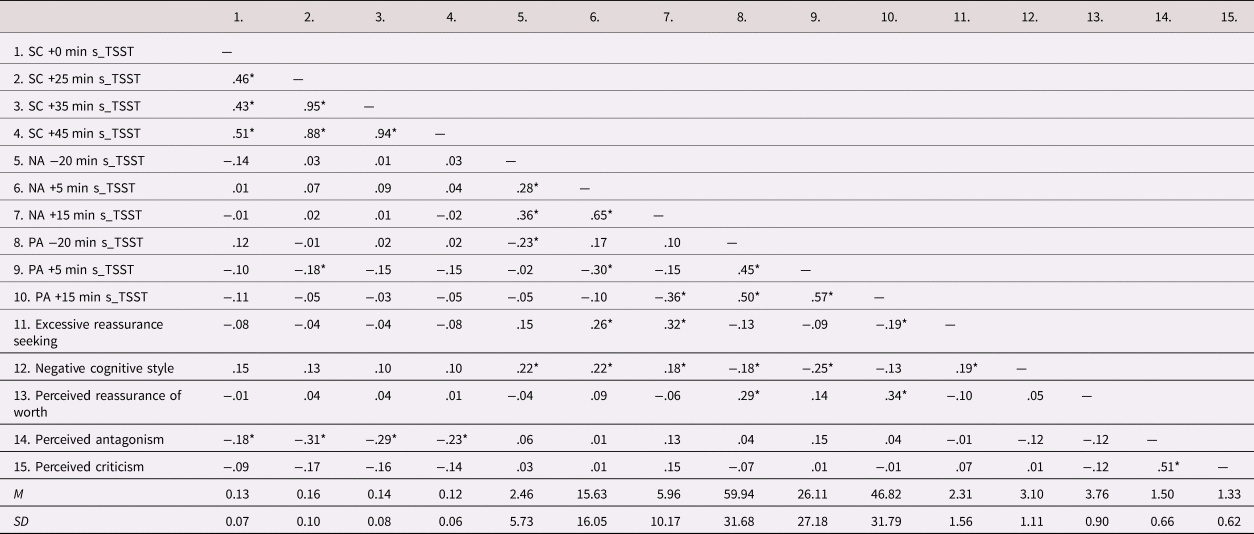
Results are organized by study aim and hypotheses. Descriptives and partial correlations (adjusting for covariates) for key study variables are presented in Table 1. Excessive reassurance seeking was positively associated with both post-stressor NA ratings and was negatively associated with the final post-stressor PA rating. Negative cognitive style was positively associated with each NA rating as well as excessive reassurance seeking, and was negatively associated with baseline PA ratings as well as the first post-TSST PA rating. Reassurance of worth was positively associated with baseline PA ratings and the final post-TSST PA rating. Antagonism was negatively associated with all four SC measurements and positively associated with criticism. SC and PA immediately following the TSST were negatively correlated. NA and PA were negatively correlated at each time point.
Descriptives and partial correlations for key study variables

Note. SC = salivary cortisol; NA = negative affect; PA = positive affect; s_TSST = start of Trier Social Stress Test.
* p < .05.
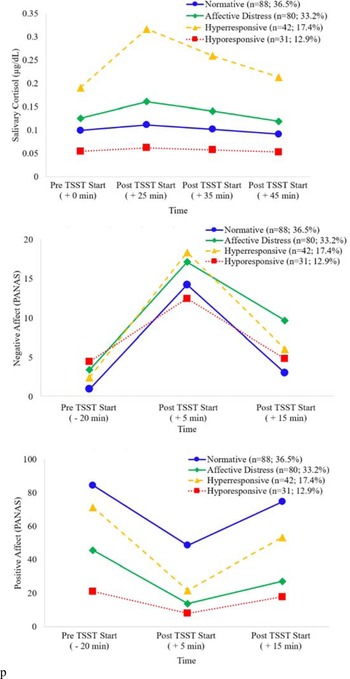
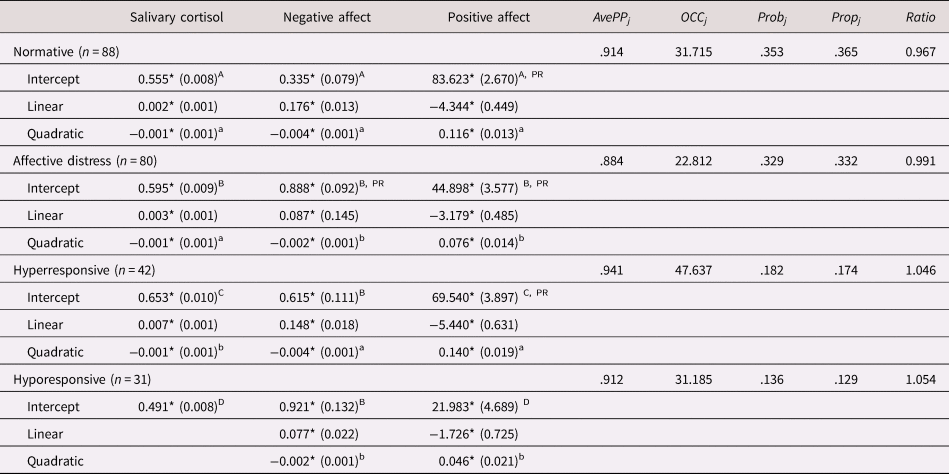
Aim 1: MTM parameter estimates and adequacy index results are presented in Table 2. As expected (H1), MTM results supported a four-group solution (Figure 1). A systematic examination of the log Bayes factor approximation comparing the two- and one-group solutions [2loge(B10) ≈ 239.90], the three- and two-group solutions [2loge(B10) ≈ 169.76], and the four- and three-group solutions [2loge(B10) ≈ 110.20] provided strong evidence for the more complex, four-group solution.Footnote 5 MTM adequacy indices suggested that the four-group solution fit the data well and captured unique heterogeneity in girls’ psychobiological stress response function.
Salivary cortisol, negative affect, and positive affect trajectories for the final four-group solution. Multitrajectory modeling (MTM) subgroups were identified using fourth-root transformed salivary cortisol and negative affect values. Raw salivary cortisol, negative affect, and positive affect values are displayed here for ease of interpretation and in the interest of cross-study communication.

Parameter estimates (standard errors) and model adequacy indices for final multitrajectory modeling four-group solution

Note. AvePPj = Average posterior probability; OCCj = Odds of correct classification; Probj = Probability of group assignment; Propj = Proportion of children assigned to each group; Ratio = Ratio of Probj to Propj; PR = denotes response index protracted recovery (i.e., significant difference between intercept and final trajectory time point estimates). Upper-case and lower-case superscripts denote significant differences in intercept and polynomial estimates, respectively, within the same Trier Social Stress Test response index.
* p < .05.
Our trajectory distinction analyses revealed statistically significant differences that helped characterize the subgroups and went on to inform our naming conventions (Table 2). The largest subgroup of girls (normative, n = 88, 36.4%) exhibited trajectories potentially reflective of healthy psychobiological stress response function (Mauss, Levenson, McCarter, Wilhelm, & Gross, Reference Mauss, Levenson, McCarter, Wilhelm and Gross2005). Three smaller subgroups of girls emerged that demonstrated trajectories potentially reflective of dysregulated psychobiological stress response function (Hankin, Wetter, & Flory, Reference Hankin, Wetter and Flory2012; Lopez-Duran, Kovacs, & George, Reference Lopez-Duran, Kovacs and George2009; Olino et al., Reference Olino, Lopez-Duran, Kovacs, George, Gentzler and Shaw2011): affective distress (n = 80, 33.2%), hyperresponsive (n = 42, 17.4%), and hyporesponsive (n = 31, 12.9%). We outline these statistically significant trajectory differences here and describe subgroup profiles in greater detail.
The normative subgroup was characterized by moderate SC baseline levels (relative to higher hyperresponsive and lower hyporesponsive levels), the lowest NA baseline levels in the sample (relative to higher affective distress, hyperresponsive, and hyporesponsive levels), and the highest PA baseline levels in the sample (relative to lower affective distress, hyperresponsive, and hyporesponsive levels). Also, the normative subgroup demonstrated moderate SC reactivityFootnote 6 (relative to more pronounced hyperresponsive and less pronounced hyporesponsive patterns), more pronounced NA reactivity (relative to less pronounced affective distress and hyporesponsive patterns), and more pronounced PA reactivity (relative to less pronounced affective distress and hyporesponsive patterns).
The affective distress subgroup was characterized by moderate SC baseline levels (relative to higher hyperresponsive and lower hyporesponsive levels), higher NA baseline levels (relative to lower normative levels), and lower PA baseline levels (relative to higher normative and hyperresponsive levels). Also, the affective distress subgroup demonstrated moderate SC reactivity (relative to more pronounced hyperresponsive and less pronounced hyporesponsive patterns), less pronounced NA reactivity (relative to more pronounced normative and hyperresponsive patterns), and less pronounced PA reactivity (relative to more pronounced normative and hyperresponsive patterns). Significant differences in final time point NA and PA levels relative to NA and PA baseline levels emerged, indicating protracted NA and PA recovery.
The hyperresponsive subgroup was characterized by the highest SC baseline levels in the sample (relative to lower normative, affective distress, and hyporesponsive levels), higher NA baseline levels (relative to lower normative levels), and higher PA baseline levels (relative to lower affective distress and hyporesponsive levels). Also, the hyperresponsive subgroup demonstrated the most pronounced SC reactivity patterning in the sample (relative to less pronounced normative, affective distress, and hyporesponsive patterning), more pronounced NA reactivity patterning (relative to less pronounced affective distress and hyporesponsive patterning), and more pronounced PA reactivity patterning (relative to affective distress and hyporesponsive patterning). Of note, Wald tests revealed significant differences in final time point PA levels relative to baseline PA levels indicating protracted PA recovery.
The hyporesponsive subgroup was characterized by the lowest SC baseline levels (relative to higher normative, affective distress, and hyperresponsive levels), lowest PA baseline levels (relative to higher normative, affective distress, and hyperresponsive levels) in the sample, as well as higher NA baseline levels (relative to lower normative levels). Hyporesponsive was the only subgroup to exhibit intercept-only (i.e., blunted) SC trajectories. Girls in this subgroup also exhibited less pronounced NA reactivity patterning (relative to more pronounced normative and hyperresponsive patterning) and less pronounced PA reactivity patterning (relative to more pronounced normative and hyperresponsive patterning).
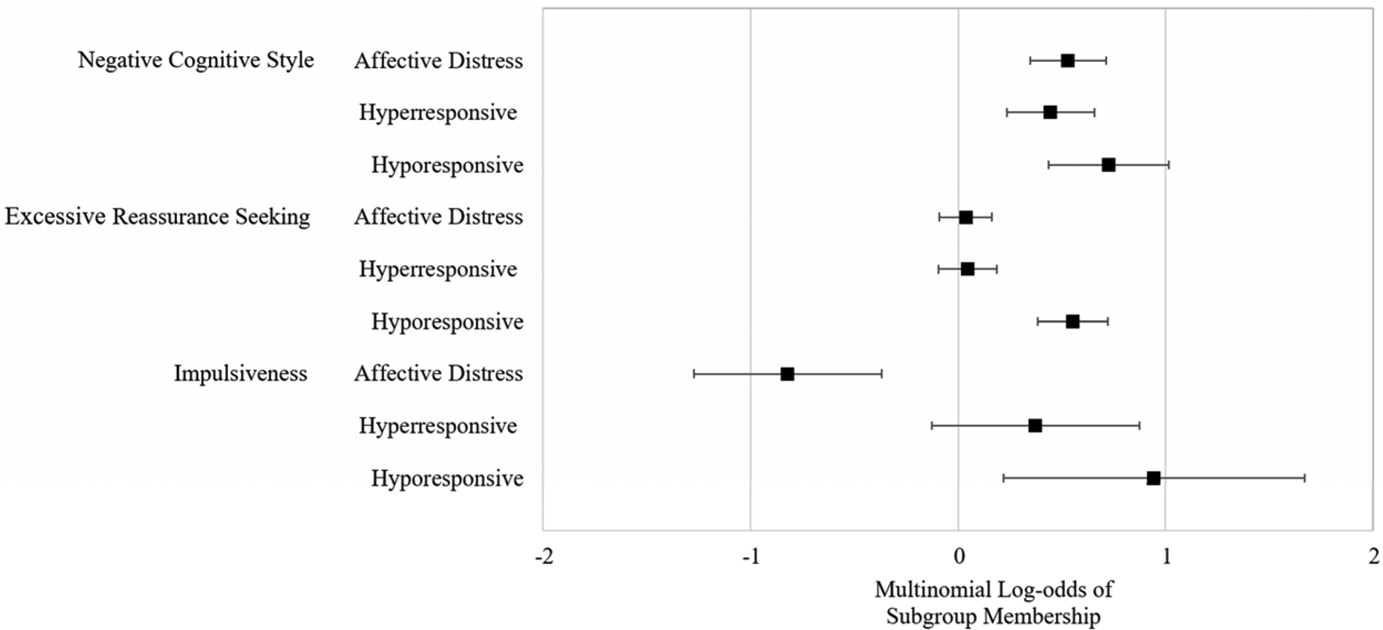
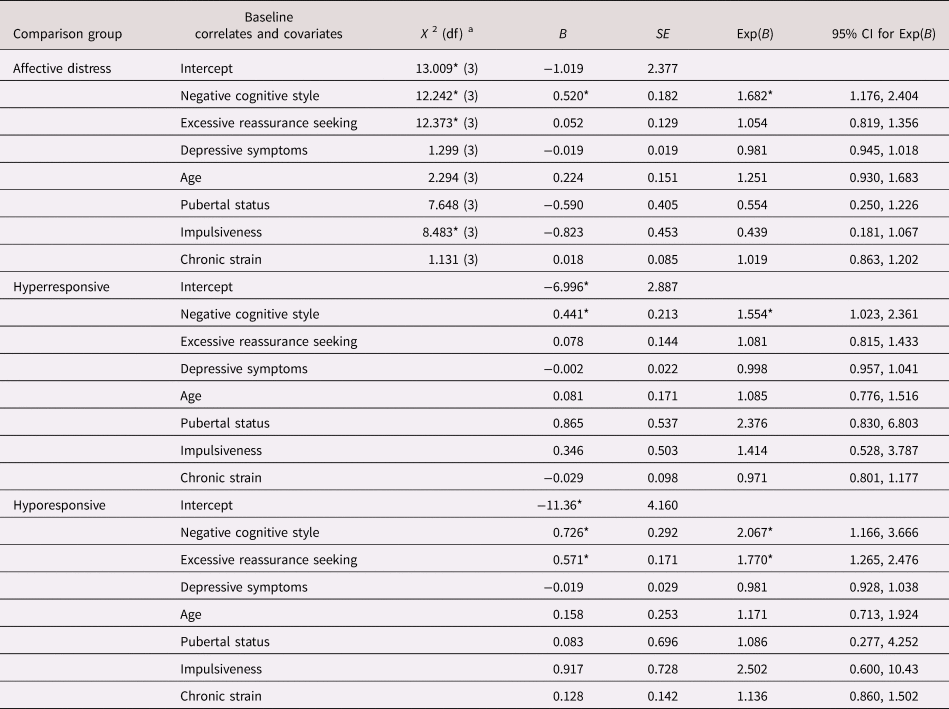
Aim 2. Multinomial logistic regression parameter estimates are presented in Table 3. The log odds of girls’ subgroup membership by each significant correlate are plotted in Figure 2. The multinomial logistic regression model examining correlate to subgroup membership associations was significant, Χ 2 (21) = 50.924, p < .05, Nagelkerke R 2 = .232. As the normative group was largest and thought to reflect healthy psychobiological stress response function based on trajectory distinction analyses, it served as the reference group in multinomial logistic regression analyses. Negative cognitive style was significantly associated with girls’ subgroup membership, Χ 2 (3) = 12.242, p < .05. As expected (H2a), the multinomial log odds of girls’ membership in one of the dysregulated subgroups (relative to normative) increased with greater levels of negative cognitive style: affective distress, B = 0.520, SE = 0.182, OR = 1.682, p < .05, hyperresponsive, B = 0.441, SE = 0.213, OR = 1.554, p < .05, hyporesponsive, B = 0.726, SE = 0.292, OR = 2.067, p < .05. Negative cognitive style multinomial log odds estimates did not differ across the three dysregulated subgroups (all p > .25), indicating that negative cognitive style may be an intrapersonal factor common to various forms of psychobiological stress response dysregulation.
Plotted multinomial log odds and standard error bars depicting the likelihood of multitrajectory modeling (MTM) subgroup membership as a function of significant correlates and covariates. The Normative group was used as reference (i.e., X axis = 0).

Parameter estimates from a multinomial logistic regression model predicting multitrajectory modeling group membership

Note. Beta parameter estimates reflect multinomial log-odds of comparison group membership relative to normative for each unit increase in the correlate or covariate of interest.
a = X 2 estimates were the same for each comparison.
* p < .05.
Excessive reassurance seeking was also significantly associated with girls’ subgroup membership, Χ 2 (3) = 12.373, p < .05. As anticipated (H2b), the multinomial log odds of girls’ membership in one of the dysregulated subgroups (relative to normative) increased with greater levels of reassurance seeking behavior. This effect was significant for the hyporesponsive subgroup, B = 0.552, SE = 0.170, OR = 1.770, p < .05, but not the affective distress, B = 0.037, SE = 0.127, OR = 1.054 p > .25, or hyperresponsive, B = 0.046, SE = 0.142, OR = 1.081, p > .25, subgroups, indicating that excessive reassurance seeking may be an interpersonal behavior unique to the hyporesponsive form of psychobiological stress response dysregulation.
With respect to covariates,Footnote 7 only impulsiveness was significantly associated with girls’ subgroup membership, Χ 2 (3) = 8.483, p < .05. Impulsiveness did not differentiate the normative subgroup from either the affective distress, B = −0.823, SE = 0.453, OR = .439, p = .08, hyperresponsive, B = 0.346, SE = 0.503, OR = 1.414, p > .25, or hyporesponsive, B = 0.917, SE = 0.728, OR = 2.502, p = .21, subgroups. However, impulsiveness did differentiate among the three dysregulated subgroups. Specifically, relative to affective distress, the multinomial log odds of girls’ being in either the hyperresponsive, B = 1.169, SE = 0.544, OR = 3.220, p < .05, or hyporesponsive, B = 1.740, SE = 0.743, OR = 5.699, p < .05, subgroups increased with greater levels of impulsiveness. These findings suggest that impulsiveness may differentiate among these specific forms of psychobiological stress response dysregulation, with impulsiveness being a distinguishing feature of both the hyperresponsive and hyporesponsive profiles.
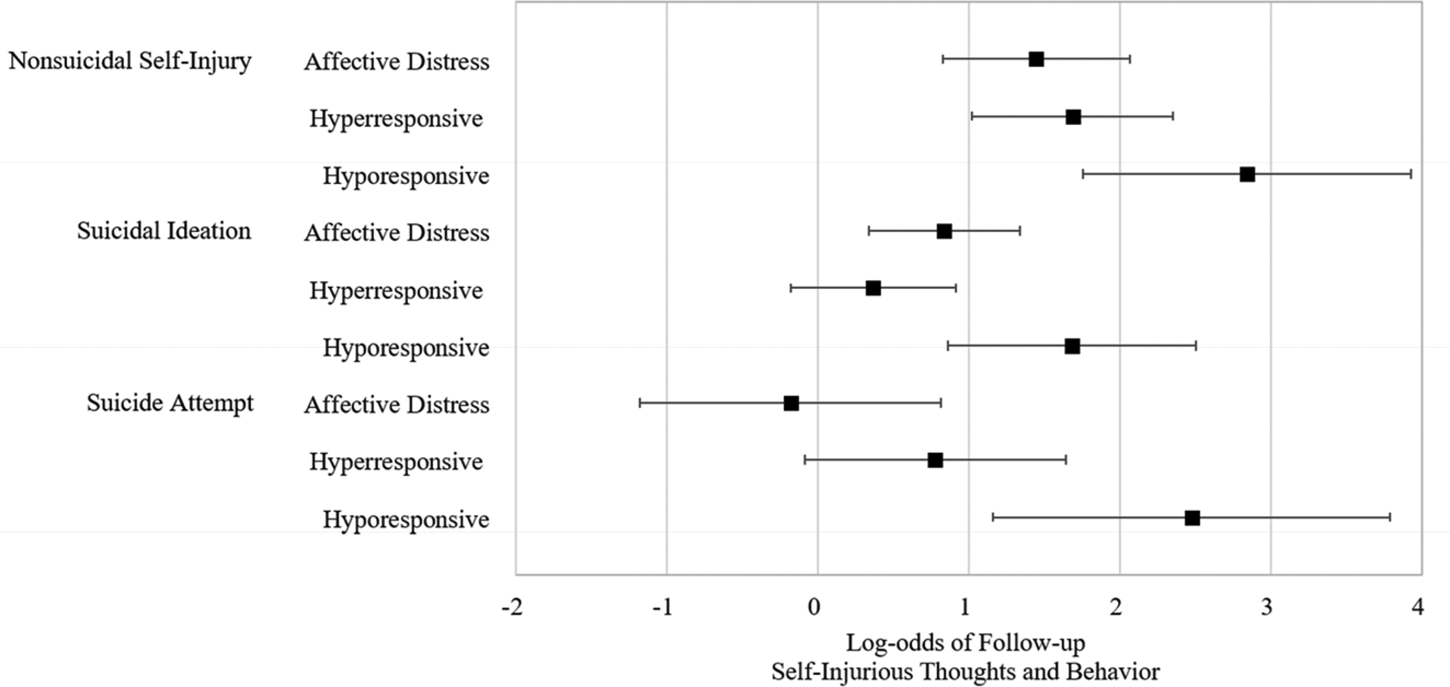
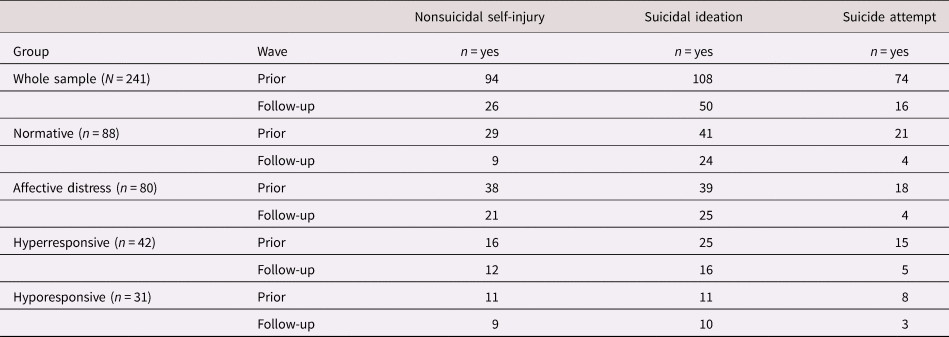
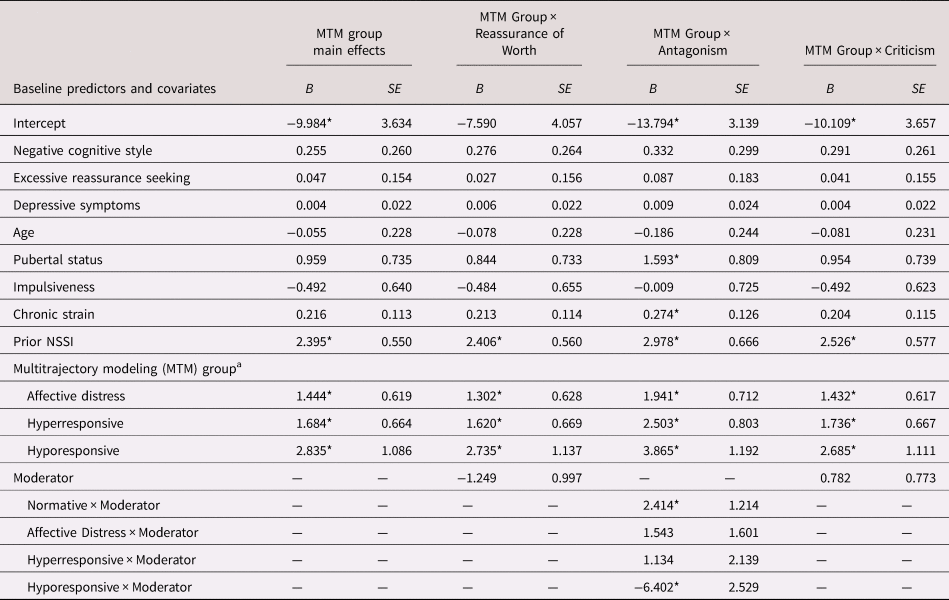
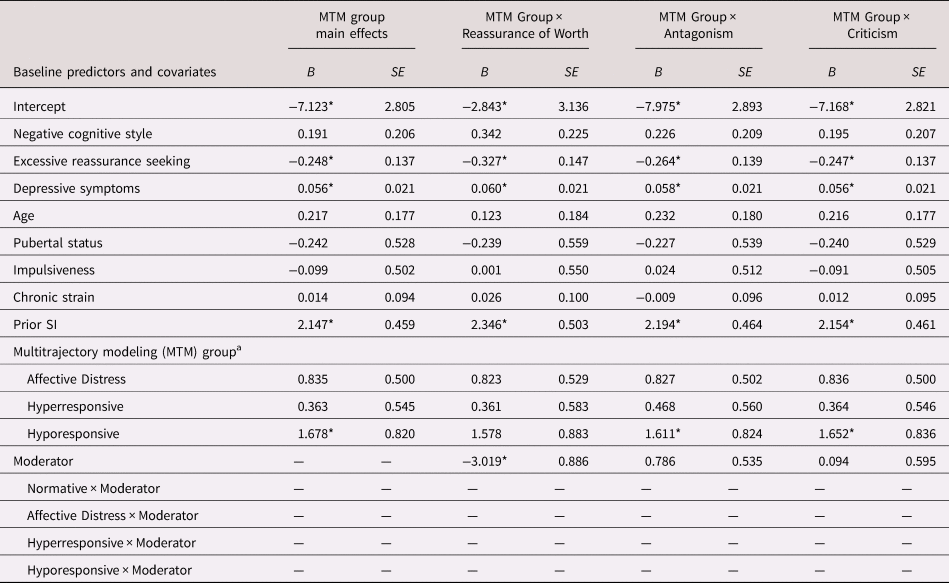
Aim 3. Frequency of NSSI, SI, and SA are presented in Table 4. Logistic regression parameter estimates are presented in Tables 5–7.Footnote 8 Log odds of follow-up NSSI, SI, and SA for each identified subgroup are plotted in Figure 3. The logistic regression model predicting follow-up NSSI was significant, Χ 2 (11) = 84.962, p < .05, Nagelkerke R 2 = .571 (Table 5). Normative served as reference in all outcome analyses. As expected (H3a), the log odds of follow-up NSSI (relative to normative) were significantly greater for all three dysregulated subgroups: affective distress, B = 1.444, SE = 0.619, OR = 4.238, p < .05, hyperresponsive, B = 1.684, SE = 0.664, OR = 5.389, p < .05, and hyporesponsive, B = 2.835, SE = 1.086, OR = 17.035, p < .05. With respect to covariates, only endorsement of NSSI at initial assessment, B = 2.395, SE = 0.550, OR = 10.973, p < .05, was associated with a greater likelihood of follow-up NSSI.
Plotted log odds and standard error bars depicting the likelihood of follow up self-injurious thoughts and behaviors as a function of multitrajectory modeling (MTM) subgroup membership. The Normative group was used as reference (i.e., X axis = 0).

Frequency of prior and follow-up nonsuicidal self-injury, suicidal ideation, and suicide attempt by multitrajectory modeling group membership

Parameter estimates for a nested taxonomy of logistic regressions predicting 3–9 month follow-up nonsuicidal self-injury (NSSI)

Note. Parameter estimates reflect log-odds of 3−9 month follow-up NSSI for each unit increase in the predictor or covariate of interest.
a = Normative served as the reference group.
* p < .05.
Parameter estimates for a nested taxonomy of logistic regressions predicting 3–9 month follow-up suicidal ideation (SI)

Note. Parameter estimates reflect log-odds of 3–9 month follow-up SI for each unit increase in the predictor or covariate of interest.
a = Normative served as the reference group.
* p < .05.
Parameter estimates for a nested taxonomy of logistic regressions predicting 3–9 month follow-up suicide attempt (SA)

Note. Parameter estimates reflect log-odds of 3–9 month follow-up SA for each unit increase in the predictor or covariate of interest.
a = Normative served as the reference group.
†p = .06. *p < .05.
The logistic regression model predicting follow-up SI was significant, Χ 2 (11) = 71.608, p < .05, Nagelkerke R 2 = .459 (Table 6). As expected (H3b), the log odds of follow-up SI (relative to normative) were greater for subgroups characterized by psychobiological dysregulation. This effect, however, was isolated to the hyporesponsive subgroup, B = 1.678, SE = 0.820, OR = 5.354, p < .05. The odds of follow-up SI for affective distress, B = 0.835, SE = 0.500, OR = 2.305, p = .095. and hyperresponsive, B = 0.363, SE = 0.545, OR = 1.438, p > .25, subgroups did not significantly differ from normative. Regarding covariates, only baseline depressive symptoms, B = 0.056, SE = 0.021, OR = 1.058, p < .05, and endorsement of lifetime SI, B = 2.147, SE = 0.459, OR = 8.561, p < .05, were associated with a greater likelihood of follow-up SI.
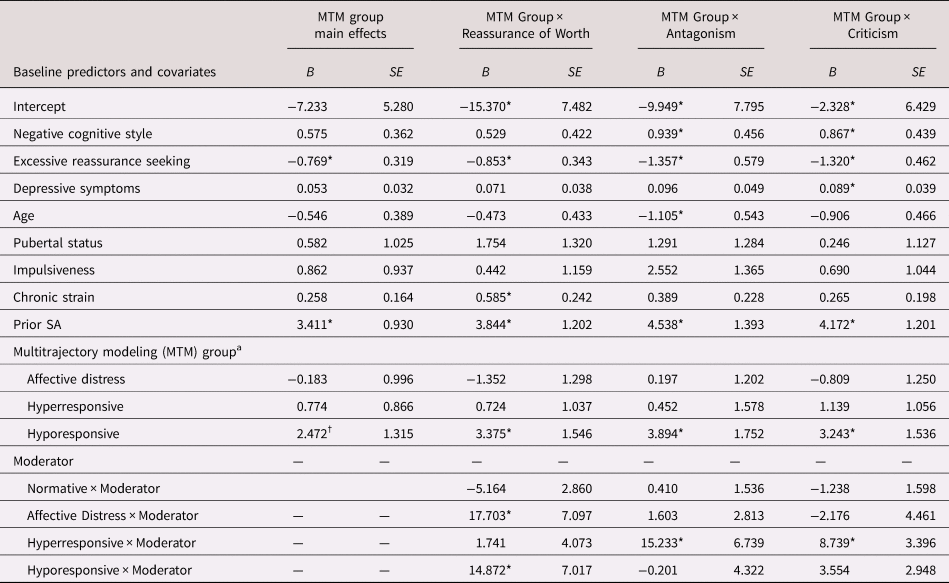
The logistic regression model predicting follow-up SA was significant, Χ 2 (11) = 40.538, p < .05, Nagelkerke R 2 = .475 (Table 7). As expected (H3c), trend-level evidence emerged suggesting that the log odds of follow-up SA (relative to normative) were greater for subgroups characterized by psychobiological dysregulation. This effect, however, was isolated to the hyporesponsive subgroup, B = 2.472, SE = 1.315, OR = 11.843, p = .06. The odds of follow-up SA for affective distress, B = −0.183, SE = 0.996, OR = .883, p > .25. and hyperresponsive, B = 0.774, SE = 0.866, OR = 2.169, p > .25, subgroups did not significantly differ from normative. With respect to correlates, only excessive reassurance seeking, B = −0.769, SE = 0.319, OR = .463, p < .05, was associated with a lower likelihood of follow-up SA. With respect to covariates, only endorsement of lifetime SA at initial assessment, B = 3.411, SE = 0.930, OR = 30.308, p < .05, was associated with a greater likelihood of follow-up SA.
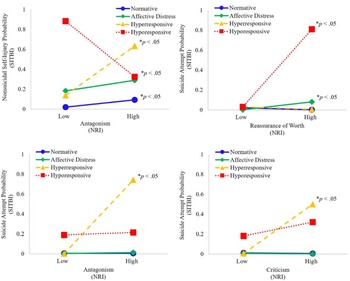
Aim 4. Figure 4 displays probabilities of follow-up STBs as moderated by close friendship characteristics for each identified subgroup of girls. With respect to follow-up NSSI, the subgroup membership by antagonism interaction was significant, Χ 2 (3) = 9.017, p < .05 (Figure 4a). For girls in the normative subgroup, antagonism was associated with an increased likelihood of follow-up NSSI, B = 2.414, SE = 1.214, p < .05. Contrary to expectation (H4a), for girls in the hyporesponsive subgroup (relative to normative), antagonism was associated with a decreased likelihood of follow-up NSSI, B = −6.402, SE = 2.529, p < .05. Antagonism was not significantly associated with the likelihood of follow-up NSSI for girls in the affective distress, B = 1.543, SE = 1.601, p > .25, or hyperresponsive, B = 1.134 SE = 2.140, p > .25, subgroups (relative to normative). However, further probing of the interaction revealed evidence consistent with expectations (H4a). Relative to hyporesponsive, antagonism was associated with increased likelihood of follow-up NSSI for girls in the hyperresponsive subgroup, B = 3.548, SE = 1.779, p < .05. No significant subgroup membership by reassurance of worth, Χ 2 (3) = 5.584, p = .13, or criticism, Χ 2 (3) = 1.221, p > .25, interactions predicting follow-up NSSI emerged.
Moderation effects of perceived close friendship characteristics on subgroup membership to 3–9 month follow-up self-injurious behavior associations. Predicted probabilities plotted at 16th and 84th percentile values of the moderator for illustrative purposes.

With respect to follow-up SI, contrary to expectation (H4b), no significant subgroup membership by reassurance of worth, Χ 2 (3) = 0.373, p > .25, antagonism, Χ 2 (3) = 5.914, p = .12, or criticism, Χ 2 (3) = 3.632, p > .25, interactions emerged. With respect to follow-up SA, the subgroup membership by reassurance of worth interaction was significant, Χ 2 (3) = 11.252, p < .05. Trend-level evidence emerged that reassurance of worth was associated with a decreased likelihood of follow-up SA for girls in the normative subgroup, B = −5.164, SE = 2.860, p = .07 (Figure 4b). Contrary to expectation (H4c), relative to normative, reassurance of worth was associated with increased likelihood of follow-up SA for girls in the affective distress, B = 17.703, SE = 7.097, p < .05, and hyporesponsive, B = 14.872, SE = 7.017, p < .05, subgroups. Relative to normative, reassurance of worth was not associated with the likelihood of follow-up SA for girls in the hyperresponsive subgroup, B = 1.741, SE = 4.073, p > .25. The subgroup membership by antagonism interaction was significant, Χ 2 (3) = 15.149, p < .05. As expected (H4c), for girls in the hyperresponsive subgroup (relative to normative), antagonism was associated with increased likelihood of follow-up SA, B = 15.232, SE = 6.739, p < .05 (Figure 4c). Antagonism was not significantly associated with the likelihood of follow-up SA for girls in the normative subgroup, B = 0.410, SE = 1.536, p > .25. Relative to normative, antagonism was not significantly associated with the likelihood of follow-up SA for girls in the affective distress, B = 1.603, SE = 2.813, p > .25, or hyporesponsive, B = −0.201, SE = 4.322, p > .25, subgroups. The subgroup membership by criticism interaction was significant, Χ 2 (3) = 11.207, p < .05. As expected (H4c), for girls in the hyperresponsive subgroup (relative to normative), criticism was associated with increased likelihood of follow-up SA, B = 8.739, SE = 3.396, p < .05 (Figure 4d). Criticism was not significantly associated with the likelihood of follow-up SA for girls in the normative subgroup, B = −1.238, SE = 1.598, p > .25. Relative to normative, criticism was not significantly associated with the likelihood of follow-up SA for girls in the affective distress, B = −2.176, SE = 4.461, p > .25, or hyporesponsive, B = 3.554, SE = 2.948, p = .23, subgroups.
Discussion
The current study identified subgroups of girls with qualitatively distinct profiles of psychobiological stress response function. These profiles were associated with theory-driven correlates and STB outcomes. In line with the tenets of developmental psychopathology (Cicchetti & Dawson, Reference Cicchetti and Dawson2002), our aim to use multiple stress response indicators to capture these profiles and link them to relevant cognitive processes and interpersonal behaviors provided an opportunity to synthesize evidence across systems (e.g., arousal regulatory, affective valence, cognitive and social processes) often studied in isolation (Glenn et al., Reference Glenn, Cha, Kleiman and Nock2017; Schreiner et al., Reference Schreiner, Klimes-Dougan, Begnel and Cullen2015). MTM of girls’ SC, PA, and NA levels in response to a modified TSST revealed four subgroups of girls. Their psychobiological stress response profiles were linked to cognitive processes (negative inferential style, impulsivity) and interpersonal behaviors (excessive reassurance seeking) known to potentiate risk for STBs (Hamza, Willoughby, & Heffer, Reference Hamza, Willoughby and Heffer2015; Hankin & Abela, Reference Hankin and Abela2011). Subgroup-specific longitudinal links to STBs were consistent with current perspectives on adolescent risk for self-harm as involving failures of the arousal regulatory and affective valence systems (Crowell et al., Reference Crowell, Beauchaine and Linehan2009; Miller & Prinstein, Reference Miller and Prinstein2019; Nock & Prinstein, Reference Nock and Prinstein2004). Still further, certain close friendship characteristics (e.g., criticism, antagonism, reassurance of worth) differentially contributed to girls’ likelihood of follow-up STBs, findings we discuss within the context of girls’ unique constellation of profile and correlate associations. With its multiple-levels-of-analysis approach (Cicchetti & Dawson, Reference Cicchetti and Dawson2002), the current study provides a comprehensive as well as nuanced depiction of adolescent girls’ risk for STBs, with implications for person-centered tailoring of prevention and intervention efforts.
Psychobiological stress response profiles
Our person-centered approach identified four subgroups of girls with qualitatively distinct psychobiological stress response profiles. One profile reflected healthy stress response function and three indicated risk for STBs vis-à-vis varied patterns of arousal regulatory and affective valence system disturbance (Miller & Prinstein, Reference Miller and Prinstein2019; Nock & Prinstein, Reference Nock and Prinstein2004). It is noteworthy that MTM revealed greater heterogeneity in physiologic arousal and PA disturbance relative to that observed in NA. Also, disruptions of NA were common to all dysregulated profiles, while arousal regulatory and PA disruptions were not. Accordingly, tonic elevations in NA as well as changes in NA under conditions of acute stress may fail to distinguish among patterns of psychobiological dysregulation. This point is consistent with conceptualizations of NA disturbance as a nonspecific feature of internalizing problems more generally (Clark & Watson, Reference Clark and Watson1991; Kotov et al., Reference Kotov, Krueger, Watson, Achenbach, Althoff, Bagby and Eaton2017; Tackett et al., Reference Tackett, Lahey, Van Hulle, Waldman, Krueger and Rathouz2013). Rather, our findings point to concurrent arousal regulatory and positive valence system disruptions as integral integrative features of a more complete understanding of psychobiological stress response dysregulation and perhaps requisite considerations in the development of more comprehensive, fine-grained conceptual models of adolescent prospective risk for STBs (Miller & Prinstein, Reference Miller and Prinstein2019; Nock & Prinstein, Reference Nock and Prinstein2004).
Most girls demonstrated psychobiological stress response functioning we labeled as normative, with cortisol and positive and NA trajectories that may signal moderate, coordinated psychobiological activation (Mauss et al., Reference Mauss, Levenson, McCarter, Wilhelm and Gross2005). Other girls displayed trajectories reflecting varied patterns of disruption across systems. Girls in the hyperresponsive subgroup exhibited the highest baseline cortisol levels, most exaggerated cortisol reactivity patterns, as well as more dramatic changes in positive and NA (relative to affective distress and hyporesponsive). Significant elevations in baseline NA (relative to normative) were also observed. In addition, although hyperresponsive girls exhibited unexpected elevations in baseline PA, their PA reactivity levels failed to return to baseline 15 min post stressor (i.e., protracted recovery). Tonic elevations in physiologic arousal and negative valence activity such as those seen in the hyperresponsive profile have been previously documented, referred to as high arousal NA (e.g., fearful, hostile) and linked specifically to HPA dysregulation (Hoyt, Craske, Mineka, & Adam, Reference Hoyt, Craske, Mineka and Adam2015). This pattern of NA and physiologic reactivity in the face of possible social evaluation has also been discussed in developmentally sensitive accounts of borderline personality disturbance and related risk for STBs (Courtney-Seidler et al., Reference Courtney-Seidler, Burns, Zilber and Miller2014; Crowell et al., Reference Crowell, Beauchaine and Linehan2009). As these accounts have focused on predispositions towards NA lability and biological hyperreactivity, our findings extend the notion that dramatic declines in PA and difficulty returning to elevated positive affective states in the face of stressors involving potential criticism and evaluation may also contribute to these girls’ risk.
The hyporesponsive profile also reflected disruption across physiologic arousal and affective valence systems, though in a fashion both statistically and qualitatively distinct from that observed in the hyperresponsive profile. Specifically, girls in this subgroup exhibited SC trajectories with the lowest baseline levels and intercept-only reactivity (i.e., no change), PA trajectories with the lowest baseline levels and less pronounced reactivity (relative to normative and hyperresponsive), and NA trajectories with high baseline levels (relative to normative) and less pronounced reactivity (relative to normative and hyperresponsive). Taken together, their psychobiological stress response patterns are consistent with accounts of adolescent depression as involving blunted arousal, low hedonic capacity, and elevated negative emotionality (Craske et al., Reference Craske, Meuret, Ritz, Treanor and Dour2016; Hankin, Reference Hankin2012; Miller & Prinstein, Reference Miller and Prinstein2019).
MTM revealed an additional, unexpected profile that may extend current theory. Affective distress trajectories reflected disruptions primarily of positive and negative valence systems. Despite showing moderate cortisol baseline levels, these girls exhibited lower baseline PA (relative to normative and hyperresponsive) and higher baseline NA (relative to normative). Also, despite showing moderate cortisol reactivity and less pronounced positive and NA reactivity, these girls’ positive and NA levels failed to return to baseline 15 min post stressor (i.e., protracted recovery). Low PA and high NA have theoretical and empirical links to risk for depression and self-harm (Chorpita & Daleiden, Reference Chorpita and Daleiden2002; Joiner, Catanzaro, & Laurent, Reference Joiner, Catanzaro and Laurent1996; Olino et al., Reference Olino, Lopez-Duran, Kovacs, George, Gentzler and Shaw2011). Our exploration perhaps extends this literature by suggesting that impaired capacity to downregulate NA and upregulate PA following exposure to a stressor may also play a central role in this risk.
Cognitive processes and interpersonal behavior
The profiles were associated with theory-driven cognitive processes and interpersonal behaviors known to confer risk for STBs. For example, relative to normative, negative cognitive style increased the likelihood of girls’ membership in the affective distress, hyperresponsive, and hyporesponsive subgroups. However, inferential style did not differentiate among these three subgroups, perhaps suggesting that negative cognitive style, alongside tonic NA, may be a nonspecific feature of psychobiological dysregulation and related risk for STBs. As an opposing point of consideration, negative cognitive style may have differentiated among the dysregulated profiles had we also examined adolescent stressful life events (e.g., Hankin & Abramson, Reference Hankin and Abramson2001). To expand, prior evidence has demonstrated stronger associations between negative inferential style and, in particular, anhedonic depressive presentations (relative to general depression or anxious arousal) specifically for children unduly exposed to negative life events (Hankin, Wetter, Cheely, & Oppenheimer, Reference Hankin, Wetter, Cheely and Oppenheimer2008). Thus, a subsequent worthy avenue of research may be examining the interactive contribution of negative cognitive style and life event exposure on children's psychobiological stress response functioning. In line with propositions outlined in Hankin (Reference Hankin2008), it may be that negative inferential style for adolescents unduly exposed to negative life events increases the likelihood of exhibiting dysphoric psychobiological stress response profiles, distinctly characterized by blunted arousal and low hedonic capacity (e.g., hyporesponsive), relative to dysregulated profiles reflecting more moderate arousal and emotional distress (e.g., affective distress) or high anxious arousal (e.g., hyperresponsive).
Girls’ interpersonal behavior also differentiated among the groups in meaningful ways. Specifically, excessive reassurance seeking was a unique correlate of the hyporesponsive profile. It is possible that the drive to excessively seek reassurance from others may function at a subconscious level to alleviate high NA levels (i.e., avoidant negative reinforcement) and to elevate low PA but also arousal levels (i.e., evocative positive reinforcement) for hyporesponsive girls (Gillett & Mazza, Reference Gillett and Mazza2018). Through this lens, excessive reassurance seeking may be viewed as a failure of autonomous capacity to downregulate NA and upregulate low arousal and PA that is maintained by temporary distress alleviation and achievement of desirable states, unaltered negative cognitive patterns, disbelief in provided assurances, and eventual return to depressotypic thinking and affective states (Joiner, Reference Joiner2005). While reassurance seeking and perceived assurances from peers and social others may have mitigated risk for STBs (e.g., SI) for the average girl in our sample, they may have done more harm than good specifically for hyporesponsive girls who may contend with negative self-schemas (e.g., worthlessness) and depressotypic cognitive biases (e.g., assurance disbelief).
Though not a focal correlate, impulsiveness differentiated among the profiles in ways that lend insight into the role psychobiological function may play in its presentation. Impulsiveness increased the odds of girls’ membership in the hyperresponsive and hyporesponsive subgroups relative to affective distress. One tenable hypothesis may be that healthy arousal functioning (e.g., moderate cortisol activity in affective distress) may offset the contributions of affective valence system disturbance toward impulsivity. That impulsiveness did not also differentiate the hyperresponsive and hyporesponsive profiles is remarkable considering how qualitatively distinct they were from one another. Impulsivity as a core feature of risk for STBs is thought to involve difficulty modulating NA (i.e., emotion dysregulation; Crowell et al., Reference Crowell, Beauchaine and Linehan2009; Linehan, Reference Linehan1993). To this, we extend the notion that impulsivity-related risk may also involve concurrent dysregulation of PA as well as arousal regulatory function, the confluence of which potentially points to meaningful psychobiological subtypes. To illustrate, impulsiveness for hyperresponsive girls may be more reflective of involuntary action (e.g., “It's hard for me to resist acting on my feelings.”) and poor distress tolerance (e.g., “When I am upset, I often act without thinking and make matters worse.”) associated with high arousal NA (e.g., fearful, hostile) and emotional lability (Beauchaine et al., Reference Beauchaine, Hinshaw and Bridge2019). Conversely, impulsiveness for hyporesponsive girls may be more indicative of inclinations toward sensation-seeking (e.g., “I welcome new and exciting experiences, even if they are frightening.”) and risk-taking to achieve desired states (e.g., “I enjoy taking risks.”) associated with blunted arousal and low hedonic capacity (e.g., fearless, risky). Future research is needed to determine whether these specific facets of impulsivity differentiate the profiles and better characterize their risk for STBs.
Longitudinal links to nonsuicidal self-injury
The profiles were longitudinally linked to NSSI in a manner consistent with expectations. Specifically, girls in the affective distress, hyperresponsive, and hyporesponsive subgroups relative to normative were more likely to endorse having engaged in NSSI between baseline and follow-up. According to functionalist theory (Nock & Prinstein, Reference Nock and Prinstein2004), children at times engage in NSSI to generate desirable physiologic and emotional states as well as reduce tension and NA (i.e., automatic reinforcement). As such, girls in the affective distress, hyperresponsive, and hyporesponsive groups may have been at increased risk of NSSI if, as theory suggests, NSSI does in fact help these girls meet various self-regulatory needs associated with their dysregulated psychobiological stress response functioning.
In addition, the odds of follow-up NSSI varied across subgroups by girls’ close friendship characteristics, a finding that aligns with socially reinforcing properties of NSSI (Nock & Prinstein, Reference Nock and Prinstein2004). For normative girls, high levels of antagonism in their relationship with their close friend was associated with a modest increase in the likelihood of NSSI at follow-up. Perceiving close friendships as being laden with high levels of antagonism (e.g., teasing that threatens belonging) may place undue strain on normative girls’ healthy physiological and affective stress response system function, and thereby create a more moderate arousal regulatory need that NSSI then may fulfill. This modest increase in likelihood of NSSI may also be understood if this perceived antagonism also metastasizes towards feelings about social pressures to conform (i.e., NSSI that allays concerns about rejection or promotes feelings of acceptance). Longitudinal research is needed to determine if the likelihood of transitioning from normative to dysregulated psychobiological function varies by perceived antagonism.
For hyperresponsive and hyporesponsive girls, however, antagonism in their close friendship had a relatively more pronounced impact on the likelihood of NSSI at follow-up, a finding consonant with developmental models of adolescent girls’ risk for NSSI that implicate psychobiological vulnerability to environmental factors (Beauchaine et al., Reference Beauchaine, Hinshaw and Bridge2019; Crowell et al., Reference Crowell, Beauchaine and Linehan2009). In addition, our findings extend to these models the consideration that a single environmental factor (e.g., close friendship characteristics) may act as both a potentiator (e.g., hyperresponsive) and buffer (e.g., hyporesponsive) of risk for NSSI depending on girls’ unique pattern of psychobiological dysregulation. For girls in the hyperresponsive subgroup, antagonistic close friendships may capitalize on predispositions towards emotional lability and negative thinking and serve to exacerbate intense emotional reactions and negative thought patterns. Their antagonism-exacerbated penchant towards self-harm further corroborates the argument that the hyperresponsive profile may in some ways reflect an etiologic precursor for borderline personality related disturbance (Courtney-Seidler et al., Reference Courtney-Seidler, Burns, Zilber and Miller2014; Crowell et al., Reference Crowell, Beauchaine and Linehan2009).
For girls in the hyporesponsive subgroup, antagonistic close friendships may serve a different function, meeting certain regulatory and affiliative needs that might otherwise be met by NSSI's automatic and socially reinforcing properties. That is, antagonistic close friendships may be affectively aversive for hyporesponsive girls, but as a result be accompanied by pain offset relief (Franklin et al., Reference Franklin, Lee, Hanna and Prinstein2013) and the generation of desirable states (i.e., increased PA and arousal) that might be more infrequently experienced (i.e., blunted arousal, anhedonia) by these girls. Close friendships experienced as antagonistic also may be egosyntonic for hyporesponsive girls, consistent with their depressotypic self-schemas (e.g., negative cognitive style), and, thus, self-affirming (Hooley & Fox, Reference Hooley and Fox2019). For this reason, hyporesponsive girls’ antagonistic friendships may have a more sisterly (e.g., “She doesn't quit on me. She sticks around.”) and sincere (e.g., “She doesn't sugar coat things. She tells me like it is.”) quality to them because messages communicated by aversive interactions are easier to believe and validate perceptions of self-worth. If so, this might make the case for an alternative function to hyporesponsive girls’ excessive reassurance seeking, which may elicit aversive (i.e., pain-offset relief generating) interactions and negative (i.e., egosyntonic, genuine) messages from friends rather than esteem-building support (Prinstein, Borelli, Cheah, Simon, & Aikins, Reference Prinstein, Borelli, Cheah, Simon and Aikins2005).
Longitudinal links to suicidal ideation and suicide attempt
Significant and trend-level evidence emerged linking profiles to SI and SA at follow-up. Specifically, membership in the hyporesponsive subgroup relative to normative predicted increased likelihood of follow-up SI and a marginally significant increased likelihood of follow-up SA. Adolescent stress response dysregulation and associated risk for STBs is thought to involve coordinated disturbance across arousal regulatory systems as well as positive and negative valence system functioning (Craske et al., Reference Craske, Meuret, Ritz, Treanor and Dour2016; Hankin, Reference Hankin2012; Miller & Prinstein, Reference Miller and Prinstein2019). However, empirical studies to date examining coordinated psychobiological disruptions in adolescents are scarce and none have demonstrated prospective associations with STBs. Rather, investigations have studied physiologic and affective functioning in isolation and links to STB outcomes have been mixed and inconsistent (Cha et al., Reference Cha, Franz, M. Guzmán, Glenn, Kleiman and Nock2018). This person-centered study is the first to illustrate an integrative pattern of psychobiological stress response dysregulation (e.g., co-occurring blunted arousal, low hedonic capacity, and elevated negative emotionality) with direct longitudinal linkages to SI and SA for adolescent girls.
Main effects linking our identified subgroups to follow-up SA (but not SI) were qualified by their interaction with specific close friendship characteristics. According to interpersonal psychological theory (IPTS, Joiner, Reference Joiner2005), propensities toward lethal self-harm can be explained by the confluence of three factors: acquired ability (i.e., repeated exposure to painful, fear-inducing events; NSSI), perceived burdensomeness (i.e., view that one's existence burdens others), and social isolation (e.g., experience that one is alienated from others). With respect to acquired ability, girls in the affective distress, hyperresponsive, and hyporesponsive subgroups each demonstrated an increased likelihood of follow-up NSSI, pointing to possible acquired ability for lethal self-harm. With respect to perceptions of being a burden to or being alienated by social others, subgroup-specific odds of follow-up SA varied by girls’ views of their close friends and how they experience their close friendships, lending additional insight into the potential roles that perceived burdensomeness and social isolation may play in subgroup-specific risk for SA.
For girls in the hyperresponsive subgroup, highly critical and antagonistic close friendships were each associated with increased likelihood of follow-up SA. For these girls, the confluence of high arousal NA (Hoyt et al., Reference Hoyt, Craske, Mineka and Adam2015), depressotypic self-schemas (e.g., negative cognitive style), and a penchant for acting without thinking under duress (e.g., negative urgency) may set the stage for SA, while close friendships that are critical, antagonistic and invalidating capitalize on this confluence of vulnerabilities to potentiate risk for SA (Beauchaine et al., Reference Beauchaine, Hinshaw and Bridge2019; Crowell et al., Reference Crowell, Beauchaine and Linehan2009). Feeling as though a close friend frequently nags or points out flaws may contribute to a sense of being a relational burden. Furthermore, given hyperresponsive girls’ physiologic and affective sensitivity to social evaluative threat, it is also possible that these girls lean towards social isolation as means of avoiding peer interactions or escaping stressful friendships that contribute to imagined threat of criticism or antagonism and, thus, affective and arousal regulatory dysregulation (Linehan, Reference Linehan2018). Considering their overall constellation of disturbances and sensitivities, hyperresponsive-related risk for SA can be articulated as acquired capacity (e.g., NSSI), perceived burdensomeness (e.g., vulnerability to threat of criticism or antagonism), and self-isolation (e.g., biosocial-driven avoidance processes).
For affective distress and hyporesponsive girls, however, the likelihood of follow-up SA was positively associated with reassurance of worth. For these girls, messages communicated by close friends that are viewed to be self-worth affirming may be egodystonic and, thus, self-alienating (Hooley & Fox, Reference Hooley and Fox2019). They may also be difficult to believe, viewed as disingenuous (e.g., “You're just trying to be nice.”) or invalidating (e.g., “You don't understand me.”), and, thus, contribute to girls’ perceived lack of closeness or sense of isolation in close friendships. As these messages may also be colored by girls’ affective states and cognitive biases, reassurance might be perceived as being motivated by self-preservation (e.g., “You try to make me feel better only so you don't have to worry.”) and, thus, increase feelings of perceived burdensomeness. Relative to affective distress, hyporesponsive blunted HPA function (e.g., Eisenlohr-Moul et al., Reference Eisenlohr-Moul, Miller, Giletta, Hastings, Rudolph, Nock and Prinstein2018) and impulsiveness (Rimkeviciene & De Leo, Reference Rimkeviciene and De Leo2015) may have contributed to the observed difference in magnitude of reassurance to follow-up SA associations. However, it is also possible that reassurance is more harmful for those who seek it in excess (Gillett & Mazza, Reference Gillett and Mazza2018). To this end, excessive reassurance seeking for hyporesponsive girls may have also contributed to this observed difference via social alienation processes (e.g., peer rejection, termination of friendships; Prinstein et al., Reference Prinstein, Borelli, Cheah, Simon and Aikins2005). In sum, SA risk for affective distress and hyporesponsive girls can be understood as acquired capacity (e.g., NSSI), perceived burdensomeness (e.g., views of reassurance as motivated by self-preservation), and social isolation (e.g., reassurance-driven lack of closeness, excessive reassurance seeking-driven alienation).
Clinical implications
Our findings highlight the importance of using multilevel assessment modalities to establish person-specific stress response patterns that hold the potential to inform tailored approaches to clinical intervention. Our subgroups reflect distinct forms of dysfunction, each of which requires careful consideration of the unique matrix of the psychobiological stress responsivity, cognitive processes, and interpersonal behaviors that characterize them during treatment planning and progress monitoring. Developmentally sensitive adaptations of cognitive behavioral therapy (CBT) may be especially beneficial for addressing girls’ negative inferential style and tonic NA elevations, each of which were common across the subgroups. Therapeutic instruction in mindfulness (i.e., directed attention and openness to the present moment), a skill addressed in Acceptance and Commitment Therapy (Hayes, Strosahl, & Wilson, Reference Hayes, Strosahl and Wilson1999), may improve acceptance of difficult thoughts and feelings for girls with exaggerated psychobiological reactivity (hyperresponsive) or protracted affective recovery (affective distress), thereby decreasing the potentially noxious toll acute stress exposure exerts on psychobiological stress response systems. Still further, practice in relaxation skills and distress tolerance, skills emphasized in Dialectical Behavior Therapy (Rathus & Miller, Reference Rathus and Miller2014), may be especially important for hyperresponsive girls, who showed strong acute stress reactions and impulsive tendencies that synergistically make them especially sensitive to input from their social environments (e.g., criticism, antagonism) (Beauchaine et al., Reference Beauchaine, Hinshaw and Bridge2019; Crowell et al., Reference Crowell, Beauchaine and Linehan2009).
Hyporesponsive girls may present unique challenges in case conceptualization and treatment planning. Their stably elevated NA and blunted arousal regulatory function could reflect a greater degree of psychobiological disturbance (e.g., heightened inflammation that suppresses HPA functioning; Slavich & Irwin, Reference Slavich and Irwin2014), one related to repeated exposure to bouts of negative thinking and affect dysregulation that take place during the reassurance seeking cycle (Gillett & Mazza, Reference Gillett and Mazza2018). As such, instruction in preventing urges to seek temporary assurances by improving tolerance towards aversive emotions and doubts about self-worth presents as one therapeutic avenue, helping to address avoidant negative reinforcement functions associated with excessive reassurance seeking and reduce overall NA. Importantly, PA training may prove to be a promising intervention modification when treating these girls (Vinograd & Craske, Reference Vinograd and Craske2020). Such training may involve instruction in behavioral activation skills (e.g., positive activity scheduling, savoring pleasurable moments) with the aim of boosting overall arousal, decreasing impulsiveness related to sensation seeking, and supplementing positive attention-related reassurance seeking. At present, the extent to which such augmentations may mitigate hyporesponsive girls’ risk for STBs remains unknown and is perhaps an important avenue for future research.
Interpersonal approaches (Mufson, Moreau, Weissman, & Klerman, Reference Mufson, Moreau, Weissman and Klerman1993) may also help to more comprehensively address the complex matrix of risk factors illustrated thus far. Perceived criticism and antagonism appear to be particularly debilitating for hyperresponsive girls, a finding consonant with the claim that girls presenting with emotional dysregulation and trait impulsivity are at particular risk for STBs in the context of relationships that reinforce emotional lability (Beauchaine et al., Reference Beauchaine, Hinshaw and Bridge2019). These girls may benefit from therapeutic instruction in discriminating those friendships that are harsh or critical from those that are supportive but are avoided due to perceptions of inadequacy or low self-worth as well as threat of criticism or social evaluation. Psychoeducation about healthy friendships, improving awareness of social-cognitive biases, training in interpersonal skills needed to shape friendships for the better, as well as guidance on how to safely end harmful relationships and seek healthier ones all present as potential routes to intervention for these girls.
Hyporesponsive girls present a unique clinical challenge with respect to interpersonal processes. Though they seek reassurance from close friends, they appear to reap little benefit from worth-affirming messages (i.e., egodystonic, false) and instead appear to benefit from interactions experienced as antagonistic (i.e., egosyntonic, genuine). Consistent with our prior postulation, antagonism in friendships may serve a protective function in some regards by validating underlying sources of cognitive distress and generating interpersonal pain offset relief. However, failure to address cognitive schema informing low self-worth in the context of therapy will likely maintain underlying patterns of psychobiological dysregulation in the long-term and, thus, further increase resistance to PA-promoting social experiences. At the outset of treatment, hyporesponsive girls may show strong preference for the familiarity of misery over the disappointment of false hope. Thus, it may be particularly important for clinicians to provide high levels of validation while gradually addressing core sources of cognitive distress before intervening on the potential role these girls’ closest friends may play in maintaining their risk.
Limitations and future directions
The current study had limitations that point to future directions for research. First, though our sample size was commensurate with other recent person-centered studies of adolescent arousal regulatory functioning (Koss, Cummings, Davies, & Cicchetti, Reference Koss, Cummings, Davies and Cicchetti2017; Turpyn, Chaplin, Cook, & Martelli, Reference Turpyn, Chaplin, Cook and Martelli2015), it nonetheless was small for a person-centered design. Second, as is common with person-centered approaches, unequal samples sizes across the subgroups emerged, which may have contributed to a reduction in power in our correlate and outcome analyses. Thus, cautious interpretation and replication with larger samples is warranted. Third, our results are limited to a sample of girls with increased clinical risk for internalizing psychopathology. Complementary research is needed to determine whether similar profiles emerge in adolescent samples including both boys and girls. Fourth, MTM specification was limited to three stress response indices. Incorporation of additional indicators (e.g., autonomic nervous system) may help identify additional profiles linked to other forms of psychopathology (e.g., externalizing; Del Giudice, Hinnant, Ellis, & El-Sheikh, Reference Del Giudice, Hinnant, Ellis and El-Sheikh2012). Fourth, our assessment of cognitive processes, interpersonal behaviors, close friendship characteristics as well as STB outcomes was limited to girls’ self-report, which may have been influenced by their emotional states and, thus, potentially be biased (De Los Reyes et al., Reference De Los Reyes, Augenstein, Wang, Thomas, Drabick, Burgers and Rabinowitz2015). Incorporating multi-informant (e.g., parent, close friend) and multimodal (e.g., observed affective response, observed close friend interactions) assessment may more fully gauge the interactive contributions of cross-system functioning and peer influence on adolescent risk for self-harm. Fifth, our assessment of environmental factors focused solely on close friendships. Maltreatment, invalidating parent–adolescent relationships, and dating violence victimization are also thought to be environmental potentiators of girls’ risk for STBs (Beauchaine et al., Reference Beauchaine, Hinshaw and Bridge2019; Caron, Lafontaine, & Bureau, Reference Caron, Lafontaine and Bureau2017; Rizzo et al., Reference Rizzo, Esposito-Smythers, Swenson, Hower, Wolff and Spirito2014). Still further, the salience of specific sources of social support (e.g., parents, romantic relationships) shifts across adolescence (Allen & Miga, Reference Allen and Miga2010; Moretti & Peled, Reference Moretti and Peled2004). Thus, future longitudinal studies may benefit from examination of additional close relationships, qualities that characterize them, and how each might buffer or exacerbate psychobiological risk for STBs across development. Sixth, stress response and correlate data were collected at a single time point, precluding inference about directionality. Psychobiological stress response dysregulation may function as a more biologically proximal mechanism of risk in prospective transactions between cognitive processes, interpersonal behavior, and STB outcomes. Still further, as proposed by Gillett and Mazza (Reference Gillett and Mazza2018) and others (e.g., Joiner & Metalsky, Reference Joiner and Metalsky2001), the association between negative cognitions, dysregulated affect/arousal, and reassurance seeking may be more dynamic in nature. Future studies incorporating assessments at multiple time points (e.g., year, day, hour) may be amenable to serial mediation or dynamical systems models that may help strengthen inference about directionality (e.g., risk factors, mechanisms, coupled oscillators). Seventh, our assessment of STBs was limited to girls’ binary endorsement of their occurrence, with models examining specific STB indices in isolation. Future research incorporating more nuanced assessment of self-harm (e.g., frequency, intensity, duration, method, motivation) or person-centered modeling of multiple, concurrent STB risk trajectories (e.g., examining heterogeneity in binary logit distributions across NSSI, SI, and SA) may provide a more fine-grained illustration of girls’ prospective risk. Finally, though consistent with rates observed in other adolescent samples (e.g., Nock et al., Reference Nock, Borges, Bromet, Alonso, Angermeyer, Beautrais and Williams2008), self-reported SA at follow-up was rare, which may have contributed to small sample bias in our outcome analyses. As girls may be reticent to disclose such sensitive information during face-to-face or telephone interviews, future research using computer-based assessment (e.g., self-interviews) may yield higher incident estimates (Kim, Dubowitz, Hudson-Martin, & Lane, Reference Kim, Dubowitz, Hudson-Martin and Lane2008; Scott, Pilkonis, Hipwell, Keenan, & Stepp, Reference Scott, Pilkonis, Hipwell, Keenan and Stepp2015).
Acknowledgments
This paper is dedicated to the memory of Henry Farfan. Thanks to Taylor Oines for her thoughtful contributions and all the adolescent girls who participated in this project.
Financial Statement
This work was supported by a Postdoctoral Fellowship from the National Institute of Mental Health under Grant T32 MH015755 awarded to Dr. Dante Cicchetti and by Grant R01 MH085505 awarded to Drs. Mitch Prinstein and Matthew Nock.
Conflicts of Interest
None.