Introduction
The bipyridyl herbicide paraquat (Gramoxone™, Syngenta, Basel, Switzerland) is a nonselective contact herbicide that interferes with photosystem I activity. It accepts electrons from ferredoxin, thereby generating superoxide free radicals, leading to lipid peroxidation and membrane damage and finally killing plants rapidly after treatment and subsequent light exposure. The characteristics of paraquat, with its broad-spectrum weed control, rapid weed-killing activity, good rain fastness, and quick inactivation in soil (Coats et al. Reference Coats, Funderburk, Lawrence and Davis2006), distinguish it from other nonselective herbicides. Paraquat has been widely used for no-till farming (Hood et al. Reference Hood, Jameson and Cotterell1963; Huggins and Reganold Reference Huggins and Reganold2008). Due to its rapid contact activity against most weeds and relatively lower price, paraquat was the most successful and best-selling herbicide in Korea for three decades until it was banned in 2012. It was extensively used not only in the orchards and non-cropping areas, but also in upland crop areas as a burn-down treatment before planting and as an interrow POST treatment in many row crops in Korea. This resulted in paraquat gaining 55% of the market share of the nonselective herbicide market in 2007, and 39% in 2011, 1 yr before it was banned.
Paraquat has also been used as a suicidal agent due to high fatality and accessibility, resulting in 20 deaths per million persons worldwide (Ko et al. Reference Ko, Chung, You, Cho, Park, Chun, Moon, Kim, Kim, Kim, Lee, Choi, Park, Park and Kim2017) and an estimated 2,000 toxic ingestions annually with an associated 60% to 70% mortality in Korea (Seok et al. Reference Seok, Gil, Jeong, Yang, Lee and Hong2009). Many efforts have been made worldwide to strengthen paraquat management and to minimize its intentional use for suicide attempts. The Korean government had restricted paraquat handling by increasing the required qualifications for sellers and recording the personal information of buyers since 1999. A new paraquat formulation containing a natural alginate that immediately gels in the gastric pH condition was developed to reduce its gastrointestinal absorption (Heylings et al. Reference Heylings, Farnworth, Swain, Clapp and Elliot2007). However, the governmental restriction was insufficient (Ko et al. Reference Ko, Chung, You, Cho, Park, Chun, Moon, Kim, Kim, Kim, Lee, Choi, Park, Park and Kim2017), and the new formulation did not significantly improve survival rates after paraquat poisoning (Wilks et al. Reference Wilks, Tomenson, Fernando, Ariyananda, Berry, Buckley, Gawarammana, Jayamanne, Gunnell and Dawson2011). The high mortality with no effective therapies to treat paraquat poisoning (Gil et al. Reference Gil, Hong, Jang and Hong2014) and a high rate of suicide attempts using the herbicide therefore led to a paraquat ban in more than 50 countries.
This review was initiated 7 yr after the imposition of the paraquat ban in Korea to summarize the toxicological profile of paraquat and to assess the impacts of the paraquat ban on human health and agriculture based on experiences in the country.
Toxicology of Paraquat
Paraquat generates highly reactive free radicals, which lead to lipid peroxidation, membrane damage, and then cell death in plants and mammals (Suntres Reference Suntres2002). In animals, paraquat is mainly absorbed orally and by inhalation, but not much dermally (EC 2003). Once absorbed, it initially gets highly concentrated in the kidneys and lungs, and then accumulates in the lungs (Gawarammana and Buckley Reference Gawarammana and Buckley2011; KEMI 2006; Lythgoe and Howard Reference Lythgoe and Howard1995; Smith Reference Smith1987). Paraquat is not metabolized but is mainly excreted via feces and urine (Daniel and Gage Reference Daniel and Gage1966). It is highly acutely toxic to mammals when administered orally (Watts Reference Watts2011). It has moderate to high acute oral toxicity, high acute inhalational toxicity, and low dermal toxicity, and acts as a severe eye irritant and moderate skin irritant, but does not affect skin sensitization. However, there is no evidence of chronic toxicity, genotoxicity, or carcinogenicity, and it is not toxic to reproductive and developmental processes.
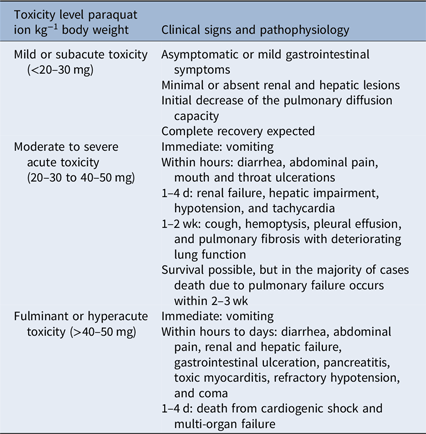
When people ingest or inhale paraquat, the first clinical signs are gastrointestinal disturbances and vomiting. Early signs include compromised renal function, mild hypertension, and pulmonary alveolar damage in the lungs, inevitably leading to death by respiratory failure (Dinis-Oliveira et al. Reference Dinis-Oliveira, Duarte, Sanchez-Navarro, Remiao, Bastos and Carvalho2008; Lock and Wilks Reference Lock, Wilks and Krieger2001; Vale et al. Reference Vale, Meredith and Buckley1987). Paraquat toxicity can be classified into three levels based on the amount of paraquat ions ingested, clinical signs, and pathophysiology after swallowing or inhaling paraquat (Table 1) (Lock and Wilks Reference Lock, Wilks and Krieger2010) at rates as low as 20 to 30 mg paraquat ion kg−1 of body weight. At this dosage, a complete recovery of the patient would be expected when appropriate treatment is made. At a marginally higher dose ranging from 20 to 30 mg to 40 to 50 mg of paraquat ion kg−1 of body weight, paraquat causes moderate to severe acute toxicity and immediately causes vomiting. Within hours, diarrhea, abdominal pain, and mouth and throat ulcerations occur. Within 1 to 4 d, renal failure, hepatic impairment, hypotension, and tachycardia occur, with pulmonary fibrosis and deteriorating lung function occurring in 1 to 2 wk. Survival is possible, but in the majority of cases, death due to pulmonary failure occurs within 2 to 3 wk. At doses greater than 40 to 50 mg paraquat ion kg−1 of body weight, paraquat causes fulminant or hyperacute toxicity in humans. Within 1 to 4 d, death occurs due to cardiogenic shock and multi-organ failure.
Clinical signs and pathophysiology after swallowing or inhaling paraquat (based on Lock and Wilks Reference Lock, Wilks and Krieger2010).

Once swallowed, paraquat causes highly acute toxicity in humans. Survival depends on the amount of paraquat swallowed and treatment timing. The earlier the treatment, the greater the survival rate. A significant number of patients with very low plasma paraquat levels—0.12 μg ml−1 at 5 h, 0.02 μg ml−1 at 12 h, and 0.01 μg ml−1 at 24 h after ingestion—will die (Gil et al. Reference Gil, Kang, Yang, Lee and Hong2008). Survival decreases with greater age and respiratory rate, as well as with increasing white blood cell count and blood urea nitrogen and amylase levels (Lee et al. Reference Lee, Hwang, Yang and Hong2002). The high fatality levels of paraquat and the lack of an antidote for patients who ingested paraquat thus led to high criticism of the product, resulting in cancellation of paraquat registration and commercial use in many countries, including Korea.
Impact of the Paraquat Ban on Human Health
Suicide Rates before the Paraquat Ban
Korea topped the suicide rate among Organization for Economic Co-operation and Development (OECD) countries, with 28.4 deaths per 100,000 population in 2009 (OECD 2011). This rate is more than two times greater than the OECD average, and almost three times greater than in the United States. The suicide death rates for men are generally three to four times greater than those for women across OECD countries, but Korea showed an exceptional trend of a gender gap, with the suicidal rate for women amounting to 19.7 per 100,000 population, while that of men was 39.3. Although suicide rates have decreased in many OECD countries, with pronounced declines of greater than 40% in Estonia and Luxembourg since 1995, Korea’s death rates from suicides have dramatically increased from 11.2 deaths per 100,000 people in 1995 to 28.4 deaths in 2009 (153.6% increase). This high suicide rate in Korea may be due to the economic crisis that occurred in 1997. Further, between 2006 and 2010, the number of persons treated for depression and bipolar disease in Korea rose sharply, with those in low socioeconomic groups more likely to be affected (HIRA 2011). The economic crisis weakened social integration and eroded the traditional family support base for the elderly, resulting in an increase in suicide rates in Korea (Kwon et al. Reference Kwon, Chun and Cho2009). In 2010, 3,206 people committed suicide by paraquat poisoning, leading to strong criticism against not only paraquat but also other herbicides (Kim et al. Reference Kim, Shin, Jeong, Suh and Kwak2017), as the general public tends to believe that all herbicides are more toxic than insecticides or fungicides.
Change in Suicide Rates after the Paraquat Ban
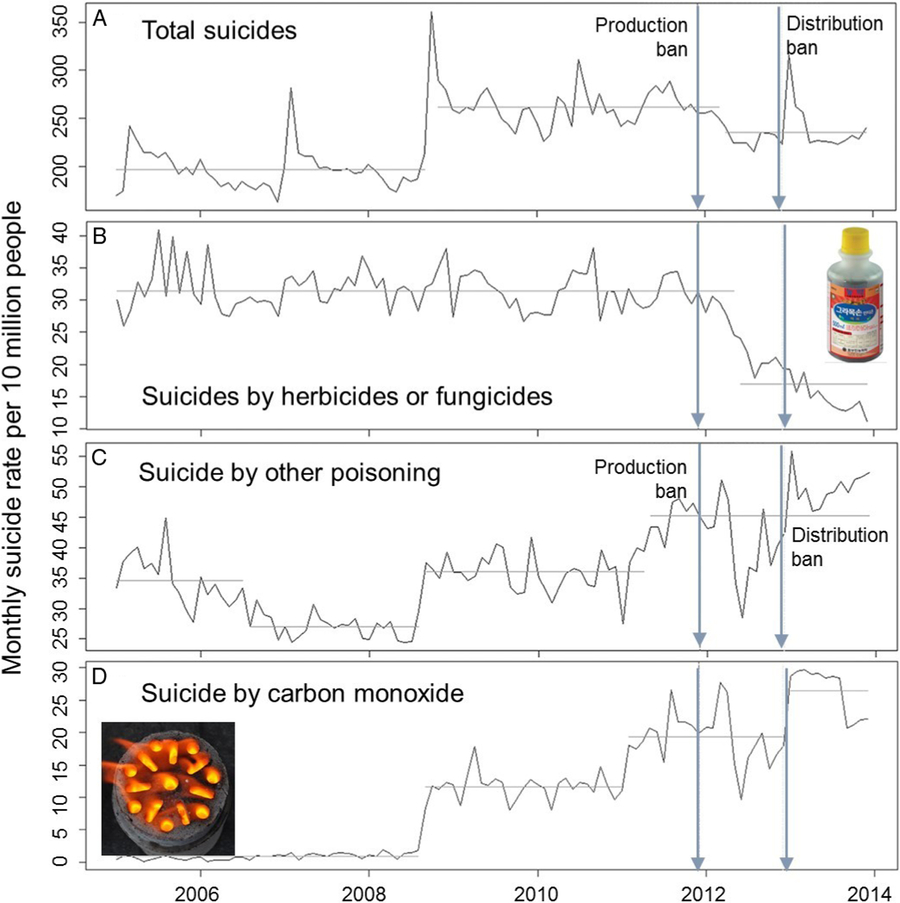
Before the paraquat ban, pesticide-associated suicides accounted for 9.7% of the total suicides during 2009 to 2010, and this immediately dropped to 6.5% after the paraquat ban (Kim et al. Reference Kim, Shin, Jeong, Suh and Kwak2017), indicating that the herbicide was the most significant agent among pesticides associated with suicides. The overall suicide rate decreased by 16.8%, positioning Korea at 4th place in suicide rates in the 3 yr after the paraquat ban (WHO 2017). The paraquat ban rapidly decreased the total intentional and occupational poisoning due to pesticides by 46.1%, from 31.39 per 10 million people in November 2011 to 16.93 per 10 million people in May 2012 (Figure 1B), leading to a 10.0% decrease in total suicides (Figure 1A). This finding indicates that national policies banning highly toxic suicidal agents may lead to lower rates of suicide with these agents and thus achieve the goal of reducing overall suicide rates (Myung et al. Reference Myung, Lee, Won, Fava, Mischoulon, Nyer, Kim, Heo and Jeon2015).
Changes in monthly suicide rate in total suicides (A), suicides by herbicides or fungicides (B), suicide by other poisoning (C), and suicide by carbon monoxide (D) (modified from Myung et al. Reference Myung, Lee, Won, Fava, Mischoulon, Nyer, Kim, Heo and Jeon2015).

Similar to Korea, and for the same reason, Sri Lanka also stopped issuing import licenses for paraquat in 2011 and officially banned the product in 2014. A phased ban of paraquat reduced pesticide-associated suicide rates, with the total suicide mortality in Sri Lanka dropping by 21% between 2011 and 2015 (from 18.3 to 14.3 per 100,000 population), and the decline in pesticide-associated suicides during this period was higher than the decline in total suicides: from 8.5 to 4.2 per 100,000 population, a 50% reduction (Knipe et al. Reference Knipe, Chang, Dawson, Eddleston, Konradsen, Metcalfe and David2017).
It is evident that bans imposed on paraquat have significantly decreased the number of people committing suicide by using the herbicide and also the overall suicide rates in both Korea (Figure 1A and B) and Sri Lanka (Knipe et al. Reference Knipe, Chang, Dawson, Eddleston, Konradsen, Metcalfe and David2017), suggesting that imposing a ban on paraquat can be a national strategy for suicide prevention.
Change in Suicide Attempts with Alternatives
The paraquat ban has also led to a substitution in the method of suicide attempts. The suicide rate using other poisonous substances has increased during the time of the paraquat ban, but has not exceeded the reduction in suicide rates by herbicide poisoning (Myung et al. Reference Myung, Lee, Won, Fava, Mischoulon, Nyer, Kim, Heo and Jeon2015). In Korea, the most significant substitution in the method of suicide attempts is the use of carbon monoxide and other poisons (Figure 1C and D), suggesting that there are limits to the effect that preventing access to toxic suicidal agents can have in lowering overall suicide rates.
Interestingly, suicide attempts using other herbicides such as glyphosate and glufosinate increased. Suicide attempts with glyphosate increased almost 3-fold from 10% in 2011 to 29.5% in 2014, and those with glufosinate increased almost 4-fold from 5% in 2011 to 19.2% in 2014 (Lee et al. Reference Lee, Hwang, Kim, Moon, Kim, Park, Gil and Hong2015). However, the number of suicide attempts using glyphosate and glufosinate is lower than the number attempted with paraquat, and suicide mortality (the ratio of persons succeeding in suicide to those attempting suicide) using pesticides has decreased since the paraquat ban (Lee et al. Reference Lee, Hwang, Kim, Moon, Kim, Park, Gil and Hong2015). The paraquat ban in Sri Lanka has also led to a concurrent rise in non-pesticide suicide mortality, with a 2% increase (9.9 to 10.1 per 100,000 population), suggesting a shift of some suicide attempts using pesticides to non-pesticides, although this increase is marginal (Knipe et al. Reference Knipe, Chang, Dawson, Eddleston, Konradsen, Metcalfe and David2017).
Impact of the Paraquat Ban on Agriculture
Change in Nonselective Herbicide Market after the Paraquat Ban
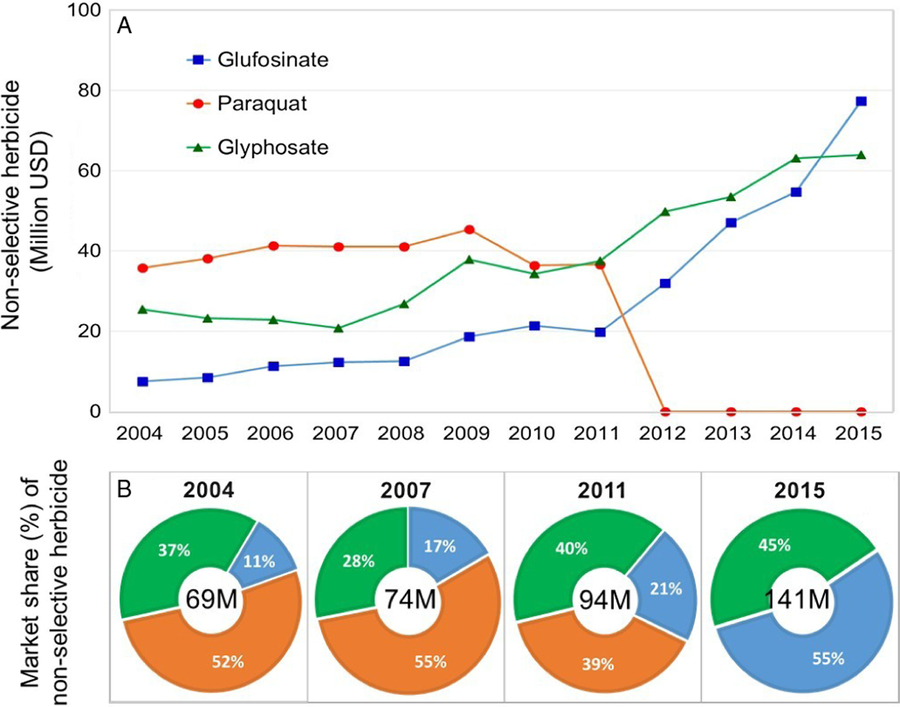
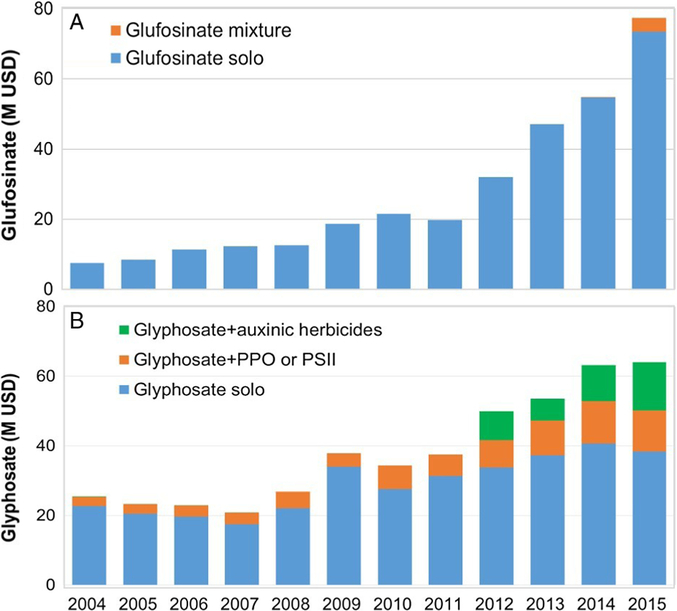
Until the ban was imposed in 2012, paraquat retained a strong market position, US$36.7 million in 2011, as the best-selling herbicide used by Korean farmers for three decades (Figure 2A). The paraquat ban in Korea had a direct impact on the Korean nonselective herbicide market. The two remaining nonselective herbicides, glyphosate and glufosinate, quickly replaced paraquat with increases in sales of 61% and 33%, respectively, just in the year after the paraquat ban (Figure 2A). At 3 yr after the paraquat ban, annual sales of the two herbicides increased by 14.9% and 41.6%, respectively, indicating that the paraquat ban provided a better opening for glufosinate than glyphosate. This is because glufosinate has herbicidal activity similar to that of paraquat, and Korean farmers prefer herbicides with contact activity and rapid action. Further, glufosinate is registered for interrow use in many upland crops. Consequently, the market share of glufosinate accounted for 55% of the total nonselective herbicide market in Korea in 2015 (Figure 2B), mainly due to a significant increase in sales of products containing only glufosinate (Figure 3A).


The paraquat ban also increased glyphosate sales. Glyphosate products marketed in Korea comprised solo products and pre-mixed formulations that included auxinic herbicides, protophorphyrin IX oxidase (PPO) or photosystem II inhibitors. The sales of glyphosate mixtures increased notably, more than sales of glyphosate products containing only the active ingredient. The glyphosate products containing only the active ingredient continue to play a main role in glyphosate sales, but glyphosate mixtures represented almost 40% of glyphosate sales in Korea in 2015 (Figure 3B). The ban of relatively cheap paraquat and the substitution with glufosinate and glyphosate increased the overall nonselective herbicide market size from US$94 million in 2011 to US$141 million in 2015 (Figure 2B).
The impact of the paraquat ban in Korea on the global market was minimal because of the relatively smaller size of the Korean market. However, the paraquat ban in China in 2015 significantly affected global sales, as China was the biggest market for paraquat in Asia until 2015. The paraquat ban in China led to dramatically reduced sales for the herbicide in Asia and globally by 23% and 12%, respectively, in 2016, as compared with sales in 2015. Similar to the situation in Korea, the paraquat ban in China coincided with an increase in the sale of other nonselective herbicides. Annual sales of glufosinate and saflufenacil increased by 11.0% and 25.5%, respectively, from 2011 to 2016 (FarmHannong Ltd., personal communication). The paraquat ban will particularly be an opportunity for PPO inhibitors such as saflufenacil and tiafenacil, which have similarly rapid action and PRE and POST weed control. Tiafenacil (Terrad’or™) in particular is a PPO inhibitor newly developed by FarmHannong of LG Chem Ltd. (Seoul, Republic of Korea) and registered in Korea (2018) and Sri Lanka (2019), where paraquat was banned for nonselective weed control.
Change in Weed Management Practice after the Paraquat Ban
Paraquat has been used for nonselective weed control in orchards, non-cropping areas, and interrow spaces between crops and for burn-down treatments before planting crops in many countries, including Korea. In some countries, it has commonly been used for desiccating potato (Solanum tuberosum L.), cotton (Gossypium hirsutum L.), and grain crops before harvest. Owing to its rapid action and contact activity, paraquat played an important role in weed management in Korean upland fields, particularly for row crops, where it had commonly been sprayed in interrow spaces for weed control. As seen in Figure 2, paraquat has quickly been replaced by the nonselective herbicides, among which glufosinate replaced paraquat more notably than glyphosate given the increase in its market share. This is due to the fact that glufosinate is also a contact and fast-acting herbicide, making it the only substitute for paraquat for weed control in interrow spaces. In addition, the paraquat ban also increased the use of PPO inhibitors such as saflufenacil (KCPA 2016). Therefore, the increased use of glufosinate and saflufenacil suggests that these herbicides have replaced paraquat, resulting in the paraquat ban having no or little impact on weed management practices. A recent launch of the new PPO inhibitor tiafenacil may also help to minimize the impact of the paraquat ban on nonselective weed control in Korea. For desiccation treatment, diquat and PPO inhibitors can replace paraquat. With such developments, the paraquat ban may not have a significant impact on weed management practices in Korea.
Conclusion
This review demonstrates that the paraquat ban reduced the total suicides in both Korea and Sri Lanka but did not impact agricultural practices, particularly in weed management, due to the availability of alternative herbicides such as glyphosate, glufosinate, and saflufenacil. The paraquat ban reduced total suicides through a significant reduction in paraquat-associated suicide, suggesting that limiting access to suicidal agents can be considered as a national strategy to lower suicide rates. However, paraquat was quickly replaced by other poisonous substances for suicide attempts, in particular carbon monoxide. The significant increase in suicide attempts by carbon monoxide is due to easy accessibility to charcoal briquettes, which can be purchased with no restriction at a low price in Korea (Myung et al. Reference Myung, Lee, Won, Fava, Mischoulon, Nyer, Kim, Heo and Jeon2015). This finding suggests that multilateral efforts are required to limit the access to chemicals with higher mammalian toxicity and to minimize social causes of suicide attempts, as the ban imposed on paraquat alone has its own limits in lowering suicide rates. The paraquat ban provided an opportunity to expand the market share of existing nonselective herbicides, particularly PPO inhibitors having herbicidal activity similar to paraquat, and to introduce a new nonselective herbicide. Apparently weed management by nonselective herbicide was not much affected by the ban due to the substitution of glufosinate and PPO inhibitors in place of paraquat. However, it should be noted that farmers had to pay more for weed management using nonselective herbicides, considering the increased market value of nonselective herbicides after the ban of cheap paraquat (Figure 2). Future analyses of changes in national suicide rates and nonselective herbicide use may help in understanding the long-term impacts of the paraquat ban.
Acknowledgments
This work was carried out with the support of the Cooperative Research Program for Agriculture Science & Technology Development (project no. PJ012457), Rural Development Administration, Republic of Korea. No conflicts of interest have been declared.