Introduction
The 10/66 Dementia Research Group reported that low- and middle-income countries are home to a majority of the world's population, and thus, a majority of individuals living with dementia (Ferri et al., Reference Ferri2005; Van der Poel and Pretorius, Reference Van der Poel and Pretorius2009; Prince et al., Reference Prince, Bryce, Albanese, Wimo, Ribeiro and Ferri2013). Individuals living in these countries may have unique risk factors (e.g. trauma, childhood adversity, low education) that make them vulnerable to dementia (Tschanz et al., Reference Tschanz, Norton, Zandi and Lyketsos2013; Kaup et al., Reference Kaup2014). Vietnam is a lower middle-income country whose older adult population and life expectancy has increased rapidly recently. Despite this rapid growth, little data exist regarding the cognitive health concerns of this population including Alzheimer's disease and related dementias. Given that there are no prevalence estimates for dementia, an understanding of how people in Vietnam perceive their memory may have important implications for functioning and healthcare.
Subjective memory complaints (SMCs) have been increasingly studied because they may indicate a person is suffering from cognitive problems typical of dementia. As adults age, SMCs become more common and in addition to risk of dementia, are associated with a variety of poor outcomes including problems with activities of daily living, nursing home placement, and depression (Johansson et al., Reference Johansson, Allen-Burge and Zarit1997; Jonker et al., Reference Jonker, Geerlings and Schmand2000; Pearman and Storandt, Reference Pearman and Storandt2004; Crane et al., Reference Crane, Bogner, Brown and Gallo2007; Waldorff et al., Reference Waldorff, Siersma, Vogel and Waldemar2012). Additionally, the clinical diagnosis of mild cognitive impairment includes memory complaints as part of the criteria.
SMCs’ association with cognitive impairment and depression
Although there is research indicating that SMCs are associated with objective cognitive impairment in some Western samples, the findings tend to be mixed (Johansson et al., Reference Johansson, Allen-Burge and Zarit1997; Reid and MacLullich, Reference Reid and MacLullich2006). Some studies report an association between SMCs and objective memory ability (Gagnon et al., Reference Gagnon1994; Jonker et al., Reference Jonker, Launer, Hooijer and Lindeboom1996; Calabria et al., Reference Calabria, Manenti, Rosini, Zanetti, Miniussi and Cotelli2011) or cognitive decline (Jorm et al., Reference Jorm, Christensen, Korten, Jacomb and Henderson2001; Wang et al., Reference Wang2004). Yet, other studies report no association (e.g. Smith et al., Reference Smith, Petersen, Ivnik, Malec and Tangalos1996; Clement et al., Reference Clement, Belleville and Gauthier2008). Two meta-analyses examining the associations between subjective and objective memory detected very small effect sizes, although they were positive and reliably different from zero (Beaudoin and Desrichard, Reference Beaudoin and Desrichard2011; Crumley et al., Reference Crumley, Stetler and Horhota2014).
Some researchers have suggested that SMCs may be more related to other psychological constructs such as mood or affect, than cognitive impairment (Grut et al., Reference Grut, Jorm, Fratiglioni, Forsell, Viitanen and Winblad1993; Smith et al., Reference Smith, Petersen, Ivnik, Malec and Tangalos1996; Kim et al., Reference Kim, Stewart, Shin, Choi and Yoon2003). Hülür and colleagues (Reference Hülür, Hertzog, Pearman and Gerstorf2015) found that fluctuations in individuals’ SMCs were, on average, coupled with fluctuations in objective memory as well as depressive symptoms, highlighting the connection among SMCs, depression, and objective memory. Depression may impact one's awareness of or attention to memory changes. People who are depressed may pay more attention to or monitor their state more closely for negative or problematic symptoms (Grut et al., Reference Grut, Jorm, Fratiglioni, Forsell, Viitanen and Winblad1993; Kim et al., Reference Kim, Stewart, Shin, Choi and Yoon2003; Hülür et al., Reference Hülür, Hertzog, Pearman and Gerstorf2015). In their longitudinal study, Jorm et al. (Reference Jorm, Christensen, Korten, Jacomb and Henderson2001) concluded that SMCs experienced at any given time are, above all, associated with anxiety and depression. West et al. (Reference West, Boatwright and Schleser1984) found that anxiety was more strongly related to SMCs than was depression, similar to Yates et al. (Reference Yates, Clare and Woods2017). People who are overly concerned about their health problems, or who display hypochondriac traits, may underestimate their health status and therefore their memory as well (Hanninen et al., Reference Hanninen1994). Thus, worry and reported pain could be important contributors to SMCs (Westoby et al., Reference Westoby, Mallen and Thomas2009).
Additionally, complaint patterns may differ across various diseases (Niederehe, Reference Niederehe and Lomranz1998). SMCs have been studied in the context of a variety of chronic illnesses, including cardiovascular disease and diabetes. Another important factor that individuals in developing countries face is difficulty in attaining basic daily necessities such as food, water, or transportation, or what is called “material hardship” (Leggett et al., Reference Leggett, Zarit, Hoang and Nguyen2013). Though material hardship has been assessed in various forms, economic disadvantage has commonly been associated with greater cognitive impairment. Additionally, material hardship is potentially an important correlate because chronic stress associated with material hardship has been shown to be related to SMCs (e.g. Peavy et al., Reference Peavy2012). Finally, and particularly relevant to Vietnam, is whether individuals suffered head trauma or other war injury. Living through a period of war (e.g. Vietnam War occurred 1954–1975, although conflict in the Southeast Asia region stretched back several decades) is a stressor that may be prolonged by the suffering of an injury. Additionally, there is some literature indicating that individuals who have a mild traumatic brain injury report more SMCs (see McAllister et al., Reference McAllister1999).
The current study
Vietnamese adults are at significant risk for cognitive impairment and depression given their low education and socio-economic status (Tschanz et al., Reference Tschanz, Norton, Zandi and Lyketsos2013; Kaup et al., Reference Kaup2014). However, little research on SMCs has been done with the aging Vietnamese population and their associations with objective cognitive function and depression are unknown. In this study, we first examine the prevalence of SMCs of community-dwelling adults living in Vietnam. Second, we examine the factors associated with SMCs, using Niederehe's (Reference Niederehe and Lomranz1998) theoretical model as a guide for our choice of predictors. This model is comprehensive and includes objective cognitive impairment, health status, including diseases, contextual factors, and psychological factors. For example, psychological or personality factors such as depression and trait anxiety may influence SMCs. Importantly, Niederehe's model highlights the important role of affect, attitudes and self-perception, and interpersonal functions on SMCs. The model suggests that these and other factors outside cognitive impairment can affect individuals’ SMCs. We also control for a variety of demographic factors (i.e. age, gender, and education level).
An understanding of the prevalence of SMCs and the complex association between SMCs, cognition, and depression as well as SMCs’ correlates, may prepare caregivers and alert physicians to assess for mood disturbance and/or cognitive impairment and help guide care decisions. Further, outside of Vietnam, these associations may have implications for the Vietnamese population in countries such as the USA.
Methods
Procedure
This research was developed from an educational partnership between the National Technical College of Medicine 2 (now the Da Nang University of Medical Technology and Pharmacy), Da Nang, Vietnam, the Institute for Gerontology, Jönköping University, Jönköping, Sweden, Penn State University, and Wake Forest University. Data are drawn from a cross-sectional study examining socio-demographic characteristics, health, social support, and mental health in a stratified sample of 600 adults aged 55 years and older living. The final analytic sample was 538 adults. Students and faculty from the Vietnam university conducted home interviews, and participants were given a small gift valued at three U.S. dollars for their participation.
Sample
A stratified sample of 600 individuals was recruited from population records with the achieved pre-recruitment goal of obtaining 500 participants with approximately equal numbers of women and men and urban and rural residents within seven age categories (55–59, 60–64, 65–69, 70–74, 75–79, 80–84, and 85 years and over). Households within the selected subdistricts in Da Nang and surrounding rural areas were randomly selected for recruitment. Da Nang is urban and is the largest city in Central Vietnam and the third largest in the entire country with regards to urbanization and economy (Biggest Cities in Vietnam, 2017). Because it is a port city, Da Nang is the leading industrial center of central Vietnam and has one of the highest GDP per capita in the country.
The multi-stage sampling technique occurred in these steps: (1) two districts were purposively selected from eight districts of Da Nang city, one urban district (Hai Chau), and one rural (Hoa Vang); (2) three subdistricts (also referred to as “wards/phường” in urban areas or “communes/xã” in rural areas) were randomly selected from the 13 total wards of Hai Chau and three communes were randomly selected from the 14 total communes of Hoa Vang; (3) ten household groups (i.e. “hamlets/tổ dân phố” in urban areas or “villages/thôn” in rural areas) were randomly selected from each ward or commune; and (4) ten older adults were purposively selected from each household group based on meeting inclusion criteria and agreement after contact with the local guides. Interviewers called on homes until they reached their goals in terms of age and gender within the district. Three participants declined participation in the study with difficulty scheduling the interview being cited as the main reason for refusal.
Measures
Translations were made from English language measures (e.g. CES-D) and back translations were performed for all measures (except for the MMSE which had already been translated) and checked by two bilingual members of the research team.
Outcome
Subjective memory complaints (SMCs)
SMCs were assessed with two items: “Do you think (on the whole) that your memory is good or poor? (four-point scale of “very good” to “very poor”)” and “Do you think that you have some problems with memory that interfere with your daily life? (four-point scale of “no, not at all” to “a great deal”).” Given that both complaints were on a four-point scale with different qualitative response categories, we standardized each variable and then averaged them for a composite score. Higher scores indicate stronger memory complaints (α = 0.73). This measure of SMCs is commonly used in studies of older adults (Johansson et al., Reference Johansson, Allen-Burge and Zarit1997; Montejo et al., Reference Montejo, Montenegro, Fernández and Maestu2011; Hülür et al., Reference Hülür, Hertzog, Pearman and Gerstorf2015; O'Shea et al., Reference O'Shea, Dotson, Fieo, Tsapanou, Zahodne and Stern2016) and was chosen for its ease of administration given that the entire assessment contained multiple measures of mood, cognition, and health, and participant burden was a concern.
Predictors
Cognitive function
Cognitive function was measured using the Mini-Mental State Examination (MMSE: Folstein et al., Reference Folstein, Folstein and McHugh1975). The MMSE assesses domains of memory, orientation, and arithmetic on a 30-point scale with a lower score indicating greater cognitive impairment. MMSE total score was used as a continuous measure to indicate overall cognitive functioning.
Depressive symptoms
Depressive symptoms were measured with the Center for Epidemiologic Studies-Depression Scale (CES-D: Radloff, Reference Radloff1977). The CES-D has shown acceptable fit in confirmatory analysis for use with Vietnamese Americans and has been found valid and reliable for use with older adults (Tran et al., Reference Tran, Ngo and Conway2003). Due to an inadvertent omission from the printed interview, the item “I talked less than usual” was omitted such that only 19 items were administered. Therefore, scores were prorated to reflect a full score on the CES-D by adding participant's mean item score in place of the missing item (α = 0.85).
Worry
Worry was assessed with a 12-item scale (11 items relevant to common superstitions and fears among older adults in Vietnam) taken from the Revised Fear Survey Schedule for Children (Ollendick, Reference Ollendick1983), which describes the extent of worry regarding dangers, cultural taboos, and superstitions (e.g. thunderstorms, ghosts, and one item was developed by the research team, “something bad might happen to one of your children” which represents a common fear not relevant for children). The research team felt this scale was more culturally relevant than other common scales of worry used in Western studies. Items were on a three-point scale from “not at all worried” to “very worried” with a higher score indicating greater worry (α = 0.82).
Cardiovascular and cerebrovascular problems (CVP)
CVPs were measured by a sum of illnesses participants self-reported on a checklist of problems (heart disease, high blood pressure, stroke with mild symptoms, stroke with paralysis, diabetes, and cholesterol).
Health
General health covariates included an overall rating of health, pain, grip strength, report of head trauma (yes/no), and body mass index (BMI). Participants rated their health on a scale from poor (1) to excellent (5). Pain was assessed with three items on the amount and frequency of pain experienced and whether pain interfered with one's work in the last month. Two items were drawn from the SF-36 (How much bodily pain have you had during the past four weeks? During the past four weeks, how much did pain interfere with your normal work – including both work outside the home and housework?) (Ware et al., Reference Ware, Kosinski and Keller1996) and one item was developed by the research team to include an assessment of pain frequency given prior geriatric work showing the importance of assessing both pain intensity and frequency (“During the past month, how often have you had pain or discomfort”) (Fries et al., Reference Fries, Simon, Morris, Flodstrom and Bookstein2001). Items were z-scored to be on a comparable scale and summed with a higher score indicating greater pain (α = 0.72). Grip strength was measured using a handgrip dynamometer. Scores were an average of three trials with one's left hand and three trials with one's right hand.
Covariates
Age, gender, and education level (a scale of 0 = no formal education to 4= college education or higher) were included as demographic controls. Material hardship was also assessed, and was a count of an individual's access to resources of daily life and includes eight items developed by the research team based on prior work within the NIA's Internal Research Program, including whether the individual owned items such as a television and whether he/she had sufficient access to water and food, with a higher score indicating greater material hardship (i.e. less access to resources).
Statistical analysis
First, descriptive statistics were run for key study variables. For the purposes of testing whether there were demographic differences between those with more SMCs, participants were classified as having SMCs if they answered “poor” or “very poor” to –- “Do you think that your memory is good or poor?” AND answered, “a little,” “somewhat,” or “a great deal” to “Do you think that you have some problems with memory that interfere with your daily life?” χ 2 and t-tests were used to examine demographic differences in SMC status for categorical and continuous variables, respectively. Next, we ran a series of stepwise multiple linear regressions to examine factors associated with SMCs. We used the continuous variable of SMCs (described earlier in Methods) because it retained the most information. We first entered demographic factors (gender, age), followed by contextual covariates (education, material hardship), health covariates (self-rated health, pain, head trauma, BMI, grip strength), a count of CVPs, psychological covariates (depressive symptoms, worry), and finally, objective cognitive function (MMSE). To address some of the previous debates in the literature and determine whether depression and objective cognitive function were associated with SMCs in the same way, we compared the magnitude of the two regression coefficients using the likelihood ratio test in LISREL 9.2 (Jöreskog and Sörbom, Reference Jöreskog and Sörbom2015). Specifically, the likelihood ratio test allowed us to test whether constraining the two coefficients to be equal would significantly impact the fit of the model. A significant difference in model fit would indicate that the strength of the association between depression and SMCs and between objective cognitive function and SMCs was different.
Results
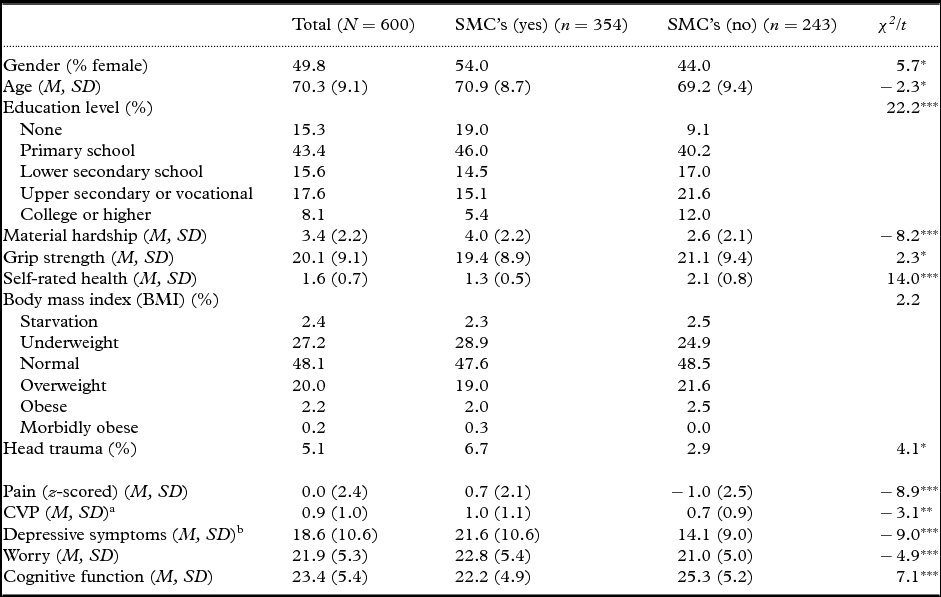
Full sample characteristics by SMCs status are displayed in Table 1. Our sample consisted of almost 50% female, with an average age of 70 years. About 58% of the sample had a primary school education or lower. Results indicated that only 3% of the entire sample reported very good memory overall, 33% good memory, 57% poor, and 6% very poor. In response to whether memory problems interfered with their daily life, 26% reported not at all, 34% a little, 19% somewhat, and 19% a great deal. Thus, SMCs were common in the sample with 64% reporting poor or very poor memory and 38% saying that memory interfered with one's daily life at least somewhat. Depressive symptoms were also common (CES-D: M = 18.6, SD = 10.6) and performance on the MMSE was relatively poor (M = 23.4, SD = 5.4). There were significant differences between those with SMCs and those without (caseness described in Methods) on all variables except BMI. Those with SMCs were more likely to be female, older, less educated, to have more material hardship, poorer grip strength and self-rated health, report pain, head trauma, self-reported CVPs, depression and worry, and lower cognitive function.
Characteristics of the study sample

Note: ***p < 0.001, **p < 0.01, and *p < 0.05.
a CVP: Self-reported cardiovascular and cerebrovascular problems; bScores are prorated due to one inadvertent item omission as described in Methods.
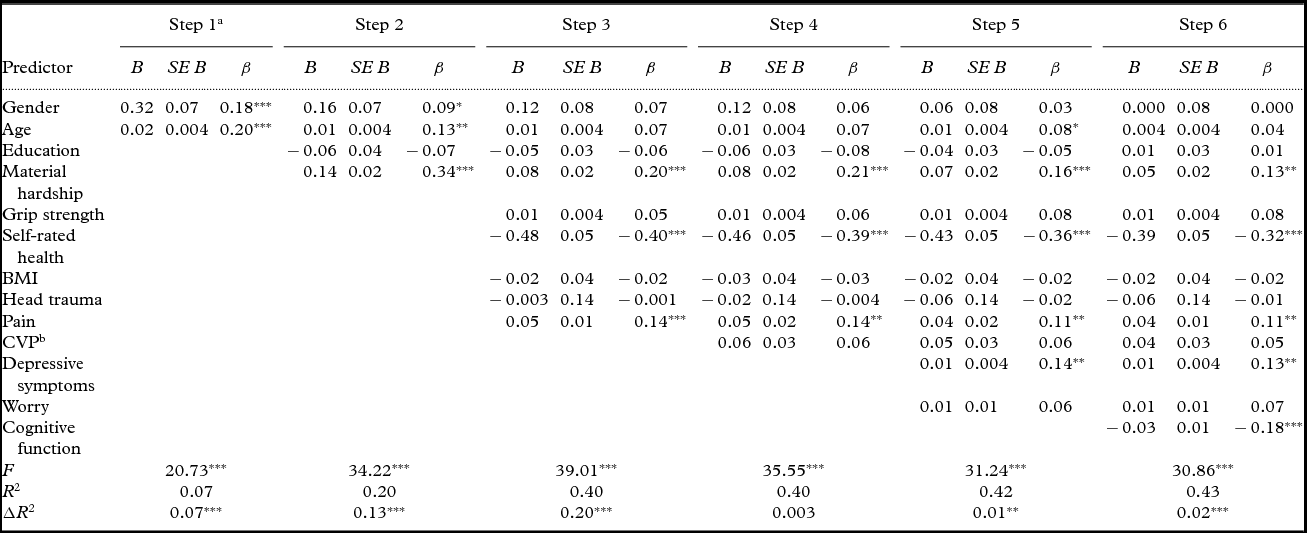
Next multiple linear regressions were run to examine demographic, contextual, health, psychological, and cognitive covariates of SMCs. Results for the full stepwise linear regression analyses can be found in Table 2. Each added block of covariates added significant explanatory value (R-squared change) to the model except for the addition of self-reported CVPs. In the final step with all covariates in the model, more SMCs were associated with greater material hardship (β = 0.13, p < 0.01), poorer self-rated health (β = −0.32, p < 0.001), and more pain (β = 0.11, p < 0.01), depressive symptoms (β = 0.13, p < 0.01), and cognitive impairment (β = −0.18, p < 0.001).
Regression of demographic characteristics, health, and psychological covariates on subjective memory complaints

Note: ***p < 0.001, **p < 0.01, and *p < 0.05; Model N = 595 (step 1), 591 (step 2), 570 (step 3), 564 (step 4), 559 (step 5), 538 (step 6).
a Step 1: Demographic factors (gender, age), Step 2: Contextual covariates (education, material hardship), Step 3: Health covariates (grip strength, self-rated health, body mass index (BMI), head trauma, pain), Step 4: Comorbidities (number of cerebrovascular and cardiovascular problems), Step 5: Psychological covariates (depressive symptoms, worry), Step 6: Objective cognitive function.
b CVP: Self-reported cardiovascular and cerebrovascular problems.
The likelihood ratio test comparing coefficients of depression and objective cognitive function was not significant (χ 2 = 1.62, p = 0.80). Hence, there was no evidence that one was more related to SMCs than the other.
Discussion
To our knowledge, this is the first study to examine prevalence and correlates of SMCs in a group potentially at risk for cognitive impairment related to dementia. In community-based studies, there is often a wide range, with the prevalence of SMCs varying from approximately 11% (Geerlings et al., Reference Geerlings, Jonker, Bouter, Ader and Schmand1999) to more than 60% (Jorm et al., Reference Jorm, Christensen, Henderson, Korten, Mackinnon and Scott1994). Results from a meta-analysis indicated that almost 40% of individuals (not excluding those with dementia) reported SMCs (Mitchell, Reference Mitchell2008). Thus, our prevalence (64%) is quite high and is interesting considering that in another study using this same sample, less than 13% met criteria for cognitive impairment using the MMSE (although the prevalence unadjusted for education was 33.5%; Leggett et al., Reference Leggett, Zarit, Hoang and Nguyen2013). However, Western studies with older Vietnamese also suggest poorer health for this population. Using a population-based sample of Californians, Sorkin and colleagues (Reference Sorkin, Tan, Hays, Mangione and Ngo-Metzger2008) found that compared to non-Hispanic Whites, Vietnamese were more likely to report needing help for mental health problems but less likely to have had their medical providers discuss their problems with them. In addition, Vietnamese participants reported significantly worse health than Whites on five of eight domains of the Medical Outcomes Survey. Research done among Vietnamese refugees in Australia showed similar findings, with Vietnamese adults reporting more disability from mental health problems compared to White Australians (Steel et al., Reference Steel, Silove, Chey, Bauman, Phan and Phan2005).
This study found that even after controlling for several potential confounders (e.g. depression), SMCs were associated with objective cognitive impairment. Our results are similar to findings by other population-based samples that indicate associations between subjective complaints and global measures of cognition (Montejo et al., Reference Montejo, Montenegro, Fernández and Maestu2011; Waldorff et al., Reference Waldorff, Siersma, Vogel and Waldemar2012). Unlike previous studies, however, we included a number of potential covariates, including depressive symptoms that might explain the relation between SMCs and objective cognitive function. Thus, we add to the literature that suggests SMCs are independently related to objective cognitive function.
In a recent meta-analysis and review of cross-sectional studies, methodologically robust studies tended to show evidence that subjective cognitive complaints (not limited to memory issues) were associated with depressive symptoms or objective cognitive functioning (Burmester et al., Reference Burmester, Leathem and Merrick2016). Genziani et al. (Reference Genziani, Stewart, Bejot, Amieva, Artero and Ritchie2013) and Montejo et al. (Reference Montejo2014) found depressive symptoms to be a greater predictor of subjective complaints than objective memory performance, although both made independent significant contributions to the models (Genziani et al., Reference Genziani, Stewart, Bejot, Amieva, Artero and Ritchie2013; Montejo et al., Reference Montejo2014). In our study, both depressive symptoms and objective cognitive impairment were equally related to SMCs, that is, one was not a stronger contributor than the other.
In addition to objective cognitive function and depressive symptoms, other correlates of SMCs emerged, including material hardship and self-reported pain, similar to previous research (Westoby et al., Reference Westoby, Mallen and Thomas2009) however, these effects were rather weak. Consistent with prior research, self-rated health emerged as a strong predictor of SMCs (Montejo et al., Reference Montejo, Mercedes, Ramón and Borja2016). This is not unexpected because poor self-rated health predicts a wide range of adverse outcomes. Recently, the Three Cities (3C) study found that self-rated health was a strong predictor of incident dementia, particularly in those with subjective cognitive complaints (Montlahuc et al., Reference Montlahuc2011).
Limitations
One limitation is related to the lack of an informant-rated measure of SMCs, which may provide a more comprehensive and/or accurate assessment of the individual with SMCs. For example, Juncos-Rabadan et al. (Reference Juncos-Rabadan2012) found that memory difficulties were linked to objective performance only when they were elicited from an informant, not the participant themselves. Additionally, a recent study indicated various methods of assessing SMCs produced different results (Burmester et al., Reference Burmester, Leathem and Merrick2017). Although our method of assessing SMCs is quite common, future research with the Vietnamese population should use several methods of assessing SMCs. The cross-sectional nature of this study also precludes us from assessing objective memory decline. It is possible that SMCs may better predict changes in memory over time, as previously demonstrated by longitudinal population studies investigating risk for cognitive decline and dementia (Schmand et al., Reference Schmand, Jonker, Hooijer and Lindeboom1996; Kryscio et al., Reference Kryscio2014). In our creation of a summed score for the MMSE, we required participants to have scores for at least 23 of 30 total item scores. This resulted in 23 participants being dropped from analysis. In many cases, there were several missing items due to low literacy or vision problems, potentially resulting in a lower overall score. Therefore, we use the MMSE as a standard measure of overall cognitive functioning, but recognize its limitations for distinguishing poor functioning due to dementia, and between low literacy and vision problems common in low- and middle-income countries. Future work on cognition among older adults in these countries may consider an additional measure that can circumvent these issues.
Implications
This study provides the only examination of the prevalence and predictors of SMCs in Vietnamese adults using a large and rigorous sample. The high prevalence of SMCs in this study indicates that clinicians should regularly assess older Vietnamese for cognitive impairment as well as depression. Even in cases where there is no evidence of memory impairment and complaints might be thought to reflect depressive symptoms, the possibility of future cognitive decline should not be discounted and SMCs still monitored for change and impact on functioning (Jonker et al., Reference Jonker, Geerlings and Schmand2000; Burmester et al., Reference Burmester, Leathem and Merrick2016). However, because we could control for depressive symptoms in the present study, even if individuals present with depressive symptoms and SMCs, a formal neuropsychological may still be necessary.
A caveat is that this population differs from community-dwelling adults in Western samples. The Vietnamese population in the USA, for example, tends to view memory problems as a normal part of aging (Meyer et al., Reference Meyer, Nguyen, Dao, Vu, Arean and Hinton2015). For this reason, individuals may complain less because memory problems are not seen as atypical or cause for concern. Thus, the presence of SMCs in this population may signal an important change/decline in cognition and functioning. On the other hand, SMCs in this population might be more common because there is no stigma attached to poor memory as one ages. That is, there is a general belief that memory problems are normal aging, so people may report SMCs more frequently because complaining about poor health is commonplace. For example, prior work has shown that other symptom complaints, such as depression and worry, are quite high in the Vietnamese context (Leggett et al., Reference Leggett, Zarit, Nguyen, Hoang and Nguyen2012). Future research should disentangle not only the effects of depression and SMCs on objective cognition, but include informant reports and other cognitive measures that can shed light onto the high prevalence of SMCs (and possibly depression and worry) in this population.
In conclusion, while it remains unclear whether SMCs indicate cognitive impairment and decline associated with dementia, prompt identification of those at highest risk of cognitive impairment, in the case of this population – individuals who face material hardship and report SMCs, pain, and poorer health – has important implications for facilitating early intervention and management of memory problems that may negatively impact quality of life.
Conflict of interest
None.
Description of authors’ roles
OLM designed the research question for this study, supervised data analyses, and wrote the paper. AL helped by providing input on designing the study, analyzing data, and writing the paper. SL provided input on and helped with data analyses and writing the paper. NHN helped collect the original data in Vietnam and writing the paper.
Acknowledgments
This research was supported in part by the National Institute on Aging [P30AG010129, K01AG052646, contract HHSN311200900097P], the Alzheimer's Association [MNIRGD-391433], the Laboratory of Behavioral Neuroscience, Intramural Research Program, and a Wake Forest School of Medicine, Office of Research Faculty Foreign Travel award. We are grateful to Dr Steven Zarit for his advice and guidance on earlier drafts of this paper.