“Threescore years and two have now elapsed since our fathers ventured on the grand experiment of freedom.” So said the renowned actor Edwin Forrest in a Fourth of July address at New York City's Broadway Tabernacle in 1838.Footnote 1 The similarity to the start of the Gettysburg Address in 1863 is striking: “Four score and seven years ago our fathers brought forth on this continent, a new nation, conceived in Liberty.”Footnote 2
That parallel would be little more than a historical curiosity except that resemblance expands. Phrase by phrase and in virtually identical order, Lincoln's address echoes the first three and final two paragraphs of Forrest's ninety-minute oration. Beyond phrasing, the rhetorical connections extend into politics. Forrest had been invited to speak as a possible Democratic candidate for Congress, joining a partisan battle that Lincoln had engaged six months earlier at the Springfield Lyceum. Although no direct evidence places the speech in Lincoln's hands, what we know of his political appetite and his fondness for theatre makes it certain that he knew of the great actor's oration to the Democrats.
Yet if any have noted the possible connection until now, they remain obscure. Neither Lincoln biographers nor Civil War historians, Forrest biographers nor theatre scholars have apparently mentioned any relation between the speeches, not even to footnote similar phrases. However, that historiographical lacuna presents an opportunity. Exploring indications of Forrest's influence offers that rare thing in Lincoln scholarship, a fresh perspective.
Also rare is the opportunity to unshackle the constricted narrative of Forrest scholarship. Public figures, including William Cullen Bryant and Walt Whitman celebrated his intelligence, talent, and preparation, yet his haughtiest critics—such as one who placed him among “bovine bellowers,” comparing him to a “bull in a china-shop” spouting a “farrago of bombast and bad rhetoric”Footnote 3—still seem to control the narrative, as he continues to be framed as the uber-b'hoy, ranting for the crude delight of rowdy fans. Discussions of the 1849 Astor Place Riot, a major event in his life, particularly seem duty-bound to pose America's first great actor as a burly ranter posed against his English rival, a presumptively refined William Charles Macready. Even as recent studies of Forrest add nuance, writers repeat the constricted symbolism.
Exploring the rhetorical universe that Forrest and Lincoln shared, the values they engaged, and the issues they contested shows strong connections between the thoughts in their respective addresses. A consideration of those connections, with the intriguing possibility that Forrest's words in 1838 influenced Lincoln's words at Gettysburg one score and five years later, offers the opportunity to reassess both of these important historical figures.
Start with “score.” Familiarity has fixed Lincoln's “four score” in the popular imagination as old-time Americana, as if it were simply the way people talked then. But it was already an archaic word, rarely used. Savvy speakers such as Forrest and Lincoln knew that starting with an unusual phrase grabs attention. This uncommon word has encouraged Lincoln scholars to seek sources. An age that knew its Bible recognized Psalm 90, which referred to a lifespan of “threescore years and ten.”Footnote 4 Shakespeare was also common currency, and Lincoln would have been familiar with the “threescore and ten” in his favorite play, Macbeth (II.iv.1). He had used a similar phrase in his Peoria speech of 1854, and a friend used it in a speech three years later.Footnote 5 Lincoln scholars have also speculated that he knew Speaker of the House Galusha A. Grow's 1861 reference to the adoption of the Declaration of Independence by the Continental Congress on 4 July 1776, or nearly “fourscore years ago.”Footnote 6 Earlier, Lincoln's political hero Henry Clay had referred to the republic in 1819 as “two score years old.”Footnote 7 Yet Forrest's “threescore years and two” stands as the earliest known iteration during Lincoln's career.
Both men used that way of describing the passage of time to point back to the Declaration of Independence. Forrest did it for the straightforward reason that he spoke on the Fourth of July, already the primary holiday in nineteenth-century America. Combining grand oratory, fireworks, crowds, “pic-nics,” and alcohol, the day was bigger than Thanksgiving, which did not exist as a national holiday until Lincoln proclaimed it a few weeks before he spoke at Gettysburg; bigger than New Year's, then mostly an occasion for genteel visits; and bigger than Christmas, which was a fraught occasion for the religious, who alternately downplayed observance, outlawed it, or tried to control the public rowdiness that it generated.Footnote 8 On the day Forrest spoke in 1838, the New York Daily Express declared the Fourth of July to be “the American Carnival, the only Carnival of all men, and all parties.”Footnote 9 Though time has diminished the reputation of July Fourth oratory to laughable bombast or impossibly noble nostalgia, it deserved its sparkling antebellum reputation, blending entertainment, patriotism, and food for thought. Forrest hit the same high notes as innumerable midsummer orators, celebrating the country's origin as a birth, honoring “our fathers,” and waxing poetic on the ideal this country offered the world. Though Lincoln spoke in November 1863, one could argue that his use of Independence Day tropes and his reference to those “who struggled here” symbolically shifted his speech to the time of the Battle of Gettysburg on 1–3 July, making it a virtual Fourth of July oration.
The word “proposition” and the invocation of equality also link the openings of the two speeches. Forrest said that the new nation had been established on “an abstract proposition … the great principle of human freedom—that inestimable principle which asserts the political equality of mankind” (6). Lincoln referred to a nation “dedicated to the proposition that all men are created equal.” Although the word “proposition” generally means an idea that is offered for consideration, the two men conveyed the more specific sense of something being tested, like a mathematical proposition. Both used the same meaning to make the same point, that the United States remained a work in progress. As Forrest elaborated, a government based on equality was an “experiment.” Lincoln's study of Euclidean geometry reinforced his appreciation of this more active meaning.Footnote 10 In his famous address, one sentence directly specified a test: “Now we are engaged in a great civil war, testing whether that nation, or any nation so conceived and so dedicated, can long endure.” For both men, comparing the nation to a mathematical proposition conjured a shared concern: that the country's form of government had yet to be proven.
That usage aimed at a core question of the American venture: Can a nation established on a mere idea endure? The question was present at the beginning in 1776, and again in 1838 when Forrest spoke in the aftermath of the Panic of 1837, and so it was in 1863 when the Civil War threatened the nation's existence. Could the center hold? The democratic republican form of government was rare in the world, and now it was at risk.Footnote 11 International skepticism seemed confirmed by the French Revolution's descent into the Reign of Terror of 1793–4 and by the crushing of democratic movements throughout Europe in 1848, not to mention the threatened civic suicide of the United States.Footnote 12 Nor was skepticism unwarranted. Americans were dealing with corruption, unpopular laws, despised opponents, and recurrent dissatisfaction, yet they continued their civic engagement, often contrary to their own self-interest. Then—as now—the United States was something of a confidence scheme, enduring because its citizens decide to believe in it. Americans can point to the Constitution with pride, but documents are insufficient to form a more perfect union, establish justice, or ensure domestic tranquility. At heart, it is the mutual determination of Americans to adhere to the nation's laws that sustains this “experiment.” No wonder older countries doubted the survival of a new one based on such a peculiar notion. So said Forrest: “The nations of the earth heard with wonder the startling novelty of the principle they asserted, and watched the progress of their enterprise with doubt and apprehension” (6). Lincoln similarly invoked global scrutiny when he referred to the “testing” the country was facing.
Forrest expressed thoughts in ways that Lincoln would echo. Each man used the communal expression “we are met” to introduce the idea that the occasion demanded more than a salute to military glory. Forrest said it at the beginning of his speech, directly before his use of “score” and “proposition”:
We are met this day to celebrate the most august event which ever constituted an epoch in the political annals of mankind. The ordinary occasions of public festivals and rejoicings lie at an infinite depth below that which convenes us here. We meet, not in honor of a victory achieved on the crimson field of war. (5)
Lincoln used the phrase directly after those two notable words to make the same point of a larger purpose:
We are met on a great battle-field of that war. We have come to dedicate a portion of that field, as a final resting place for those who here gave their lives that this nation might live. It is altogether fitting and proper that we should do this. But in a larger sense, we can not dedicate—we can not consecrate—we can not hallow—this ground. The brave men, living and dead, who struggled here, have consecrated it, far above our poor power to add or detract. The world will little note, nor long remember what we say here, but it can never forget what they did here.
The different symbolic elevations—Forrest placing customary observances “at an infinite depth” below the occasion on which he spoke, Lincoln placing the soldiers above the “poor power” of those at Gettysburg—reflected the same idea, that the commonplace would not suffice. When Forrest said “We meet, not in honor of a victory achieved on the crimson field of war,” he deflected the concept of celebrating military victory, as Lincoln did later. In Lincoln, that was extraordinary. Though he clung to the theory that he led a united nation, he would have been justified in glorifying Union soldiers or demonizing the South. Most leaders in most wars have roundly cheered their side while verbally abusing the enemy. Yet despite the horrific conflict, Lincoln avoided that claptrap—originally a trap for applause. To emphasize that the moment needed more, he, like Forrest before him, returned to the theme of global scrutiny. Forrest concluded his first paragraph by expressing “deep acknowledgement for the glorious charter of liberty our fathers this day proclaimed to the world” (6). Twenty-five years later, Lincoln echoed that global appeal: “The world … can never forget what they did here.”
Forrest devoted the bulk of his address, the middle nineteen of twenty-four paragraphs, to saluting the country's inventions. (That civic self-congratulation was the same topic Lincoln chose for lectures in the 1850s.)Footnote 13 Then came Forrest's two concluding paragraphs, and resemblance resumes in Lincoln's two final sentences.
Both turned to the duty facing their audience. Forrest said in his penultimate paragraph, “Armed with the ballot … we fight the sure fight, relying with steadfast faith on the intelligence and virtue of the majority to decide the victory on the side of truth” (23). The duty Forrest outlined, to sustain the American experiment, anticipated the conclusion of Lincoln's message:
It is for us the living, rather, to be dedicated here to the unfinished work which they who fought here have thus far so nobly advanced. It is rather for us to be here dedicated to the great task remaining before us—that from these honored dead we take increased devotion to that cause for which they gave the last full measure of devotion—that we here highly resolve that these dead shall not have died in vain—that this nation, under God, shall have a new birth of freedom.
Forrest and Lincoln assigned the same task to residents of the republic, that of striving to achieve the nation's ideals.
Lincoln's “of the people, by the people, and for the people” is as famous as “four score and seven” and has also sparked a search for sources. Daniel Webster used a similar triad in his famous 1830 speech, “Second Reply to Hayne,” which Lincoln considered the “grandest specimen of American oratory,” according to his law partner, William Herndon.Footnote 14 In that speech, Webster referred to a government “made for the people, made by the people, and answerable to the people.”Footnote 15 Lincoln was aware of another similar use: Herndon had given him the sermons of Theodore Parker, an abolitionist preacher, who said in 1850, “Democracy is direct self-government, over all the people, for all the people, by all the people.”Footnote 16 Lincoln's secretary, John G. Nicolay, repeated the uses in Webster and Parker, and added one from an 1851 congressional report on fortifications. Nicolay listed those uses to demonstrate that his boss had not copied from a single source, to forestall any inference that he had taken his concluding “sentence at second hand.”Footnote 17 One potential source seems offered simply because it repeats the word “people”: in 1852 the Hungarian freedom fighter Lajos Kossuth gave a widely reported speech in Ohio that extolled the democratic spirit of the age: “All for the people and all by the people. Nothing about the people without the people.”Footnote 18
While Lincoln scholars repeatedly speculate about these possible influences, Forrest's previously unnoted usage comes closest in meaning and sequence. “A hundred millions of happy people! A hundred millions of co-sovereigns, recognizing no law, but the recorded will of a majority; no end of law, but mutual and equal good; no superior, but God alone!” (24). To appreciate the similarity, consider what Lincoln intended. He was not engaging in repetition simply to be poetic. He split his concluding phrase into three parts to express a political idea about component aspects of the body politic. “Of the people,” like Forrest's “A hundred millions of happy people,” referred to the composition of the government in the people. “By the people” emphasized self-government, that the people, and no religious or political elite, were sovereign, precisely what Forrest said with his “A hundred millions of co-sovereigns, recognizing no law, but the recorded will of a majority.” “For the people,” the concluding part of Lincoln's triad, proclaimed that the government's proper aim was the good of the people. Forrest's concluding part of his triad made the same point, that government and its laws should aim for “mutual and equal good.” More than any other invocation of “the people” that scholars have adduced till now, Forrest's tripartite conclusion most nearly anticipated Lincoln's in phrase, order, and meaning.
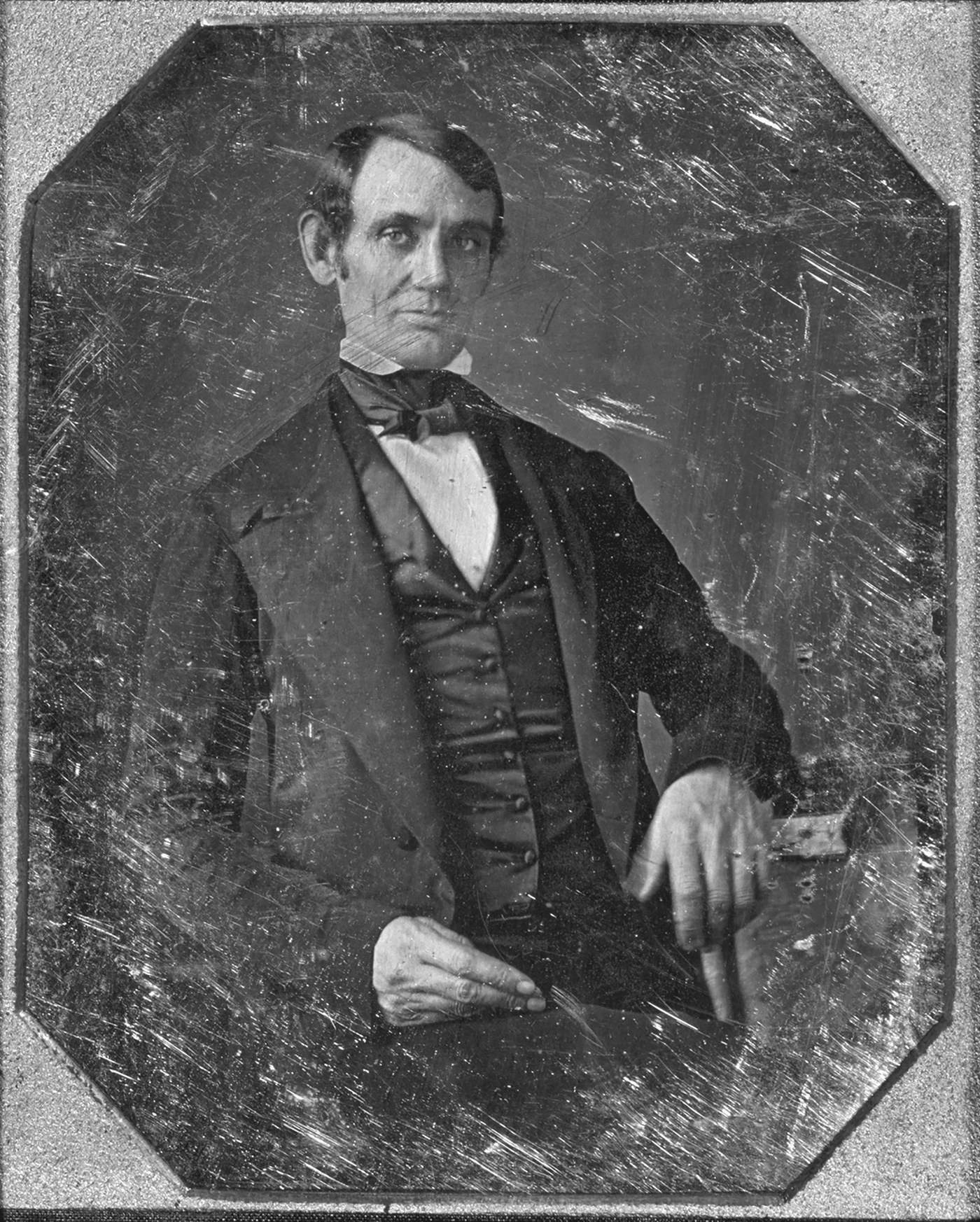
Politics deepens the connections. Lincoln's address in 1863 and Forrest's in 1838 form a political chain with Lincoln's lyceum speech earlier in 1838.Footnote 19 Together the three trace Lincoln's developing thought about the nature of the republic (Fig. 1). While Lincoln's awareness of Forrest's speech remains at issue, what the actor said on July Fourth was precisely the standard Democratic fare that Lincoln engaged.
Abraham Lincoln, daguerreotype by Nicholas H. Shepherd, ca. 1847. Library of Congress Prints and Photographs.

When Lincoln spoke before the Springfield Young Men's Lyceum on 27 January 1838, he was a twenty-eight-year-old man joining a cultural phenomenon. Lyceums were clubs that offered ambitious men an opportunity to present speeches on issues of public interest. The public lecture, as exemplified in the lyceum movement, constituted “a major source of education and entertainment” in the era.Footnote 20 So despite Lincoln's title, “The Perpetuation of our Political Institutions,” the politics of his first published address has often been discounted, with the moment treated as an exercise in introducing himself to his Springfield neighbors. William Lee Miller argues that his topic was “a slightly pompous one of the sort lecturers often did choose.”Footnote 21 Garry Wills contends that, appearing in “a cultural club meant to train future leaders in speaking skills,” Lincoln presented “conventional” Whig complaints about Andrew Jackson.Footnote 22 John Channing Briggs acknowledged that Lincoln “partly served his party's cause,” but did “not take a narrowly partisan Whig line.”Footnote 23 Douglas L. Wilson writes that, repeating “standard Whig rhetoric,” Lincoln merely presented “a rehearsal of familiar, nonpartisan themes in the hackneyed oratorical style of the day.”Footnote 24 Thomas F. Schwartz suggests that Lincoln was dodging a political fight.Footnote 25
With politics dismissed, scholarly focus has traditionally shifted to Lincoln's emphasis on violence. His concern was warranted.
The habitual American distrust and defiance of authority created an antebellum soil that encouraged the growth of violence. The widespread consumption of alcohol, much greater per capita than in later ages, exacerbated the problem.Footnote 26 Holidays became excuses for public rowdiness. When the New York Daily Express reported on Forrest's July Fourth oration, it also reported on a riot that erupted elsewhere in the city that day.Footnote 27 Antislavery advocates were particularly at risk. Meetings were mobbed, houses burned, printing presses smashed, and no antislavery lecturer could be sure of being alive for the next lecture. (Though opponents of slavery were usually the victims, the antislavery icon John Brown would later murder people too.) “American mobbing,” in David Grimsted's felicitous phrase, was a fact of life in antebellum America.Footnote 28
But as a fact of life, antebellum violence was quotidian, as common—and mundane—as drinking. Disorder was so customary that reporting on Forrest's oration two days later, the New York Daily Express also carried adjacent items about the Fourth, one that it had been quiet— indicating that quiet was worthy of note—and the other about the riot mentioned above.Footnote 29 Paradoxical now, that juxtaposition was commonplace then.
While the worst excesses hit the news, often making it seem as if fatality lurked in each encounter, violence occurred across a wide range, from death and destruction through fisticuffs and on to plain pushing and shoving on the streets. As Frank Towers, the editor of an ATQ special issue on violence points out, we are “[e]merging from an academic tradition that either ignored riots or mentioned them only to condemn them.”Footnote 30 That tendency can be seen in discussions of antebellum violence. Analyzing the context in which Lincoln spoke, Eric Foner declared in The Fiery Trial that “literally hundreds of riots of one kind or another took place in the United States in the 1830s”; his source, Michael Feldberg's The Turbulent Era, refers to thirty-five major riots in Baltimore, New York, and Boston from 1830 to 1860, “some degree” of major disorder in American cities over the same time period, and two hundred antiabolitionist or racist “incidents” in the 1830s and 1840s. But these vague descriptors—riots “of one kind or another,” “some” disorder, “incidents”—suggest greater chaos than the evidence supports. As Feldberg pointed out, antebellum violence was common but “deaths in Jacksonian rioting were a relatively rare occurrence.” He also devotes a chapter to “disorder” that was merely recreational.Footnote 31 Young men used fighting to blow off steam in an era with no organized team sports and no sanctioned opportunity for slamming into people that football would later provide. Traveling circuses routinely encountered that recreational violence. Circus has come down to us as sweetly innocuous, but a show on the road had to also be a fighting unit, to deal almost daily with local toughs who, tired of beating on each other, were happy to find new foes. As a major showman recalls, “The sturdy sons of toil came to the show eager to resent any imagined insult; and failing to fight with the showmen, would often fight among themselves; … ‘fighting was in the air,’ and as may be imagined, the showmen received their full share of it.”Footnote 32 As with antebellum violence generally, these circus fights occasionally turned fatal. But the majority of fights on the circus lot tended toward the recreational.Footnote 33
So when Lincoln spoke on that wintery 1838 evening in Springfield, he was a rising civic leader joining an “‘elocution revolution’” that sought to employ oratory to quell public passions.Footnote 34 At the same time, he was a politician starting out and seeking to make his reputation by attacking opponents. Partisan aggressiveness doesn't mesh well with Lincoln's later statesmanlike image, and it especially does not fit the hagiographic aura that has flourished ever since his assassination. Nevertheless, it fits the ambitious young man he was.
So too the Whigs generally: while their concern about law and order was legitimate, they went further, diving deep into political waters. Framing violence as a political issue, they used it to demonize the growing democratic bent of the still-new republican nation.Footnote 35 Whigs displayed “an almost deafening silence on the entire subject of political democracy,” instead arguing that American civilization was in danger.Footnote 36 What particularly stoked Whig fervor was the increasingly heated response to antislavery activity. With slaveowners putting prices on the heads of abolitionists and Northern mobs attacking black and white abolitionists, civic concerns about balancing rowdiness and restraint had become a focus of Whig rhetoric. Lincoln spoke at the Springfield Lyceum soon after a mob had killed abolitionist editor Elijah Lovejoy in Alton, Illinois, on 7 November 1837.Footnote 37 Such events, and oratorical alarms such as Lincoln's or one published by the Missouri Republican of nearby St. Louis, had spawned a Whig Young Men's Committee of Vigilance there.Footnote 38 (Ironically, committees of vigilance, as “vigilantes,” would become emblematic of precisely the lawlessness Lincoln deplored.)
Lincoln at the lyceum repeated the party line. When he warned that danger lurked in the “increasing disregard for law which pervades the country,”Footnote 39 he was referring to the Democrats. Andrew Jackson's populist appeal had galvanized Whigs, including Lincoln, a Whig member of the state legislature. For them, Jacksonian democracy meant indulging violent passions. This was not a peripheral issue for Whigs. Lincoln declared that the country's founding “proposition” was not equality, as he would decide later; it was, he emphasized with italics, about “the capability of a people to govern themselves.”Footnote 40 Like politicians everlasting, he proclaimed that the body politic was in danger, blamed that danger on the opposition, and heightened the apparent threat by emphasizing the most extreme aspects. Feldberg writes that “Lincoln was not exaggerating” about lawlessness,Footnote 41 but that was precisely what he was doing in 1838, exaggerating for political effect. The young politician complained at the lyceum of “wild and furious passions,” and of “worse than savage mobs.” He deplored the “lawless in spirit,” for they encouraged others to be lawless in practice. In a standard political tactic, he repeatedly sounded an alarm about mobs: “savage mobs,” the “mobocratic spirit,” the “caprice of a mob,” the “mob of to-morrow,” and more than once, “mob law.”Footnote 42 In so careful a literary craftsman, this repetition was not sloppiness but what would today be called talking points, a party's message repeated often to make partisan carping seem like fact.
Lincoln did not stop there. He wrought pictures of violence to shock, even titillate. Referring to recent events in Mississippi, he asserted that dead men were “literally dangling from the boughs of trees upon every road side.”Footnote 43 That was literally wrong but politically shrewd. In today's parlance, he was playing to his base. Next Lincoln described “that horror-striking scene at St. Louis” from 1836,Footnote 44 when a black sailor was slain by a crowd. Lincoln did not initially mention that the sailor had just killed a sheriff. That momentary omission has been lauded as subtlety, Lincoln focusing his audience on larger issues of national stability before raising the incendiary topic of race.Footnote 45 Subtlety it may have been, but Lincoln made sure to cast the situation in its most dreadful light. He leapt to arrant partisan claptrap to pronounce the sailor's death the “most highly tragic, of any thing of its length, that has ever been witnessed in real life.” Again, for a careful verbal craftsman, this was blatant excess. Unwilling to trust that an accurate depiction would make his political point, Lincoln pictured the killer as an innocent, “attending to his own business, and at peace with the world.” This was simply false.Footnote 46
The excess in his lyceum speech displays what Douglas L. Wilson has characterized as an “earlier and rougher version” of the man who became president.Footnote 47 Another historian, Harry V. Jaffa, called Lincoln at this stage of his career a “hack politician,”Footnote 48 while David Herbert Donald in his masterful biography wrote that the young politician “resorted to “demagogy” in a subsequent speech in the legislature, where he displayed “fierce partisanship.”Footnote 49 Yet as Michael Lind points out, Lincoln has been “posthumously deprived not only of his political tradition, but of most of his career in politics.”Footnote 50 To claim, as Jean H. Baker does, that Lincoln was unusual in his concern about violence ignores the political ground on which he stood.Footnote 51 To go further and cite Jacksonian mob rule is taking sides. Mark E. Neely Jr. observes that depicting Lincoln “at odds with democracy in the age of Jackson is either unfair to Lincoln or paints a dark caricature of Jacksonian democracy.”Footnote 52 Lincoln may not have been at odds with Jacksonian democracy, but a careful reading of the lyceum address shows Lincoln sketching that dark caricature first. This was rough-and-tumble politics, and he gave as good as he got.
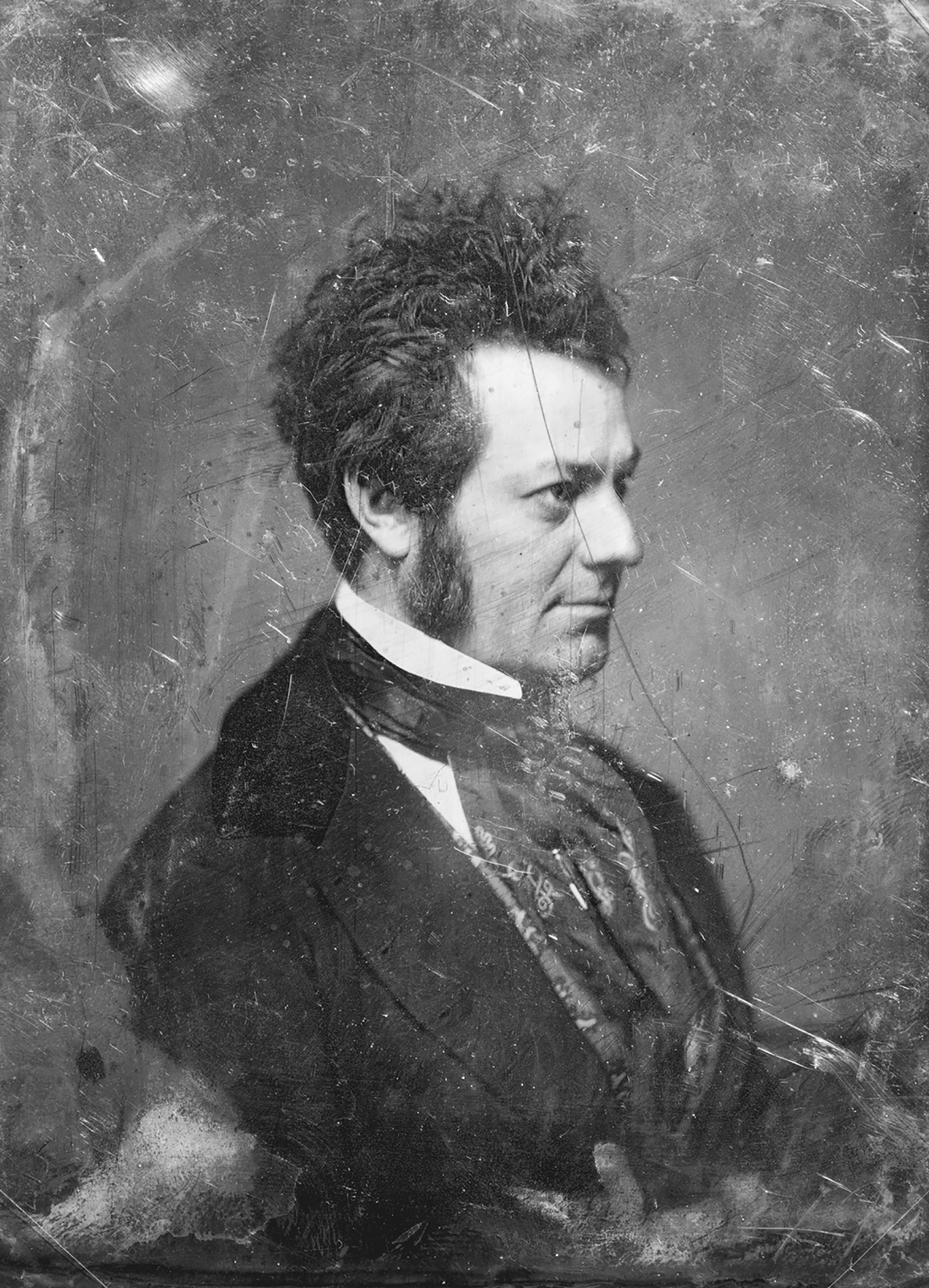
As did the Democrats. Six months later, Edwin Forrest jumped into the fray. He built his career as America's first great actor on a robust populism that meshed with robust Jacksonian democracy (Fig. 2). The link was not merely symbolic. He stood stoutly with the Democratic Party, contributing money and befriending party leaders, particularly William Leggett. Leggett, who with William Cullen Bryant edited the Democratic Evening Post, was a political force.Footnote 53 Forrest's bond with the party deepened when leaders invited him to speak on the Fourth to the Democrats, four thousand strong, at the Broadway Tabernacle in New York City. Though “Broadway” did not yet stand for New York theatre, the location symbolized the era's blend of performance and politics, as the nation's foremost actor pitched the party line.Footnote 54 This Fourth of July speech was a trial run, an audition, as the party considered him for their candidate for Congress.
Edwin Forrest, daguerreotype by Mathew B. Brady, ca. 1850. Library of Congress Prints & Photographs.
Forrest was not replying directly to Lincoln. He would not have heard of an obscure lawyer in what was then a geographic and political backwater. Yet he did not have to read Lincoln's speech in the 3 February issue of the Sangamo Journal from the then-wild West of Illinois to know standard Whig attacks.Footnote 55
The actor ceded no ground as a champion of civic restraint. Like the Whigs, Forrest stressed the “self-evident axioms” (7) of life, property, and social order. Yet where Whigs decried mounting violence, Forrest saw isolated instances that they politicized. Acknowledging that clouds sometimes dot the civic sky, he decried “political soothsayers, who, with malignant alacrity of evil augury, magnify each transient speck into a fearful harbinger of desolating tempests” (13). Stark difference of opinion based on the same information is familiar to observers of political arguments in every age, albeit not always in such extravagant language. Much has been made of Lincoln's emphasis on reason at the Springfield Lyceum, but Forrest too advocated the “sober convictions of reason” (11), which would prevail despite the “eager passions of men” (13). Still, he intimated, the vultures would not be satisfied. “But how pitiful—how worse than pitiful, the wretched aim of those who gloat over these rare and transient ebullitions of tumultuous rage as supplying an argument against the adequacy and benign effects of democratic government” (14). For Forrest and other Democrats, the Whigs were not simply hurling partisan criticisms, they were attacking the country's core values.
Forrest also invoked states' rights, “the proud arch of our confederated democracies” (8). When he warned in 1838 against those who would split the union, he was not referring to Southerners but to abolitionists. Though then a small faction, abolitionists were to Forrest, to the Democrats, and to many Whigs a threat to the union. So “should we guard against a blow being aimed … against that great elementary principle of liberty” (19). By liberty, he meant freedom from government interference in the era's assumed right to own human beings. Forrest objected to slavery but believed that the “peculiar institution,” the era's evasive reference, lay beyond legal challenge because the Constitution allowed it, from the compromises at its inception through four decades of supporting laws and judicial decisions. That was the apparent stance of Forrest's political friend Leggett, and it was Lincoln's stance deep into the Civil War. Referring to slavery, Forrest conceded there were “social institutions, even of acknowledged errors,” yet he warned against strident impatience, for change “cannot be instantly accomplished, without endangering those boundaries of private right which ought to be held inviolate and sacred” (22).
Just as the politics of Lincoln's speech at the Springfield Lyceum must be recuperated, so too must the politics of Forrest's July Fourth speech, for the actor's biographers have neglected that speech's political core. In 1874, two years after Forrest died, his first biography claimed he had been asked to run for Congress “on several occasions,” and on the following pages reprinted an excerpt from his Fourth of July oration, but did not connect those two strands.Footnote 56 An 1877 biographer repeated the pattern: he referred to the intense party feeling of 1838 and included an excerpt of the speech but did not link them. After printing Forrest's letter declining the nomination, the 1877 author allowed only that Forrest's words on the Fourth were “exactly suited to the tastes of those who heard it.”Footnote 57 A third effort, by the actor Lawrence Barrett four years later, buried politics deeper; in successive sentences, he introduced the offer of the nomination, declared that Forrest would have improved Congress, and mentioned the oration “before a political gathering,” but all as preface to his view of the event's real importance, the actor's “social elevation.”Footnote 58 An 1889 biographer wrote about neither the oration nor Forrest's politics.Footnote 59 In a 1929 biography, Montrose Moses discussed the era's politics at greater length, devoting a chapter to “The Forensic Forrest,” yet he too diminished his subject's political involvement. According to Moses, Forrest “was closely in touch with the spirit of democracy” in his “oratorical platitudes,” but he “was not asked to touch on” issues of the day for the Democrats.Footnote 60 In a more recent biography, Richard Moody provides the model for the modern attitude toward Forrest's politics, reprinting a nonpolitical part of his oration and otherwise dismissing the mutual interest between party and actor as a flirtation of little importance. Despite his carefully researched work, Moody does not engage the politics in his subject's Fourth of July oration.Footnote 61 Historiographical thought continues to embrace Forrest as a symbol of Jacksonian politics writ large without recognizing the politician in him—or his intellect and immense talent.
Newer scholarship provides greater nuance, yet the diminishment of Forrest's politics—and the man—continues. Mark E. Mallett declares that Forrest was a “symbolic leader” who functioned “primarily through his meaning or image.” While acknowledging that politics and Forrest's performances “had a closer relationship than has previously been acknowledged,” Mallett decides that the actor's proposed candidacy was, despite the evidence, not a genuine offer but merely the Democrats' attempt to exploit a star's publicity.Footnote 62 Laura Mielke focuses on his elocution.Footnote 63 A recent book on the Astor Place Riot of 1849 and Forrest's role in it depicts him as mostly oblivious to the era's political struggles.Footnote 64 This ongoing diminishment has generated a routine trope of Forrest as a ranter. Indeed, the historiography so often applies “rant” to the great actor that it can seem as if “ranting Forrest” were his name. Although Matthew Rebhorn does much to resuscitate the potency of the actor's oratorical skill, he falls into that unfortunate tradition, in this instance quoting Walt Whitman about Forrest's “loud mouthed ranting style.” However, Whitman was not referring to Forrest. Instead, in the piece quoted, he praised the actor as a “deserved favorite with the public” who “has high talent in his profession” but he condemned lesser actors who, unable to match Forrest's skill in enacting extreme passion, reverted to a “loud mouthed ranting style.” Trying to forestall precisely the misunderstanding seen here, Whitman emphasized that he did not include Forrest in this condemnation, only the great actor's “vapid imitators.”Footnote 65
Contemporary evidence of Forrest's Fourth of July speech serves as a reminder of his political potency. The speech was widely reported, making the dark-haired actor the Democrats' fair-haired boy. The Evening Post devoted its lead article on 9 July 1838 to his “discourse in which the principles of democracy were beautifully illustrated and enforced.”Footnote 66 The editor, Forrest's friend Leggett, probably wrote that article. Forrest's zealous Democratic speech also made him a target for Whigs. Some party papers tried to diminish his effect by ignoring the widely reported speech, some by eliding its politics. Neither the New York Daily Express nor the Evening Star reported on the oration. The New York Gazette and General Advertiser dodged the issue, denying the speech's partisanship: “Party politics we are told were not descanted on at all.”Footnote 67 The Daily National Intelligencer of Washington concurred: Forrest's “real eloquence of language … was not sprinkled with Locofocism,” a reference to the nickname for New York Democrats.Footnote 68 But the Whigs could not let stirring Democrat oratory go entirely unchallenged. According to the Evening Post, the editor of the Evening Star “laughs at the idea of a player being in Congress.”Footnote 69 On July 6, the Morning Courier and New York Enquirer made its displeasure clear from the title, “Democracy and Mr. Forrest.” Though later eyes might read that as a neutral description, it reflected Whiggish anguish over the emerging populist involvement of “Democracy,” as opposed to an elite-led republic. In an allusion combining Forrest's theatre fame and the Democrats' nickname, the article scoffed at the “new play of Loco Foco” with its “odd mixture of farce and tragedy.”Footnote 70 The next day, Horace Greeley's weekly, The New Yorker, exercised the partisan technique of deploring partisanship, complaining that a hallowed day “should thus be desecrated by the introduction of party politics.”Footnote 71 Suggesting that Leggett had penned the speech, the article sneered that “Mr. Forrest recited Mr. Leggett's Oration.” Leggett countered. Denying that he played any role, except “for the alteration of a single word,” he damned the “gratuitous impertinence” that flowed from Greeley's “notorious and habitual mendacity.”Footnote 72 When another editor echoed Greeley's mockery, Forrest's friend—manifesting the age's rowdiness—went beyond words: Leggett “pulled [the editor's] nose,” before “inflicting other indignities,” as reported in a Peoria, Illinois newspaper the following month,Footnote 73
Whether or not a “notorious” liar,” Greeley could have been correct here. Though Leggett and others stoutly denied his involvement, he may have written the speech. However, the sentiments of a political speech are routinely attributed to the politician delivering that speech. In our own age, people have not cared if Ronald Reagan or Barack Obama wrote the words they spoke. Antebellum Democrats sought Forrest not for his writing but for his ability to persuade and inspire audiences, making the fact of the oration and the possibility of influence key here. In any case, to treat Greeley's political attack as objective fact, and thus conclude that Forrest did not write it, goes beyond the evidence. That arbitrary stance depends, again, on Forrest's critics and the persistent stereotype of a crude, ranting entertainer beneath his presumed betters, combined with absolute disregard of those who insisted he wrote it.Footnote 74 The key point remains: writer or not of the words, the nationally famous and politically connected Forrest was regarded as author of its thoughts.Footnote 75
Forrest's stature as an actor sparked interest far beyond New York City. That Peoria newspaper referred simply to “the Forrest oration,” assuming its Illinois readers would understand the reference. In their efforts to promote Forrest's candidacy in 1838, the Democrats published and distributed the speech as a twenty-four-page pamphlet, perhaps 40,000 copies.Footnote 76 That was common practice. In an “era of mass participation in politics, and endless parades and rallies in small towns and big cities alike ... great speeches would be reprinted in the newspapers in full, and then reproduced by the thousands in cheap pamphlets.”Footnote 77 The Whigs did exactly that after Lincoln gave a speech there in 1839;Footnote 78 so too the later Republicans published and circulated a pamphlet of Lincoln's Cooper Union speech in 1860.Footnote 79 The party also spread word by newspaper, writing about the speech or publishing it. Most dailies of the era were partisan. Editors proclaimed their political stance in the title or by raising the names of favored candidates “to the masthead,” the title at the top of the front page or editorial page. In 1850, 95 percent of the nation's newspapers had some political affiliation; “politics was what made the world of the newspaper go round.”Footnote 80 Articles went round as well, passed from paper to paper like a slow-motion wire service. This was a crucial part of the political process, “the primary means of communication between a political leader and the public.”Footnote 81 Shouldering into the jostling mix, Illinois newspapers were “intemperate, belligerent and fanatically partisan.”Footnote 82 That was meat and drink to a political animal like Lincoln. One scholar points out he “read newspapers insatiably,” and another wrote that he “devoured” them.Footnote 83 That especially included opponents' papers, the better to counter them and to absorb whatever insights they could offer.Footnote 84 According to his law partner, Herndon, Lincoln retained “them all about as well as an ordinary man would any one of them who made only one at a time his study.”Footnote 85
Forrest's oration made its way west. On 15 August, the Pittsburgh Mercury published it in full on its front page. In a testament to his stature, the newspaper did not identify him as the country's leading actor, nor even give his full name, instead simply attributing the speech to “E. Forrest,” with a subheading referring to the “Democratic Republican Celebration.” Contemporary practice would have placed the speech in other party organs around the country. Though no Illinois Democratic newspapers from summer 1838 have survived, in St. Louis, the closest city to Lincoln's Springfield home, the Missouri Republican published an account of Forrest's speech on 9 July. The Republican quoted the New York Star about the “terrible jam” that crammed to hear Forrest's “slop,” with a conventional partisan sneer that the Democratic crowd was unable to understand what they heard.Footnote 86 Responding to such “opponents of the democracy,” the Democratic Review, a literary and political journal of Washington, praised Forrest for the “fervor of his language” and the “strength of his patriotism,” in a seven-page report in September.Footnote 87 In an example of “broad casting,” a metaphor for spreading news borrowed from a farming term for speading seed, the Democratic Illinois State Register and People's Advocate of Vandalia in September reprinted an item on the speech from the Mississippi Free Trader of Natchez. Considering that Lincoln “read newspapers insatiably,” especially the opposition, the State Register was one he would have routinely read. The item reported that Forrest's oration was “so popular in New York, that it is now being declaimed regularly at the theatre by popular actors.”Footnote 88
The Democrats invited Forrest to run for Congress and planned that the speech would catapult him into a winning campaign. The date of the invitation is not clear. The evidence comes in his 17 October letter declining the nomination. One newspaper that published his letter in full was the Illinois State Register the following month.Footnote 89 Writing to the Democratic Republican Nominating Committee from his Philadelphia home, Forrest declared both that he would lose money as an actor and that he would not have time to devote to a study of the issues. Though scholars routinely emphasize Forrest's self-interested, monetary reason, his civic, political reasons turned the letter into national news.
The Democratic thoughts in Forrest's speech stood as a signpost on the political path of the future president, who would later be renowned for incorporating opposing thoughts into his worldview. According to Joseph Fornieri, Lincoln's “political faith emerges as a response to rival accounts of American order,”Footnote 90 and Harry Jaffa describes the Gettysburg Address as “the consummate epitome of a quarter-century of Lincoln's thought and expression.”Footnote 91 As a practical matter, Lincoln would have been unlikely in 1863 to respond to a recent Democratic speech, thus giving a current foe prominence. Better to reply to the core arguments about the nature of the country, but from a speech now buried by thousands of angry speeches and millions of agitated words over a quarter century.Footnote 92 Though Americans revere the Gettysburg Address for its soaring expression of the country's ideals, careful reading shows it to also be shot through with politics. Lincoln was aiming to reunite a country torn not only by the bitter, bloody war but by decades of political tumult, and he joined political ideas to poetic expression.
First, Lincoln engaged one of the country's most divisive questions, whether the government had been created by the people or the states. Forrest in 1838 knew his answer: the states had joined to found the United States. In his oration Forrest extolled “the proud arch of our confederated democracies” (8)—that is, the states. Later that year, his letter declining the nomination similarly referred to the “confederacy.”Footnote 93 The South focused on that model, insisting that the country had been formed by a confederation of states that joined to ratify the Constitution. That's why the South called itself the Confederate States of America. This insistence on formation by the states had a particular reason: the states-ratified Constitution allowed slavery. When Southerners complained that abolition was unconstitutional, they were correct. Here was the core of states' rights; here was original original intent. Abolitionists agreed: William Lloyd Garrison burned a copy of the Constitution in protest in 1844. Lincoln had a different answer at Gettysburg. There he highlighted the Declaration of Independence as the nation's founding document. His notable opening—“Four score and seven years ago”—was not mere civic poetry but political invocation of the eighty-seven-year-old Declaration, with its central promise that “all men are created equal.” Similarly, his concluding tripartite invocation of the people, echoing the repeated use of “the People” in the Declaration, reinforced his view that the nation had been founded by the people and not by the states. Beginning to end, he presented the Declaration as the country's key founding document. A strong believer in law, Lincoln had entered the Civil War certain—like Forrest before him—that the Constitution did not allow abolition, and in November 1863 he was still not ready to free the slaves. Nevertheless he posed the Declaration's ideal of equality against the Constitution, which protected America's original sin of slavery. Implicitly framing the Constitution, like the Articles of Confederation before it, as a flawed draft of the founding promise in the Declaration, Lincoln made a Republican argument.Footnote 94
This was not an obscure point, overlooked by a benighted electorate. Republicans easily recognized the partisan undercurrent because the primacy of the Declaration had become a core element of party thought. Meanwhile Democrats complained because of that partisan element. The day after Lincoln spoke, an old nemesis, the Chicago Times, scorned his “silly, flat, and dish-watery utterances.”Footnote 95 Meanwhile the Indiana State Sentinel of 5 December, copying the New York World of 27 November, sneered at the “obstetrical analogies” in his use of the words “conceived” and “birth,” and the Columbus, Ohio Crisis, a Copperhead paper, objected to Lincoln's invocation of the people precisely because it challenged states' rights.Footnote 96 The Harrisburg Patriot & Union, complaining on 24 November about Lincoln “coldly calculating the political advantages” of “the solemn ceremonies,” editorialized that they would “pass over the silly remarks of the President; for the credit of the nation, we are willing that the veil of oblivion shall be dropped over them and that they shall no more be repeated or thought of.”Footnote 97 In 1863 citizens of all stripes recognized that Lincoln was not peddling vague patriotism but was delivering a passionate political thesis at Gettysburg. From his attention-getting start to his ringing conclusion about government “of the people, by the people, and for the people,” he countered what Democrats had been saying, what Forrest had said.
A second political thread wove these two speeches together. Both men evoked the age-old question of democracy: Who qualifies for equality? In 1838, Forrest emphasized the “great elementary principle of liberty” (19), just as Lincoln later emphasized that the country was “conceived in liberty.” Though liberty and equality are often paired, they coexist in uneasy tension. Antebellum Democrats argued for a limited meaning of liberty: freedom from interference with slavery, or what Forrest called “social institutions, even of acknowledged errors” (22). That stance is a reminder that the Declaration's promise that “all men are created equal” only went so far in the nineteenth century. It was constricted by racial prejudice and habit, as promulgated by Democrats, accepted by Whigs, sanctioned by the Constitution, and propelled by a Supreme Court invoking its opinion about the founding fathers' original intent. This bias posed liberty against equality, or at least restricted equality to white males.Footnote 98
With the North finally achieving military success at Gettysburg and in the West in 1863, Lincoln took the opportunity to articulate a different view, tying liberty in his first sentence to the proposition of equality. In his characterization, they were complementary, and he raised equality to the same revered stature as liberty.Footnote 99 This was a Republican position but also a national vision, one that Lincoln had begun to formulate in 1838. If the states were to become truly united, the war had to mean more than subduing the South. Too much blood had been spilled for power alone to justify the conflict. Though neither the North nor the South was prepared to admit black people to full fellowship in American life, Lincoln proposed a “new birth of freedom,” making equality central. The contrast with the Confederacy was stark. The South insisted that inequality had been a hallmark of the original founding in 1776 and remained so in 1861. But by 1863, the crucible of war was showing Lincoln a way clear of his Constitutional hesitations, as he grew into the belief that the war had yoked equality to Union. Without the Union, equality was empty; without equality, the Union was empty. Though he never claimed for himself the often-reviled word “abolitionist,” Lincoln became one. In a consummate example of leadership, he nudged the country where it would not have gone before the war but ultimately seemed the only place it could go. Even the legions who later denied that the South fought for slavery would acknowledge Lincoln's literally fundamental point, that slavery could no longer be countenanced. Ending slavery, the country reached closer to its ideals.Footnote 100
Harry Jaffa asserts that Lincoln's “ideas crystallized in 1863, in prose not unworthy of the greatest master of our language, had been pondered and matured full twenty-five years before.”Footnote 101 That would be 1838, the year of his lyceum speech—and of Forrest's Independence Day oration. Douglas L. Wilson made the same point that Lincoln's address at Gettysburg “had a very long gestation period indeed, predating even the presidency”:
Consider, for a moment, the possibility that the opening and closing portions … were not conceived and written after the invitation to Gettysburg but before, and that they constitute a kind of template of the ideas Lincoln most wanted to engage. This, obviously, is the Gettysburg Address without Gettysburg. In this perspective, we see a configuration of three related ideas, all from the Declaration—equality, freedom, and self-government.”Footnote 102
Those were precisely the ideas that Forrest had addressed in 1838, the template his oration offered. He spoke of equality (We rejoice in “an abstract proposition … the political equality of mankind” [6]). He spoke of freedom (“Threescore years and two … our fathers ventured on the grand experiment of freedom” [6]). He spoke of self-government (“A hundred millions of happy people!” [24]). Though the two men came to different conclusions in their corresponding speeches, Forrest shaped the issues in a way that was congenial to the younger politician's thoughts, as Lincoln later drew “consciously or unconsciously on the stores of his memory.”Footnote 103
But did Lincoln read Forrest's speech?
He undoubtedly knew about it. News of the address reached the West, as discussed above, and its text almost certainly made its way into now-lost Illinois Democratic papers that Lincoln read. Later, he could have had access to the text. It survives in the Pittsburgh Mercury. Other Democratic newspapers that carried it presumably survived. Even if the printing did not reach 40,000 copies, the Democrats printed enough for it to still be available; that means it was available to Lincoln. Lincoln used the Library of Congress, which has two copies of it. Though accession records on those copies are incomplete, the library could have acquired these copies as early as 1863.Footnote 104
To complete the case requires the kind of speculation that is common, and necessary, in Lincoln scholarship. For instance, Douglas L. Wilson asserts that Lincoln made notes while preparing for the Gettysburg Address, not because any notes have ever been found but because “we know enough about Lincoln's way of working to be reasonably sure he was making notes on the subject as ideas occurred to him.”Footnote 105 Here, we “know enough about Lincoln's way of working” to be sure he was reading Democratic newspapers when they were publishing Forrest's speech.
Another issue insinuates itself, reflected in John Nicolay's concern that some might think Lincoln had taken his sentences “second hand.” But this is not a case of plagiarism; Lincoln did not copy. Again, everything we know about him makes that clear. Gabor Boritt particularly rejects the notion that Lincoln copied as “ludicrous.”Footnote 106 Wilson put it well when comparing the Gettysburg Address to ancient Greek funeral orations: “Yet far from being an imitation or an attempt to follow a classic formula, Lincoln's speech is an American original, like the man himself. Although he began his career as a public speaker using the current conventions of oratory, he soon gave them up and followed his own bent.” That included working to hone his writing—especially the skill of rewriting.Footnote 107
More than a self-made man, this “quintessential Whig would become known as the self-taught man.”Footnote 108 His own words and those of others were raw material to be wrestled into shape. Garry Wills offers a sterling example of this process: Lincoln masterfully revised the proposed First Inaugural his secretary of state, William Seward, had provided, rendering Seward's words more poetic and powerful. Forrest's words in 1838 may have been more material in Lincoln's “verbal workshop.”Footnote 109 We expect great writers to imbibe their age and transform it for readers. Consider that other great nineteenth-century writer, Mark Twain, who copied nothing but used everything. So too the great writer Lincoln would have been influenced by his keen understanding of his age, including an appreciation of the great actor's intellect and towering talent.
In the rhetorical universe of the era, the closest parallel to the Gettysburg Address is Forrest's address in 1838. Although Lincoln's words are more sublime than Forrest's, that counts little because they are more sublime than most anything political written or uttered through the long nineteenth century. Lincoln's words at Gettysburg are distinct enough to show an original mind at work, in powerfully poetic—and political—expression that transcends similarities. Yet the structure and the thoughts of the speech are similar enough to Forrest's 1838 speech to infer an effect. If Lincoln's words had come first, that counterfactual would allow absolutely no doubt of his influence on Forrest; the reverse but factual situation likewise suggests influence. The verbal resemblance between the two speeches, including strikingly similar beginnings, parallel phrases, and analogous tripartite endings, is remarkable. Political arguments further link them. To finally engage these similarities after a century and a half offers new perspectives on both speakers, helping us to see more than a saintly Lincoln or a burly Forrest.