


Recent studies have shown that waist circumference (WC) increased much faster than BMI in children and adolescents over the past 10–20 years (McCarthy et al. Reference McCarthy, Ellis and Cole2003, Reference McCarthy, Jarrett, Emmett and Rogers2005; Moreno et al. Reference Moreno, Sarria, Fleta, Marcos and Bueno2005).
While the BMI is generally accepted and used to classify children as overweight or obese in population studies, it is recognised that the BMI cannot distinguish between muscle and fat masses and gives no indication about body adiposity distribution (Reilly et al. Reference Reilly, Dorosty and Emmett2000). The BMI therefore seems a poor proxy for central adiposity. The WC is a highly sensitive and specific measure of trunk adiposity (Taylor et al. Reference Taylor, Jones, Williams and Goulding2000) and a strong predictor of visceral adiposity in the paediatric population (Brambilla et al. Reference Brambilla, Bedogni, Moreno, Goran, Gutin, Fox, Peters, Barbeau, De Simone and Pietrobelli2006; Lee et al. Reference Lee, Bacha, Gungor and Arslanian2006). Further, WC is related to metabolic complications of obesity, including poor lipid profile, increased blood pressure and insulin resistance in children and adolescents (Freedman et al. Reference Freedman, Serdula, Srinivasan, Gerald and Berenson1999; Savva et al. Reference Savva, Tornaritis, Savva, Kourides, Panagi, Silikiotou, Georgiou and Kafatos2000; Maffeis et al. Reference Maffeis, Pietrobelli, Grezzani, Provera and Tato2001; Moreno et al. Reference Moreno, Pineda, Rodriguez, Fleta, Sarria and Bueno2002).
It has therefore been recommended that WC should be used to identify young individuals at risk of morbidity associated with central body adiposity and could be adopted as an alternative or additional measurement to BMI (McCarthy et al. Reference McCarthy, Ellis and Cole2003). However, there are no commonly accepted WC cut-offs for classifying children with high central adiposity.
The prevalence of overweight based on BMI has tripled in Brazilian children and adolescents over the past two decades (Wang et al. Reference Wang, Monteiro and Popkin2002); however, there are no data on WC values and the level of central adiposity in Brazilian children and adolescents.
The aim of the present study was to: (a) describe WC centiles in 7- to 10-year-old Brazilian children derived from 2919 schoolchildren living in Florianopolis; (b) describe the prevalence of overweight and obesity as defined by BMI and the prevalence of at-risk abdominal adiposity and excess abdominal adiposity as defined by WC, using British reference data in the same population; (c) examine the agreement between two measures of adiposity, based on BMI and WC.
These data are important to allow valuable comparisons with other studies and to monitor the prevalence of (central) adiposity over time.
Methods
Subjects
The present study was conducted in the city of Florianopolis, from September to November 2002. Florianopolis is the capital of the province of Santa Catarina, in the south of Brazil.
The study design has been described elsewhere (de Assis et al. Reference de Assis, Rolland-Cachera, Grosseman, de Vasconcelos, Luna, Calvo, Barros, Pires and Bellisle2005). Briefly, a representative sample of 7- to 10-year-old schoolchildren attending the first four grades of elementary schools of the city was selected, using a stratified multistage cluster-sampling design. Information included anthropometric data (height, weight, skinfolds and circumferences) and socio-economic status (SES) of the family. Parents completed a questionnaire with sociodemographic information, including monthly family income. Tertiles of monthly family income were used to indicate low, medium and high SES.
Of the 3313 eligible children, 377 had missing anthropometric data (child absent or ill; child refused to participate). In the present article 2926 children (1502 boys and 1424 girls), with complete information on age, sex, school level, SES and all anthropometric measurements were included (88·3 %). Participation rate did not significantly differ according to sex and age. However, SES differed between participants and non-participants: more participants were categorised in the low and medium SES and fewer in the high SES compared with non-participants (low SES, 48·8 v. 38·6 %; medium SES, 21·7 v. 14·6 %; high SES, 29·5 v. 46·7 %; P < 0·01).
Santa Catarina's population is predominantly of European origin; specific information on ethnicity was not available in the present study.
Parents gave written informed consent to their child's participation in the study, which received approval from the Committee on Human Studies of the Federal University of Santa Catarina.
Anthropometric measurements
The administrative department of each school provided information on age, based on birth certificates. Anthropometric measurements of participants were taken by trained technicians, according to the procedures recommended by Lohman et al. (Reference Lohman, Roche and Martorell1988).
Anthropometric measurements were performed in lightly dressed children, without shoes. Weight was measured with a digital-solar 180 kg scale (Marte® model PP; Marte Scale and Precision Equipment, Minas Gerais, Brazil). Height was measured using a metric tape fixed to a wall without a baseboard, with the child standing up, weight being equally distributed on both feet, with the head held in the Frankfort plane and head back and buttocks on the vertical land on the height gauge. The triceps and subscapular skinfold thicknesses were measured to the nearest mm with a skinfold caliper (Cescorf®; Scientific Sports Equipment, Porto Alegre, RGS, Brazil). Triceps skinfold was measured at the midpoint between the acromion and olecranon process. Subscapular skinfold was measured about 20 mm below the tip of the scapula, at a 45° angle to the lateral side of the body. The mean of triplicate records was used in the analysis. The WC was measured to the nearest mm with a flexible non-elastic tape, midway between the tenth rib and the iliac crest. The BMI was computed as weight in kg divided by height in m2. Two other indicators of central adiposity were also examined: the waist:height ratio (WHtR) as an index of abdominal adiposity; the subscapular:triceps skinfold ratio (STR) as an index of trunk adiposity.
Data analysis
The data were first examined for outliers, and those with WC values exceeding ± 5 age-standardised sd scores were eliminated (six girls and one boy). The final analytical population contained 2919 children (1501 boys and 1418 girls).
Weight, height, WC, BMI, WHtR and STR are presented as medians and ranges by sex and age. Because anthropometric variables were not normally distributed (Kolmogorov–Smirnov test), non-parametric tests were used. Differences between sexes in each age group were assessed using the Mann–Whitney U test. Differences across ages for each sex were assessed using the Kruskal–Wallis H test. Regression analysis with the Pearson coefficient was used to examine the relationship of WC and WhTR to height in each age group and sex. The association was controlled by age as a continuous variable to take into account even small differences.
Smoothed percentiles for WC were constructed from the raw data using the ‘COLELMS’ command in STATA® to calculate the crude least mean square (LMS) values. The LMS method enables normalised growth centile standards to be developed, and deals with skewness which might be present in the distribution of the measurements. The LMS method summarises the changing distributions by three independent curves representing the median, CV and skewness, the latter expressed as a Box-Cox power (Cole, Reference Cole1990). The 50th and the 90th centiles values of WC were compared with data from the UK (McCarthy et al. Reference McCarthy, Jarrett and Crawley2001) and with data from the USA for American-European children (Fernández et al. Reference Fernández, Redden, Pietrobelli and Allison2004).
Overweight and obesity were estimated using cut-off points corresponding to the 91st and 98th centiles (sd scores of 1·33 and 2, respectively) of the British reference populations based on BMI (Cole et al. Reference Cole, Freeman and Preece1995); at risk of abdominal adiposity and excess of abdominal adiposity were estimated using cut-off points corresponding to the 91st and 98th centiles of the WC British reference, respectively (McCarthy et al. Reference McCarthy, Jarrett and Crawley2001). Similar cut-off points allow prevalence of at risk and excess abdominal adiposity (defined by WC) to be compared with that of overweight or obesity (defined by BMI), using the British reference populations, as described by McCarthy et al. (Reference McCarthy, Ellis and Cole2003). The 91st and 98th centiles for BMI are similar to the cut-off points based on adult BMI health-risk-related outcomes for overweight and obesity defined by the International Obesity Task Force (Cole et al. Reference Cole, Bellizi, Flegal and Dietz2000).
Overall frequencies of total overweight or obesity and at risk or excess of abdominal adiposity were computed by using direct standardisation on age and sex. Comparisons of frequencies between sexes were performed using the χ2 test. The agreement between the two measures of adiposity was analysed by the weighted κ statistic. Discordant subgroups of children classified as non-overweight according to the BMI cut-off, but as at risk and with an excess of abdominal adiposity according to the WC cut-off (WC-only group), were compared with those classified as without abdominal adiposity according to the WC cut-off, but overweight and obese according to the BMI cut-off (BMI-only group), for the ancillary anthropometric variables: height, WHtR and STR.
The significance level was set at P < 0·05. Statistical analyses were performed with SPSS version 10.0 and STATA® version 8.0 (Statistical Analysis System software, version 8.0, 1989; SAS Institute, Cary, NC, USA).
Results
Table 1 presents medians and ranges for anthropometric characteristics by age and sex. Weight, height, BMI, WC and STR increased with age in both boys and girls, while WHtR decreased with age in both sexes. Boys tended to have higher values for BMI than girls; however, significant sex differences occurred only at age 8 years. Between sexes, boys presented higher WC (P < 0·001) and WHtR (P ranging between 0·01 and 0·001) than girls in all age groups.
Anthropometric characteristics of 2919 schoolchildren by age and sex (Medians and ranges)

WC, waist circumference; WHtR, waist:height ratio; STR, subscapular:triceps skinfold ratio.
* Median value was significantly different from that of the girls in a given age group (P < 0·05).
WC was moderately correlated with height in all age groups, for both sexes (P < 0·001). In the analysis of the entire sample, the Pearson correlation coefficients between WC and height, after controlling for age, were r 0·57 (P < 0·001) for boys and r 0·54 (P < 0·001) for girls. In contrast, a weaker correlation was seen between WHtR and height, for both boys (r 0·11; P < 0·04) and girls (r 0·16; P < 0·3).
Table 2 presents the smoothed sex- and age-specific WC values at the 5th, 10th, 15th, 25th, 50th, 75th, 85th, 90th and 95th percentiles. Boys had higher values than girls at every age and percentile point. The difference between boys and girls on the 95th percentile at age 10 years was 4·4 cm.
Values of percentiles of waist circumference (cm) by age and sex

Fig. 1 compares the WC data of Florianopolis school children with the British (McCarthy et al. Reference McCarthy, Jarrett and Crawley2001) and US (Fernández et al. Reference Fernández, Redden, Pietrobelli and Allison2004) reference populations. Compared with the British reference, Florianopolis children had higher levels of WC at the 50th and 90th percentiles, in the same age range. At the 90th percentile differences increased substantially, ranging from 6·1 to 8·7 cm for boys and from 5·3 to 7·5 cm for girls. Compared with the US data, Florianopolis children had slightly lower 50th percentile WC values, but the difference was much larger between 90th percentiles. At the 90th percentile, differences between Florianopolis and US children ranged from 1·8 to 3·7 cm for boys and from 2·8 to 5·0 cm for girls.
Comparisons of the 50th and 90th percentiles for waist circumference obtained from the UK, the USA and Brazil (Florianopolis city) for boys (A) and girls (B) aged 7–10 years. (●), USA 90th; (■), Brazil 90th; (♦), UK 90th; (○), USA 50th; (□), Brazil 50th; (◇), UK 50th.

Age-standardised frequencies of obesity and overweight (non-obese), using the BMI cut-offs (Cole et al. Reference Cole, Freeman and Preece1995) and excess abdominal adiposity and at-risk abdominal adiposity, using the WC cut-offs (McCarthy et al. Reference McCarthy, Jarrett and Crawley2001), estimated in boys and girls separately, are presented in Table 3. Using British reference values, 5·6 % of girls and 8·3 % of boys were above the 98th percentile for BMI-for-age, and 15·1 % of girls and 20·1 % of boys were above the 91st percentile. The corresponding values for WC were 10·1 % of girls and 13·4 % of boys exceeding the 98th percentile and 22·0 % of girls and 26·9 % of boys exceeding the 91st percentile of British WC references. In all age groups total and centrally distributed adiposity prevalences were significantly higher than expected on the basis of British reference data (P < 0·001), except for BMI-overweight and obesity prevalence in 10-year-old girls.
Frequencies (%) of overweight and obese 7- to 10-year-old boys and girls defined according to body mass index (1990 British reference data; Cole et al. Reference Cole, Freeman and Preece1995) and frequencies (%) of excess and at-risk abdominal adiposity defined according to waist circumference (WC) (McCarthy et al. Reference McCarthy, Jarrett and Crawley2001)
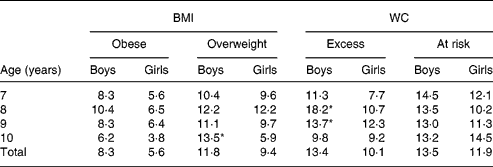
* Frequency was significantly different from that of the girls (P < 0·01).
Between sexes, a difference was observed in frequency of overweight (non-obese) according to the BMI British reference in 10-year-old children (13·5 % for boys v. 5·9 % for girls; P = 0·001). Frequencies of obesity (BMI) did not differ significantly between boys and girls, whatever the age group. Using British WC references, 8- and 9-year-old boys presented higher frequencies of excess abdominal adiposity compared with girls in the same age groups (P = 0·003).
Nutritional status categories of children assessed by BMI (non-overweight, overweight and obese) and assessed by WC (without abdominal adiposity, at risk of abdominal adiposity and excess of abdominal adiposity) showed 84·9 % agreement. When analysis was stratified by sex, the agreement was slightly higher for girls compared with boys (86·2 v. 83·6 %; P = 0·046). The amount of agreement beyond that explained by chance as described by the κ statistic showed a moderate agreement for both boys (κ 0·58) and girls (κ 0·57). Table 4 presents mean values and standard deviations for the ancillary anthropometric variables in subgroups of children only detected by the WC cut-off for abdominal fat (WC-only group) and the group only detected by the BMI cut-off for overweight and obesity (BMI-only group). Overall, 252 of the 2403 children (10·5 %) were classified as non-overweight according to BMI but at risk of abdominal adiposity according to WC cut-offs. By contrast, the BMI cut-off identified fifty-two children (2·4 % of 2203) as overweight or obese, which were not identified as at risk of abdominal adiposity by the WC cut-off. In subgroups of children where BMI and WC percentiles were discordant, an elevated WC preferentially identified children who were taller and also had higher WHtR. There was no mean age difference between children detected by the WC-only group and children detected by the BMI-only group (9·2 (sd 1·1) v. 9·0 (sd 1·1) years; P = 0·2).
Ancillary anthropometric variables among subgroups of children with discordant status (above cut-offs) defined according to the body mass index and waist circumference (WC) cut-offs (Mean values and standard deviations)

WHtR, waist:height ratio; STR, subscapular:triceps skinfold ratio.
* Children classified as at risk of abdominal adiposity according to the WC cut-off, but not as overweight and obese according to the BMI cut-off.
† Children classified as overweight and obese according to the BMI cut-off, but not as at risk of abdominal adiposity by the WC cut-off.
Discussion
In the present article we compared the estimated frequencies of centrally distributed adiposity (as defined by WC) and total adiposity (as defined by BMI) in 7- to 10-year-old schoolchildren living in a city located in the south of Brazil to the corresponding age and sex data from British references. We also presented age- and sex-specific WC percentiles for these children in order to allow valuable comparisons with other populations.
Some limitations of the present study have to be considered. The data were not representative for the whole country, but to the best of our knowledge this is the most up-to-date large set of data on WC in 7- to 10-year-old Brazilian children. Santa Catarina's population is predominantly of European origin; however, specific information on ethnicity was not available in the present study. Due to a high degree of miscegenation in the Brazilian population, it might be advisable to develop standards in the national context, with representative samples of children from all ethnic backgrounds.
A difficulty in this type of research is the absence of commonly accepted cut-offs for classifying children with high WC. This is in contrast with the BMI, for which the International Obesity Task Force cut-offs are now widely accepted. Using this reference, the frequencies of obesity and overweight (including obesity) in the same sample of the present study were 5·5 and 22·1 % respectively (de Assis et al. Reference de Assis, Rolland-Cachera, Grosseman, de Vasconcelos, Luna, Calvo, Barros, Pires and Bellisle2005). For WC, some studies have derived WC cut-offs on the basis of the relationship with metabolic risk factors (Freedman et al. Reference Freedman, Serdula, Srinivasan, Gerald and Berenson1999; Maffeis et al. Reference Maffeis, Pietrobelli, Grezzani, Provera and Tato2001; Moreno et al. Reference Moreno, Pineda, Rodriguez, Fleta, Sarria and Bueno2002; Katzmarzyk et al. Reference Katzmarzyk, Srinivasan, Chen, Malina, Bouchard and Berenson2004). The optimal threshold differed markedly between these studies, depending on the number and type of metabolic risk factors and probably due to ethnic and environmental differences between populations. Others have developed thresholds on the basis of the correlation of WC with high trunk fat mass (Taylor et al. Reference Taylor, Jones, Williams and Goulding2000), or based on the distribution of WC data from reference populations (McCarthy et al. Reference McCarthy, Ellis and Cole2003; Fredriks et al. Reference Fredriks, van Buuren, Fekkes, Verloove-Vanhorick and Wit2005). In the absence of Brazilian WC reference data, we chose the criterion proposed by McCarthy et al. (Reference McCarthy, Ellis and Cole2003), based on British reference data, to compare frequencies of nutritional status categories as defined by BMI and WC.
The results of the present study showed that, using BMI or WC, there were higher frequencies of Brazilian children with total and central adiposity compared with the corresponding age and sex data from the British references, except for BMI-defined overweight prevalence in 10-year-old girls. According to the cut-off points corresponding to the 91st and 98th centiles to define central adiposity based on WC (McCarthy et al. Reference McCarthy, Jarrett and Crawley2001) and overall adiposity based on BMI (Cole et al. Reference Cole, Freeman and Preece1995), we found higher frequencies of children with centrally distributed adiposity than total overweight and obesity. The prevalence rates recorded in the present study agree with those reported in British adolescents aged 11–16 years (McCarthy et al. Reference McCarthy, Ellis and Cole2003), using the same British references for WC and BMI, regardless of the different age ranges between the two studies. In the British study centrally distributed adiposity affected a higher percentage of youth than total obesity (McCarthy et al. Reference McCarthy, Ellis and Cole2003). In Australian children aged 7–8 years, the WC identified a greater number of boys over the cut-off point (as defined by the 91st percentile) compared with the BMI cut-off points (as defined by International Obesity Task Force references). However, more girls were identified by BMI cut-offs as overweight or obese compared with the WC cut-off points (Garnett et al. Reference Garnett, Cowell, Baur, Shrewsbury, Chan, Crawford, Salmon, Campbell and Boulton2005).
In the present study, we analysed indirect associations among measures of adiposity and physical growth. The correlation between WC and height suggests that the increase in WC in childhood is due in part to linear growth, as stated by others (McCarthy & Ashwell, Reference McCarthy and Ashwell2006). In fact, children identified by the WC cut-off as at risk of abdominal adiposity but not by BMI cut-off were 7 cm taller, suggesting that the magnitude in the WC can be in part explained by the difference in height. Although children classified as at risk of abdominal adiposity according to the WC cut-offs (WC-only group) presented a significantly higher WHtR compared with children classified only by the BMI cut-offs (BMI-only group), the clinical significance of this increase (P < 0·01) may be irrelevant. It is important, however, to examine the WHtR, as this index takes height into account.
The WHtR has recently been proposed as an index to assess central adiposity in children and adolescents, based on evidence that it is a better predictor of CVD risk factors than the BMI (Savva et al. Reference Savva, Tornaritis, Savva, Kourides, Panagi, Silikiotou, Georgiou and Kafatos2000; Kahn et al. Reference Kahn, Imperatore and Cheng2005; McCarthy & Ashwell, Reference McCarthy and Ashwell2006). Although WC measurement cannot differentiate between visceral and subcutaneous adiposity stores, it has been shown that WC is a good predictor of visceral fat, linked to increased risk of metabolic diseases in children and adolescents (Hirschler et al. Reference Hirschler, Aranda, Calcagno Mde, Maccalini and Jadzinsky2005; Lee et al. Reference Lee, Bacha, Gungor and Arslanian2006).
Values of WC at the 90th percentile in Florianopolis children were higher than those from British data (1977–87) (McCarthy et al. Reference McCarthy, Jarrett and Crawley2001) but lower than those found in European-American children (Fernández et al. Reference Fernández, Redden, Pietrobelli and Allison2004), in the same age range. Indeed, the 75th percentile in boys and girls of Florianopolis approached or exceeded the 95th percentiles in British children (McCarthy et al. Reference McCarthy, Jarrett and Crawley2001). These comparisons should be interpreted considering several important differences between the studies, such as the site of waist measurement, the date of data collection, the method of derivation of the percentile values and the genetic, ethnic and socio-economic characteristics of the populations. Data from the UK and in the present study were measured midway between the tenth rib and the iliac crest and the derivation of percentile values were developed using the LMS method. The USA study used the site just above the uppermost lateral border of the right ilium for measurement of the WC and percentile regression to model centiles. These issues have been discussed elsewhere (McCarthy et al. Reference McCarthy, Jarrett and Crawley2001; Eisenmann, Reference Eisenmann2005).
These data add to the existing WC percentile distributions developed for children and youth in Italy (Zannolli & Morgese, Reference Zannolli and Morgese1996), Spain (Moreno et al. Reference Moreno, Fleta, Mur, Rodriquez, Sarria and Bueno1999), the UK (McCarthy et al. Reference McCarthy, Jarrett and Crawley2001), Cyprus (Savva et al. Reference Savva, Kourides, Tornaritis, Savva, Tafouna and Kafatos2001), Australia (Eisenmann, Reference Eisenmann2005) and the USA (Fernández et al. Reference Fernández, Redden, Pietrobelli and Allison2004). There are important differences in mean values of WC for age between countries, with the highest values for the USA and Cyprus and the lowest for the UK, with intermediate values for Australia, Italy, and Spain. Unmeasured factors such as socio-economic, dietary and physical activity patterns, and ethnic characteristics might explain some of the variation in the WC values between studies. In a representative sample of US children and adolescents (NHANES III), the distribution of WC differed according to ethnic origins in boys and girls (Fernández et al. Reference Fernández, Redden, Pietrobelli and Allison2004). An inverse association among high cardiorespiratory fitness and central obesity (defined by the subscapular skinfold and sum of trunk skinfolds), BMI and percentage body fat was showed in Greek children aged 6–13 years (Nassis et al. Reference Nassis, Psarra and Sidossis2005).
In conclusion, WC percentile distributions of Florianopolis schoolchildren aged 7–10 years showed higher values than British reference data and lower values than American data. Compared with British children, the schoolchildren from Florianopolis were heavier and had a more marked central distribution of body fat. Using British references for WC and BMI, centrally distributed adiposity was more prevalent than total overweight and obesity.
Taking these data as baseline, regular and frequent monitoring of childhood WC values would be advisable. Even if the gold standard to define centrally distributed adiposity prevalence remains uncertain, valid within-population comparisons of relative changes can be made against the same standard over time. More research is required to identify optimal WC cut-offs related to elevated risk factor levels in children and to establish international reference data for WC.
Acknowledgements
The present study was supported by the Fundação de Amparo à Pesquisa de Santa Catarina (FAPESC), the Secretaria da Saúde – Prefeitura Municipal de Florianopolis and the Universidade Federal de Santa Catarina (UFSC). We gratefully thank the staff of the schools as well as the children and their parents for their participation in the study.



