Theorists have long identified adolescence as a period in which identity crystallizes. Although both psychological and neurodevelopmental research suggest that adolescence is actually a time of change and challenge, the accompanying Sturm und Drang (storm and stress) of interpersonal conflict, mood disruption, and risk behavior experienced by some adolescents is no longer considered as pervasive as once believed (Arnett, Reference Arnett1999; Offer, Kaiz, Ostrov, & Albert, Reference Offer, Kaiz, Ostrov and Albert2002). The distinction between normative identity confusion and dysfunctional disturbance in identity formation among adolescents is not well understood. Clinicians and researchers receive minimal guidance from the Diagnostic and Statistical Manual of Mental Disorders, Fourth Edition, Text Revision (DSM-IV-TR; American Psychiatric Association, 2000) for identifying and conceptualizing psychopathological manifestations of identity disturbance in adolescents. The aims of this study are to examine the structure of identity disturbance and the relationship between identity disturbance and personality pathology in adolescence, particularly borderline personality disorder (BPD).
Erikson (Reference Erikson1962, Reference Erikson1968) described consolidation of identity as a central task of adolescence. Putting Erikson's developmental theory to an empirical test, Crawford, Cohen, Johnson, Sneed, and Brook (Reference Crawford, Cohen, Johnson, Sneed and Brook2004) corroborated that Cluster B personality disorder (PD) symptoms representing identity diffusion were actually associated with reduced well-being in adolescence, and that symptomatic improvements over time related to consequent improvement in well-being and the ability for intimate relationships into adulthood. Identity consolidation involves experiencing oneself as consistent over time and situations, displaying stable attitudes and values, having long-term goals and aspirations, and making commitments to people and roles experienced as self-defining (Erikson, Reference Erikson1968; Marcia, Reference Marcia, Bosma, Graafsma and Tobi1994; Westen, Reference Westen1985). In contrast, identity confusion is manifest in a sense of incoherence or confusion about who one is; difficulties committing to occupational, familial, and social roles; or a tendency to take on others' thoughts, feelings, and beliefs in lieu of establishing one's own values, beliefs, and commitments (Westen & Heim, Reference Westen, Heim, Leary and Tangney2003; Wilkinson-Ryan & Westen, Reference Wilkinson-Ryan and Westen2000).
Marcia, Waterman, Mattesonh, Archer, and Orlofsky (Reference Marcia, Waterman, Matteson, Archer and Orlofsky1993) operationalized these concepts by distinguishing adaptive identity achievement from three unresolved “identity statuses”: moratorium, foreclosure, and diffusion. In moratorium, often occurring in the 20s and sometimes beyond, identity issues are put off and remain “on hold” vis-à-vis occupational or other role commitments. In foreclosure, role and value commitments are made without consideration of alternatives or the experience of any period of struggle. Diffusion is more pathological, as reflected in, for example, repeated changes in careers, affiliations, values, and ideologies (see also Kernberg, Reference Kernberg1975). However, both empirical and clinical data suggest that many adolescents who experience a period of adolescent storm and stress go on to live normal, healthy lives.
When identity diffusion becomes clinically relevant or genuinely psychopathological, particularly in adolescence, is relatively uncharted empirical territory, partially reflecting the lack of instruments sensitive enough to detect the difference between various degrees and types of identity confusion. Identity disturbance is one of the symptom criteria for BPD diagnosis in DSM-IV-TR. However, the criteria for BPD and the other PDs were designed for use with adults, and the categorical nature of the criteria makes it difficult to conceptualize or identify thresholds for exactly what might constitute pathological identity disturbance (Beauchaine, Klein, Crowell, Derbidge, & Gatzke-Kopp, Reference Beauchaine, Klein, Crowell, Derbidge and Gatzke-Kopp2009). Little research exists on the forms of identity disturbance in adolescence that might meet criteria for BPD, although emerging prospective evidence suggests that early adolescent disturbance in self-representation mediates the relationship between infant attachment disorganization and adult BPD symptoms (Carlson, Egeland, & Sroufe, Reference Carlson, Egeland and Sroufe2009). Investigation of the manifestations, correlates, and development of personality psychopathology in adolescents is vital in light of the increasing evidence that PDs are diagnosable in adolescents, show similar degrees of stability and change in adolescence as in adulthood, and are strongly associated with concurrent and future psychiatric problems and maladaptive behaviors (Bornovalova, Hicks, Iacono, & McGue, Reference Bornovalova, Hicks, Iacono and McGue2009; Cohen, Crawford, Johnson, & Kasen, Reference Cohen, Crawford, Johnson and Kasen2005; Crawford & Cohen, Reference Crawford and Cohen2008; de Clercq, van Leeuwen, van den Noortgate, de Bolle, & de Fruyt, Reference De Clercq, van Leeuwen, van den Noortgate, de Bolle and de Fruyt2009; Johnson et al., Reference Johnson, Cohen, Skodol, Oldham, Kasen and Brook1999; Levy et al., Reference Levy, Becker, Grilo, Mattanah, Garnet and Quinlan1999; Shiner, Reference Shiner2009). BPD is the most widely studied PD in adolescents, and it appears to resemble the adult disorder as early as age 14 (cf. Ludolph et al., Reference Ludolph, Westen, Misle, Jackson, Wixom and Weiss1990; Meijer, Goedhart, & Treffers, Reference Meijer, Goedhart and Treffers1998; Westen, Shedler, Durrett, Glass, & Martens, Reference Westen, Shedler, Durrett, Glass and Martens2003).
Wilkinson-Ryan and Westen (Reference Wilkinson-Ryan and Westen2000) developed an Identity Disturbance Questionnaire (IDQ) for use by clinically experienced observers to describe patients based on either a systematic Clinical Diagnostic Interview (Westen & Muderrisoglu, Reference Westen and Muderrisoglu2003, Reference Westen and Muderrisoglu2006) or ongoing clinical observation. They solicited data on 95 adult patients, one-third of whom were diagnosed with BPD and the remainder with either another PD or no PD. Factor analysis identified four factors: role absorption (defining oneself in terms of a specific role or cause, or the tendency to have “epiphany” experiences in which the patient developed a new identity), painful incoherence (subjective feelings of a lack of coherence), inconsistency (objective manifestations of incoherence or instability), and lack of commitment (e.g., to jobs or values). Each of the four factors distinguished patients diagnosed with BPD from other patients, and patients with BPD evidenced more severe disturbance on each factor than both the other PD and no PD groups. Given the high incidence of sexual abuse histories among BPD patients and the high correlation between sexual abuse history and dissociation, the investigators used multiple regression to disentangle the relative contributions of sexual abuse and BPD in relation to these four dimensions of identity disturbance. Sexual abuse was strongly associated with painful incoherence, which includes some of the more dissociative aspects of identity disturbance. However, inclusion of BPD diagnosis significantly improved the model's power in relation to all four dimensions, suggesting that identity disturbance is a core aspect of BPD in adults with or without sexual abuse histories.
In the present study, we applied factor analysis to an adolescent version of the IDQ (IDQ-A) to identify dimensions of identity disturbance in adolescents and to see if the nature of identity disturbance in adolescents is similar to that in adults. Our first goal was to see whether we could differentiate dimensions of identity disturbance in adolescents. Our second goal was to examine the relation between any observed dimensions of identity disturbance and personality pathology. Thus, we examined the relations between obtained factors and dimensional measures of the DSM-IV PDs. Our third goal was to see whether identity disturbance in adolescents, as in adults, is uniquely associated with BPD. Our fourth and final goal, following Wilkinson-Ryan and Westen (Reference Wilkinson-Ryan and Westen2000), was to test the incremental relationship of dimensions of identity disturbance with BPD diagnosis after accounting for history of sexual abuse.
Method
Sample
As part of a broader NIMH-funded project on adolescent personality pathology, we contacted a random national sample of psychiatrists and psychologists with at least 5 years experience postresidency (MDs) or postlicensure (PhDs) from the membership registers of the American Psychiatric Association and American Psychological Association, including clinicians targeted in prior solicitations to create a practice research network. We selected clinicians whose membership records indicated an interest in children or adolescents, and supplemented this where necessary with a general sample, given that many clinicians treat adolescents as well as adults. Over one-third of clinicians agreed to participate in the study by the time we completed recruitment of the sample, with psychologists represented at roughly twice the rate as psychiatrists. Participating clinicians received a consulting fee of $200 to complete a battery of measures. Clinicians received a packet containing a cover letter, a consent form, a postage-paid return envelope, and the study measures. Each clinician contributed data on only one patient, to minimize rater-dependent variance.
To obtain a broad range of personality pathology from relatively minimal to substantial, we asked clinicians to describe “an adolescent patient you are currently treating or evaluating who has enduring pattern of thoughts, feeling, motivation or behavior—that is, personality problems—that cause distress or dysfunction” and emphasized that patients did not need to have a DSM-IV PD diagnosis. We also instructed clinicians to disregard the caveats in the DSM-IV-TR regarding the application of Axis II diagnoses to adolescents and simply to select a patient with any degree or form of personality pathology.
We obtained a stratified random sample, stratifying on age (13–18) and sex. The only exclusion criteria were chronic psychosis and mental retardation. In addition, we asked clinicians to select a patient whose personality they felt they knew, using as a guideline ≥6 hr of clinical contact but ≤2 years (to minimize confounds imposed by personality change with treatment). To minimize selection biases, we directed clinicians to consult their calendars to select the last patient they saw during the previous week who met study criteria, regardless of setting (e.g., private practice, residential facility).
The patient sample (N = 139) consisted of 48.2% males and 51.8% females. The majority were Caucasian (78.4%) and middle class (43%), with 22% identified as poor or working class and 34% identified as upper middle class or higher. The most common Axis I diagnoses included major depression (29.5%), dysthymic disorder (42.4%), posttraumatic stress disorder (12.2%), anxiety disorders other than posttraumatic stress disorder (42.9%), attention-deficit/hyperactivity disorder (30.2%), conduct disorder (14.4%), and oppositional defiant disorder (30.2%). A quarter of the sample reported previous psychiatric hospitalization. The sample included patients diagnosed with all categories of Axis II diagnosis: paranoid (17%), schizoid (11%), schizotypal (4%), antisocial (32%), borderline (25%), histrionic (12%), narcissistic (19%), avoidant (25%), dependent (9%), and obsessive–compulsive (6%). In line with prior epidemiologic findings, there was a significantly greater prevalence of BPD diagnosis in females (15 females, 6 males) in the sample. The Global Assessment of Functioning Scale scores ranged from 30 to 85 (M = 58.41, SD = 9.72). Thus, the sample was diverse in level of adaptive functioning, from relatively troubled to relatively healthy, with substantial representation of both internalizing and externalizing pathology.
Measures
The core battery of measures required approximately 2 hr to complete. We describe here only the measures used in this report.
Clinical Data Form for Adolescents (CDF-A)
The CDF-A (see Westen et al., Reference Westen, Shedler, Durrett, Glass and Martens2003) is a clinician-report form developed over several years that assesses a range of variables relevant to demographics, diagnosis, and etiology. Clinicians first provide demographic data on themselves and the patient. They then rate the patient's adaptive functioning using a number of indices, such as ratings of school performance and peer relations, as well as relatively objective indicators such as history of arrests, suicide attempts, and psychiatric hospitalizations. Research has demonstrated that clinician ratings of adaptive functioning variables show high interrater reliability and concurrent validity (e.g., correlations with the same data obtained by independent interview r > .60; DeFife, Drill, Nakash, & Westen, Reference DeFife, Drill, Nakash and Westen2010; Hilsenroth et al., Reference Hilsenroth, Ackerman, Blagys, Baumann, Baity and Smith2000; Westen, Muderrisoglu, Fowler, Shedler, & Koren, Reference Westen, Muderrisoglu, Fowler, Shedler and Koren1997). The next section of the CDF-A assesses aspects of the patient's developmental and family history with which clinicians who have met with adolescents and/or their parents over several sessions are likely to be familiar. The CDF-A assesses a wide range of variables of potential etiological relevance, such as history of foster care, family stability, and physical and sexual abuse. Clinicians working with adolescent patients generally have relatively direct access to such information from having met with parents and/or other collateral sources. In prior studies with both adolescent and adult samples, clinicians' judgments on these variables have predicted theoretically relevant criterion variables and have reflected reasonable (and conservative) decision rules (Dutra, Campbell, & Westen, Reference Dutra, Campbell and Westen2004; Nakash-Eisikovits, Dutra, & Westen, Reference Nakash-Eisikovits, Dutra and Westen2002). For example, when asked to indicate reasons for their belief that a patient had a history of sexual abuse, virtually all clinicians checked off items indicating involvement of authorities such as police or Department of Social Services, intact pretreatment memories of sexual abuse, and corroboration from family members or court records; less than 5% indicated that their judgment reflected inferences from the symptom picture or memories recovered in treatment, and clinicians tended to rate cases with questionable or ambiguous reasons for inference as “unsure” (Russ, Heim, & Westen, Reference Russ, Heim and Westen2003; Wilkinson-Ryan & Westen, Reference Wilkinson-Ryan and Westen2000). CDF-A ratings of quality of patients' relationships with their parents also correlate strongly with scores on a clinician-report Parental Bonding Inventory (Parker, Tupling, & Brown, Reference Parker, Tupling and Brown1979; Russ et al., Reference Russ, Heim and Westen2003), which has similar factor structure and correlates to the self-report version. Research just completed in our lab (DeFife et al., Reference DeFife, Drill, Nakash and Westen2010) has also found extremely high correlations (most ranging from r = .50 to .70) between clinician-report and self-report data on CDF variables, particularly aggregated variables, suggesting that the clinician-report data strongly converge with data from alternative informants vis-à-vis both their current adaptive functioning and family and developmental history.
Axis II checklist
To generate both categorical and dimensional DSM-IV-TR PD diagnoses, we presented clinicians with a randomly ordered checklist of the criteria for all Axis II disorders. Prior research with both adolescents and adults finds that Axis II ratings collected in this manner have similar external correlates and produce similar patterns of comorbidity to those obtained in structured interviews (Blais & Norman, Reference Blais and Norman1997; Morey, Reference Morey1988; Westen et al., Reference Westen, Shedler, Durrett, Glass and Martens2003; Zittel Conklin & Westen, Reference Zittel Conklin and Westen2005). To generate categorical diagnoses, we applied DSM-IV-TR decision rules. To generate dimensional diagnoses, we summed the number of criteria met per disorder, as is standard practice in PD research.
IDQ-A
This 35-item adaptation of the IDQ for adults (Wilkinson-Ryan & Westen, Reference Wilkinson-Ryan and Westen2000) assesses a wide range of potential manifestations of identity disturbance among adolescents on a 7-point scale (1 = not true at all, 4 = somewhat true, 7 = very true). Although the adolescent and adult forms are very similar, in several cases items were revised from the original instrument to reflect age-appropriate identity issues for adolescents. The items in both the adult and adolescent versions were based on an extensive review of the clinical, theoretical, and empirical literatures. For example, based on Erikson's (Reference Erikson1968) concept of a negative identity, the IDQ-A includes items assessing the extent to which the adolescent defines himself in terms of, for example, a stigmatized group, negative label, or being “bad.” Multiple items capture both Erikson's and Marcia's (1994) emphasis on commitment to roles, affiliations, values, and goals and aspirations. Items representing subjective feelings and thoughts about identity disturbance were based on clinical literature and observation (e.g., “Tends to feel like a ‘false self,’ whose social persona does not match his/her inner experience”; “Subjectively feels as s/he is a different person depending on who s/he is with”). The IDQ-A, like the IDQ, also addresses phenomena more readily observed by a clinically trained observer (e.g., “Holds beliefs that are grossly inconsistent with one another and seems unconcerned by contradictions”; “Patient has trouble telling life story; narrative accounts have large gaps or inconsistencies”). In general, the questions are written in straightforward language with minimal jargon.
Results
Patients (N = 139) were evenly distributed across sex (52% female) and age (13–18) and were described by clinicians who were, on average, highly experienced (professional experience, M = 18.5 years, SD = 8.6 years). In keeping with other studies of clinician theoretical orientation (Norcross, Karpiak, & Lister, Reference Norcross, Karpiak and Lister2005), the modal clinician reported an eclectic or integrative theoretical orientation (52.3%), followed by cognitive–behavioral (20.5%) and psychodynamic (18.7%).
As a brief validity check to ascertain whether the item set assessed the construct it was designed to assess in adolescents, as in Wilkinson-Ryan and Westen (Reference Wilkinson-Ryan and Westen2000), we used clinicians' categorical ratings of presence/absence of identity disturbance (one of the DSM-IV-TR criteria for BPD) to divide patients into two groups (identity disturbed/nondisturbed), irrespective of diagnosis. We then compared the means of each identity item for patients with and without identity disturbance. Thirty-two of the 35 items significantly discriminated between patients who met the DSM-IV-TR identity disturbance criterion at the .001 level (conservatively using two-tailed tests, even though predictions were directional). Of the 3 remaining items, two were significant at the .05 level and the last showed a strong trend. Thus, the item set clearly assessed dimensions relevant to clinicians' understanding of identity disturbance as defined by DSM-IV-TR.
Factor structure of the IDQ-A
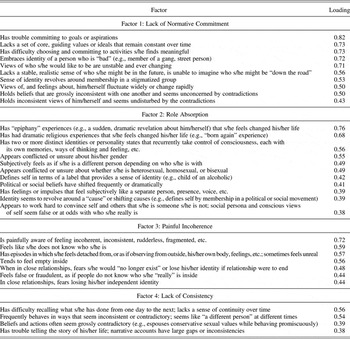
Our first goal was to identify the factor structure of the IDQ-A. We used the scree plot, percentage of variance accounted for, and parallel analysis (Horn, Reference Horn1965; O'Connor, Reference O'Connor2000) to select the number of factors to rotate. All three indicated a four-factor solution (as in the adult IDQ), with parallel analysis identifying four factors with eigenvalues larger than would be expected by chance (p < .05 with 100 random data sets). We therefore ran four-factor solutions using multiple algorithms, rotations, and estimation procedures essentially as consistency tests. We report here the most coherent solution, the Promax (oblique) solution using principal axis factoring. This solution accounted for 46.6% of the variance and yielded factors well marked by at least four items each, suggesting stable factor structure unlikely to be substantially affected by sample size (Fabregar, Wegener, MacCallum, & Strahan, Reference Fabregar, Wegener, MacCallum and Strahan1999).
Table 1 lists the items loading on each factor. To create factor-based scores for use in this and subsequent studies, we included items loading ≥0.35 for all four factors to maximize reliability (coefficient α). Intercorrelations among the four factors ranged from .30 to .35. The first factor, lack of normative commitment (α = 0.89), reflects age-discrepant difficulty maintaining stable values, activities, and views of the future. The second factor, role absorption (α = 0.82), describes a tendency to define the self in terms of a single or primary group membership, ideology, or “cause,” which may shift dramatically across time or situations (often in epiphany experiences). The third factor, painful incoherence (α = 0.84), reflects distressing subjective experiences of feeling incoherent, confused, or empty. The fourth factor, lack of consistency (α = 0.71), captures observable manifestations of contradictory actions and beliefs as well as a lack of sense of continuity of consciousness or sense of self over time. As expected (because items were intended to tap pathological, not normatively developing forms of identity), none of the factors was significantly associated with age.
Factor structure of the adolescent identity disturbance questionnaire (N = 139)

Note: The reported items are with high loadings on each factor (>.35).
Identity disturbance and personality pathology
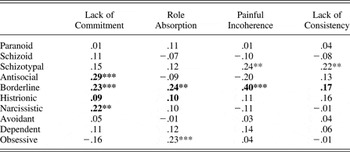
Our second goal was to understand the relation between identity disturbance in adolescence and personality pathology, indexed by dimensional PD diagnosis (i.e., number of criteria met for each disorder). Although categorical analyses produced similar findings, dimensional diagnosis is statistically more powerful, avoids arbitrary cutoffs that are particularly problematic in adolescents (for whom such cutoffs were not designed), and allows assessment of the range of personality pathology from relatively minimal to relatively severe. Because identity disturbance is a core criterion of the BPD diagnosis, we expected that identity disturbance would be associated most prominently with BPD across all four of the factor-analytically derived dimensions. Based on prior research using the IDQ with adults and clinical experience with adolescents, we then hypothesized positive correlations between histrionic PD and lack of normative commitment and role absorption, positive correlations between antisocial PD and narcissistic PD and lack of normative commitment, and a moderate negative association between obsessive–compulsive PD and lack of normative commitment (given the tendency of obsessive–compulsive adolescents to follow rules and obey norms, particularly those established by adults). To control for the comorbidity across PDs in DSM-IV-TR in adolescents as in adults (Durrett & Westen, Reference Durrett and Westen2005), we used partial correlations to partial out the variance accounted for by the other nine disorders in all analyses, rendering these data very conservative.
Table 2 describes the partial correlations between identity factors and PDs, with hypothesized correlations in bold. As expected, the first three IDQ-A factors correlated with BPD even holding constant the other PDs; the fourth factor showed a trend (partial r = .17, p = .06). The hypotheses for antisocial and narcissistic PDs were supported, whereas those for histrionic and obsessive disorders were not significant. An interesting pattern emerged for schizotypal PD, which was associated with both painful incoherence and lack of consistency. These findings make sense in light of research suggesting that schizotypy can reflect either schizophrenia-spectrum pathology or subthreshold disordered thinking associated with a history of abuse, neglect, or early separations (see Shedler & Westen, Reference Shedler and Westen2004), similar to the lapses in metacognitive monitoring and narrative coherence associated with unresolved attachment status on the Adult Attachment Interview (Main & Goldwyn, Reference Main and Goldwyn1985).
Partial correlations among adolescent identity disturbance dimensions and dimensional Axis II diagnoses (N = 139)
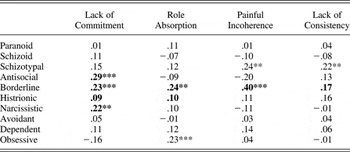
Note: The partial correlations are controlled for all other Axis II disorders. The bold values reflect correlations hypothesized to be significant.
**p < .01.***p < .001.
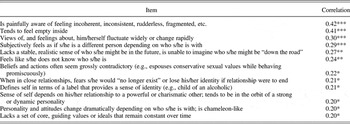
Given the unique relation that emerged between the identity disturbance factors and BPD, to characterize the precise nature of identity disturbance in adolescent BPD we examined the correlation between each IDQ-A item and number of BPD symptoms, holding constant dimensional measures of the other nine PDs. This gave us a relatively “pure” portrait of the forms of identity disturbance that are distinctly characteristic of BPD in adolescents. Significant correlations are reported in Table 3. Of interest is the large number of items that distinguished identity disturbance in BPD from forms of identity disturbance one might expect to be common in a clinical sample of adolescents.
Identity disturbance items most strongly associated with number of borderline personality symptoms, holding constant all other personality disorder symptoms

*p < .05. **p < .01.***p < .001.
The role of sexual abuse
Identity disturbance in adults is associated not only with BPD but with sexual abuse (Westen, Reference Westen, Cicchetti and Toth1994), and BPD in adolescents, as in adults, is associated with a history of sexual abuse (Johnson, Smailes, Cohen, Brown, & Bernstein, Reference Johnson, Smailes, Cohen, Brown and Bernstein2000; Westen, Ludolph, Misle, Ruffins, & Block, Reference Westen, Ludolph, Misle, Ruffins and Block1990). Thus, our final goal was to examine the extent to which the disturbances in identity seen here reflect the effects of sexual abuse rather than BPD. To address this question, we used hierarchical linear regression to assess the incremental relationship of borderline pathology with identity disturbance. We conducted four regression analyses, using each of the identity disturbance factors as the criterion variable, and entered sexual abuse history (0 = absent, 1 = unsure, 2 = present) in the first step and number of borderline symptoms in the second. Adding BPD symptoms at Step 2 significantly increased the relationship in all four cases (Model 2 R 2 = .25, .23, .29, .21, ps < .001, for each respective factor). Although sexual abuse history was strongly associated with lack of commitment (β = 0.24, p = .005) and painful incoherence (β = 0.22, p = .008), inclusion of BPD symptoms significantly increased the relationship in both cases (β = 0.46, ΔR = .26, p = .001 for lack of commitment and β = 0.50, ΔR = .31, p = .001 for painful incoherence). For the other two factors (role absorption and lack of continuity), the model including sexual abuse was not significant, whereas adding BPD in the second step substantially increased the relationship with identity disturbance (β = 0.48, ΔR = .36, p = .001 for role absorption and β = 0.46, ΔR = .36, p = .001 for lack of continuity). These findings closely match the results obtained previously using an adult sample and suggest that although sexual abuse contributes to some dimensions of identity disturbance, BPD is related to all four identity disturbance dimensions independent of abuse history.
Discussion
Pathological variants of identity can be observed in adolescents, and they bear a systematic relation to personality pathology. Identity disturbance in adolescence is multidimensional, consisting of dimensions that resemble in many respects those identified in adults. Factor analysis yielded four factors, each constituting a distinct facet of identity disturbance. The first factor, lack of normative commitment, reflects difficulty maintaining a relatively constant set of goals, aspirations, values, and attitudes, even for an adolescent. Part and parcel of this lack of commitment is what Erikson described as a “negative identity,” such as an identity of a person who is “bad” or stigmatized. Thus, where patients high on this dimension have commitments, it is to reference groups or identities that are viewed negatively by others.
The second factor, role absorption, describes over identification with, or epiphany experiences leading to changes in identification with a particular role or group. In a sense, this form of identity diffusion reflects confusion of part and whole or a tendency to define oneself in terms of one role or group that can help create order from chaos in a person whose identity is otherwise diffuse. In adolescents, this factor includes uncertainty about sexual identity and sexual orientation as well as, at its extreme, multiple personalities experienced as distinct from one another.
The third factor, painful incoherence, reflects subjective experiences of feeling incoherent, confused, fragmented, or empty. These experiences of self are powerfully distressing and are associated with feelings of being desperately in need of others but engulfed in relationships or somehow fraudulent (a “false self”).
The fourth factor, lack of consistency, captures observable manifestations of contradictory actions and beliefs, or what one might call “objective” inconsistency. However, it also includes lapses in the adolescent's sense of continuity over time, as well as correlative difficulty telling coherent life narratives that link one moment in time with the next. It is of interest that this latter phenomenon is manifest already in teenagers as early as age 13, given that the capacity to tell coherent life stories is usually studied in older subjects.
Although factor analytic methods are geared toward the production of the most empirically ideal constructs, the question of the factors' conceptual coherence is matter for subjective evaluation and future work on empirical validation. The four factors appear to represent independent and unique functional domains of personality and identity development. Lack of normative commitment reflects aspirational concerns and definitional group membership. Although the role absorption factor contains items related to group definition (e.g., defining self in terms of a label, shifting political beliefs, involvement with shifting causes), these items are more reflective of concerns with internal self-representation related to personal beliefs such as politics, religion, and sexuality. Painful incoherence is the most affectively charged factor with items representing emotional turmoil, subjective distress, and attachment anxieties. Lack of consistency reflects cognitive disturbances and discontinuities that may manifest in disorganized behavior.
Despite some important differences, identity disturbance in adolescents bears a surprisingly strong resemblance to identity disturbance in adults, with similar factors and item loadings. Two factors, role absorption and painful incoherence, have very similar item content in adolescents and adults. The lack of normative commitment factor in adolescents is, however, somewhat broader, adding aspects of negative identity (being “bad”) that are not present in the lack of commitment factor in adults. The lack of consistency factor in adolescents is similar to the comparable adult factor, except that it includes difficulty maintaining continuity of the sense of self and correlative ability to have and narrate a coherent life story. This likely reflects a developmental delay, given that the ability to present coherent narratives is an aspect of developmental social cognition that continues developing through adolescence and is disturbed in adolescents with personality pathology (Westen et al., Reference Westen, Klepser, Silverman, Ruffins, Lifton and Boekamp1991).
Limitations
This study has a number of limitations. First, this is the first study to apply this measure and method to an adolescent sample. The data on reliability and validity, however, are encouraging in this respect, with acceptable levels of internal consistency and predictable patterns of external correlates.
Second, future research should investigate identity disturbance as expressed in larger and more diverse adolescent samples. For example, lower socioeconomic status has been related to a greater incidence of PD development (Cohen et al., Reference Cohen, Chen, Gordon, Johnson, Brook and Kasen2008); it is possible that identity disturbances may manifest differently in a sample including more patients from impoverished social environments. Similarly, we do not know what factors might have emerged if we had instead interviewed a nonclinical sample and whether levels of identity disturbance would differentiate clinical and nonclinical groups. Although the differentiation of normative and pathological identity disturbance remains an area for further empirical investigation, the identity disturbance reflected in this sample was strongly correlated with PD symptoms known to be associated with maladaptive functioning across numerous domains both concurrently and prospectively.
Third, a single informant (the treating clinician) provided all the data for each case, raising questions of potential interdependence of ratings of identity disturbance and its correlates. This limitation is actually the norm in psychiatric research, in which a single informant (usually the patient) provides all or most of the data (either by self-report or structured interviews that rely primarily on self-report). Future research should employ independent ratings from multiple sources to avoid potential bias. However, several considerations reduce concerns about potential effects of clinicians' biases. Clinicians responded to a set of highly specific items as part of a 2- to 3-hr battery unrelated to identity disturbance. Research suggests that clinicians can make highly reliable and valid judgments if given psychometric instruments such as the one used in this study to quantify their observations and inferences (Westen & Weinberger, Reference Westen and Weinberger2004). In addition, clinicians do not have shared theories about dimensions of identity disturbance, yet we identified four dimensions that resemble those previously observed in adults. We used dimensional diagnoses, operationalized as the number of symptoms of each PD, rather than categorical diagnoses, and held constant dimensional diagnoses of other PDs. Clinicians would have to be remarkably intuitive statisticians to keep in mind and covary hundreds of items from other measures in a battery including thousands of data points while altering their responses to items on an identity disturbance questionnaire to make these responses consistent with their intuitive theories of PDs, particularly BPD.
Fourth, because identity disturbance is itself one of nine criteria for BPD, it could be that some of the association between BPD and the dimensions of identity disturbance that we identified could reflect overlap of predictor and criterion variables. However, part of our goal was to “unpack” the single-item construct of identity disturbance in the DSM-IV (a single present/absent criterion for BPD) into nearly four dozen, more highly differentiated items to see which ones are or are not related to that construct and to BPD more generally and to see if they produced a unidimensional or multidimensional factor solution. That they produced a four-dimensional solution suggests that identity disturbance is not a single construct, as the DSM-IV implies. Further, identity disturbance is only one of nine BPD criteria, and even many adolescents who met criteria for BPD did not meet this criterion. In any case, one of nine criteria would not produce the magnitude and patterns of correlations we obtained.
Clinical Implications and Conclusion
Adolescent identity disturbance as measured by the IDQ-A is a clinically meaningful and multidimensional construct. As evidenced in its relationships with severe forms of personality pathology, identity disturbance appears to be distinctive from developmentally normative aspects of storm and stress in adolescence, although future research should compare clinical and nonclinical samples using this measure.
Identity disturbance is a central feature of BPD in adolescents, as it is in adults. Although it is associated with sexual abuse in adolescents, identity disturbance is not solely or primarily a response to trauma (Herman & Harvey, Reference Herman and Harvey1997); BPD symptoms accounted for unique variance in all four identity disturbance factors above and beyond the effects of abuse. Although we found isolated correlations among the identity disturbance factors and other PDs, BPD was associated with all four factors. As noted above, although identity disturbance is a BPD symptom, rendering this finding perhaps less surprising, identity disturbance is neither a necessary nor a sufficient condition for BPD diagnosis. The significant associations observed among IDQ-A factors and BPD dimensional diagnosis suggest that identity disturbance is actually a central aspect of BPD and BPD-spectrum pathology, and that identity disturbance can be described in a more clinically meaningful and rich depiction than presently exists in the current DSM-IV-TR categorical criterion.
From this study, a clinical picture begins to emerge of adolescents with severe identity disturbance associated with BPD. The items most distinctively associated with BPD describe feelings of emptiness, fluctuations in self-perception, and dependency on specific relationships to maintain a sense of identity. Thus, identity disturbance in adolescent BPD, as in adults, is best characterized in terms of patients' painful internal experience of their own identity instability and uncertainty about fundamental aspects of who they are. It is also associated with a need for others to define their identity (the chameleon-like quality first described by Deutsch, Reference Deutsch1942) and a fear that without others, they have no internal anchors.
The DSM-IV-TR explicitly discourages considering personality diagnosis in adolescents. The issue of personality diagnosis in adolescents frequently raises concerns about stigmatization and questions about concurrent and predictive validity. However, numerous studies have now documented that severe personality pathology exists in adolescents, is clinically distinctive from normative development, and frequently persists into adulthood. Failure to consider pathological expression of personality factors in adolescents overlooks essential aspects of clinical presentation, with a potentially detrimental impact on treatment conceptualization and hence effectiveness. As identity disturbance is a core feature of personality disturbance in adults, for adolescents, the construct merits further empirical investigation and clinical evaluation.