Introduction
Patients with Parkinson disease (PD) suffer significant disability from impaired motor control. Schwab, Chafetz, and Walker (Reference Schwab, Chafetz and Walker1954) observed that patients with PD have an impairment in integrating simultaneous motor acts such as tracing the outline of a triangle and drawing three perpendicular lines with one hand while they squeezed a bulb with the contralateral hand. Schwab et al. commented that failure to integrate independent movements, asynkinesia, can lead to significant difficulty with daily activities.
Aleksandr Luria (Reference Luria1966) described three levels at which motor dysfunction may occur: elemental (e.g., paresis, dystonia, ataxia, or hyperkinesis), sensorimotor integration, and “dynamic organization” of the sequential and/or simultaneous components into a complex motor action. He noted that lesions of the premotor cortex can significantly impair dynamic organization of complex movements. To test for dysfunction of the premotor cortex, Luria described an Alternating Hand Posture (AHP) test, which he attributed to Ozeretskii (Reference Ozeretskii1930). As the test is traditionally administered, a subject is instructed to place both hands on a table or on one's lap, and one hand is closed in a fist-like posture while the other hand is open, palm down, with fingers fully extended. The subject then repeatedly alternates the postures of these two hands (the subject closes the hand that was opened and simultaneously opens the hand that was closed and continues to reverse this pattern).
In clinic, we typically assess patients with this test and have noted that many patients do not keep their hands in the same coronal plane (side by side) as they perform the alternating movements. Instead, they make swimming movements by extending one elbow and simultaneously opening (extending) the fingers on that hand while concurrently flexing the other elbow and simultaneously closing (flexing) the fingers on the other hand. This is reminiscent of how young children often swim when they are put in the water. This swimming stroke is known as the “doggie paddle” since it resembles the manner in which a dog swims. The doggie paddle is believed to be the first swimming stroke used by ancient people, possibly learned by watching animals swim (Colwin, Reference Colwin2002).
The crawl stroke, in which a person extends one arm and then the other in an alternating manner, has since emerged as a fast and efficient swimming technique (Colwin, Reference Colwin2002). The name of this swimming stroke, which describes the alternating movements of both upper and lower extremities, also draws an analogy between swimming and another form of locomotion seen early in human development. In addition to resembling swimming movements, the alternating forward hand movements we have observed when some patients try to perform an AHP test resembles the way babies crawl.
Hughlings-Jackson was strongly influenced by Darwin. In his Remarks on Evolution and Dissolution of the Nervous System (Reference Hughlings-Jackson1887), Hughlings-Jackson posited that as organisms evolved and developed more complex behaviors to allow for more advanced environmental and social interactions, newer regions of the brain developed to mediate these advanced behaviors. In order for these more highly evolved centers in the brain to be effective, they must inhibit phylogenetically lower (more primitive) centers that program more stereotypic behaviors. Dysfunction or disconnection of these more recently evolved higher centers in the brain can lead to negative symptoms (loss of function) as well as positive symptoms in which more “primitive” behaviors re-emerge due to loss of inhibition or functional release of a lower center. We wondered whether this dissolution condition evolves in the course of PD.
The purpose of this study was to learn if participants with PD, compared to matched control participants, would exhibit an impairment in making simultaneous independent movements with the right and left hands as tested with an AHP test in which the two hands remain parallel to each other and in the same coronal plane (parallel AHP test), and also if participants with PD would perform a swimming movements AHP test better than the parallel AHP test. We also expected it would be more difficult for patients with PD to perform a reverse swimming movements AHP test (with flexion of the fingers and extension of the arm with one limb and extension of the fingers and flexion of the arm with the other limb) compared to the swimming movements AHP and the parallel AHP tests. Failure to correctly produce independent alternating hand movements may also be related to defective inhibition. Previous studies of patients with PD have revealed that they do often have defective response inhibition (Crucian et al., Reference Crucian, Heilman, Junco, Maraist, Owens, Foote and Okun2007), and one of the signs of defective response inhibition is echopraxia such that one hand echoes the movements of the other hand. Therefore, subjects’ right and left hands were independently tested for echopraxia by using Luria's test for echopraxia. Another movement programming deficit sometimes seen with frontal-subcortical dysfunction is impairment in programming sequences of movement, and to test for this, the participants’ right and left hands were also tested using a variation of Luria's “fist-edge-palm test.”
Materials and methods
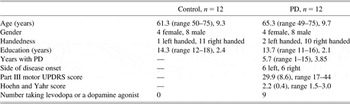
Twenty-four participants were recruited, 12 with PD and 12 healthy controls. All experimental and control participants had greater than a 6th grade education and all signed informed consents approved by the University of Florida Institutional Review Board. Participants with idiopathic PD were recruited from the University of Florida Movement Disorders Clinics at the time of their periodic-regular clinic visits. In experimental participants, the diagnosis of idiopathic PD was made by fellowship trained neurologists with specialization in Movement Disorders using UK Brain bank criteria (Gelb, Oliver, & Gilman, Reference Gelb, Oliver and Gilman1999; Jankovic, Reference Jankovic2008). None of these participants had a history of deep brain stimulation or ablative surgery for PD. All participants in the experimental and control groups were without current or past diseases of the nervous system that would significantly affect their cognitive or motor abilities to perform these tasks (other than PD) or a history of psychosis, refractory depression, drug abuse, learning disability, severe sensory defects such as deafness or blindness, or chronic medical diseases including organ failure that could influence the nervous system. Participant demographics are listed in Table 1.
Demographics (listed as mean, standard deviation unless otherwise stated)

PD = Parkinson disease; UPDRS = Unified Parkinson's Disease Rating Scale.
For all PD subjects, the medical record was reviewed to obtain the most recent Part III motor Unified Parkinson Disease Rating Scale (UPDRS) scores and medications. For 8 of the 12 participants, the UPDRS scores were those assessed on the day of the study. In one of these cases, the participant had a motor UPDRS score of 37 but the rigidity subscale was omitted although the note indicated that the patient had asymmetrical rigidity. We adjusted that participant's motor UPDRS score to 39 to attempt to reflect this. For each of the four participants with PD who did not have motor UPDRS scores recorded on the day of the study, the most recent motor UPDRS score within the past year was recorded. Eight of the participants with PD were taking levodopa, four were taking dopamine agonists, seven were taking MAO-B inhibitors, and five were taking amantadine. Three of the 12 participants with PD were not taking either levodopa or a dopamine agonist. Participants presented to clinic on their typical medication regimen and were tested before or after their regularly scheduled clinic visits. One of the participants in the PD group was taking primidone for co-existing essential tremor. None of the normal controls were taking levodopa, a dopamine agonist, an MAO-B inhibitor, or amantadine. In the PD group two participants were taking clonazepam and one was taking alprazolam. Of the normal controls, one was taking clonazepam, one was taking alprazolam, and one was taking pregabalin. Three participants with PD and one normal control were taking antidepressants.
As part of our experimental protocol, all participants were evaluated with the following neuropsychological tests: the Montreal Cognitive Assessment (MoCA) test (Nasreddine et al., Reference Nasreddine, Phillips, Bédirian, Charbonneau, Whitehead, Collin and Chertkow2005), the Controlled Oral Word Association test with the letters F, A, and S to test phonemic fluency, and a modified digit span test forward and backward to test attention and working memory.
Apparatus
A laminated poster board was placed on a table directly in front of the subject such that the subject's mid-sagittal plane bisected the poster board. This poster board had six circles that were 6 inches in diameter, three on the right side and three on the left side. The centers of these circles were 5 inches, 11 inches, and 17 inches from the edge of the poster board that was flush with the edge of the table (the edge of the poster board closest to the subject). The center of each circle was 18 inches from the center of the circle on the other side. The circles were painted black. A stop-watch was used to time the participants’ performances.
Procedures
Independent hand movements
All subjects were tested in three experimental simultaneous bilateral movement tests and two control conditions listed below. Before each test, the participants were shown each AHP test by the examiner for 20 repetitions and were asked to repeat each sequence of actions while keeping their hands on the poster board in the conditions listed below. Before each test, the examiner instructed the participant to “do each task as accurately as you can, but the faster the better.” The examiner did not refer to the swimming movements AHP test by name, and participants were not instructed that the goal of this study was to learn how bimanual movements in Parkinson disease are affected by modification into a swimming or crawling type of movement.
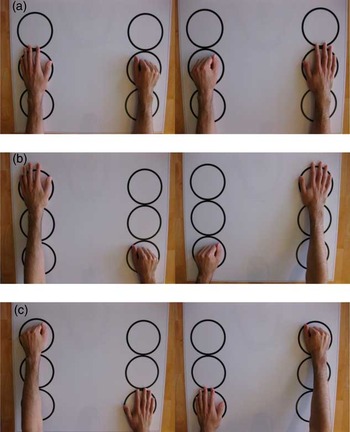
1. Parallel AHP test (Figure 1a)
Each participant placed the left hand on the left circle 11 inches from the proximal edge of the poster board and the right hand on the right circle at the same distance. Initially one hand was closed in a fist-like posture while the other hand was open with fingers fully extended. The participant then repeatedly alternated the postures of the two hands (closed the hand that was open and opened the hand that was closed) and continued to reverse this pattern. There was no forward or backward movement (both the right and left hands remained in the circles 11 inches from the edge of the poster board) during hand alternation.
Photographs of Alternating Hand Posture (AHP) tests. a: Parallel AHP test. b: Swimming movements AHP test. c: Reverse swimming movements AHP test.

2. Swimming Movements AHP test (Figure 1b)
As each participant performed the hand alternation task, the open hand advanced forward to the circle at 17 inches while the closed hand was brought back to 5 inches. The participant then alternated hand gestures and positions, closing the open hand that was at 17 inches and bringing it back to 5 inches while opening the closed hand that was at 5 inches and bringing it forward to 17 inches.
3. Reverse Swimming Movements AHP test (Figure 1c)
In this test, the participant again performed the hand alternation task, but in this test the closed hand advanced forward to the circle at 17 inches while the open hand was brought back to 5 inches. The participant then alternated hand gestures and positions, opening the closed hand that was at 17 inches and bringing it back to 5 inches while closing the open hand that was at 5 inches and bringing it forward to 17 inches.
During the participants’ performance of the above tests, the examiner silently counted and then informed them to stop. The time taken to perform these 20 alternating movements was recorded. If after the initiation of the trial, the participants could not correctly make these movements within 20 s, 20 s was added to the score for that trial and the examiner again demonstrated these movements. If the participant again could not correctly perform these movements, another 20 s was added to the score for that trial and the examiner demonstrated these movements a third time. If the participant could not perform the movements correctly after the third demonstration, the failure was noted and the participant was given a maximum score of 180 s for that test.
4. Control tests
To help assess for a possible effect of bradykinesia on the task, we also performed two trials in which the participants placed both hands in the circles at 11 inches and tapped the table with both hands as fast as they could. For one trial, the subjects did 20 taps with their hands open and for one trial they did 20 taps with their hands closed.
The order in which these conditions were tested was counter-balanced across subjects. Half of the subjects did the five tests in the following randomly selected order: swimming movements AHP test, open hand taps, reverse swimming movements AHP test, parallel AHP test, and then closed hand taps. The other half of the subjects did the five tests in the reverse order.
Participants also performed the following two unimanual cognitive motor tasks.
1. Movement Sequencing Test – Fist-Edge-Palm (right hand) and Palm-Edge-Fist (left hand)
The examiner asked the participants to make the same movements made by the examiner. They were shown this procedure (e.g., fist-edge-palm) by the examiner for three complete cycles before each of the subjects’ hands were tested. They were then asked to repeat this sequence of actions until they could complete three cycles of the movement with the tested hand. All subjects were tested with one and then the other hand. In half of the subjects, the right hand was tested first and in the other half the left was tested first. If the subject could not perform three complete cycles within 16 s, the examiner again demonstrated this movement sequence. If the subject could correctly perform this task after seeing the examiner perform it the first time the subject was given a score of 4, after demonstrated a second time, a score of 3, and after demonstrated a third time a score of 2. If the subject still could not perform this sequence after three demonstrations, the subject received a score of 1.
2. Echopraxia Test
The participants were told to make a fist and then when the examiner extends one finger they are to extend two and when the examiner extends two fingers they are to extend one. Each hand was tested independently and the order counterbalanced across subjects, so in half of the subjects the right hand was tested first and in half of the subjects the left hand was tested first. There were 12 trials and the score was the number correct, scored separately for each hand.
Statistical Analysis
To compare the two groups’ abilities to perform the tests of independent hand movements (the parallel AHP test, the swimming movements AHP test, the reverse swimming movements AHP test, open hand taps and closed hand taps), participants were evaluated with a Kruskal-Wallis test. Because of the variability between the two groups in their abilities to perform the reverse swimming movements AHP test, we considered that an inability to perform a task may be different than the ability to perform a task poorly, and we compared the two groups’ performances on the reverse swimming movements AHP test with a binary logistic regression. Since ranking in the Kruskal-Wallis test was based on time to complete the independent hand movement tests, we performed separate one-way analyses of variance (ANOVAs), including only those participants who were able to complete the parallel, swimming, and reverse swimming AHP tests to assess for any differences between the groups primarily due to differences in performance speed.
Results
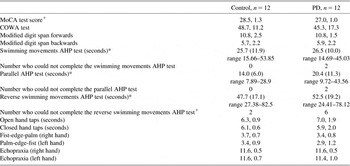
Results of cognitive and cognitive-motor tests are listed in Table 2. One of the participants with PD was initially doing well with the parallel AHP test but after 16 of the 20 repetitions, this participant insisted on stopping and was excluded from the parallel AHP test analysis. That participant fully attempted to complete all other tests and was included in those analyses. All other participants fully attempted to complete all tests.
Scores on cognitive and motor tests (listed as mean, standard deviation unless otherwise stated)

Note. MoCA = Montreal Cognitive Assessment test; COWA = Controlled Oral Word Association test; AHP = Alternating Hand Posture test.
*Times listed are only for those participants who completed that test. When participants who were unable to perform the test were also included in the two groups for comparison, there was a statistically significant difference (p < 0.05) between the two groups for the parallel AHP test but not the swimming or reverse swimming movements AHP tests.
+represents a statistically significant difference (p < 0.05) between the two groups.
One of the participants with PD who could not complete the parallel AHP test also could not complete the swimming movements AHP test while the other participant with PD who could not complete the parallel AHP test could complete the swimming movements AHP test. All three participants with PD who could not complete the parallel AHP test and/or the swimming movements AHP test were among those who could not complete the reverse swimming movements AHP test.
The PD and normal control groups were compared with a Kruskal-Wallis test that demonstrated significant differences between the two groups for performance on the parallel AHP test (one tailed p value = .042) and no significant difference between groups for the swimming movements AHP test, reverse swimming movements AHP test, open hand taps, closed hand taps, fist edge palm (right hand) or palm edge fist (left hand). Participants with PD and normal controls performed identically for echopraxia testing with the right hand and almost identically for echopraxia testing with the left hand. There were no significant differences between the two groups on the Controlled Oral Word Association test or tests of digit span forward and backward. While there was a significant difference between the two groups on the MoCA test, in both groups all scores were within the normal range (as per our inclusion criteria).
Since six participants with PD and two normal controls could not complete the reverse swimming movements AHP test, we were also interested to see if there was a difference between the groups’ abilities to perform or not perform this task. To test this, a binary logistic regression analysis was done to compare the number of participants who could not complete the reverse swimming movements AHP test in each group. This showed a significant difference between the two groups for ability to complete the reverse swimming movements AHP test (one tailed p value = .048).
We were also interested to learn whether, among those participants who could complete the tasks, performance speed varied between the two groups. This was tested with a one-way ANOVA and did not show significant differences in performance speed between the two groups for the parallel AHP test, swimming movements AHP test, or reverse swimming movements AHP test among participants who were able to complete those tasks. Motor UPDRS scores did not significantly correlate with performance on any of the cognitive or cognitive-motor tests in this study.
Discussion
Johnson et al. (Reference Johnson, Cunnington, Bradshaw, Phillips, Iansek and Rogers1998) studied the ability of people with PD to perform in phase movements (symmetrical movements of both hands) and antiphase movements (in which both hands perform the same movement pattern but at opposite times from each other) and found that the PD group was unable to perform antiphase movements. All three AHP tests in our study required antiphase movements. Based on the concept of dissolution described by Hughlings-Jackson, a priori we predicted that a swimming movements AHP test may be easier than the parallel AHP test or a reverse swimming movements AHP test. The swimming movements AHP test may represent a natural pattern of locomotive behavior seen in many animals and in babies as they learn to crawl. Locomotion, like other more primitive movements, is thought to be controlled by central pattern generators (Grillner, Hellgren, Ménard, Saitoh, Wikström, Reference Grillner, Hellgren, Ménard, Saitoh and Wikström2005; Marder and Bucher, Reference Marder and Bucher2001; Swanson, Reference Swanson2005). The central pattern generators for locomotion are thought to exist in the spinal cord and act under control from centers in the brainstem, a system that remains intact in decerebrate cats that have retained ability to walk (Whelan, Reference Whelan1996). Locomotion, like other primitive movements that use central pattern generators, involves antiphase movements, and the relatively preserved ability to perform swimming movements might be related to the reduced reliance on cortico-basal ganglia systems to program these movements. Our results appear to support this phylogenetic hypothesis as patients with PD demonstrated impaired performance on the antiphase parallel AHP test and the reverse swimming movements AHP test compared to normal controls. However, when the bilateral simultaneous independent hand movement was modified to a swimming movement, which is also an antiphase movement, there was no significant difference in performance between the two groups.
Grefkes, Eickhoff, Nowak, Dafotakis, and Fink (Reference Grefkes, Eickhoff, Nowak, Dafotakis and Fink2008) demonstrated that the supplementary motor area (SMA) has an important role in variably activating and inhibiting different parts of the ipsilateral and contralateral hemispheric motor systems during different types of unimanual and bimanual movements. This is consistent with the localization of the Bereitschafts potential (BP, readiness potential), a negative cerebral potential that is thought to begin in the pre-SMA and SMA proper (Kornhuber & Deecke, Reference Kornhuber and Deecke1965). Parts of the BP may also reflect associated motor inhibition necessary for coordinated movements (Shibasaki & Hallett, Reference Shibasaki and Hallett2006). Observations after surgical resections of the right SMA (Laplane, Talairach, Meininger, Bancaud, & Orgogozo, Reference Laplane, Talairach, Meininger, Bancaud and Orgogozo1977) and functional imaging studies (Immisch, Waldvogel, van Gelderen, & Hallett, Reference Immisch, Waldvogel, van Gelderen and Hallett2001) have demonstrated the important role of the SMA in performance of bimanual antiphase movements. However, it remains uncertain whether the role of the SMA in bimanual coordination primarily relates to impaired bimanual coordination (Brinkman, Reference Brinkman1984), movement initiation (Kazennikov et al., Reference Kazennikov, Hyland, Wicki, Perrig, Rouiller and Wiesendanger1998; Kermadi, Liu, Tempini, & Rouiller, Reference Kermadi, Liu, Tempini and Rouiller1997), or whether these two components are separable. These studies all illustrate the value of the AHP test for its ability to detect mesial frontal dysfunction, including that seen in PD.
The number of individual joint movements that make up the overall movement is known as the number of degrees of freedom. Benecke, Rothwell, Dick, Day, and Marsden (Reference Benecke, Rothwell, Dick, Day and Marsden1986) found that compared to controls, patients with PD were significantly slower when performing certain movements requiring 2 rather than 1 degree of freedom. The parallel AHP test and the swimming movements AHP test are both antiphase movements, but the swimming movements AHP test requires more joint movements than the parallel AHP test. In our study, the subjects with PD performed the parallel AHP test more poorly than the swimming movements AHP test, as compared with normal controls, even though the swimming movements AHP test has a greater number of degrees of freedom than the parallel AHP test.
Two of 12 normal controls and 6 of 12 participants with PD could not perform the reverse swimming movements AHP test. Both the swimming and reverse swimming movements test require movements of the shoulders, elbows, and fingers, but the pattern of simultaneous flexion and extension between joints is different between the two tests. While the reverse swimming movements test was relatively difficult for normal controls, it was significantly more difficult for the PD group. This finding that reverse swimming movements were more difficult than swimming movements for normal participants and the PD group could be related to the relatively complex nature of the inter-joint coordination required to perform reverse swimming movements. It may follow that performance of the reverse swimming movements test requires greater divided attention and/or greater executive motor control, and this may have led to the increased difficulty experienced by the participants with PD. Wu and Hallett (Reference Wu and Hallett2008) previously demonstrated an association between impaired dual task performance in PD and impairments of attention and executive function. Whereas future studies may be directed to learn if the impaired performance of simultaneous movements in PD is related to disorders of attention and action-intention, as well as executive function, the differences in these tasks may also be related to the portions of the brain that help to program these movements.
Schwab et al. (Reference Schwab, Chafetz and Walker1954) noted that in their study, some of their patients’ performances of simultaneous independent movements improved with the anticholinergic medications that were then used to treat PD. Subsequent studies have shown that levodopa (Benecke, Rothwell, Dick, Day, & Marsden, Reference Benecke, Rothwell, Dick, Day and Marsden1987) as well as deep brain stimulation of the subthalamic nucleus and pallidotomy (Levy, Lang, Hutchison, Lozano, & Dostrovsky, Reference Levy, Lang, Hutchison, Lozano and Dostrovsky2002) lead to improvement in the ability to perform simultaneous independent movements in patients with PD. Furthermore, this treatment effect was demonstrated to be greater for simultaneous movements than for the individual movements. We, however, did not test our participants with PD on and off medication and future research may be directed at learning more about how simultaneous independent movement tasks in PD are affected by different types of treatments including medications and surgical procedures that modulate levels of dopamine and acetylcholine.
In conclusion, our study demonstrated that participants with PD were impaired on the parallel AHP test, consistent with previous studies that demonstrated participants with PD have more difficulty with antiphase as compared with in phase movements. Participants with PD were also impaired on the reverse swimming movements AHP test, possibly because of its complex combination of joint movements and more challenging motor programming and executive control requirements as compared with the swimming movements AHP test. We did not find a difference on performance of the swimming movements AHP test between the two groups and hypothesize that swimming movements represent a rhythmical locomotive behavior that is not as dependent on cortical control as the parallel AHP test and the reverse swimming movements AHP test. It is important that physical therapy programs for patients with PD include consideration of the particular impairment of performing more than one motor task simultaneously. Perhaps more phylogenetically primitive movements can be adapted to assist patients with PD in their performance of daily activities or be incorporated into exercise regimens to help these patients maintain mobility. Finally, our study suggests that testing bilateral independent hand movements with a parallel AHP test may reveal impairment in PD, and when testing patients’ ability to perform alternating hand movements, care should be taken to avoid having patients perform them as swimming movements as the latter type of action may be a less sensitive measure of frontal-subcortical dysfunction.
Acknowledgments
This research received no specific grant from any funding agency, commercial, or not-for profit sectors. There are no conflicts of interest.