INTRODUCTION
The sea urchin Paracentrotus lividus (Lamarck, 1816) is distributed along western Atlantic coasts from Ireland to southern Morocco, and throughout the Mediterranean Sea. Its ecological role and its commercial importance make this urchin a key species. In the Mediterranean Sea it exerts an important influence on seaweed-dominated communities through grazing (see review Sala et al., Reference Sala, Boudouresque and Harmelin-Vivien1998); on the Atlantic coasts of Ireland or France intense harvesting has seriously depleted populations. Locally though, even at low densities, this species can regulate the macrophytic biomass of maerl beds (Guillou et al., Reference Guillou, Grall and Connan2002). The commercial interest of P. lividus is due to its gonads which are highly appreciated as seafood. Many studies in the natural environment and in experimental conditions have attempted to understand the factors controlling gonad yield. Manipulations of quantity and quality of food have been used to improve gonad biomass in the laboratory. In natural populations, the variability in annual gonad production and reproductive pattern are very high. Some populations are able to spawn over a very short period (Spirlet et al., Reference Spirlet, Grosjean and Jangoux1998), while others spawn several times over the year (Fenaux, Reference Fenaux1968). Such differences can sometimes be higher between neighbouring populations (Lozano et al., Reference Lozano, Galera, López, Turon, Palancín and Morera1995) than between populations situated at the extremities of the species distribution area (Byrne, Reference Byrne1990; Bayed et al., Reference Bayed, Quiniou, Benrha and Guillou2005). However in spite of the large number of natural examples studied, the explanations for this variability remain unclear. Moreover, the majority of studies, focused on European coasts (Ireland, France and Spain), thus covering only a limited part of the species distribution area.
In this paper, we continue the research on the reproductive cycle of Paracentrotus lividus from North African coasts following the studies of Bayed et al. (Reference Bayed, Quiniou, Benrha and Guillou2005) and Sellem & Guillou (Reference Sellem and Guillou2007). The present study was made in the vicinity of Algiers Bay, where the densities of this species are high. Three sites in this area were chosen for their contrasting situations along a pollution gradient (Soualili et al., Reference Soualili, Dubois, Gosselin, Pernet and Guillou2008) and studied over two years with differing seawater temperature patterns. The reproductive strategy of the species was investigated through gonad index and histological examinations. The aim of this study was to compare the P. lividus reproductive cycle from the Algerian coast to the reproduction of other populations of the same species from the Mediterranean and the Atlantic. Locally the study will be focused on the possible role of heavy metal pollution and seawater temperature on the reproductive pattern of the species.
MATERIALS AND METHODS
Sampling sites
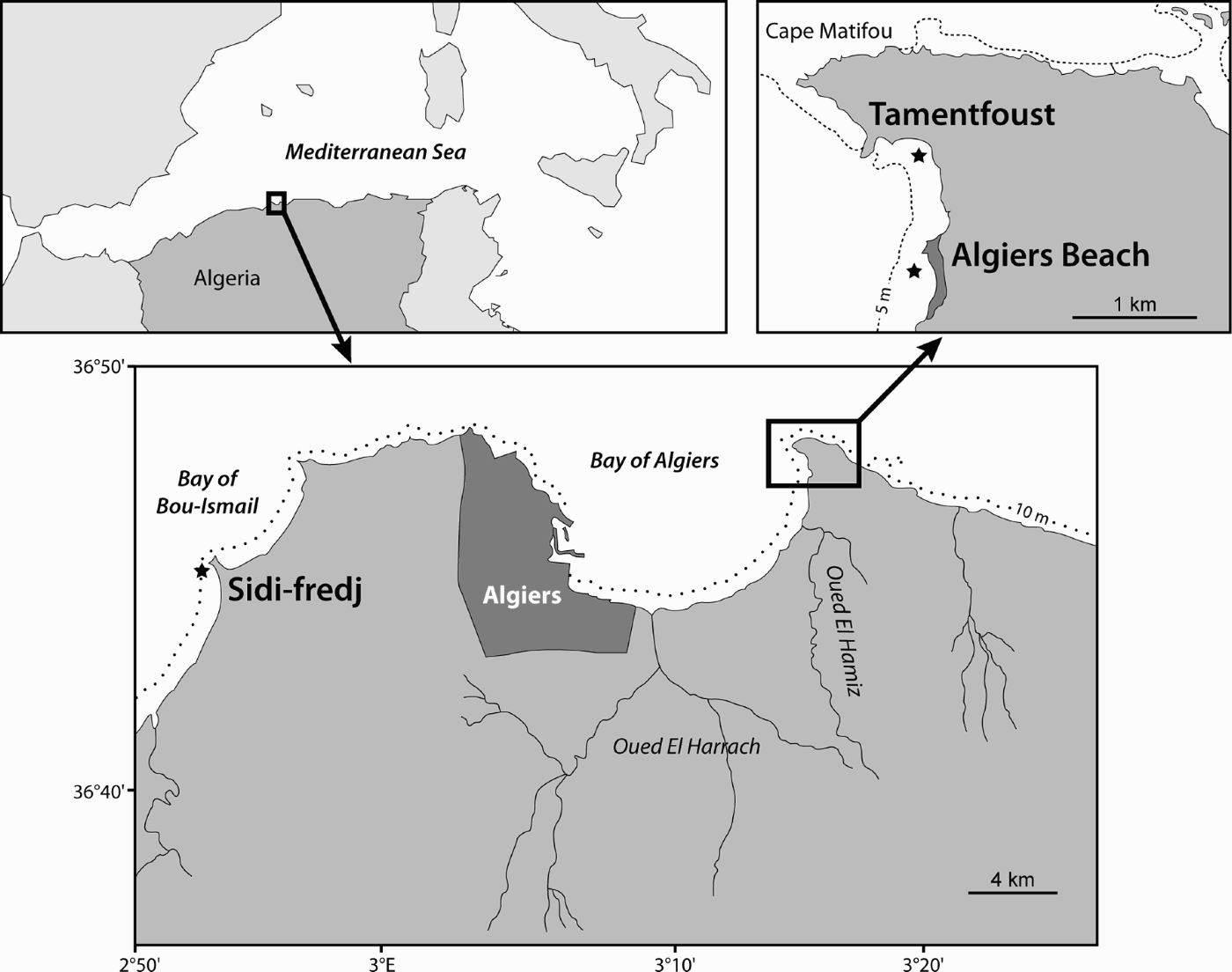
Investigations were carried out at two sites in Algiers Bay (Algiers Beach and Tamentfoust) and at Sidi Fredj, in the north of the Bay of Bou-Ismail (east of the Algiers Bay) at 1–5 m depth (Figure 1). The Algiers Beach site is characterized by a habitat of rocks and photophile algae dominated throughout the year by Dictyotales sp. and Colpomenea sinuosa (Mertens ex Roth) Derbes & Solier (H. Seridi, personal communication) mixed with degraded Posidonia oceanica (L.) Delile. This site is exposed to the discharge from several oueds (El Harrach and El Hamiz) and domestic wastewaters. The fraction of sediment <63 µm was 1.56% of the total (Soualili et al., Reference Soualili, Dubois, Gosselin, Pernet and Guillou2008).
Location of the three sampling sites: Algiers Beach, Tamentfoust and Sidi Fredj.

The site of Tamentfoust, in Algiers Bay, is situated in a half closed creek, protected from dominant winds. The sea urchins inhabit the rocky bottom, with photophile algae dominated throughout the year by Colpomenea sinuosa and sparse Posidonia oceanica beds and seasonally by Fosliella sp and Ulva rigida C. Agarth. The sediment is less muddy than in Algiers Beach: only 0.26% was in the <63 µm fraction.
The site of Sidi Fredj is located in the Bay of Bou-Ismail, which is much less exposed to domestic wastewaters than the sites in Algiers Bay but more exposed to the dominant winds (Guettaf et al., Reference Guettaf, San Martin and Francour2000). The sampling station is situated on a rock ledge interrupted by sandy and heterogeneous block bands where phanerogams were dominant. A Posidonia meadow is in better health than in the previous sites. A Cymodocea nodosa meadow is also present. The site is located in a semi-protected area, enclosing a marine medical centre. Less than 0.05% of the sediment was <63 µm in size.
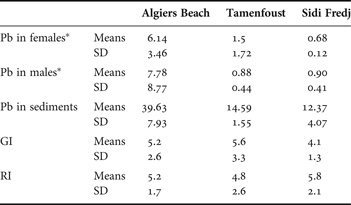
Metal contamination in the sediments, metal accumulation in the gonads and sea urchin larval abnormalities discriminated the site of Algiers Beach as highly polluted by lead (Pb). The site of Sidi Fredj more distant from the very industrialized area influenced by Algiers metropolis was considered as the less polluted (Soualili et al., Reference Soualili, Dubois, Gosselin, Pernet and Guillou2008) (Table 1).
Lead (Pb) concentrations in µg g−1 dry wt in the male and female gonads of Paracentrotus lividus (N = 10) and in the total fraction (N = 3–8) of the sediment collected from the three Algerian sites (from Soualili et al., Reference Soualili, Dubois, Gosselin, Pernet and Guillou2008) compared to the mean gonad index during the gonad growth (data from January to June 2004 and 2005) and to the mean repletion index (over both years) from P. lividus collected in the same sites at the same time.

*Pb in gonads; GI, gonad index; RI, repletion index.
Seawater temperature was measured at each sample. Water salinity varies little between the three sites (Guettaf et al., Reference Guettaf, San Martin and Francour2000).
Collection and preparation of samples
In each of the three sites, approximately 40 sea urchins of 45–55 mm in diameter were collected monthly over two years from January 2004 to December 2005. These were taken at 1–5 m depth by SCUBA diving. The horizontal test diameter without spines was measured in mm at the ambitus. For each site, ten urchins (5 males and 5 females) were selected for gonad histology. Gonads were dehydrated in alcohol, embedded in paraffin wax and cut into sections of 7 µm.
The other 30 individuals were dissected and five gonads and gut contents were dried for 48 hours at 70°C and then weighed (to 1/10 mg). The gonad index (GI) and the repletion index (RI) were calculated as the ratio of gonad or gut content dry weight over the horizontal test diameter cubed (Régis, Reference Régis1979; Nédélec, Reference Nédelec1982; Guettaf et al., Reference Guettaf, San Martin and Francour2000).
GI = (GDW/d3)×106 where GDW is the gonad dry weight in mg and d the horizontal test diameter without spines in mm.
Histology study allowed several stages to be distinguished. The spawned stage was used as an indication of spawning to clearly identify this period in the present study. A spawning was considered effective when the spawned stage frequency was superior to 20% whatever the stage duration. A relationship was established during the studied period between the number of spawnings and the GI peak value in the period preceding the spawning. The mean spawning duration was estimated by the number of months showing a spawned stage frequency superior to 20%.
Once the homogeneity of the variances had been verified, comparisons were made between males and females, and GI or RI in pairs, using t-tests (P < 0.05). Multiple GI or RI were tested with one-way analysis of variance (ANOVA) (P < 0.05) and post-hoc LSD multiple mean comparisons. The relationship between GI and the number of spawnings was tested with simple regression, the relationship between Pb values and GI with linear and non-linear regressions. The analyses were performed with Statgraphics software.
RESULTS
Gonad histology
The pattern of gonad growth was divided in 5 stages defined from the Guettaf (Reference Guettaf1997) scale adapted from Byrne (Reference Byrne1990) where 6 developmental stages were described. In the present study the stages 5 and 6 of the previous authors (partly spent and spent stages) were brought together. Stage 1 was the post-spawned stage, stage 2 the growing stage, stage 3 the premature stage, stage 4 the mature stage and stage 5 the spawned stage. In stage 5, spaces among the mature gametes identified in the mature stage are vacated by spawned gametes. In the gonads where all the mature gametes were spawned, relict ova and spermatozoa may be present and nutritive tissue spreads out around the gonad periphery.
Changes in gonad index
As no difference was detected between males and females (P < 0.05), all the GI data were pooled (Figure 2).
Relative frequencies of gonadal stage 5 (spawned stage) from January 2004 to December 2005, and changes in the gonad index (GI) and repletion index (RI) in the three Algerian sites (means + SD). The horizontal line represents 20% of stage 5.

Algiers Beach presented the clearest annual cycle with a relatively simple GI trend that increased from January to May in 2004 (t-test P < 0.05) and from January to March in 2005 (t-test P < 0.05), to reach high values of 9.9 and 9.2 respectively. These increases were followed by a main spawning period of variable length.
In 2004 Tamentfoust presented a GI cycle close to the cycle at Algiers Beach, with a GI increase from February to May (t-test P < 0.05), when it reached the high value of 12, followed by a main spawning that was almost identical in pattern to the one of Algiers Beach. However, while at Algiers Beach the index remained at a low and constant value after spawning, indicating a long resting stage from August to January, the GI trend at Tamentfoust presented two successive and significant increases (t-test P < 0.05) between September and October and December and January. However, none of these increases was followed by a spawning. In 2005, two GI significant increases (t-test P < 0.05) were observed between February and March then between May and June; they were of smaller size than the increases previously described at the same periods, but were followed by a clear spawning.
At Sidi Fredj the periodicity was less obvious with a succession of significant (t-test P < 0.05) but low increases (from 4.1 to 6.6) throughout the year, from January and March, April and May, July and August 2004, December 2004 and January 2005 and March and June 2005. Each was followed by spawning. Both years, from January to June, the values of the previous GI peaks in Sidi Fredj were significantly lower than those of Tamentfoust and Algiers Beach excepted for the February 2004 peak in Algiers Beach and the March 2005 peak in Tamentfoust (one-way ANOVA, P < 0.05).
The results as a whole show that the two sites in the Bay of Algiers have a fairly apparent annual cycle: a period of gonadal growth in winter and spring (from January to June according to site and year) followed by a main spawning in summer which can go on until December (2005 result). These two sites differ from the third, where sea urchins have the capacity to spawn throughout the year. During the studied period, two spawnings were observed at Algiers Beach, three at Tamentfoust and five at Sidi Fredj.
The number of annual spawnings is a function of the intensity of the GI increase in the pre-spawning period. A negative linear relationship existed between the GI preceding a spawning and the number of annual spawnings (R2 = 0.975; P < 0.05). Moreover the GI increased, and the total number of annual spawnings was low. At Sidi Fredj therefore, the GI peaks were of low intensity but repetitive over time and every increase was able to give rise to spawning, i.e. low reproductive investment at first spawning was associated with subsequent partial spawnings.
Spawning and seawater temperatures
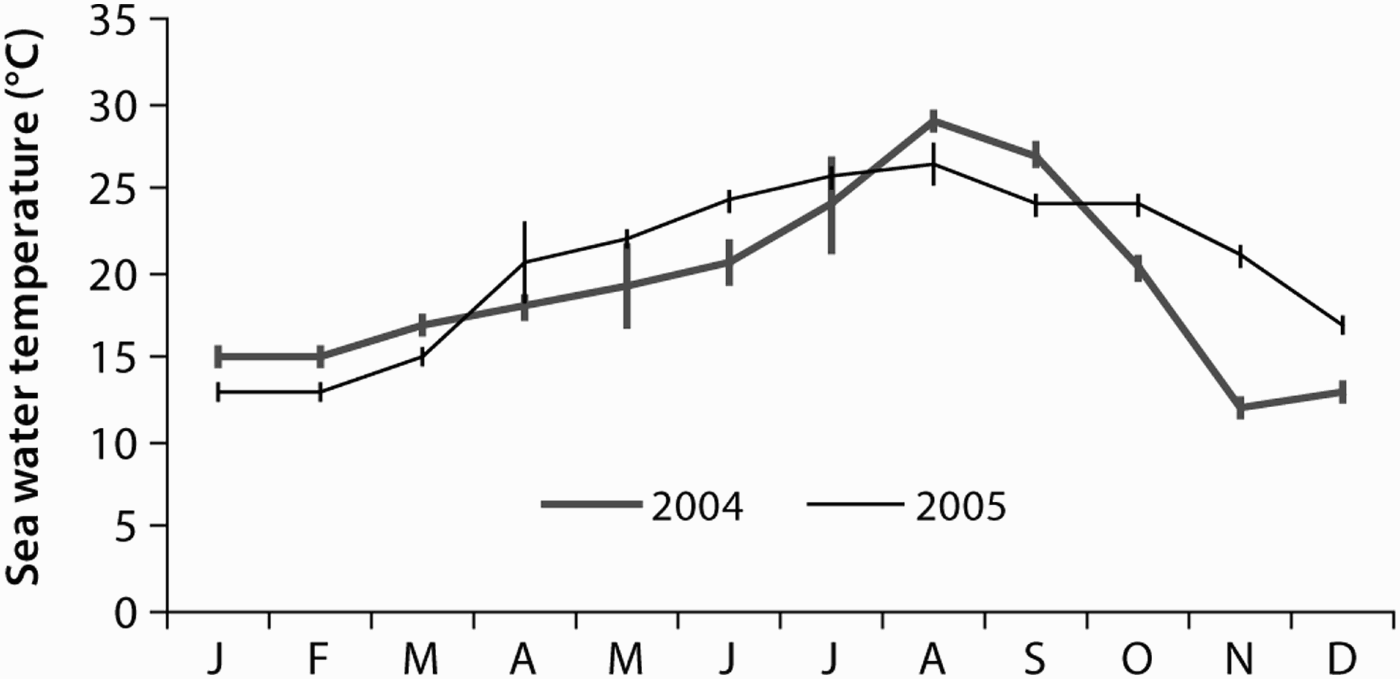
The spawning comparison between 2004 and 2005 indicated a generalized lengthening of the spawning period between these years at all sites. The effective spawning (stage 5 > 20%) occurred two months earlier in the three sites (in February versus April for Sidi Fredj and in April versus June for Tamentfoust and Algiers Beach). The spawning period was also prolonged by two to three months in the Bay of Algiers (December versus September and October versus August for Tamentfoust and Algiers Beach respectively), and by one month for Sidi Fredj where the spawning period was also quite long in 2004. These inter-annual differences can be attributed to a difference of temperature observed between the two years. Figure 3 shows the mean annual changes in seawater temperature in the sampling sites. In 2004 the temperature increased very slightly from February to May (1.2±0.1°C) while in 2005 a clear (5.7±2.3°C) and significant different increase (t-test P < 0.05) was observed during this period. In 2005 the temperature went on increasing until August. The mean 2005 monthly values were significantly higher than the 2004 ones during all the gonad mature stage from April to July (monthly t-test P < 0.05). August was the last month where a GI increase may provide an effective spawning. From April to August, the monthly 2005 seawater temperature was 2°C superior to the 2004 ones. During and after this period (from April to December) the mean spawning period was 8 months in 2005 versus 3.7 months in 2004 with no significant difference in monthly level of sea urchins at stage 5 between the years (t-test P < 0.05).
Changes in the seawater temperature in 2004 and 2005 (mean values of the three locations ± SD).

Changes in repletion index
The repletion index (RI) did not show a clear annual cycle. Two decreases were however significant (one-way ANOVA, P < 0.05) and generally concomitant in the three sites in both years: a decrease between January and February (except at Sidi Fredj in 2004 where the decrease occurred between February and March) and another drop between June and July (except at Algiers Beach in 2004 where the values were lower from March). RI was significantly higher at Sidi Fredj than in Tamentfoust (one-way ANOVA P < 0.05). No significant differences were observed within any one site between the two sampling years (t-test, P < 0.05).
Physiological indices and pollution
A previous study (Soualili et al., Reference Soualili, Dubois, Gosselin, Pernet and Guillou2008) using chemical and toxicological data from sediments and sea urchins identified the site of Algiers Beach as highly polluted by Pb. Sidi Fredj was expected to be the less polluted site by heavy metals. Table 1 compares the GI and RI values from the present study to the Pb concentrations in the sediments and in the gonads of Paracentrotus lividus collected in the three studied areas (Soualili et al., Reference Soualili, Dubois, Gosselin, Pernet and Guillou2008). These data display a very high relationship between Pb in the sediments and Pb in the gonads. This relation is linear with R2 = 0.99 for both sexes. No correlation, however, was observed between Pb values and the physiological indices: no linear or non-linear regression fit the data (Statgraphics plus, P < 0.05).
DISCUSSION
This study shows that the use of gonad index to determine the sexual cycle and spawning period of Paracentrotus lividus is not sufficient. At Algiers Beach the GI peak was clear and followed by a spawning, but at Tamentfoust, numerous increases and decreases were observed between October and February. These did not reflect spawning events as they were not followed by observations of spawned stages. During this period, gonads stored biochemical components as an energy source for subsequent use in gametogenesis. The observed decreases should correspond to use of these reserves for sea urchin metabolism following any disturbance in the environment (storms, temperature decrease, etc.) (Byrne, Reference Byrne1990; Lozano et al., Reference Lozano, Galera, López, Turon, Palancín and Morera1995). At Sidi Fredj GI increases and decreases were not of any great magnitude, but did continue throughout the year, even in autumn and winter, and corresponded to spawning events. Without histology it would have been impossible to determine the spawning periods. Guettaf et al. (Reference Guettaf, San Martin and Francour2000) found a similar GI pattern in a site very close to the present one and, on the basis of this index value, concluded there was only a single spawning period.
Comparison of the GI trends between the three sites shows that the higher the pre-spawning increase in GI, the lower the number of spawning events in the year. The gonad growth reflected by the GI increase is triggered by environmental factors different from those that influence spawning. GI value is known to be strongly correlated with food availability and quality which ensure the supply of carbohydrates and total lipids to the gonads. On the Atlantic coast, numerous sea urchin populations exhibit an annual cycle of gonad growth with a seasonal breeding period. Sea urchins accumulate nutrient resources in autumn and early winter before gametogenesis. GI then generally drops from the end of winter to the end of summer and increases again in autumn after a small quiescent period of gonad growth. The greater GI noted for the northern populations could have resulted from the higher temperature variation between seasons leading to a need to stock more nutrients during winter (Spirlet et al., Reference Spirlet, Grosjean and Jangoux1998). In the Bay of Algiers, especially at Algiers Beach, the high GI suggests that a large stock of reserves was accumulated in the gonad during the growth stage to favour effective gametogenesis capable of giving an annual and sufficiently intense spawning.
Level of pollution does not act on the GI values as the more polluted site in heavy metals, especially in Pb, is Algiers Beach that presents no difference in mean GI compared to the less polluted site of Sidi Fredj. If significantly higher GI peaks were observed at Algiers Beach and Tamentfoust between January and June, they must be attributed less to the heavy metal pollution than to the level of organic matter which comes with these pollutants (PAC, 2006). If the metal pollution, however, has no effect on the gonad production, we cannot forget that it affects the gamete quality as previously demonstrated by means of bioassays by Soualili et al. (Reference Soualili, Dubois, Gosselin, Pernet and Guillou2008) and by observations of a high level of larval developmental abnormalities in sea urchin populations from Algiers Beach (Soualili, Reference Soualili2008).
Numerous examples have shown that temperature may influence spawning. Latitudinal differences were observed in the time of sea urchin spawning onset on Atlantic coasts, with a delay of about two months from Morocco northwards to Ireland (March to May) (Byrne, Reference Byrne1990; Bayed et al., Reference Bayed, Quiniou, Benrha and Guillou2005). Temporal variability was also observed locally between years in relation with temperature (Byrne, Reference Byrne1990). In the three Algerian sites of the present study, spawning was induced early in 2005 compared to 2004. Previous studies on Paracentrotus lividus highlighted that rising sea temperature may serve as a proximate cue for the induction of spawning (Fenaux, Reference Fenaux1968; Dominique, Reference Dominique1973; Byrne, Reference Byrne1990). In the Bay of Algiers, a clear and significant increase was observed in March 2005 (+5.7°C) compared to 2004 where the temperature was relatively stable between March and April (+1.2°C). At this time, the 2005 first spawning occurred two months earlier in the three sites.
Temperature also can affect spawning duration and thus act directly on the gonad growth and nutrient accumulation that allow gametogenesis. In this study, a monthly temperature increase of 2°C during the April to August period of gonad growth led to a 3.7 month increase of the spawning period compared to the previous year. GI values were not high during this warmer period but were probably masked by a continuous release of gametes. Sea temperature may influence gonad growth by acting directly on food availability or food intake. Our data does not allow this hypothesis to be verified. The repletion indices did not show any clear seasonal cycle and no difference appeared between years. Apart from February 2004 at Tamentfoust, RI values did not really drop in the same way as in sites where seasonality is well-marked, e.g. in the Atlantic (Spirlet et al., Reference Spirlet, Grosjean and Jangoux1998; Bayed et al., Reference Bayed, Quiniou, Benrha and Guillou2005) but also in the Mediterranean Sea (Régis, Reference Régis1979; Lozano et al., Reference Lozano, Galera, López, Turon, Palancín and Morera1995; Sellem et al., 2007). A pattern such as this, without significant oscillations, is characteristic of an environment sufficiently rich in food to ensure reproduction and to make periods of active search for nutrients unnecessary (Fernandez & Boudouresque, Reference Fernandez and Boudouresque1997; Guillou & Lumingas, Reference Guillou and Lumingas1999).
In the Bay of Algiers (Tamentfoust and Algiers Beach) in 2004 and at Algiers Beach in 2005, such RI changes coupled with a GI scenario characterized by early and high peaks followed by an annual spawning (see above) are typical of these food enriched environments. In the site of Sidi Fredj the sea urchins more exposed to hydrodynamism (Guettaf et al., Reference Guettaf, San Martin and Francour2000), the winter nutrient level would not be high enough to give a main spring spawning. Several lower spawnings occurred throughout the year governed by a higher spring and summer feeding activity. This site presents the highest mean annual RI.
In the three sites, two RI decreases were generally concomitant. The first occurred between January and February and was probably due to the lower annual temperatures. The second, between June and July, was generally concomitant with the onset of a spawning period.
In conclusion, this study has demonstrated that the level of pollution in heavy metals in the studied sites was not high enough to affect the gonad yield of the sea urchins near the Bay of Algiers. Seawater temperature appears to be an important controlling factor for the onset and duration of the breeding period. The comparison of the present scenario with different Paracentrotus lividus reproductive patterns also suggests the presence of better nutritional conditions in the Bay of Algiers compared to the outer and more exposed site.
ACKNOWLEDGEMENTS
The study described in this paper forms part of the work done by D. Soualili towards her PhD. This research was partly supported by a grant from the Algerian Department of Higher Education and Research. D. Soualili gratefully acknowledges the hospitality and access to facilities of the Laboratoire des Sciences de l'Environnement Marin (Plouzané, France). The authors also thank F. Boukroufa for assistance in the field and H. McCombie for revision of the English.