





No CrossRef data available.
Article contents
The evolution of peace (and war) is driven by an elementary social interaction mechanism
Published online by Cambridge University Press: 15 January 2024
Abstract
Here we revise Glowacki's model by proposing a simple and empirically tested mechanism that is applicable to a comprehensive set of social interactions. This parsimonious mechanism accounts for the choice of both cooperative and peaceful alternatives and explains when each choice benefits the interacting parties. It is proposed that this mechanism is key to the evolution of both peace and conflict.
Information
- Type
- Open Peer Commentary
- Information
- Copyright
- Copyright © The Author(s), 2024. Published by Cambridge University Press
References
Axelrod, R. M., & Hamilton, W. D. (1981). The evolution of cooperation. Science (New York, N.Y.), 211(4489), 1390–1396. https://doi.org/10.1126/science.7466396CrossRefGoogle ScholarPubMed
Fischer, I. (2009). Friend or foe: Subjective expected relative similarity as a determinant of cooperation. Journal of Experimental Psychology: General, 138(3), 341–350. https://doi.org/10.1037/a0016073CrossRefGoogle ScholarPubMed
Fischer, I. (2012). Similarity or reciprocity? On the determinants of cooperation in similarity-sensitive games. Psychological Inquiry, 23(1), 48–54. https://doi.org/10.1080/1047840X.2012.658004CrossRefGoogle ScholarPubMed
Fischer, I., Frid, A., Goerg, S. J., Levin, S. A., Rubenstein, D. I., & Selten, R. (2013). Fusing enacted and expected mimicry generates a winning strategy that promotes the evolution of cooperation. Proceedings of the National Academy of Sciences of the United States of America, 110, 10229–10233. https://doi.org/10.1073/pnas.1308221110CrossRefGoogle ScholarPubMed
Fischer, I., Levin, S. A., Rubenstein, D. I., Avrashi, S., Givon, L., & Oz, T. (2022). Interacting with others while reacting to the environment. Behavioral and Brain Sciences, 45(E106), 27–28. https://doi.org/10.1017/S0140525X21001291CrossRefGoogle ScholarPubMed
Fischer, I., Rubenstein, D. I., & Levin, S. A. (2022). Vaccination-hesitancy and global warming: Distinct social challenges with similar behavioural solutions. Royal Society Open Science, 9(6). https://doi.org/10.1098/rsos.211515CrossRefGoogle ScholarPubMed
Flood, M. M. (1958). Some experimental games. Management Science, 5(1), 5–26. https://doi.org/10.1287/mnsc.5.1.5Google Scholar
Fraser, N. M., & Kilgour, D. M. (1986). Non-strict ordinal 2 × 2 games: A comprehensive computer-assisted analysis of the 726 possibilities. Theory and Decision, 20(2), 99–121. https://doi.org/10.1007/BF00135087/METRICSCrossRefGoogle Scholar
Johnson, D. D. P., Stopka, P., & Bell, J. (2002). Individual variation evades the prisoner's dilemma. BMC Evolutionary Biology, 2(1), 1–8. https://doi.org/10.1186/1471-2148-2-15/FIGURES/2CrossRefGoogle ScholarPubMed
Kilgour, D. M., & Fraser, N. M. (1988). A taxonomy of all ordinal 2 × 2 games. Theory and Decision, 24(2), 99–117. https://doi.org/10.1007/BF00132457/METRICSCrossRefGoogle Scholar
Northcott, R., & Alexandrova, A. (2015). Prisoner's dilemma doesn't explain much. In Peterson, M. (Ed.), The prisoner's dilemma. Classic philosophical arguments (pp. 64–84). Cambridge University Press. https://philpapers.org/rec/NORPDDCrossRefGoogle Scholar
Rapoport, A., & Chammah, A. M. (1965). Prisoner's dilemma: A study in conflict and cooperation. University of Michigan Press.CrossRefGoogle Scholar
Rapoport, A., & Guyer, M. (1966). A taxonomy of 2×2 games. General Systems, 11, 203–214.Google Scholar
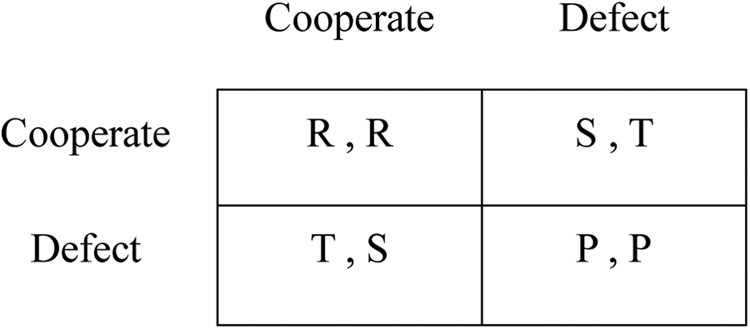
Figure 1. Prisoner's dilemma game. Left and right payoffs in each cell indicate the payoffs for the row and column player, respectively. The game is defined by the inequalities: T > R > P > S (and in some experiments also requires assuring 2R > S + T).
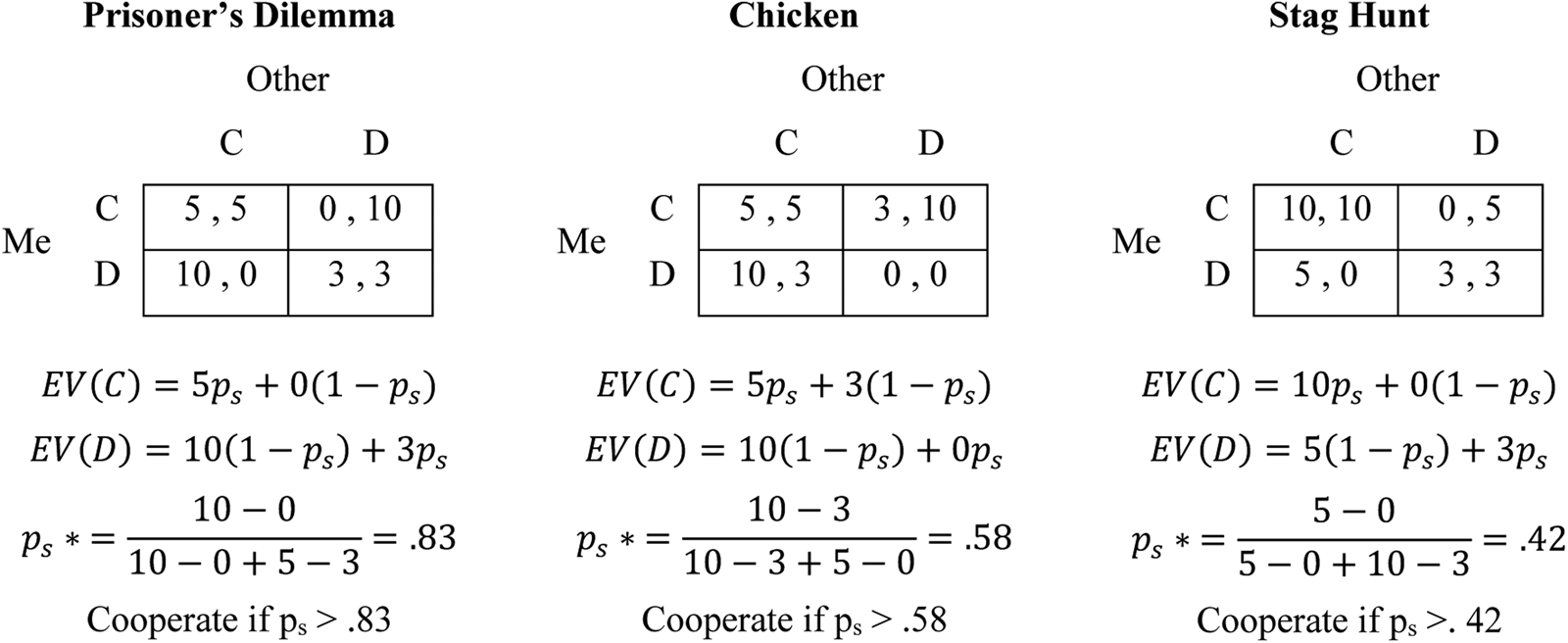
Figure 2. Example of three game matrices, each showing two alternatives, termed C (cooperation) and D (defection), for each of the two players. Detailed under each matrix are: The expected values (EVs) for each alternative – EV(C) and EV(D), the game's similarity threshold (ps*), and the corresponding decision rule (where ps denotes the probability of similarity with the opponent as subjectively perceived by each player).
Target article
Related commentaries (30)
Capacities for peace, and war, are old and related to Homo construction of worlds and communities
Experimental evidence suggests intergroup relations are, by default, neutral rather than aggressive
Group-structured cultural selection can explain both war and peace
Peace as prerequisite rather than consequence of cooperation
The evolution of (intergroup) peace hinges on how we define groups and peace
The evolution of peace (and war) is driven by an elementary social interaction mechanism
 You have
Access
Aiming to identify the conditions for the emergence of peace, Glowacki points to intergroup cooperation as a key selective force in human populations, taking into account the costs and benefits of intergroup cooperation for oneself, one's group, and the neighboring groups. Glowacki associates both peace and war with increased social complexity and argues that peace is best understood as a solution to a cooperative dilemma like the prisoner's dilemma (PD), chicken, or stag hunt games.
Indeed, mixed-motives interactions such as the PD game have often been proposed as models of peace and war (Axelrod, Reference Axelrod1984; Axelrod & Hamilton, Reference Axelrod and Hamilton1981). Nevertheless, they form only a fraction of all possible social interactions both from theoretical and ecologically-valid perspectives. When considering all two-by-two games, PD is only one out of 78 different strictly ordinal game types (Rapoport & Guyer, Reference Rapoport and Guyer1966), and one out of a total of 726 games when also including non-strictly ordinal games (i.e., games in which the same payoff may be repeated twice or more per player; Fraser & Kilgour, Reference Fraser and Kilgour1986; Kilgour & Fraser, Reference Kilgour and Fraser1988). The same also holds for other games such as chicken and stag hunt. Clearly, this count does not necessarily correspond to the frequency of occurrence of each game type in natural settings. Estimating games' actual frequency of occurrence, Northcott and Alexandrova (Reference Northcott, Alexandrova and Peterson2015) suggest that PD games are uncommon among actual field cases, and thus have rarely been found in nature (Johnson, Stopka, & Bell, Reference Johnson, Stopka and Bell2002). Therefore, learning to solve specific games, such as the PD, might be an insufficient condition for developing all-encompassing successful social strategies; specifically optimizing cooperative and confrontational behavior, and accounting for the evolution of peace and conflict.
Additionally, Glowacki suggests four necessary and significant preconditions for the development of peace in human populations. These include: (i) high-potential benefits from intergroup interactions; (ii) the ability to anticipate the behavior of strangers; (iii) the ability to regulate the behavior of group members; and (iv) the capacity to signal future cooperation intent of group members. Undoubtedly, these are valuable social skills that assist in managing both peaceful and conflictual interactions. However, learning to master all four preconditions is a complex and rather demanding requirement. Instead, one might want to consider a simpler, more elementary, and empirically validated mechanism that directs human choices across most social interaction types.
Here we propose a plain, fundamental, and empirically tested mechanism, which is applicable to the entire set of two-by-two games. This parsimonious mechanism, termed Subjective Expected Relative Similarity (SERS; Fischer, Reference Fischer2009, Reference Fischer2012), allows making optimal decisions and choosing cooperative and peaceful alternatives whenever they are expected to provide better outcomes.
SERS computes an expected value (EV) that integrates (i) the perception of strategic similarity with the other player (p s), which indicates the probability of the opponent to choose an alternative identical to the alternative selected by oneself, with (ii) the payoffs expected under each choice. For example, consider two players choosing an alternative while interacting in a PD game, as depicted in Figure 1 (Flood, Reference Flood1958; Rapoport & Chammah, Reference Rapoport and Chammah1965). Players who assume the other player is likely to choose the same alternative as themselves with the probability of p s (and the other alternative with the complementary probability of 1 − p s) may compare the EV for the choice of cooperation with the EV for the choice of defection, where EV(cooperate) = Rp s + S(1 − p s) and EV(defect) = Pp s + T(1 − p s), and choose the alternative that provides the higher EV. Further defining the critical threshold (p s*) where EV(cooperate) = EV(defect) results in p s* = (T − S)/(T − S + R − P) and provides a simple decision rule: Cooperate whenever p s > p s*, and defect whenever p s < p s*. This simple rule optimizes individual payoffs and drives the convergence toward peaceful interactions, whenever they are advantageous for the parties. SERS has been: (i) shown to describe actual human behavior (Fischer, Reference Fischer2009, Reference Fischer2012), (ii) developed into an evolutionary computerized strategy that outperforms prominent strategies and learning algorithms (Fischer et al., Reference Fischer, Frid, Goerg, Levin, Rubenstein and Selten2013), and (iii) proposed as an explanation for individuals' strategic motivations and behaviors across a wide range of social interactions (Fischer et al., Reference Fischer, Levin, Rubenstein, Avrashi, Givon and Oz2022). It has also been suggested that SERS explains both contemporary vaccination hesitancy and noncompliance with climate policies (Fischer, Rubenstein, & Levin, Reference Fischer, Rubenstein and Levin2022). Figure 2 depicts examples of SERS-based decisions for PD, chicken, and stag hunt games.
Prisoner's dilemma game. Left and right payoffs in each cell indicate the payoffs for the row and column player, respectively. The game is defined by the inequalities: T > R > P > S (and in some experiments also requires assuring 2R > S + T).
Example of three game matrices, each showing two alternatives, termed C (cooperation) and D (defection), for each of the two players. Detailed under each matrix are: The expected values (EVs) for each alternative – EV(C) and EV(D), the game's similarity threshold (p s*), and the corresponding decision rule (where p s denotes the probability of similarity with the opponent as subjectively perceived by each player).
By providing a single and fundamental payoff-maximizing strategy across a comprehensive set of social interactions, SERS accounts for both cooperative and confrontational behaviors, which may then evolve into more elaborate, either peaceful or belligerent, group interactions. Having a single plain strategy reduces cognitive loads, shortens response times, and hence streamlines social conduct. From an evolutionary perspective, a strategy that optimizes behavior across many games is likely to maximize expected payoffs, increase fitness, and shape social interactions. Importantly, SERS provides an explanation not only for the evolution of peace, but also for the evolution of conflict and war.
Financial support
The reported research was supported by ISF grant no. 24154511, Similarity-driven strategic choices, and by GIF grant no. 1084-7.4/2010, The impact of subjective expected relative similarity on strategy selection in repeated similarity sensitive games.
Competing interest
None.