
Background
Due to the rapidly increasing demand for renewable and clean energy sources, water electrolysis has been examined frequently as a possible route for hydrogen generation.[Reference Stojić, Marčeta, Sovilj and Miljanić1] However, owing to the common usage of high-cost noble metal-based electrocatalysts for oxygen evolution reaction (OER), such as Ir, Ru, and Pt, the large-scale industrialization of water electrolysis is impeded.[Reference Lee, Suntivich, May, Perry and Shao-Horn2] Recently, many low-cost materials have been explored to replace noble metals for OER.[Reference Faber and Jin3, Reference Liu, Chen, Wei, Xiao and Ding4] Among them, first row transition metals, such as Ni, Fe, Co, Cu, and Mn, are especially appealing, due to their special electronic structures and the abundance on earth.[Reference Fei, Min, Yuxue and Xianghua5] High-entropy alloys (HEAs), a new type of alloys, constructed of five or more metallic elements at equal or near-equal molecular ratios,[Reference Zhang, Mu, Gao, Meng and Guo6, Reference Wang, Zhang, Niu, Wang, Kou, Li, Wang and Beaugnon7] are emerging into an attractive category of functional metallic materials in the past decade.[Reference Miracle and Senkov8] Due to the varied atomic radius and geometrical configurations of different elements, the crystal lattices of HEAs can be finely tuned over a certain range, and the crystal lattices of HEAs can be severely distorted with significant residual strain remaining.[Reference Wang, Qiu, Yang and Liu9] Such a high level of crystal imperfection could effectively increase the amount of active catalytic sites.[Reference Bak, Nowotny, Sucher and Wachsman10] Moreover, due to the highly complex combination of transition metals with different electron configurations, the d-band vacancy number of HEA can be altered to tune its binding strength toward reaction species.[Reference Lv, Liu, Jia, Wang, Wu and Lu11] Because few studies have been conducted on the catalytic performance of HEAs, this paper examines the hypothesis that by tuning the HEAs compositions, an improved OER performance would be achieved.
HEA design for improved OER performance
The binding strength of the reaction species toward the surfaces of an electrocatalyst determines the activity of the electrocatalyst. For selected metallic catalysts, the volcano plot of catalytic activity versus the absorption energy of atomic oxygen[Reference Nørskov, Rossmeisl, Logadottir, Lindqvist, Kitchin, Bligaard and Jónsson12] reveals that a moderate binding strength leads to a high catalytic activity. For OER applications, a weak binding between the reaction species and the electrocatalyst surface would result in difficult stabilization of intermediates, while a too strong binding would hinder the release of O2. The binding strength is affected by several factors. Firstly, it is affected by the electronic structures of the electrocatalyst. The existence of d-band vacancy in transition metals enables the formation of intermediate species to lower the activation energy, and a moderate d-vacancy number is preferable for OER applications.[Reference Thomas and Thomas13] Secondly, in the heterogeneous reactions, the lattice spacing of the electrocatalyst and the reaction species should match. In other words, too large an interatomic distance would impede diatomic reactant adsorption and the bond formation between oxygen atoms, while too closely packed atoms would cause strong repulsions between intermediates and inhibit product formation.[Reference Thomas and Thomas13] Thirdly, a certain degree of intrinsic structural defects could contribute to an improved catalytic performance.[Reference Cui, Xu, Xie, Dorman, Gutierrez-Wing and Wang14] Therefore, compared with the traditional metals and alloys, a well-designed HEA with proper compositions is highly possible to combine the merits of each constitute element and meet the above criteria for improved OER performance.
Based on the criterion number 1, two HEAs were selected to demonstrate that HEA compositions would impact the OER performance. The first HEA would have a non-transition metal element and the second HEA would be formed by pure transition metals. In this regard, the classical FeCoNiCrAl HEA, with non-transition metal element Al, was chosen as the starting point to investigate how HEAs could be designed to have an improved OER performance. For FeCoNiCrAl HEA, Fe, Co, Ni, and Cr are all on the left side of the peak on the volcano plot,[Reference Nørskov, Rossmeisl, Logadottir, Lindqvist, Kitchin, Bligaard and Jónsson12] indicating their overstrong binding strength toward the reactant. Also, being a main group element, Al is a strong electron donor that can bind strongly to electron accepters to form stable compounds. All these may aggravate the difficulty of O2 formation and release.
Based on the criterion number 2, the bond length of M–O (M = metal) for Fe, Co, Ni, Cr, and Al is 2.08, 2.13, 2.09, 2.02, and 1.89 Å, respectively[Reference Brown and Shannon15–Reference Caputi, Jiang, Amoddeo and Tucci17] with an average of 2.04 Å. Considering the symmetric trapezoid configuration of OER diatomic reaction in the alkaline environment,[Reference Cui, Zhang, Zeng, Wen, Yao and Guo18] the calculated optimal lattice spacing to facilitate O2 formation for a perfect electrocatalyst is ~2.50 Å. However, from the x-ray diffraction (XRD) testing results, to be shown in later section, FeCoNiCrAl mainly composes a FCC phase with a = 3.3183 ± 0.0013 Å, demonstrating the lattice spacing for the most densely packed plane (111) to be 2.35 Å. Therefore, tuning the baseline FeCoNiCrAl HEA compositions with elements that can slightly decrease the d-vacancy number and enlarge the lattice spacing is expected to improve the activity of HEA electrocatalyst.
To design an HEA with more favorable features as an electrocatalyst toward OER, we decided to replace Co and Al with Mn and Cu. Because Cu has fully filled d orbitals, the electrons in Cu can transit to the d-band of other transition metals to reduce the d-vacancy number and the overall binding strength can be reduced. In addition, Mn (r = 161 pm) is among the few low-cost elements with an apparent larger radius than that of Al (r = 118 pm) and Co (r = 152 pm) and has an acceptable affinity toward O atom. With more matched d-vacancy number and lattice spacing toward OER, the FeNiMnCrCu HEA is expected to have a better performance than the baseline FeCoNiCrAl HEA.
Experimental
To synthesize the FeNiMnCrCu HEA, commercial iron (fine powder, Sigma Aldrich, St. Louis, MO, USA, >99%, metals basis), nickel (3–7 µm, Alfa Aesar, Ward Hill, MA, USA, >99.9%, metals basis), manganese (325 mesh, Alfa Aesar, 99.95%, metals basis), chromium (325 mesh, Alfa Aesar, 99%, metals basis), and copper (~170 + 400 mesh, Alfa Aesar, 99.5%, metals basis) powders with the ratio of 1:1:1:1:1 were well mixed inside a polystyrene ball mill jar by a high-speed ball milling machine for 2 min. Then the mixed powders were pressed in a dry pressing die with a diameter of 12.7 mm. Next, the as-prepared sample was placed into the chamber of an arc melting system (model Edmund Bühler/MAM-1). During the melting process, the ingots were inverted and re-melted for four times to ensure homogeneity. The FeCoNiCrAl HEA was prepared the same way by using equivalent mole amount of iron, cobalt (325 mesh, Alfa Aesar, 99.5%, metals basis), nickel, chromium, and aluminum (325 mesh, Alfa Aesar, 99.5%, metals basis).
The HEA phase diagrams are calculated by ThermoCalc™ software. The crystal structures of the HEA samples were characterized by XRD using a Rigaku MiniFlex diffractometer with Cu Kα radiation operated at 30 kV and 15 mA with a scan rate of 2°/min. The lattice parameters of each phase in the HEAs are calculated based on Bragg's law. Firstly, phases are identified according to the experimental results and the known compositions; then each peak in the spectra is indexed to h, k, l miller indices; next, the lattice spacing d hkl is calculated according to the peak position; and finally, lattice parameters are derived statistically. To prepare the HEA electrode, a copper wire was attached to each of the arc-melted ingots by tin soldering. Then the ingots with the connecting wire were mounted into an epoxy resin (SamplKwick fast cure acrylic resin, Buehler, Lake Bluff, IL, USA). At last, for each sample, a flat surface was exposed by cutting through the ingot using a low-speed saw. The electrochemical measurements were carried out in a three-electrode system using a CHI 650C electrochemical workstation. The HEAs served as the working electrode in a 1 M NaOH aqueous electrolyte, with Pt wire and saturated calomel electrode (SCE) as counter electrode and reference electrode, respectively. Linear sweep voltammetry (LSV) and Tafel measurement were carried out at a scan rate of 5 mV/s in the potential range of 0–1 V versus SCE. Commercial Pt was tested the same way for comparison. Electrochemical impedance spectra (EIS) measurements were carried out at 438 mV overpotential in the frequency range from 105 to 0.01 Hz. To study the stability of the HEAs, the chronoamperometry was carried out at 438 mV overpotential for 10 h.
Results and discussion
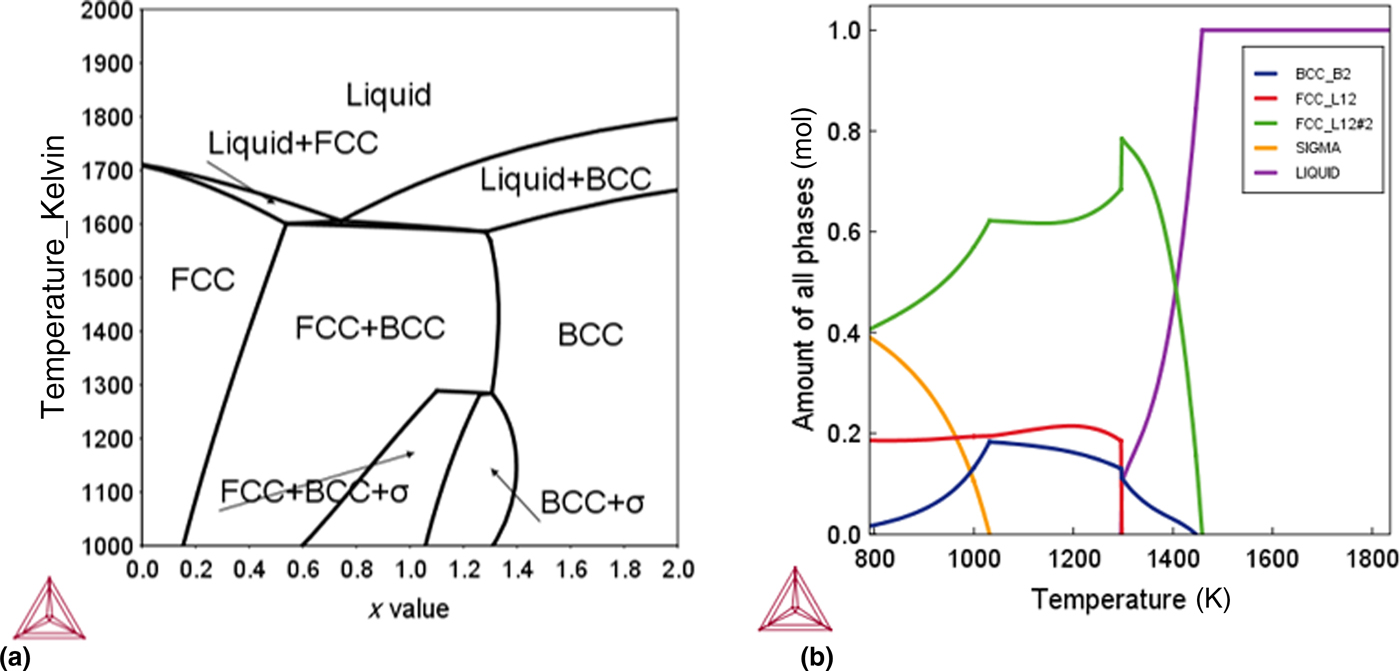
CALPHAD method was adopted to calculate the phase diagram and the phase composition during an equilibrium solidification process. For the baseline quinary HEA system FeCoNiCrAlx, with increasing of the Al content, the phase structure of the system gradually changes from a single FCC into a single BCC structure. This prediction has been proved experimentally by other researchers.[Reference Chou, Chang, Chen and Yeh19] Figure 1(a) shows the pseudobinary phase diagram of FeCoNiCr-Alx system calculated using ThermoCalc software. While keeping the molecular ratio of FeCoNiCr constant, the phase structure change, along with the (FeCoNiCr) and Al ratio, was presented as an ordinary binary phase diagram. Using the phase diagram, the equimolar FeCoNiCrAlx = 1 can be seen consisting of both FCC and BCC structures, with FCC phase as the primary phase. Under the sample preparation condition with a rapid cooling rate, equilibrium phase transformation at low temperatures is usually inhibited, leading to the precipitation of high-temperature phases.
(a) Pseudobinary phase diagram of FeCoNiCr-Alx; (b) phase composition during equilibrium solidification of FeNiMnCrCu.

Figure 1(b) shows the equilibrium solidification process of FeNiMnCrCu, starting from the liquidus temperature at ~1458 K. Both FCC and BCC phases start to form almost simultaneously, with a secondary FCC phase that forms at ~1297 K, which is almost the solidus temperature (1295 K). Considering the rapid cooling rate of the sample made in the water-cooled copper hearth of the arc melting furnace, the diffusion-introduced phase transformation at low temperatures could be neglected. Thus, the phase structures of FeNiMnCrCu should consist mainly of double FCC phases and a BCC phase. It is also interesting to see that the intrinsic residual strain of FeNiMnCrCu is reported to be 3.18%[Reference Ye, Liu and Yang20] that is higher than the FeCoNiCrAl case value of 2.96%.[Reference Ye, Liu and Yang20] Therefore, the FeNiMnCrCu HEA is in a more non-equilibrium state possessing higher potential energy that is expected to activate reactions at a lower applied potential.[Reference Egami21]
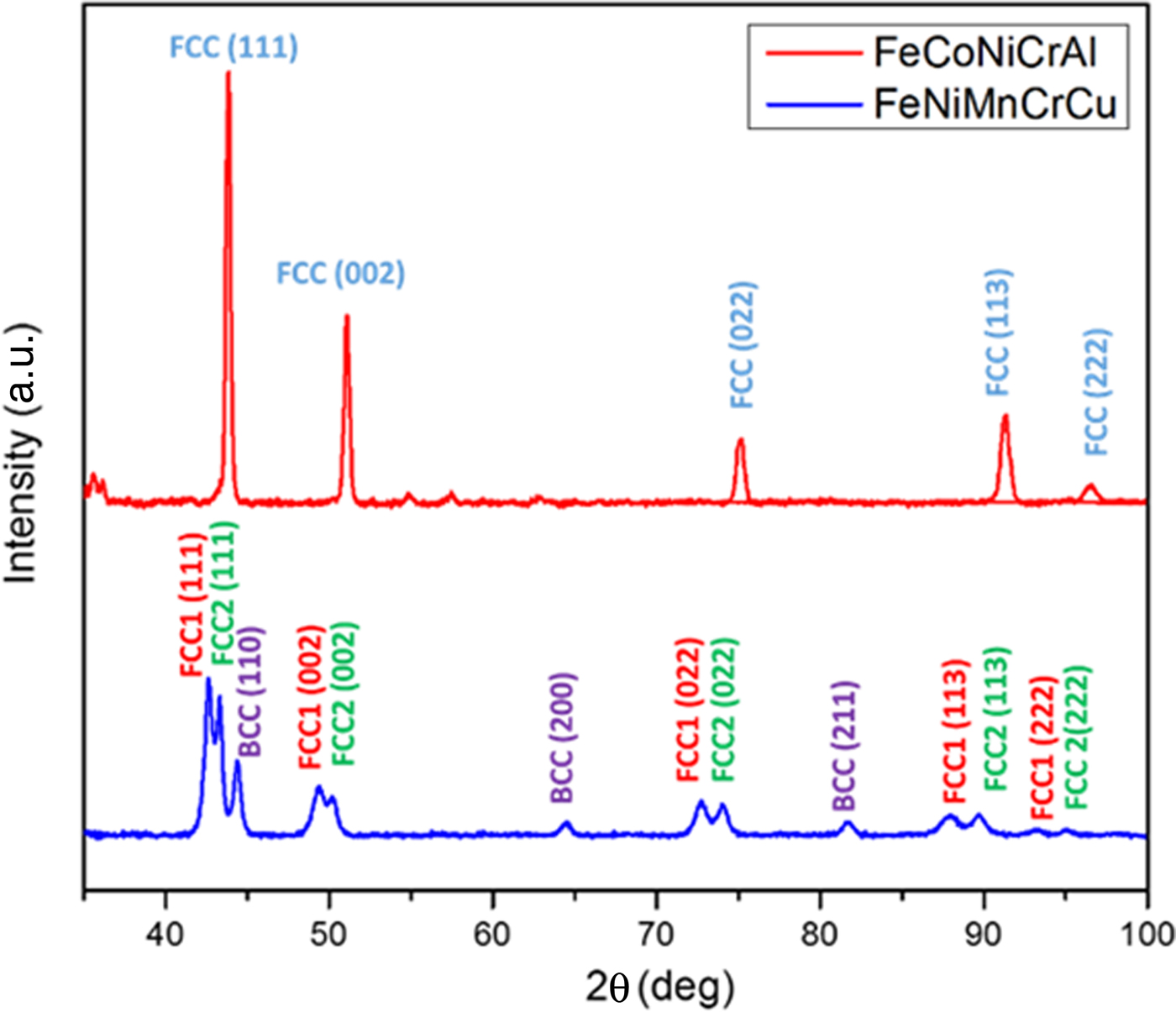
The XRD patterns are presented in Fig. 2. The XRD spectrum of FeCoNiCrAl indicates a complete dissolution of all five elements and the formation of a single FCC phase. This differs from the equilibrium prediction shown in Fig. 1(a). Based on other researchers, FCC is the major structure of the FeCoNiCrAl HEA annealed at a temperature higher than 800°C and then free cooled to room temperature.[Reference Ji, Fu, Wang, Wang, Zhang, Wang and Zhang22] Under the arc melting process, the rapid cooling rate inhibits phase transformation to BCC and leads to the domination of the FCC phase. Peaks at 2θ = 43.85°, 51.08°, 75.09° 91.34°, and 96.59° corresponding to the planes of (111), (200), (220), (311), and (222) of the FCC can be observed. The lattice parameter is calculated to be a = 3.3183 ± 0.0013 Å.
XRD spectra of FeCoNiCrAl and FeNiMnCrCu.

For the FeNiMnCrCu HEA, it has a more complicated structure and is composed of two FCC and one BCC phases. The first FCC phase has peaks at 2θ = 42.59°, 49.40°, 72.78°, 87.89°, and 93.34° corresponding to the planes of (111), (200), (220), (311), and (222). The lattice parameter is calculated to be a = 3.4160 ± 0.0055 Å. The second FCC phase has peaks at 2θ = 43.43°, 50.24°, 74.05°, 89.77°, and 95.02° corresponding to the planes of (111), (200), (220), (311), and (222). The lattice parameter is calculated to be a = 3.3601 ± 0.0076 Å. The BCC phase has peaks at 2θ = 44.38°, 64.51°, and 81.81° corresponding to the planes of (110), (200), and (211). The lattice parameter is calculated to be a = 2.678 ± 0.0020 Å. Therefore, the lattice constants of the FCC phases in the FeNiMnCrCu are larger than that of FeCoNiCrAl. This is due to the replacement of Al (r = 118 pm) and Co (r = 152 pm) by Cu (145 pm) and Mn (161 pm), whose radii are relatively larger, causing the extension of lattice. In addition, due to the higher atomic packing density of FCC (74%) than that of BCC (68%), the replacing of Al and Co with Cu and Mn leads to a mixture of FCC and BCC phases and causes larger residual strains. This gives higher lattice distortion energy. Therefore, to release the distortion energy, some of the FCC phase splits to two different FCC phases, with the rest transfers to a more stable BCC phase.[Reference Zhang, Fu, Zhang, Wang, Wang, Wang, Zhang and Shi23] It can be seen that the lattice spacing of {111} planes in FCC1 and FCC2 phases of FeNiMnCrCu HEA are 2.38 and 2.42 Å, respectively, which are closer to the optimal lattice spacing (2.50 Å) than that of FeCoNiCrAl HEA (2.35 Å).
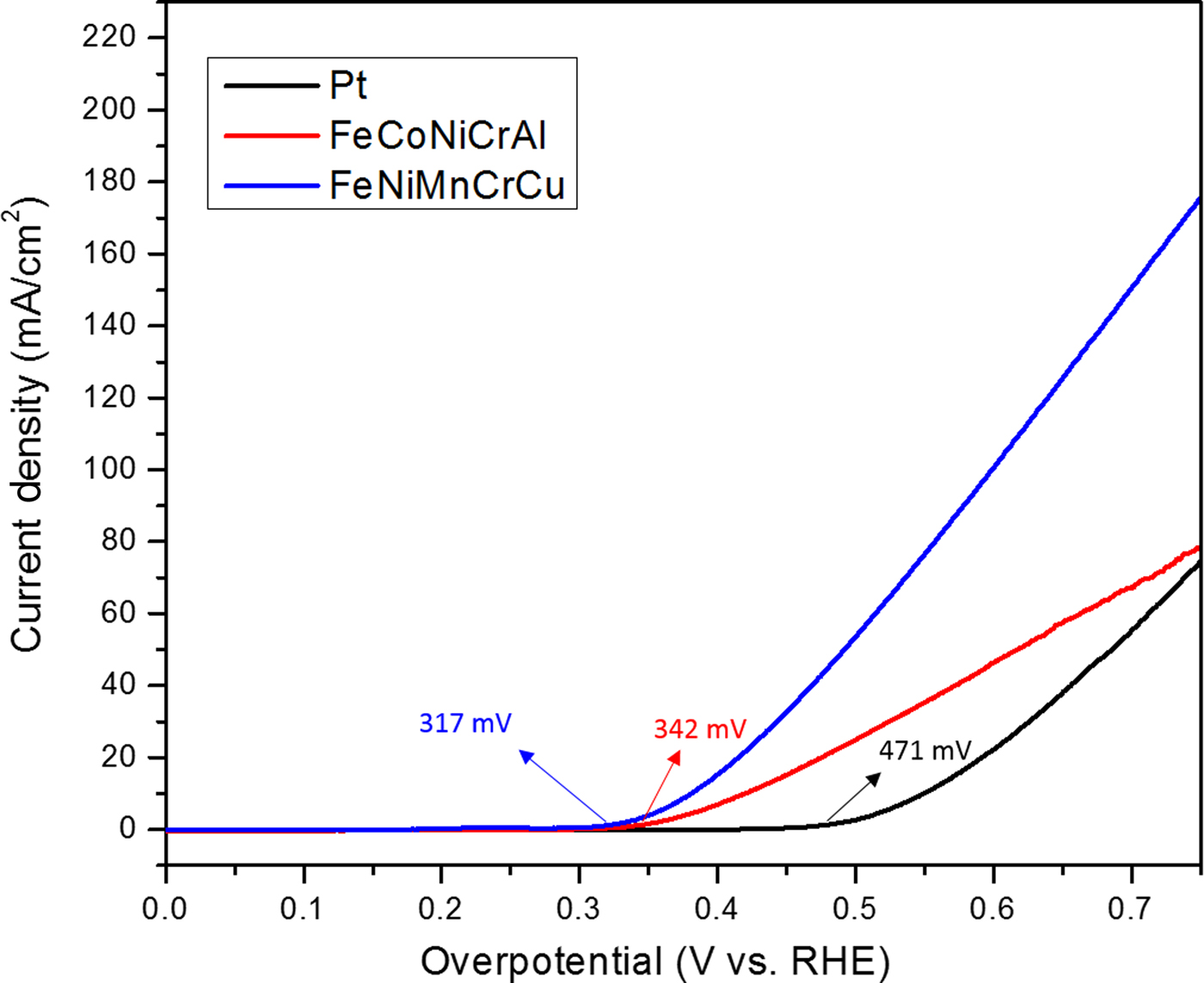
To evaluate the electrocatalytic performance of FeCoNiCrAl and FeNiMnCrCu HEAs, the LSV results are shown in Fig. 3. Onset overpotential is the overpotential where the OER current starts to generate, defined by the point where the current density starts to sharply increase on the LSV spectra as labeled on Fig. 3. It is seen that the onset overpotentials for FeCoNiCrAl and FeNiMnCrCu HEAs are 317 and 342 mV, respectively, which are significantly lower than that of the Pt electrode (471 mV), indicating a lower activation energy needed by the HEA electrocatalysts to initialize the OER redox reaction.[Reference Zhou, Cao, Zhang, Ma, Gao, Wang, Lu, He and Zhao24] The FeCoNiCrAl electrode exhibits a relatively lower activity with slowly increased current density and is not able to reach an OER current density of 100 mA/cm2 in the tested voltage range. It is observed that the FeNiMnCrCu electrode possesses a better electrocatalytic activity with the current density increasing rapidly after the onset potential and reaches 40 and 100 mA/cm2 OER current density at 466 and 599 mV overpotential, respectively. For comparison, FeCoNiCrAl and Pt electrodes require 580 and 656 mV to achieve 40 mA/cm2, respectively. It can be seen that HEAs have a great potential in serving as OER electrocatalyst due to their much improved performance than the Pt electrocatalyst. In addition, as expected, the performance of the FeNiMnCrCu HEA electrocatalyst is significantly higher than that of FeCoNiCrAl, due to its higher residual strain, better matched d-vacancy number and lattice spacing toward OER.
The OER polarization curves of FeCoNiCrAl and FeNiMnCrCu electrodes.

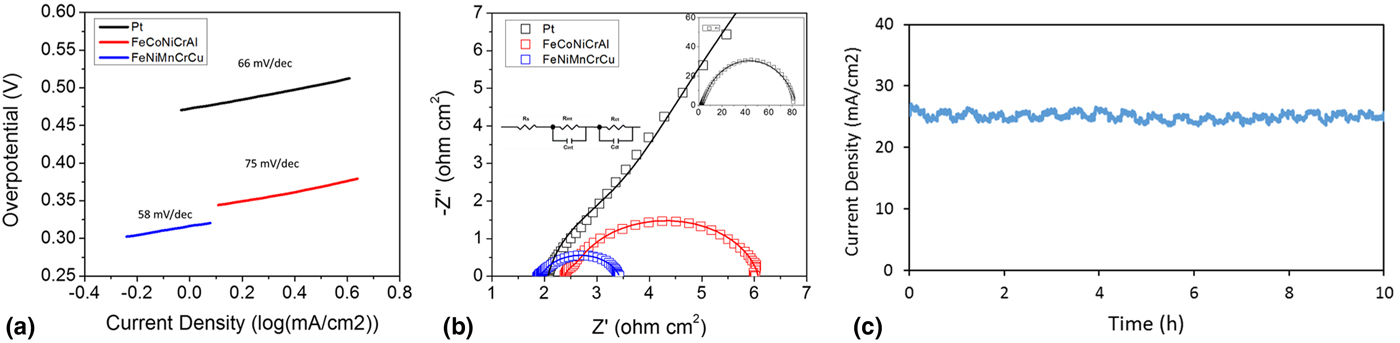
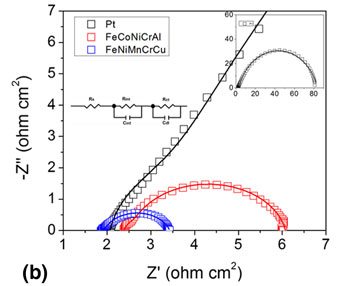
To study the kinetic of the OER with HEA electrocatalysts, the Tafel plots are provided in Fig. 4(a). In the Tafel plots, a smaller slope indicates a more rapid electron transfer at the electrode and electrolyte interface at the applied potentials, suggesting a better catalytic activity of the electrocatalyst.[Reference Fabbri, Habereder, Waltar, Kotz and Schmidt25] Tafel slopes for FeCoNiCrAl, FeNiMnCrCu, and Pt electrodes are 75, 58, and 66 mV/decade, respectively. It can be seen that the Tafel slope of FeNiMnCrCu is smaller than Pt. The electrochemical process is further studied by EIS at an overpotential of 438 mV in the frequency range of 105–0.01 Hz as displayed in Fig. 4(b). The equivalent circuit elements are fitted by CHI 650 C electrochemical workstation software package with the results listed in Table I. The intercept of the plot with the horizontal axis at high frequency (R s) is the overall series resistance, including material bulk resistance and contact resistance.[Reference Cui, Xu, Xie and Wang26, Reference Cui, Xie and Wang27] The first semicircle with a diameter of R int is due to the metal hydroxide intermediates formation.[Reference Franco, Da Silva, Jardim and Boodts28] It is noticed that the R int of FeNiMnCrCu (0.065 Ω cm2) is apparently lower than that of FeCoNiCrAl (0.177 Ω cm2), demonstrating a more facilitated OH− absorption and intermediate formation at the electrode and electrolyte interface, which could effectively lower down the activation energy of the electrochemical reaction. It is also noticed that the CPE1 of FeNiMnCrCu (1.393 mF sn−1 cm−2) is larger than that of FeCoNiCrAl (0.650 mF sn−1 cm−2), indicating more atoms on FeNiMnCrCu surface are involved in reaction species absorption, attributed to its more distorted crystal structure. The second semicircle describes the electron charge transportation process of the OER redox reaction, with a diameter of R ct representing the charge transfer resistance.[Reference Franco, Da Silva, Jardim and Boodts28] It can be seen that the R ct of FeNiMnCrCu (1.482 Ω cm2) is much smaller than that of FeCoNiCrAl electrode (3.505 Ω cm2), indicating a faster electron transfer rate from reactant to product. As it is observed, the superior electrochemical characteristic of FeNiMnCrCu is the result of its optimized binding strength toward reaction species. A better matched d-vacancy number effectively accelerates electron transfers and the matched lattice spacing facilitates the reactant absorption and product desorption, and the high residual strain contributes to a higher potential energy that can activate OER at a lower overpotential. The stability of the FeNiMnCrCu HEA electrocatalyst was evaluated by the chronoamperometry at a potential of 438 mV overpotential for 10 h [Fig. 4(c)]. The FeNiMnCrCu HEA displays an initial current density of ~26 mA/cm2 and maintains this performance without significant changes for 10 h, which indicates a good electrochemical reversibility in the extensive OER durability testing.
(a) Tafel slopes of FeCoNiCrAl and FeNiMnCrCu electrodes and (b) the EIS spectra of FeCoNiCrAl and FeNiMnCrCu electrodes; symbols: experimental data; solid lines: simulated data; inset: equivalent circuit; (c) time-dependent potential response during 10 h chronoamperometric water-splitting reaction, at a constant DC potential of 438 mV overpotential.

EIS parameters.

It can be seen that compared with traditional metals and alloys, a well-designed HEA can combine the merits of each constitute element and become an efficient electrocatalyst toward OER. Firstly, since the atomic structure in HEAs is highly complex with random occupancies of elements in the lattice, the crystal structure of a HEA can be highly distorted with non-negligible residual strain. As a result, the atoms are in a thermodynamically metastable state possessing higher potential energy and more catalytic active sites. It is noticed that the lattice distortion in FeNiMnCrCu is more severe that leads to its higher catalytic activity than FeCoNiCrAl. Secondly, due to the combination of different elements, the atomic lattice spacing and electronic configuration can be tuned to match better with OER.
Conclusions
Due to the unique crystal structures with severe lattice distortions, HEA-based electrocatalysts may possess attractive electrocatalytic properties. In this study, based on a set of OER criteria, two transition metal-based HEAs, namely FeNiMnCrCu and FeCoNiCrAl, are selected to demonstrate that the compositions of HEAs could be tuned to improve the OER performance. Both FeNiMnCrCu and FeCoNiCrAl samples are prepared and tested. Their crystal structures and electrocatalytic performance are examined. Owing to the replacement of Al and Co by Cu and Mn, the d-vacancy number and lattice spacing for FeNiMnCrCu are more suitable for improved OER performances. In comparison with the baseline FeCoNiCrAl and the platinum, FeNiMnCrCu needs less activation energy to initialize the OER reactions and its current density increases more rapidly with a potential than that of FeCoNiCrAl and platinum. As predicted, FeNiMnCrCu exhibits a good activity toward OER, which demonstrates the potential of using finely tuned HEAs for electrocatalytic applications.
Acknowledgments
This publication is based upon the work supported by NSF-Consortium for innovation in manufacturing and materials (CIMM) program (grant number # OIA-1541079).