Media oversight is thought to be so important to effective governance that the press is sometimes referred to as the Fourth Estate. Although the media in China cannot freely exercise this oversight role, an awareness is building among scholars and others that the practice of Chinese journalism has changed dramatically from the era where the People's Daily (Renmin ribao 人民日报) was seen to be the profession's standard bearer. Recent work concentrating on the growth of a “professional” identity among Chinese journalists, although an excellent start, has sometimes elided the fact that media professionalism is not a monolithic construct, even in the West.Footnote 1 Instead, I argue, Chinese news workers belong to at least four ideal-type professional orientations. Below, I examine each of these orientations and explain why a nuanced typology of professional Chinese journalists is important for understanding political and social developments in the People's Republic.
Although the Chinese press ranks among the world's least free,Footnote 2 at times its journalists have shaped policy in impressive ways.Footnote 3 Perhaps because of these visible successes, some have argued that the growth of an “American-style”Footnote 4 professional ethos built on a commitment to neutral, independent reporting might represent the vanguard of inevitable professionalization. Such journalists do exist, but their rarity, lack of congruence with the domestic media context and disinterest in advocacy mean that they are unlikely to be transformational. While the optimism attached to these few reporters is perhaps misplaced, it is equally erroneous to see all contemporary news workers as they were during the Maoist era, the “throat and tongue” (houshe 喉舌) of the Chinese Communist Party (CCP). Many Chinese reporters are indeed still “communist professionals” who take CCP marching orders, but scholarly focus on “the conventional dichotomy of ‘Western professionalism vs. party journalism’”Footnote 5 misses the importance of two additional – and more numerous – groups: “advocate journalists,” independent-minded crusaders who wear their opinions on their sleeves and aim to push policy change, and “workaday journalists,” who care for little but money or steady employment.
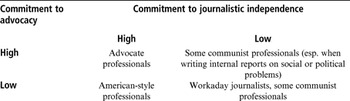
These four types differ principally on two dimensions: their level of commitment to journalistic independence, and their level of commitment to advocacy (see Table 1). Journalistic independence refers to the idea that news workers themselves should determine standards of newsworthiness, rather than writing stories with an eye towards pleasing higher authorities or the CCP. Advocacy, by contrast, refers to reporters and editors' willingness to stand up for causes they believe in, even when these causes might be politically sensitive. In other words, independence is about control and advocacy about content. More concretely, if reporters' support for independence is high but advocacy is low (as with the American-style professionals), they would be likely to support press freedom without pushing any specific political agenda. By contrast, journalists with a commitment to advocacy but not independence (the communist professionals) would tend to push an agenda in internal CCP memoranda while sincerely believing in the publicly expressed values of the party-state. Categorizing people is necessarily imprecise and these types are only meant to reflect ideals.Footnote 6 Individual news workers may not neatly fall into categories, and indeed may shift category over time or issue area. Advocacy can be an especially risky strategy in an environment where political boundaries can alter day by day and where news workers faced with ambiguous party-state signals must often rely on their own shared understandings of the limits of acceptable discourse.Footnote 7 In other words, even journalists with a high commitment to advocacy might be unwilling to “play edge ball” (da cabianqiu 打擦边球) on certain issues or at certain times, and even communist professionals might suddenly find themselves on the wrong side of an issue.
A Typology of Chinese Journalism

Methodology
This study is principally based on 62 in-depth interviews with Chinese professional news workers, academics and others collected in China over 14 months. Note that because of political sensitivity, names of interview subjects are pseudonyms. To increase generalizability, I selected four fieldwork sites: Beijing, Shanghai, Guangzhou and Chongqing. As the national capital and headquarters of many of China's most prominent publications, Beijing is a natural choice. Moreover, its media market is highly commercialized, and the level of political control varies from high (during major political meetings or sessions of the National People's Congress) to relatively low (the rest of the time). Although the phenomenon of cyclical political opening and tightening is true across China,Footnote 8 the level of control seems to vary most in Beijing. Shanghai represents a curious example of a city with both a highly marketized media environment and a very high level of media control.Footnote 9 Guangzhou is a natural choice by virtue of its status as the most politically open journalistic environment in the country. Finally, Chongqing was selected as a more “typical” Chinese city, with relatively low levels of market competition and high state media control. Chongqing also helped make the sample more indicative of China as a whole, rather than simply rich, coastal cities (see Table 2).
Fieldwork Sites

Within these cities, I relied on my network of journalistic contacts to provide a snowball sample of news workers, concentrating on elite journalists or those who worked at particularly influential papers. My results are thus unlikely to be representative of all Chinese journalists, but should be a fairly robust portrait of those at the top of the profession.
Making Professional Chinese Journalists
Before further detailing differences among the four ideal types, it is helpful to discuss commonalities. Although their backgrounds differ, the vast majority of Chinese journalists (91 per cent in one 2005 survey)Footnote 10 have a college degree, compared with around 2.2 per cent of the general population.Footnote 11 All legally employed journalists in China must have a press card issued by the state's General Administration of Press and Publication (GAPP) (Xinwen chuban zongshu 新闻出版总署).Footnote 12 To obtain a press card, reporters are “required to take a training program in official ideology, media policies and regulations, journalism ethics, communication theory, and related topics.”Footnote 13 Indeed, it is not enough that the GAPP forces journalists to attend these training sessions; to receive a press card, they must also pass a test that includes Marxist-Leninist press theory.Footnote 14 In training reporters, the CCP emphasizes the importance of the “Party principle” (dangxing yuanze 党性原则), which is the idea that the party-state should dominate the media.Footnote 15 This system is carried over from Maoist times, when the CCP enjoyed absolute dominance over Chinese mass communication. Although the situation has clearly changed since then,Footnote 16 Chinese journalist training curricula still officially demand that the press serve as the CCP's voice.
Chinese journalists are also formally guided by an ethos of public service put forward by their official professional association, the All-China Journalists' Association (ACJA) (Zhonghua quanguo xinwen gongzuozhe xiehui 中华全国新闻工作者协会). All Chinese journalists must belong to the ACJA, a theoretically autonomous social organization that is actually run by the CCP's Central Publicity Department (CPD) (Zhongyang xuanchuan bu 中央宣传部) as part of the party-state's media control apparatus.Footnote 17 Although described by one interviewee – quite typically – as an organization that “doesn't train, doesn't help and doesn't protect journalists,”Footnote 18 the ACJA does promulgate a code of professional conduct and, at least in theory, advocates for the profession. The code requires that journalists report the truth and not take bribes or blackmail sources, and the GAPP publicly posts a rotating list of news workers who have committed such professional misconduct.Footnote 19 The ACJA also posts moralizing stories and exhortations on its website, with a typical example arguing “fake news confuses public opinion and throws it into disorder (raoluan yulun 扰乱舆论), becoming a harmful and malignant cancer (duliu 毒瘤) on society.”Footnote 20 Journalists, then, are required to be truthful and honest in their reporting. The ACJA has always been thoroughly co-opted by the CCP, but its existence as a formal, professional journalistic organization advancing a code of conduct and norm of public service strengthens the case that official Chinese journalists are all, formally at least, professionals.
Journalists and scholars sometimes disparage old-line practitioners of communist journalism and propaganda. Prominent former editor Lu Yuegang 卢跃钢, for instance, writes that “the media playing the ‘mouthpiece’ role” can be summarized in eight characters “when you are an accomplice to evil, you are hitting a man when he is down” (zhuzhouweinüe, luojingxiashi 助纣为虐, 落井下石), a view that is hardly confined to the Chinese press.Footnote 21 This persistent attitude makes it important to draw out the argument that these news workers are indeed professional journalists. Clearly the standards of the Party press – including a reliance on Marxist/Leninist ideology and an uncritical acceptance of CCP decisions – are unlikely to appear on any Western journalism curriculum. It is a mistake, however, to translate a normative dislike of the training and practice of communist journalism into a claim that such reporters are not professionals. I argue that even news workers who unabashedly take up their role as the “throat and tongue” of the CCP share the three core features of a profession laid out by political scientist Harold Wilensky in 1964Footnote 22: membership in a professional association, widely acknowledged ethical normsFootnote 23 and a commitment to public service.Footnote 24 Many Westerners, especially Americans, are enamoured with the notion that professional journalism is synonymous with objectivityFootnote 25; even in the contemporary United States, however, the daily partisan mudslinging of Fox News or MSNBC seriously challenges a reliance on objectivity as the sole criterion of “professional” journalism. The sections below discuss the four ideal types in greater detail.
The American-Style Professionals
Not all academics agree with the idea, discussed further below, that professional journalism in China is analogous to that of the United States. Chin-Chuan Lee, for example, differentiates among three models of Chinese journalism, but he does not further develop his model for causal inference or discuss the many workaday journalists.Footnote 26 Lee's models are Confucian liberalism, Maoism and communist capitalism, mainly divided by time period. Although the Maoist model (1949–present) and the communist capitalist model (after the 1980s, especially after 1992) have some temporal overlap, the thrust of Lee's argument is that the Chinese press has moved in stages between these three models, which have both differences and similarities. His analysis is perceptive and intuitive, but it does not fully capture the present complexities of Chinese journalists' role. More recently, sociologist Fen J. Lin has conducted survey work among Chinese news workers in which she sees a mixture of “three types of ideal elements – Western professionalism, literati tradition, and party journalism” that “coexist in the current Chinese journalism landscape.”Footnote 27 While a useful counterpoint to more dogmatic assertions of the primacy of “professionalism” in the media, this view glosses over the existence of the non-ideologically minded workaday journalists and does not fully acknowledge that advocacy can come not only from what she terms “party journalism,” but from more independently minded reporters as well. These exceptions aside, scholars have long been interested in American-style professional journalists dedicated to independent, objective reporting.
Media scholar Yuezhi Zhao, for example, speaks of “China's nascent culture of independent professional journalism,”Footnote 28 and refers to “journalists' growing sense of the liberal watchdog model.”Footnote 29 In one of the few large-scale surveys of Chinese journalists, Chen et al. conclude that “Chinese journalists are in the midst of professionalization,” without further disaggregating the concept.Footnote 30 But this characterization is not confined to recent work; as early as 1993, Allison Liu Jernow was able to see “a new generation of journalists at work,” who “emphasized professionalism, not propaganda.”Footnote 31 Even scholars like Li Liangrong, who has examined the historical waxing and waning of Western-style objectivity in China, occasionally make sweeping statements that “the principles of objectivity and fairness have become an irreversible trend after over a decade of profound reforms.”Footnote 32
Chinese academics and reporters, too, sometimes make the assumption that only one model of professional journalism exists, and “use exemplars from the West to define ‘professional standards’.”Footnote 33 In Watchdog Journalism and Global Democracy, liberal scholar Zhan Jiang 展江 writes about the relationship between professional journalists and ethical codes, explicitly saying that “in the US such [a model] is often called ‘news professionalism’.”Footnote 34 And in interviews, journalists often conflate “professionalism” with “American-style professionalism.” One reporter, for example, thinks that younger reporters are more professional than older ones because they have more formal training in college and journalism school and are “more influenced by America.”Footnote 35 Another claims that the journalists at the Beijing News (Xin jing bao 新京报) are professional because they cover stories with objectivity.Footnote 36 Admiration for an idealized American Fourth Estate is common. Many more reporters admire the ethical codes at American papers and link professionalism with ethics. These journalists often specifically draw a comparison with Chinese journalists, who they feel are corrupt. In short, many journalists and scholars in China and abroad think that “professionalism” means emulating the United States, and state that it is desirable to do so.
There certainly are some American-style professionals, driven to present objective facts and include balanced opinions. A small core of journalists “really look up to” an idealized American model of the press, which many have studied in school.Footnote 37 These professionals tend to work at the better-known or more respected periodicals in China, publications like Southern Weekend (Nanfang zhoumo 南方周末), Beijing News and Finance (Caijing 财经).
The reality, however, is that most Chinese journalists are not American-style media professionals. One editor even stated that “if the media are too professionalized, it is a problem,” because he finds such journalists to be overly objective and boring.Footnote 38 This quotation is telling, as it came near the end of an interview in which the editor first claimed that reporters should be neutral information providers. Over the course of the interview, he revealed a common pattern: many Chinese journalists initially claim to be objective, independent professionals, but when pressed, espouse values incompatible with the normative standards of American journalism. In other words many, although professional journalists, are not American-style professional journalists.
At the beginning of an interview, for example, reporter Zhu HongxuFootnote 39 argued that the press should serve as a neutral Fourth Estate and “supervisor of the party-state” (dangzheng jiandu 党政监督), and that his paper specifically looked to the New York Times for inspiration. When pressed further, however, he espoused a belief that the press should influence government policy directly, agreeing with prominent former editor Li Datong 李大同 that “news should influence today.”Footnote 40 Another reporter at one of China's most influential papers claimed that a professional reporter is one who objectively reports the facts while also serving as a mediator between the people and the government.Footnote 41 A different interviewee argued that a professional journalist, while serving as the objective writer of the “manuscript of history” (lishi de digao 历史的底稿) should also be a jiduzhe (济度者), a Buddhist term meaning “one who provides salvation to the masses.”Footnote 42 It is hard to reconcile these two roles, but this remains a typical attitude among Chinese news workers.
The normative appeal of the American-style strand comes from abroad, where the ideal of neutrality and objectivity has often displaced rival journalistic standards.Footnote 43 This model seems to disseminate among Chinese journalists in at least three ways: first, since a number of high-level Chinese reporters have studied in the West, especially in the United StatesFootnote 44; second, through informal professional organizations in China dedicated to journalistic trainingFootnote 45; and third, via the “soft support”Footnote 46 and training sessions of foreign NGOs like Internews, a journalist advocacy and training group whose Chinese activities are primarily funded by the US State Department.Footnote 47 Prominent former editor Li Datong writes about the internationalization of the Chinese press:
Starting in the 1980s, books of Western news media theories, principles and techniques started to be translated. … And the result was that we started to see ourselves as members of the world news community, in the same profession as people in other countries. … And we started to realize that we were all in complete agreement: news is not the lackey of authority, but is instead the critic and arbiter of that authority.Footnote 48
In other words, Li and like-minded journalists started to look specifically towards the West for models of professional journalism.
But rather than serving as a spur to bold reporting, a true American-style orientation can actually result in a more deferential Chinese media environment. For example, Zhang Nan,Footnote 49 an editor for a government-circulationFootnote 50 legal paper, feels so strongly that reporters should have enough technical knowledge to report news accurately that she helped found an informal organization for training legal reporters. This group avoids sensitive topics and concentrates on imparting basic skills to legal journalists so that they do not, for example, misreport laws or “incorrectly write the name of the Supreme People's Court.”Footnote 51 Although this and similar informal organizations serve as a nexus of journalistic independence and an important way for norms and practices to spread through the profession, Zhang Nan herself feels that professional journalists should not push their own views in articles.
Even in the West, objectivity has long been seen as a “strategic ritual” and a way for reporters to avoid writing confrontational or controversial articles.Footnote 52 A recent study of the Hong Kong media has found that sometimes a culture of objectivity actually encourages self-censorship among news workers,Footnote 53 a phenomenon that is even more pressing in Mainland China. Such journalists can hide behind procedure and high-mindedness, while avoiding pushing an aggressive agenda. For example, a story on the planning of transport capacity during the Chinese New Year discusses the issue of rural labour mobility, a mildly sensitive issue in China,Footnote 54 but does so without commentary:
This paper has learned from the provincial Labour and Society Protection Office that in order to ensure the orderly flow and transport of peasant labour (mingong 民工) during the busy Spring Festival period, the province [Jiangsu] has implemented an employment and labour mobility information forecasting system. The first areas selected will be Suzhou, Wuxi, Xuzhou and Huai'anchu prefectures.Footnote 55
Although it is impossible to know whether this story's reporters are in fact American-style professionals without interviewing them, such writing is a hallmark of the work that American-style journalists tend to produce. Unlike many Chinese-language stories, for example, this piece avoids either emotional language or commentary on an issue that is ripe for both. Such attributes are common among the stories that American-style professionals aspire to write.
Ultimately, though, China presents a very different news environment from the United States. Journalists who wish to work towards an idealized, independent, objective press find many institutional roadblocks and little encouragement. The practice of a true American-style reporter involves little more than producing neutral-sounding reports and avoiding corruption, something Chinese reporters can manage without challenging the powers that be. Confrontation is ultimately riskier than producing neutral stories on approved topics, and therefore seems to require a larger sense of commitment than simply keeping to professional norms. As one reporter told me, in the long term Chinese journalism should move towards the American model, but the current Chinese news environment is better suited to more aggressive journalism.Footnote 56 In short, many Chinese reporters claim to be American-style professionals; many fewer actually are, and even those few tend towards political passivity.
“Throat and Tongue”: The Communist Professionals
Communist professionals represent another class of Chinese journalist commonly discussed in Western academic and media circles. When stories refer to “China's official media” as “ignoring or twisting” the words of Western leaders,Footnote 57 or when scholars call CCP mouthpiece People's Daily the paper that “sets the tone for all other media in China,”Footnote 58 they reinforce the sense that most Chinese journalists are still communist professionals. Often seen as an anachronistic relic of Maoist times when all journalists were state employees distributing rigidly standardized propaganda, communist professionals have been shrinking in numbers and stature since the start of the reform era in 1978. Although there are still many such journalists, they hardly merit their occasional position as the stereotypical representatives of the contemporary Chinese news media.
Nearly 40 per cent of reporters are Party membersFootnote 59 compared to about 5 per cent of the general public,Footnote 60 but Party membership is neither necessary nor sufficient for communist professionals, who aim to serve as the CCP's mouthpiece, a role consistent with the Marxist-Leninist theory of the press as a transmission belt between leaders above and people below.Footnote 61 In addition to their desire to serve the CCP, communist professionals also share demographic features, typically being older, male, and working at government-run or non-commercial papers. Although their desire for media independence from the CCP is low, many communist professionals have a high commitment to advocacy, especially those who view intra-bureaucracy internal reference reportsFootnote 62 as “an alternative that could help solve problems, given the current state-media regime.”Footnote 63 Finally, communist professionals tend to dominate outlets like People's Daily, Peasant Daily (Nongmin ribao 农民日报), the various papers of the provincial Party committees (such as Sichuan Daily [Sichuan ribao 四川日报]) and China Central Television, though all these media groups also employ journalists of the other three types.
Chen Hu,Footnote 64 an editor at Workers' Daily (Gongren ribao 工人日报), clearly thought of himself as representing the CCP and seemed pleased with the status quo. Although Chen vaguely claimed to “represent the people,” when pressed he equated their interests with those of the CCP. Although he is typical of this group, there is also a smattering of younger journalists with a similar role conception. For example, Li Lei,Footnote 65 a female reporter in her 20s working for a paper sponsored by the official Xinhua News Agency, is avowedly quite “conservative” (baoshou 保守) and thinks that it is not for individual journalists to decide their own role. Rather, she believes, the state should decide such questions, especially since both she and the state share the goal of developing Chinese society. Although unhappy with what she sees as the CCP's overly heavy-handed control of the press, she is nevertheless comfortable with its overall role in the media. Li Fang,Footnote 66 a young radio reporter, explicitly considers himself the “throat” (houlong 喉咙) of the government but not its “tool” (gongju 工具). Unlike a “tool,” a “throat” has two facets: when the government wants to speak, it uses the throat, but the rest of the time the throat can and should speak on its own. Such a statement does not undermine the characterization of Li as a communist professional, and is consistent with early survey work suggesting that regardless of their orientation “Chinese journalists' job satisfaction has less to do with material rewards … than with their perceptions of job autonomy.”Footnote 67
Communist professionals, then, are neither a distant relic of the Maoist past nor the most numerous and powerful representatives of the Chinese media. On the whole, they are a contented group who have little wish to rock the boat. For example, here is an excerpt from a front-page story on 21 October 2009 in People's Daily, a paper that by all accounts is heavily staffed by communist professionals:
The Dalai Lama has always shielded himself with the “democracy” sign to cater to Westerners. … However on 9 September, Jamyang Norbu, a radical Tibetan separatist, published a long article on a “pro-Tibet independence” website … which pitilessly exposed the Dalai Lama's “democracy myth” and again helped people see through the true autocratic features of the Dalai Lama clique.Footnote 68
Stories like this are entirely non-controversial (within China) and highly unlikely to cause trouble for anyone. Any irony about a CCP functionary criticizing the Dalai Lama as “autocratic” is unremarked – and unintended. Similarly, stories on diplomatic visits to China often use recycled phrases like “‘building stronger bilateral ties’ to describe, with never a variation, the purpose of meetings between national VIPs.”Footnote 69 Such reporting is a hallmark of the communist professionals.
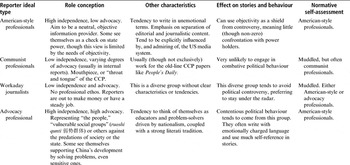
Although often discussed in Chinese and Western scholarship, American-style and communist professionals do not monopolize the Chinese journalistic field, as Table 3 and the following sections explain.
Characteristics of the Four Types

“Guard Against Fire, Theft and Journalists”Footnote 70: The Workaday Journalists
All legally employed Chinese journalists are, formally at least, professionals. There is, however, a large and perhaps growing cohort of “illegal” journalists. These unofficial reporters fall into two broad categories: those employed as news workers by legitimate media outlets, an increasing number of internet blogsFootnote 71 and a few samizdat publications; and those who are self-promoters, information traders or outright hucksters. Because “any person who does not hold a reporter identification issued by the [GAPP] is a fake reporter [and] it is an illegal activity for fake reporters to gather news,”Footnote 72 both groups are officially illegal, but it is important to distinguish between them.
The first group generally consists of legitimate reporters who do not have a press card or legal employment, and who are often referred to as “freelance writers” (ziyou zhuangaoren 自由撰稿人) or “part-time journalists” (mingong jizhe 民工记者). The reasons for this situation vary, but it commonly occurs when publications do not want the hassle and inflexibility of formal employment. Functionally, however, these reporters are represented in all four categories despite their nominally illegal status.
The second group of illegal journalists, the hucksters, pass themselves off as legitimate reporters to blackmail or extort members of the business community by demanding payment not to publicize real, or even invented, negative information. These fictitious news workers often congregate at the scene of industrial or mining accidents, awaiting payment,Footnote 73 and are interested in neither media independence nor advocacy. In one particularly lurid 2003 case, for instance, journalists who had visited the scene of a gold mine collapse were later found to have gold bars stashed in their houses as “hush money” payments.Footnote 74 And such scenes are “very, very frequent,” according to an editor whose paper “exposed an instance of extravagant corruption in central Henan province in 2005” that attracted “480 reporters and others pretending to be reporters who asked for ‘shut-up fees’ to keep news of a mine flood out of the public eye.”Footnote 75
“There really is a problem with fake reporting and reporters,” Li Datong writes,Footnote 76 a plague that exists for two principal reasons: first, it is often cheaper for business owners to bribe journalists than to make necessary safety improvements, and second, businesspeople often have no way of distinguishing real reporters from fake ones. This second reason is especially poignant because many “real” reporters themselves take bribes. In such situations, business owners often pay off “real” and “fake” alike. In comparing workaday but legal journalists with their illegal counterparts, the major difference is often simply that the former have press cards and the latter do not. Indeed, one popular saying urges listeners to “guard against fire, theft and journalists.”Footnote 77
But journalists do not have to be “fake” to be unprofessional. As with the “fake” journalists, money is the workaday journalists' lodestar, and such reporters probably make up an outright majority of Chinese journalists. However, like every official, legally employed, journalist in China, workaday reporters must undergo state training and be certified by the GAPP. Strictly by this measure, every legally employed Chinese reporter is a professional news worker. What distinguishes workaday reporters from other types is professionalization's third component – a normative commitment to public service. Workaday journalists, who will “do anything for money,”Footnote 78 lack this normative commitment and therefore cannot be considered fully professionalized.
Although these reporters probably represent most Chinese news workers, in general they are politically and socially quiescent.Footnote 79 They are simply interested in money or steady employment, and as such do not invoke the professional public service ethos. Such reporters are probably mixed in various ratios in most or all Chinese newspapers, though interview data and personal observation suggest that they are less common at the most influential publications (especially those which enforce bans on corrupt behaviour, like Southern Weekend, Finance, China Youth Daily [Zhongguo qingnian bao 中国青年报], and so on) and more common at smaller or less prominent outlets. Over time, some workaday reporters convert into one of the other types of news worker, but this on-the-job professionalization seems relatively infrequent.
Corruption, from taking “car fare” (chemafei 车马费) to outright bribes, market manipulation and blackmail, is rampant among workaday journalists. Providing “car fare,” usually envelopes stuffed with between 200 and 500 yuan (US$30–70), is an exceptionally common way for companies and even government bureaus to encourage journalistic attendance at news events. Most journalists readily and openly admit to taking it, and one even told me that press conferences “must” offer such envelopes (chemafei shi yinggai de 车马费是应该的).Footnote 80 Even otherwise professional advocacy journalists take them, and at news conferences all reporters take the envelopes “without exception.”Footnote 81 Indeed, “the payoffs have become so accepted that a reporter who showed up” for one company's news conference “complained loudly and walked out when he discovered he would be given only a bottle of mineral water, according to other reporters present.”Footnote 82 One media scholar writes that corruption has become an “institutional and occupational phenomenon involving the majority of journalists and the majority of media organizations.”Footnote 83 Although such behaviour is commonplace, reporting on it is quite unusual. The end result is a culture of impunity allowing workaday journalists to continue with a role orientation that allows no higher purpose than lining their own pockets.
Because the regime now emphasizes the importance of the rule of law, it is often important for the CPD or other party-state actors to have a pretext on which to discipline unruly journalists. If a reporter is engaging in illegal or corrupt practices – as most Chinese journalists seem to be – it is easier for the party-state to silence the offender. In such cases, the corruption serves as an excuse to fire or imprison the journalist, while the punishment actually reflects the CCP's displeasure over political matters.Footnote 84 There is even anecdotal evidence that the CPD abets corruption. One professor told me about a conference that he organized at which the CPD encouraged him to offer “car fare” to journalists. When he demurred, officials forced him to make such financial inducements available.
Ultimately this endemic corruption serves as a strong deterrent to greater professionalization among Chinese news workers, many of whom condemn such behaviour.Footnote 85 Reporters commonly complain that their colleagues have no ethics (daode 道德), and that the problem is “uncontrollable” (kongzhi bu liao 控制不了).Footnote 86 They grumble about the effects of corrupt reporters, such as the ones who planted evidence of dirty manufacturing practices in a Häagen-Dazs facility in a failed attempt to blackmail the company,Footnote 87 arguing that such actions taint public perception of their field and make it more difficult for other reporters to be taken seriously. This mistrust, in turn, encourages more corrupt behaviour by news workers who feel they have little reputation left to lose. In short, systemic corruption among Chinese journalists simultaneously encourages an “every woman for herself” attitude and discourages efforts to impose an effective ethical code. Those relatively few news workers who have become genuinely professional journalists – of whatever stripe – have done so despite the obstacles thrown up by both the party-state and their own organizational culture. Indeed, it is not surprising how few Chinese journalists are true professionals, but how many.
Representing “The People”: The Advocate Professionals
Rather than writing for money, the CCP or even objectivity, advocate journalists aim to push a specific, social, ideological or economic viewpoint in their stories. They thus score high on commitment to both media independence and advocacy. Often, such news workers claim to represent “vulnerable social groups” (ruoshi qunti 弱势群体) in an attempt to better their plight, but advocate journalists can agitate for a range of causes. For example, a 2005 story in Southern Weekend with the poetic title “Venus: The Price Inside the Wall for the Floating Fragrance Outside the Wall,”Footnote 88 pushes for more support and sympathy for China's artistic community:
Reporter: “In 2000, after leaving the Beijing Modern Dance Troupe, Venus moved to Shanghai to make a fresh start and open the wholly owned Venus Modern Dance Troupe, China's only private modern dance group.” …
Venus: “In China, the significance of opening a modern dance company is enormous. It far exceeds just opening another one in Europe, because my theatrical company represents the very existence of modern dance in China.”
Reporter: “Is it easy to set up a dance company domestically?”
Venus: “It is not easy. Actually, many students especially want to come and dance with me, because with me they are able to find truth and freedom.”Footnote 89
The writers' sympathy towards the notion that the arts, and modern dance in particular, should receive more social support is apparent in this section and throughout the article. These reporters, as advocate professionals do, wear their hearts on their sleeves.Footnote 90
A striking number of advocate journalists see their role as essentially nationalistic. As sociologist Fen Lin puts it, they feel that the “crucial function of news media is to serve the long-term goal of national development.”Footnote 91 For them, being a reporter means solving social problems and engaging in the national project of pushing forward China's development. Sometimes this advocacy means publicizing weighty concerns like justice for pollution victims or the prevalence of local corruption, and other times it might mean pushing less sensitive topics like greater arts funding. The common thread in all these examples, though, involves journalists trying to mobilize public opinion with an eye towards building a better China and pushing CCP policy in a way that it might not otherwise go.
Lin Mei,Footnote 92 an editor at China Youth Daily, is one such journalist. She likes the job because she can serve the country and see the direct results of her endeavours every day. She has relatives who are businesspeople, and although their jobs help improve the country's GDP, her gratification is much more direct. As a journalist, she can do more than just “supervise” the state – she can also affect policy in an effort to make China great.
Many reporters say they consider their role as representing “the people,” rather than the party-state. One former reporter for Southern Weekend went further, claiming that “about half of reporters want to criticize and change the government.”Footnote 93 One reporter even told me that “being a reporter is impossible in China,” in part because press restrictions make it difficult for reporters to push policy changes.Footnote 94 These advocacy journalists have “an increasing tendency to distinguish between state and citizenry and to see themselves on the side of the latter.”Footnote 95 For example, Zhang Yongchun,Footnote 96 a mid-30s journalist of 11 years, works for a national opinion magazine and is avowedly “leftist,” believing that the media should help the people and Chinese society rather than the state. Although Zhang is a bit more outspoken than most, his claim that journalists should explicitly side with the forces of “labour” and critique the forces of “capitalism” would not be out of place among other advocate journalists. Quoting – in English – the idea that “journalists shift our perceptions of the world,” he thinks that the role of journalists is more educational and nuanced than offering straightforward political commentary. In other words, journalists should represent the people by “representing the world to the people.”
Why Advocacy Journalism Resonates in China
Chinese advocacy journalism is hardly new. Such a role orientation has a long tradition, beginning with late 19th-century reformer Liang Qichao's efforts to establish newspapers that were “factional organs (dangbao)” and even “protopolitical opposition parties.”Footnote 97 These early journalists still have relevance today, and several interviewees spoke explicitly of late Qing dynasty or early Republican-era media history. The view that journalists are essentially educators or intellectuals with a specific viewpoint and a desire to help “the people” and shape public opinion (yulun 舆论) goes back even further. “Yulun, the character compound [that early 20th-century journalists] used for public opinion, dated back at least to the third century and had been used throughout Chinese history to describe elite opinion within the bureaucracy,” historian Joan Judge writes.Footnote 98 Intellectuals have long had a privileged place in Chinese society simultaneously to critique the government by representing “the people” and to educate the people as to how – the intellectuals believe – they should think and act.Footnote 99
Chinese journalists, who still consider themselves intellectuals, have long been “committed not only to represent and inform but also mobilize their compatriots,”Footnote 100 an attitude that continues today for the advocacy journalists. This education of the people is sometimes overt, like telling them that “one plus one equals two,” for example.Footnote 101 Or it can be subtle, as when Xiao Guangxu,Footnote 102 an editor for Southern Weekend, discussed a Chinese husband and wife team who live in the United States and report on their experiences abroad. Readers can then “make the comparison themselves” and see China's problems indirectly through the column. For Xiao, this sort of careful triangulation lets people know the situation in other countries without a direct, politically aggressive comparison. Sometimes the idea that journalists should educate the people blurs into contempt. Bai Xinguo,Footnote 103 for example, told me his magazine does not particularly care if readers are interested in a story, because he and his colleagues do not write for readers' pleasure but for their benefit. He thinks that media outlets that stick too closely to readers' interests put out a low quality product. In the end, though, his desire to educate the populace and build a better China resonates with the heart of advocacy journalism.
Many of China's top papers, including Southern Weekend, Beijing News and China Youth Daily, and magazines like Finance, not coincidentally are full of advocate journalists pushing their views with firmness but subtlety. Southern Weekend journalist Liu Jianqiang gives a telling example from when he was considering a job at the paper. In the wake of the CCP's 2003 removal of top staff for over-zealous reporting, Liu was worried that the new editor would reverse course and control the paper too tightly. The deputy editor, though, told him “the paper won't change that easily – rather, we hope that we can change the new editor.”Footnote 104 This determination is emblematic of the advocate journalists, who are ultimately – and perhaps unexpectedly – some of the key drivers of policy change in China.
Conclusion
Some speak of the increasing American-style professionalism of Chinese journalists with a barely concealed normative approval that often glosses over important empirical and theoretical differences among a heterogeneous group of journalists. At the same time, however, few Chinese journalists maintain their role as the “throat and tongue” of the Party. Indeed, both orientations are rare and have neither the normative appeal nor practical effects to warrant their near monopoly on scholarly attention. In the past, communist professionals dominated the Chinese press, and one day American-style journalists will perhaps dominate, but both days are a long way off.
In addition to revealing the problems raised by the very notion of a “professional” Chinese journalist, I hope to focus attention away from the common, but often inaccurate, notion that only a true American-style journalist is capable of independent political action. Indeed, the biggest drivers of day-to-day political change in the Chinese news environment are not these “American-style” journalists or even market pressure,Footnote 105 but the advocate professionals. It is time to step back from the Procrustean bed of a Western media theory that refuses to see advocates as anything other than “unbalanced” polemicists and engage with the empirical realities faced by actual – not idealized – Chinese reporters. Ultimately it is the advocate professionals who have the most congruity with Chinese intellectual and media tradition, and we should not be surprised to find them at the vanguard of sensitive coverage, and of policy and media change in China.