Emergency events, such as disease outbreaks, natural disasters, and biological terrorist attacks, require public health agencies and community stakeholders to be adequately prepared to conduct rapid mass dispensing operations to decrease large-scale morbidity and mortality.Reference Baccam, Willauer and Krometis1-Reference Rebmann and Coll4 In 1999, the Centers for Disease Control and Prevention (CDC) created the Strategic National Stockpile (SNS), a supply of antibiotics, chemical antidotes, and medical supplies to protect against an array of public health threats.Reference Richter and Khan5,Reference Zerwekh, McKnight and Hupert6 SNS medical countermeasures are intended to supplement state, local, territorial, and tribal jurisdictions when their emergency-specific medical countermeasures are absent, diminished, or are not locally available in sufficient quantities.Reference Bhavsar, Esbitt and Yu7 In accordance with the Cities Readiness Initiative and the CDC, during these public health emergencies communities must dispense post-exposure prophylaxis to the population in its entirety within 48 hours.Reference Rebmann and Coll4,Reference Nelson, Willis and Chan8 The potential human cost of these emergency events (ie, mass morbidity and mortality) and high transmissibility of infectious agents involved provide a strong case for communities to be optimally prepared and capable to carry out emergency mass prophylaxis operations.Reference Rebmann and Coll4,Reference Richter and Khan5,Reference Wallin, Luksiene, Zagminas and Surkiene9
The standard method to increase dispensing efficiency during public health emergencies is the utilization of strategically located emergency dispensing clinics. Often termed as points of dispensing (POD), these clinics serve as the foundation to dispense mass prophylaxis to the general population.Reference Baccam, Willauer and Krometis1,Reference Richter and Khan5,Reference Zerwekh, McKnight and Hupert6,Reference Pagaoa, Leblanc and Renard10 Drive-through clinics (DTCs) are a novel type of POD in which participants drive to a designated location and receive prophylaxis while remaining inside their vehicle.Reference Le, Charney and Gerard11,Reference Nicholas, Eileen, Julia and Ron12 DTCs are particularly well-suited for mass dispensing operations and have demonstrated beneficial aspects superior to traditional walk-in clinics. These benefits include increased access for minority and underserved populations, support for infectious disease outbreak mitigation, the provision of a more streamlined mass dispensing model with decreased patient bottlenecks, and decreased disease propagation within emergency clinics due to participants’ vehicles acting as an isolation chamber.Reference Rebmann and Coll4,Reference Zerwekh, McKnight and Hupert6,Reference Nicholas, Eileen, Julia and Ron12,Reference Gupta, Evans and Heragu13
Existing research on DTCs have studied DTC processes (eg, DTC layouts, staffing allocation, throughput rates) either through conducting live DTCs (eg, seasonal influenza vaccination clinics and mock emergency events) or using computer software as a decision support system (DSS) to model, simulate, and optimize DTCs. To date, there is no comprehensive review on practices and recommendations derived from these studies. Thus, there is a need for a formal, evidence-based summary of known effective practices and recommendations for implementing DTCs.
Establishing evidence-based practices and recommendations ascertained from peer-reviewed literature is a critical step for understanding how to best implement DTCs so patient throughput times, adverse events, and disease propagation are minimized. These evidence-based practices and recommendations encourage DTCs to effectively and efficiently dispense prophylaxis to their targeted community within the specified time frame. Doing so has the potential to minimize morbidity and mortality associated with the emergency event, which serves as the primary goal of DTCs. This review aims to identify and present evidence-based practices and recommendations for implementing successful DTCs during public health emergency events.
METHODS
Article Inclusion and Exclusion Criteria
Initial article inclusion criteria were broad. An article included in this review must (1) be written in English, (2) include “drive-thru” or “drive-through” or “mass prophylaxis” or “point-of-dispensing” or “public health infrastructure” in its title, and (3) address DTCs in the body of the article. Articles excluded from this review were (1) articles not published in peer-reviewed journals, (2) letters to the editor, (3) journal news periodicals, (4) articles published before 1990, and (5) articles that did not sufficiently address DTCs in the bodies of the articles.
Search Strategy
To ensure complete article ascertainment, 2 authors (the primary author and a research librarian) conducted multiple search strategies. The first search strategy used 5 databases, including ScienceDirect, Academic Search Complete, MEDLINE with Full Text, CINAHL Complete, and Complementary Index. Key words used to search the databases included “drive-thru AND clinic AND vaccination,” “drive-through vaccination clinic,” “drive-thru vaccination clinic,” “mass prophylaxis drive through,” “drive-through AND medicine,” “drive-thru influenza,” and “drive-through influenza.” The search used expanders, in that key words could be in the title of the article, within the full text of the article, or contain related words in the article. The search was limited to academic journal articles published between 1990 and 2019.
The second search strategy used PubMed and CINAHL complete databases. For the PubMed search, MeSH terms “influenza vaccines” and “mass vaccines” were used as major headings and were combined with “drive-through.” For the CINAHL complete database, a key word search of “open points of dispensing” was conducted.
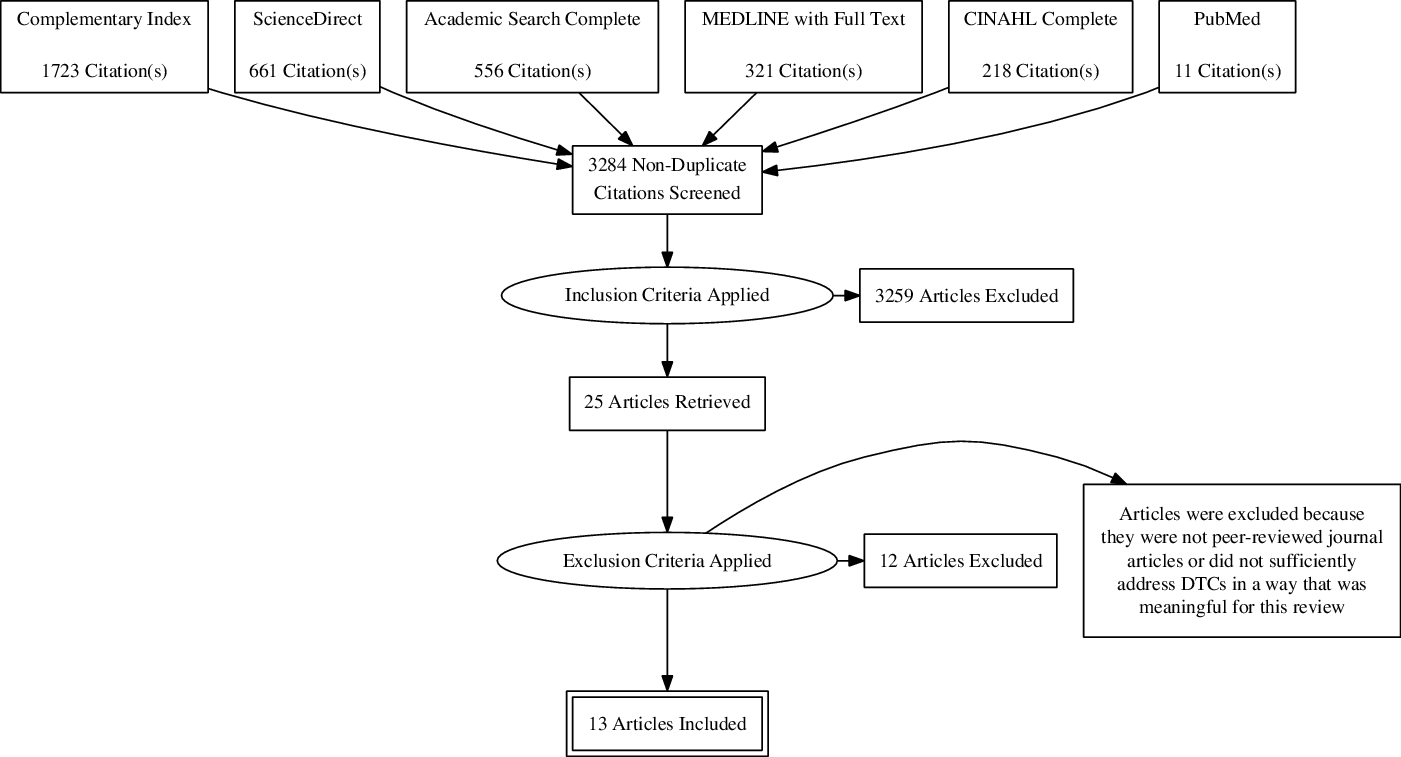
Every title from each search strategy was evaluated for relevance. If the article was considered relevant, the abstract was read, and, if available, the full article was electronically searched for mentions of “drive-through” or “drive-thru.” If the article covered DTCs, then it was screened to ascertain whether the article covered DTCs sufficiently. Moreover, references from the articles that met initial inclusion criteria were assessed for relevance. A detailed overview of the study screening and selection process is presented in Figure 1.
Systematic Review Search Strategy.

Data Extraction
Data extraction was completed using a customized data extraction spreadsheet developed for this review. The extracted data were entered into the spreadsheet by study characteristics, including (1) study author names, (2) study title, (3) publication dates, (4) article database, (5) article journal, (6) study type (ie, cross-sectional/descriptive observational studies, feasibility/pilot studies, mathematical modeling/simulation studies, literature reviews), (7) study location, (8) study sample size, (9) sampling methods, (10) research question, (11) potential themes, (12) exposure, (13) outcome, (14) ascertainment of outcome, (15) measure of association and results, (16) main findings, (17) effective practices and recommendations, (18) future directions, (19) study limitations, and (20) whether the article met eligibility requirements. The extracted data were checked by 2 co-authors, and disparities between authors were resolved through consensus.
When all data were extracted, the primary author created a document, using the partial portfolio grounded theory methodology for narrative developmentReference Wiesche, Jurisch, Yetton and Krcmar14 that categorized effective practices and recommendations identified in each article by themes. Specifically, final themes were developed by extracting all effective practices and recommendations and grouping them by high-level abstraction concepts.Reference Wolfswinkel, Furtmueller and Wilderom15 Concepts were then refined and categorized into themes that addressed the study aims.Reference Wolfswinkel, Furtmueller and Wilderom15 Two co-authors reviewed the document, and it was finalized through consensus. A review outline was developed to guide the synthesis of the manuscript based on the effective practices and recommendations identified. Identified effective practices and recommendations were presented by theme.
RESULTS
Study Selection and Study Characteristics
After screening, 25 articles were assessed for eligibility. During the second stage screening process, 12 articles were excluded because they were not peer-reviewed journal articles (ie, news periodicals, letters to the editor, commentary) or did not sufficiently address DTCs. In total, 13 articles satisfied the inclusion and exclusion criteria and were included in this review.Reference Lee, Chien-Hung, Pietz and Benecke2-Reference Zerwekh, McKnight and Hupert6,Reference Le, Charney and Gerard11-Reference Gupta, Evans and Heragu13,Reference Weiss, Ngo, Gilbert and Quinn16-Reference Carrico, McKinney and Watson20
The majority of the articles were descriptive studies (53.85%, n = 7), followed by modeling and simulation studies (30.77%, n = 4), and summary articles (15.38%, n = 2). Five of the descriptive studies were real-world scenarios – where participants were members of the community being served – and 2 of the descriptive studies were hypothetical exercises, where case scenarios were created to mimic/replicate an outbreak. The main aims of the descriptive studies were to assess participant throughput times,Reference Zerwekh, McKnight and Hupert6,Reference Le, Charney and Gerard11,Reference Weiss, Ngo, Gilbert and Quinn16,Reference Banks, Crandall and Esquibel17 exposure to toxic carbon monoxide (CO) levels,Reference Nicholas, Eileen, Julia and Ron12 clinic usage questions and demographic characteristics of the DTC participants,Reference Banks, Vanderjagt and Crandall18 and to evaluate the effectiveness of university organized DTCs in the event of an outbreak.Reference Rega, Bork and Chen19 The modeling and simulation studies focused on creating DSSs and decision support tools to be used by decision-makers and public health agencies for preparing and responding to future outbreaks and potential biological attacks.Reference Lee, Chien-Hung, Pietz and Benecke2,Reference Ramirez-Nafarrate, Lyon, Fowler and Araz3,Reference Richter and Khan5,Reference Gupta, Evans and Heragu13 The summary articles focused primarily on adverse events associated with DTCs and traditional PODs. Specifically, Carrico et al.Reference Carrico, McKinney and Watson20 estimated the probability of an adverse event (ie, syncopial and vehicle accidents) occurring during a DTC, while Rebmann and CollReference Rebmann and Coll4 outlined infection prevention recommendations for traditional and DTC POD modalities.
Although most articles did not focus primarily on the identification of effective practices and recommendations, each article did address effective practices and recommendations specific to its study. Therefore, extrapolation of effective practices and recommendations was conducted. The effective practices presented in this review refer to practices demonstrated as being effective, but not as a best practice through a formal validation process.21 The identified themes and associated number of articles were (1) optimal DTC design and planning via DSSs and decision support tools (5 articles [39%]); (2) clinic layouts, locations, and design aspects (5 articles [39%]); (3) staffing, training, and DTC communication (9 articles [69%]); (4) throughput time (7 articles [54%]); (5) community outreach methods (6 articles [46%]); (6) DTC equipment (6 articles [46%]); (7) infection prevention and personal protective equipment (PPE) (5 articles [39%]); and (8) adverse events prevention and traffic management (7 articles [54%]). Table 1 presents the overall results (ie, themes, effective practices, recommendations, and study findings) from each article.
Effective Practices, Recommendations, and Study Findings by Article

CO = carbon monoxide; DSS = decision support system; DTC = drive-through clinic; ED = emergency department; EMS = emergency medical services; GA = genetic algorithm; ICS = incident command system; LOS = length of stay; PCP = primary care physician; POD = point of dispensing; PPE = personal protective equipment; PPM = parts per million; RN = registered nurse; USPS = United States Postal Service.
Optimal DTC Design and Planning via DSSs and Decision Support Tools
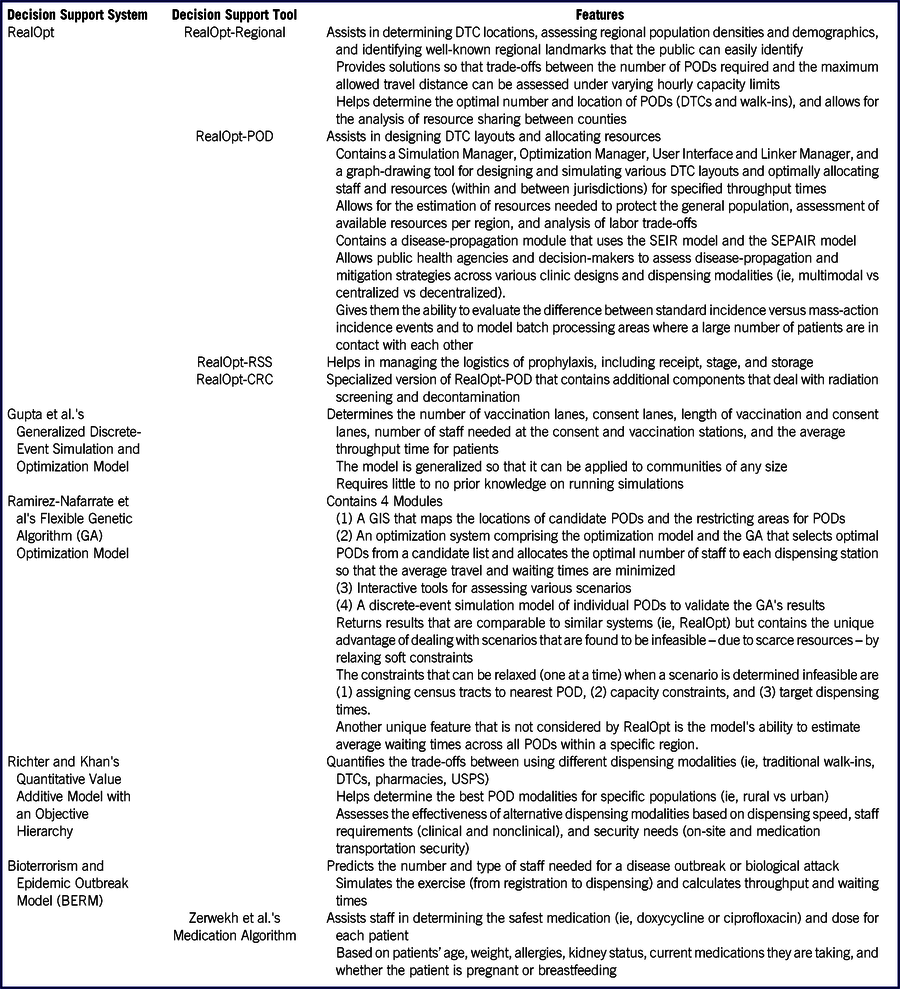
Five DSSs identified in the literature focused on the DTC design and planning phases, and 1 decision support tool focused on identifying the safest medication for each patient. The DSSs varied by their intended applications, model type (eg, simulation, optimization, combination of simulation and optimization), features (eg, graphical tools, user interface), model complexity, and ease of use. Patient throughput time/speed of dispensing, performance evaluation through large-scale emergency event simulation, and the number of staff needed were the most popular topics for modeling, with every DSS identified evaluating said variables in a way specific to the models’ intended application.Reference Lee, Chien-Hung, Pietz and Benecke2,Reference Ramirez-Nafarrate, Lyon, Fowler and Araz3,Reference Richter and Khan5,Reference Zerwekh, McKnight and Hupert6,Reference Gupta, Evans and Heragu13
Specifically, Lee et al.Reference Lee, Chien-Hung, Pietz and Benecke2 developed a DSS to design and simulate various DTC layouts to optimally allocate staff and resources based on a specified throughput time. Gupta et al.Reference Gupta, Evans and Heragu13 combined generalized discrete-event simulation and optimization to estimate the average patient throughput time based on the expected number of vehicles, the number and length of consent form and vaccination lanes, and the number of staff per lane. Ramirez-Nafarrate et al.Reference Ramirez-Nafarrate, Lyon, Fowler and Araz3 proposed a flexible algorithm to select optimal PODs from a candidate list and allocate the optimal number of staff to each dispensing station so the average travel and waiting times are minimized. Zerwekh et al.Reference Zerwekh, McKnight and Hupert6 used the Bioterrorism and Epidemic Outbreak Response Model (BERM), which predicts the number and type of staff needed while providing feedback on patient throughput and queuing times. Last, Richter and KhanReference Richter and Khan5 applied a qualitative value additive model with an objective hierarchy to assess the trade-offs between using various dispensing modalities (eg, DTCs, traditional walk-in clinics, pharmacies, and USPS delivery) for a specific population by determining their overall effectiveness based on POD dispensing speed, staff requirements, and security needs. In addition to the applications mentioned previously, unique applications and features that distinguish each DSS and decision support tool can be found in Table 2.
Decision Support Systems and Decision Support Tools

DTC = drive-through clinic; GA = genetic algorithm; GIS = graphical information system; POD = point of dispensing; SEIR = susceptible, exposed, infectious, and recovered; SEPAIR = susceptible, exposed, infectious, asymptomatic, symptomatic, and recovered; USPS = United States Postal Service.
Clinic Layouts, Locations, and Design Aspects
Various clinic layouts and locations were ascertained from the descriptive studies. They varied by the number of stations, types of stations, number of processing lanes, and clinic locations based on specific target populations and goals. The types of stations identified included (1) triage, (2) registration, (3) screening, (4) evaluation/examination, (5) special needs/services, (6) dispensing/vaccination, (7) emergency medical services/post-vaccination observation, (8) discharge, and (9) medical records. Locations included a large covered parking-structure,Reference Weiss, Ngo, Gilbert and Quinn16 open parking lots,Reference Le, Charney and Gerard11,Reference Banks, Crandall and Esquibel17,Reference Rega, Bork and Chen19 a large stadium,Reference Zerwekh, McKnight and Hupert6 and an enclosed school bus garage.Reference Nicholas, Eileen, Julia and Ron12
Beneficial clinic design aspects were identified. A large spatial arrangement was found to be beneficial due to the large distance between stations, which allowed vehicles to stack up.Reference Zerwekh, McKnight and Hupert6 The stacking of vehicles allowed the staff to process bottlenecked vehicles more rapidly, therefore, increasing throughput.Reference Zerwekh, McKnight and Hupert6 It was recommended to locate DTCs near major intersections and streets to increase visibility and accessibility.Reference Le, Charney and Gerard11 Providing a screening/triage station at the beginning of the DTC was found to be beneficial because it allowed staff to identify patients in need of special assistance or who needed to be diverted and transported to a hospital.Reference Rebmann and Coll4,Reference Zerwekh, McKnight and Hupert6,Reference Weiss, Ngo, Gilbert and Quinn16 Critically ill patients could be transported quickly to a hospital by exiting the normal processing lanes via an emergency bypass lane.Reference Zerwekh, McKnight and Hupert6,Reference Weiss, Ngo, Gilbert and Quinn16 An evaluation station located between registration and dispensing stations was found to be beneficial in determining the correct medication for each patient.Reference Zerwekh, McKnight and Hupert6 Using various colors for each tent station helped patients identify specific stations.Reference Zerwekh, McKnight and Hupert6
Staffing, Training, and DTC Communication
Determination of staff needed for DTCs, proper staff training, and establishment of communication within DTCs were crucial planning and implementation steps identified in the literature. Utilization of the aforementioned DSSs and decision support tools (ie, RealOpt, BERM, Gupta et al.’s DSS, Ramirez-Nafarrate et al.’s DSS, and Richter and Khan’s DSS) was found to be an effective practice in determining the optimal number of staff needed for each DTC and station within each DTC.Reference Lee, Chien-Hung, Pietz and Benecke2,Reference Ramirez-Nafarrate, Lyon, Fowler and Araz3,Reference Richter and Khan5,Reference Zerwekh, McKnight and Hupert6,Reference Gupta, Evans and Heragu13 Allocating registered nurses to clinical stations where they were more familiar with clinical terms (ie, compared to nonclinical staff) was also found to be effective.Reference Zerwekh, McKnight and Hupert6
Effective training strategies and recommendations were mentioned in the literature. They included multiple trainings on SNS preparedness plans, leadership, safety, security, clinic design and function, staff roles, staff responsibilities, mental health support issues, event times, DTC communication and radio etiquette, and infection prevention strategies.Reference Rebmann and Coll4,Reference Zerwekh, McKnight and Hupert6,Reference Rega, Bork and Chen19 Training on implementing infection prevention and occupation health strategies, such as exposure prevention, handling and disposing sharps, using cold-chain techniques (ie, refrigerate vaccines), proper screening, hand hygiene techniques, environmental decontamination, selecting and using the correct PPE, respiratory etiquette, and spatial distancing techniques, were recommended to decrease disease transmission.Reference Rebmann and Coll4 Preregistration of the staff, staff’s families, and first responders was found to be beneficial in training staff on efficiently administering registration forms.Reference Zerwekh, McKnight and Hupert6
DTC communication practices identified were using 2-way radios,Reference Zerwekh, McKnight and Hupert6,Reference Weiss, Ngo, Gilbert and Quinn16,Reference Rega, Bork and Chen19 inviting HAM radio operators to assist in communications,Reference Rega, Bork and Chen19 communicating and reporting through an Incident Command Communication Center,Reference Rebmann and Coll4,Reference Rega, Bork and Chen19 and establishing a Joint Information Center for communication between multiple stakeholders and PODs.Reference Rega, Bork and Chen19
Throughput Time
Increasing overall participant throughput while decreasing participant length of stay was identified as a critical effective practice. Staffing strategies included optimal allocation of staff via utilization of the aforementioned DSSs and decision support tools,Reference Lee, Chien-Hung, Pietz and Benecke2,Reference Ramirez-Nafarrate, Lyon, Fowler and Araz3,Reference Richter and Khan5,Reference Zerwekh, McKnight and Hupert6,Reference Gupta, Evans and Heragu13 staff increases when and where necessary,Reference Zerwekh, McKnight and Hupert6 and thorough staff training on the registration form format (ie, registration station was often found to be the most time-consuming station).Reference Zerwekh, McKnight and Hupert6 Moreover, registration forms provided in large, single-sided print,Reference Zerwekh, McKnight and Hupert6 verbally administered surveys/registration forms,Reference Zerwekh, McKnight and Hupert6,Reference Le, Charney and Gerard11 and forms that were completed while patients were in queue helped decrease patient throughput times.Reference Rega, Bork and Chen19
Other effective strategies and recommendations identified were vehicle stacking at each station, which allowed the evaluation of multiple vehicles simultaneously,Reference Zerwekh, McKnight and Hupert6,Reference Banks, Crandall and Esquibel17 specification of the optimal number of patients per vehicle (ie, 3 to 4 patients per vehicle based on resources and DTC capacity) and encouragement of carpooling,Reference Zerwekh, McKnight and Hupert6,Reference Banks, Crandall and Esquibel17 small trays with supplies carried by multiple staff members allowed vaccination of multiple patients per vehicle,Reference Banks, Crandall and Esquibel17 and having plans that address inquisitive patients in a way that decreases questions and maximizes throughput.Reference Zerwekh, McKnight and Hupert6 Last, multiple PODs (ie, combination of traditional walk-ins and DTCs) across a region could also decrease throughput time.Reference Zerwekh, McKnight and Hupert6
Community Outreach Methods
To inform and attract the community, a diverse advertising campaign that used multiple outlets was found to be effective. The outlets used and recommended were newspapers,Reference Zerwekh, McKnight and Hupert6,Reference Le, Charney and Gerard11,Reference Banks, Vanderjagt and Crandall18 radio stations,Reference Zerwekh, McKnight and Hupert6,Reference Le, Charney and Gerard11,Reference Weiss, Ngo, Gilbert and Quinn16,Reference Banks, Vanderjagt and Crandall18 television ads,Reference Banks, Vanderjagt and Crandall18 websites,Reference Le, Charney and Gerard11,Reference Banks, Vanderjagt and Crandall18 student/staff e-mail,Reference Banks, Vanderjagt and Crandall18 flyers,Reference Zerwekh, McKnight and Hupert6 and ads posted at primary care clinics.Reference Le, Charney and Gerard11 Banks et al.Reference Banks, Vanderjagt and Crandall18 surveyed DTC participants on how they were informed of the DTC to ascertain the most effective advertising modalities. Newspaper and television ads were discovered to be most effective, with 33.85% and 33.21% of participants reporting they heard about the DTC through these 2 modalities, respectively.Reference Banks, Vanderjagt and Crandall18 These advertising modalities were followed by word of mouth (19.6%), university website (8.17%), radio (2.81%), and other websites (2.36%). Rega et al.Reference Rega, Bork and Chen19 noted the importance of confirming accurate and consistent DTC opening and closing times posted by various media outlets. Furthermore, incentives such as free vaccinationsReference Banks, Vanderjagt and Crandall18 and child car seat fittingsReference Le, Charney and Gerard11 were used to increase community participation.
In addition to informing the public about DTCs, local radio stations dedicated to public safety broadcasts can routinely update the community on projected wait times, DTC instructions, and live reports.Reference Weiss, Ngo, Gilbert and Quinn16 Informative/educational brochures should be available to inform the public about the DTC event, the specific disease outbreak, infection prevention strategies, strategies to identify infected individuals, methods to limit exposures and high-risk populations, and when and where someone should seek prophylaxis.Reference Rebmann and Coll4,Reference Zerwekh, McKnight and Hupert6,Reference Weiss, Ngo, Gilbert and Quinn16
Banks et al.Reference Banks, Vanderjagt and Crandall18 recommended using surveys in future, non-emergency DTCs to ascertain participating community member demographic characteristics so members of the community who do not participate could be identified and better targeted. Furthermore, it is recommended that the surveys be culturally sensitive (ie, offered in various languages using culturally appropriate terminology) to increase the accuracy of responses and should incorporate other critical variables associated with participation and vulnerable populations, such as insurance coverage and high-risk medical conditions.Reference Banks, Vanderjagt and Crandall18
DTC Equipment
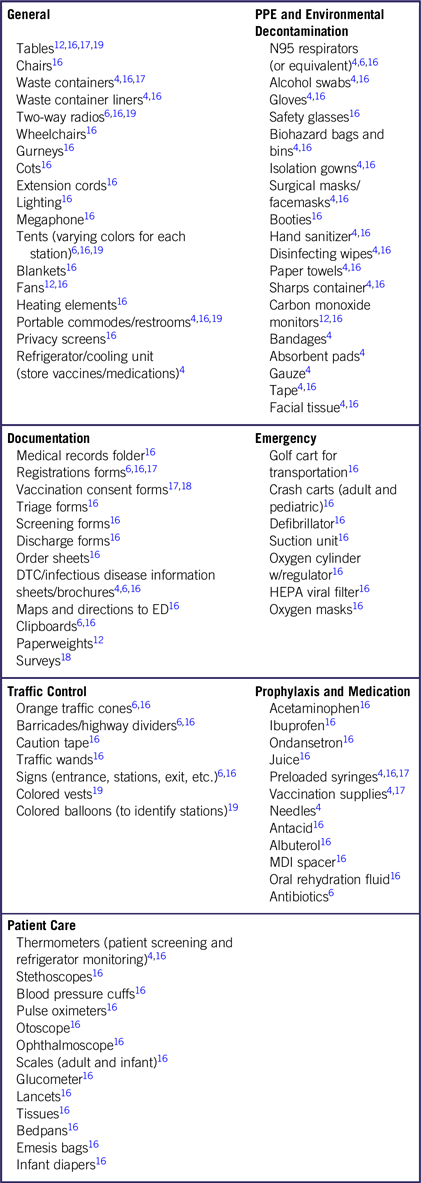
DTC equipment and supplies used and recommended in the articles included general equipment,Reference Rebmann and Coll4,Reference Zerwekh, McKnight and Hupert6,Reference Nicholas, Eileen, Julia and Ron12,Reference Weiss, Ngo, Gilbert and Quinn16,Reference Banks, Crandall and Esquibel17,Reference Rega, Bork and Chen19 emergency equipment,Reference Weiss, Ngo, Gilbert and Quinn16 traffic control supplies,Reference Zerwekh, McKnight and Hupert6,Reference Weiss, Ngo, Gilbert and Quinn16,Reference Rega, Bork and Chen19 prophylaxis and medication,Reference Rebmann and Coll4,Reference Zerwekh, McKnight and Hupert6,Reference Weiss, Ngo, Gilbert and Quinn16,Reference Banks, Crandall and Esquibel17 documentation/forms,Reference Rebmann and Coll4,Reference Zerwekh, McKnight and Hupert6,Reference Nicholas, Eileen, Julia and Ron12,Reference Weiss, Ngo, Gilbert and Quinn16-Reference Banks, Vanderjagt and Crandall18 environmental decontamination supplies and PPE,Reference Rebmann and Coll4,Reference Zerwekh, McKnight and Hupert6,Reference Nicholas, Eileen, Julia and Ron12,Reference Weiss, Ngo, Gilbert and Quinn16 and patient care supplies.Reference Weiss, Ngo, Gilbert and Quinn16 Public health agencies and decision-makers should assess the equipment needed for their specific DTC based on the event (ie, disease outbreak, biological attack, seasonal flu vaccination, natural disaster), target population, location and size of the DTC, capacity restrictions, and resources available. Table 3 presents the specific DTC and PPE identified or recommended in each article.
DTC Equipment and Personal Protective Equipment Identified or Recommended

DTC = drive-through clinic; ED = emergency department; HEPA = high efficiency particulate air; MDI = metered-dose inhaler.
Infection Prevention and PPE
A unique advantage of DTCs over traditional walk-in clinics is the social distancing of patients (ie, vehicle acts as an isolation chamber), which mitigates providers’ exposure to infected patients.Reference Rebmann and Coll4,Reference Zerwekh, McKnight and Hupert6,Reference Nicholas, Eileen, Julia and Ron12,Reference Gupta, Evans and Heragu13 Isolating patients helps reduce infection propagation, especially at PODs where large numbers of infected patients may be in close proximity. Other strategies and recommendations identified in the literature to prevent infection propagation were screening and triage (ie, patients and staff),Reference Lee, Chien-Hung, Pietz and Benecke2-Reference Rebmann and Coll4,Reference Zerwekh, McKnight and Hupert6,Reference Weiss, Ngo, Gilbert and Quinn16 infection prevention training,Reference Rebmann and Coll4,Reference Weiss, Ngo, Gilbert and Quinn16,Reference Rega, Bork and Chen19 proper hand hygiene,Reference Rebmann and Coll4 occupational health techniques,Reference Rebmann and Coll4 sufficient PPE provision,Reference Rebmann and Coll4,Reference Zerwekh, McKnight and Hupert6,Reference Weiss, Ngo, Gilbert and Quinn16 and potential disease-propagation evaluation (eg, RealOpt) within the DTC pre-event so mitigating strategies could be employed.Reference Lee, Chien-Hung, Pietz and Benecke2
One study recommended screening and triage be conducted at the beginning of the DTC to divert critically ill patients to a hospital to receive specialized care.Reference Weiss, Ngo, Gilbert and Quinn16 Additionally, screening of the clinic staff should be conducted periodically. If a staff member presents symptoms of infection, prompt removal from the DTC is recommended.Reference Rebmann and Coll4 Multiple screening strategies were recommended, including visual screening, measuring temperature, direct questioning, or a combination of these techniques.Reference Rebmann and Coll4
Proper hand hygiene, environmental decontamination, and providing PPE were critical aspects of infection prevention in DTCs. To decontaminate hands, physically washing with soap and utilization of alcohol-based sanitizers are effective.Reference Rebmann and Coll4 Environmental decontamination should involve Environmental Protection Agency registered disinfectants or a 0.5% bleach solution.Reference Rebmann and Coll4 Last, PPE should be appropriate to the task performed and the transmission route of the disease/pathogen.
Adverse Events Prevention and Traffic Management
In addition to infection prevention, adverse event prevention was identified as crucial to DTC implementation. Possible adverse events included CO exposure,Reference Nicholas, Eileen, Julia and Ron12,Reference Weiss, Ngo, Gilbert and Quinn16 vehicle accidents,Reference Carrico, McKinney and Watson20 syncopal episodes,Reference Carrico, McKinney and Watson20 adverse reactions to medications,Reference Rebmann and Coll4,Reference Zerwekh, McKnight and Hupert6 aggressive pet interactions,Reference Rega, Bork and Chen19 and other issues such as lane blockage and delays in the transport of critically ill patients.Reference Rebmann and Coll4,Reference Weiss, Ngo, Gilbert and Quinn16,Reference Rega, Bork and Chen19 The likelihood of these adverse events occurring depended on the specific DTC location (ie, indoor versus outdoor) and the target population served.
Exposure to toxic levels of CO was a concern primarily for indoor/sheltered DTCs that lacked sufficient ventilation. Weiss el at.Reference Weiss, Ngo, Gilbert and Quinn16 instructed participants to shut off their vehicle before staff approached. Nicholas et al.Reference Nicholas, Eileen, Julia and Ron12 recommended the identification of vehicles in disrepair with the potential to emit high levels of CO before entrance into the indoor DTC and to process these vehicles outside or in an expedited fashion. Moreover, it was suggested to purchase CO monitors or to collaborate with local agencies (ie, fire departments, health departments) that can provide CO monitors to be worn by staff.Reference Nicholas, Eileen, Julia and Ron12
Contraindications were avoided through utilization of a medication algorithm tailored to the specific medications intended to treat the disease/agent that were addressed by the DTC. For example, Zerwekh et al.Reference Zerwekh, McKnight and Hupert6 used a medication algorithm to select the safest medication (ie, doxycycline or ciprofloxacin) for each patient based on the patient’s medical history. Using this algorithm, 98.9% of dispensed medications were the safest option.Reference Zerwekh, McKnight and Hupert6
Syncopal episodes following vaccinations have been documented.Reference Carrico, McKinney and Watson20 Although rare, consideration of these events is necessary for implementing DTCs.Reference Carrico, McKinney and Watson20 To avoid these events and/or to mitigate their impacts, it was recommended to provide an observation station following prophylaxis to monitor patients.Reference Weiss, Ngo, Gilbert and Quinn16,Reference Rega, Bork and Chen19,Reference Carrico, McKinney and Watson20 Further, safety monitoring teams could be dispatched to roam around the DTC to monitor vaccinated patients.Reference Rega, Bork and Chen19
Transport of critically ill patients to a clinic or hospital to receive specialized care was an effective practice. If the DTC was located adjacent to a hospital, providing on-site transportation, such as golf carts equipped with stretchers, was found to be effective.Reference Weiss, Ngo, Gilbert and Quinn16 If the DTC was not located adjacent to a hospital, an emergency exit/bypass lane should be provided for vehicle exit and emergency vehicle access.Reference Zerwekh, McKnight and Hupert6,Reference Rega, Bork and Chen19
Additional adverse event prevention strategies identified were vaccination of patients outside vehicles if patients were accompanied by aggressive pets,Reference Rega, Bork and Chen19 tents anchored to the ground,Reference Zerwekh, McKnight and Hupert6 large signs used to direct special needs patients,Reference Zerwekh, McKnight and Hupert6 provision of mental health resources,Reference Rega, Bork and Chen19 and the presence of security to protect medications and vaccinations.Reference Zerwekh, McKnight and Hupert6
Last, traffic management was a critical component of effective DTC implementation. To best address this issue, the aforementioned DSSs were used to optimally design and select DTC layouts and locations. Additional traffic management strategies included the presence of police/security to direct traffic,Reference Zerwekh, McKnight and Hupert6,Reference Weiss, Ngo, Gilbert and Quinn16,Reference Rega, Bork and Chen19 designated lanes and stopping points with clear and visible signs,Reference Zerwekh, McKnight and Hupert6,Reference Weiss, Ngo, Gilbert and Quinn16 identification of stations and locations through the use of various colored balloons,Reference Rega, Bork and Chen19 traffic flow management to prevent the backup of vehicles,Reference Weiss, Ngo, Gilbert and Quinn16 pre-establishment of towing procedures,Reference Rega, Bork and Chen19 designation of a space for special needs vehicle processing,Reference Zerwekh, McKnight and Hupert6,Reference Banks, Crandall and Esquibel17 the use of barricades/cones to direct traffic,Reference Zerwekh, McKnight and Hupert6,Reference Weiss, Ngo, Gilbert and Quinn16 and the provision of sufficient space to allow staff to move freely.Reference Zerwekh, McKnight and Hupert6
DISCUSSION
This review identified evidence-based effective practices and recommendations for implementing successful DTCs that can be applied to various emergencies and populations. We found dispensing prophylaxis to a large population in a short amount of time required DTCs to be well-planned and optimally designed to meet their target dispensing goals. Optimizing DTC layouts and staffing allocations pre-event ensured the minimization of patient throughput times, adverse events, and disease propagation, which allowed efficient and effective dispensing of prophylaxis to the target population. Evidence showed that optimally dispensing mass prophylaxis can be achieved through utilization of DSSs and decision support tools to plan and optimize DTC layouts, locations, staffing, resources, capacity, medication decision-making, disease propagation attenuation strategies, and multiple POD modaltiesReference Lee, Chien-Hung, Pietz and Benecke2,Reference Ramirez-Nafarrate, Lyon, Fowler and Araz3,Reference Richter and Khan5,Reference Zerwekh, McKnight and Hupert6,Reference Gupta, Evans and Heragu13 – and through proper staff training,Reference Lee, Chien-Hung, Pietz and Benecke2,Reference Rebmann and Coll4,Reference Zerwekh, McKnight and Hupert6,Reference Rega, Bork and Chen19 effective traffic management,Reference Zerwekh, McKnight and Hupert6,Reference Le, Charney and Gerard11,Reference Weiss, Ngo, Gilbert and Quinn16,Reference Banks, Crandall and Esquibel17,Reference Rega, Bork and Chen19 the establishment of communication channels within the DTC and among participating stakeholders,Reference Zerwekh, McKnight and Hupert6,Reference Weiss, Ngo, Gilbert and Quinn16,Reference Rega, Bork and Chen19 the provision of sufficient PPE and DTC equipment,Reference Rebmann and Coll4,Reference Zerwekh, McKnight and Hupert6,Reference Nicholas, Eileen, Julia and Ron12,Reference Weiss, Ngo, Gilbert and Quinn16-Reference Rega, Bork and Chen19 and the development and deployment of effective community outreach methods to ensure that the DTC attracts as much as the community as possible.Reference Rebmann and Coll4,Reference Zerwekh, McKnight and Hupert6,Reference Le, Charney and Gerard11,Reference Weiss, Ngo, Gilbert and Quinn16,Reference Banks, Vanderjagt and Crandall18,Reference Rega, Bork and Chen19
In addition to the evidence-based practices and recommendations identified in this review, the CDC,22,23 the Federal Emergency Management Agency (FEMA),24 the National Association of County and City Health Officials (NACCHO),25 and the Division of Emergency Medicine and Department of Health Research and Policy at Stanford University26 developed resources to help health departments with their DTC strategic planning and emergency preparedness and response capabilities. Each of these resources vary in the breadth of DTC-specific practices recommended and their specific applications. For instance, 3 resources focused exclusively on DTC recommendations,24-26 while the other 2 only briefly mentioned DTCs.22,23 The findings of this review corroborate many of the components outlined by the aforementioned resources, such as identifying dispensing locations, assessing resource availability, cross-jurisdictional resource sharing, medical countermeasure logistics, security measures, informing the public on dispensing sites, dispensing medical countermeasures, and reporting adverse events. Findings also distinctively contribute to the literature on DTCs by highlighting evidence-based practices found to be effective either through real-world drive-through vaccination clinics, feasibility/pilot studies, or simulation/optimization studies.
The use of sophisticated DSSs and decision support tools to optimize DTC efficiency will be crucial during emergency events that require complex interactions between various organizations and where a large influx of community members may severely strain the mass dispensing site. There is a great need for public health systems thinking to continue to develop and use various analytical DSSs to improve strategic decision-making for emergency preparedness and response.Reference Leischow, Best and Trochim27 Ideally, simulation and optimization DSSs would be widely used at all levels of emergency preparedness (ie, federal, state, local, regional, tribal), but the complexity and cost associated with developing and\or employing DSSs may limit their use, especially in smaller health departments that often lack dedicated funding and staff expertise.28,Reference Hazır29 DSSs were similarly developed and widely employed in other focus areas with success, such as supply-chain systems,Reference Choi, Govindan, Li and Li30 project-monitoring and control,Reference Hazır29 sustainable supply-chain management,Reference Taticchi, Garengo and Nudurupati31 health care systems operations and various hospital units (eg, intensive care units, operating rooms, critical care units, pharmacies, screening units),Reference Zhang32,Reference Günal and Pidd33 and population health models (eg, infection prevention, vaccination strategies, population screening).Reference Fone, Hollinghurst and Temple34
While health departments often conduct DTCs as an emergency preparedness exercise,22 they can also present opportunities to further local health department goals through community outreach and awareness, increasing community-wide vaccination rates, conducting community health assessments, and providing services to underserved, rural areas. Le et al.Reference Le, Charney and Gerard11 and Banks et al.Reference Banks, Vanderjagt and Crandall18 demonstrated the added utility of DTCs by providing child passenger safety seat fittings and surveying DTC participants to gather relevant data on participant demographics, prior DTC use, alternative vaccination options, and how they learned of the DTC, respectively. Furthermore, the DTC model was also used to provide companion animals with rabies vaccinations. Thus, when feasible and appropriate, DTCs should be conducted in a way that addresses the community’s needs, as well as builds public health emergency preparedness and response capabilities.
The effective practices and recommendations identified in this review can directly inform future areas of research for DTCs. Specifically, research on if and how health departments at various levels (ie, local and state health departments) and jurisdiction sizes (ie, < 50 000, 50 000–499 000, and 500 000+) use these effective practices and recommendations could provide useful information for targeting the least prepared departments. These agencies may benefit from capacity building efforts, such as state or federal assistance, cross-jurisdictional sharing, and/or intersectoral collaboration, especially for smaller health departments that lack personnel and financial resources and access to appropriate tools (ie, DSSs).28 Identifying how often DSSs are employed, the influencing factors to conduct DTCs, what training techniques are used, security measures most often taken, and barriers to the use of evidence-based practices can inform decision-makers and policy-makers on the current state of DTC emergency preparedness and response capacities. Future research should also include comparison studies on the effectiveness of various DSSs to ascertain which ones are best suited for different types of emergency events. Last, an increase in research on DTCs may lead to the establishment of best practices through a formal validation process, which can lead to more effective DTCs across the nation.
Limitations and Strengths
Major limitations of this review included a small sample size (ie, 13 articles included), the limited inferences inherent to descriptive studies, heterogeneity between the DTCs studied, and the extrapolation process used. The small sample size can be attributed to the novel nature of DTCs, resulting in a limited number of published research articles addressing DTCs. The small number and heterogeneity of the studies included in the review did not allow for an adequate comparison and contrast of practices between studies, making it impossible to ascertain best practices. Therefore, effective practices mentioned in the literature were identified and presented. Although these practices have not been designated as a best practice through a formal validation process, they have been demonstrated as being effective. This demonstration was the first step in developing best practices and should be used for practice recommendations when there is no other evidence available.Reference Moralejo, Ogunremi and Dunn35 Ascertaining effective practices and recommendations from descriptive studies that have inherent limitations was acceptable in this case due to the lack of other more robust empirical evidence.Reference Moralejo, Ogunremi and Dunn35 Another necessary compromise was extrapolation when a study did not directly address this study’s research question or when a study used simulations for their research. Most studies had a relatively small sample size or simulated an emergency outbreak, which may have produced an artificially controlled, manageable environment. These studies may have overstated or misclassified effective practices. In a real-world emergency, the practices deemed effective may be strained by a large influx of stressed, anxiety-stricken community members, inducing a more chaotic environment where these practices may not suffice.
Major strengths of the current study included a robust search strategy using multiple databases, researchers, and bibliography searches; an adjudicated data extraction process; and, most notably, this review was the first of its kind to use published empirical research on DTCs to identify effective practices and recommendations. The effective practices and recommendations identified in this review can help public health agencies and decision-makers optimize their DTCs by ideally designing and planning their DTC, which will optimize the effectiveness of the DTC based on location, resources, target dispensing goals, and staffing. Further, this review can serve as a guide for health departments with little to no experience conducting DTCs and can be used in conjunction with resources developed by the CDC, NACCHO, Stanford University, and other organizations/agencies to ensure optimal DTC implementation.
CONCLUSION
Emergency events such as biological attacks, infectious disease outbreaks, and natural disasters may require health agencies to dispense prophylaxis to the entire community within 48 hours. Failure to dispense prophylaxis to the entire community within 48 hours could result in dire public health consequences. To best accomplish this goal, the effective practices and recommendations identified in this study for implementing DTCs can be employed.
Conflict of Interest Statement
The authors have no conflicts of interest to declare.