INTRODUCTION
Recently, very large amplitude electron plasma waves (EPWs) with density variations on the order of or larger than the background plasma density have received much attention, since intense EPWs can be easily excited in rarefied plasmas by ultrashort ultraintense (USUI) laser or electron pulses without affecting much the latter. Such intense EPWs can accelerate the participating electrons to very high energies (Tajima & Dawson, Reference Tajima and Dawson1979; Joshi et al., Reference Joshi, Mori, Katsouleas, Dawson, Kindel and Forslund1984; Joshi, Reference Joshi2007; Zhou et al., Reference Zhou, Yu and He2007). EPWs are in fact ubiquitous in plasmas and have been extensively investigated since the beginning of plasma physics research. They are also the simplest waves that exhibit many of the basic, especially nonlinear, characteristics of the vast number of waves in plasmas. Studies of the highly nonlinear and complex interaction of intense laser or charged particle beam with plasma are usually carried out using particle-in-cell simulation and the numerical results justified by rough a posteriori analytical models (Yu et al., Reference Yu, Chen and Stenflo2001). On the other hand, there also exist a few nonperturbative analytical studies of large amplitude waves in cold (Davidson, Reference Davidson1972; Karimov et al., Reference Karimov, Stenflo and Yu2011) and warm (Yu, Reference Yu1976; Mirza et al., Reference Mirza, Mahmood and Murtaza2003; Wang et al., Reference Wang, Yu, Lu and Chen2010) plasmas. It was found that smooth as well as sharply peaked, continuous as well as highly localized, propagating waves involving phase regions almost completely void of particles, can exist. These phase regions are associated with extremely high electrostatic charge-separation fields that can accelerate the charged particles trapped in them to ultrahigh energies (Tajima & Dawson, Reference Tajima and Dawson1979; Joshi et al., Reference Joshi, Mori, Katsouleas, Dawson, Kindel and Forslund1984). Intense plasma oscillations are also useful as robust plasma (instead of the usual metallic) gratings for use in chirped pulse amplification of intense laser pulses (Wu et al., Reference Wu, Sheng and Zhang2005).
For plasmas in the quasistationary state, the fully nonlinear warm fluid equations describing wave motion are often integrable (Davidson, Reference Davidson1972; Karpman, Reference Karpman1975; Dodd et al., Reference Dodd, Eilbeck, Gibbon and Morris1982) into a quadrature and expressed in terms of an energy integral analogous to that of a classical particle in a potential field (Sagdeev, Reference Sagdeev and Leontovich1966; Chen, Reference Chen1974). Because of nonlinear fluid convective compression and absence of dissipation, the pseudopotential can be infinitely deep. As a result, sharply peaked, or cusped, quasistationary continuous and solitary wave solutions consisting of density depressions or even holes can appear (Yu, Reference Yu1976; Mirza et al., Reference Mirza, Mahmood and Murtaza2003; Wang et al., Reference Wang, Yu, Lu and Chen2010).
In this paper, we investigate analytically the excitation of wake EPWs by finite charged objects moving through an adiabatic plasma. The charged object can model a laser pulse (Tajima & Dawson, Reference Tajima and Dawson1979; Niu et al., Reference Niu, He, Qiao and Zhou2008), an electron or ion beam (Joshi et al., Reference Joshi, Mori, Katsouleas, Dawson, Kindel and Forslund1984; Zhou et al., Reference Zhou, Yu and He2007), a test charge (Montgomery et al., Reference Montgomery, Joyce and Sugihara1968; Stenflo & Yu, Reference Stenflo and Yu1973), a charged probe (Chen, Reference Chen1974), an artificial satellite (Liu, Reference Liu1967, Gurevich et al., Reference Gurevich, Pitaevsky and Smirnova1969; Garrett, Reference Garrett1981), a dust grain (Goertz, Reference Goertz1989), etc. In contrast to that of the earlier studies (Rosenbluth & Liu, Reference Rosenbluth and Liu1972; Suk et al., Reference Suk, Barov, Rosenzweig and Esarey2001; Lin et al., Reference Lin, Xu, Li and Chen2004; Gupta et al., Reference Gupta, Nam and Suk2011), the nonlinear EPWs investigated here are nonperturbative. They are exact solutions of the adiabatic electron fluid equations, so that very large amplitude waves with density variation much larger than the background density are allowed for. It is also shown that two charged objects moving in tandem can generate the expected long wake waves, as well as single and multiple peaked solitary EPW waves without have a long wake wave. Our approach can serve as a simple model for investigating particle acceleration by USUI lasers and charged particle beams.
FORMULATION
The conservation equations of an ideal electron gas under adiabatic conditions are
 $$\partial _t n + \partial _x \lpar nv\rpar = 0\comma \;$$
 $$\partial _t v + v\partial _x v = \displaystyle{e \over m}\partial _x {\rm \phi} - \displaystyle{1 \over {nm}}\partial _x P\comma \;$$
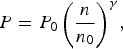 $$P = P_0 \mathop {\left({\displaystyle{n \over {n_0 }}} \right)}\nolimits^{\rm \gamma} \comma \;$$
where n, m, −e, v, γ, and P 0 = n 0T 0 are the electron density, mass, charge, velocity, adiabatic constant, and reference pressure, respectively, of the electron gas, and n 0 is the uniform immobile ion density. In the absence of a charged object, the Poisson's equation
 $$\partial _x^2 {\rm \phi} = - 4e{\rm \pi} \lpar n_0 - n\rpar \comma \;$$
relates the electrostatic potential ϕ to the electron density.
The charged pulse is assumed to have a fixed Gaussian profile. Accordingly, for the single-pulse case the Poisson's Eq. (4) before normalization can be written as (Liu, Reference Liu1967)
 $$\partial _x^2 {\rm \phi} = - 4{\rm \pi} e\left[{n_0 - n - cn_0 \exp\left({ - x^2 /{\rm \lambda} ^2 a^2 } \right)} \right]\comma \;$$
where c and a are the charge number and (normalized) width of the pulse. For the case of two charged pulses moving in tandem, the second pulse cn 0exp[−(x−b)2/λ 2a2] is added in the square brackets on the right-hand side of Eq. (5). Here b is the distance between the two pulses.
We are interested in exact quasistationary solutions corresponding to wave structures propagating at a constant speed V. The continuity and momentum equations can then be integrated to
 $$nv = -M\comma \;$$
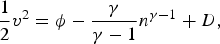 $$\displaystyle{1 \over 2}v^2 = {\rm \phi} - \displaystyle{{\rm \gamma} \over {{\rm \gamma} - 1}}n^{{\rm \gamma} - 1} + D\comma \;$$
where x, v, n e, and ϕ have been normalized by the Debye length λ = (T/4πn 0e2)1/2, thermal speed v T = (T/m)1/2, an arbitrary density n 0 and T/e, respectively, T is an arbitrary temperature, and M = V/v T. The isothermalcase is γ = 1 excluded, as it involves a different (logarithmic instead of power-law) nonlinearity (Wang et al., Reference Wang, Yu, Lu and Chen2010). Since Eqs. (1) to (4) are homogeneous, we have for definitiveness used the condition v = − V and ϕ = 0 at n = 1 to evaluate the integration constants. Note that it is not necessary to specify where in this occurs. Note that the actual value of the integration constant D = − M 2/2 + γ/(γ − 1) is actually unimportant here since the potential ϕ is to be substituted into the left-hand side of the Poisson's Eq. (4). Other initial boundary conditions of interest can also be used.
LARGE AMPLITUDE EPWS
In order to see the general behavior of e shall first consider the characteristics of intense EPWs in the absence of a charged object. Substituting Eqs. (6) and (7) into the Poisson's Eq. (4), after straightforward algebra one can integrate the latter to a quadrature
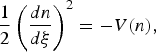 $$\displaystyle{1 \over 2}\mathop {\left({\displaystyle{{dn} \over {d{\rm \xi} }}} \right)}\nolimits^2 = - V\lpar n\rpar \comma \;$$
where ξ = x − Mt, and
 $$V\lpar n\rpar = \displaystyle{{n^4 \left({{\textstyle{1 \over 2}}M^2 - M^2 n - Cn^2 + {\textstyle{{\rm \gamma} \over {{\rm \gamma} - 1}}}n^{{\rm \gamma} + 1} - n^{{\rm \gamma} + 2} } \right)} \over {\mathop {\left({M^2 - {\rm \gamma} n^{{\rm \gamma} + 1} } \right)}\nolimits^2 }}\comma \;$$
where C is an integration constant that is determined by the value of dξn at a given n. Again, other conditions can also be applied in order to obtain different solutions. The quadrature Eq. (8) can be integrated directly to obtain solutionsof the form of ξ(n). However, inversion is usually difficult and it is often much simpler to numerically integrate the governing ordinary differential Eq. (4) together with the relations (6) and (7) directly, using the potential V(n) as a guide in determining the existence and type of the solution.
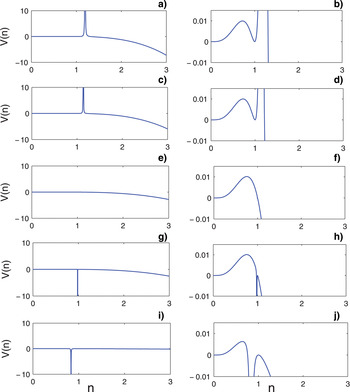
Figure 1 shows the pseudo potential V(n) for M = 1.2 and γ = (a) And (b) 1.01, (c) and (d) 1.1, (e) and (f) 1.45, (g) and (h) 1.5, (i) and (j) 3.0. For definitiveness, dξn = 0 at n = 1 is assumed. One can see that for smaller values of γ, such as that in 1(a), the pseudo potential contains only a smooth well or valley, so that there exist well-behaved nonlinear plasma waves, as well as plasma wave solitons (Chen, Reference Chen1974). As γ increases, the pseudo potential remain similar until the critical value γ = 1.45 is reached, above which a quadratic zero in its denominator can appear. Figures 1(g) and 1(i) show that the pseudo potential also contains narrow wells that are infinitely deep, or singular, at a certain density n = n cr. From Eq. (9) we can see that the latter is given by n cr = (M 2/γ)1/γ−1 (corresponding to a quadratic zero in its denominator), which also shows why (since n cr is infinite) the singularity does not exit if γ = 1, which as mentioned is however precluded here. Corresponding to the singular wells are sharply peaked waves. In terms of the particle-in-well analogy (Chen, Reference Chen1974), a trapped pseudo particle with suitable energy (determined by the integration constants) trapped in this region of the potential well will pass through the singularity at infinite speed and be reflected by the finite but steep potential wall on the other side, leading to the apparently peaked waves or solitons (Yu, Reference Yu1976; Mirza et al., Reference Mirza, Mahmood and Murtaza2003). For γ < 1.45 only smooth waves exist. As example, Figure 1 for M = 1.2 and γ = 1.1 shows a peaked EPWs. The peaks and valleys of the waves are of different profiles because the right and left walls of the pseudo potential V have different (but both steep) gradients.
The pseudo potential V(n) for M = 1.2 and γ = (a) and (b) 1.01, (c) and (d) 1.1, (e) and (f) 1.45, (g) and (h) 1.5, (i) and (j) 3.0. EPW can exist only if a potential well exists. The singular regions in the potentials are magnified in (b), (d), (f), (h), and (j). Note that the potential in (e) for γ = 1.45 has neither valley nor peak. (g) and (i) indicate existence of peaked localized solutions.

Depending on the parameter values and the initial conditions, the pseudo potential V(n) that determine the solutions can have very different forms. For example, for M = 2.0, 1 < γ ≤ 3, and the same initial conditions, one can show that only smooth wave and soliton solutions exist. For completeness, and to see the effect of other values of the adiabatic coefficient, such as that for some complex degenerate, and high energy density systems, we have also considered cases with. It is found that when γ is small (γ < 1), only smooth nonlinear plasma waves are excited. With increasing γ, both smooth and peaked waves can appear. When γ is too large (γ ≫ 3), no EPW or soliton can exist. This can be expected since the thermal pressure becomes too large for dynamic force balance to occur.
EPWS DRIVEN BY A CHARGED PULSE
We now consider EPWs excitation by one or more charged objects by including in the Poisson equation a source term. As mentioned, the latter can model intense laser pulses (Tajima & Dawson, Reference Tajima and Dawson1979; Yu et al., Reference Yu, Cao, Yu, Cai, Xu, Yang, Lei, Tanaka and Kodama2009) and highly charged particle beams (Zhou, Reference Zhou, Yu and He2007), as well as test charges (Montgomery et al., Reference Montgomery, Joyce and Sugihara1968, Stenflo & Yu, Reference Stenflo and Yu1973), charged probes (Chen, Reference Chen1974), artificial satellites in the ionosphere (Liu, Reference Liu1967; Gurevich et al., Reference Gurevich, Pitaevsky and Smirnova1969, Garrett, Reference Garrett1981), highly charged dust grains (Goertz, Reference Goertz1989), etc. Large amplitude laser or beam driven EPWs propagation high speeds can accelerate electrons trapped in the wakefield to very higher energies that are suitable for electron radiography (Mangels et al., Reference Mangles, Wlaton, Najmudim, Dangor, Kruschelnik, Malka, Mangloskki, Lopes, Caras, Mendes and Dorchies2006), etc.
We are interested in wake EPWs that copropagate with the driving pulse, so that a quasistationary moving frame can again be used. However, the governing equations are now inhomogeneous and no longer integrable even in the quasistationary frame. One can however still readily solve the ordinary differential equations numerically, searching for solutions by trial and error. It should be emphasized that since our formulation considers only comoving pulse and wake wave systems, solutions corresponding to noncomoving or detached pulses and wake waves, which can certainly also exist, are precluded.
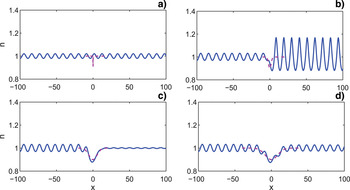
Figure 2 shows modification of EPWs by a Gaussian pulse of amplitude c = 0.1 moving at M = 2, for γ = 1.1 and different values of the pulse width a. One can see that the amplitude of the waves varies with the pulse width. When the width is sufficiently small, the pulse has no effect on the plasma. Wake waves of increasing amplitude are excited when the width increases until a critical value, for which the wake wave becomes very weak. Figure 2(d) shows that when the pulse width is increased further, the wake plasma wave becomes the same as that before the pulse. This wake excitation behavior can be attributed to a nonlinear resonant coupling of the pulse and the EPW to excite a wake wave when there is appropriate matching of the pulse width and the EPW wavelength, although not in sense of the familiar linear resonant coupling. When strong coupling takes place, the field of the modulated EPW can even dominate over that of the driving pulse (Wang & Yu, Reference Wang and Yu2010; Galyamin & Tyukhtin, Reference Galyamin and Tyukhtin2011). However, no unusually large-amplitude EPWs as predicted by the linear resonance theory are found, which can be attributed to the strong nonlinear plasma response to the resonant growth. We should also mention that as the pulse parameters or initial conditions are varied, the solution space is discontinuous. That may be due to the fact that only comoving pulses and waves are included in our formulation. In reality, the driver pulse and the excited wave need not propagate at the same speed.
EPWs modified by a comoving Gaussian pulse of c = 0.1 and a = (a) 0.1, (b) 2.5, (c) 7.88, and (d) 12, for M = 2 and γ = 1.1. The red dashed curves mark the profile of the driver pulses. Note that the amplitudes of the front and wake EPWs are determined by the initial conditions as well as the driver pulse amplitude and width.

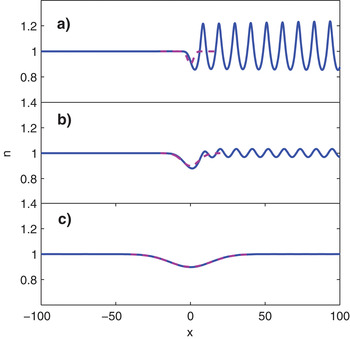
Figure 3 shows the excitation of EPWs in a quiescent plasma by a charged pulse. The parameter values are M = 2, γ = 1.1, c = 0.1, and a = (a) 2.8, (b) 7.88, and (c) 20. We see that the amplitude of the wake wave can dominate over that of the driver, but it decreases with the width of pulse. This behavior can be expected since EPW excitation should be strongest when the pulse width (nonlinearly) matches the EPW wave length, which is determined (or limited) by the initial field amplitude used inthe numerical integration. In fact, Figure 3(c) shows that for a = 20 no wake wave can be observed, indicating that the driver pulse has created a self-consistent electric field that traps itself. That is, the driver and the excited electrostatic field together form a self-consistent soliton.
EPWs excited by a comoving Gaussian pulse with c = 0.1 and a = (a) 2.8, (b) 7.88, and (c) 20, for M = 2 and γ = 1.1. Note that the the excited wave density can completely dominate over that of the drivers (the red dashed curves), and it is also possible that no wave is excited by the charged pulse, as in the case (c). In this case the driver and the excited electrostatic field together form a self-consistent soliton.

EPWS DRIVEN BY A PAIR OF CHARGED PULSES
We now consider EPW modulation or excitation by two Gaussian charged pulses comoving in tandem. Using two laser pulses has been proposed for producing otherwise unattainable frequency or interaction regimes (Rosenbluth & Liu, Reference Rosenbluth and Liu1972; Joshi et al., Reference Joshi, Mori, Katsouleas, Dawson, Kindel and Forslund1984, Hora, Reference Hora1988; Joshi, Reference Joshi2007; Gupta & Suk, Reference Gupta and Suk2007; Gupta et al., Reference Gupta, Nam and Suk2011; Yu et al., Reference Yu, Cao, Yu, Cai, Xu, Yang, Lei, Tanaka and Kodama2009), as well as for increasing the charge of the electron bunch produced in laser wakefield acceleration (Shvets & Fisch, Reference Shvets and Fisch2001), etc.
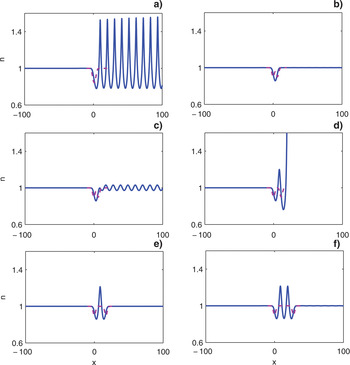
For simplicity, we assume that the second pulse is of the same form as the first pulse, but is at a distance b apart. Figure 4 for γ = 1.1, M = 2, c = 0.1, and a = 2.5 shows the effect of two charged pulses at different distances apart. As expected, we see that the separation distance also affects the resonant excitation of large amplitude EPWs and solitons. For completeness, we show in Figure 4(d) a solution that blows up at a finite x. In fact, most initial conditions for which no wave or soliton solution exist exhibit such behavior.
EPWs exited by two comoving tandem Gaussian pulses for M = 2, γ = 1.1, c = 0.1, a = 2.5, and (a) b = 2.5, (b) b = 6.195, (c) b = 6.5, (d) b = 11, (e) b = 16.835, (f) 27.475. The red dashed curves show the profiles of the driving pulses.

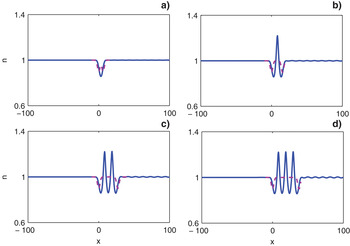
Highly localized EPWs can also be excited by the tandem pulses. Figure 5 shows solitary EPWs excited by two comoving Gaussian pulses. The parameter values are γ = 1.2, M = 2, c = 0.1, a = 2.5, and b = (a) 6.12, (b) 15.553, (c) 26.96, and (d) 37.43. We see that single and multi peaked solitary EPWs with almost no wakefield can exist. However, no clear relation between the number of peaks and the distance b between the two driving pulses is found. This indicates that the nonlinearity of the pressure force plays a subtle role in determining the peak number.
EPWs excited by two comoving Gaussian pulses with M = 2, c = 0.1, a = 2.5, for M = 2 and γ = 1.2, and (a) b = 6.12, (b) b = 15.553, (c) b = 26.96, and (d) b = 37.43. The red dashed curves show the profiles of the driving pulses.

DISCUSSION
In this paper, we have considered fully nonlinear quasistationary EPW propagation in an adiabatic electron plasma. The solutions are exact in that no perturbation of the fluid and Poisson's equations is involved. As a result, the wave itself represents the entire plasma system and can thus be useful for qualitatively modeling intense laser interaction with rarefied plasmas. Smooth as well as peaked EPW trains and solitons are found. Such structures appear to be common to highly nonlinear states described by the fluid equations, and can be relevant to many waves in plasmas. In the presence of a driver pulse system, the amplitudes of the EPWs on its front and back sides are determined by the driver's amplitude and width, as well as the initial plasma conditions. The density variation of the excited wave can completely dominate over that of the driver. It can also occur that, if the amplitude, speed, and width of the driver pulse are appropriate, no EPW or soliton is excited by a single pulse, or a finite number of solitons are excited by a pair of pulses.
In wakefield excitation by USUI laser or electron beam pulses in rarefied plasmas (Tajima & Dawson, Reference Tajima and Dawson1979; Zhou et al., Reference Zhou, Yu and He2007), the excited wake wave closely follows, i.e., comoves with, the driver pulse. Thus, the problem of EPW excitation by a moving charged pulse considered here provides a simple model appropriate for analyzing and interpreting the wakefield excitation by laser and charged beam pulses obtained from elaborate but not quite transparent numerical simulations and experiments. The solitary EPWs excited by two charged pulses found here should be of particular interest to efficient trapping and acceleration of electrons by USUI laser and charged beam pulses, since no energy is wasted in creating the long wake wave. One can also expect that suchlarge amplitude electron pulses propagating at high (relativistic) speeds can excite few and sub cycle electromagnetic pulses (Wu & Meyer-ter-Vehn, Reference Wu2012).
It should be pointed out that since one-dimensional warm fluid theory is used in the present model, higher dimensional as well as kinetic effects such as transverse instabilities, viscous and Landau damping, particle trapping, etc., are precluded. Extension of the present model to include some of these effects is therefore warranted. The results here also differ from the Bernstein-Greene-Kruskal (Bernstein et al., Reference Bernstein, Greene and Kruskal1957; Schamel, Reference Schamel2012) and other (Liu, Reference Liu1967; Stenflo & Gradov, Reference Stenflo and Gradov1998; Yu et al., Reference Yu, Chen and Stenflo2001) fully nonlinear EPW solutions of the Vlasov-Poisson equations. The peaked nonlinear waves considered here also differ from that of the cusped upper hybrid solitary waves investigated by Porkolab and Goldman (Porkalab & Goldman, Reference Porkalab and Goldman1976) and later found to exist also for many other wave systems, or that associated with the giant waves on fluid surfaces (Karpman Reference Karpman1975). Instead of an infinitely deep pseudo potential well with steep walls considered here, the potential well associated with the latter waves has a vertical wall with infinite gradient (Karpman Reference Karpman1975; Porkalab & Goldman, Reference Porkalab and Goldman1976). The latter originates from an odd (instead of even, like here) powered denominator in V(n) that can vanish. In fact, the upper hybrid wave cusps are mathematically true cusps (discontinuous gradients at the peak). The peaked waves discussed here remain analytic at the peak but have infinite gradients in its immediate (left and right) neighborhood.
ACKNOWLEDGMENTS
This work was supported by the Ministry of Science and Technology (2011GB105000), the National Nature Science Foundation of China (10835003 and 11247007), and the National Basic Research Program of China (2008CB717806).