At the stroke of a pen on the evening of December 25, 1991, the Union of Soviet Socialist Republics was officially and irrevocably dissolved. For many observers of and participants in the ensuing experiment in post-Soviet state building, the demise of the USSR symbolized a clean slate, a long-awaited chance at responsive government and economic freedom that people living in “normal” countries took for granted.Footnote 1 Heady with optimism about the future, Western and Russian economists from Anders Aslund, Jeffrey Sachs, and Andrei Shleifer to Yegor Gaidar and Anatoly Chubais promoted economic liberalization and privatization as a way to build new societies out of the discredited Soviet rubble.Footnote 2 A turn to the market, they argued, would not only create efficiencies and opportunities for growth, in contrast to the notoriously inefficient and stagnant command economy, but would also set the stage for pluralist politics, and eventually democracy, to emerge. While it is not clear that the recipients of this advice (and the foreign assistance, loans, and investment that accompanied it) were themselves true believers in economic and political competition, it is clear that many saw Western know-how as critical to reversing the economic collapse that threatened both their legitimacy as heads of state and their countries' fragile independence.Footnote 3 Thus, with international recognition arrived a plethora of foreign advisors and business interests who, armed with an updated version of 1960s-era modernization theory, framed economic liberalization as integral to the broader struggle for democratization. As Nicolas Guilhot documents in The Democracy Makers, with the end of the Cold War “the fight for democratic political systems [became] tightly connected to the imposition of neoliberal orthodoxy”Footnote 4 and the expansion of capitalism into new markets.
In hindsight, the assumed ease with which democratic, capitalist societies could be established glossed over complex and persistent obstacles to genuine reform. Only three outliers, the Baltic states of Estonia, Latvia, and Lithuania, embraced markets and democracy, and they did so out of a deep anti-Soviet and pro-European impetus.Footnote 5 The more common response among leaders has been either to forge ahead with economic reforms, if only in certain sectors, while continuing to manipulate politics so as to maintain their hold on power, or to reject liberalization in any guise. As M. Steven Fish, Michael McFaul, and Joel Hellman argued early on in the reform process, most post-Soviet states—with Russia a case in point—failed to democratize precisely because privatization was not extensive enough to undermine state control over the economy, dislodge entrenched “social forces from the ancién regime,” and create sustained societal pressures for democracy to take root.Footnote 6
In all fairness, authoritarian resilience is certainly not unique to the region. A burgeoning literature on authoritarian and semi-authoritarian rule, pioneered by Jason Brownlee, Thomas Carothers, Steven Levitsky and Lucan Way, Marina Ottoway, Andreas Schedler, and others, points to the durability of these regimes.Footnote 7 Most agree with Carothers that “[o]f the nearly 100 countries [once] considered [to be transitioning to democracy], only a relatively small number—probably fewer than 20—are clearly en route to becoming successful, well-functioning democracies or at least have made some democratic progress.”Footnote 8 In the vast majority, variously called “mixed,” “hybrid,” or “competitive authoritarian” regimes,Footnote 9 nominally democratic institutions exist alongside enduring nondemocratic practices—whether the result of clever autocratic manipulation or of fundamental autocratic weakness.Footnote 10
While the initial post-Soviet optimism has been tempered by unfolding events in the region and beyond, a number of important scholars—most notably Aslund, Timothy Frye, Kelly McMann, Scott Radnitz, and Lucan Way—continue to argue that economic liberalization has, in fact, led to greater political participation and contestation in Moldova, Russia, Georgia, Kyrgyzstan, and Ukraine and that recently-liberated capitalists play an important role in these processes.Footnote 11 In the latter three countries, empowered civil society activists and private business owners successfully joined forces during the “color revolutions” to topple autocrats enfeebled by their own pro-market policies. Moreover, according to Aslund and Radnitz, similar processes unleashed by capitalism in Russia will eventually destabilize authoritarian rulers there—if not Vladimir Putin, then certainly his successors.Footnote 12 Thus, despite very different views regarding the success and extent of economic reform, there appears to be widespread agreement among scholars of post-Soviet political economy that economic competition engenders political competition. This consensus is somewhat surprising, given that the link between the market and democracy has been challenged on numerous fronts at least since Dankwart Rustow leveled his critique of modernization theory in 1970.Footnote 13 The resuscitation of modernization theory as an explanation of post-Soviet politics is particularly noteworthy if one recalls that “[b]y the 1970s, modernization theory could be considered a defunct research program,” “the [target] for a generation of scholars and students who rejected [its] political implications.”Footnote 14
With two decades of experimentation with political and economic reform under their collective belt, the post-Soviet autocracies—Armenia, Azerbaijan, Georgia, Kazakhstan, Kyrgyzstan, Moldova, Russia, Tajikistan, Turkmenistan, Ukraine, and Uzbekistan—provide fertile grounds for examining whether the political promise of economic liberalization and the logic of modernization that underlies it hold true.Footnote 15 Spanning nine time zones, the region stretches from Eastern Europe to Northeast Asia, from the Arctic Circle to the deserts where the Central Asian republics merge into Iran and Afghanistan, and from the southern Caucasus to the Tian Shan Mountains that mark China's western frontier. Despite commonalities inherited from the Soviet past, the countries range from “neo-Soviet”Footnote 16 Turkmenistan, where the command economy remains largely intact, to capitalist Georgia, where private enterprise and markets are the norm. Politically, they include parliamentary rule in Moldova, presidential-parliamentary rule in Ukraine and Kyrgyzstan, a populist strongman in Belarus, and various autocratic and semi-autocratic permutations in between. The post-Soviet region, then, is a useful “laboratory” for testing broader theories of post-communist transition and authoritarian resilience. But it is much more than this. Given its significant reserves of oil, gas, and other natural resources; potential for instability and upheaval; and proximity to Western Europe, the region is of crucial economic and geopolitical importance. Further, processes underway here echo some of the political dynamics present in other authoritarian regimes, notably in China, where globalization and the spread of market capitalism have not been accompanied by related transformations in the political realm.
Using the experience of the post-Soviet autocracies, in this article I first review the standard causal account of political transformation,Footnote 17 which is in many ways a repackaging of modernization theory as applied to the post-Soviet context. I then provide an empirical critique that combines existing quantitative data on privatization and political pluralism in all 12 countries, with original qualitative data on opposition movements in Belarus, Kazakhstan, Kyrgyzstan, and Uzbekistan from the early 1990s to the present. While modernization theory characterizes capitalists as likely proponents of democracy, these data demonstrate that post-Soviet capitalists are, in fact, rarely willing to publicly oppose autocrats or to support pro-democracy causes. To uncover the processes and mechanisms at play on the ground that explain this discrepancy, I draw heavily on the experiences and narratives of opposition activists, regime supporters, business owners, and experts.Footnote 18 These voices reveal a fundamentally different formulation of the relationship between economics and politics than that found in the standard causal account, one that is less mechanistic and that underscores the contingencies of political choice. Instead of confirming a pattern in which political outcomes are driven by overarching economic conditions, multiple cases of post-Soviet capitalist defection to the opposition suggest the opposite—the very tangible ways in which politics encroaches upon and shapes economic outcomes.
Having demonstrated the serious limits of the conventional account, I then turn to an analysis of the complex entwinement of politics and economics known throughout the region as reiderstvo, from the English “to raid,” which involves the hostile takeover or “raiding” of private property.Footnote 19 An understanding of reiderstvo helps elucidate the reasons why business actors across the region should be conceived of as improbable opponents of authoritarian rule at best, as well as the rare occasions when they have transformed from unlikely champions of democracy to vocal opposition figures. In one version of reiderstvo, government officials and other agents close to autocrats have abused their positions of formal and informal power to expropriate profit-generating businesses in the private sector. Under conditions in which political connections are crucial to economic success, property rights are inherently insecure,Footnote 20 and formal channels of redress are severely compromised or nonexistent, a number of otherwise acquiescent capitalists have been pushed, not lured, into the political opposition in a last-ditch effort to defend themselves and their property against attack.Footnote 21 Far from unique to this particular region, regime-opposition dynamics set into motion by reiderstvo may be present elsewhere, especially in regions that are characterized by a similar constellation of personalism, corruption, and weak property rights.
Post-Soviet Modernization Theory and Its Limits
More so than other long-standing debates, modernization theory has featured prominently in the study of politics over the last half century.Footnote 22 For some, the causal link between economic conditions and regime type is indisputable, one of the very few “iron laws” of political life.Footnote 23 For others, the relationship is spurious, inverse, inconsistent, curvilinear, historically situated, and/or contingent on the convergence of other factors.Footnote 24 At times, modernization theory appears roundly discredited, an abstraction lacking in agency or an artifact of an earlier, ethnocentric way of thinking about the world. Then follows a new study or approach, which resuscitates it and inspires another round of works for and against.Footnote 25
Currently, a growing body of research on the Soviet successor states has revived a chiefly economic approach to understanding political outcomes.Footnote 26 Taking as a starting point a modernization-esque logic, many of these works echo ideological arguments made in the early 1990s by economists working to dismantle the Soviet command economy.Footnote 27 The words of Maxim Boycko, Andrei Schleifer, and Robert Vishny, published in 1995, articulate the deeply political aims of the post-Soviet privatization project:
The principal accomplishment of privatization has been the massive retreat of the government from economic activity, and the transfer of control rights from politicians to managers and investors … But perhaps the most significant consequences of privatization are political. Privatization has created a class of property owners who have become the clear economic beneficiaries, and political supporters, of further liberalization of the Russian economy and society. This class is not limited to a few brokers and traders driving BMWs around Moscow, as some Western observers would like to believe. These property owners include the 40 million Russians holding shares in privatized firms and in mutual funds who want their investments protected. They also include millions of people working for the growing service sector. In a country of 100 million voters, these are significant constituencies … Privatization and reform have created powerful political interests that are injecting some liberalism into Russian politics. Footnote 28
According to the standard causal account—as formulated in early versions of modernization theory during the 1960s, again in the push for post-Soviet privatization in the 1990s, and today, more than 20 years after the breakup of the USSR—private ownership under capitalism fosters political pluralism in ways that fundamentally undermine authoritarian rule. The scenario unfolds as follows: Privatization disperses economic resources and gives rise to a broad array of actors outside the control of the state, “… creat[ing] alternatives and counters to state power.”Footnote 29 Financial autonomy raises the likelihood that private and state interests will diverge and eventually clash over contentious issues such as economic regulation and the power of the state.Footnote 30 With privatization, the newly wealthy develop an appetite for political power that is commensurate with their economic status and enter the political fray, directly by competing with authoritarian leaders in elections and/or indirectly by supporting opposition-minded civil society organizations and political movements. “Economic dispersion,” as Radnitz explains, “creates elites who are not dependent on the regime's patronage and endows this cohort with the resources to oppose the incumbent, thus encouraging members of the ruling clique to defect.”Footnote 31 Meanwhile, the middle classes and business owners who no longer depend on the state for their wellbeing coalesce to form natural constituencies in favor of limited government, the rule of law, political protections, and free and fair elections.Footnote 32 In short, the “beneficiaries of privatization”Footnote 33 become the backbone of and form the economic basis for competitive politics, which is inherently difficult for any one figure or clique to control.
To its architects, the twin goals of post-Soviet privatization were to “depoliticize” economic decision-making by “sever[ing] the links between enterprise managers and politicians,” and, in the process, to liberalize and pluralize political life.Footnote 34 Yet, instead of championing structural reforms that would fundamentally alter how business and politics are conducted, powerful constituencies who became fabulously rich during the early stages of reform have done everything to defend the status quo, protect their access to rents, and prevent able competitors from emerging.Footnote 35 Instead of creating a broad-based middle class in most, if not all, of the post-Soviet autocracies, a thin stratum has thrived while society as a whole bears the costs of what has been called a “capture economy,” “economy of favors,” or simply “crony capitalism.”Footnote 36
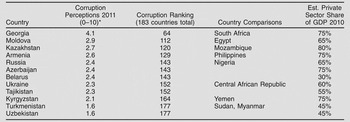
Corruption, a key feature of crony capitalism, is a good indicator of how closely intertwined political and economic power remain across the region. According to European Bank for Reconstruction and Development (EBRD) data presented in Table 1, the private sector in Kazakhstan, Georgia, Armenia, Kyrgyzstan, and Azerbaijan accounts for 75% or more of domestic economic output, making these countries chief privatizers among their peers. Yet, citizens of these very countries, with the partial exception of Georgia, experience corruption as a major problem that negatively affects their day-to-day lives. Most of the post-Soviet autocracies, irrespective of the relative size of the private sector, fall within the “2” range on a scale of 1 (highly corrupt) to 10 (clean). Thus, in Armenia, where 75% of economic activity is generated by the private sector, citizens perceive society to be about as corrupt as in Belarus, where the private sector accounts for only 30% of GDP.

Rather than de-coupling economic power from political power, privatization has generated ample opportunities for politicians to control productive economic assets, formally and informally, as well as for the wealthy to buy their way into local and national politics.Footnote 37 This fact of life has not gone unnoticed by the average person, for whom privatization is often seen as a cause of, rather than a remedy for, ailments endemic to post-Soviet society.Footnote 38 As we will see, this has serious consequences for independent-minded elites seeking to mobilize public opinion in their favor and build up a political base of their own. How can those who took advantage of privatization to the detriment of the public good be trusted to represent the interests of the people? The answer, for many, is that they cannot.Footnote 39
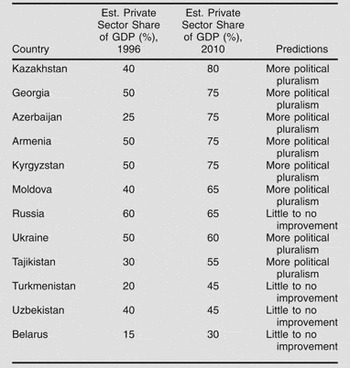
The second goal of privatization, the liberalization of political life, has proven similarly elusive. All else being equal, the expansion of private ownership should foster greater political pluralism. That is, countries in which the private sector predominates or has grown over time should be more politically open and more politically competitive than those in which the private sector has been stifled. Diachronically, countries displaying a strong private sector today should be more pluralist than they were prior to the adoption of reforms. Table 2 summarizes the predicted direction of change for each country, given the extent to which the private sector contributes to economic output in 2010 as compared to 1996. Within the region as a whole, greater pluralism appears most likely in Kazakhstan, Georgia, Azerbaijan, Kyrgyzstan, and Armenia. Moldova, Ukraine, and Tajikistan should also experience an increase in pluralism over time, given that private economic activity has grown to around two-thirds of total domestic output. In Uzbekistan, Turkmenistan, Belarus, and Russia, however, continued dominance of the state in the economy or few overall changes in the level of private economic activity suggests little to no change in the political climate over time.Footnote 40
Predicted Direction of Political Change

Sources: EBRD, Structural and Institutional Change Indicators 1991–2010; Myant and Drahokoupil Reference Myant and Drahokoupil2011.
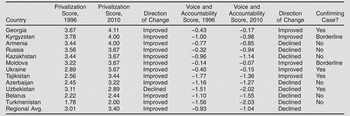
To assess how well these expectations have been met, Table 3 compares EBRD privatization scores per country in 1996 versus 2010 with World Bank Voice and Accountability scores for the same years.Footnote 41 The privatization score is a composite index of each country's averaged scores on three combined EBRD transition indicators: large- and small-scale privatization and price liberalization.Footnote 42 Scores near 1 indicate very little liberalization of the inherited Soviet economy, while scores over 4 signify alignment with “the standards and performance typical of advanced industrial economies.”Footnote 43 The Voice and Accountability Index, a subset of the World Bank's World Governance Indicators, serves as a proxy for the degree of political pluralism in a given country. The index “captures perceptions of the extent to which a country's citizens are able to participate in selecting their government, as well as freedom of expression, freedom of association, and a free media.”Footnote 44 Together, these elements are associated with participation and contestation, hallmarks of political pluralism. The index ranges from −2.5 to +2.5, with negative scores associated with serious impediments to political participation and the exercise of basic civil liberties.

It is certainly the case that countries with extensive privatization tend to be more politically open than those where few reforms have been implemented. Thus, governments in Uzbekistan, Turkmenistan, and Belarus, where resistance to privatization is strong, are perceived as less pluralistic than in Georgia, Kyrgyzstan, and Armenia, all pro-market pioneers. The correlation between privatization and political openness, however, becomes less clear-cut if we look within individual countries over time. Six countries have defied predictions, at least thus far (Armenia, Russia, Kazakhstan, Azerbaijan, Belarus and Turkmenistan), four find support (Georgia, Ukraine, Tajikistan, and Uzbekistan), and two are borderline cases (Kyrgyzstan and Moldova). With the exception of Uzbekistan, all 12 countries made at least some overall progress in privatization between 1996 and 2010. Yet, only in three (Georgia, Ukraine, and Tajikistan) was there greater political openness in 2010 as compared to 1996. In fact, over half of the post-Soviet privatizers were actually more repressive in 2010 than in 1996.
Examining more closely the experience of the three top privatizers underscores the inconsistent relationship between privatization and political change. Unlike Georgia, Armenia has made significant strides in privatization without exhibiting similar improvements in political pluralism. In the face of a very high privatization score, Armenia's Voice and Accountability score declined slightly. While Kyrgyzstan's Voice and Accountability score improved, the change may not be substantively meaningful as the difference between the 1996 and 2010 scores is quite small. Of the four countries with moderately high privatization scores (Russia, Kazakhstan, Moldova, and Ukraine), only Ukraine clearly made strides toward greater political openness over time. Moldova, like Kyrgyzstan, became only somewhat less repressive. In sharp contrast, any gains previously achieved in energy giants Russia and Kazakhstan were erased by 2010. Given that Kazakhstan's 80% private sector share of GDP surpasses all of its peers, the decline in political openness over time is particularly striking.
The political climate also worsened across the board in Uzbekistan, Belarus, and Turkmenistan, the most reluctant of the post-Soviet privatizers. Uzbekistan's scores declined on both counts, which seems to follow the pattern painted by the standard causal account. That is, if less state control over the economy leads to greater political pluralism, presumably more state involvement will have the reverse effect. In Belarus and Turkmenistan, on the other hand, Voice and Accountability scores declined during the very period that privatization scores improved. Although one might argue that this is because economic reforms did not go far enough to reduce the dominant role of the public sector, it is nonetheless curious that in both countries the adoption of some market reforms and some growth in private economic activity went hand in hand with more rather than constant levels of repression.
Post-Soviet Capitalists as Improbable Opponents: The Limits of Privatization as Causality
Where privatization has been comprehensive, the standard account predicts that a new class of independently wealthy and politically ambitious individuals outside of the regime's control will emerge as agents of democracy. Conversely, where “all economic life is absorbed into government”Footnote 45 and the state has jealously prevented economic assets from falling into private hands, an autonomous capitalist class cannot emerge. And without capitalists, there can be “no conceivable financial base for opposition.”Footnote 46 Cognizant of their extreme dependence on the caprices of those at the top, elites remain loyal out of fear and self-interest.Footnote 47
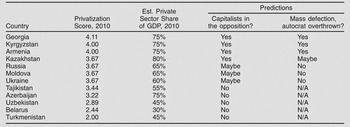
If this narrative is correct, capitalists are most likely to oppose autocrats in Georgia, Kyrgyzstan, and Armenia, where economic resources have been “irretrievably dispersed”Footnote 48 and where the probability of capitalist defection and autocratic defeat is high. Capitalist defection should also be evident in Russia, Kazakhstan, Moldova, and Ukraine, where privatization has been less thorough but nonetheless impressive. In these countries, however, the state may still control critical productive assets, which can be drawn upon to co-opt and coerce key segments of society, thereby shoring up support and preventing mass defection. Based on Kazakhstan's substantial private sector, a shift in the balance of power away from the state and toward the beneficiaries of market reform appears more likely there than in Russia, Moldova, or Ukraine. While all four have the same privatization score, the public sector contributes 35–40% of GDP in the latter three, implying a greater economic role for the state and thus greater leverage over society. The least likely settings for capitalist ventures into opposition politics are, unsurprisingly, Uzbekistan, Belarus, and Turkmenistan, where the public sector accounts for more than half (indeed, 70% in Belarus) of all economic activity and capitalists are part and parcel of the ruling elite, rather than independent actors. Predictions for Tajikistan and Azerbaijan are less straightforward, although one might reasonably expect a pattern similar to that of the least enthusiastic reformers. Table 4 summarizes the predicted outcomes for all 12 countries.
Predicted Outcomes: Extent of Privatization and Capitalist-Led Opposition

How have these expectations borne out? To answer this question, I investigate cases of capitalist defection to the political opposition in all of the post-Soviet autocracies since 1991. My broad definition of capitalists includes all forms of private ownership of productive resources, from small and medium sized businesses and traders to large holding companies and corporations. Also included are “oligarchs,” businessmen who have furthered their economic interests by holding formal political office or by virtue of their political connections.Footnote 49 Although these groups differ considerably from one another and typically share little political affinity or class consciousness within or across categories,Footnote 50 casting a wide conceptual net is critical to gauging whether (and what kinds of) owners of private capital have opposed autocrats and attempted to act as agents of democratization. As with conceptual breadth, examining trends over a broader span of time can reveal variation within individual countries that might otherwise remain hidden. A longer-term perspective, moreover, helps us tease out patterns and relationships in a way that studies that are event- or time-specific cannot. As Paul Pierson argues, “much that is important about the social world is likely to remain concealed if our inquiries are grounded, as they too often are, in efforts to examine only a moment in time.”Footnote 51 Finally, looking at the region in its entirety gives us a better sense of the palpable but sometimes underappreciated ways in which these countries differ from one another.
Defection to the opposition occurs when individuals who were either previously apolitical (i.e, not associated with the regime or the opposition) or formerly connected to the regime publicly challenge the authoritarian leader and the system of rule associated with him. Public challenges include but are not limited to calling for the ruler's ouster; establishing or joining opposition political parties, movements, or civic organizations whose stated mandate is to oppose the ruler (and pursue democratic reforms writ large); or announcing the intention to run for office as an opposition candidate. I restrict defections to observable cases that have been documented in the local or international media and are widely accepted by local political observers and actors as defectors to the opposition. While there may be numerous private acts of opposition and hedge betting (i.e., secretly providing funds and other resources to both the president and the opposition), such cases are beyond the scope of this article precisely because they are difficult, if not impossible, to document.
Departing from classic works by Guillermo O'Donnell and Phillipe Schmitter and Barbara Geddes, I include individual defections and other unsuccessful cases of anti-regime behavior that have failed to split the regime at its core or usher in a period of political liberalization.Footnote 52 I do so for empirical and theoretical reasons. The vast majority of post-Soviet defections to date have been crushed or otherwise neutralized, in contrast to the three instances of elite realignment that led to the “color revolutions.” To ignore failed defections is to ignore a broad set of cases that shed light on both the practices that undergird autocratic rule and the processes by which entrenched autocrats might be suddenly and unexpectedly toppled. Focusing on successful defections not only artificially truncates the range of possible outcomes, it also downplays both the dangers inherent in defection and the conditions that have proven unfavorable to defectors' chances of success.
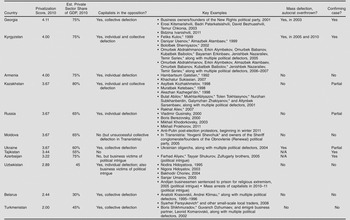
An overview of the history of post-Soviet capitalist defection to the opposition, presented in Table 5, provides some support for the standard account of privatization as a force leading to capitalist opposition. But it also reveals noteworthy discrepancies. By far, the strongest evidence in favor of the standard account lies in the timing of defection to the opposition. Most cases of capitalist defection occurred in the 2000s, after market reforms had time to create opportunities for the accumulation of wealth and the expansion of private ownership. In addition, collective defections involving capitalists and political figures, either spontaneous or organized, are most common in countries that have gone farthest in privatization (i.e., those with a score of 3.67 or higher). In the middling reformers, Tajikistan and Azerbaijan, business has been notably absent from the opposition, just as their relatively low 2010 privatization scores suggested would be the case. In Uzbekistan, capitalist defections have been restricted to individual instances, signifying serious obstacles to collective action there. These are likely rooted in the continued dominance of the state, which both continues to exercise extensive coercive powers and also retains a substantial economic presence, thus severely limiting the lucrative opportunities available in the private sector.
Extent of Privatization in 2010 and Capitalist-Led Opposition since Perestroika

Sources: EBRD, Transition Indicators 1991–2010; Bremmer and Welt Reference Bremmer and Welt1996; Buyanova Reference Buyanova2003; Dubnov Reference Dubnov2002; Grigoryan Reference Grigoryan2008; Korbov and Byanov Reference Korbov and Byanov2006; Radnitz Reference Radnitz2010; informants in/from Kyrgyzstan, Kazakhstan, Turkmenistan, Uzbekistan, Armenia, Azerbaijan, and Belarus.
* Denotes individuals who, in addition to their business endeavors, also held formal political office or who were otherwise employed by the state at some point in time prior to defection.
Yet despite these affirmations of the standard account, there are a number of empirical twists that the conventional narrative cannot explain. What is perhaps most surprising is that business actors' involvement in the opposition is more common across the region than expected. In the highly unlikely settings of Belarus, Turkmenistan, and Uzbekistan, businessmen (and women in the latter) have risked and in some cases lost their lives by openly challenging autocrats. Furthermore, unlike in Uzbekistan, in both Belarus and Turkmenistan capitalists actively coordinated their efforts with other disaffected groups, including political elites who were being pushed out of power. That capitalists have taken up opposition politics in the least conducive of environments—and, curiously, more often than they have in one of the most conducive (i.e., in Armenia)—urges us to look beyond privatization in order to understand the underlying processes at play.
Second, despite their presence throughout post-Soviet space, capitalist defectors have had a very limited impact on political outcomes overall. Even when multiple business elites—including those with political connections at the very top, owners of mass media outlets, millionaires, and in some cases billionaires—combine their efforts and resources to challenge autocrats, success is far from guaranteed. In fact, of the eight instances of collective defection,Footnote 53 half failed to unseat autocratic presidents, and in those where autocrats (or their successors) were deposed, prospects for longer-term democratic outcomes remain uncertain. As Table 5 illustrates, instructive cases of failed defections of powerful movers and shakers can be found in Armenia, Kazakhstan, Kyrgyzstan, Russia, and Transnistria (in Moldova), not to mention in Uzbekistan, Belarus, and Turkmenistan. The neutralization of a number of defections in the top privatizers suggests that economic opportunities and growth generated by reforms can serve to strengthen the regime rather than weaken it, as is generally assumed. Failed defections also challenge the assumption that capitalists are in a special position to provoke anti-regime mobilization. In fact, unsuccessful defectors, some of whom have headed their countries' most lucrative businesses and have owned or controlled popular newspapers and radio and television stations, have one feature in common: None have been able to activate a lasting broad-based coalition of elites and citizens to pose a meaningful threat to autocrats.
The reasons for this are varied. Working people may justifiably fear punishment for engaging in or being associated with unsanctioned political activity. Busy trying to make ends meet, they may also view political activism as a luxury that they cannot afford. Beyond these factors, I argue that the lack of trust between the haves and have-nots in the post-Soviet world plays a crucial role, one that has been largely underestimated in the literature.Footnote 54 No matter how much money capitalists may have at their disposal to buy support, the distance separating the rich and poor often circumscribes their ability to sway public opinion in their favor. The gap between wealthy elites, who travel the world on private jets and pay top dollar to have international pop stars perform private concerts at their galas, and the poor, who survive on bread and tea, can be all but insurmountable. In addition, defectors are themselves often ambivalent about seeking mass support. They may fear inciting a revolt that could easily spin out of control, worry about the consequences that will surely befall participants should they fail, or lack mutual relationships with non-elite constituents and thus have few strong ties to tap into when the time comes to take a political stand.Footnote 55
A third anomaly emerges from the data. Although more prevalent across the full range of countries than anticipated, surprisingly few capitalists have exercised their political muscles by contesting elections, defying presidents, or supporting opposition parties. Over the course of 20 years and the holding of multiple presidential and parliamentary elections (and provincial and local elections, where permitted) in a dozen countries, capitalists have seldom denounced the regime and publicly challenged authoritarian leaders' right to rule. When particular capitalists have defected, the majority of elites have remained on the sidelines or in the autocrat's camp. This is true even where privatization has been highly successful and economic resources have clearly been dispersed beyond a small ruling elite, including in Armenia, Kazakhstan, and Russia. The only exception to this was the “color revolutions” in Georgia, Kyrgyzstan, and Ukraine, of which the ultimate outcomes, it bears repeating, remain unclear.
Fourth, in those uncommon cases when capitalists have joined forces and toppled autocrats, their participation in contentious politics—as a check against the abuse and concentration of power in the hands of a new ruler—has been intermittent at best. A number of once powerful king makers, moreover, have since vanished from the political scene. Highly variable contestation has been characteristic of Kyrgyzstani politics since 2005, with coalitions forming, being co-opted or coerced, and breaking up at various points in time. A number of capitalists who helped to make Ukraine's “orange revolution” possible have consequently fallen in step behind or become silent under President Viktor Yanukovych. And, as Georgian activist and scholar Irakly Areshidze recounts, capitalists who were primarily responsible for Georgian President Eduard Shevardnadze's overthrow following the “rose revolution” have quit politics, if not the country, in response to pressure from his successor, Mikheil Saakashvili, and those who accompanied Saakashvili to power.Footnote 56
These last two points highlight important subtleties that have often been overlooked in studies of capitalist-led opposition in the post-Soviet region. For capitalists who have done well under current conditions, there may be enormous advantages to the status quo, such as access to patronage and rents, circumventing complicated regulations and bureaucratic red tape via bribery, and otherwise exploiting the loopholes and market distortions that have become endemic to post-Soviet political economy. There are other, no less attractive material benefits. Prosperous business owners are allowed to enrich themselves and those close to them; can travel the world and enjoy all the perquisites of relative economic freedom; and, in general, as long as they refrain from engaging in opposition politics, are free to go about their lives and can live very well in the process. These benefits may outweigh the considerable costs associated with a corrupt, non-transparent political system where rules and regulations are applied at will.
Capitalists are also aware of the potential future costs associated with establishing a more accountable and transparent system of governance, where new rules have to be learned and under which today's “winners”Footnote 57 might be replaced by upstart competitors. Such fears are well-founded, given that changes in political leadership, from the rotation of regional governors to the arrival of a new president (whether via election, usurpation, or death), are invariably associated with a turnover in personnel as the former boss's allies are supplanted by those close to the new boss.Footnote 58 Last but not least are the significant personal costs associated with attempting (and failing at) transformative political reform, as the experiences of a number of activists and defectors to the opposition highlight.Footnote 59
Finally, defecting to the opposition is neither the only nor necessarily the most attractive option available to disaffected capitalists. As Albert Hirschman in Exit, Voice, and Loyalty reminds us, the choice is not a binary one between actively supporting the regime and actively defying it.Footnote 60 Instead of choosing to voice their opposition, capitalists who are unhappy with the status quo may prefer to utilize existing, if informal, channels rather than be perceived as disloyal. Far too many who have attempted to press their cases formally through the courts or who have openly demanded that those in power be made accountable via competitive elections have found themselves facing surprise tax inspections, which can lead to debilitating fines, renationalization of property, time in jail, and exile. If attempts at working behind the scenes fail, capitalists may choose to exit the system, that is, sell or shut down their firms and/or relocate to a more favorable and predictable business environment.Footnote 61 The fact that countless capitalists, both burgeoning and established, from Armenia, Georgia, and Russia have chosen emigration over opposition speaks volumes about the power of exit.Footnote 62
When Improbable Opposition Becomes Active Opposition: Reiderstvo as Condition and as Trigger
Despite the improbability of defection and the even greater improbability of successful defection, it cannot be denied that in certain situations important post-Soviet capitalists have risked it all by challenging autocrats and calling for systemic democratic reforms. We see the fruits of this most poignantly in thwarted cases where defectors have suffered years in jail, been tortured, and lost their lives. Casualties include Belarus's Anatolii Krasovskii, presumed dead following his disappearance in 1996; Kyrgyzstan's Feliks Kulov, sentenced to a total of 14 years in jail on corruption charges beginning in 2001 (and released in 2005 during the “tulip revolution”); Kazakhstan's Altynbek Sarsenbaev, who along with two of his bodyguards was murdered on an isolated stretch of road in 2006; and Galymzhan Zhakiyanov, who was sent to a penal colony in 2002, developed tuberculosis, was subsequently pardoned in 2006, and now lives in exile; Russia's Mikhail Khodorkovsky and Platon Lebedev, both currently serving 13-year sentences; Turkmenistan's Boris Shikhmuradov, who was sentenced to life imprisonment and has not been seen since 2002; and Uzbekistan's Sanjar Umarov, who was imprisoned in 2005 and released on amnesty to the U.S. in 2009 after torture and months on end in solitary confinement.Footnote 63 Many of these have garnered extensive media coverage abroad and have become high-profile cases of human rights abuse; yet, at home they usually find it difficult to muster strong support among the general population, which either knows little about their country's home-grown opposition or remains highly skeptical of it.
How can we explain these contradictory tendencies? On the one hand, post-Soviet capitalists, big and small, are on the whole reluctant to risk the good life by defecting to the opposition, which makes perfect sense in terms of rational self-interest. Yet, under certain conditions the most improbable of opponents have emerged as champions of democracy and, in many instances, they have suffered greatly for it. Given the perils associated with opposition political activism and the benefits of business as usual, why would business owners ever openly challenge the regime, especially in the face of the substantial obstacles to success presented by authoritarian or semi-authoritarian regimes?
Contrary to the standard account, references to economic autonomy and political ambition made possible by privatization cannot fully account for patterns of capitalist defection. Neither can privatization explain why these actors at these particular points in time decided, against all odds, to confront a system which had for many years benefited them. A fuller explanation is one that takes seriously Rustow's counsel to “specify the mechanisms, presumably in part political, by which [background conditions] penetrate to the … foreground.”Footnote 64 Following Rustow's injunction, I unpack the puzzle of capitalist defection by (1) situating the act of defection in the context of certain distinctive features of post-Soviet personalist rule and (2) tracing the events that triggered the decision to defect given the alternatives of loyalty and exit. By exploring the ways that background conditions shape and constrain the range of choices available to actors in authoritarian settings, this approach avoids the determinism of studies that emphasize structural conditions at the expense of contextualized agency.
In my view, an analysis of capitalist defections across the post-Soviet spectrum must center on the ways that informal political arrangements and tacit rules shape the set of choices available to individuals and foster particular behaviors at both the individual and collective levels. Rather than a more or less direct outcome of privatization, I conceive of defection to the opposition as the product of the tensions between the unfulfilled promises of privatization and the realities of post-Soviet personalist rule. In particular, reiderstvo, or the expropriation of private property by state and regime actors, has triggered political opposition among a number of formerly compliant capitalists. Privatization may indeed disperse economic resources beyond the direct control of the autocrat, the ruling clique surrounding him, the state, and the bureaucracy, as the standard causal account maintains. Yet, the reality is such that no matter how “dispersed” and widely privatized assets may be, they can just as easily be renationalized or redistributed to other, more favored actors. The reality is also such that the more profitable private assets become, the greater is their risk of falling prey to reiderstvo. Indeed, highly lucrative enterprises, those that earn millions of dollars or more annually, are often too tempting for regime actors to resist.
A form of predation, reiderstvo involves, among other practices, “theft, the involuntary and unrequited transfer of property rights, through the use of inside information and through intimidation, extortion, threats and actual violence against property or persons.”Footnote 65 As Willem Buiter explains, reiderstvo emerges as an enticing way to supplement one's income under conditions in which “… the returns to productive activity are low and the return to predation high.”Footnote 66Reiderstvo has become an important, if implicit, means of rewarding individuals for their continued loyalty to the regime, in effect, serving as a mechanism for redistributing assets back into the hands of regime actors despite ostensible privatization.Footnote 67 It has, moreover, become widely perceived as such by the population at large and especially by capitalists who must factor such considerations into all business decisions. Reiderstvo, in short, is a constitutive feature of post-Soviet societies, in which privatization has fueled extreme forms of opportunism unconstrained by the norms of fairness and the rule of law, and it profoundly structures post-Soviet political economy. And while it is certainly true that even private, non-regime actors engage in reiderstvo, these seizures of property are unlikely to have the same galvanizing effect as those perpetrated by regime actors.
The lack of formal protections against asset appropriation has had a significant effect on how targets of reiderstvo respond. Understanding that formal governing structures function primarily as buttresses to legitimize informal practices, post-Soviet capitalists are unlikely to go through the courts for arbitration. Instead, knowing that their chances of avoiding compliance without punishment are small, they may decide to cut their losses and give in to demands that they hand over their property without compensation. Attempts at resistance are almost always undertaken behind the scenes, via connections to some more politically powerful figure or ally who can act as arbiter. If negotiations fail, victims of reiderstvo may then choose to give up their property in silence and/or exit the system, for example by liquidating their assets and moving abroad—if that option is available to them. Only in a limited number of cases have the alternatives of loyalty and exit been discarded in favor of the riskier option of voicing opposition and public defection. In fact, in all of the cases of capitalist defection that are investigated below, voicing opposition was pursued only after going through other channels proved untenable or impossible.
Reiderstvo and Capitalist Opposition in Belarus, Kazakhstan, Kyrgyzstan, and Uzbekistan
In what follows, I retrace the processes that led to instances of defection involving prominent capitalists in Belarus, Kazakhstan, Kyrgyzstan, and Uzbekistan. As we have seen, background conditions in these countries vary in key respects. In Belarus and Uzbekistan political and economic competition are less tolerated than in Kazakhstan, which is in turn less privatized and less politically plural than Kyrgyzstan. Kyrgyzstan, of course, is the only case in the subsample where defections have been broad enough to topple an autocratic ruler. Despite this relative diversity, there is one key background condition that these countries have in common—a highly personalized form of autocratic ruleFootnote 68 in which private property rights are insecure and the threat of expropriation is very real. As capitalist defection in each of the four countries indicates, expropriation of private property was what triggered the difficult decision to defect.
Collective defection involving wealthy capitalists and politicians in Belarus in 1995–1996, Kazakhstan in 2001, and Kyrgyzstan in 2005Footnote 69 highlight the process by which the usurpation of political and economic assets has converted a handful of the most improbable into the most vocal proponents of democracy. In all three examples, the catalyst for defection was the impending threat of reiderstvo by what is commonly called the “inner circle, “the family,” “the presidential clan,” or “the president's entourage.” Rather than government officials supplementing their income via expropriation, attacks on private property at the level of big business have come from well-known elites with close personal ties to the autocrat in power.Footnote 70
In Belarus, tentative steps toward the market were introduced under parliamentary rule in 1991–1994. This was followed by a sharp and clear reversal of reforms when Alyaksandr Lukashenka, the country's first and only president to date, effectively sidelined reform elements in parliament and among the political and business elites who had, ironically, helped get him elected. The defection of prominent capitalists Anatolii Krasovskii and Andrei Klimau was in response to Lukashenka's push to concentrate power in his own hands at their and other elites' expense. This involved, on the one hand, the disbanding of parliament, of which Klimau was a member and to which Krasovskii had strong personal and professional ties. In addition, Lukashenka's renationalization effort directly threatened the economic power of these and other big businessmen. As part of renationalization, Lukashenka placed his key allies at the head of formerly privatized companies owned by capitalists like Krasovskii and Klimau, a pattern that would be repeated in future instances of reiderstvo in other post-Soviet states. When it became clear that the president was unwilling to negotiate with the country's emerging capitalist class in 1995, Krasovskii provided financial support to political defector Viktar Hanchar, a former parliamentarian who had once been Lukashenka's campaign manager and had served as his vice prime minister the year before. Member of Parliament Klimau, listed at the time as one of the five most well-known businessmen in Belarus, emerged as an opposition leader in 1996 upon the dissolution of the legislature. In addition to Krasovskii and Klimau, other “major businessmen” and “business structures” similarly “provided the [opposition] Civic Party with material and financial assistance … , since among the party's membership were many people well known in financial and entrepreneurial circles,” including a former chair of the National Bank and the president of the Union of Entrepreneurs.Footnote 71 However, support for the opposition never gained momentum because “the majority of business owners … preferred the old way of resolving disputes—not via parliament or legislation, but through their connections in government.”Footnote 72 In other words, most chose loyalty over voice, hoping for an informal resolution that never materialized.
Since the mid-1990s, loyalty has remained a popular option for Belarus's remaining capitalists. In the face of burdensome regulation and demands by the president to “voluntarily” fund public works projects and “donate” to the state, business owners have had little choice but to comply with these written and unwritten rules.Footnote 73 For entrepreneurs who are fed up with doing business domestically and who can afford the cost of taking their companies elsewhere, neighboring Russia and Ukraine are natural markets for relocation.Footnote 74 As a Belarusian scholar and frequent political commentator noted,
… Businessmen who have left for Russia to escape the repressive environment sometimes plead with us intellectuals who remain in the country, ‘Do something to improve the political situation!’ But they themselves are unwilling to take the risk.”Footnote 75
The direct result of this overwhelming preference for exit over voice, according to one opposition member, is that in Belarus
There are no businessmen in our opposition. People with money do not join the opposition. This is much different than in Kyrgyzstan or in Kazakhstan. When I was in Bishkek [the capital of Kyrgyzstan] … , I met with the opposition there. I rode in their expensive cars. We don't have those kinds of financial resources here.Footnote 76
While the extent of economic reform in Kyrgyzstan and Kazakhstan far exceeds anything known in Belarus, Kyrgyzstan and Kazakhstan share the same fundamental dilemma of insecure property rights. In both, state officials are not the only players enticed by successful enterprises; for capitalists who own substantial assets, an equally dangerous threat has come from the president's inner circle. Describing the risks of doing big business during first president Askar Akaev's rule, an anonymous Kyrgyz businessman explained, “If your business is more than $1 million, you immediately get attention.”Footnote 77 A defector from Kazakhstan's business elite likewise noted, “If you are in business and try to run away from politics, politics will catch up to you … The bigger your business, the more difficult it is to keep it from attracting unwanted attention.”Footnote 78
Defection among wealthy businessmen in Kazakhstan and Kyrgyzstan has followed a similar pattern. In Kazakhstan, President Nursultan Nazarbaev's inner circle has claimed most of the oil, gas, and metals industries, run major banks, and own a number of “independent” media outlets. In Kyrgyzstan, Akaev's inner circle dominated the hotels, markets, casinos, restaurants, telecommunications, and gas stations, as well as service provision to the U.S. air base (especially military fuel subcontracts).Footnote 79 While the wealth to be had in Kyrgyzstan is on a much smaller scale than in Kazakhstan, this difference does not imply that competition over access to resources is diminished in the former. Quite the contrary, under conditions in which new sources of wealth are difficult to generate and the economy is in decline or stagnant, intra-elite competition can be fierce.
Prominent in both the Nazarbaev and Akaev inner circles have been the presidents' children and their spouses. As their children increasingly acted outside of the law, taking over or shutting down competitors' businesses, a deep resentment built up among other elites who had been victims of reiderstvo. While most Kazakh business elites refrain from overt political activity and avoid political conflict, others have fought for political guarantees that would allow them to compete with those closest to the president. In Kyrgyzstan, business elites who were otherwise supportive of Akaev's pro-market policies had similarly become frustrated by the impunity of Akaev's son, Aidar Akaev, and especially his son-in-law, Adil' Toigonbaev, in their business dealings. Despite deepening alienation, however, it appeared that Kyrgyzstan's business elites were keeping clear of politics and, outwardly, continued to express loyalty to the Akaev family. According to an anonymous banker in 2003, “… everyone tries to maintain their distance from politics because they are afraid for their own business. And businessmen will never finance political parties.”Footnote 80
Within two years' time, the situation changed dramatically. A number of business elites who earlier seemed the unlikeliest candidates for defection emerged as key figures in the “tulip revolution,” and the once far-fetched idea of business elites financing political parties and opposition protests was now a reality. How can this about-face be explained? Simply put, when economic conflict between the president's inner circle and other elites leaves them little choice, capitalists may be forced into opposition politics. In particular, when loyalty to the president fails to secure their economic interests, capitalists may choose defection despite the reprisals that their actions are likely to provoke. While dissatisfaction among the aggrieved can linger indefinitely, the appearance of a severe and common threat can focus and activate latent resentment. This transpired in Kazakhstan in 2001 and in Kyrgyzstan in 2005.
Throughout the second half of the 1990s, two members of Nazarbaev's inner circle, his eldest daughter, Dariga Nazarbaeva, and her former husband, Rakhat Aliev, had strong-armed their business rivals into submission, forcing them to sell at below-market prices, hand over their businesses, or close down operations.Footnote 81 Kazakh capitalists' long-standing grievances came to a public head in the fall of 2001, when Aliev emerged as focal point for simmering discontent on the part of business elites who had become prime targets of reiderstvo. Triggered by the threat of reiderstvo, a dozen members of the business establishment, several high-ranking government officials, and three members of parliament defected from the ruling coalition and formed the Demokraticheskii Vybor Kazakhstana (Democratic Choice of Kazakhstan or DVK) opposition movement.Footnote 82
The DVK, the first and to date only time that a group of wealthy and connected capitalists openly and publicly challenged President Nazarbaev and his system of rule, emerged out of a series of economic clashes over private property over the years involving Aliev and other young members of the Kazakh business elite. The conflict came to a head when Mukhtar Ablyazov, then one of the richest men in Kazakhstan, refused to give Aliev majority share in Ablyazov's bank, Turan Alem.Footnote 83 Turan Alem had been a major competitor to a bank controlled by Aliev and Nazarbaeva. Crucially, Ablyazov was not the only business elite who had been threatened by reiderstvo at the hands of Aliev and other members of the president's inner circle. Just a few weeks before the DVK went public with its political demands, 19 major capitalists, including owners of the country's largest banks, signed an open letter to the president complaining that their businesses were under threat from state security organs then headed by the president's son-in-law.
In Kyrgyzstan, a dynamic echoing the unanticipated emergence of the DVK culminated in collective defection. The 2005 parliamentary elections were hotly contested because a seat in the legislature imparted security and protection, rare commodities in the world of Kyrgyz business. The practice of parliamentary immunity meant that deputies who had been engaged in illegal business activity could not be prosecuted, and, in the absence of secure property rights, elected office was an effective way to prevent reiderstvo by other predatory elites.Footnote 84 These attributes made parliamentary seats highly desirable, and, as a result, “[t]he controversial parliamentary elections in February-March 2005 contained the largest ever proportion of candidates from among the business elite.”Footnote 85
As was true in Kazakhstan, Kyrgyz capitalists who had initially benefited from the president's economic policies and who had been his supporters emerged as unexpected opponents. Most businessmen running for parliament did so with the tacit or overt support of Akaev's circle, and the new parliament was packed with pro-Akaev deputies (including his daughter, Bermet Akaeva), as had been planned. Akaev, however, lost power before he had the chance to bask in his victory. In a number of cases, the president's strategy during the elections worked against him, alienating his allies running for office and pushing them into the opposition. Surprisingly, Akaev's troubles began in the north, traditionally considered his support base, when pro-Akaev candidates in Issyk Kul', Naryn, and Talas provinces were deregistered or lost in races that pitted them against members of the inner circle, including relatives of the first lady.Footnote 86 Among the defectors were oligarchs and politicians who had heretofore been allied with the president.Footnote 87 All were known Akaev loyalists; yet, their campaigns faced legal and/or administrative obstacles that were clearly meant to advantage rival candidates from the president's inner circle.
The defection of elites moved to the south, where prominent businessmen and local political figures running against candidates associated with the Akaev regime rallied their supporters to protest electoral fraud. Business elites with national recognition who had formerly been Akaev supporters also began openly challenging the president's right to rule. Combining their efforts and resources with those of previous defectors, capitalists helped provide transportation, food, toilets, and tents to protestors brought from all over the country to the capital, Bishkek; provided cell phones to youth organizers; and even paid thousands of dollars to rent a giant television from a company in neighboring Almaty, Kazakhstan, that was set up in the square to broadcast live coverage from a television station owned by one of the business defectors.Footnote 88
While the elections served as the focal point for elite resentment toward Akaev and his closest allies, the roots of their alienation lay elsewhere. Many capitalists had been forced to sell or give their enterprises to those closest to the president, especially his son and son-in-law.Footnote 89 Those who had “lost business to the family” or were otherwise frustrated by “the limitations” that the inner circle “imposed on their growth” had by then become dissatisfied with Akaev's rule.Footnote 90 Not only was big business at risk for reiderstvo, but small-scale operations had also become fair game. A small business owner explained the state of affairs by the end of Akaev's 14-year tenure. “Things had gotten so bad that even small businesses were no longer safe,” he explained.
I owned a small café, one that had finally begun bringing in a profit, but was not a major income earner like the usual targets [for takeover] … One evening, Aidar Akaev came to my café with some other men. When I went to serve him, he asked me, “How much do you want for your business?” I told him that I wasn't prepared to sell. They left, but returned after hours, forced me into their car, and drove me somewhere outside of the city. There they beat me until I gave in. I said, “Name your price, and the café is yours.”Footnote 91
In addition to disgruntled capitalists who had suffered from reiderstvo were political elites who unwittingly found themselves competing against members of Akaev's inner circle for parliamentary seats. With the reduction in the number of seats that election cycle, competition for votes was intense. Not only were political elites at times running against elites from the inner circle, but business elites were pitted against one another for limited seats in the legislature. All of those who experienced interference in their campaign, whether by the Akaev administration or by competing elites, were able to use both financial resources and support among their constituents, neighbors, and extended family to fight back.
Suddenly, the president appeared quite vulnerable, and there were few left in his camp left to back him. In the context of an economy that had yet to recover from the breakup of the Soviet Union, Akaev's blatant preference for his inner circle alienated powerful former allies. As one defector summed up the situation in late winter/early spring of 2005,
In the end, the elite was already tired of Akaev and did not want him in power anymore. The elite was, as a whole, negatively inclined toward the [Akaev] family. They were upset about the family's hoarding of resources and its excessive influence in politics. In addition, the president pushed many strong elites out of power [vlast'], and it was, of course, natural for them to turn against him.Footnote 92
The Uzbek case differs from Kazakhstan and Kyrgyzstan in the severity of coercion and repression against citizens. Although present elsewhere in the post-Soviet region, in Uzbekistan government harassment of all forms of business—from small traders to the elites who own the markets where traders hawk their wares—is frequent and extensive. The International Crisis Group (ICG) documents the range of abuses that Uzbek business owners suffer at the hands of the state, including beatings, confiscation of goods, and the closing and demolition of marketplaces.Footnote 93 These practices have played a key role in fomenting public opposition to the regime on a number of occasions. According to the ICG, “the vast majority of protests have [involved] people angered by economic policies that have concentrated wealth in the hands of a tiny elite while stifling opportunities for others.”Footnote 94 The most high profile case of unrest involving capitalists occurred in 2005, when 23 local businessmen in a town in densely populated Ferghana Valley were found guilty of Islamic extremism. Evidence suggests that the businessmen were victims of processes typical of post-Soviet personalist rule, and in particular, reiderstvo. Footnote 95 All were closely associated with a provincial governor who had fallen out of favor with President Karimov and been removed from power. His replacement acted as all presidential appointees do, filling the provincial administration with his own people and turning his eye to the province's most profitable businesses. With their former patron out of power, the local entrepreneurs could not prevent their businesses from being taken over by the new governor and those close to him.Footnote 96 The arrests were also in no small measure intended to eliminate potential rivals to the regime, since the 23 capitalists had gained the local population's trust and respect by funding social services that had long been neglected by the state.Footnote 97
Another wave of arrests took place most recently in early 2010 and again in late 2011, when the Attorney General's office launched criminal investigations of at least a dozen business elites, including the owners of Uzbekistan's major banks, joint ventures, factories, bazaars, and retail markets.Footnote 98 The accusations ranged from tax evasion, fraud, and misuse of funds to failing to meet sanitation standards. Apparently, the round-up of the country's wealthiest capitalists was foreshadowed in a presidential speech in which Karimov stated, “There will be no oligarchs [in Uzbekistan] … If there is anyone for whom this remains unclear, let him mark my words.”Footnote 99 At least two of the accused fled the country in advance of the arrests.
Uzbek businesses, predictably, also fall under the watchful eye of those in the president's inner circle. First daughters Gul'nora and Lola Karimova are oft-cited predators of businesses operating in sectors where the first family holds an economic stake.Footnote 100 International companies working in Uzbekistan may also be fair game. An American-based firm, Interspan, claims that Gul'nora Karimova ordered the kidnapping, torture, and “malicious incarceration” of its employees in an attempt to force the company to withdraw from the tea business. As a result,
Interspan was forced to surrender its business operations in Uzbekistan, including such things as tea inventory, trucks, computers, cash and other physical property, as well as … valuable intellectual property, good will, and its distribution network, among other things. Interspan has been advised that a company in which Ms. Karimova has an ownership interest has taken over those assets.Footnote 101
Considering the fate of Interspan and the Uzbek oligarchs and local businessmen who have been arrested and have had their property “reallocated,” it is no wonder that elites and ordinary citizens are reluctant to openly oppose the Karimov regime. Yet, millionaire Sanjar UmarovFootnote 102 publicly formed the opposition group “Sunshine Coalition” (Solnechnaya Koalitsiya in Russian and Serkuesh Uzbekistonim in Uzbek) and paid a high price for doing so. Umarov had profited handsomely from Uzbekistan's main cash “crops”—cotton, oil, and gas—until he was found guilty of a host of economic crimes, including heading a criminal ring and funding a terrorist organization, following his defection to the opposition in the spring of 2005.Footnote 103
Umarov's defection, and his movement's unconfirmed backing from oil and cotton businesses, was the first time that someone heading a major national business took a public stance against the Karimov regime.Footnote 104 Initially calling for the resignation of the Cabinet of Ministers, Umarov soon hardened his stance, demanding that presidential powers be curbed, early parliamentary elections held, and a series of political and economic reforms be immediately implemented.Footnote 105 Sweeping reforms, he explained, were essential to eliminate the widespread problem of reiderstvo:
The legal and tax systems provide any high-ranking or small local official with the means to take away others' property, whether farms or businesses … And this is why the first task must be to radically alter the system to keep bureaucrats from taking advantage of their positions.”Footnote 106
According to both his supporters and detractors, Umarov's ability to earn a fortune in strategically important economic sectors hinged in large part on his family's connection to the ruling coalition, and in particular to the national security services.Footnote 107 Surprised by his sudden emergence on the political stage, some observers explained Umarov's defection as an attempt to keep those in the inner circle from stealing his business assets.Footnote 108 The reality proved more complex. Beginning in the 1990s, the Umarov family devised a clever strategy to mitigate the effects of reiderstvo. By constantly reinvesting profits into new projects, they were careful to have a new business endeavor waiting in the pipeline in the eventuality that their established businesses were taken over.Footnote 109 Part of the family had relocated to the United States and opened companies there, with connections to American firms in cotton and natural gas, as well as to American politicians. These ties were cultivated in part to gain legitimacy as international, rather than Uzbek, business owners, and in part to secure the protection of US law. In this way, the Umarovs were able to work within the existing system for many years despite the constant threat of reiderstvo.
Yet, ultimately, the inner circle's tight hold over the economy pushed Sanjar Umarov into publicly demanding fundamental reforms that would both greatly benefit his own business and seriously upset the status quo. Umarov had been eager to expand direct foreign investment in Uzbekistan and establish formal economic ties with Afghanistan. He had already found investors willing to back two major energy projects—the first a billion dollars in foreign direct investment to develop Uzbekistan's liquid gas reserves for domestic and export markets and the second a project to export natural gas and propane to Afghanistan. Government officials refused to approve either. Elites closest to Karimov—who control foreign investment over $1 million and monopolize the shipping industry and (legal and illicit) trade with Afghanistan—fought Umarov's proposals to open up trade and liberalize the economy.Footnote 110 Confronted with obstacles at every turn and after unsuccessfully petitioning the president, the ambitious Umarov placed his bets on his business connections and the appeal of his reform platform and co-founded the Sunshine Coalition reform movement.
Erroneously, Umarov, a U.S. permanent resident, believed that his wealth and ties to the West would unite disaffected business owners behind him and force President Karimov to undertake economic reforms.Footnote 111 Business proved unwilling to risk it all with a public show of solidarity, and Karimov's inner circle was disinclined toward further liberalization, especially in the wake of the “tulip revolution” in neighboring Kyrgyzstan, which Karimov believed to have been incited and funded by the U.S. government.Footnote 112 Instead of marking the beginning of a new era inspired by the Umarov defection, 2005–2006 ushered in icy relations with the West, the closing of Western and Western-funded organizations, and a clampdown on any activities remotely resembling dissent.
Unlike in Uzbekistan, where individual defection has been the norm, in Belarus, Kazakhstan and Kyrgyzstan, capitalists collectively defected due to the absence of formal protections against machinations of those in the president's inner circle. Also in all three, long-standing tensions flared up around a focal point. In Belarus, the dissolution of parliament and renationalization of entire economic sectors proved central to anti-Lukashenka mobilization. In Kyrgyzstan, the 2005 parliamentary elections pitted business and political elites against one another and against members of the inner circle during heightened competition over limited legislative seats. In 2001, a Kazakh oligarch converted latent discontent over the distribution of economic resources into open political conflict by mobilizing other oligarchs around a concrete threat that they had faced or could imagine themselves a victim of in the future: the naked demand that their profitable businesses be handed over to a member of the inner circle.
However, despite similar roots, the outcomes of the defections differed markedly. Unlike the Belarusian and Kazakh defections, the temporary alliance of Kyrgyz defectors led ultimately to Akaev's resignation—although not immediately to the restructuring of politics so as to prevent the emergence of another personalist ruler within months. The success of the Kyrgyz defections was facilitated by large numbers of capitalists either already in parliament or fighting for a seat, knowing that the protections it afforded were key to their economic survival. Kyrgyz business elite candidates were thus well situated to mobilize the protest potential of ordinary citizens. Since those running for office had already primed their constituents for action during the campaign, it took little extra effort to channel that energy into street protests. The country's miserable economic condition, blamed in large part on an increasingly unpopular autocrat, also played an important role.Footnote 113 Whereas by 2005, Akaev was widely disdained as a weakling with no control over the country or his family, Lukashenka in 1995 and Nazarbaev in 2001 were seen as strongmen who would bring (in the case of Belarus) or who had brought (in the case of Kazakhstan) the country out of the economic chaos and misery of the immediate independence period.
As this last point implies, the choices made by autocrats have been decisive in managing elite opinion and preventing further defection. Nazarbaev, in sharp contrast to Akaev, quickly and expertly neutralized the brewing political crisis. In addition to coercion and repression, he eliminated the common threat that had united disparate and competing elites in the first place. To defuse the tension that might lead additional business elites to join the opposition, Nazarbaev “exiled” his son-in-law by appointing him the Ambassador to the Organization of Cooperation and Security in Europe (OSCE) in Vienna, Austria. Aliev's departure effectively removed the focal point around which so much discontent had been concentrated. The president also successfully played on capitalist fears that a change in political leadership would likely lead to the systematic redistribution of economic resources. It proved easy to deprive the DVK of the business holdings that its leaders had accumulated in the period leading up to the movement's establishment, reaffirming for capitalists observing the events from the sidelines that resources built up can quickly and definitively be lost should they be used to upset the status quo. Instead of fatally weakening the president, the 2001 defections confirmed Nazarbaev's stature as the country's most powerful patron and the only figure capable of resolving economic conflict between warring elite factions. As a result, the majority of capitalists continue to place their faith in the current regime, biding their time until it becomes clear that the president's tenure is coming to an end.
Concluding Thoughts: Improbability, Contingency, and the Primacy of Politics
Echoing predictions made by economists in the early 1990s, scholars of post-Soviet political economy continue to presume that privatization will alter the balance of power away from autocrats and toward private actors outside of the regime's control. The unwitting autocrat who opens up the Pandora's Box of privatization, the logic goes, “irreversibly” disperses economic resources, “… sow[ing] the seeds of [his] opposition … ” and the ultimate “destruction” of authoritarian rule.Footnote 114 If all unfolds according to plan, these processes will lay the groundwork for democracy to emerge. The problem with images of inevitable destruction and decline is the determinism that underlies them, which fails to fully appreciate the agency of the actors involved. Decisions made by capitalists and autocrats matter a great deal, despite the constraints on their ability to maneuver. Constraints facing capitalists are obvious, not the least of which is the fear of losing everything with one misstep. Specific to the post-Soviet region, moreover, is the deep resentment that ordinary citizens harbor against those who got rich quick through shady, if not outright illegal, means. In the face of these limitations, the range of options available to capitalists is more nuanced than simply to support or oppose. Autocrats, too, must walk a fine line in order to satisfy competing demands and keep in check informal practices that often take on a logic of their own. Rulers who are able to do so have displayed a resilience that the narrative of autocratic decay underestimates.
In light of these constraints, post-Soviet capitalists' flirtation with opposition politics has read more like a cautionary tale than a happy ending in which markets and democracy overcome entrenched autocrats. Only rarely have capitalists emerged as champions of democracy, and they have often paid dearly for it. While business actors may have the resources and rationale for challenging autocrats, doing so entails substantial risk and great uncertainty. In the face of sanctions, capitalists are unlikely to challenge autocratic regimes and even less likely to organize sustained popular protests. For this reason, they ought to be considered improbable democrats at best. In this regard, post-Soviet capitalists are not very different from capitalists in other authoritarian and semi-authoritarian regimes. Where capitalists “see their economic interests served by the state,” they exhibit very little “enthusiasm for democratic reform.”Footnote 115 Thus, in places as varied as Azerbaijan, Malaysia, Russia, Singapore, Syria, and Tunisia, capitalists tend to regard democracy with indifference or suspicion, if not outright disdain.Footnote 116 And in China, despite a dramatic expansion of the private sector and the emerging political clout of business associations, capitalists exhibit a familiar unwillingness to openly oppose authoritarian leaders.Footnote 117 As Scott Kennedy explains, “[Chinese] associations in all sectors and companies in most sectors tend to avoid challenging the government's authority; instead, deference to the state and finding win-win outcomes is the most common strategy to persuade the government to adopt policies consistent with one's own interests.”Footnote 118
And yet, it would be a mistake to see this pattern in static terms. As eloquently explained by Eva Bellin, capitalists in authoritarian regimes the world over are “contingent democrats for the very reason that they are consistent defenders of their material interests.”Footnote 119 As the post-Soviet experience highlights, where state and regime actors indiscriminately prey on profit-generating businesses, faithful capitalists may unexpectedly find themselves pushed into the opposition camp. Under the threat of reiderstvo, at least some may come to see democracy and the rule of law as vital to their self-interest and as the surest way to defend against predation in an unpredictable and uncertain environment. In short, capitalists who under normal circumstances are highly unlikely champions of democracy can be triggered to take up the opposition banner when the predatory practices of the state leaves them little choice. In the post-Soviet region, this has occurred not only in more pluralistic authoritarian regimes, but also in those that are highly repressive.
This contingency of political outcomes suggests that scholars of comparative authoritarianism ought to reconsider how regime change is conceptualized. So often we envision political transformation as punctuated, momentous, conclusive, rather than “slow-moving dimensions of social life … unfolding over an extended period of time.”Footnote 120 We look for sudden volcanic eruptions and tectonic shifts that yield a clear realignment of political actors and resources. When realignment does not occur, we erroneously assume that autocracy is consolidated, stable, in equilibrium, and thus incapable of change.Footnote 121 Capitalist defection in the post-Soviet autocracies suggests an alternative metaphor, one that conceives of political contestation as a series of undercurrents, mutually reinforcing under certain conditions but countervailing under others, which only sometimes disturb the water's surface but nonetheless persist. Although political and economic institutions tend to reify and perpetuate one another, the “circular interaction”Footnote 122 between them can also create space for an unexpectedly different dynamic to take hold and for patterns and behaviors which were once mutually reinforcing to come into conflict.
Finally, the experiences of post-Soviet capitalists who have chosen defection over the alternatives indicate that politics ought to be placed squarely in the forefront of any analysis of political contestation and transformation in authoritarian societies. Rather than merely the result of objective economic conditions, politics should be conceived of as the primary driver of unfolding events. Contrary to approaches that stress the “the primacy of economics,”Footnote 123 to borrow from Sheri Berman, numerous post-Soviet cases of capitalist defection clearly point to “the primacy of politics”: the tangible ways that formal and informal institutions structure economic opportunities and ultimately impinge on individual calculations to comply with, oppose, or seek refuge from the regime. Indeed, it is precisely because of their power to set the parameters of future action that political practices and arrangements are crucial to the development or inhibition of political opposition.Footnote 124 And it is always politics—in the form of laws, rules, procedures, and regime formats, but also in the form of existing organizations and repertoires of action—that conditions the operation of private markets, by providing a framework of economic opportunities, as well as by presenting obstacles and challenges as institutions like reiderstvo make clear.