INTRODUCTION
Psychosocial function and functional outcome are some of the terms used to cover different aspects of daily living such as social interaction, community participation, recreation, independent living, and employment (Sanchez-Moreno, Martinez-Aran, Tabares-Seisdedos, Torrent, Vieta, & Ayuso-Mateos, Reference Sanchez-Moreno, Martinez-Aran, Tabares-Seisdedos, Torrent, Vieta and Ayuso-Mateos2009; Zarate, Tohen, Land, Cavanagh, Reference Zarate, Tohen, Land and Cavanagh2000). In this study, these terms will be used interchangeably to represent the above domains measured by rating scales of real life achievements. Poor functional outcome is a large problem for most people with schizophrenia and for many with bipolar disorder both during symptom free as well as symptomatic phases (Sanchez-Moreno et al., Reference Sanchez-Moreno, Martinez-Aran, Tabares-Seisdedos, Torrent, Vieta and Ayuso-Mateos2009; Schultz & Andreasen, Reference Schultz and Andreasen1999). In both disorders neurocognitive function is also impaired during remission (Arts, Jabban, Krabbendam, & van Os, Reference Arts, Jabben, Krabbendam and van Os2008; Gold, Reference Gold2004), and is thus considered trait rather than state specific.
In schizophrenia, neurocognition has been found to be related to functioning (Green, Reference Green1996, Reference Green2006; Green, Kern, Braff, & Mintz, Reference Green, Kern, Braff and Mintz2000; Pijnenborg, Withaar, Evans, van den Bosch, Timmerman, & Brouwer, Reference Pijnenborg, Withaar, Evans, van den Bosch, Timmerman and Brouwer2009; Vaskinn et al., Reference Vaskinn, Sundet, Friis, Simonsen, Birkenaes and Jonsdottir2008), and to predict functional outcome longitudinally (Green, kern, & Heaton, Reference Green, Kern and Heaton2004; Tabares-Seisdedos et al., Reference Tabares-Seisdedos, Balanza-Martinez, Sanchez-Moreno, Martinez-Aran, Salazar-Fraile and Selva-Vera2008). There are also reports of current symptoms as mediators between neurocognition and functioning (Ventura, Hellemann, Thames, Koellner, & Nuechterlein, Reference Ventura, Hellemann, Thames, Koellner and Nuechterlein2009). Yet a few studies report symptoms, mainly negative, as independent, equal or better correlates of functional outcome (Bowie, Reichenberg, Patterson, Heaton, & Harvey, Reference Bowie, Reichenberg, Patterson, Heaton and Harvey2006; Kurtz, Moberg, Ragland, Gur, & Gur, Reference Kurtz, Moberg, Ragland, Gur and Gur2005; Kurtz, Reference Kurtz2006; Leifker, Bowie, & Harvey, Reference Leifker, Bowie and Harvey2009; Mohamed, Rosenheck, Swartz, Stroup, Lieberman, & Keefe, Reference Mohamed, Rosenheck, Swartz, Stroup, Lieberman and Keefe2008; Perlick, Rosenheck, Kaczynski, Bingham, & Collins, Reference Perlick, Rosenheck, Kaczynski, Bingham and Collins2008; Velligan, Alphs, Lancaster, Morlock, & Mintz, Reference Velligan, Alphs, Lancaster, Morlock and Mintz2009). In bipolar disorder, clinical variables, including symptoms and subsyndromal symptoms, have been related to functioning (Kauer-Sant’anna, Bond, Lam, & Yatham, Reference Kauer-Sant’anna, Bond, Lam and Yatham2009; Martinez-Aran et al., Reference Martinez-Aran, Penades, Vieta, Colom, Reinares and Benabarre2002; Rosa et al., Reference Rosa, Reinares, Franco, Comes, Torrent and Sanchez-Moreno2009; Sanchez-Moreno et al., Reference Sanchez-Moreno, Martinez-Aran, Tabares-Seisdedos, Torrent, Vieta and Ayuso-Mateos2009). Yet recent studies report several neurocognitive functions as independent, equal and even primary correlates of functioning (Altshuler, Bearden, Green, van Gorp, & Mintz, Reference Altshuler, Bearden, Green, van Gorp and Mintz2008; Mur, Portella, Martinez-Aran, Pifarre, & Vieta, Reference Mur, Portella, Martinez-Aran, Pifarre and Vieta2009; Sanchez-Moreno et al., Reference Sanchez-Moreno, Martinez-Aran, Tabares-Seisdedos, Torrent, Vieta and Ayuso-Mateos2009; Wingo, Harvey, & Baldessarini, Reference Wingo, Harvey and Baldessarini2009; Zarate et al., Reference Zarate, Tohen, Land and Cavanagh2000), or as predictors of functional outcome in longitudinal studies (Bonnin et al., Reference Bonnin, Martinez-Aran, Torrent, Pacchiarotti, Rosa and Franco2009; Jaeger, Berns, Loftus, Gonzalez, & Czobor, Reference Jaeger, Berns, Loftus, Gonzalez and Czobor2007; Martino et al., Reference Martino, Marengo, Igoa, Scapola, Ais and Perinot2009; Tabares-Seisdedos et al., Reference Tabares-Seisdedos, Balanza-Martinez, Sanchez-Moreno, Martinez-Aran, Salazar-Fraile and Selva-Vera2008). However, the use of different assessment measures, focusing on different aspects of functioning, neurocognition and symptomatology, and heterogeneous study populations that vary from euthymic to symptomatic or from first episode to chronic, makes comparisons across studies problematic.
Few studies have investigated whether psychosocial function and its relationship to neurocognition and symptoms are different for schizophrenia and bipolar disorder, and the existing findings are inconsistent (Dickerson, Sommerville, Origoni, Ringel, & Parente, Reference Dickerson, Sommerville, Origoni, Ringel and Parente2001; Laes & Sponheim, Reference Laes and Sponheim2006; Martinez-Aran et al., Reference Martinez-Aran, Penades, Vieta, Colom, Reinares and Benabarre2002; Tabares-Seisdedos et al., Reference Tabares-Seisdedos, Balanza-Martinez, Sanchez-Moreno, Martinez-Aran, Salazar-Fraile and Selva-Vera2008). Lately, the dichotomization of the severe mental disorders into schizophrenia and bipolar disorder has been questioned. Many argue that these disorders are best seen as part of a continuum (Craddock & Owen, Reference Craddock and Owen2007; van Os & Kapur, Reference van Os and Kapur2009). In line with this dimensional approach, psychosocial function and its relationship to neurocognition and current symptoms may be independent of diagnostic category yet differ across clinical subgroups with and without a lifetime history of affective or psychotic episodes.
In the bipolar disorder spectrum, more severe neurocognitive dysfunction is reported in individuals with a history of psychotic episodes (“psychotic bipolar disorder”) compared with those without previous psychotic episodes (“non-psychotic bipolar disorder”) (Bora et al., Reference Bora, Vahip, Akdeniz, Gonul, Eryavuz and Ogut2007; Glahn et al., Reference Glahn, Bearden, Barguil, Barrett, Reichenberg and Bowden2007; Martinez-Aran et al., Reference Martinez-Aran, Torrent, Tabares-Seisdedos, Salamero, Daban and Balanza-Martinez2008). Along with two other studies, we have previously found that individuals with psychotic bipolar disorder seem to have neurocognitive dysfunction in line with individuals with schizophrenia and schizoaffective disorder (Glahn et al., Reference Glahn, Bearden, Cakir, Barrett, Najt and Serap2006; Simonsen et al., Reference Simonsen, Sundet, Vaskinn, Birkenaes, Engh and Faerden2009; Smith, Barch, & Csernansky, Reference Smith, Barch and Csernansky2009). This suggests that neurocognitive functioning depends more on history of psychosis than on diagnostic category. A few studies also reported poorer functional outcome in individuals with psychotic bipolar disorder compared with those with non-psychotic bipolar disorder (Martinez-Aran et al., Reference Martinez-Aran, Torrent, Tabares-Seisdedos, Salamero, Daban and Balanza-Martinez2008; Rosen, Rosenthal, Dunner, & Fieve, Reference Rosen, Rosenthal, Dunner and Fieve1983). However, others have reported no functional differences between these subgroups (Dickerson, Baoronow, Stallings, Origoni, Cole, & Yolken, Reference Dickerson, Boronow, Stallings, Origoni, Cole and Yolken2004; Keck et al., Reference Keck, McElroy, Havens, Altshuler, Nolen and Frye2003; Martinez-Aran et al., Reference Martinez-Aran, Vieta, Torrent, Sanchez-Moreno, Goikolea and Salamero2007), thus further research is required.
In the schizophrenia spectrum, neurocognitive or psychosocial comparisons between individuals with a history of affective episodes (“affective schizophrenia”) and without (“nonaffective schizophrenia”) are scarce. A comparison of first episode patients with and without a history of major depressive episodes revealed no demographic or clinical differences (Romm et al., Reference Romm, Rossberg, Berg, Barrett, Faerden and Agartz2010). Yet the role of affect in schizophrenia spectrum disorders has mainly been studied by comparing schizophrenia and schizoaffective disorder, or by focusing on the impact of current affective symptoms. It remains unclear whether schizophrenia groups have poorer neurocognitive performance than groups with schizoaffective disorder (Evans, Heaton, Paulsen, McAdams, Heaton, & Jeste, Reference Evans, Heaton, Paulsen, McAdams, Heaton and Jeste1999; Heinrichs, Ammari, McDermid, & Miles, Reference Heinrichs, Ammari, McDermid and Miles2008; Simonsen et al., Reference Simonsen, Sundet, Vaskinn, Birkenaes, Engh and Faerden2009), although they seem to have poorer psychosocial functioning (Evans et al., Reference Evans, Heaton, Paulsen, McAdams, Heaton and Jeste1999). However, schizophrenia subgroups that have been related to lower levels of affective symptoms, such as the so called deficit syndrome (Cohen, Brown, & Minor, Reference Cohen, Brown and Minor2009; Kirkpatrick, Buchanan, Breier, & Carpenter, Reference Kirkpatrick, Buchanan, Breier and Carpenter1994), has been associated with more severe neurocognitive dysfunction and poorer functional outcome than the non-deficit syndrome (Bora, Yucel, Fornito, Berk, & Pantelis, Reference Bora, Yucel, Fornito, Berk and Pantelis2008; Cohen, Saperstein, Gold, Kirkpatrick, Carpenter, & Buchanan, Reference Cohen, Saperstein, Gold, Kirkpatrick, Carpenter and Buchanan2007; Kirkpatrick, Buchanan, Ross, & Carpenter, Reference Kirkpatrick, Buchanan, Ross and Carpenter2001).
Based on the above unanswered questions, the main aim of the present study was to investigate whether psychosocial function and its relationship to neurocognition and current clinical symptoms in schizophrenia and bipolar spectrum disorders differ across diagnostic categories or clinical subgroups with and without a history of affective and psychotic episodes. We examined this in a substantial sample, recruited from a naturalistic clinical setting, with variation in levels of both current symptoms and neurocognitive function. The groups were rated and tested across the same assessment measures, including self-rated as well as clinician-rated functioning, to answer the following research questions: First, does psychosocial function differ across schizophrenia with and without affective episodes and bipolar disorder with and without a history of psychosis? Second, what is the association between psychosocial function, neurocognition and current symptoms within the whole clinical sample? Third, what is the independent contribution of neurocognition and current symptomatology to psychosocial functioning, and does their relative impact vary across diagnostic category or clinical subgroups with and without a history of psychotic or affective episodes?
METHOD
Participants
Between 2003 and 2007, 234 Diagnostic and Statistical Manual of Mental Disorders-IV (DSM-IV; American Psychiatric Association, 1994) diagnosed participants were included in the study. Amongst these, 114 had a schizophrenia spectrum disorder and 120 had a bipolar spectrum disorder. The participants with schizophrenia spectrum disorders were considered to have a history of affective episodes if they had one or more previously verified affective (major depressive, manic or hypomanic) episodes according to the Structured Clinical Interview for DSM-IV Axis I disorders (SCID-I; First, Spitzer, Gibbon, & Williams, Reference First, Spitzer, Gibbon and Williams1995). The participants with bipolar spectrum disorders were considered to have a history of psychotic episodes if they had one or more previous SCID-I verified psychotic episodes. Four clinical subgroups were defined based on illness history: Group 1 (non-affective schizophrenia) consisted of 60 participants with schizophrenia spectrum disorders that did not have a history of affective episodes (100% schizophrenia). Group 2 (affective schizophrenia) consisted of 54 participants with schizophrenia spectrum disorders that had a history of affective episodes (54% schizophrenia; 46% schizoaffective disorder). Group 3 (psychotic bipolar disorder) consisted of 64 participants with bipolar disorder that had a history of psychotic episodes (82% bipolar I; 18% bipolar II). Group 4 (non-psychotic bipolar disorder) consisted of 56 participants with bipolar disorder that had no history of psychotic episodes (29% bipolar I; 71% bipolar II). Additionally, 268 healthy control participants were included.
The clinical participants were recruited consecutively from psychiatric units (out-patient and in-patient) in four major hospitals in Oslo. The healthy control participants were randomly selected from national statistical records from the same catchment area and contacted by letter inviting them to participate. The study is part of the ongoing study Thematically Organized Psychosis (TOP) Research initiative and was approved by the Regional Committee for Medical Research Ethics and the Norwegian Data Inspectorate. Data was obtained in compliance with regulations of our institutions. After complete description of the study all participants gave written informed consent.
Exclusion criteria for all groups were: hospitalized head injury, neurological disorder, unstable or uncontrolled medical condition that interferes with brain function, IQ below 70 (Wechsler, Reference Wechsler2007a) and age outside the range of 18–60 years. To assure valid neurocognitive test performance and self rating of psychosocial functioning all participants had to have Norwegian as their first language or have received their compulsory schooling in Norway. They also had to score 15 or above on the forced recognition trial in the California Verbal Learning Test (CVLT-II; Delis, Kramer, Kaplan, & Ober, Reference Delis, Kramer, Kaplan and Ober2004), which is a measure of adequate test effort (Root, Robbins, Chang, & van Gorp, Reference Root, Robbins, Chang and VAN Gorp2006). To assure a healthy control sample the control participants, screened with the Primary Care Evaluation of Mental Disorders (PRIME-MD; Spitzer et al., Reference Spitzer, Williams, Kroenke, Linzer, deGruy and Hahn1994), were excluded if they or any of their first-degree relatives had a life time history of a severe psychiatric disorder (schizophrenia, bipolar disorder, and major depression), or if they had substance abuse or dependency in the last 6 months. To obtain a representative clinical sample, the clinical participants were only excluded if they had reported substance intake on the day of assessment.
Clinical Assessment
Clinical assessment was carried out by trained investigators consisting of psychiatrists and clinical psychologists, based on a structured interview, standardized measures, medical charts, and reports from therapists and relatives. Diagnosis was based on the SCID-I (First et al., Reference First, Spitzer, Gibbon and Williams1995). Diagnostic reliability was found satisfactory with overall agreement for DSM-IV diagnostic categories of 82% with κ = 0.77 (95% CI: 0.60–0.94). Current depressive symptoms were rated using the Inventory of Depressive Symptomatology–Clinician rating (IDS-C; Rush, Gullion, Basco, Jarrett, & Trivedi, Reference Rush, Gullion, Basco, Jarrett and Trivedi1996). Current manic symptoms were rated using the Young Mania Rating Scale (YMRS; Young, Biggs, Ziegler, & Meyer, Reference Young, Biggs, Ziegler and Meyer1978). Current positive and negative symptoms were rated using The Positive and Negative Syndrome Scale (PANSS; Kay, Fiszbein, & Opler, Reference Kay, Fiszbein and Opler1987). Inter-rater reliability was acceptable with intraclass correlation coefficients (ICC (1.1)) for PANSS subscales ranging from 0.71 to 0.73.
Duration of illness (years since first contact with mental health services due to a primary symptom), and use of medication at time of testing was determined through clinical interview and medical charts. Substance abuse during the last 6 months was assessed with the Evaluating Substance Abuse in Persons with Severe Mental Disorders (Drake, Mueser, & McHugo, Reference Drake, Mueser, McHugo, Sederer and Dickey1996), in which alcohol and drug use are rated separately as: 1 (non-use), 2 (use), 3 (abuse), 4 (dependence), or 5 (dependence with hospitalization). For both alcohol and drug use participants with abuse and dependence were collapsed into a single “abuse group”.
Neurocognitive Assessment
Neurocognitive assessment was carried out by psychologists trained in standardized neuropsychological testing. A test battery was administered in a fixed order with two breaks with refreshments. Included in this study is current IQ measured with the abbreviated scale WASI (Wechsler, Reference Wechsler2007a) and measures from cognitive domains previously found sensitive to dysfunction in schizophrenia and bipolar spectrum disorders (Simonsen et al., Reference Simonsen, Sundet, Vaskinn, Birkenaes, Engh and Faerden2009), taking in total around two hours to complete. Verbal memory was tested with the Logical Memory test (LM-I) from WMS-III (Wechsler, Reference Wechsler2007b) and the Total List A1-5 score from the CVLT-II (Delis et al., Reference Delis, Kramer, Kaplan and Ober2004). Processing speed was assessed with the Digit Symbol test from the WAIS-III (Wechsler, Reference Wechsler2003) and the Color-Naming subtest from the Color-Word Interference test in the D-KEFS battery (Delis, Kaplan, & Kramer, Reference Delis, Kaplan and Kramer2005). Working memory was assessed with Digit Span (forward and backward task) from the WAIS-III (Wechsler, Reference Wechsler2003), and with d-prime (d’) from the Bergen n-back task (Haatveit, Sundet, Hugdahl, Ueland, Melle, & Andreassen, Reference Haatveit, Sundet, Hugdahl, Ueland, Melle and Andreassen2010). Verbal fluency was measured with the Letter Fluency and Category fluency from the Verbal Fluency Test in the D-KEFS battery (Delis et al., Reference Delis, Kaplan and Kramer2005). Interference control was measured by the Inhibition and the Switching subtests from the Color-Word Interference Test in the D-KEFS battery (Delis et al., Reference Delis, Kaplan and Kramer2005). Raw scores were reported for all tests. The subtest with best discriminating power within each domain was chosen as candidate measure for further analyses.
Psychosocial Function Assessment
Psychosocial function was assessed with The Social Functioning Scale (SFS; Birchwood, Smith, Cochrane, Wetton, & Copestake, Reference Birchwood, Smith, Cochrane, Wetton and Copestake1990), which is a seven-scale self-report questionnaire covering social interaction, participation in community activities, independent living and work functioning. The scale was developed to assess social functioning in individuals with schizophrenia, and has been standardized on a schizophrenia sample with a mean of 100 and a standard deviation of 15 for each of the seven sub-scales. Standardized scores for each sub-scale were reported, along with a total score calculated by averaging the standardized scores for the seven sub-scales. The SFS has been reported to have adequate psychometric properties for individuals with schizophrenia (Burns & Patrick, Reference Burns and Patrick2007), and bipolar disorder (Hellvin et al., Reference Hellvin, Sundet, Vaskinn, Simonsen, Ueland and Andreassen2010).
Psychosocial function was also assessed with The Global Assessment of Functioning scale-Split version (GAF; Pedersen, Hagtvet, & Karterud, Reference Pedersen, Hagtvet and Karterud2007), which is a clinician-rated scale. The split version distinguishes between symptom level (GAF-S), focusing on the overall degree of present symptoms, and function level (GAF-F), focusing on the overall degree of social and occupational functioning. Both scales are rated from 1 to 100 with “100” representing the hypothetically best possible functioning and “1” representing the hypothetically lowest possible functioning. For the purpose of this study only the function scale (GAF-F) was used. The GAF rating was carried out by the clinical assessment investigators, with a satisfactory inter-rater reliability for GAF-F (ICC (1.1) = 0.86). Psychosocial function was based on the self-rated SFS total standardized score and clinician-rated GAF-F score across research questions. To investigate potential differences between the subscales, the self-rated SFS sub-scale standardized scores were also included in the first research question.
Statistical Analyses
The Statistical Package for the Social Sciences (SPSS Inc., Chicago, version 16.0) was used. Group differences were investigated with χ2 analyses and analyses of variance (ANOVAs) with Scheffé post hoc comparisons when relevant. Multiple analyses of variance (MANOVAs) were performed for the set of 10 neuropsychological measures and the seven SFS subscales. Effect sizes were calculated by ŋ2. Pearson’s correlation analyses were used to investigate the relationship between neurocognition (5 neuropsychological tests), current symptomatology (4 symptom scales), and psychosocial function (self-rated and clinician-rated scales) in the whole clinical sample. Multiple regression analyses were carried out to explore the independent contribution of neurocognition and current symptomatology to self-rated (SFS) and clinician-rated (GAF-F) psychosocial function. Four regression models were used to analyze each of the four clinical subgroups independently. In model 1 and 2, neurocognitive measures or current symptom measures were entered to investigate how much of the variance in psychosocial function was explained by neurocognition and current symptomatology separately. In model 3, current symptoms were entered in block 1 and neurocognitive domains were entered in block 2 to investigate the unique contribution of neurocognition to psychosocial function once the contribution of current symptomatology was controlled for. In model 4, neurocognitive domains was entered in block 1 and current symptoms in block 2 to investigate the unique contribution of current symptomatology to psychosocial function once the contribution of neurocognition was controlled for. Multiple R and change in R square are reported for each model. Beta values are reported only for models 1 and 2 because they remained largely unchanged in models 3 and 4.
RESULTS
Demographics, Clinical Characteristics, and Neurocognition
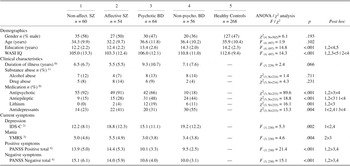
Group differences in demographics, clinical characteristics and current symptom ratings are presented in Table 1. There were no group differences in gender or age distribution. Although the two schizophrenia groups had less education compared with healthy controls and the non-psychotic bipolar group and obtained lower IQ scores, all groups remained within the normal range. The clinical groups did not differ in duration of illness or frequency of substance abuse. Use of medication and presence of current symptoms differed across groups largely in line with diagnostic categories and clinical subgroups. One exception from this pattern is the higher mania scale score in the affective schizophrenia group than in the psychotic bipolar group, due to more delusions and hallucinations that also impact on this measure.
Demographics, clinical characteristics, and current symptoms

Note
Means (SD) are reported unless otherwise specified. n = number; SZ = schizophrenia; BD = bipolar disorder.
0) Number of missing scores for group 4 = 1.
1) Last 6 months.
2) IDS-C: Inventory of Depressive Symptoms – Clinician rating.
3) YMRS: Young Mania Rating Scale.
4) PANSS: Positive and Negative Syndrome Scale.
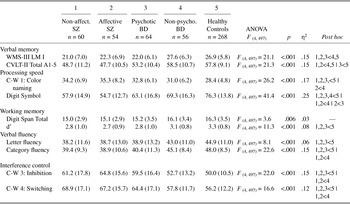
Neuropsychological test results are presented in Table 2. A significant overall difference between the groups in neurocognitive performance was detected (MANOVA: F (44,1960) = 5.1; p < .001) with the two schizophrenia groups and the psychotic bipolar group scoring significantly poorer than the healthy control group across neuropsychological measures. The largest effect size was found for the Digit Symbol test and the smallest for Digit Span. The neurocognitive pattern is in line with what we previously reported in a largely overlapping sample (Simonsen et al., Reference Simonsen, Sundet, Vaskinn, Birkenaes, Engh and Faerden2009), restating that the non-psychotic bipolar group performs at the same level as healthy controls whereas the psychotic bipolar group resembles the two schizophrenia groups. However, within the schizophrenia sample, a history of affective episodes did not affect neurocognitive performance. Based on the effect sizes and their capacity to separate groups, LM-I from WMS-III, Digit Symbol, d’, Category Fluency, and the Color-Word Inhibition subtest were chosen for the further analyses.
Neurocognition

Note
Means (SD) are reported; n = number; WMS-III LM I = Wechsler’s Memory Scale-III Logical Memory I; CVLT-II = California Verbal Learning Task-II; C-W 1 = Color-Word 1; C-W 3 = Color-Word 3; C-W 4 = Color-Word 4; SZ = schizophrenia; BD = bipolar disorder.
Psychosocial Function
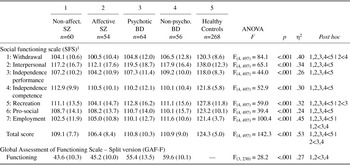
Group differences in self-rated psychosocial function (SFS sub-scale scores and total score) and clinician-rated psychosocial function (GAF-F) are presented in Table 3. All four clinical groups scored significantly lower than the healthy control group across all SFS sub-scales (MANOVA: (F (28,1976) = 15.1; p < .001) and the total score. Individuals with affective schizophrenia reported significantly more withdrawal (subscale 1) than individuals with non-psychotic bipolar disorder, and significantly more problems with recreation (subscale 5) than individuals with psychotic bipolar disorder. Apart from this, there were no significant differences between the four clinical groups on subscales 1–6. Both schizophrenia groups had however significantly lower employment (subscale 7) scores than the two bipolar groups. On the clinician-rated GAF-F scale, the two schizophrenia groups also had significantly lower functioning than the two bipolar groups.
Psychosocial function

Note
Means (SD) are reported; n = number; SZ = schizophrenia; BD = bipolar disorder
1 Standardized scores.
Relationship Between Neurocognition, Current Symptoms, and Psychosocial Function
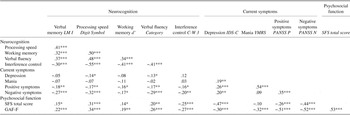
Correlations between the five neuropsychological measures, four current symptom scales and two psychosocial functioning scales for the clinical sample are presented in Table 4. Overall, both self-rated (SFS total score) and clinician-rated (GAF-F) functioning correlated significantly with all five neuropsychological measures and current symptom ratings. The only exception was the YMRS that did not correlate significantly with the SFS. The GAF-F and the SFS were not fully overlapping (r = .53 for the total group and .45–.63 within the clinical groups), and the degree of correlation between SFS and neuropsychological and current symptom measures was generally lower than for the GAF-F. For both SFS and GAF-F the correlations with current symptoms were slightly higher (of a small to large size) than the correlations with neurocognition (of a small to medium size).
Relationship (Pearson’s r) between neurocognition, current symptoms, and psychosocial function (clinical sample, n = 234)

Note
IDS-C = Inventory of depressive symptoms-clinician rated; YMRS = Young mania rating scale; PANSS P = Positive and negative syndrome scale - positive subscale; PANSS N = Positive and negative syndrome scale - negative subscale; SFS = Social functioning scale -total standardized score; LM I = Logical Memory I; C-W 3 = Color-Word Inhibition subtest; GAF-F = Global assessment of functioning scale (split version) - functioning scale.
*p < 0.05; **p < 0.01; ***p < 0.001.
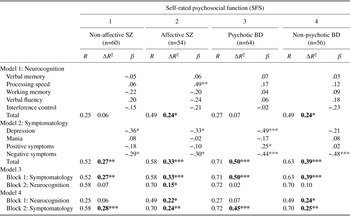
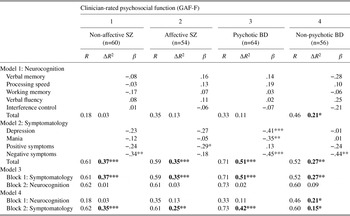
Results from the four regression models exploring the independent contribution of neurocognition and current symptomatology to self-rated psychosocial function (SFS total) and clinician-rated psychosocial function (GAF-F) are presented in Tables 5 and 6. The overall pattern of results was largely similar for self-rated and clinician-rated functioning. In model 1, neurocognition alone explained 6–24% of the variance in SFS total score across the four clinical groups, but significantly so in the affective schizophrenia group and the non-psychotic bipolar group. Similarly, neurocognition alone explained 3–21% of the variance in GAF-F across the four clinical groups, but significantly so only in the non-psychotic bipolar group. In model 2, current symptomatology alone significantly explained 27–50% of the variance in SFS and 27–51% in GAF-F across the four clinical groups. In model 3, adding neurocognition increased the explained variance with 2–15% in SFS after current symptomatology was controlled for, but significantly so only in the affective schizophrenia group. In the analyses of GAF-F, adding neurocognitive measures after clinical symptom load did not have a significant effect in any of the clinical groups. In model 4, current symptomatology significantly explained 24–45% of the variance in SFS after neurocognition was controlled for in all four clinical groups. Similarly, current symptomatology significantly explained 15–42% of the variance in GAF-F after neurocognition was controlled for across all clinical groups.
Impact of neurocognition and current symptoms on self-rated psychosocial function (SFS)

Note
Verbal memory = LM I; Processing speed = Digit symbol; Working memory = d’; Verbal fluency = Category; Interference control = C-W 3; Depression = IDS-C; Mania = YMRS; Positive symptoms = PANSS P; Negative symptoms = PANSS N; SFS = Social Function Scale -Total score; SZ = schizophrenia; BD = bipolar disorder
*p < 0.05; **p < 0.01; ***p < 0.001.
Impact of neurocognition and current symptoms on clinician-rated psychosocial function (GAF-F)

Note
Verbal memory = LM I; Processing speed = Digit symbol; Working memory = d’; Verbal fluency = Category; Interference control = C-W 3; Depression = IDS-C; Mania = YMRS; Positive symptoms = PANSS P; Negative symptoms = PANSS N; GAF-F = Global Assessment for Functioning Scale -Split version-Function Scale; SZ = schizophrenia; BD = bipolar disorder
*p < 0.05; **p < 0.01; ***p < 0.001.
In model 1, processing speed was the only neurocognitive domain that significantly explained any variance in SFS, but only in the affective schizophrenia group. For GAF-F, none of the neurocognitive domains reached significance for any of the clinical groups. In model 2, current depressive and negative symptoms significantly explained between 30 and 50% variance in SFS across all groups, whilst current positive symptoms explained a smaller part only in the psychotic bipolar group. For the GAF-F, the picture was somewhat more differentiated. Negative symptoms significantly explained 34–45% variance in GAF-F for all but the affective schizophrenia group, whilst depressive and manic symptoms explained 41% and 35% variance in the psychotic bipolar group only. These patterns remained unchanged in models 3 and 4 when the predictive value of current symptoms and neurocognition were examined together.
In sum, current symptoms explained more of the variance in psychosocial functioning, than neurocognition across all four clinical groups. This was the case both when neurocognition and current symptoms were investigated separately (models 1–2) and when the impact of the other was controlled for (models 3–4). Furthermore, this overall pattern of findings was found for clinician-rated as well as self-rated psychosocial function. Thus, current symptoms had a greater independent contribution than neurocognition to psychosocial functioning across all clinical groups.
DISCUSSION
There are three main findings from this study. First, clinician-rated psychosocial function was poorer in schizophrenia groups than in bipolar disorder groups, whilst self-rated psychosocial function appeared similar across the four clinical groups, but still significantly poorer than in controls. Second, both neurocognition and current symptoms were associated with psychosocial function. Third, current symptoms had a greater independent contribution than neurocognition to both self-rated and clinician-rated functioning, across all four clinical groups. Thus, both self-rated functioning and the relative impact of neurocognition and current symptoms on psychosocial function were similar across diagnostic categories and clinical subgroups. To our knowledge, this is the first time this has been shown in a substantial and heterogeneous sample with variation in level of current symptoms and neurocognitive function, recruited from a naturalistic clinical setting, and assessed with the same clinical, neurocognitive, and psychosocial measures.
The poorer clinician-rated functioning and employment status reported in the schizophrenia groups compared with the bipolar groups is in line with three previous studies, two of which also used GAF (Laes & Sponheim, Reference Laes and Sponheim2006; Martinez-Aran et al., Reference Martinez-Aran, Penades, Vieta, Colom, Reinares and Benabarre2002; Tabares-Seisdedos et al., Reference Tabares-Seisdedos, Balanza-Martinez, Sanchez-Moreno, Martinez-Aran, Salazar-Fraile and Selva-Vera2008). The similar self-rated functioning across schizophrenia and bipolar groups that was poorer than in healthy controls is also consistent with a previous report using SFS (Dickerson et al., Reference Dickerson, Sommerville, Origoni, Ringel and Parente2001). The two measures of psychosocial function correlated significantly across groups, although not completely. These findings suggest that self-rated functioning does not depend on diagnostic category and that there is a need to pay attention to functional outcome in bipolar disorder as well as in schizophrenia (Green, Reference Green2006; Zarate et al., Reference Zarate, Tohen, Land and Cavanagh2000).
Equal self-rated levels of functioning in schizophrenia and bipolar disorder despite higher levels of clinician-rated functioning and education in the bipolar disorder groups could be influenced by a self-rating response bias. The bipolar groups may be more susceptible to comparing themselves to peers, thus expecting and anticipating a higher level of functioning than participants with schizophrenia, resulting in relatively lower self-ratings. The participants with schizophrenia may also have poorer insight into their functional level than the participants with bipolar disorder, resulting in relatively higher self-ratings. An alternative view is that clinician rated functioning by the GAF-F, a global and subjective measure with few anchor points, is more influenced or biased by the clinician’s perception of clinical symptoms assessed in the same session.
There were no differences between the psychotic and non-psychotic bipolar groups in either self-rated or clinician-rated psychosocial function, which is consistent with the few earlier studies in this field (Dickerson et al., Reference Dickerson, Boronow, Stallings, Origoni, Cole and Yolken2004; Keck et al., Reference Keck, McElroy, Havens, Altshuler, Nolen and Frye2003; Martinez-Aran et al., Reference Martinez-Aran, Vieta, Torrent, Sanchez-Moreno, Goikolea and Salamero2007). Previous reports of less or no neurocognitive dysfunction in non-psychotic compared with psychotic bipolar disorder individuals (Bora et al., Reference Bora, Vahip, Akdeniz, Gonul, Eryavuz and Ogut2007; Glahn et al., Reference Glahn, Bearden, Barguil, Barrett, Reichenberg and Bowden2007; Martinez-Aran et al., Reference Martinez-Aran, Torrent, Tabares-Seisdedos, Salamero, Daban and Balanza-Martinez2008; Simonsen et al., Reference Simonsen, Sundet, Vaskinn, Birkenaes, Engh and Faerden2009) suggest that the non-psychotic group displays psychosocial impairment despite relatively intact neurocognitive function. The non-affective schizophrenia group did not have poorer self-rated or clinician-rated psychosocial function or neurocognitive performance than the affective schizophrenia group. This is in contrast to what we might expect based on poor neurocognitive and psychosocial functioning in schizophrenia subgroups with low levels of affective symptoms compared with those with higher levels of affective symptoms, such as the deficit syndrome compared with the non-deficit syndrome (Cohen et al., Reference Cohen, Saperstein, Gold, Kirkpatrick, Carpenter and Buchanan2007; Kirkpatrick et al., Reference Kirkpatrick, Buchanan, Breier and Carpenter1994, Reference Kirkpatrick, Buchanan, Ross and Carpenter2001). However, the present lack of difference between affective and non-affective schizophrenia groups is in accordance with our earlier report of no demographic or clinical differences between largely the same clinical subgroups in a first episode sample (Romm et al., Reference Romm, Rossberg, Berg, Barrett, Faerden and Agartz2010). The lack of difference between the four clinical subgroups suggests that, unlike neurocognitive function that seems to depend on history of psychosis, psychosocial function does not depend on history of psychotic or affective episodes.
Our finding that both neurocognition and current symptoms were associated with psychosocial functioning is consistent with previous schizophrenia and bipolar disorder research (Green, Reference Green1996; Green et al., Reference Green, Kern, Braff and Mintz2000, Reference Green, Kern and Heaton2004; Martinez-Aran et al., Reference Martinez-Aran, Vieta, Torrent, Sanchez-Moreno, Goikolea and Salamero2007). Yet there are also studies indicating more limited and overlapping associations between neurocognition, symptoms and functioning (Bozikas et al., Reference Bozikas, Kosmidis, Kafantari, Gamvrula, Vasiliadou and Petrikis2006; Dickinson & Coursey, Reference Dickinson and Coursey2002). The relationship was slightly more evident for the clinician-rated measure of functioning than for the self-rated measure, and the relationship was only marginally more evident for current symptoms than for neurocognition. Nevertheless, current symptom level had a greater independent contribution than neurocognition to both self-rated and clinician-rated psychosocial function, across all four schizophrenia and bipolar disorder groups. These findings are consistent with some recent studies on schizophrenia (Leifker et al., Reference Leifker, Bowie and Harvey2009; Nuechterlein et al., Reference Nuechterlein, Green, Kern, Baade, Barch and Cohen2008; Perlick et al., Reference Perlick, Rosenheck, Kaczynski, Bingham and Collins2008), and bipolar disorder (Sanchez-Moreno et al., Reference Sanchez-Moreno, Martinez-Aran, Tabares-Seisdedos, Torrent, Vieta and Ayuso-Mateos2009). Yet it is at odds with the leading trend reporting neurocognition as the primary predictor and positive symptoms as a limited predictor of functioning (Kurtz, Reference Kurtz2006; Wingo et al., Reference Wingo, Harvey and Baldessarini2009). Moreover, it is not consistent with the three studies that have previously investigated this relationship with clinician-rating scales across schizophrenia and bipolar disorder. Two of these studies found that symptomatology was an independent or better predictor than neurocognition, but only in one of the two diagnostic categories (Laes & Sponheim, Reference Laes and Sponheim2006; Martinez-Aran et al., Reference Martinez-Aran, Penades, Vieta, Colom, Reinares and Benabarre2002), and the final study found that neurocognition was the best longitudinal predictor of functioning in both categories (Tabares-Seisdedos et al., Reference Tabares-Seisdedos, Balanza-Martinez, Sanchez-Moreno, Martinez-Aran, Salazar-Fraile and Selva-Vera2008).
However, these inconsistent findings may be due to the use of different assessment measures, focusing on different aspects of functioning, neurocognition and symptomatology, as well as heterogeneous study populations that vary from euthymic to symptomatic or from first episode to chronic. Correlates of functional outcome may be distinct when investigating functional capacity measured by performance tests as opposed to more “subjective” functioning measured by rating scales such as the SFS and GAF (Bowie et al., Reference Bowie, Reichenberg, Patterson, Heaton and Harvey2006). The strongest associations have been found between neurocognition and functional capacity measured by performance tests (Leifker et al., Reference Leifker, Bowie and Harvey2009). Several of the studies that reported neurocognition as the best predictor of functioning in bipolar disorder have used asymptomatic samples where the influence of symptoms by definition is minimal (Martinez-Aran et al., Reference Martinez-Aran, Penades, Vieta, Colom, Reinares and Benabarre2002, Reference Martinez-Aran, Vieta, Torrent, Sanchez-Moreno, Goikolea and Salamero2007). This is necessary to establish proof that neurocognitive traits influence functioning, but is of less value when assessing the impact of symptomatology compared with neurocognition or evaluating targets for intervention in clinical groups. Thus, our finding that psychosocial function is better predicted by current symptoms than neurocognition across clinical groups could be affected by the use of rating scales capturing more “subjective” functioning, as well as a larger variation in the level of current symptoms in our sample compared with many previous studies. Ultimately, the present findings may suggest that symptoms mediate the relationship between neurocognition and functioning, which would be in line with previous research that has been emphasized in a recent meta-analysis (Ventura et al., Reference Ventura, Hellemann, Thames, Koellner and Nuechterlein2009). Nevertheless, the fact that the relative impact of neurocognition and current symptoms on functioning did not differ across the four clinical groups suggests that it does not depend on either diagnostic category or history of affective or psychotic episodes.
There are several limitations to the study. There was no primary measure of attention apart from digit span forward, limiting our ability to discuss attention. Lower levels of education and IQ in the schizophrenia groups compared with the bipolar groups and healthy controls were not controlled for because these characteristics are thought to be a part of the core features of the disorders and thus illness specific. The role of medication on our findings was not possible to control for because of the various different combinations of medication regimens used. Effective treatment of affective and psychotic symptoms with antidepressant and antipsychotic medication may have clouded potential state-related differences in neurocognition and functioning across the clinical groups with and without a history of affective and psychotic episodes. To assure a representative clinical sample, we also included clinical participants with substance abuse, which may confound the results. The influence of symptom load on SFS ratings, or symptom ratings’ on GAF-F ratings cannot be ruled out. Yet, the influence of cognitive assessment on functioning ratings is considered limited because different investigators were involved and, most importantly, the GAF ratings were done before cognitive assessment. The SFS may be compromised by inaccurate reports of own functioning in this population, and the GAF-F is limited by being a global measure. Performance based measures and more comprehensive clinician-rated measures may therefore be preferable. Finally, future efforts could explore the impact of additional factors that might moderate or mediate the relationship between neurocognition, symptoms, and functioning, such as self-esteem, social anxiety, family support, social cognition, and more performance based tests.
In conclusion, in a symptomatically heterogeneous sample with schizophrenia and bipolar spectrum disorders recruited from a naturalistic clinical setting, clinician-rated but not self-rated psychosocial function differed across diagnostic categories. Both neurocognition and current symptoms were associated with psychosocial function, but current symptoms had a greater independent contribution than neurocognition to self-rated and clinician-rated functioning, irrespective of diagnostic category or history of affective and psychotic episodes. Overall, these findings do not support a representation of schizophrenia and bipolar disorder as categorically different disorders (Vieta & Phillips, Reference Vieta and Phillips2007). The findings suggest that psychosocial intervention should be considered across diagnostic categories and clinical subgroups with and without a history of affective and psychotic episodes.
ACKNOWLEDGMENTS
The authors thank the participants for their time and essential contribution to the study. This work was supported by: Eastern Norway Health Authority (grant # 2005-115, # 2004-123), and Research Council of Norway, STORFORSK grant (# 167153), TOP study group. Ingrid Melle has been a speaker at meetings arranged by the Norwegian departments of Lundbeck, Astra Zeneca, Bristol-Myer Squibb, Pfizer, Wyeth, Eli Lilly, and Janssen-Cilag. She has also received travel funding from Eli Lilly and Astra Zeneca Norway. Ole A. Andreassen has been a speaker at meetings arranged by the Norwegian departments of Lundbeck, Astra Zeneca, Bristol-Myer Squibbs, Pfizer, Wyeth, Eli Lilly, and Janssen-Cilag. He has also received travel funding from Eli Lilly and Lundbeck Norway. Carmen Simonsen has been a speaker at a meeting arranged by the Norwegian department of GlaxoSmithKline. Kjetil Sundet, Anja Vaskinn, Torill Ueland, Kristin Lie Romm, Tone Hellvin and Svein Friis report no competing interests.