Introduction
Hospital palliative care provides comprehensive multidisciplinary total care for patients suffering complex physical, psychosocial, and spiritual symptoms related to advancing life-limiting disease and treatment, and includes family members in the circle of care. The central goal of hospital palliative care is to enhance patients’ quality of life through addressing these symptoms as early in admission as possible. Given the acute care setting, however, hospital palliative care is often provided late in the disease trajectory when patients are experiencing significant quality of life and care concerns (Humphreys & Harman, Reference Humphreys and Harman2014; Reville et al., Reference Reville, Miller and Toner2010). Further, palliative clinicians can find it challenging to illuminate these concerns within a care culture and administrative environment that prioritizes physical symptom management, stabilization, and discharge (Bruce & Boston, Reference Bruce and Boston2008; Floriani & Schramm, Reference Floriani and Schramm2012). Consequently, hospital-based palliative clinicians have called for practice supports that facilitate their ability to solicit and address patients’ and family members’ quality of life and experiences of care concerns, as well as make results visible to other stakeholders in care (Fitzsimons et al., Reference Fitzsimons, Mullan and Wilson2007; Peters & Sellick, Reference Peters and Sellick2006; Tavares et al., Reference Tavares, Paparelli and Kishimoto2017).
A promising practice for supporting this work is the integration of patient-reported outcome measures (PROMs) and patient-reported experience measures (PREMs) into routine hospital care. PROMs and PREMs consist of standardized validated questionnaires that solicit and measure patients’ self-reports of their symptoms, functional status, and physical, social, and emotional well-being (PROMs), as well as their experiences with healthcare (PREMs). Primary studies and systematic reviews have shown that providing healthcare professionals with this information in clinical settings can benefit healthcare communication and planning, raise awareness of problems that would otherwise be unidentified, and support multidisciplinary collaboration (Antunes et al., Reference Antunes, Harding and Higginson2014; Catania et al., Reference Catania, Beccaro and Costantini2015, Reference Catania, Beccaro and Costantini2016; Etkind et al., Reference Etkind, Daveson and Kwok2014; Hughes et al., Reference Hughes, Aspinal and Addington-Hall2003; Simon et al., Reference Simon, Higginson and Harding2012; Tavares et al., Reference Tavares, Paparelli and Kishimoto2017). PROMs and PREMs are increasingly delivered through real-time electronic platforms that collect, store, and report results. Studies indicate that such electronic quality-of-life assessment systems decrease response burden, increase satisfaction in use, improve ease of use, and have fewer missing data points than paper-based measures (Jensen et al., Reference Jensen, Snyder and Abernethy2013). In turn, healthcare administrators, managers, and care providers are interested in developing and implementing quality-of-life assessment systems across all care settings to support rapid and accurate assessment, enhance person-centered care, and for program evaluation and quality improvement purposes (Gliklich et al., Reference Gliklich, Dreyer and Leavy2014; Johns Hopkins University, 2017).
Research has identified the potential benefits of using PROMs and PREMs during routine care with patients who have an uncertain prognostic trajectory because of advancing life-limiting illnesses (Catania et al., Reference Catania, Beccaro and Costantini2016; Etkind et al., Reference Etkind, Daveson and Kwok2014). However, there is limited research about the processes of integrating electronic systems for using PROMs and PREMs in palliative care, particularly within palliative outreach consultant teams and acute care settings for older adult patients who may be nearing end of life. Consequently, researchers have identified the need for further insights into the routine use of electronic quality-of-life assessment systems in palliative care contexts (Jensen et al., Reference Jensen, Snyder and Abernethy2013; Tavares et al., Reference Tavares, Paparelli and Kishimoto2017) and palliative clinicians’ views on using these tools and systems (Bausewein et al., Reference Bausewein, Simon and Benalia2011; Hughes et al., Reference Hughes, Aspinal and Addington-Hall2003).
Our research aim is to contribute to a better understanding of hospital palliative care providers’, patients’, and family members’ experiences and perspectives of using a previously developed electronic Quality of Life Assessment and Practice Support System (QPSS). More specifically, our exploratory collaborative research was designed to generate themes for future mixed methods investigation regarding feasibility and desirability of integrating a quality-of-life practice support system in routine hospital palliative consult care.
As a response to the call for new analytical approaches to understand use of PROMs and PREMs in routine clinical care (Catania et al., Reference Catania, Beccaro and Costantini2016; Greenhalgh et al., Reference Greenhalgh, Long and Flynn2005), we draw on theoretical perspectives from medical anthropology and science and technology studies to interpret developing themes. In particular, we consider how the QPSS exemplifies Star and Griesemer's concept of a “boundary object” (Reference Star and Griesemer1989). A boundary object is a particular set of interconnected social relations and/or physical materials, coalesced into a specific entity, designed to promote collaboration between stakeholders. Boundary objects transfer, translate, and generate knowledge by providing both a shared language and infrastructure around which collaboration is organized. They have a robust identity across groups, and in simultaneously inhabiting these different social words, play a role in structuring relationships between them. Boundary objects thereby create the conditions for collaboration, while also being flexible enough to adapt to local needs in different contexts. Although the concept has been used to understand such diverse healthcare practices as the development of surgical sterility protocols (Fox, Reference Fox2011), cardiac telecare (Nicolini, Reference Nicolini2010), integration of complementary medicine into surgical settings (Ben-Arye et al., Reference Ben-Arye, Karkabi and Shapira2012), automated prescriber systems (Zhou et al., Reference Zhou, Ackerman and Zheng2011), and interdisciplinary collaboration (Keshet et al., Reference Keshet, Ben-Arye and Schiff2013), it has not yet been applied to PROMs and PREMs or systems for using them. We use the concept to consider how electronic quality of life assessment systems may motivate stakeholders to collaboratively construct and coordinate meanings about quality of life and experiences of care.
Methods
This study is part of the overarching QPSS initiative, which focuses on the user-centered design, implementation, and evaluation of innovative electronic healthcare information systems for using PROMs and PREMs at point of care to solicit patients’ and family caregivers’ self-reports on their quality of life and experiences of care as the basis for enhanced person-centered care and shared decision-making. The tablet-based system used in this study was developed based on previous research and user-centered design with healthcare providers and patients and family caregivers receiving hospital- and home-based palliative care. The system can be tailored to any practice setting, facilitates the process of administering PROMs and PREMs, and provides instantaneous feedback on assessment scores and how these have changed over time.
In this project, the QPSS was used by a palliative outreach consult team (POCT) at St. Paul's Hospital (Vancouver, Canada), which is a large urban tertiary care center with more than 500 beds and a dedicated 12-bed palliative unit. The team provides specialized palliative consultation throughout the hospital, and referrals can be requested by any healthcare provider, family member, or patient. The hospital consult team consists of one (rotating) palliative physicians, two nurses, and frequently one to two rotating residents. Consultants using the QPSS had an average of >10 years of palliative specific expertise.
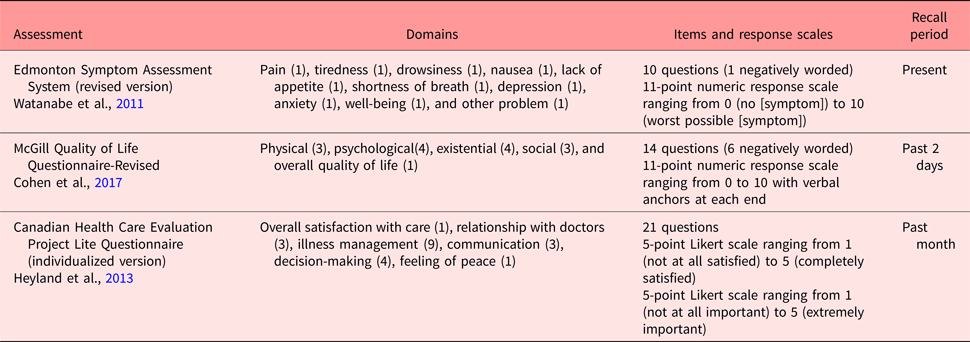
The overall project took place between March and October 2016, with two POCT nurses using the QPSS for 9 weeks. Project design was participatory, with focus groups (n = 3) that included the whole team before, during, and at project completion. The team reviewed PROMs and PREMs used elsewhere in palliative settings and chose the following for use: the Edmonton Symptom Assessment System–Revised Version (Watanabe et al., Reference Watanabe, Nekolaichuk and Beaumont2011), McGill Quality of Life Questionnaire-Revised Version (Cohen et al., Reference Cohen, Sawatzky and Russell2017), and the Canadian Health Care Evaluation Project Lite Questionnaire (Heyland et al., Reference Heyland, Jiang and Day2013) (Table 1).
Patient-reported outcome and experience measure assessment tools used by palliative outreach consult team nurses

The POCT nurses were interviewed about their experiences 2 weeks after beginning to use the QPSS, and again at project completion. Interviews ranged from 20 to 45 minutes. Three patients were also interviewed; each had used the QPSS at least twice. Interviews with patients ranged from 5 to 30 minutes. Interview questions for all participants focused on experiences of use, perception of relevance in hospital care, suggestions for future design, and use of data. Focus groups and interviews were recorded and transcribed verbatim. Observation of nurse and patient use was conducted over 50 hours during the 9 weeks.
Inductive thematic analysis was used as the initial method to reviewing transcripts and field notes (Guest et al., Reference Guest, MacQueen and Namey2011). Observation notes were compared with the data derived from interviews and focus groups, with particular attention given to experiences of use and categorizing aspects of shared and nonshared experiences. Credibility was sought through sharing emerging themes in focus groups and interviews with POCT clinicians.
We focused on older adult patients who may have less comfort or familiarity with using technology (Fischer et al., Reference Fischer, David and Crotty2013). Inclusion criteria for patients included being 55 years or older with an advancing chronic and/or life-limiting illness, ability to speak and read English, and capable of consenting to using the QPSS as part of their routine care. All participants, including POCT clinicians, provided written informed consent. Ethics approval was granted by relevant ethics review boards.
Results
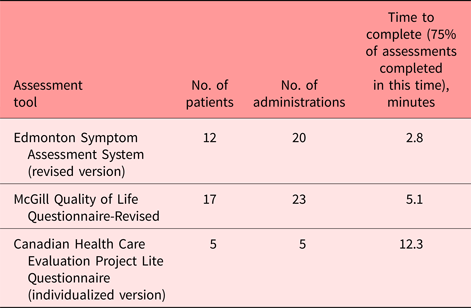
The POCT nurse-consultants approached 27 patients that met inclusion criteria. Seven patients declined to participate, resulting in an overall response rate of 78%. Patients who used the QPSS were an average age of 66 years, 75% identified as male, and slightly more than half identified as Caucasian and born in Canada or the United States. Educational status varied, with all reporting a minimum of high school graduation. Nearly two-thirds (62%) had diagnoses other than cancer, including chronic obstructive pulmonary disease (n = 6), heart failure (n = 4), renal failure (n = 2), and cirrhosis (n = 1). Self-reported length of diagnosis varied, with an average nearing 4 years. Number of assessment uses and time to completion for each assessment is provided in Table 1.
The QPSS ran efficiently with few technical or user problems. The POCT nurses most often assisted patients in using the QPSS. This relational use usually took the form of the nurse sitting or standing close to the patient's bed and holding the QPSS so that the patient could see and/or touch the face of the tablet, verbally reviewing instructions and assessment scales, and then asking each question and pausing for patient response, which was then either entered by nurse or the patient. Some patients provided a specific numerical response relatively quickly with no, or very little, prompting or re-wording from the nurses. Others answered within a numerical “range,” used declaratory statements (e.g. “it's not good”), and/or narrated their responses within broader considerations. In these instances, the nurses supported patients in generating a concrete number through further discussion, rewording the question, and/or choosing a numerical range and narrowing from there. At times, patients independently used the QPSS while the nurse either stayed in the room or returned after a short time. Both nurses however, expressed a clear preference for relational rather than independent use.
Nurse: If [patients] just fill it out silently, you don't hear any of the thought processes. And there's no opportunity… It's much more awkward to go, “Oh, why did you put that?” …Because you might not even see what they're doing. And so, how do you then navigate the responses? Do you look at them…? “Okay, I'm just going to review these with you now,” which you could do. You could do, but I just felt like kind of, still, either physically holding the tablet or having them hold it but reading it…And then, sometimes people were like, “Okay, yeah, I'm reading it,” but there has to be some dialogue or, in my experience, you didn't get as much out of it…I think there's such a big difference between reading it out loud and just handing it over to somebody, in terms of what I got out of it as a clinician.
During interviews and focus groups, the nurses acknowledged a tension between their desire for assessment results to reflect patients’ unmediated independent responses and the therapeutic benefits of relational use. However, concerns for the possibility of response bias were subordinated by the nurses’ preference for relational use, contextualized by examples where this style of use generated in-depth knowledge about quality of life concerns and experiences of care, strengthened therapeutic relations, and positively influenced their subsequent capacity to provide person-centered care.
In opting to use the QPSS in a relational rather than independent manner, patients often mentioned physical limitations because of disease progression, preexisting conditions, and constraints imposed by hospital beds. In both interviews and observations, patients reported that the QPSS was easy to use and did not suggest any changes to software or hardware features. Observationally, in relation to specific assessments, it was not uncommon for patients to ask the nurse about the meaning of certain words, questions, or scaling of the questionnaires, particularly on initial use. All three patients interviewed expressed that the process and outcome of using the QPSS was relevant to current hospital care and future care both for themselves and for other patients, and were willing to use the QPSS as a routine part of care if they were re-hospitalized.
Based on observations and interviews, relational use of the QPSS was important in enabling patients to effectively communicate quality of life and care concerns. As one patient noted, “I feel like if I can relate my feelings and experiences as accurately as possible, it's valuable. It benefits me.” Relational use also at times generated a new, or more nuanced, understanding of these issues through collaborative exploration with the POCT nurses. In turn, this shared labor resulted in stronger therapeutic connections with the nurses. In the words of another patient:
It's bringing things to the surface that maybe I need to examine. It helps me understand where I'm at. And I think that is important when you're dealing with something like I'm dealing with… I preferred both of us sort of sitting together and doing it together…It just made for more communication and a little extra discussion…It created a bond.
The POCT nurses also referenced three similar benefits of relational QPSS use. First, they stated that using the QPSS as an object of mutual focus helped to create a shared physical and topical space for open and in-depth conversations about patients’ quality of life and experiences of care. Second, the nurses reported that conversations emerging from QPSS use strengthened their ability to rapidly build relationships of trust with consult patients they may see only infrequently and/or for a short time. This therapeutic relationship building was not only to the benefit of patients; the nurses also expressed how using the QPSS supported their development as relational care providers.
Nurse: I feel like this is an area of real development for me, personally…Because just going in there and telling [patients] practical information or teaching them about fluids [is necessary]… but once you break through that next barrier into what's really going on and people start telling you that stuff, it's like, to me…really connecting with you as a human being and as a person…And although it is more challenging because there's some distress for feeling like, “I've unearthed real emotions or whatever,” for me, yeah, it's harder but also easier because I feel like, “I've gotten real meaning from this, for me,” and hopefully for them as well.
Third, the nurses reported that relational QPSS use enabled them to assist patients in expressing their quality of life concerns and experiences of care. As one nurse reflected, using the QPSS helped her “…feel like I had a real, genuine sense of…‘You've shared with me some feelings that you hadn't even really maybe thought of yourself’…You get a lot of information about what somebody is thinking and feeling…and then also all the clinical stuff about symptoms.” Because of these therapeutic and clinical benefits, both POCT nurses reported incorporating some of the standardized questions into routine verbal interactions with non-participating patients. A final benefit the nurses reported regarding the QPSS was its ability to increase the visibility of patients’ quality of life and experiences of care within an institutional space that conventionally has limited capacity to focus on these issues. As part of this benefit, the nurses felt that use also increased patients’ awareness that their concerns were relevant to both individual clinicians and their overall hospital care (and by proxy the wider healthcare system).
The nurses also valued the material outcome of using the QPSS. They used the numerical outcomes data to: (1) engage in on-the-spot reviews with patients, (2) discuss results with other POCT members, (3) record notable outcomes in the patient's chart, and (4) if available, have on-the-spot discussions with a member of the primary care team. The nurses reported that they reviewed results with each patient after use, usually after all assessments had been filled out. In observation, nurses also paused the assessment process for short periods to discuss a response that they felt indicated potential distress. With patients who were able to use the QPSS at least twice, nurses reported the ease and benefit of the graphing function to show response changes over time. Patients also identified graphing as useful to understanding their evolution of quality of life during hospitalization. Any result the nurses felt relevant to consult care they shared conversationally with the overall POCT team, during the day or in the next morning's meeting. During focus group discussions POCT team members identified this information as useful in gaining a better overall understanding of the patient, including family dynamics and discharge needs. On several occasions, the nurses reported notable outcomes in the patient chart and/or engaged in informal “hallway discussion” with one of the patient's primary care team members.
Although the length of time to complete each assessment was usually brief (Table 2), both nurses stated that the QPSS increased the amount of overall time they spent with each patient. Given their fluctuating workload as consultants, the nurses reported the benefits of discretionary use and flexibility when integrating the QPSS into daily workflow. Other considerations for integrating the QPSS into routine care included symptom acuity, structure of consultations, lack of patient privacy on busy medical wards, and English literacy constraints. The QPSS nurses did not suggest any significant changes to existing hardware or software features; however, they expressed a preference for the McGill Quality of Life Questionnaire-Revised (MQOL-R) assessment, citing ease of use and relevance of information collected. Both the POCT nurses and the overall POCT team articulated a strong interest in continuing to use the QPSS beyond the project end date. Suggestions for future use included a shoulder carry bag, additional assessment tools, and information on the tablet about palliative care for educating physicians, family members, and patients.
QPSS administration data

CANHELP LITE, ; ESAS-R, ; MQOL-R, .
Discussion
Our findings, based on observation, interviews, and focus group data, indicate that the palliative nurse consultants and their patients experienced significant collective benefits to processes of care when using the QPSS. Notably, many of these benefits emerged from relational use of the system. This preferred style of use appeared to accelerate development of a shared therapeutic space for candid exploration of quality of life and care experiences. Our results also illustrate that in some instances, this therapeutic space enabled active collaboration between patients and their nurses in cocreating new understandings about these experiences. The nurses expressed that use of the QPSS enhanced their ability to engage with patients about their quality of life and experiences with care within a healthcare environment traditionally focused on acute physical care. In addition, the nurses spoke about QPSS use supporting their development as relational care providers. Collectively, these results suggest that QPSS use as part of routine hospital palliative consult care enhanced practices consistent with person-centered care.
Studies of PROMs and PREMs have identified the need for more nuanced descriptions of use (Catania et al., Reference Catania, Beccaro and Costantini2016; Greenhalgh, Reference Greenhalgh2009), as well as further attention to the social, emotional, and cognitive processes that shape use within wider considerations of cultural and structural contexts (Antunes et al., Reference Antunes, Harding and Higginson2014; Hughes et al., Reference Hughes, Aspinal and Addington-Hall2003). We believe that analytic framing of the QPSS as a boundary object is a useful way to understand how the system organized and motivated collaboration. First, the concept requires that we attend to the interconnection between social relations and physical materials that facilitated a successful collaboration between two groups of stakeholders trialing an electronic quality-of-life assessment system in hospital palliative consult care. Our findings suggest that the QPSS functioned as a physical object of mutual and simultaneous focus that facilitated a shared therapeutic space. Second, understanding the QPSS as a boundary object highlights that, as it created the conditions for collaboration, the system also remained flexible to different types of use in different contexts. In instances of independent use, the QPSS appeared to function primarily as a relatively neutral technology for transferring patients’ perspectives. However, users identified that benefits accrued primarily through relational use, and most participants exhibited strong preference for this form of use. Relational use therefore appeared to intensify the collaborative capacity of the QPSS. Finally, this conceptual framing enables insight as to how the QPSS functioned as a “boundary object with agency” (Fleischmann, Reference Fleischmann2006); providing a shared language and infrastructure, which organized flexible instances of use that not only transferred and translated preexisting knowledge, but also engendered new relations of care, increased feelings of interconnection and, at times, cocreated new knowledge.
Although the anticipated benefits of routine use of PROMs and PREMs in palliative care have been well-documented, successful integration remains elusive. This is in part because of clinicians’ concerns that use may negatively impact therapeutic relationships, add to patient burden, and/or cause iatrogenic harm by triggering emotional distress (Bausewein et al. Reference Bausewein, Daveson and Currow2016; Donaldson, Reference Donaldson2008; Greenhalgh, Reference Greenhalgh2009; Hughes et al., Reference Hughes, Aspinal and Addington-Hall2003; Simon et al., Reference Simon, Higginson and Harding2012). Although these concerns were not experienced by participants in our project, they require further consideration and research in conjunction with other identified challenges to integration. At the same time, we believe that introducing the concept of boundary objects enables considerable insight as to how innovative technologies designed to assess and address quality-of-life and care experiences can positively motivate and enhance collaborative person-centered palliative care in both anticipated and unanticipated ways. Additionally, given the preference for relational use evidenced in our study, the concept of boundary objects may also be of value to future design and development of quality-of-life assessment systems to enable flexible pathways of “doing with” patients, as well as supporting an independent “doing for” themselves. Finally, development of electronic systems for supporting quality-of-life assessments in routine clinical care may profit from further exploring relational use to better understand how these boundary objects hold the potential not only to inform, but also to transform, care.
Limitations
Our sample is neither representative nor can results be generalized to other locations or care populations. Participants and clinicians were self-selecting. Additionally, the number of interviews with patients was limited because of symptom acuity. Different perspectives may have been provided by clinicians and patients with different life experiences and backgrounds. Nonetheless, to the best of our knowledge, this is the first study to examine hospital palliative consult clinicians’ use of a tablet-based system for routine use of PROMs and PREMs with older adults who may be nearing end of life. The findings of our project have advanced understanding of hospital clinicians’ and patients’ experiences with an electronic quality of life assessment system. Finally, our research was originally designed to include family caregivers but this proved challenging due to the structure of hospital consult care. We recommend additional research on family caregivers’ experiences of using electronic quality of life assessment systems within hospital settings.
Conclusions
Participants expressed that relational use of the QPSS in routine palliative hospital consult care positively influenced relations of care by facilitating a therapeutic space for transferring, translating, and, at times, generating new knowledge relevant to quality-of-life and care experiences. The nurse consultants also expressed that QPSS use increased the visibility of these experiences within an environment that prioritizes acute physical care, and furthered their capacity as relational care providers. Our results indicate that in some instances electronic assessment systems such as the QPSS not only enables collaboration between stakeholders, but may also function as an actor-object for engendering new knowledge and relations of care rather than merely as neutral technological platforms for transferring pre-constituted information and experiences.
Acknowledgments
We thank all participants for their time and the organization where the study took place for the collaboration. The research was, in part, possible because of fellowship funding for the first author from the Canadian Frailty Network and Trinity Western University, and funds from the Canada Research Chairs Program. We also acknowledge, with gratitude, the in-kind contribution of our industry partner James Voth of Intogrey Research and Development Inc.