A hallway trophy case displays photos of Fordson’s athletes—a cacophony of Anglo, Arab, Italian, and Polish names… . Catch a glimpse inside a student’s locker and you might find a picture of a current rock star—or of Ayatollah Khomeini. Bathroom graffiti runs the political gamut from “Kill the Arabs” to “Death to America.” … Middle America meets the Middle East at this school.
—Tom Hundley, Detroit Free Press Footnote 1
Published in a Detroit Free Press article entitled “MidAmerica Meets Mideast,” this vignette described the atmosphere of Dearborn, Michigan’s Fordson High School in 1986. The piece highlighted extremes on either end of Fordson’s “cross-cultural kaleidoscope,” revealing an important site for identity development among youth: schools. Relaxed restrictions following the Immigration Act of 1965 prompted an influx of Arab peoples to the United States. Categorized under the decolonial label Southwest Asian and North African (SWANA), these populations comprised the third wave of SWANA immigrants to the United States, with 250,000 arriving between 1967 and 1985.Footnote 2 First-wave immigrants arrived from Greater Syria beginning in the late nineteenth century and consisted primarily of Christians who found work as peddlers and industrial laborers, while second-wave immigrants (mid-1940s to 1965) included a larger percentage of Muslim populations, refugees, and university students and professionals. Distinct from these earlier waves, third-wave immigrants, who arrived from the late 1960s through the 1990s, encompassed an ethnically, religiously, and economically diverse group. Muslims comprised a large portion of this group, with many fleeing refugee camps, civil war, and “abysmal violence” abroad.Footnote 3 Exact numbers of immigrant populations settling in the United States are significantly flawed due to inaccurate and inconsistent categorizations of this group.Footnote 4 Regardless, of the many locations SWANA populations eventually called home, Dearborn consistently attracted a growing number of new arrivals—a trend with significant impacts on the demographic makeup of schools by the end of the twentieth century.
Dearborn’s public schools experienced increased enrollment of students of Arab descent by the 1980s and 1990s. While children of SWANA immigrants enrolled in Dearborn schools in the early twentieth century, Arab youths did not comprise a significant proportion of enrolled students until the latter half of the century.Footnote 5 Furthermore, third-wave SWANA populations brought with them children who, in many instances, lacked formal education due to disruptions from the North Yemen Civil War (1962-1970) and the Lebanese Civil War (1975-1990).Footnote 6 Consequently first-, second-, third-, and fourth-generation SWANA populations mingled with non-Arab descendants of other ethnic groups within Dearborn schools, where Arab-descendant school-age youth of this period faced an onslaught of racist caricatures while asserting their linguistic, religious, and cultural interests. During the late 1970s, tensions around bilingual education, religious accommodations, and Arab and American identity surfaced in Dearborn schools. For new and established students of Arab descent, interactions with Arab and non-Arab peers and staff and the predominantly Judeo-Christian practices and values of Dearborn’s schools compounded these tensions.
Despite all this, by the 1980s and 1990s, conflict was not the defining feature of Arab American students’ experiences in Dearborn. As the presence of Arab-descendant youth increased in Dearborn’s public schools, these institutions shifted from emphasizing assimilation to becoming more accepting of cultural pluralism. This shift developed through a reciprocal process in which Arab-descendant students and their adult allies demanded respect for their multifaceted linguistic, religious, and ethnic identities even as they refashioned conceptions of who they were through acculturation.Footnote 7 In short, students and their communities shaped their schools just as schools shaped them.
Centering these institutions and the Arab American populations they served challenges age-old debates about whether schools were tools of social control or sites of opportunity. In the 1980s and 1990s, Dearborn’s public schools were both: recalcitrant to challenge American customs and expectations, yet responsive to the needs and developing identities of the Arab American populations they served.
This article offers three contributions to the history of education, identity, and ethno-racial politics in the postwar United States. First, an examination of Arab and Muslim students’ post-1967 school experiences complicates understandings of Arab American identity formation in the United States. Specifically, my research highlights the complex role that schools played in Arab-descendant youths’ identity formation and the range of adolescent understandings regarding an “Arab American” identity. This was the case even after 1967, which scholars point to as a significant period of mobilization for identity development among this population.Footnote 8 Pan-Arabism, which originated in the early nineteenth century, constituted a broader political ideology fostering a collective Arab identity along political, cultural, and linguistic lines. It contributed to a modern Arab American identity emerging from the 1967 Arab-Israeli War.Footnote 9 While scholars disagree about the origins and evolution of Pan-Arabism, many emphasize the Arab-Israeli War of 1967 as integral to the formation of an “Arab American” identity. The war linked religiously, racially, and ethnically diverse SWANA populations under a singular identity. Referencing Michael Suleiman, Nadine Naber notes “the collective sense of belonging to a community whose homelands are becoming increasingly important to U.S. imperial expansion after 1967 ignited what many scholars have referred to as an ‘Arab American awakening,’” with pan-Arab community organizations forming in the late 1960s into the 1980s.Footnote 10 This unified identity, according to Naber, Suleiman, and Alixa Naff, entailed renewed ethnic pride and SWANA populations’ assertions of nationalist affiliations following the 1967 War.Footnote 11 Hani Bawardi and Pamela Pennock also note the significance of this war in mobilizing political groups and connecting diverse Arab populations across the United States.Footnote 12
Centering the experiences of Arab-descendant youth who spent their formative years in American public schools after 1967 complicates assumptions of a collective identity. On the one hand, the concurrent rise in Arab American student enrollment and anti-Arab racism in Dearborn during the 1980s and 1990s heightened conflicts within the city’s schools. At times, those conflicts pressed SWANA peoples to respond collectively, and the concessions they secured from the school system reinforced external perceptions of Arab Americans as a monolithic group. On the other hand, however, Arab-descendant students identified variously as Arab American, Arab, American, Palestinian, Yemeni, and Lebanese, among other identities, as they battled societal, familial, school, and peer expectations of what it meant to be Arab in America. Precisely how they identified also shifted situationally based upon the varied and volatile conditions they faced within schools.Footnote 13
Second, emphasis on the multiple intersecting identities among minority students complicates prevailing approaches to schooling and identify formation among education historians.Footnote 14 Historians of education point to schools as powerful sites of assimilation and resistance, yet they generally attend to race, gender, culture, religion, and politics as separate components of identity or use a limited combination of analytic categories to address the experiences of students of color.Footnote 15 For Arab Americans, sharing classes and hallways with non-Arab peers exposed them to misconceptions of SWANA peoples as portrayed in the media and aggravated by tensions abroad. These geopolitical forces became central to the daily experiences of Arab American students, who developed understandings of their identities as they attended American schools. This rivaled the experiences Yoon Pak documents of Nisei and Nikkei students before their internment during World War II. Pak states, “They were equal yet not quite equal,” underscoring the ways Americans questioned Nisei loyalties even as the latter proudly proclaimed their American identities.Footnote 16 While Arab Americans experienced similar criticisms born out of geopolitical conflicts, unlike Japanese Americans, religious identities reinforced assumptions that they were suspect citizens well after tensions subsided. Intersections between geopolitics and religious, national, racial, and gendered identities distinguished Arab American students from individuals belonging to other racially, religiously, ethnically, and nationally marginalized groups.Footnote 17
Finally, this article contributes to the historiography of metropolitan Detroit and the urban Midwest. Field-shaping books such as Thomas Sugrue’s Origins of the Urban Crisis and Jeffrey Mirel’s Rise and Fall of an Urban School System marginalize communities of Arab descent and prioritize a Black/White binary.Footnote 18 This is especially surprising as Dearborn, located within the broader Detroit metropolitan area, holds one of the nation’s highest concentrations of SWANA immigrants.Footnote 19 Considering the multilayered identities of Arab Americans is required to fully comprehend race, education, and student experiences in the urban Midwest.
This essay’s first section examines expanding post-1965 SWANA immigration in the United States, centering émigrés’ settlement in the broader Detroit metropolitan area. The second section addresses the political, cultural, and religious tensions that unfolded in Dearborn and their impacts on school support of students’ “Arab” and “American” identities. The final section points to the spectrum of student perception and reception of Arab American students as demonstrated by peer interactions between Arab and non-Arab students. I focus particularly on students of Fordson High School, whose testimonies were featured in a special edition of the Detroit Free Press. While an examination of a White-owned mainstream news outlet such as the Detroit Free Press has limitations, it nonetheless offers the personal testimonies of Dearborn students and their perceptions of the peer and institutional dynamics they faced in schools. Additionally, school-issued documents, articles from alternate media outlets, and oral histories of former students complement the special edition of the newspaper. Overall, an educational history centering Arab Americans reveals new findings regarding schools as pluralistic sites of identity formation.
A History of SWANA Settlement in the United States
First-wave SWANA immigrants, mostly Christian men from Lebanon, Syria, and present-day Palestine, entered the United States between 1880 and 1924. As peddlers and factory workers, they reluctantly settled into life in the United States, hoping that economic prosperity would allow them to return home.Footnote 20 When this did not happen, many sent for their families, leading to a second wave of Arab immigrants. Second-generation immigrants aimed to assimilate into mainstream America, as one informant explained to Lebanese-born American historian Alixa Naff:
After the young generation became of age and start[ed] to go to school and have their own companies, we had to adapt ourselves to the American way of life to satisfy our children and their companions, so we start[ed] to drift from our ways of life to the Western way of life … because of our children and business associates.Footnote 21
For most second-wave immigrants, assimilation proved the best path to economic and social prosperity.Footnote 22 Yet even as Americanization reshaped their identities, these groups maintained cultural ties to their homelands.
A national origins quota set in motion by the Immigration Act of 1924 prevented significant numbers of SWANA populations from entering the country, with exceptions made for educated immigrants as well as immigrants seeking political and religious asylum.Footnote 23 The 1965 Immigration and Nationality Act then stimulated a third wave of newcomers, many of whom were educated Arabs.Footnote 24 Between 1968 and 1971, thousands of individuals from SWANA regions made their way to the United States. Palestinians who fled Israeli occupation arrived in the United States after World War II, and Lebanese immigrants came to the US escaping civil war that erupted in the country.Footnote 25 While earlier Yemeni immigrants were drawn to Detroit’s growing automotive industry, later arrivals immigrated to escape famine and war.Footnote 26 For Yemeni arrivals, their darker complexion and limited English language skills differentiated them from other SWANA immigrants.Footnote 27 Over time, diverse socioeconomic groups and groups with varied national ties immigrated to American cities, with many settling in the Detroit metropolitan area.
This metropolitan area remains home to the country’s highest concentration of Arab populations. In 1960, the Arabic-speaking population in Detroit exceeded twenty thousand people, with clusters settling in Wayne County, which encompasses Dearborn.Footnote 28 Roughly one in eight Arabic speakers who arrived in the United States between 1969 and 1970 listed the Detroit area as the place they intended to settle, and the 1970 Census reported a total of 18,089 people in the Detroit metropolitan area whose native language was Arabic.Footnote 29
Occupying the southeastern corner of the state, Dearborn is located only ten miles from downtown Detroit.Footnote 30 Dearborn’s Public Use Microdata Area records show that 70 percent of Arab residents in the city arrived between 1980 and 1990. By 1990, eighteen thousand of Dearborn’s eighty-six thousand residents were of Arab descent, and 29 percent of Arab residents in the broader metro area resided in Dearborn.Footnote 31 Those same records reveal significant ancestral diversity among this population, which included Algerians, Egyptians, Moroccans, Iraqis, Kuwaitis, Jordanians, Palestinians, and Lebanese.Footnote 32
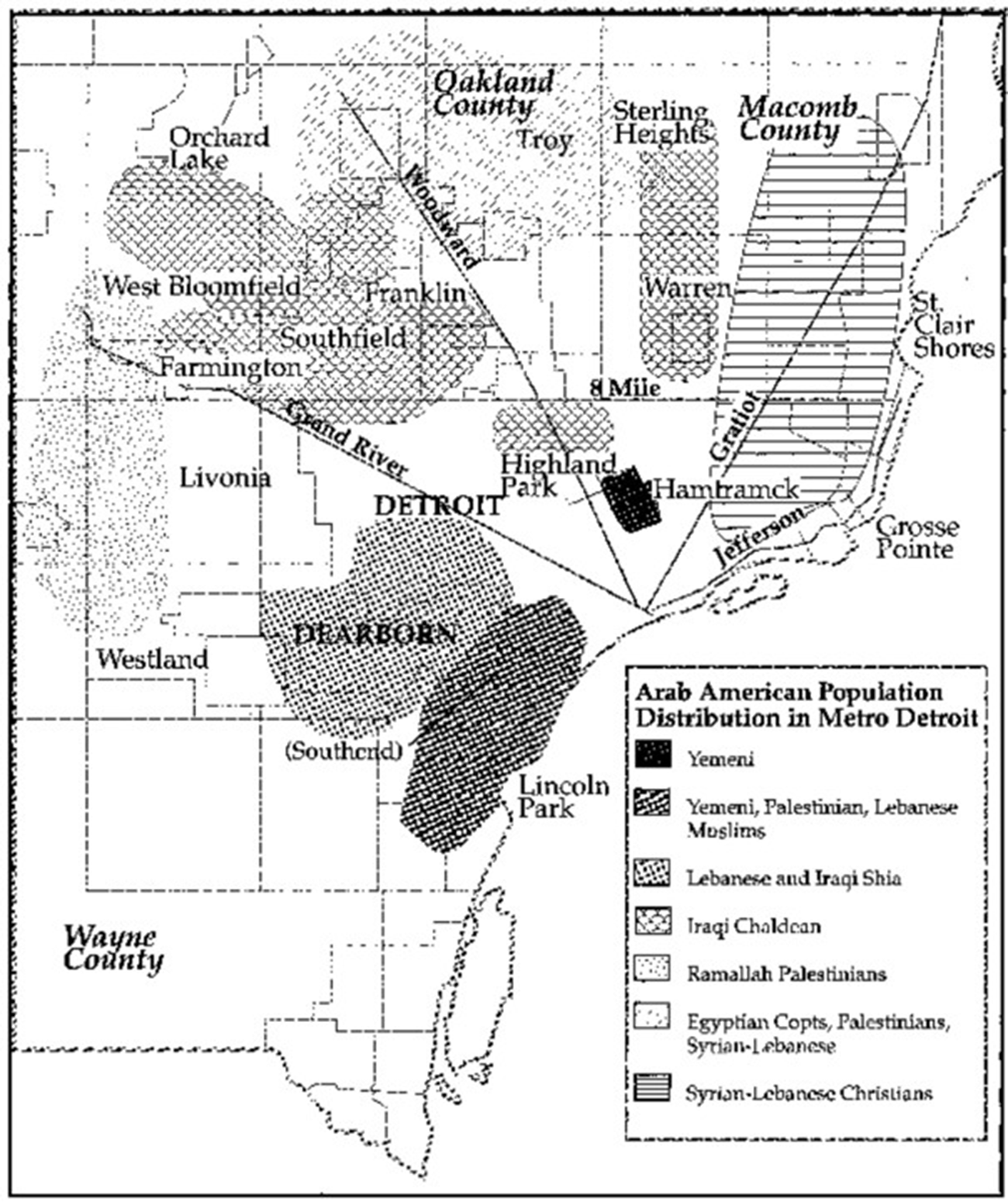
SWANA populations frequently settled in metro Detroit according to their national affiliations (see Figure 1). While Lebanese Muslims and Syrian Christians comprised a majority of the metro area’s total Arab population by 1990, other groups dominated specific portions of the metropolis.Footnote 33 Excluding the city of Detroit, 87 percent of the metro area’s more than 1,600 Yemini immigrants lived in the Wayne County suburbs in 1990.Footnote 34 Among other Arab groups who settled in the metro area (excluding the city of Detroit), 59 percent of Palestinian-Jordanians, 55 percent of Lebanese, 40 percent of Syrians, and 21 percent of Iraqis settled in Wayne County. Those who did not live in Wayne County primarily settled north of Detroit and Wayne County’s 8 Mile Road border in Oakland and Macomb Counties.Footnote 35
Arab American population distribution in metro Detroit, 1983. Map designed by Melinda Hamilton and adapted from Sameer Y. Abraham and Nabeel Abraham, eds., Arabs in the New World: Studies on Arab-American Communities (Center for Urban Studies, Wayne State University, 1983). It is featured in Kim Schopmeyer, “Demographic Portrait of Arab Detroit,” in Arab Detroit: From Margin to Mainstream, ed. Nabeel Abraham and Andrew Shryock (Wayne State University Press, 2000), 62.

Figure 1 Long description
The map shows the distribution of Arab American populations in metro Detroit, 1983. It highlights different ethnic groups using patterns and shading. Yemeni, Palestinian and Lebanese Muslims are concentrated in Dearborn. Lebanese and Iraqi Shia are found in Highland Park. Iraqi Chaldeans are located in Southfield. Ramallah Palestinians are in Livonia. Egyptian Copts, Palestinians and Syrian-Lebanese are in Warren. Syrian-Lebanese Christians are in Troy. The map includes Wayne, Oakland and Macomb Counties, with key cities like Detroit, Dearborn and Warren marked. The legend explains the patterns used for each group.
Arab Americans shifted the landscape of Dearborn. Beginning in the early twentieth century, the construction of the Ford Rouge Plant attracted Arabs to the area surrounding present-day Dearborn.Footnote 36 Referenced frequently as the “Southend,” this area consisted predominantly of working-class immigrant populations who by the mid-twentieth century established Arab cultural spaces including local coffeehouses and the American Moslem Society mosque.Footnote 37 By the 1960s, Arab populations, including Palestinian, Lebanese, and Yemeni Arabs, made up roughly half of the Southend’s five thousand residents. Additionally, while a majority of Arabs across metro Detroit were Christian, Dearborn’s Southend residents were primarily Muslim Arab Americans.Footnote 38 Displaced by war and political upheaval, these new arrivals ultimately restructured Dearborn’s demographic makeup and urban landscape through their language, cultural values, and religious beliefs.Footnote 39
School populations reflected this movement of people. Detroit’s public school system reported that 37 percent of “new alien student registrations in the 1973-74 school year” consisted of “Arabic-speaking children.”Footnote 40 Dearborn itself was home to three major high schools: Dearborn High School, Edsel Ford High School, and Fordson High School. During the 1970s and 1980s, increases in SWANA populations resulted in schools hiring Arabic speakers, first for bilingual programs and later for general instruction.Footnote 41 By the early 1980s, the district-wide provision of vegetarian alternatives to non-halal meals served as another indicator of higher Muslim enrollment.Footnote 42
Because of the coverage Fordson High School received in the Detroit Free Press, much of this article focuses specifically on that school. Completed in 1928 and located in the northeastern region of Dearborn, Fordson is named after the founder of the Ford Motor Company, Henry Ford, and his son Edsel.Footnote 43 Upon opening, children of European immigrants comprised the largest segment of the student body. However, Fordson High School also became a budding center for families of Arab descent and their children as the school resided within the shadows of Ford’s River Rouge Plant, a factory employing significant numbers of Arab immigrants. By the 1980s, students of Arab descent replaced White ethnic immigrants as the majority group.Footnote 44 In this decade, Fordson High School experienced significant enrollment numbers and recorded “over-utilization” as class sizes swelled to include the growing population of students of Arab descent.Footnote 45 By 1982, the federal government provided Fordson over $200,000 within a two-year period to support English language learning for non-native speakers at the school.Footnote 46 A few years later, a 1988 pamphlet presented recommendations to address growing enrollment and the possibility of rerouting feeder schools to Edsel Ford High School rather than Fordson. Despite these recommendations, Superintendent Thomas D. McLennan acknowledged the “very real bond” between Fordson High School and its community, with citizens communicating their desire to have their students attend the school.Footnote 47
Recent immigrants and their children were in general agreement about the importance of preserving culture, language, and religion. While Dearborn schools offered Arab youth new understandings of their identities, peer cultures, and the communities they represented, the students brought with them their own ideas about education and schools.
Political, Linguistic, and Religious Tensions in Dearborn Schools
Despite some success integrating accommodations into school policy throughout the 1980s and 1990s, broader prejudice against Arab Americans of Dearborn impeded youth efforts toward belonging. At that time, discriminatory rhetoric seeped into the schools. Michael Guido, Dearborn’s longtime mayor and two-term City Council member, was a highly contentious yet popular figure who built his political reputation on his outspoken approach to “Arab issues” during the 1980s. Most notably, the twelve-page campaign flier he mailed as part of his 1985 mayoral campaign against Marge Powell sparked controversy. Despite the flier’s inflammatory title, “Let’s Talk About the City Parks and the ‘Arab Problem,’” Guido won the election. His success marked the beginning of a winning streak that lasted until his final election in 2005 and his death in 2006.Footnote 48 Throughout his mayoral tenure, Guido’s tepid relationship with the Arab American community at times warmed; yet on numerous occasions he battled with Arabs over policies pertaining to Arab students of Dearborn’s public schools.Footnote 49 While Guido’s attention to Arabs encompassed only one aspect of his broader political focus, early emphasis on this population as “a problem” and his resulting success as mayor reflected the pervasive hostility from White residents that students of Arab descent faced in schools.
Bilingual classes served as one such source of controversy. Bilingual education programs at schools such as Fordson supported immigrant youth in developing English fluency.Footnote 50 Yet the programs faced opposition from residents over required accommodations for English-as-a-second-language learners that stemmed from misunderstandings regarding the intention behind such programs.
Between 1976 and 1977, there were only 218 students enrolled in bilingual programs at Dearborn schools, but that number surged in the following years. Fleeing the Lebanese Civil War, nearly four thousand of the roughly forty thousand Lebanese immigrants who arrived in the United States between 1983 and 1990 settled in the metro Detroit area.Footnote 51 Interest in bilingual education programming in Dearborn schools reflected the needs of these new immigrants to the city. By 1983-84, enrollment had increased to 1,720, with the largest influx coinciding with the first Israeli invasion of Lebanon in 1978.Footnote 52 While enrollment dipped slightly during the following years, it increased to 1,644 across Dearborn by 1986. In 1980, Dearborn Public Schools’ Department of Instructional Service noted that Fordson identified itself as a “bilingual/bicultural center,” as did Lowrey Elementary School, Howe Elementary School, and Salina Intermediate School.Footnote 53
Despite an increasing demand for bilingual services and the accomplishments of bilingual programming, Fordson High School’s English as a Second Language program frequently received disapproval from those mistaking bilingual education for efforts to teach students Arabic or preserve students’ Arabic fluency.Footnote 54 The Guido campaign pamphlet that sparked controversy in 1985 claimed that “so-called Arab-American leaders we have here in Dearborn continually badger and browbeat our government for tax funds … to teach Arabic in Dearborn schools.”Footnote 55 In reality, bilingual programming eliminated barriers for students and their families. In a 1985 school newsletter, Dearborn bilingual resource teacher Wageh Saad noted, “The main duty of bilingual aides is to work with students who are limited English proficient. They help the teacher communicate with the student, the student communicate with the teacher, and they facilitate communication between the teacher and the students’ parents.”Footnote 56 Responding to questions about and criticisms of bilingual education, Arab American leader Alan Amen stated that figures such as Guido “have a mental block” regarding the program. “No matter what we show them or tell them, they insist we are teaching Arabic… . Bilingual education seems to engender in a lot of people in Dearborn a kind of hate. To them, it seems to represent everything that’s un-American.”Footnote 57
Attacks against the bilingual program often stemmed from feelings of resentment among previous waves of White ethnic immigrants such as Italians and Poles. These European immigrants largely arrived in the Detroit area during the early twentieth century, seeking work in automobile factories alongside first-generation SWANA immigrants.Footnote 58 Ron Stockton, president of his neighborhood association and a University of Michigan–Dearborn professor, recalled that residents with strong Polish and Italian accents frequently made emotional statements regarding the raw deal they received when they immigrated compared with recent SWANA arrivals. According to Stockton, statements such as, “When I first came to this county, I didn’t get any favors,” were the very beliefs Mayor Guido embraced. Stockton noted, “It’s an emotional thing. They’ve got these family hurts that they’ve carried a long time, and now they see others getting special treatment, and to them it’s an incredible injustice.”Footnote 59 White ethnic residents’ contempt toward bilingual education reflected their own beliefs about what the Americanization process should look like for newer immigrants. Frustrated and resentful, ethnically self-identified White Americans brooded over what they deemed unfair treatment.Footnote 60
Mandated by the State of Michigan in 1974, bilingual education supported a large influx of Arabic-speaking refugees, including Lebanese immigrants resettling in Dearborn amid the 1975 civil war.Footnote 61 Yet, by spring 1979, citing civil rights and Lau compliance guidelines—a result of the 1974 Lau v. Nichols supreme court case ruling that schools provide language assistance to equalize education for non-native speakers—the Office of Civil Rights declared Dearborn schools non-compliant in providing appropriate bilingual services for non-native English learners. Geopolitical unrest in regions of SWANA which led to “unpredictable increases in eligible students” requiring language assistance as well as restructuring efforts as part of bilingual programing, contributed to the district’s non-compliant status.Footnote 62 Additionally, while White ethnic communities bemoaned what they considered an excessive level of bilingual instruction for new Arab residents, the State of Michigan mandate regarding bilingual education funded an increase in language offerings to four additional schools and two more language groups during the 1979-1980 school year. These additional languages included Albanian and Italian.Footnote 63
That White ethnic communities railed against bilingual education even as they maintained their own cultural and religious traditions was ironic. There was an additional irony: While White ethnic students and their parents criticized Arab immigrant families for their supposed “resistance to Americanization”—use of the veil, religious accommodations, and the upholding of cultural ties—they simultaneously condemned immigrant efforts to Americanize.
Despite criticisms of bilingual education, Dearborn continued offering programming for Arabic speakers and acknowledged its importance considering the geopolitical instability fueling immigration from SWANA regions. By 1989, Dearborn Public Schools was operating the nation’s largest bilingual program for Arabic-speaking students. In a letter to the director of the International Affairs Department of the American Federation of Teachers, Dearborn Federation of Teachers president Sally Barnett connected Dearborn students to issues abroad, writing, “Clearly the turmoil in the Middle East is of great concern to us.”Footnote 64 As Barnett noted, more and more students at this time were war refugees.Footnote 65 Indeed, just a year after Barnett sent her letter, enrollment increased exponentially to 2,700, spurred by a new wave of immigration due to continued civil unrest in Lebanon.Footnote 66 A decade later, in the late 1990s, Dearborn school officials not only hired more support staff for these students, but also began offering Arabic language classes at Fordson. Suehaila Amen, a Fordson class of 1997 graduate, recalled her junior year at Dearborn High School prior to transferring to Fordson her senior year. She was one of several students bused from Dearborn High to Fordson during lunch to participate in Arabic language classes.Footnote 67 Students’ need for and interest in bilingual education not only ensured it would continue to be offered, but, ultimately, it ensured what many White ethnic people feared: institutional recognition of Arabic as a critical language in Dearborn. Dearborn schools have since increased their Arabic language offerings across their schools.
Like bilingual education, religious conflicts over co-education and the teaching of sex education caused tensions within Dearborn schools in the 1980s and through the 1990s. Pushback against school practices that threatened youth Muslim identities not only contributed to changes in schools, including religious accommodations for practicing Muslims, but also led to new considerations regarding the place of religion in schools.
Dearborn’s Islamic leaders deemed particular educational activities “haram,” or forbidden, including course content referencing homosexuality and material featuring drawings that displayed the location of sexual organs. Such leaders also opposed discussions of dating and premarital sex that contradicted strict interpretations of Islam.Footnote 68 In May 1987, representatives of several Islamic organizations distributed letters to the Arab American community urging parents to keep their kids out of sex education classes. According to school officials, in June 1987, the parents of 65 percent of fifth and sixth graders at Salina Intermediate School required that the school substitute other activities for sex education. Dr. Noureddine Saab, a Dearborn teacher and chairman of the Detroit-based Islamic Center of America, noted efforts that officials made to change the curriculum, yet religious leaders deemed these adjustments insufficient. Interestingly, the religious objections did not push for an entire ban on sex education. Rather, petitions against teaching premarital sex, dating, and use of “indecent” drawings in classroom instruction also included community demands to teach morals alongside the biology of sexual acts. Dr. Saab acknowledged that Islamic leaders did not necessarily object to sex education. However, “this is an area that’s loaded with moral values. If we teach about the biological act, then we should include some instruction on moral values.”Footnote 69
Such resistance regarding the recognition of sexual relations among teenagers continued into the early 1990s. According to a 1994 survey on behavior risk factors among Wayne County Arab American residents, Arab Americans were significantly less likely to encourage condom use among sexually active teenagers compared with other Wayne County residents. Of roughly 388 participants, a little under 60 percent of Arabs encouraged condom use compared with 92 percent of the rest of Wayne County community members. Likewise, only 57 percent of Arabs supported “Sexuality Education” compared with roughly 88 percent of the rest of Wayne County residents.Footnote 70 While the survey did not account for differences in religion among the respondents, only in education level and class background, there was undoubtedly a correlation between religion and support for or rejection of sex education.
Seeking to maintain their religious beliefs, Arab American communities and their youth asserted their opinions regarding religion in schools. Two years after a Dearborn City Council resolution prohibited the use of “Arabic prayer” (Islamic prayer) at Fordson’s June 1984 graduation ceremony, officials responded to requests from parents and students by establishing religious accommodations regarding Muslim students’ participation in co-ed gym courses.Footnote 71 Fordson established a separate course for religious girls uncomfortable participating in a co-ed class. In a few other instances, officials provided students with full exemptions from certain classes, including gym, in an effort to abide by Arab students’ religious beliefs regarding appropriate gender interactions.Footnote 72 Requests for such accommodations raised age-old debates regarding religion’s place in public schools. Accommodations enabled youth to establish themselves as both American students and practicing Muslims, yet these accommodations also angered White ethnic communities who claimed schools supported Islamic practices while denying the religious rights of their own communities.
Non-Arab residents critiqued religious accommodations for Muslim students much as they had done with bilingual education. In response to a 1986 newspaper series about Arab communities in metro Detroit, some non-Arab readers expressed resentment. While praising the school administration for its attentiveness to the needs of Muslim students and sharing hopes that high schools across the country would follow Fordson and adopt religious “tolerance,” Karen Schroder mistook the school’s religious accommodations for religious practices.Footnote 73 Pushing instead for installing religion’s place in schools, she asked:
Why is it that in some schools Christian students desiring to meet together for prayer during the school day are denied on the basis of this free practice of religion being “unconstitutional?” Let us follow the example of Fordson High.Footnote 74
Unlike Schroder, Betty Prange of Detroit took a more direct approach in her complaints over the different ways Fordson handled Muslim students and Christian students:
I’m puzzled. In one of your extensive articles on Arab-Americans on April 28 I learned that Arab Muslim students have a “private area” in Fordson High School set aside for their noon prayers. However, Christian students cannot have Bible study or prayers any place on public school property, not even after school. This double standard is not conducive to better relations among Americans.Footnote 75
Questions regarding religious accommodations for Muslim students revived larger debates over the role of religion in public schools.
Tensions over the relationship between religion and public schools also surfaced amid a proposal to erect an Islamic educational institution in northeast Dearborn. Brought before the City Plan Commission in May of 1989, campaigns for a private school catering to “children of Islamic heritage” prompted concerns about the impact this proposed school would have on public school enrollment and, consequently, state aid.Footnote 76 Youssef Abdallah, a spokesperson for the organization aspiring to develop the school, asserted that Muslim residents “should have their own schools the way other minorities do.”Footnote 77 While the impact the proposal would have on public school enrollment was a valid concern, one newspaper article supporting the new school pointed to the existence of other parochial schools in the city, asserting that “to deny this project on the basis of its impact on the public schools might smack of some form of discrimination.”Footnote 78 Making a more direct observation about the acceptance of religious educational institutions, Dearborn resident Linda S. Walbridge addressed the criticism regarding the Islamic institution, noting, “Catholics, Jews and other religious groups have built schools with the aim of teaching their own values. These schools have made a valuable contribution to American society… . No one questions their right to exist.” Elaborating further, Walbridge refuted accusations that the school would aim to curb youth assimilation, noted its potential as an asset to the community, and even declared she would have considered it a viable institution for her own children had it been an option.Footnote 79 For Arab Americans, if public schools refused to recognize their religious needs, private school served as a viable solution for the preservation of their religious identities.
While underscoring the hypocrisy around criticisms of religious accommodations in schools, these debates also point to the unique leverage that Arab-descendant youth had, such that districts felt comfortable providing prayer space for Muslim students despite the constitutional restrictions on school prayer enacted decades prior. The educational experiences of Arab Americans reveal a double-edged sword, where religious accommodations in schools had the potential to both promote and thwart educational equity.
A Clash of Cultures: The Spectrum of Identity Formation and Reception
The perceptions that Dearborn students had of one another’s differences reveal the schools as critical spaces for both the acceptance and denial of cultural and social practices employed by American students of Arab descent.
Peer interactions may have constituted one of the most contentious factors influencing identity formation among youth of Arab descent, with school policies both supporting and dismissing students’ cultural identities. Schools and the policies implemented within them simultaneously contradicted and confirmed non-Arab students’ negative assumptions and stereotypes regarding Arab populations, ultimately influencing constructions of what it meant to be of Arab descent in America. For Arab students, however, schools offered paths to assert their allegiance to being either Arab or American, to remain suspended in identity limbo, or to create new adaptations of what it meant to be Arab within these American institutions.
Heightened tensions in SWANA regions after 1967 resulted in increased Arab immigration to the US in the following decades and ultimately shifted Arab students’ understandings of their identities throughout the 1980s and 1990s. A 1969 graduate from Fordson High School, Suzanne Sareini, recalled, “Being Arab was no different from being an Italian or a Romanian or anything else. Arabs were only about ten percent of the school then. I never experienced any kind of discrimination because I was an Arab when I was going to school. I could not imagine anyone not liking me because I was an Arab.”Footnote 80 Ismael Ahmed, a 1966 Fordson graduate and co-founder and former director of the Arab Community Center for Economic and Social Services (ACCESS), expressed a similar sentiment. “Arabs were just another ethnic group. The thing was to be part of America, to fit in. And school was seen as the best way to do that,” Ahmed said.Footnote 81 While Sareini and Ahmed paint somewhat neutral or even idyllic perceptions of their integration into American life, in subsequent decades sociopolitical events in SWANA regions compounded conflicts in schools between Arab and non-Arab students.
For Arab-descendant students in the 1980s and 1990s, their identity as “Arab” often sparked intercommunal and interpersonal tensions. Sareini’s daughter, Nawal, a student at Fordson in the mid-1980s, had an entirely different experience from that of her mother. She found herself caught in the center of conflicts between Arabs and non-Arabs. While she believed well-assimilated second- and third-generation Arab Americans like herself had more in common with non-Arab students, she also recognized a strong identification with new arrivals to the United States. She noted, “When you see the new kids—the kids who have just come from Lebanon—and you see the hurt and frustration in their eyes, you can understand that sometimes things just build up and they go a little crazy.”Footnote 82 Although the frustrations that Nawal described were perhaps normal and stemmed from the challenges young immigrants faced settling into a new environment, they also stemmed from their feelings regarding the homelands they had to leave behind. Mirvet Makki was one student who faced such frustrations. Originally born in Bint Jbeil, a village located in Southern Lebanon, Makki was ten years old when she arrived in Dearborn in March of 1990.Footnote 83 Growing up under Israeli occupation, she recalled taking shelter under her desk during bomb threats and remembered the many times her father was detained.Footnote 84 New students like Makki brought these experiences with them to the classrooms and hallways of Dearborn schools. Eventually, America’s geopolitical engagement in SWANA regions, which often conflicted with the interests of these new immigrant groups, increased tensions between Arab and non-Arab students. As a result, new students from SWANA regions who confronted America’s racism and sense of superiority restructured the ways established generations of Arab Americans viewed both their Arab heritage and their status as a marginalized group. Similarly, the increased presence of Arab students in Dearborn impacted how non-Arab youth viewed their peers.
To be clear, non-Arab students formed perceptions of “Arabness” well before they stepped inside schools. Testimonies from high school students, including a district survey released in 1983, revealed that non-Arab youth held negative perceptions of their peers of Arab descent. The study asked for feedback from students at ten middle and high schools regarding how they might improve their schools. While most responses included requests for longer lunch periods, better teachers, less strict dress codes, and a crackdown on drugs, others confirmed that negative perceptions of SWANA populations held by non-Arab youth was, in fact, a district-wide issue. Student responses included statements such as “Wider lockers, get rid of Arabs,” “Get rid of all the Arabs, put them in another school before I shoot them all, they all stink badly,” and “Put [Arabs] in some kind of institution to learn to respect our country, school and our privileges as citizens who have lived here for all our lives.”Footnote 85 Use of the terms them and our reflect the divide these students felt existed between Arab and non-Arab students. It also indicates deep-seated prejudices that endured in Dearborn schools.
Some non-Arab students asserted their often negative perceptions of youth of Arab descent both indirectly and directly through in-school interactions. In a March 7, 1984, edition of Dearborn High’s weekly student newspaper, The Observer, journalism students devoted five news stories and two editorials to the experiences of Arab Americans, covering topics ranging from their settlement in Dearborn to bilingual education at the school. The lead story relayed results of a survey that detailed opinions Dearborn High students held of their Arab peers. Of the more than one hundred students surveyed, 63 percent felt that Arabs gave Dearborn a bad image, while about half believed Arabs were “conceited, lazy, aggressive and unclean.”Footnote 86 This survey, together with other incidents, contributed to later disruptions at Dearborn High School, which like Fordson served a high percentage of Arab students. In response to the survey, students of Arab descent charged the newspaper with inciting bigotry. Responding to these criticisms, non-Arab student editor Lori Jaspere claimed:
We expected controversy because it is such a volatile issue… . When we distributed the newspaper, the Arabic students here were upset because they thought it was a derogatory story. We said we were simply putting out the facts. We clearly said some Dearborn High School students were prejudiced and bigoted.Footnote 87
Less than a month later, The Observer published a follow-up editorial declaring that results from the survey were meant to address and mitigate student prejudices at the school. Responding to the criticism, Jaspere asserted, “I don’t see how we could have done anything differently. It got people talking. It’s an issue that needs to be faced.”Footnote 88
Experiences at schools sometimes solidified non-Arab students’ negative views. The aforementioned 1986 Detroit Free Press article by journalist Tom Hundley confirmed that the non-Arab students’ statements reinforced the stereotype of the “‘Ugly Arab,’ a perception that some Arabs are too clannish; that they are not grateful for the privilege of living in America; that they drive big cars and have fat wallets, yet use state-subsidized lunch coupons; that they treat women as inferiors; and they deliberately exclude non-Arabs from their circle by speaking Arabic.”Footnote 89 Richard Abdullah, a 1983 graduate of Fordson High School, recalled one particular discriminatory term hurled at Arab American students. Students called “Arabs ‘camel jockeys,’” noted Abdullah. “That was a good way to pick a fight with an Arab … there was a lot of that that went on.”Footnote 90 Despite the persistence of these discriminatory remarks, some youth of Arab descent maintained a sense of connection with their non-Arab peers—a connection which translated to a complex understanding of their own identities. Such was the experience for seventeen-year-old Fordson student Samira Mashhour. In a 1986 interview, Mashhour, who immigrated from Lebanon at the age of eight, claimed she experienced little tension among her non-Arab peers. In fact, she described her school experience as relatively normal despite her distinct background. She recalled, “My parents don’t speak English. But even though I speak Arabic at home, half my friends are American. I don’t have any problem with American students.”Footnote 91
While Mashhour’s remarks provide insight into her personal experiences as an Arab American, her choice of words draws attention to the ways she distinguished notions of Arabness from those of Americanness. Even though she declared having close-knit relationships with non-Arab peers, Mashhour’s statement reveals distinctions she recognized between herself and her classmates. After almost a decade of living stateside, Mashhour described her friends as Americans rather than as non-Arabs, pointing to the subtle ways students of Arab descent recognized the cultural gulf that existed between themselves and their peers as well as possibly even their self-image as “Arabs living in America” rather than as Arab Americans.Footnote 92 While Dearbornites of Arab descent often used the term American instead of non-Arab, the employment of this term by Arab-descendant teenagers who attended Dearborn schools—during a time in life that is perhaps the most formative stage of identity development, and in a space where many youths find common ground among their peers—reveals a lot about these groups and schools as spaces of self-formation. Like other youth of Arab descent, Mashhour’s application of this term when speaking about her friends, a group she presumably felt closely connected to, speaks to the pervasiveness of this term as well as of schools as a space in which this language further indurates misconceptions around citizenship.
For other students, distinctions between themselves and their peers materialized in a less subtle fashion. Speaking about her experience in Dearborn schools in the 1990s, Yemeni student Khadigah Alasry repeatedly pointed to distinctions between herself and her White peers. In particular, she noted her confusion during the Christmas season. Although she welcomed the gifts associated with the holiday, she recalled the puzzlement she and her predominantly Muslim elementary-age classmates experienced when they received yearly school visits from Santa Claus at Christmastime.Footnote 93 In addition to encountering these religious and cultural distinctions, Alasry’s shift to Middle School in Dearborn’s West End meant she spent more time around those who looked different from her. She recalled the presence of “so many white people,” noting “I [was] not prepared for this.”Footnote 94 Both Mashhour and Alasry recognized that they were distinct from their peers, albeit in different ways. While Mashhour pointed to perceived differences related to nationality, Alasry observed distinctions related to religion, culture, and race.
Though Mashhour was less overt than Alasry in denoting distinctions between herself and her non-Arab classmates, Mashhour’s non-Arab classmates were particularly forthright in their assessments of differences between themselves and Arab youth. In April of 1986, the same year Mashhour made her comments, some Fordson students directly confirmed non-Arabs’ often negative perceptions of Arab Americans. Paul Swiatlowski, an eighteen-year-old senior, recalled experiences he had with Arab American students at his school:
The guy didn’t want to be here at all. He wanted to be in Lebanon, fighting. He didn’t like it here. He had no national pride. Three lockers down from me, another kid has pictures of [Ayatollah] Khomeini and a burning American flag. This kid, he’s not a troublemaker; he doesn’t fit in anywhere. But I sort of resent it. What is he doing here? If you have a picture of a burning American flag, what are you doing here? Why don’t you go back?Footnote 95
Swiatlowski’s views of these students perhaps exemplify feelings shared by other non-Arab students at Fordson and the ways negative stereotypes portrayed by the media may have found their way into school buildings. Additionally, his response not only indicates his own views of Arab American students but also his beliefs about what it meant to be American during that time. For Swiatlowski, being American required a certain display of loyalty to and investment in the country.
Displays of national pride were not an issue for other Arab American students, particularly those who strongly asserted their American identities. In 1986, Sam Amen proudly declared his perception of his two identities, even ranking the order in which he perceived himself, stating, “I’m proud of being an Arab-American, but I’m always an American first. I put the U.S.A. in front. I’m proud of it.”Footnote 96 As a lifelong Dearborn resident, Amen’s unique perspective of his American-first identity may easily be credited to his status as a fourth-generation Arab American. However, his testimony reveals that his experience in school drove these understandings. As a defensive back on Fordson’s football team, Amen compared tensions between non-Arab and Arab students to those between competing teams:
Kids tend to divide themselves into groups all the time. It’s part of searching for your identity. It’s like in football: you identify the other team as the enemy. We don’t sit around before a game and talk about why we like them; we talk about them like the enemy. Same thing at school—when we see kids that are different from us, we say, “Wait a minute, do they think they’re better than us?”Footnote 97
The only thing more overtly American than employing a football analogy is Amen’s emphasis on “we” and “us” when describing Fordson’s tensions. Unlike Mashhour, whose word choice distinguished herself from her non-Arab American peers, Amen placed himself alongside his American teammates (in both a literal and figurative sense) when addressing confrontations between kids from different backgrounds.
Eschewing veiled verbal indicators such as ‘teammates’ and ‘opponents’ on the playing field, some students directly acknowledged their awareness of the divide between themselves and their peers. Nasser Al Rayshi, an eighteen-year-old Yemeni American at Henry Ford Community College, directly addressed the “us versus them” dichotomy by emphasizing the importance of unity among minority groups. Recalling his own experiences, Al Rayshi asserted, “Minorities tend to stick together. If you don’t fight for your own, they’d take advantage of you.”Footnote 98 As the article noted, “they” referred to any non-Arab student as well as police officers. While Amen prioritized his American identity, Al Rayshi and other students claimed their minority status, if only as a means of self-protection.
In efforts to blend into American society, some students such as Sam Amen heavily leaned into the life and culture of America. In some cases, some Arab American students even adopted Anglo-American names as a means of integrating more seamlessly among their White ethnic peers. Suehaila Amen notes that male students often took on new names. Khalil became Cal, Charlie, or Chuck and Ahmed changed to Al, Allen, or Alex.Footnote 99 For students such as Richard Abdullah, feelings of belonging came more naturally. As a son of mixed European, Native American, and Moroccan ancestry with a diverse network of friends in his youth, Abdullah described himself as “a white boy with an Arab last name,” noting, “I’m kind of like a white boy that grew up in an Arab community.”Footnote 100 While his diverse background perhaps shaped perceptions of his identity, his time in school also shaped how he came to identify himself. Whether students leaned into their culture or adopted new tactics for fitting in, schools clearly served as spaces for renegotiating how students chose to identify and how they hoped to be perceived.
Arab American identity was never a monolith, nor did Arab Americans ever perceive themselves as such. Conversely, generalizing all non-Arab student perceptions of Arabs as purely discriminatory is inaccurate. Some non-Arab students of the period recognized and actively attempted to combat faulty perceptions. After altercations with Arab students at his school in 1986, Todd Gonzalez, an eighteen-year-old senior and president of Fordson’s Student Congress, relayed frustrations regarding this situation:
I’ll catch myself. You can’t condemn a whole race because of a few bad individuals. There are some people who are jerks because they’re jerks, not because they’re Arabs. You have a bad experience with one, and you want to condemn the whole culture but that’s pretty stupid.Footnote 101
Ted Stockton, a sixteen-year-old junior, also reported having contrasting experiences with Arabs. Unlike Gonzalez, however, Stockton distinguished between two types of Arab-descendant students: those who participated in student life and those who chose not to. He recalled, “It seems the ones who are willing to participate don’t cause problems. The other ones, they just seem to take a dislike to everything.” Stockton also noted instances of discrimination despite Arab students’ participation in American customs, stating, “Once someone makes it known that they want to participate, there’s no discrimination—well, only a little—but they’re pretty much accepted.”Footnote 102 Stockton’s mid-sentence correction provides further insight into the experiences of Arab students at schools such as Fordson, where even full investment in the American experience failed to shield students of Arab descent from discrimination. Just as Arab American testimonies highlight their diverse school experiences, testimonies from non-Arab students provide insight into the range of peer perceptions.
Participation—or lack of participation, as Stockton emphasized—served as much to prove or disprove Arab students’ claims of loyalty to their ancestry as it did to prove or disprove their loyalty to American culture in the eyes of their peers. For nineteen-year-old senior, Ahmed Algazaly, who arrived in the United States in 1972 from North Yemen at the age of five, co-ed physical education challenged his religious values. Algazaly explained his discomfort playing volleyball alongside girls sporting shorts:
You are not going to go into a room and be blind. People think Muslims are prejudiced against women, but that’s not true. There is a saying that you should not look at a woman more than once. You should not be with a woman alone. The problem with dating is that most likely it will lead to sex.Footnote 103
By opting out of co-ed activities, Algazaly asserted his religious ties to Islam and his cultural ties to his place of birth. As with Mashhour, time in the US, combined with Americans’ racist and discriminatory perceptions of Muslim populations, may have impacted Algazaly’s views of American cultural practices.
The role of schools as sites for identity construction also led Arab American students to challenge expectations and customs they faced within their communities. In addition to confronting non-Arabs who challenged their claims to Americanness through derogatory terms such as “Ay-rab” and “terrorist,” Arab youth felt pressured to conform to the values and customs of their families. Dating and premarital sex frequently served as points of contention, with youth caught between expectations held by their families and those by their peers. Amina Kleit, a former coordinator of AIDS programs offered by the Arab Community Center for Economic and Social Services (ACCESS) which provided talks to the community about the disease, noted that Arab American families struggled to speak about sexually transmitted diseases and related issues. As Kleit stated, “They’re afraid to talk about sex and drugs.”Footnote 104 This was particularly true for young women of Arab descent. For them, upholding tradition meant resisting US dating culture, living with their family until marriage, and feeling pressured to marry within the Arab community. Public schools often placed Arab-descendant youth in direct opposition to these cultural expectations. Such tensions reframe understandings of the relationship between family, schooling, and ethnicity as presented in Stephen Lassonde’s book Learning to Forget, his 2008 account of Italian immigrant students in New Haven. In contrast to working-class Italian American parents during the mid-twentieth century, who ultimately relinquished control over their children to school structures and peer influences, school officials in the 1980s encountered SWANA parents who set strict parameters around the rights of schools to educate their children on certain subjects.Footnote 105 In these instances, control over youth began in the homes and infiltrated schools. These school experiences of Arab American students point to immigrant groups’ mixed responses to institutional assimilation and perhaps even divergent notions of the degree of involvement from schools versus families when socializing youth.
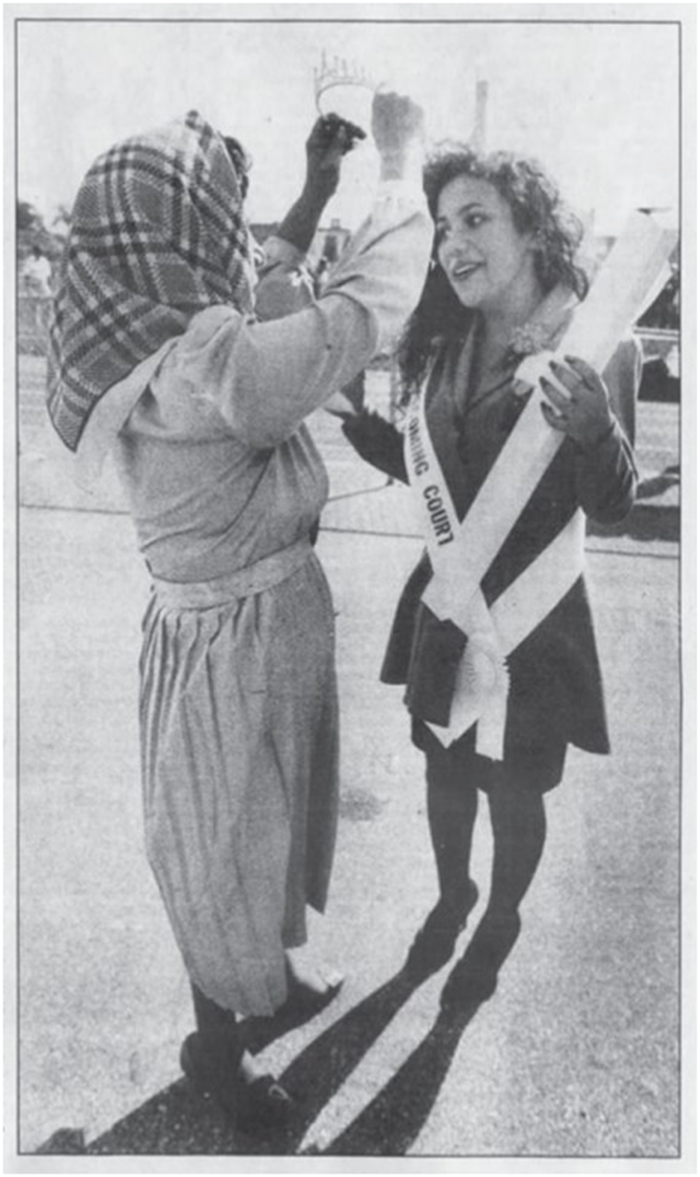
At the same time that schools challenged cultural expectations, they also offered pathways for successful hybrid identities. Fay Saad, a seventeen-year-old American-born Fordson High School student, embodied the tug-of-war between Arab and American identities that unfolded in Dearborn schools in the 1980s and 1990s. In an October 1990 Detroit Free Press article published as part of a special report, Fay is pictured alongside her mother Fatime Saad, who is placing a tiara on her daughter’s head after her Fordson classmates elected her homecoming queen (see Figure 2). Fay Saad noted, “At home, I’m brought up in the traditional Lebanese way and at school, I have to take on a more Americanized role.”Footnote 106 This balancing act was one many students of Arab descent faced. Despite the challenges, the young Saad found peace in the friendships she had made at Fordson with peers who were “in the same situation.” While Saad found solace among those experiencing a similar tug-of-war between their Arab identities at home versus their Americanized identities at school, others took comfort in the relationships they formed with their non-Arab peers. Suehaila Amen recalled her positive experiences in school, even noting her friendship with Polish, Italian, and German Americans. “We didn’t really see a difference. And I was wearing a scarf at seven,” she recalled.Footnote 107 In yet another example, in 1998, the Detroit Free Press published an article focusing on Chaldean and Jewish students attending West Bloomfield High School, located in a suburban area north of Dearborn, and the strong friendships that formed between these diverse groups.Footnote 108 Peer interactions in both instances proved vital to assimilation and the managing of these dual identities.
Fatime Saad (left) and Fay Saad (right). Photograph by Jessica Greene in Jocelyne Zablit, “The Arab Woman? Now She Is Many,” Detroit Free Press, Oct. 18, 1990, 7E.

Figure 2 Long description
A photograph showing a woman placing a tiara on a young woman who is holding a sash. They are outdoors, with the woman wearing a patterned headscarf and a long dress, while the young woman is in a dark outfit. The setting is open, with indistinct structures in the background, suggesting a ceremonial or celebratory moment.
Observing the words, actions, and feelings of Arab American youth and their non-Arab peers attending school in the 1980s and 1990s addresses the ways schools forced youth to contend with their multilayered identities. Even as more established generations readily embraced the process of Americanization, many still acknowledged persistent conflicts between these groups. For newer arrivals to the country, the tension they experienced in schools only compounded their feelings of isolation and longing for home.
Conclusion
In Dearborn, Michigan, during the 1980s and 1990s, Arab American communities and their youth asserted their identities as they pressed local schools to adopt policies responsive to youths’ linguistic, religious, and cultural needs. At the same time, these institutions often resisted efforts to fully accommodate these populations, ultimately restraining the cultural expression of the Arab-descendant students they served. Political battles, the assertion of linguistic needs, and demands for religious accommodations proved crucial for Arab Americans who fought for schools to honor, and in some cases foster, the identities and values of their students.
White ethnic prejudices, supported by then mayor Michael Guido’s anti-Arab platform, failed to halt the expansion of bilingual education in schools. Similarly, outcry against the supposed “hypocrisy” of institutional accommodations for Islamic practices fell on deaf ears as community leaders and students incrementally gained more recognition regarding in-school Islamic practices.
Heavily influenced by media, international events, and perceptions held by White ethnic communities, peer interactions in schools reveal how students of Arab descent navigated non-Arab youth acceptance of and opposition to their identities. Most significantly, both Arab and non-Arab youth attempted to make sense of what it meant to be Arab and American. In the process, peer acceptance of Arab youths’ American identities through sports, investment in American high school traditions, and friendships, indicates some degree of institutional success in assimilating Arab youth to American ways of life.
Dearborn public schools in the 1980s and 1990s, while resistant to the demands of Arab American youth and their communities, ultimately conceded to the needs and developing identities of the Arab American populations they served. In the process, students of Arab descent who spent much of their time within these predominantly White, Judeo-Christian institutions found themselves assimilating to life in the US. For Arab American communities in Dearborn, public schools became a place of give and take.
Examination of Arab-descendant youth in schools reshapes what we know about educational injustice for groups living with multifaceted racial, religious, and social identities. Continued study of this population may illuminate the complex tapestry of shared identities experienced by Americans of Arab descent as well as other marginalized populations, and the related ways in which these groups, through their time in schools, challenged conceptions of who is and is not American.
Alexandra Pasqualone is a joint PhD student in Educational Policy Studies and History at the University of Wisconsin-Madison. This manuscript has been supported by funding from the Walter P. Reuther and Bentley Historical Libraries, as well as assistance from the NAEd/Spencer Foundation. The author is incredibly thankful for the participants who trusted her with their stories as well as comments from her adviser, Professor Walter Stern. Most importantly, the author is grateful for the love and support of her partner, Seth Heller.
Disclosure Statement
The author has reported no competing interests.