As a colonizer of the gastrointestinal tract, enterococci are commonly implicated in both community-acquired and healthcare-associated infections (HAIs). From 1997 to 2016, enterococci accounted for 5%–10.7% of all bloodstream infections (BSIs) reported to the SENTRY antimicrobial surveillance program, with North America reporting the highest prevalence.Reference Pfaller, Cormican, Flamm, Mendes and Jones1 Overall, enterococci are the second most common antimicrobial-resistant pathogens associated with HAIs, ranking second for central-line–associated bloodstream infections (CLABSIs) and catheter-associated urinary tract infections (CAUTIs) in intensive care units (ICUs), and second for surgical site infections.Reference Weiner-Lastinger, Abner and Edwards2
Optimizing timely and appropriate initial antimicrobial therapy for critically ill patients with sepsis and septic shock is a cornerstone of care that decreases mortality.Reference Kumar, Roberts and Wood3 Moreover, delay to appropriate vancomycin-resistant enterococcal (VRE) therapy has been associated with increased 30-day mortality.Reference Zasowski, Claeys, Lagnf, Davis and Rybak4 Until rapid diagnostic testing becomes more widely available, identifying mechanisms that improve empiric antibiotic selection for patients at high risk of infection with antibiotic-resistant organisms is warranted. Screening for methicillin-resistant Staphylococcus aureus (MRSA) colonization via nasal swab and VRE colonization via rectal swab has been historically utilized to prevent horizontal transmission in hospitalized patientsReference Muto, Jernigan and Ostrowsky5; however, active surveillance and contact precautions have not been shown to consistently reduce acquisition rates.Reference De Angelis, Cataldo and De Waure6–Reference Huskins, Huckabee and O’Grady8
Similar to studies evaluating the clinical utility of MRSA nasal swabs,Reference Sarikonda, Micek, Doherty, Reichley, Warren and Kollef9 studies in hospitalized and immunocompromised cohorts have evaluated the ability of polymerase-chain reaction (PCR)–based rectal swab to identify VRE-colonized patients and subsequently predict VRE infections.Reference Butler-Laporte, Cheng, McDonald and Lee10–Reference Tavadze, Rybicki and Mossad12 In these studies, it has been challenging to extrapolate to critically ill patients due to low rates of subsequent enterococcal infections, low patient acuity, or an extended duration between rectal swab collection and the enterococcal infection. The purpose of this study was to determine the predictive ability of a vanA rectal swab in critically ill adults with an enterococcal BSI.
Methods
This retrospective cohort study was conducted at a large academic medical center and included patients with an enterococcal BSI between January 1, 2007, to September 1, 2014, identified by an institutional data repository. Patients were excluded if they were <18 years of age, did not have a vanA rectal swab, had a vanA rectal swab >14 days prior to the enterococcal BSI, had a vanA rectal swab collected after blood culture results were available, were not in the ICU or transferred to the ICU within 24 hours of blood culture collection, had a positive VRE BSI within the 1 year preceding the included BSI, were incarcerated, or were placed in hospice or comfort care at the time of blood culture results. For patients who were readmitted to the ICU during a single hospital stay or during the study period, data collected during the first admission meeting inclusion and exclusion criteria were collected. At our institution, routine screening for VRE colonization was discontinued for ICU patients in 2015. This investigator-initiated study was performed to identify unique antimicrobial stewardship efforts in critically ill patients. Approval from our institutional review board was obtained prior to the study.
The primary objective of this study was to determine the sensitivity, specificity, positive predictive value (PPV) and negative predictive value (NPV) of a vanA rectal swab collected within 14 days of an enterococcal BSI to predict VRE BSI.Reference Butler-Laporte, Cheng, McDonald and Lee10,Reference Brasg, Elligsen, MacFadden and Daneman13 Secondary objectives were to evaluate these end points in 3 subgroups: (1) if the vanA rectal swab was collected within 7 days of an enterococcal BSI; (2) if the vanA rectal swab was collected within 3 days of an enterococcal BSI; (3) which patients were in the cohort of immunocompromised patients with a vanA rectal swab collected within 14 days of an enterococcal BSI; and (4) the impact of a positive vanA rectal swab on empiric antimicrobial therapy selection, defined as therapy initiated or active from time of blood culture collection to blood culture result availability.
During the study period, institutional policy required screening for VRE colonization by rectal cotton swab by the bedside nurse for all patients at ICU admission and for inpatients on oncologic wards as an infection control measure. Chlorhexidine bathing and enteric decolonization were not employed during the study period. All hospital rooms were private single-patient rooms. Patients with a positive vanA rectal swab were placed on contact precautions with a door sign that required gloves and a gown to enter the patient’s room for the duration of hospitalization. Repeat and follow-up swabs were not authorized under the protocol, and repeat results were not analyzed for the study. A separate hospital policy for contact precaution discontinuation required the patient to be off antibiotics active against VRE for at least 48 hours with a negative vanA rectal swab. Rectal swabs were collected and analyzed using Xpert vanA Assay (Cepheid, Sunnyvale, CA), an FDA-cleared PCR test for amplification and detection of vanA vancomycin-resistant gene sequence directly from rectal-swab specimens. Blood cultures were analyzed during the study period utilizing the BacT/Alert (bioMérieux, Durham, NC) or the BD BACTEC (Becton, Dickinson, Sparks, MD). PCR-based assays and gene profiling were not utilized for blood culture analysis during the study period.
Definitions
Patients were considered immunocompromised if they were a solid organ or bone marrow transplant recipient, had human immunodeficiency virus (HIV) or acquired immunodeficiency syndrome (AIDS) or had an active cancer diagnosis or an autoimmune disease receiving an immunosuppressive medication and/or prednisone equivalent of >20 mg/day prior to admission. Neutropenia was defined an absolute neutrophil count <1,000 cells/µL; central line was defined as a central vascular access device in place for at least 48 hours prior to time of blood culture collection; and abdominal surgery was defined as an open or laparoscopic procedure prior to culture during that admission. Sequential organ failure assessment (SOFA) score was calculated using the worst value from the first 24 hours following ICU admission.Reference Ferreira, Bota, Bross, Mélot and Vincent14 A multidrug-resistant (MDR) organism was defined as resistant to 3 or more classes of antibiotics. A patient was classified as having a history of an MDR organism if isolated from any site during the year prior to the index enterococcal BSI. If multiple species of enterococci were isolated in the index BSI, the most resistant species was utilized to calculate end points. Receipt of empiric antibiotics was defined as an active antibiotic order at the time that blood cultures were positive. To characterize the impact of the vanA rectal swab results on clinical decision making, a change in gram-positive empiric antibiotic coverage was documented if the antibiotic changed within 6 hours of blood-culture positivity, thus prior to antibiotic susceptibilities.
Statistical analysis
Nominal data are reported as number (%), parametric continuous data are reported as mean (standard deviation, SD), and nonparametric continuous data are reported as median (interquartile range, IQR). Patient characteristics were analyzed using the t test, the Wilcoxon test, or the Fisher exact test, as appropriate. The ability of a vanA rectal swab result to correctly classify patients according to VRE-positive blood cultures was assessed to calculate sensitivity, specificity, positive predictive value (PPV), negative predictive value (NPV), positive likelihood ratio (LR), and negative LR. A receiver operating characteristic (ROC) curve analysis was conducted to assess the discrimination performance of vanA rectal swab. Area under the ROC curve (AUC) was estimated with 95% confidence intervals using the Delong method. For all analyses, P < .05 was considered statistically significant. Analyses were performed using JMP Pro version 15 software (SAS Institute, Cary, NC).
Results
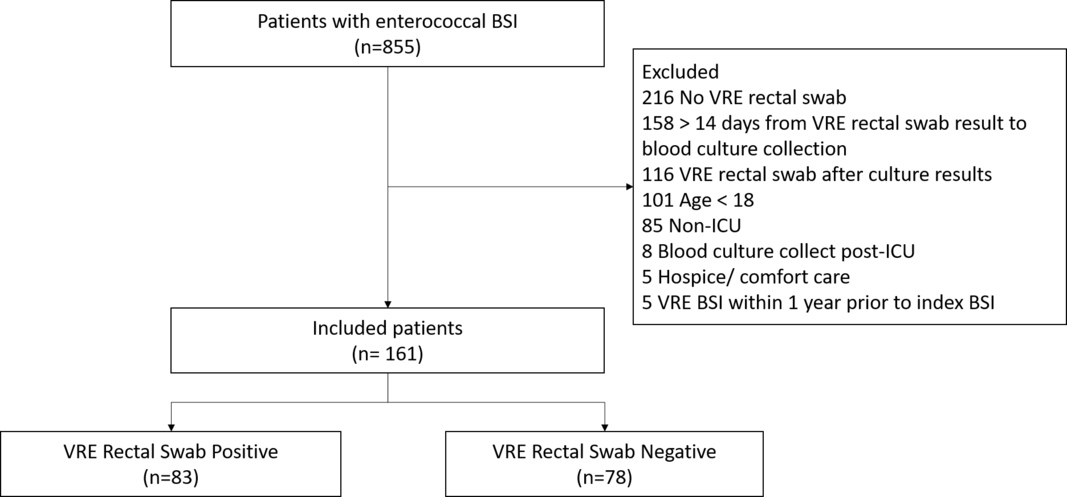
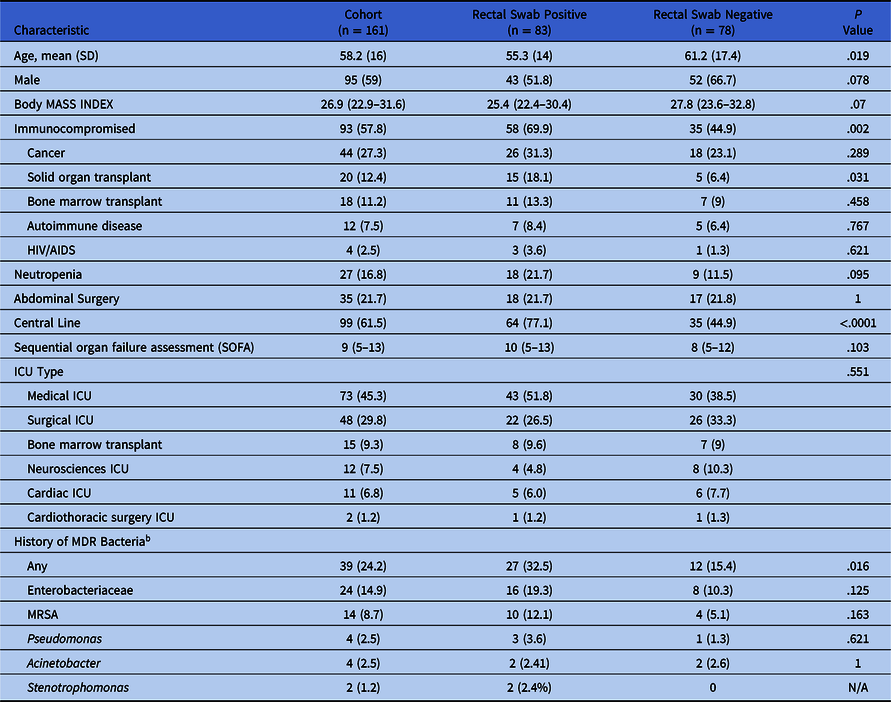
In total, 855 patients with an enterococcal BSI were identified within the study period, with a 74.7% swab compliance rate, of whom 161 met criteria for inclusion (Fig. 1). Demographics and clinical characteristics are summarized in Table 1. VanA rectal swab–positive patients were more likely to be younger, to be immunocompromised, to have a central line, and to have a history of MDR bacteria. The median time from vanA PCR collection to result was not different between groups: 0.64 days (IQR, 0.42–0.91) versus 0.71 days (IQR, 0.50–0.71) (P = .654) (data available 55 patients). The time from blood culture collection to first result was not different between the groups: 0.96 days (IQR, 0.85–1.2) versus 0.91 days (IQR, 0.72–1.1) (P = .16) (data available for 158 patients). The ICU was the first inpatient unit of contact for 84 patients (52.1%). The medical ICU had the largest proportion of patients with VRE BSI (see supplementary digital content online).
Study enrollment.

Baseline Characteristicsa

Note. SD, standard deviation; HIV, human immunodeficiency virus; AIDS, acquired immunodeficiency syndrome; ICU, intensive care unit; MDR, multidrug resistant; MRSA, methicillin-resistant Staphylococcus aureus.
a Data are reported as no. (%) or median (IQR) unless noted.
b Patients may have multiple MDR bacteria.
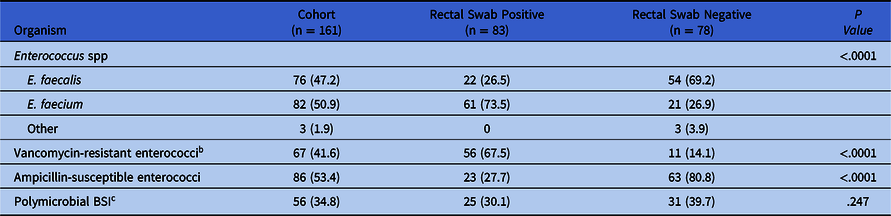
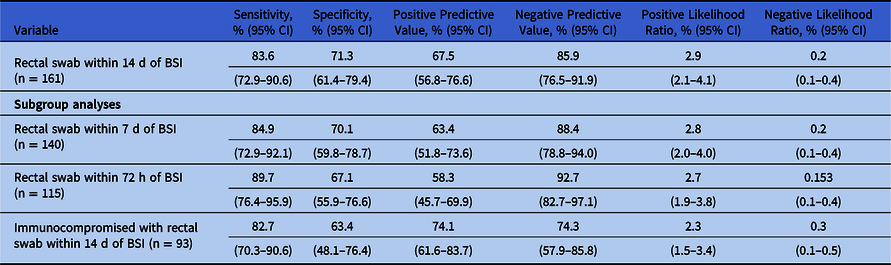
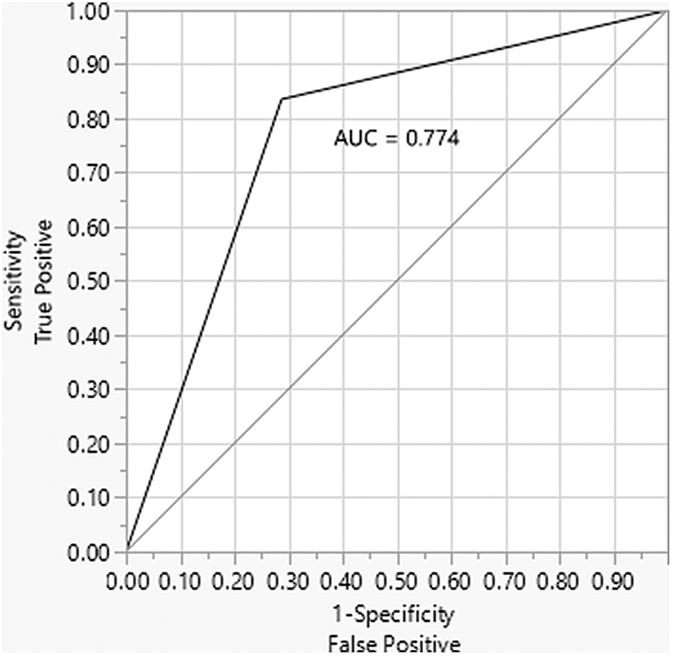
Microbiological data are reported in Table 2. Patients with a positive vanA rectal swab were more likely to have E. faecium isolated and were more likely to have a vancomycin-resistant enterococcal BSI. A vanA rectal swab had similar sensitivity, specificity, PPV, and NPV for predicting a vancomycin-resistant enterococcal BSI in critically ill adults across subgroups (Table 3). The AUC was 0.774 (95% CI, 0.702–0.834) for the vanA rectal swab to predict VRE BSI when collected within 14 days of the blood culture (Fig. 2). When collected within 3 and 7 days of the blood culture, the AUCs were 0.784 (95% CI, 0.706–0.847) and 0.775 (95% CI, 0.701–0.839), respectively. In immunocompromised patients, the AUC was 0.731 (95% CI, 0.632–0.811).
Microbiology of Bloodstream Infectionsa

Note. BSI, bloodstream infection.
a Data are reported as no. (%).
b All vancomycin-resistant isolates were susceptible to daptomycin and linezolid.
c Polymicrobial organisms included Enterobacteriaceae (n = 18); coagulase-negative staphylococci (n = 17); Candida spp (n = 8); S. aureus (n = 6); anaerobes (n = 5), other enterococci (n = 5).
Predictive Performance of Rectal Swab for Vancomycin-Resistant Enterococcal Bloodstream Infection

Note. BSI, bloodstream infection.
Receiver operating characteristic.

Patients with a positive vanA rectal swab were more likely to have empiric VRE coverage (14.5% vs 2.6%; P = .01). Empiric VRE coverage was started in 12 patients (17.9%) with a VRE BSI and 2 (3.2%) of those without vancomycin resistance. Antibiotics were started prior to the rectal swab in 52 patients (32.3%) of the entire cohort. Empiric VRE coverage was started before the rectal swab in 6 patients. Among 67 patients with a VRE BSI, 26 (38.8%) received antibiotics start prior to the swab and 3 (4.5%) received empiric VRE coverage. Antimicrobial therapy was changed to VRE coverage when positive cultures were reported more often in patients with a positive vanA rectal swab (16.9% vs 1.3%; P = .0006) to daptomycin (13.3% vs 1.3%) or linezolid (3.6% vs 0%).
The overall ICU mortality and hospital mortality rates were 49 (30.4%) and 57 (35.4%), respectively. The ICU mortality and hospital mortality rates were greater in patients with a positive vanA rectal swab: 42.1% versus 17.9% (P = .0011) and 44.6% versus 25.6% (P = .0138). The ICU mortality and hospital mortality rates were also greater in patients with VRE BSI: 46.3% versus 19.1% (P = .0004) and 21.1% versus 14.3% (P = .0008). ICU length of stay and hospital length of stay were not significantly different for vanA swab positive versus negative: 7.7 days (IQR, 3.0–18.5) versus 4.7 days (IQR, 2.2–12.6) (P = .081), respectively, and 21.5 days (IQR, 10.8–39.0) versus 18.5 days (IQR, 9.3–36.1) (P = .294), respectively.
Discussion
For critically ill adults with an enterococcal BSI, the vanA PCR rectal swab yielded a PPV of 85.9% and NPV of 67.5% when collected within 14 days prior to a VRE BSI. A vanA rectal swab within 3 and 7 days of an enterococcal BSI provided similar predictive ability. Patients with a positive vanA rectal swab were younger, more likely to be immunocompromised, to have a central line, and to have a history of MDR bacteria. ICU mortality and hospital mortality were also higher for patients with a positive vanA rectal swab. The results of this study suggest the potential utility of the vanA rectal swab to influence empiric antimicrobial selection and de-escalation for BSI in a mixed ICU population. Differences seen in baseline characteristics suggest that patients with a positive vanA rectal swab had multiple risks for infection with MDR organisms.
Recent studies have examined the predictive value of a rectal swab in various patient populations. Brasg et alReference Brasg, Elligsen, MacFadden and Daneman13 analyzed inpatients and outpatients with an enterococcal sterile site infection and prior vanA and vanB rectal swab at any time. The PPV and NPV were 37% and 99%, respectively, with an AUC of 0.84. In this study, vanA and vanB rectal swabs were performed in a targeted population with history of or at high risk of MDR organisms, likely enhancing the swab predictive ability; however, only 4% of rectal swabs were positive, with 2% of included patients having a VRE BSI. Butler-Laporte et alReference Butler-Laporte, Cheng, McDonald and Lee10 conducted a retrospective cohort study in a mixed population of 241 enterococcal BSI and most recent vanA and vanB screen of the rectum, stool or colostomy collected within 30 days prior to the BSI. A 73.7% sensitivity and 82.2% specificity were reported; however, patient-level data, time between swab and culture, and predictive values for the ICU population were not described. In both of these studies, limited proportions of critically ill patients (46% and 29%, respectively) were included and VRE rectal swabs were only analyzed by PCR if culture growth was found, which limits the generalizability and rapid clinical utility of our findings.
A single-center cohort analysis of surgical ICU patients with a rectal swab within 72 hours of admission, with growth analyzed by pyrrolidonyl arylamidase enzyme testing, by Liou et alReference Liou, Barmparas and Ley11 reported a PPV of 25% and NPV of 25% for the rectal swab to predict any VRE HAI. Incidence of sterile site infection was not reported. Although our study assessed only BSI in a broader ICU cohort to increase generalizability of the rectal swab, our study findings are concordant with Liou et al; we both reported an NPV of the VRE rectal swab of >90% within 72 hours. Thus, the rectal swab may assist with antimicrobial stewardship efforts.
The prevalence of VRE infection in immunocompromised patients has been well-documented. In a meta-analysis of 34 studies of 8,391 patients with malignancy, overall VRE colonization was 20% and VRE-colonized patients were 24 times more likely to develop a VRE BSI than noncolonized patients.Reference Alevizakos, Gaitanidis, Nasioudis, Tori, Flokas and Mylonakis15 Additionally, a history of AIDs, positive HIV status, drug abuse, liver transplantation, and allogeneic hematopoietic stem cell transplantation have also been identified as risk factors for VRE infection.Reference Tavadze, Rybicki and Mossad12,Reference Bhavnani, Drake and Forrest16 Similarly, our study found that a vanA rectal swab had a high PPV for VRE BSI in immunocompromised patients, although lower than the overall cohort.
The strengths of this analysis are the inclusion of patients from any ICU, reporting of clinical characteristics including severity of illness, an evaluation of timing of the vanA rectal swab in relation to its predictive ability, and the inclusion of a diverse immunocompromised patient population to enhance generalizability. A large sample of VRE BSI were identified, aiding our prediction analysis as evidenced by the narrow confidence intervals in the primary outcome. The limitations of this study include those inherent to retrospective study design, including reliance upon accurate documentation in the medical record. BSI was chosen for analysis to decrease identification of colonization, thereby increasing PPV at the expense of NPV and limited generalizability of our findings to all enterococcal infections. The rectal swab screening PCR assay employed was specific to the vanA phenotype, which may limit the test’s sensitivity to other van phenotypes. The source of the enterococcal BSI and sources of other infections were not collected due to inconsistent chart documentation. Information regarding overall VRE prevalence during the study duration was not available.
Institutions with VRE screening already in place for infection control purposes may be able to use VRE rectal swabs to assist in antimicrobial stewardship efforts in the ICU population. In the clinical setting, a higher PPV would be warranted to implement a universal screen on all ICU patients.
Acknowledgments
Financial support
No financial support was provided relevant to this article.
Conflicts of interest
All authors report no conflicts of interest relevant to this article.
Supplementary material
To view supplementary material for this article, please visit https://doi.org/10.1017/ice.2020.1218