INTRODUCTION
Several species of Heteroptera, commonly known as sunn pests, are responsible for kernel damage in common wheat, Triticum aestivum L. (Poaceae). These species feed on wheat, piercing the stems, leaves and ears. With early attacks during the crop life-cycle, they can cause serious economic losses from a decrease in grain yield, mainly due to losses in kernel weight. Later attacks during the grain-filling period can cause a reduction in baking quality (Paulian & Popov Reference Paulian, Popov and Hafliger1980), with the maximum damage occurring when sunn pests feed at the late milk-ripe stage (Vaccino et al. Reference Vaccino, Corbellini, Reffo, Zoccatelli, Migliardi and Tavella2006). The compromised quality results from the actions of proteolytic enzymes injected into kernels by the insects via their saliva. The activity of such proteases is low in the flour but it increases when dough is formed, leading to protein degradation and alteration of gluten structure, without modifying other physicochemical properties (Aja et al. Reference Aja, Pérez and Rosell2004; Pérez et al. Reference Pérez, Bonet and Rosell2005).
Proteases are highly specialized, with specific hydrolysing effects on the high molecular weight (HMW) subunits of glutenins (Every et al. Reference Every, Sutton, Shewry, Tatham and Coolbear2005; Vaccino et al. Reference Vaccino, Corbellini, Reffo, Zoccatelli, Migliardi and Tavella2006), which are primarily responsible for gluten quality and contribute to dough strength and elasticity (for a comprehensive review on HMW glutenins and their role in wheat processing quality see Shewry et al. Reference Shewry, Halford, Tatham, Popineau, Lafiandra and Belton2003). The digestive glutenin-hydrolysing proteinases (GHPs) from Eurygaster integriceps Puton (Heteroptera: Scutelleridae) were purified from infested wheat seeds (Darkoh et al. Reference Darkoh, El-Bouhssini, Baum and Clack2010) and from both damaged kernels and salivary glands (Konarev et al. Reference Konarev, Beaudoin, Marsh, Vilkova, Nefedova, Sivri Özay, Koksel, Shewry and Lovegrove2011). Very recently, such enzymes were cloned and expressed in heterologous systems (Hosseininaveh et al. Reference Hosseininaveh, Bandani and Hosseininaveh2009; Dolgikh et al. Reference Dolgikh, Senderskii and Konarev2014; Yandamuri et al. Reference Yandamuri, Gautam, Darkoh, Dareddy, El-Bouhssini and Clack2014) and their exploitation as gluten modifiers for specific food applications is promising (Olanca & Sivri Özay Reference Olanca and Sivri Özay2010; Konarev et al. Reference Konarev, Beaudoin, Marsh, Vilkova, Nefedova, Sivri Özay, Koksel, Shewry and Lovegrove2011).
The strong depletion of wheat technological quality due to sunn pests highlights the importance of bug damage control before batch processing. The practical tolerance for bug-damaged kernels in industry, regardless of wheat type (common or durum) or variety, is 0·02–0·03 (Canhilal et al. Reference Canhilal, Kutuk, Kanat, Islamoglu, El-Haramein and El-Bouhssini2006). Damage can be detected through visual inspection of the kernels, which are characterized by a discoloured halo around the stylet penetration point (Critchley Reference Critchley1998). Sometimes, however, such detection is not completely reliable and should be combined with complex biochemical analyses, such as reverse-phase or size-exclusion high performance liquid chromatography and free zone capillary or gel electrophoresis (Sivri et al. Reference Sivri, Sapirstein, Köksel and Bushuk1999; Rosell et al. Reference Rosell, Aja, Bean and Lookhart2002; Aja et al. Reference Aja, Pérez and Rosell2004). At the technological level, one of the most specific methods to detect bug damage on grains and flour is the sodium dodecyl sulphate (SDS) sedimentation volume test (SSV) proposed by Every (Reference Every1992). In addition, Mixolab®, a recent instrument that can be used to accurately describe the technological behaviour of flour dough, is a suitable tool for the rapid detection of sunn pest damage in common and durum wheat flour (Blandino et al. Reference Blandino, Marinaccio, Ingegno, Pansa, Vaccino, Tavella and Reyneri2015). A micro-method combining both technological and biochemical assessment was also developed and shown to be valid for protease damage detection (Vaccino et al. Reference Vaccino, Corbellini, Reffo, Zoccatelli, Migliardi and Tavella2006). However, there remains a requirement for a method to rapidly assess wheat batch injury by sunn pests.
Among sunn pests, the species of the genera Eurygaster and Aelia (Heteroptera: Pentatomidae) are the most prominent on wheat in Europe (Ruiz et al. Reference Ruiz, Monleón, Pujol, Gordún and Goula2001; Vaccino et al. Reference Vaccino, Corbellini, Reffo, Zoccatelli, Migliardi and Tavella2006), Asia (Kinaci et al. Reference Kinaci, Kinaci, Yildirim and Atli1998) and northern Africa (Vidal Reference Vidal1949; Parker et al. Reference Parker, El-Bouhssini and Skinner2001). In particular, the most noxious pests are E. integriceps in south-eastern Europe and Asia (Critchley Reference Critchley1998), and Eurygaster maura (L.) and Eurygaster austriaca (Schrank) in western Europe (Ruiz et al. Reference Ruiz, Monleón, Pujol, Gordún and Goula2001; Vaccino et al. Reference Vaccino, Corbellini, Reffo, Zoccatelli, Migliardi and Tavella2006). Other important detrimental species in Europe belong to the genus Aelia, particularly the species Aelia rostrata Boheman (Ruiz et al. Reference Ruiz, Monleón, Pujol, Gordún and Goula2001). In New Zealand, common wheat is attacked sporadically by Nysius huttoni White (Heteroptera: Lygaeidae) (Every et al. Reference Every, Farrell, Stufkens and Wallace1998). Moreover, in the USA the green stink bug Nezara viridula (L.) (Heteroptera: Pentatomidae) is also responsible for reductions in wheat germination, kernel weight and kernel texture even when milk stage kernels are infested with only a few individuals (Viator et al. Reference Viator, Pantoja and Smith1983).
In Piedmont, north-western Italy, different species of Pentatomidae and Scutelleridae have been found frequently and sometimes abundantly on wheat, including E. maura, E. austriaca, Aelia acuminata (L.), N. viridula and Carpocoris purpureipennis (De Geer). To implement effective and sustainable pest control strategies, it is crucial to know the actual harmfulness of these species and the specific detrimental damage they cause to common wheat. The objectives of the present work are to make clear the real harmfulness of each of those five species on T. aestivum, and to develop a more reliable and rapid method to assess bug damage detection even at very low damage levels, by comparison with usual visual detection of damaged kernels.
MATERIALS AND METHODS
Bug collection and mass rearing
During the early spring of 2011 and 2012, large quantities of A. acuminata, C. purpureipennis, E. austriaca, E. maura and N. viridula were collected in wheat fields of Piedmont (north-western Italy) and transferred to the laboratory. Here, field-collected individuals were first identified following the keys of Ruiz et al. (Reference Ruiz, Goula, Infiesta, Monleón, Pujol and Gordún2003) and Tamanini (Reference Tamanini1959). Then, individuals of A. acuminata, E. austriaca and E. maura were reared on kernels and potted plants of wheat, and individuals of C. purpureipennis and N. viridula were reared on French bean pods (Phaseolus vulgaris L., Fabaceae). All mass-rearings took place in 3-litre plastic boxes. The lid of each box (265 × 175 mm2) was cut in the middle and closed with net. Mass rearing was conducted in climatic chambers at 25 ± 1 °C, 70 ± 5% relative humidity and in a 16L : 8D photoperiod.
Exposure of wheat to bug feeding in agronomic trials
The experiments were carried out in Leinì, Piedmont (45°11′N 7°42′E, 245 m a.s.l.), in two growing seasons (2010/11 and 2011/12). The two widely cultivated bread wheat cultivars, Bologna and Aubusson, were grown in the experimental field. According to the Italian wheat quality classification system (Borasio Reference Borasio1997), cvar Bologna is a high-quality wheat with hard seed texture, while cvar Aubusson is an ordinary bread-making wheat with medium endosperm texture. Both cultivars were grown according to an integrated crop management programme, with sowing in mid-October, weed chemical control with active ingredient (a.i. tribenuron-methy) and fungal disease control (a.i. prochloraz) in late April. A total of 170 kg N/ha was applied as a granular ammonium nitrate fertilizer, split as follows: 50 kg N/ha at wheat tillering, growth stage (GS) 23 according to Zadoks et al. (Reference Zadoks, Chang and Konzak1974), 80 kg N/ha at stem elongation (GS 32) and 40 kg N/ha at booting (GS 46), according to the rate suggested by the local government for yield optimization.
The study was conducted according to a completely randomized experimental design with five or six treatments in 2011 and 2012, respectively (A. acuminata, C. purpureipennis, E. maura, N. viridula and a control without insects, plus E. austriaca in 2012), and five replications. In both years, in early June, at booting stage (GS 46) white sleeve cages of polythene nets (1·5 m long, 0·4 m diameter, 60 mesh), supported by one pole in the ground, were placed on each cultivar, for a total of 50 cages (five treatments × five replications × two cultivars) in 2011 and 60 cages (six treatments × five replications × two cultivars) in 2012. The cages were mounted on the wheat plants in order to contain at least 20 spikes, and they were closed at the base and over the vegetation to prevent insect entry and escape. On 20 June 2011 and 12 June 2012, at the ripening stage between late milk and early dough (GS 80), two 5th-instar nymphs of the respective bug species were introduced to each cage, to provide a high infestation rate, since the damage threshold for E. maura is 5 individuals/m2 (Pinna et al. Reference Pinna, Arnoulet, Gamba, Ingegno, Pansa, Tavella, Ferro and Peris2012). In 2011 and 2012, the nymphs were left for 18 and 22 days, respectively, and then removed. In both years, the bug mortality in the sleeve net cages was recorded for all species by an accurate inspection of cage content. Spikes were harvested from each cage, placed in paper bags and transferred to the laboratory for quality analysis.
Analytical methods
Spikes from each cage were threshed separately. Thousand kernel weight (TKW) was assessed by weighing two independent 100-kernel sub-samples. The same 100-kernel samples were used to determine damaged kernel rate (i.e., the percentage of seeds showing, at visual inspection, the typical discoloured area around the point of bug stylet penetration). Samples of 50 g were ground to wholemeal with a 1-mm sieve Cyclotec mill (Foss Tecator AB, Höganäs, Sweden). Protein content (PC) [N × 5·7, dry matter, AACC 39-10 (AACC International 2000)] was determined by a near infra-red (NIR) System Model 6500 (FOSS NIR Systems, Laurel, MD, USA). The SSV was carried out according to Every (Reference Every1992). The specific SDS sedimentation volume (SSSV) was calculated as the ratio between SSV and PC. All analyses were performed in duplicate on each replication.
To analyse gluten protein degradation, the procedure described by Vaccino et al. (Reference Vaccino, Corbellini, Reffo, Zoccatelli, Migliardi and Tavella2006) was followed. Briefly, for each sample, micro-doughs were prepared from 200 mg flour and incubated at 30 °C for 30 min. The glutenin components were subsequently extracted from the micro-doughs and separated by means of SDS polyacrylamide gel electrophoresis (SDS-PAGE). The analyses were carried out on the samples produced in 2012.
Biochemical methods
Antibody production
Eurygaster maura adults feeding on developing wheat grains were briefly anaesthetized by exposing them to carbon dioxide (CO2) and then dissected under a stereomicroscope. Salivary glands (10 pairs) were excised and homogenized in 0·6 ml of ice-cold isotonic saline (0·02 M Tris-HCl pH 7·0) and immediately frozen at −80 °C. Polyclonal antibodies were produced by immunization of rabbits with E. maura salivary gland homogenates at the Istituto di Virologia Vegetale (now Istituto per la Protezione Sostenibile delle Piante), Consiglio Nazionale delle Ricerche (CNR) of Torino, Italy.
Protein extraction
For each bug species, five females and five males were anaesthetized and dissected, and the salivary glands excised as described above. Total proteins were extracted from the salivary glands by incubating salivary gland homogenates with half the volume of cracking buffer 66 mM Tris(hydroxymethyl)aminomethane (Tris-HCl), pH 6·8, 22 g/l SDS, 100 ml/l glycerol, 10 mM dithiothreitol at room temperature for 1 h and then at 95 °C for 5 min.
To study the presence of salivary proteinases in damaged wheat, single damaged seeds or 30 mg of flour or micro-dough were mixed with 750 µl of cracking buffer in which dithiothreitol was substituted by 0·715 M 2-mercaptoethanol, and incubated at room temperature for 1 h. Samples were then heated at 80 °C for 15 min and centrifuged at 13 000 g for 5 min.
Sodium dodecyl sulphate polyacrylamide gel electrophoresis, Western blots and immunostaining
Protein extracts from salivary glands and damaged wheat were separated by SDS-PAGE on 4–12% acrylamide gels using a Mini-Protean® II system (Bio-Rad, Hercules, CA, USA). In the experiments, each gel was always made in duplicate. After electrophoresis, one gel was stained with Coomassie Brilliant Blue R-250 and the duplicate was subjected to Western blotting. Proteins were electro-blotted onto polyvinylidene difluoride (PVDF) transfer membranes using a Trans-Blot® SD Transfer Cell (Bio-Rad, Hercules, CA, USA) according to the manufacturer's instructions. The membranes were blocked for 2·5 h in Phosphate-Buffered Saline (PBS), containing 30 g/l non-fat dry milk and 0·5 ml/l Tween 20 (PBS-T), and incubated overnight with the polyclonal antibody (1 : 1000) raised against E. maura salivary gland protein extract. After washing in PBS-T (3 × 5 min), the membranes were incubated with secondary antibody conjugated to peroxidase (1 : 5000) (Goat Anti-Rabbit IgG Sigma Chemical Company, St. Louis, MO, USA) for 2·5 h and then washed with PBS-T (3 × 5 min). The proteins were detected using diaminobenzidine tablets (Sigma Chemical Company, St. Louis, MO, USA). Primary and secondary antibodies were diluted in PBS-T. All the experiments were performed in three independent replications.
Statistical analyses
The percentage of damaged kernels was compared within years and cultivars using standard analysis of variance (ANOVA), or Kruskal–Wallis analysis when homogeneity of variance (Levene test) and normality (Shapiro–Wilk test) were not achieved. The source of variation years and species were considered as fixed factors during ANOVA of the analytical results. Data on SSV for Aubusson and SSSV for both cultivars were power-cube transformed for homogeneity of variance (Levene test) and normality (Shapiro–Wilk test). For a better interpretation of the data, treatments were also compared separately for each cultivar and year, using Kruskal–Wallis analysis for Aubusson, and one-way ANOVA for Bologna. The SPSS® statistical package for Windows (version 21·0; SPSS® Inc., Chicago, IL, USA) was used for the analyses.
RESULTS
Exposure of wheat to bug feeding in agronomic trials
In 2011, the mortality of bugs at cage opening varied from 0·10 to 0·60, with the highest values for N. viridula and C. purpureipennis in Bologna. In 2012, mortality was higher than in 2011 varying from 0·50 to 1·00, and the highest values were recorded for the same two bug species in Aubusson. All individuals, alive and dead, picked up at cage opening had reached the adult stage.
Analytical results
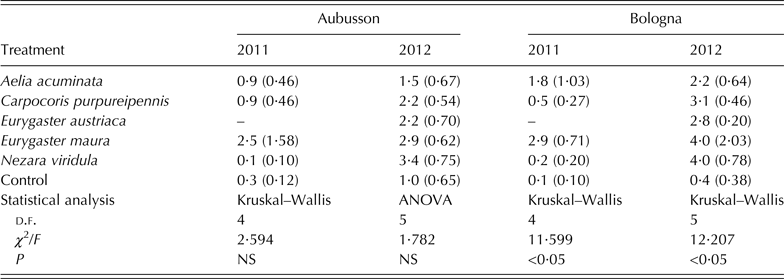
The proportion of damaged kernels (i.e., seeds showing, at visual inspection, the typical discoloured area around the point of bug stylet penetration) was overall higher for both cultivars in 2012 than in 2011. In Aubusson, no differences were found in the proportion of damaged kernels between treatments in both years (Table 1). In Bologna, in 2011 a higher proportion of damaged kernels was found in cages with E. maura while in 2012 the proportion in the cages with all tested insects (always exceeding 0·02) was higher than that in the cages without insects (Table 1).
Mean percentage of damaged kernels in the cages with and without insects on cultivars Aubusson and Bologna in 2011 and 2012

Values in parentheses are s.e.
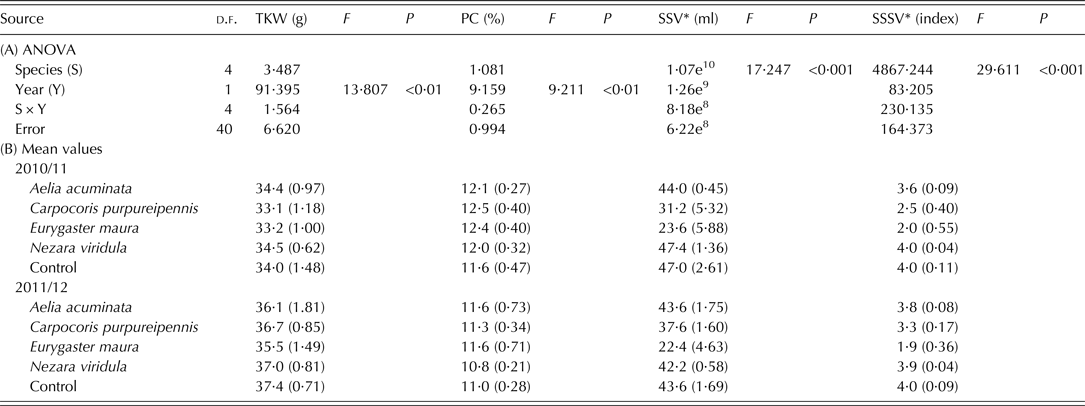
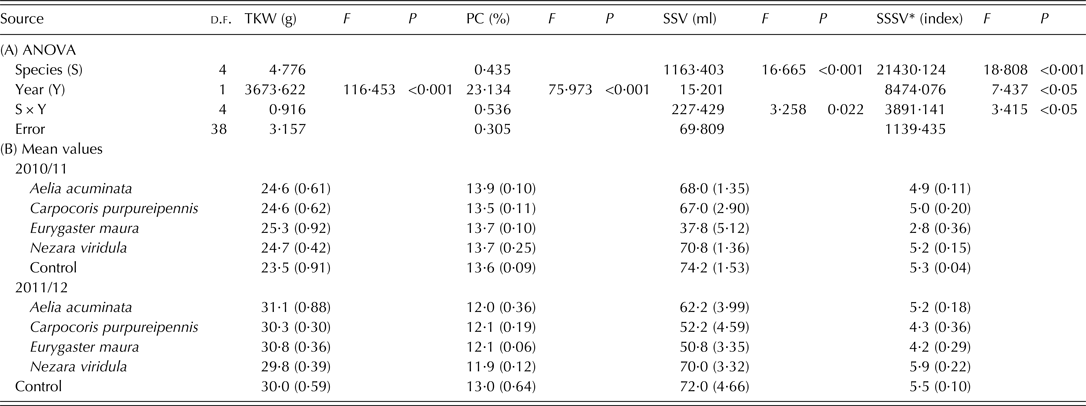
Bug feeding did not affect TKW in either of the cultivars under study. No significant differences were found for TKW of the samples obtained in the cages with different bug species for both cultivars, while some differences were found between years (Tables 2 and 3). Similarly, the protein content was not significantly affected by bug feeding; significant differences (P < 0·05) were found for both cultivars only between the 2 years and not between treatments (Tables 2 and 3).
Analysis of variance (ANOVA) (mean squares) (A) and mean values of the qualitative traits (B) for Aubusson exposed to the different bug species during the growing seasons 2010/11 and 2011/12

TKW, thousand-kernel weight; PC, protein content; SSV, sodium dodecyl sulphate sedimentation volume; SSSV, specific sodium dodecyl sulphate sedimentation volume.
Values in parentheses are s.e.
* Data for analysis were power cube transformed.
Analysis of variance (ANOVA)(mean values) (A) and mean values of the qualitative traits (B) for Bologna exposed to the different bug species during the growing seasons 2010/11 and 2011/12

TKW, thousand-kernel weight; PC, protein content; SSV, sodium dodecyl sulphate sedimentation volume; SSSV, specific sodium dodecyl sulphate sedimentation volume.
Values in parentheses are s.e.
* Data for analysis were power cube transformed.
In contrast, the SSV was affected by bug feeding and varied significantly depending on species (ANOVA: Aubusson 2011 d.f. = 4, 20, F = 8·154, P < 0·001; Bologna 2011 d.f. = 4, 19, F = 25·483, P < 0·001; Aubusson 2012 d.f. = 4, 20, F = 12·389, P < 0·001; Bologna 2012 d.f. = 4, 18, F = 5·646, P < 0·01). In both cultivars and years, the heaviest quality depletion was observed in the cages containing E. maura. The feeding activity of E. maura caused a reduction of SSV in comparison with the control, by 50% on average in both Aubusson and Bologna (23·6 ml v. 47·0 ml, and 37·8 ml v. 74·2 ml, respectively) in 2011, and by 49% in Aubusson (22·4 ml v. 43·6 ml) and 30% in Bologna (50·8 ml v. 72·0 ml) in 2012 (Tables 2 and 3).
In addition, the feeding activity of C. purpureipennis induced a reduction of SSV (by 24% in comparison with the control), showing the heaviest effects on Aubusson in 2011 (31·2 ml v. 47·0 ml) (Table 2). Therefore, this bug species was the most dangerous after E. maura, causing damage in terms of protein degradation and alteration of the gluten structure, except in Bologna in 2011 (Tables 2 and 3).
In contrast, no detrimental effects were observed in the samples from the cages containing E. austriaca (data not shown), N. viridula, or A. acuminata. In fact, these species did not adversely affect wheat quality, because the values of SSV were not significantly different compared with the values of the control without insects (Tables 2 and 3).
Biochemical results
The results of the electrophoresis of glutenins extracted from micro-doughs are shown in Fig. 1. For both cultivars, in the region of the gel corresponding to the high molecular-weight glutenins (HMW-GS), a decrease in the intensity of some components (arrows) was evident in the samples derived from the cages containing C. purpureipennis and E. maura (lanes 2, 4, 8 and 10), which is a sign of proteolytic degradation induced by bug feeding activity. The highest degradation was evident in the sample of Aubusson exposed to E. maura, where the degradation was associated with the appearance of minor fragments (arrowheads) that represented the products of bug proteinase hydrolysis. In contrast, no proteolytic degradation of HMW-GS was observed in the samples exposed to N. viridula, A. acuminata or E. austriaca. In contrast to HMW-GS, the low molecular-weight glutenins (LMW-GS) did not seem to be affected by the feeding activity of any of the bug species tested.
Sodium dodecyl sulphate polyacrylamide gel electrophoresis (SDS-PAGE) of glutenin components extracted from micro-doughs of cvars Aubusson (a) and Bologna (b) exposed to N. viridula (lanes 1 and 7), C. purpureipennis (2; 8), A. acuminata (3; 9), E. maura (4; 10), E. austriaca (5; 11), and a control without insects (6; 12). The regions of the gel corresponding to the high and low molecular weight glutenin subunits (HMW-GS and LMW-GS, respectively) are indicated on the left of the figure. Arrows indicate the components subjected to proteolytic degradation; arrowheads indicate the products of hydrolysis.

The electrophoretic profiles of salivary gland extracts from the five bug species revealed several proteins ranging in molecular mass from around 60 to 350 kDa (Fig. 2(a)). Three major components of about 60, 80 and 120 kDa (Fig. 2(a), arrows) were common to all the species. Other minor components had slightly different mobilities across the species and, within species, between males and females. The polyclonal antibody raised against E. maura salivary glands extracts recognized a similar pattern of polypeptides in E. maura and E. austriaca (Fig. 2(b)). In particular, the antiserum reacted strongly with a fragment of approximately 180 kDa present in E. maura females and in both sexes of E. austriaca (Fig. 2(b), arrowheads), while two fragments of slightly different mobilities were detected in E. maura males. Another component of about 350 kDa was also recognized in both sexes of E. maura (Fig. 2(b), asterisks). The salivary gland extracts from the other insect species either were not recognized (C. purpureipennis) or induced only a weak response (N. viridula and A. acuminata). In general, the antibody reacted more strongly with female than male individuals.
Sodium dodecyl sulphate polyacrylamide gel electrophoresis (SDS-PAGE) of salivary gland extracts from the bug species under study, stained with Coomassie Brilliant Blue R-250 (a) and Western blot of a duplicate gel incubated with the polyclonal antibody raised against E. maura salivary glands (b). Em, E. maura, Ea, E. austriaca, Cp, C. purpureipennis, Nv, N. viridula, Aa, A. acuminata; M, molecular weight standard (Bio Rad ColorBurst); 25 µl of salivary gland extracts were loaded in gel (a), 12 µl in gel (b). Arrows indicate the salivary gland components common to all species; arrowheads and asterisks indicate the major components recognized by the antiserum.

The pattern of polypeptides recognized by the polyclonal antibody on the Western blots of protein extracts from single seeds of Aubusson damaged by each of the five bug species is shown in Fig. 3. Five major and some minor bands, all ranging from approximately 70 to 180 kDa, were recognized in E. maura-damaged seeds; two of these bands were detected, very weakly, also in E. austriaca-damaged seeds. No immune-reactive polypeptides were detected in protein extracts derived from seeds exposed to N. viridula, C. purpureipennis and A. acuminata or from the undamaged seeds used as controls. The same pattern was obtained by using single-damaged seeds from Bologna (not shown).
Sodium dodecyl sulphate polyacrylamide gel electrophoresis (SDS-PAGE) of protein extracts from single seeds of Aubusson exposed to the bug species under study, stained with Coomassie Brilliant Blue R-250 (a) and Western blot of a duplicate gel incubated with the polyclonal antibody raised against E. maura salivary glands (b). Em, E. maura, Nv, N. viridula, Cp, C. purpureipennis, Aa, A. acuminata, Ea, E. austriaca; T, undamaged seed; M, molecular weight standard (Bio Rad ColorBurst); 25 µl of protein extracts were loaded in gel (a), 15 µl in gel (b).

The ability of the antibody to detect damage caused by E. maura was confirmed on protein extracts from flour and micro-doughs (Fig. 4). Starting from a proportion of 0·01 damage, two fragments of approximately 150 kDa were already detectable in both flour and micro-doughs (Fig. 4, arrows).
Western blot of the protein extracts from flour (lanes 1 and 3) and micro-doughs (lanes 2 and 4) of Aubusson with 1% (a) and 2·5% (b) damage by E. maura incubated with the polyclonal antibody raised against E. maura salivary glands. Arrows indicate the components recognized by the antiserum.

DISCUSSION
Although several species of sunn pests are usually found in the Piedmontese wheat fields, the SSV analyses and electrophoresis of glutenins extracted from micro-doughs showed that only a few species are able to seriously damage protein and cause alterations of gluten structure. Among them, E. maura was the most noxious pest, as already reported in previous studies (Rosell et al. Reference Rosell, Aja, Bean and Lookhart2002; Vaccino et al. Reference Vaccino, Corbellini, Reffo, Zoccatelli, Migliardi and Tavella2006), consistent with its role in gluten hydrolysis. In contrast, E. austriaca and A. acuminata, which have been considered important wheat pests for many years (Malenotti Reference Malenotti1931; del Cañizo Reference del Cañizo1941; Goidanich Reference Goidanich1975; Paulian & Popov Reference Paulian, Popov and Hafliger1980; Infiesta et al. Reference Infiesta, Goula, Monleon, Valero and Gordun1999), caused no damage or only a moderate amount of damage to wheat quality. This discrepancy could be due to the wheat cultivars: in fact, Infiesta et al. (Reference Infiesta, Goula, Monleon, Valero and Gordun1999) reported a different level of infestation of Aelia spp. and E. austriaca on cultivars characterized by different protein contents.
In addition, the green stink bug N. viridula did not cause any reduction in kernel weight and protein content. It also did no damage to the gluten proteins, as assessed by the SSV test and the electrophoresis of micro-dough extracts. These results are in contrast to those observed in the USA by Viator et al. (Reference Viator, Pantoja and Smith1983). In addition to the wheat cultivars, the discrepancy may arise from different factors, such as climatic conditions, ripening stage at which the infestation occurred and experimental conditions (i.e., natural or forced bug infestations).
In contrast, C. purpureipennis was very noxious to wheat, and sometimes as noxious as E. maura. Carpocoris purpureipennis is a polyphagous bug species living on several plant species, both arboreous and herbaceous, including hazelnut, willow, pear, rice, wheat, umbelliferous, cruciferous and vegetables (Boselli Reference Boselli1932; Coutin et al. Reference Coutin, Milaire, Monnet and Robin1984; Ribes & Pagola-Carte Reference Ribes and Pagola-Carte2013). Although this bug species was found on wheat in several countries (Djavaheri Reference Djavaheri1979; Stavraki Reference Stavraki1979; Özgen et al. Reference Özgen, GözüaçIk, Karsavuran and Fent2005), sometimes being the dominant species as observed in Sicily (Italy) (Boselli Reference Boselli1932), only in Pakistan was it reported to cause considerable damage to wheat and rice at the ‘earing’ stage (as reported by Anwar Cheema et al. Reference Anwar Cheema, Irshad, Murtaza and Ghani1973, equivalent to ear emergence). In some areas of Piedmont (NW Italy), C. purpureipennis has been frequently collected in wheat fields (Vaccino et al. Reference Vaccino, Pansa, Tavella and Mancuso2012) and the present results demonstrated that this bug species can cause serious wheat damage if present at a high population density.
Visual inspection of kernels was confirmed not to be a fully reliable method to detect damage caused by sunn pests, as previously observed (Vaccino et al. Reference Vaccino, Guidone, Corbellini and Tavella2008). The discoloured area related to stylet penetration was detected in different amounts in all treatments, including the control without insects. Nevertheless, significant differences in the proportions of damaged kernels compared with the control were found only in Bologna in both years, in spite of severe damage revealed by the qualitative analyses in both cultivars. The discoloured area, in fact, may also result from fungal infections (e.g., in the case of black point) or from abnormal starch deposition. On the other hand, SSSV proved to be a valid method for detecting bug damage, but it is strongly related to the content and quality of kernel proteins, and can evaluate gluten damage caused by bugs only indirectly and non-specifically. Gluten structure disruption due to bug activity is directly and effectively assessed by the extraction of the gluten proteins and their evaluation by complex biochemical tests, such as high performance liquid chromatography and gel electrophoresis. Therefore, a rapid test with high reliability is clearly required.
Specific agriculturally important pests have been identified using diagnostic tests based on immunodetection of pest-specific antigens with monoclonal or polyclonal antibodies. By using a polyclonal antibody raised against salivary gland extracts from the hemipteran Leptoglossus occidentalis Heidemann (Heteroptera: Coreidae), Lait et al. (Reference Lait, Bates, Kermode, Morrissette and Borden2001) successfully identified residual salivary proteins on Western blots containing proteins from Douglas-fir seeds that had sustained various degrees of conifer seed bug feeding damage. Moreover, the same polyclonal antibody proved to recognize a large number of proteins in salivary gland extracts from the congenus L. corculus (Say) (Lait et al. Reference Lait, Miller, Bates, Borden and Kermode2003).
The present results show that the antibody-based assay can be effectively used to detect damage by E. maura. The antibody raised against E. maura salivary glands, in fact, proved to be specific to this species. Salivary protein constituents were detected in seeds damaged by E. maura and partly by the congenus E. austriaca, whereas they were not present in seeds exposed to the other bug genera and in the undamaged control. Moreover, this test can be used directly on flour batches, proving to be reliable at a very low damage level. Considering that the practical tolerance for bug-damaged kernels in industry is 0·02–0·03 (Canhilal et al. Reference Canhilal, Kutuk, Kanat, Islamoglu, El-Haramein and El-Bouhssini2006), in the present experiments flour batch contaminations as low as 0·01 could be detected effectively.
In conclusion, in the present work it is proved that only some bug species present on soft wheat fields are seriously harmful and have a negative effect on flour quality, considering the variability of response to bug damage between cultivars. Thus, the usual procedure of population level evaluation by visual inspection in wheat fields (Pinna et al. Reference Pinna, Arnoulet, Gamba, Ingegno, Pansa, Tavella, Ferro and Peris2012), collection and reliable species identification may lead to a sustainable use of pesticides, as recommended by the European regulation (Directive 302 2009/128/EC, EC 2009). Also, in the present work, immunodetection is proven to be a reliable method to detect damage to wheat kernels resulting from feeding by sunn pests. The results are promising for the development of a reliable test for the quick evaluation of commercial wheat flour batches.
We are grateful to Istituto per la Protezione Sostenibile delle Piante, CNR of Torino, Italy, for the production of the polyclonal antibodies against salivary glands of E. maura. The research was funded by Regione Piemonte (research project QUALICHAIN) and Province of Torino, Italy.