INTRODUCTION
Entomopathogenic nematodes in the families of Steinernematidae and Heterorhabditidae are lethal endoparasites of insects. Members of these families form a close symbiotic relationship with bacteria in the genera Xenorhabdus and Photorhabdus, respectively (Thomas and Poinar, Reference Thomas and Poinar1979; Akhurst, Reference Akhurst1982a; Akhurst, Reference Akhurst1983). Entomopathogenic nematode symbiotic bacteria are carried between hosts by the free-living infective juvenile stage and are harboured by infective juveniles (IJs) within special vesicles of steinernematids and throughout the gut tract of heterorhabditids (Forst and Nealson, Reference Forst and Nealson1996). Once released inside the host insect, symbiotic bacteria produce toxins and antibiotics that help overcome the host immune system and modify the environment necessary for nematode development. The nematodes feed on the bacteria and host tissues, develop, and reproduce (1–3 generations within 1 host) until crowding and nutrient depletion trigger the formation of new IJs (Kaya and Gaugler, Reference Kaya and Gaugler1993; Adams and Nguyen, Reference Adams, Nguyen and Gaugler2002). Infective juveniles emerge from the host cadaver and actively search for and infect new hosts (Campbell and Lewis, Reference Campbell, Lewis, Lewis, Campbell and Sukhdeo2002).
The process of host infection by parasites typically involves a series of steps, including host-habitat finding, host-finding, host acceptance, and host suitability (Salt, Reference Salt1935; Laing, Reference Laing1937; Doutt, Reference Doutt and DeBach1964). This model has been adopted widely and has proven useful for understanding the search behaviour of parasites such as parasitoids (Godfray, Reference Godfray1994), trematodes (Combes et al. Reference Combes, Bartoli, Théron, Lewis, Campbell and Sukhdeo2002), and entomopathogenic nematodes (Campbell and Lewis, Reference Campbell, Lewis, Lewis, Campbell and Sukhdeo2002). Foragers typically respond to hierarchical stimuli from the environment in ways that likely improve the probability of encounter with a resource, but this hierarchical set of behaviors is not necessarily rigid (Vinson, Reference Vinson, Nordlund, Jones and Lewis1981; Lewis et al. Reference Lewis, Vet, Tumlinson, van Lenternen and Papaj1990; Vet et al. Reference Vet, Lewis, Papaj and van Lenternen1990; Godfray, Reference Godfray1994). However, some parasite infective stages may not respond to specific cues until the final steps in the infection process, but instead use specific behaviours that increase the tendency to remain in host habitats and increase probability of encounter with hosts (Combes et al. Reference Combes, Bartoli, Théron, Lewis, Campbell and Sukhdeo2002). An encountered organism may be a suitable or unsuitable host and unsuitable hosts may not trigger parasite acceptance. However, within the range of suitable hosts there can be variation in quality that may influence the decision of a parasite to accept a host and initiate changes in behaviour and physiology associated with the establishment of an infection.
For entomopathogenic nematodes, the processes of host-habitat finding (Kaya, Reference Kaya, Gaugler and Kaya1990; Rasmann et al. Reference Rasmann, Köllner, Degenhardt, Hiltpold, Toepfer, Kuhlmann, Gershenzon and Turlings2005) and host-finding (Campbell and Lewis, Reference Campbell, Lewis, Lewis, Campbell and Sukhdeo2002) are better understood than the process of host acceptance. However, the host acceptance step is of critical importance in the infection process of entomopathogenic nematodes. After host encounter, IJs need to make an irreversible ‘decision’ about whether or not to infect that host. Host acceptance may be influenced by the status of the nematode, such as sex, infectivity, and age (Hominick and Reid, Reference Hominick, Reid, Gaugler and Kaya1990; Grewal et al. Reference Grewal, Selvan, Lewis and Gaugler1993; Bohan and Hominick, Reference Bohan and Hominick1996, Reference Bohan and Hominick1997a, Reference Bohan and Hominickb; Griffin, Reference Griffin1996; Renn, Reference Renn1998; Stuart et al. Reference Stuart, Abu Hatab and Gaugler1998; Campbell et al. Reference Campbell, Koppenhöfer, Kaya and Chinnasri1999). Potential hosts may also vary considerably in quality based on the characteristics of the host species/stage, physiological status (e.g. stress, feeding on toxins, etc.), and whether or not they are already parasitized by heterospecific or conspecific entomopathogenic nematodes.
Given the difficulty of conducting behavioural observations in the soil environment, little is known about the probability of IJs encountering a host, the conditional probability of encountering a second host if the first potential host is rejected, or the degree of variation in host quality of encountered potential hosts. However, given that entomopathogenic nematodes and potential hosts are typically patchily distributed in the soil and that the quality of an already infected host as a resource to an IJ can be either higher or lower than that of an uninfected host depending on the time after initial infection, it is important to consider if IJs respond differently to hosts depending on their infection status. Laboratory studies of the proximate behavioural response of IJs to cues from hosts of different quality can enable us to develop predictions about what might be happening in soil ecosystems. Previous studies have indicated that several species of entomopathogenic nematodes respond differently toward parasitized hosts versus non-parasitized hosts. Some studies have found increased attraction to hosts parasitized with conspecifics (Grewal et al. Reference Grewal, Lewis and Gaugler1997; Lewis and Gaugler, Reference Lewis and Gaugler1994), but others have found no changes in attraction (Ramos-Rodríguez et al. Reference Ramos-Rodríguez, Campbell, Christen, Shapiro-Ilan, Lewis and Ramaswamy2007). Changes in infection have also been reported, with both decreases (Glazer, Reference Glazer1997) and increases (Campbell and Lewis, Reference Campbell, Lewis, Lewis, Campbell and Sukhdeo2002) found at some specific time-points after initial infection. However, studies investigating how responses to conspecific infections change over time have been limited.
We investigated the response of IJs at different times post-infection of the entomopathogenic nematode Steinernema riobrave Cabanillas, Poinar and Raulston to hosts previously parasitized with conspecific nematodes to determine if there is a preference for previously parasitized hosts and when this preference might occur. Experiments were designed to focus on the steps in the infection process associated with host acceptance, and excluded behavioural responses associated with habitat-finding and host-finding (e.g. long range attraction). Earlier studies tended to focus on nematode responses to previously infected hosts only within the first 24 h after infection (e.g. Lewis and Gaugler, Reference Lewis and Gaugler1994; Glazer, Reference Glazer1997; Grewal et al. Reference Grewal, Lewis and Gaugler1997). Here, using a combination of no-choice and choice bioassays we wanted to extend these investigations of IJ infection behaviour in response to hosts further along in the infection process. We hypothesized that S. riobrave IJs would exhibit preference for previously parasitized hosts in the early stages of infection (24–48 h post-infection) and avoid infection of hosts in the later stages. Finally, to explore the potential sources of the cues used to make infection decisions, we tested the effect of infection by the nematode/bacterium complex or the bacteria alone on IJ infection behaviour.
MATERIALS AND METHODS
Nematode and insect species
For all experiments, the entomopathogenic nematode S. riobrave, was used (originally obtained from Harry K. Kaya (University of California-Davis)). Nematodes were reared in Galleria mellonella (L.) (Lepidoptera: Pyralidae) at 25°C following methods described by Kaya and Stock (Reference Kaya, Stock and Lacey1997). Ten G. mellonella larvae were exposed to S. riobrave IJs, and after 2 days insect cadavers were transferred to White traps. After emergence, nematodes were stored at room temperature (25°C) in capped 275 ml flasks (NUNCTM EasY, Daigger®, Vernon Hills, IL, USA) for less than 2 weeks prior to use in experiments. In each block of an experiment, we used a batch of IJs from infections set up on different days.
Late instar larvae of G. mellonella (weighing 0·20–0·25 g) or Tenebrio molitor (L.) (Coleoptera: Tenebrionidae) (0·1–0·15 g) from Webster's Waxie Ranch (Webster, WI, USA) and Southeastern Insectaries (Perry, GA, USA), respectively, were used as host insects in the experiments.
No-choice bioassays
Larvae of each host species were exposed individually to 100 IJs in 1·5 ml plastic microcentrifuge tubes (Daigger®, Vernon Hills, IL, USA) with 3 small holes in the lid and 1 hole in the bottom to allow airflow. Nematodes were added in 50 μl of deionized water to a 3·5×1·5 cm piece of grade 360 filter paper (Baxter Scientific Products, McGaw Park, IL, USA) placed inside the microcentrifuge tube. Individual host larvae were then added to each tube. Treatments for the no-choice bioassays were as follows: no larva (control), uninfected larvae or 24, 48, or 72 h post-infection larvae. To obtain all appropriate time-points post-infection on the same day, larvae were infected 1, 2, or 3 days prior to beginning the experiment.
The number of IJs infecting a host was determined by the sand tube bioassay (Lewis, personal communication), which measures the number of IJs not infecting a host. By subtracting the number of IJs remaining in the sand after exposure to the host from the number of IJs originally added to the tube, the number infecting can be determined. The number originally added to the tube was estimated by adding IJs to a control tube into which no host was added and running the tube in parallel to the experimental tubes and then extracting the IJs from the sand. This method was used because insects exposed to nematodes were already infected and therefore already contained nematodes, thus it is difficult to determine which nematodes inside a host resulted from the first versus the second exposure to nematodes. This subtraction method can be more accurate than estimating the average initially infecting from additional control hosts and subtracting this from the total number inside the host. Tests were conducted in a 15 ml conical-bottomed centrifuge tube (17 mm outer diameter×120 mm length) containing 2 ml of washed play sand (<0·595 mm diameter). One hundred S. riobrave IJs were added in deionized water so that the final moisture content of the sand was 10% by weight. One G. mellonella or T. molitor larva (uninfected or 24, 48, or 72 h post-infection) was added to the sand surface in each tube; however, a live larva sometimes burrowed into the sand. The tube was sealed with Parafilm and held at 25°C for 24 h. Control tubes were treated the same, but did not receive a host insect. Two blocks of 5 replicates per insect species of each treatment were performed.
After 24 h, the number of IJs infecting a host was determined by rinsing any remaining IJs from the sand. First, the tubes were filled with deionized water and the insect larvae were agitated in the water and then removed. The sand was then rinsed 4 times with 10 inversions of the tube and the number of nematodes in the rinse water was counted. Nematode extraction efficiency for no insect controls was 98·1%. Therefore, the number of nematodes infecting was determined by subtracting the number of nematodes remaining from the number inoculated (100 IJs).
Choice bioassays-nematode infection
Infective juveniles were presented with a choice between 2 potential host larvae of the same species that differed in their infection status. The following treatment combinations were tested: uninfected/uninfected; uninfected/24 h post-infection; uninfected/48 h post-infection; 24 h post-infection /24 h post-infection; 24 h post-infection/48 h post-infection; and 48 h post-infection/48 h post-infection. Both G. mellonella and T. molitor larvae were used as hosts. Five replicates for each treatment pair were performed for each host species in complete blocks of 1 replicate each by day.
Infection preference exhibited by S. riobrave was determined by using the previously described sand tube bioassay, but instead of counting the remaining nematodes in the sand, each host insect was dissected. The subtraction method of estimating infection, as used in the no-choice experiments, could not be used here because it would not enable us to know how the infecting IJs were distributed between the 2 insects present in the choice bioassay. Instead, as described below, the number of nematodes already established within a host was estimated based on dissections of a representative group of insects prior to the start of the experiment and this number was used to adjust the number of nematodes per host determined at the end of the experiment. Due to the limitations of this method, we could not use choice experiments as late in the host infection process as we could using the no-choice method.
Larvae of appropriate infection status were obtained by infecting larvae 1 or 2 days before starting the experiment. Larvae were infected as previously described for the no-choice bioassays, except that head capsules of 24 h post-infection and 48 h post-infection larvae were marked with different colours of fingernail polish (Bon-Bons, Bari Cosmetics, Ltd) so that they could be identified in the sand tubes at the end of the second exposure. On the day of the experiment, the various insect combinations described above were setup in sand tubes with 100 IJs. Additional 24 and 48 h post-infection larvae were held without a second exposure to nematodes and dissected at the same time as the insects exposed for a second time to nematodes to provide a baseline infection level to adjust subsequent infection number, as discussed later. After 24 h of exposure to IJs, larvae were removed from the tube and placed in labelled dishes until dissection.
Each insect was dissected in deionized water under a binocular microscope and total number of nematodes inside hosts was determined. The number of IJs infecting hosts already parasitized with nematodes was calculated after using an Abbott's correction (Abbott, Reference Abbott1925) by subtracting the number of nematodes inside the host with 2 exposures (24 and 48 h post-infection) from the number of nematodes in each host with only 1 exposure. To incorporate variation from both the first and second exposures, we bootstrapped the Abbott's correction using 10 000 iterations (Resampling Stats 5.0.2, Arlington, VA, USA) and calculated means based on these values. All negative values within the raw bootstrapped data set were replaced with zero. Abbott's correction was used to adjust for the initial number of IJs infecting, which is analogous to adjusting for control mortality.
Choice bioassays-bacterial injection
The choice bioassays were repeated with larvae injected only with the phase 1 (primary) variant Xenorhabdus sp. bacteria. Primary Xenorhabdus sp. cells from S. riobrave IJs were obtained as follows: IJs were sterilized for 1 min in 0·05% sodium hypochlorite solution, rinsed with sterile water once, 1 min in 70% ethanol, and rinsed with sterile water 3 times (Zurek et al. Reference Zurek, Schal and Watson2000). The IJs were crushed using a Kontes pellet pestle (Fisher Scientific Co., Pittsburgh, PA, USA). The total volume of the homogenate was brought up to 1000 μl by adding sterile deionized water, and 100 μl was plated onto 100×15 mm Petri dishes with NBTA (1 litre of nutrient agar, 0·04 g triphenyltetrazolium chloride, and 0·025 g bromothymol blue (Kaya and Stock, Reference Kaya, Stock and Lacey1997)) to allow for the selection of Xenorhabdus bacteria. Pure primary Xenorhabdus colonies were maintained by subculturing every week and colonies used in experiments were less than 20 days post-isolation when used in experiments. Twenty-four hours prior to the beginning of the experiment, cells were removed from a single streak plate and suspended in 75–100 ml of sterile yeast salts (YS) broth [0·5 g K2HPO4; 0·5 g NH4H2PO4; 0·2 g MgSO4·7H20; 5·0 g NaCl; 5·0 g yeast extract; 1 litre of H20 (Akhurst, Reference Akhurst1980)] prior to injection into larvae. Total counts of bacterial cells in the suspension were determined using a Petroff-Hausser bacterial counter (Arthur H. Thomas Co., Philadelphia, PA, USA).
Treatment combinations tested included the following: YS broth injected (control)/YS broth injected (control); YS broth injected (control)/24 h post-bacteria injection; YS broth injected (control)/48 h post-bacteria injection; 24 h post-bacteria injection/24 h post-bacteria injection; 24 h post-bacteria injection/48 h post-bacteria injection, and 48 h post-bacteria injection/48 h post-bacteria injection. Both G. mellonella and T. molitor hosts were used. Hosts of appropriate infection status were obtained by injecting larvae 1 or 2 days before starting the experiment. Surface sterilized larvae of each host species were injected with 0·80–0·85 μl of YS broth containing approximately 2·9×103Xenorhabdus sp. cells or 0·80–0·85 μl of sterile YS broth only (control) using a Hamilton Model 7000 modified 5·0 μl syringe (Fisher Scientific Co., Pittsburgh, PA, USA), which was rinsed in sterile water before each use. We chose the number of bacteria cells to be injected based on the estimated number of cells per infective juvenile multiplied by the average number of founding nematodes calculated from preliminary experiments. Individual injected larvae were placed in 1·5 ml microcentrifuge tubes containing a 3·5×1·5 cm piece of grade 360 filter paper, to which 50 μl of deionized water were added. Host larvae were held at 25°C in the dark. Treatments were arranged in a randomized complete block design blocked by day. Each of the 6 possible treatment combinations for each host species was represented in all blocks (n=5).
Infection preference of S. riobrave was determined as described above for natural infection. Each treatment combination was exposed to a single batch of 100 IJs. After 24 h, host larvae were removed and placed in labelled dishes. All larvae were dissected in deionized water under a dissecting microscope. The number of nematodes infecting was determined by counting the number of juveniles present in each insect.
Statistical analysis
For the no-choice experiment, the best regression models for the relationship between time after initial infection and the number of nematodes infecting a potential host were selected using TableCurve 2D (Systat Software, Point Richmond, CA, USA). No-choice data were also analysed with PROC MIXED (SAS Institute, 2003) and single degree of freedom contrasts (Kuehl, Reference Kuehl2000) for pre-planned comparisons.
To determine if S. riobrave preferred one host to another in choice bioassays using larvae that were infected with S. riobrave IJs, the means of the bootstrapped values for each replicate were compared with paired t-tests (SAS Institute, 2003). Paired t-tests were used to analyse data from choice bioassays in which larvae were injected with primary Xenorhabdus cells. For all choice bioassays (nematode infection and bacteria injection), differences between the average number of nematodes infecting at different time-points after infection regardless of treatment combination and differences between the average total number of nematodes infecting a host for each treatment combination were analyzed using General Linear Models (GLM) (SAS Institute, 2003). Means were separated using Tukey's test with α=0·05 significance level.
RESULTS
No-choice bioassays
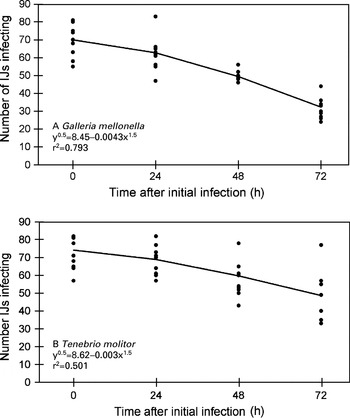
The number of IJs infecting was observed to decrease with increasing time after initial infection in G. mellonella (Fig. 1A) and T. molitor (Fig. 1B). However, infection of previously parasitized hosts continued to occur up to 72 h after initial infection, with an average of 31·7±1·8 and 47·0±4·3 IJs/host for G. mellonella and T. molitor at 72 h post-infection, respectively. In general, a larger range in the mean number of nematodes infecting was observed with G. mellonella (31·7 to 70·4 IJs/host) than with T. molitor (47·0 to 73·0 IJs/host). With G. mellonella, the number of nematodes infecting a previously parasitized host was significantly lower than the number infecting a control (uninfected) insect at all time-points (24, 48, 72 h) after initial infection (PROC MIXED with single d.f. contrasts, 24 h: F=7·44, d.f.=1, P=0·0098; 48 h: F=33·47, d.f.=1, P<0·0001; 72 h: F=134·56, d.f.=1, P<0·0001). In contrast, the number of IJs infecting a previously parasitized host in T. molitor, was significantly different from the uninfected control only at 48 h and 72 h after initial infection (PROC MIXED with single d.f. contrasts, 48 h: F=12·04, d.f.=1, P=0·0014; 72 h: F=30·26, d.f.=1, P<0·0001).
Relationship between number of Steinernema riobrave infective juveniles infecting a host ((A) Galleria mellonella and (B) Tenebrio molitor) and the infection status of the host (uninfected (0 h), 24, 48, and 72 h after initial infection).

Choice bioassays-nematode infection
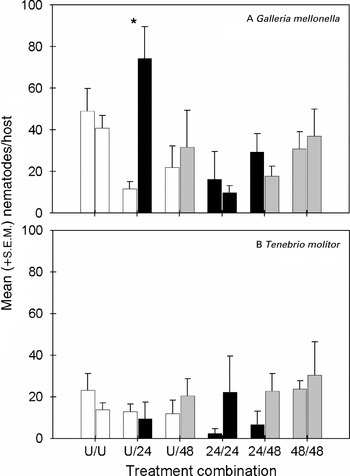
Steinernema riobrave exhibited significant preference for 24 h post-infection G. mellonella larvae over uninfected larvae (paired t-test, t=−4·28, d.f.=4, P=0·013), while all remaining treatment combinations were not significantly different (Fig. 2A). However, the nematode showed no significant preference in any treatment combination involving T. molitor (Fig. 2B), with little or no infection of 24 h post-infection T. molitor larvae. The mean number of nematodes infecting a host at different time-points (uninfected, 24 h post-infection, 48 h post-infection) after infection, regardless of original treatment pairing, was not significantly different for either host species (G. mellonella: GLM; F=0·06, d.f.=2, P=0·9414; T. molitor: GLM, F=2·81, d.f.=2, P=0·0683). In addition, for both host species, the total mean number of nematodes infecting hosts, i.e., combining number of infecting nematodes from both paired hosts, was not significantly different among treatments (G. mellonella: GLM; F=2·12, d.f.=5, P=0·0768; T. molitor: GLM; F=0·84, d.f.=5, P=0·5289).
Infection preference of the entomopathogenic nematode, Steinernema riobrave to hosts ((A) Galleria mellonella or (B) Tenebrio molitor) when presented with 2 late instar larvae with different infection status. Mean (+s.e.m.) number of nematodes are based on infection data corrected for number of founders from first exposure. Combinations tested consisted of uninfected larvae (U, white), 24 h post-infection larvae (24, black), and 48 h post-infection larvae (48, grey). * Indicates treatment combinations in which a significant preference for one host over the other was observed (paired t-test, P⩽0·050).

Choice bioassays-bacterial injection
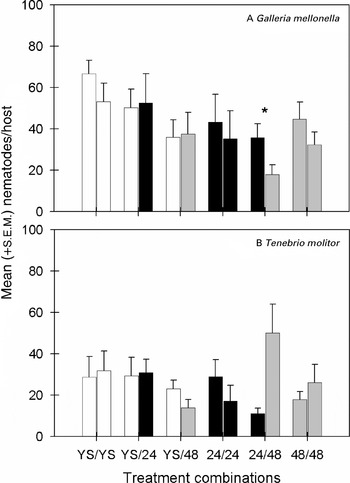
Infective juveniles preferred 24 h post-injection G. mellonella larvae to 48 h post-injection larvae (paired t-test, t=3·58, d.f.=4, P=0·023); no other treatments were significantly different (Fig. 3A). With T. molitor, in contrast, there was no significant preference for any treatment combination tested (Fig. 3B). The mean number of nematodes per host ranged from 18·0 to 66·6 in G. mellonella and 11·0 to 50·2 in T. molitor across treatment combinations. A significant difference was observed for the mean number of nematodes infecting hosts at different time-points (uninfected, 24 h post-injection, 48 h post-injection) after infection regardless of treatment pairing for G. mellonella (GLM, F=3·48, d.f.=2, P=0·0374), but not for T. molitor (GLM, F=0·61, d.f.=2, P=0·5450).
Infection preference of the entomopathogenic nematode, Steinernema riobrave to hosts ((A) Galleria mellonella or (B) Tenebrio molitor) when presented with 2 late instar larvae with different injection status. Bars represent mean (+s.e.m.) number of nematodes per host. Combinations tested consisted of YS injected larvae (YS, white), 24 h post-injection larvae (24, black), and 48 h post-injection larvae (48, grey). * Indicates treatment combinations in which a significant preference for one host over the other was observed (paired t-test, P⩽0·050).

Using 2 types of test, infection of G. mellonella larvae 48 h post-injection by Xenorhabdus sp. was lower than for the control treatments. Means separated using Tukey's test (α<0·050) showed that the number of nematodes infecting hosts 48 h post-injection with bacteria was significantly lower than the number infecting YS broth (control) injected larvae, but the number infecting 24 h post-injection larvae did not differ from any of the other treatments. Moreover, a significant difference among treatments was observed for mean number of nematodes infecting the pair of G. mellonella larvae (GLM, F=3·07, d.f.=5, P=0·0165). The 24 h post-injection/48 h post-injection treatment pair was significantly different from the YS broth injected/YS broth injected treatment pair (means separated using Tukey's test, α<0·050). No other treatment pairs were significantly different. There was no difference for average total number of nematodes infecting T. molitor among any of the treatment pairs (GLM, F=0·75, d.f.=5, P=0·5913).
DISCUSSION
Our original hypothesis, that there would be an increase in infection of previously parasitized hosts early in the infection process, was not supported by the data collected in this study. Infection of the 2 insect hosts, G. mellonella or T. molitor, by the entomopathogenic nematode S. riobrave, at different stages of conspecific infection continued up to 72 h post-infection, the maximum time tested in the current study. In no-choice bioassays, the number of nematodes invading previously parasitized hosts decreased over time post-infection. There were, however, time-points when IJs preferentially infected previously parasitized hosts when presented with a choice (e.g. 24 h post-infection G. mellonella versus uninfected G. mellonella).
Invasion of previously parasitized hosts may be advantageous to an infective juvenile for a number of reasons. First, parasitized hosts have reduced infection risks to invading IJs because they have a compromised immune system and have been conditioned for improved nematode development (Akhurst, Reference Akhurst1982b; Akhurst and Boemare, Reference Akhurst, Boemare, Gaugler and Kaya1990; Akhurst and Dunphy, Reference Akhurst, Dunphy, Beckage, Thompson and Federic1993; Forst and Nealson, Reference Forst and Nealson1996; Isaacson and Webster, Reference Isaacson and Webster2002). Second, for an invading nematode the chances of successful reproduction could increase if the host is already parasitized by conspecifics, at least for sexually reproducing parasite species. Finally, at least at the early time-points post-infection tested in this study, we hypothesized that the level of nutrients in the parasitized hosts were unlikely to be significantly reduced and development and reproduction would still be possible. However, based on our data, it was only in some of the choice bioassays where preference for parasitized cadavers was observed. In no-choice bioassays, infection continued even at time points when we would hypothesize that the environment was becoming unfavourable and it is less likely that an invading infective juvenile could complete its life-cycle and reproduce (e.g. 72 h post-infection). Given the availability of just one host in the no-choice bioassays, the observation of infection occurring much later than expected may simply be the result of nematodes invading the only resource available. How IJs respond to previously parasitized hosts after 72 h could not be determined in this study due to the nature of the bioassay. However, we hypothesize that the number of IJs invading would continue to decrease.
Several studies have shown that as nematode density within a host increases, the number of IJs produced from each invading nematode decreases (Selvan et al. Reference Selvan, Campbell and Gaugler1993; Koppenhöfer and Kaya, Reference Koppenhöfer and Kaya1995; Boff et al. Reference Boff, Wiegers, Gerritsen and Smits2000; Ryder and Griffin, Reference Ryder and Griffin2002). Moreover, Selvan et al. (Reference Selvan, Campbell and Gaugler1993) found that no Steinernema carpocapsae (Weiser) IJs were produced at initial nematode densities higher than 151·0 per host. Koppenhöfer and Kaya (Reference Koppenhöfer and Kaya1995) found that as nematode density within a host increased, the number of Steinernema glaseri (Steiner) IJs produced from each invading nematode decreases. Some studies on the number of IJs invading hosts containing various concentrations of conspecifics did not show a change in the number invading over a range of concentrations (Fan and Hominick, Reference Fan and Hominick1991; Epsky and Capinera, Reference Epsky and Capinera1993; Ryder and Griffin, Reference Ryder and Griffin2002), while other studies have shown a decline in the number invading with increasing concentration (Selvan et al. Reference Selvan, Campbell and Gaugler1993; Koppenhöfer and Kaya, Reference Koppenhöfer and Kaya1995; Boff et al. Reference Boff, Wiegers, Gerritsen and Smits2000). Results from the latter series of studies indicate that it may be possible for IJs to detect and avoid potential hosts with high nematode densities. Other fitness costs that may result at high densities include reduction in adult size (Roberts, Reference Roberts1961; Moss, Reference Moss1971), increased mortality (Hasselberg and Andreaseen, Reference Hasselberg and Andreaseen1975; Chappell and Pike, Reference Chappell and Pike1976; Anderson and Michel, Reference Anderson and Michel1977), and delayed development (Benson, Reference Benson1973; Rotary and Gerling, Reference Rotary and Gerling1973).
Prior studies have also shown that several species of entomopathogenic nematode exhibit preference for previously parasitized hosts within the first 24 h post-infection. Some of these studies have focused on measuring attraction to hosts. Grewal et al. (Reference Grewal, Lewis and Gaugler1997) found that IJs of several species of Steinernema exhibited stronger attraction to hosts parasitized (up to 24 h post-infection) with conspecifics than unparasitized hosts. In a similar study, Lewis and Gaugler (Reference Lewis and Gaugler1994) found an increased attraction of S. glaseri IJs to volatiles from parasitized hosts (4–6 h after nematode exposure) compared to unparasitized hosts. However, Ramos-Rodríguez et al. (Reference Ramos-Rodríguez, Campbell, Christen, Shapiro-Ilan, Lewis and Ramaswamy2007) found no change in attraction of S. glaseri, S. carpocapsae, or S. riobrave IJs to hosts parasitized with conspecifics compared to unparasitized hosts over a period of 24 h from the time of infection until emergence of IJs (96–168 h post-infection depending on species).
Changes in infection behaviour of IJs toward parasitized hosts have also been reported. Using 3 different steinernematids (S. riobrave, S. carpocapsae, and S. feltiae), Glazer (Reference Glazer1997) demonstrated a significant decrease in infection rate 6–9 h after injecting a host with conspecifics. Campbell and Lewis (Reference Campbell, Lewis, Lewis, Campbell and Sukhdeo2002) reported that when S. feltiae was given a choice between a previously parasitized host (24 h) and an unparasitized host significant infection preference was shown for the parasitized host. In the present study, S. riobrave also showed preference for 24 h post-infection G. mellonella over an uninfected G. mellonella. In contrast, results with T. molitor and S. riobrave showed no significant infection preference for any of the host combinations tested. However, interestingly, in all combinations including 24 h post-infection T. molitor larvae, little or no infection by S. riobrave occurred. Thus, there appear to be nematode species, host species, and time post-infection influences on the process of host-finding and host-acceptance.
While the stimuli triggering changes in infection are unknown, it is likely that volatile and non-volatile cues produced by the parasitized host are involved and that both quantitative and qualitative differences in the compounds produced exist. The source of these compounds could be the host, bacteria, or nematodes. Previous studies have shown that IJs respond to a variety of cues including CO2 (Gaugler et al. Reference Gaugler, LeBeck, Nakagaki and Boush1980; Thurston et al. Reference Thurston, Yule and Dunphy1994), host excretory products (Schmidt and All, Reference Schmidt and All1979; Gaugler et al. Reference Gaugler, LeBeck, Nakagaki and Boush1980; Byers and Poinar, Reference Byers and Poinar1982), temperature gradients (Byers and Poinar, Reference Byers and Poinar1982; Choo et al. Reference Choo, Kaya, Burlando and Gaugler1989), presence or absence of bacterial symbionts (Pye and Burman, Reference Pye and Burman1981), and pH (Pye and Burman, Reference Pye and Burman1981). In addition, Shapiro et al. (Reference Shapiro, Lewis, Paramasivam and McCoy2000) found that nitrogen released from cadavers parasitized with Heterorhabditis bacteriophora Poinar attracted IJs early in the infection process when nitrogen levels are low, but repelled IJs later in the infection process when levels are high. Kunkel et al. (Reference Kunkel, Shapiro-Ilan, Campbell and Lewis2006) recently reported that S. glaseri-infected host exudates repel approaching IJs after 48–72 h of infection. Recently, water-soluble compounds such as amino acids and inorganic ions have been implicated in the chemotaxic response of phytopathogenic nematodes (Shingai et al. Reference Shingai, Wakabayashi, Sakata and Matsuura2005). Such compounds may also be involved in the chemotaxis of entomopathogenic nematodes.
Gaugler et al. (Reference Gaugler, LeBeck, Nakagaki and Boush1980) suggested that the level of response by IJs to CO2 depends on the concentration. Ramos-Rodríguez et al. (Reference Ramos-Rodríguez, Campbell, Lewis, Shapiro-Ilan and Ramaswamy2006) found that CO2 production from a parasitized insect changed over time, with 1 or 2 spikes of production occurring after infection. These spikes, however, did not correspond with increased long-range attraction by IJs (Ramos-Rodríguez et al. Reference Ramos-Rodríguez, Campbell, Christen, Shapiro-Ilan, Lewis and Ramaswamy2007). Concentration of CO2, along with other cues, may also be involved in the process of host-acceptance and the location of routes of entry. Some of the patterns observed in the choice bioassays suggest that there may be an optimal level of attractant for infection above and below which a preference is not exhibited. This may explain the differences between G. mellonella and T. molitor and between some of the different paired treatments. Infected G. mellonella at 24 h produce significantly more CO2 than T. molitor at the same time point and CO2 production peaks later in T. molitor (Christen et al., manuscript submitted), suggesting the possibility of a CO2 concentration threshold effect. The idea of a concentration threshold may also help explain the trend for lower infection, although not to a level that is statistically significant, for the 24 h post-infection/24 h post-infection treatment combination of G. mellonella, while strong preference was shown for a single 24 h post-infection larva when combined with an uninfected larva. Since approximately 3 times as much CO2 is produced at 24 h post-infection in comparison with 0 h post-infection, it is possible that the level of CO2 present when two 24 h post-infection larvae were combined decreased infection in general. However, it may also be that 2 strong sources of volatiles may have disrupted the nematode host-finding behaviour, reducing the level of infection.
Symbiotic bacteria appear to play a significant role in the production of CO2 and other compounds from parasitized hosts that may be involved in nematode host-infection (Pye and Burman, Reference Pye and Burman1981; Christen et al., manuscript submitted). In this study, G. mellonella larvae, but not T. molitor larvae, injected with primary phase Xenorhabdus cells elicited a different response by IJs of S. riobrave compared with larvae parasitized with conspecifics. Injection of bacteria caused production of an initial peak of CO2 from a parasitized host that was similar to that produced from an infective juvenile initiated infection, but these hosts did not produce the second peak observed in infective juvenile-infected G. mellonella (Christen et al., manuscript submitted). Since there was no significant difference in the height or the timing of the peak between infective juvenile-infected hosts and bacteria-injected hosts, differences in infection observed between these 2 types of hosts cannot be fully explained by a shift in the timing or strength of CO2 peak. This suggests that either some other cue(s) are involved, which are not produced by the bacteria alone, or that there has been some shift in the timing of the peak that was missed due to the temporal resolution of the bioassay.
While there are likely considerable fitness benefits and costs to infecting a host at different time-points during the progression of an infection, our studies suggest that changes in S. riobrave IJ infection behaviour are limited and they continue to infect, although at a reduced level, beyond when it would appear to maximize their fitness. There are a variety of reasons why nematodes might make what appear to be non-adaptive infection decisions. If the probability of host encounter under natural conditions in the soil is very low, then there may not be strong selection pressure to make host infection decisions; perhaps the best strategy for an IJ under these conditions is to infect any potential host, even when the probability of successful establishment and reproduction is low. Alternatively, IJs may have a limited ability to assess the quality of a host, either because they lack the sensory systems or there is a lack of reliable cues on which to base the decisions. For example, CO2 levels may not be reliable because they vary among host species and while increases in CO2 production from infected hosts occur at a theoretically optimal time to infect, peaks also occur at predicted suboptimal times. Finally, it may be that we are overestimating the costs of infecting a host at these later time-points. The range of laboratory studies conducted to date suggests that the host infection process is complex. Infective juvenile nematodes are exposed to a variety of cues that influence behaviour and can lead to either increases or decreases in infection. Further research is needed to address these broader issues of the role of host infection decisions in the ecology of entomopathogenic nematodes.
This research was supported in part by National Science Foundation Grant Number IBN-0333099. We thank Ludek Zurek and Harry Kaya for their comments on an earlier version of this manuscript. Mention of trade names or commercial products in this publication is solely for the purpose of providing specific information and does not imply recommendation or endorsement by the U.S. Department of Agriculture or Kansas State University. This is Contribution No. 06-303-J of the Kansas Agricultural Experiment Station, Kansas State University, Manhattan, Kansas, USA.