Introduction
Reproductive management of dairy heifers is certainly one area that many dairy producers can improve. Heifers are the most fertile animals in the herd and should have the greatest genetic potential. Dairy producers need to pay more attention to getting heifers bred sooner and breeding them to genetically superior bulls. Heifers should be artificially inseminated (AI) to top sires to further increase the genetic potential (Looper and Bethard, Reference Looper and Bethard2000). Unfortunately, in a number of 126 Jordan dairy farms, only 54% of dairy heifers receive at least one AI service (AI centre, personal communication). Upon asking dairy farmers in Jordan about the reason of using natural service to breed heifers, they claim getting low conception rate with AI service in addition to difficulty and time involved in oestrous detection in heifers. The same observations were reported elsewhere by other workers (Erven and Arbaugh, Reference Erven and Arbaugh1987). This has limited the use of AI in dairy heifers. Synchronisation programs that include timed artificial insemination (TAI), which achieve acceptable pregnancy rates (PR), can increase the use of AI in dairy heifers (Peeler et al., Reference Peeler, Nebel, Pearson, Swecker and Garcia2004). Using the Ovsynch protocol for TAI in dairy heifers decreased PR by 39% compared with AI following observed oestrus (Schmitt et al., Reference Schmitt, Diaz, Drost and Thatcher1996; Pursley et al., Reference Pursley, Mee and Wiltbank1995 and Reference Pursley, Wiltbank, Stevenson, Ottobre, Garverick and Anderson1997). The incidence of oestrus before TAI was higher in dairy heifers (18% to 24%; Rivera et al., Reference Rivera, Lopez and Fricke2004 and Reference Rivera, Lopez and Fricke2005) compared to lactating cows (6% to 9%; Roy and Twagiramungu, Reference Roy and Twagiramungu1996). Meanwhile, synchronisation of oestrus in dairy heifers, using gonadotropin-releasing hormone (GnRH) and prostaglandin F2-alpha (PGF2α) 7 days apart followed by AI on observed oestrus, was more efficient than various protocols using TAI (Peckelhoff et al., Reference Peckelhoff, Kuchenbuch, Kühne, Biedermann and Heuwieser2000). Cows and heifers that fail to become pregnant following TAI return to oestrus 15 to 25 days after insemination (Van Cleeff et al., Reference Van Cleeff, Macmillan, Drost, Lucy and Thatcher1996; Chenault et al., Reference Chenault, Boucher, Dame, Meyer and Wood-Follis2003). Hence, intensive oestrus detection and reinsemination of heifers returning to oestrus is required to maximise the number of heifers becoming pregnant to AI. Progesterone-releasing (P4) intravaginal device (CIDR: controlled internal drug-releasing dispenser) for 7 days can be used to synchronise the return to oestrus in non-pregnant cows (Chenault et al., Reference Chenault, Boucher, Dame, Meyer and Wood-Follis2003; Alnimer and Lubbadeh, Reference Alnimer and Lubbadeh2008).
Pregnancy loss contributes to reproductive inefficiency in dairy cows because fertility assessed at any point during pregnancy is a function of both conception rate and pregnancy loss (Fricke, Reference Fricke2002). Early embryonic mortality in cows returning to oestrus before day 24 after insemination is around 20.5% to 43.6%, and late embryonic mortality in cows returning to oestrus after day 24 is around 8.0% to 17.5% (Humblot, Reference Humblot2001). However, 5% to 20.5% of pregnancies in lactating dairy heifers were lost between 30 and 75 days of gestation (Smith and Stevenson, Reference Smith and Stevenson1995; Fricke et al., Reference Fricke, Guenther and Wiltbank1998; Rivera et al., Reference Rivera, Lopez and Fricke2004). The hypotheses of the current study was that incorporating the intravaginal progesterone device between day 14 and day 20 after TAI synchronise the return to oestrus and increase the reinsemination rate of non-pregnant heifers. Therefore, the purpose of the present study was to evaluate the efficacy of using CIDR device to synchronise the return to oestrus in dairy heifers failing to conceive to first TAI and to evaluate embryonic survival to first service and increase PR in heifers which are reinseminated for the second, third or fourth time.
Material and methods
This experiment was conducted on a private dairy farm at Alkhaldia area, Northern part of Jordan at 32°33′N, 35°51′E, during the period between September 2006 and January 2007. Friesian heifers were born in the same farm and were sorted by age to different pens and managed until 13 months; then they are transferred to open barns provided with shade. Heifers were fed, according to the National Research Council recommendations (NRC, 1989), a total mixed ration of forage (corn silage and alfalfa hay) and concentrate (corn, barley, wheat bran, soybean meal and minerals with vitamins) containing 1.71 Mcal of net energy of lactation (NEL)/kg and 13% CP (dry matter (DM) basis) throughout the experiment. Heifers had ad libitum access to fresh water. Body condition scores (BCS) were assigned to every heifer, before synchronisation protocol, by the same evaluator throughout the experiment using a quarter point scale from 1.0 to 5.0, where 1.0 = emaciated and 5.0 = obese (Ferguson et al., Reference Ferguson, Galligan and Thomsen1994). Live body weight (BW) was recorded for every heifer before synchronisation protocol.
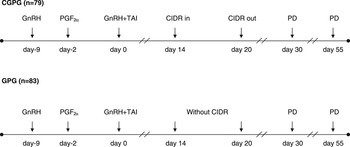
At the onset of the TAI protocol (day −9), heifers were randomly assigned into two groups (treated group CGPG, n = 79) and (control group GPG, n = 83). All heifers were subjected to TAI protocol without regard to the stage of the oestrous cycle (Figure 1). Every heifer in both groups was injected with a GnRH agonist (Buserelin, Receptal®; Intervet International B.V, Boxmeer, Holland) and PGF2α (Lutalyse; Pharmacia & Upjohn S.A., Puurs, Belgium) as follows: 10 μg GnRH on day −9, 25 mg PGF2α on day −2, 10 μg GnRH and TAI on day 0. Heifers in both groups received TAI within 30 min after the second GnRH injection. All heifers received the protocol with TAI or received AI (before the last hormonal injection) within 64 days from the onset of the protocol. In addition, heifers were subjected to oestrus detection program during the experimental period. The program included an ALPROTM system with an activity meter (Delaval International AB, Tumba, Sweden) fitted to the neck of every heifer to detect and record the activities exhibited by the heifer when she approaches heat and transmits data every hour to a computer. In addition, standing heat was confirmed by visual observation. Every heifer observed in oestrus before scheduled TAI on day 0 was inseminated to maximise pregnancy. AI throughout the experiment was performed by one experienced AI technician using tested semen (ABS Global, Inc., Deforest, Wisconsin, USA).
Schematic diagram of treatment protocols used in the experiment. All heifers in both treatments were injected with gonadotropin-releasing hormone (GnRH) on day −9; prostaglandin F2-alpha (PGF2α) on day −2; GnRH and timed artificial insemination (TAI) on day 0. On day 14 after TAI, every heifer in the CGPG group received intravaginal progesterone-releasing device (CIDR: controlled internal drug-releasing dispenser). Devices were removed on day 20 after TAI. Following CIDR removal, all heifers were observed for signs of oestrus, pregnancy diagnosis (PD) were performed at day 30 and day 55 after TAI to confirm pregnancy and determine embryonic loss.

On day 14 after timed insemination, every heifer in the CGPG group received controlled internal drug-intravaginal progesterone-releasing device containing 1.38 g progesterone (CIDR; Pharmacia & Upjohn, Mt Wellington, Auckland, NZ). Devices were removed on day 20 after TAI. Following CIDR removal, heifers were observed for signs of oestrus using the same procedures (ALPRO™ system and visual observation) between days 20 and 30 after TAI, herein referred to as the resynchronisation-of-oestrus period. Heifers that exhibited oestrus in this period were mated by AI. Heifers in the GPG group served as control and were observed for oestrus between days 20 and 30 after TAI to be compared to the resynchronisation group in this period and every heifer detected in oestrus was inseminated as in the CGPG group.
Pregnancy diagnosis was conducted on day 30 after TAI using transrectal ultrasonography (scanner 100 Vet, equipped with a 5.0 MHz transducer; Pie Medical, Maastricht, The Netherlands). Pregnancy was determined by visualisation of a fluid-filled uterine horn and the presence of a conceptus was used as positive indicator of pregnancy (Fricke et al., Reference Fricke, Guenther and Wiltbank1998). A second pregnancy diagnosis was performed on day 55 after TAI to confirm pregnancy and to determine the number of embryos that were lost between day 30 and day 55 post AI.
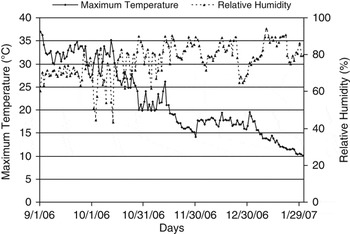
Heifers in both groups, which were diagnosed non-pregnant on days 30 and 55, received new injections of 25 mg PGF2α and inseminated 12 h after any observed oestrus till the fourth AI that ended at mid-December. Mean maximum temperature and relative humidity during the experimental period were obtained from the Official National Station at Alkhaldia area (Figure 2). PR was defined as the proportion of all treated heifers that were pregnant on days 30 and 55 post insemination. Overall PR was defined as proportion of all pregnant heifers up to fourth AI. Synchronisation returns to oestrus was calculated as:
Trend of maximum daily temperature and relative humidity during the experimental period.


Logistic regression models (Proc logistic) of the Statistical Analysis Systems Institute (SAS, 2000) were used to analyse PR to first breeding and embryonic losses between days 30 and 55 post TAI using a stepwise selection procedure to determine independent variables at predetermined significance levels (P < 0.10). Mathematical models for reproductive responses included effects of treatments (CGPG and GPG) and months as class variables and BCS, BW and Age as covariates; however, effects of BCS, BW and Age were not significant (P < 0.3) for all measurements. To assess potential carryover effects of CIDR devices to synchronise return to oestrus after TAI, the model included proportion of heifers that return to oestrus after CIDR removal, days from TAI to 3 days after CIDR removal and days to pregnancy diagnoses up to day 30. The general linear model (GLM) of SAS (2000) was then utilised using the reduced model of the significant variables determined by the logistic regression. All continuous variables were analysed using GLM procedure of SAS. Cumulated PRs to first, first to second, first to third and overall upto fourth inseminations between treatments were compared. For all heifers, days from TAI to second AI, second to third and third to fourth and number of AI per pregnant heifer were analysed using two-way analysis of variance.
Results
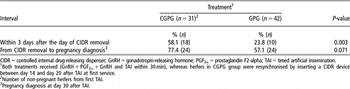
Mean BW of heifers before synchronisation protocol (CGPG 365 ± 2.5; GPG 364 ± 2.4 kg), BCS (CGPG 2.67 ± 0.016; GPG 2.66 ± 0.015 units) and mean age (CGPG 14.8 ± 0.037; GPG 14.9 ± 0.036 months) did not differ significantly between groups. During TAI program, around 16% (26/162) of the heifers exhibited oestrus and were inseminated to maximise PR prior the last hormonal injection. In addition, 3.7% (5/136) of those heifers, which returned to oestrus after TAI program, were reinseminated at detected oestrus for the same purpose. Meanwhile, during the period of CIDR device administration (group CGPG), no heifers showed oestrus. Around 39% (31/79) and 50.6% (42/83) of heifers in the CGPG and GPG groups diagnosed were not pregnant on day 55 after TAI. Therefore, percent heifers observed in oestrus after resynchronisation is presented in Table 1. The proportion of heifers that showed oestrus within 3 days after the day of CIDR removal was higher (P = 0.003) for heifers in the CGPG group compared to heifers in the GPG group. Similarly, the proportion of heifers that showed oestrus from CIDR removal upto day 30 post TAI in CGPG group tended to be higher (P = 0.071) than that for heifers in GPG group.
Percent heifers observed in oestrus after resynchronisation

CIDR = controlled internal drug-releasing dispenser; GnRH = gonadotropin-releasing hormone; PGF2α = prostaglandin F2-alpha; TAI = timed artificial insemination.
1Both treatments received (GnRH + PGF2α + GnRH and TAI within 30 min), whereas heifers in CGPG group were resynchronised by inserting a CIDR device between day 14 and day 20 after TAI at first service.
2Number of non-pregnant heifers from first TAI.
3Pregnancy diagnosis at day 30 after TAI.
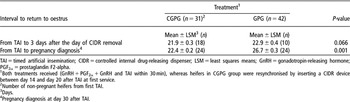
Mean interval to return to oestrus from TAI to 3 days after the day of CIDR removal in CGPG group tended to be lower (P = 0.066) than that for heifers in GPG group (Table 2). Meanwhile, mean interval to return to oestrus from TAI to day 30 was lower (P = 0.001) for heifers in the CGPG group compared to heifers in the GPG group.
Mean interval from TAI to return to oestrus

TAI = timed artificial insemination; CIDR = controlled internal drug-releasing dispenser; LSM = least squares means; GnRH = gonadotropin-releasing hormone; PGF2α = prostaglandin F2-alpha.
1Both treatments received (GnRH + PGF2α + GnRH and TAI within 30 min), whereas heifers in CGPG group were resynchronised by inserting a CIDR device between day 14 and day 20 after TAI at first service.
2Number of non-pregnant heifers from first TAI.
3Days.
4Pregnancy diagnosis at day 30 after TAI.
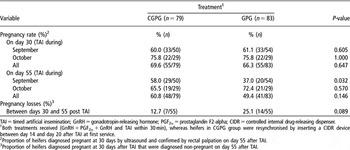
Pregnancy rate on days 30 and 55 and pregnancy losses between days 30 and 55 post first TAI during September and October for both groups are described in Table 3. No differences were detected in PR on day 30 between groups. A month (P = 0.032), September but not October, effect was detected in the PR on day 55. PR on day 55 was higher for heifers in the CGPG group compared to heifers in the GPG group. Collectively, PR for heifers that were inseminated during September was lower (P = 0.042) than that for heifers inseminated during October. No differences were observed in PR for the other months (November, December and January) between either groups or months.
Pregnancy rate on days 30 and 55 and pregnancy losses for heifers in both groups

TAI = timed artificial insemination; GnRH = gonadotropin-releasing hormone; PGF2α = prostaglandin F2-alpha; CIDR = controlled internal drug-releasing dispenser.
1Both treatments received (GnRH + PGF2α + GnRH and TAI within 30 min), whereas heifers in CGPG group were resynchronised by inserting a CIDR device between day 14 and day 20 after TAI at first service.
2Proportion of heifers diagnosed pregnant at 30 days by ultrasound and confirmed by rectal palpation on day 55 after TAI.
3Proportion of heifers diagnosed pregnant at 30 days after TAI that were diagnosed non-pregnant on day 55 after TAI.
A tendency (P = 0.089) of treatment group effects was detected in pregnancy losses between days 30 and 55 (Table 3). Pregnancy losses between days 30 and 55 tended to be lower for heifers in the CGPG group compared to heifers in the GPG group.
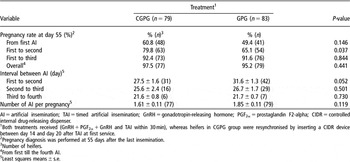
Reproductive performance measured as PR, day interval between successive inseminations and number of services per pregnancy for both groups are described in Table 4. PR from first TAI for heifers in the CGPG group was not different (P = 0.146) from that for heifers in the GPG group. In contrast, PR to second AI was higher (P = 0.037) for the CGPG group compared with the GPG group. No treatment effect was detected between the two groups in PR to third and upto the fourth AI (Table 4).
Pregnancy rate, interval between inseminations and number of services per pregnancy for both groups

AI = artificial insemination; TAI = timed artificial insemination; GnRH = gonadotropin-releasing hormone; PGF2α = prostaglandin F2-alpha; CIDR = controlled internal drug-releasing dispenser.
1Both treatments received (GnRH + PGF2α + GnRH and TAI within 30 min), whereas heifers in CGPG group were resynchronised by inserting a CIDR device between day 14 and day 20 after TAI at first service.
2Pregnancy diagnosis was performed at 55 days after the last insemination.
3Number of heifers.
4From first till the fourth AI.
5Least squares means ± s.e.
A significant effect (P = 0.052) was detected between the two groups in the interval days between first and second AI. Interval between first and second AI was lower for the CGPG group compared with the GPG group, but no effect was detected between the two groups in interval days between AI from second to third and from third to fourth. Number of services per pregnancy was not different between CGPG and GPG groups (Table 4).
Discussion
In the present study, all heifers were synchronised by GPG protocol and received first TAI by day 0 of the AI breeding period. This strategy not only increases the AI service rate and groups heifers to conceive more uniformly, but also concentrates on the return to oestrus for heifers failing to conceive to first TAI. During the synchronisation protocol, 16% heifers showed oestrus before the second GnRH injection and 3.7% heifers after TAI and they were inseminated. The overall proportion of heifers displaying oestrus during this protocol was less than that reported by Rivera et al. (Reference Rivera, Lopez and Fricke2005) where they found that 24% of heifers showed oestrus and inseminated before scheduled TAI, when the GnRH injection was initiated at a random stage of the cycle followed 6 days later by PGF2α. Meanwhile, the possible physiological basis for the occurrence of expression of oestrus during the GPG protocol in dairy heifers has been described in previous studies (Rivera et al., Reference Rivera, Lopez and Fricke2004 and Reference Rivera, Lopez and Fricke2005).
The percent of heifers observed in oestrus was higher in the CGPG group than in the GPG group. After CIDR removal, 58.1% of the heifers that failed to breed from TAI showed oestrus within 1.9 days and 77.4% within 2.4 days for CGPG group compared to 23.8% and 57.1% heifers, which showed oestrus within 2.9 and 6.7 days, respectively, for the control group. Similar observations were found in lactating dairy cows (Chenault et al., Reference Chenault, Boucher, Dame, Meyer and Wood-Follis2003; Alnimer and Lubbadeh, Reference Alnimer and Lubbadeh2008), beef heifers (Colazo et al., Reference Colazo, Kastelic, Mainar-Jaime, Gavaga, Whittaker, Small, Martinez, Wilde, Veira and Mapletoft2006) and in dairy heifers (Van Cleeff et al., Reference Van Cleeff, Macmillan, Drost, Lucy and Thatcher1996; Hanlon et al., Reference Hanlon, Williamson, Steffert, Wichtel and Pfeiffer1997; Rivera et al., Reference Rivera, Lopez and Fricke2005).
In the present study, PRs for the first eligible oestrus after CIDR removal were not different on day 30 which are in agreement with the results reported by Rivera et al. (Reference Rivera, Lopez and Fricke2005) and Colazo et al. (Reference Colazo, Kastelic, Mainar-Jaime, Gavaga, Whittaker, Small, Martinez, Wilde, Veira and Mapletoft2006) on day 30 in dairy and beef heifers and by El-Zarkouny and Stevenson (Reference El-Zarkouny and Stevenson2004) on day 29 in dairy cows. On the other hand, PRs on day 55 post TAI in the present study were numerically higher (not significant) in CGPG group than in the control which are in agreement with the results of Hanlon et al. (Reference Hanlon, Williamson, Steffert, Wichtel and Pfeiffer1997) who reported a similar PR to a resynchronised oestrus in dairy heifers using CIDR device for 5 days beginning 14 or 16 days after AI. In addition, similar conception rates were found in CIDR-treated and control groups of beef heifers (Colazo et al., Reference Colazo, Kastelic, Mainar-Jaime, Gavaga, Whittaker, Small, Martinez, Wilde, Veira and Mapletoft2006). In contrast, Xu and Burton (Reference Xu and Burton1999) reported reduced PR in dairy heifers after resynchronisation with a CIDR device from day 16 to day 21 after first AI. In a similar protocol in dairy cows at the same farm, Alnimer and Lubbadeh (Reference Alnimer and Lubbadeh2008) found that PR was significantly higher in CGPG group than in the control. Perhaps, with a larger group of experimental heifers, the present study might have shown significant differences. On the other hand, the higher PRs in the current study, than previous studies, in dairy heifers could be due to the TAI program and oestrus detection system (ALPRO™ system and visual observation).
In the present study, PR was higher for CGPG group in September than that for GPG group and with a tendency of lower embryonic loss in CGPG group than GPG group (Table 3). The differences in PRs or pregnancy losses may be due to high maximum temperature during September (Figure 2). Similar to what occurs in lactating dairy cows exposed to high environmental temperatures, dairy heifers have impaired reproductive performance because of the deleterious effect of heat stress on fertilisation and embryo survival (Hansen and Arechiga, Reference Hansen and Arechiga1999; Wolfenson et al., Reference Wolfenson, Roth and Meidan2000). Dairy heifers exposed to average daily maximum temperatures of 27.5°C had lower PR (Orr et al., Reference Orr, Cowan and Davison1993). In another study, in Florida, heifers inseminated during summer were less likely to conceive than heifers inseminated during winter (Donovan et al., Reference Donovan, Bennett and Frederick2003). Heat stress may reduce embryo quality and development by compromising oocyte quality, increasing the number of degenerated cells, compromising steroidogenesis and reducing progesterone production by the CL formed after ovulation (Hansen and Arechiga, Reference Hansen and Arechiga1999; Wolfenson et al., Reference Wolfenson, Roth and Meidan2000). Therefore, higher PR in the CGPG group may be due to P4 supplementation with the CIDR device between days 14 and 20 after TAI, which might have influenced embryonic development during high ambient temperatures. In 14 studies cited by Santos et al. (Reference Santos, Thatcher, Chebel, Cerri and Galvão2004), they found that late embryonic losses in lactating dairy cows between days 27 and 58 of gestation ranged from 3.2% to 42.7% with an average of 12.8%, while foetal losses were usually less prevalent than late embryonic losses with an average of less than 10.7%. In the present study, however, pregnancy losses in both groups were 18.9%, which are in agreement with the results of previous studies (Smith and Stevenson, Reference Smith and Stevenson1995; Fricke et al., Reference Fricke, Guenther and Wiltbank1998; Rivera et al., Reference Rivera, Lopez and Fricke2004) which reported that 5% to 20.5% of pregnancies in lactating dairy heifers were lost between 30 and 75 days of gestation. In addition, the proportion of Holstein heifers which experienced pregnancy loss between 40 and 90 days of gestation was 3.4% (Chebel et al., Reference Chebel, Braga and Dalton2007).
As expected, PR to second AI was higher for CGPG than for GPG heifers, while no differences were detected in cumulative PRs to third, and upto the fourth AI between the two groups (Table 4). No studies in the literature discussed cumulative PR upto fourth AI after resynchronised oestrus with CIDR device only. The results of this study are in agreement with Rivera et al. (Reference Rivera, Lopez and Fricke2005) who reported that PR to second AI was higher for resynchronised than for control heifers. On the other hand, similar PRs were found after the second AI between resynchronised cows with CIDR compared to control (Chenault et al., Reference Chenault, Boucher, Dame, Meyer and Wood-Follis2003).
Mean interval from TAI to return to oestrus was lower in the CGPG group than in the GPG group, which is similar to the results reported in dairy cows (Alnimer and Lubbadeh, Reference Alnimer and Lubbadeh2008). Meanwhile, mean interval between first and second AI was similar in treated and control dairy heifers (Van Cleeff et al., Reference Van Cleeff, Macmillan, Drost, Lucy and Thatcher1996; Stevenson et al., Reference Stevenson, Johnson and Medina-Britos2003). While, in beef heifers, mean interval from TAI to onset of oestrus was lower for CIDR-treated group than the control (Colazo et al., Reference Colazo, Kastelic, Mainar-Jaime, Gavaga, Whittaker, Small, Martinez, Wilde, Veira and Mapletoft2006). In addition, the number of services per conception (1.61) was better than that in previous studies for dairy cows in TAI where it was 1.7 with CIDR device and 1.78 without CIDR (Alnimer, Reference Alnimer2005; Alnimer and Lubbadeh, Reference Alnimer and Lubbadeh2008).
Conclusion
Results of this study support the hypothesis that a CIDR device when properly used, between days 14 and 20 after TAI program, synchronised the following oestrus in the majority of non-pregnant heifers within few days after CIDR removal and reduced embryonic losses in heifers that did not return to oestrus but PRs were similar for CGPG and GPG groups. PR was higher for the CGPG group in high temperature months than in the GPG group.
Acknowledgements
The Deanship of Research at the University of Jordan is gratefully acknowledged for funding this project (921/2005). The authors express their appreciation to Mohammad Alkhateeb, Mohammad Abu Eaid and Hammoudeh farm for providing facilities and assistance.