Everything which we observe in nature imprints itself uncomprehended and unanalyzed in our percepts and ideas, which, then, in their turn, mimic the processes of nature in their most general and most striking features. (Mach Reference Mach1893/1960, 36)
1. Introduction: Moderate Instrumentalism
Instrumentalism is no longer a popular position and is rarely discussed in serious depth. The action in the realism debate now revolves around more recent alternatives to scientific realism, namely constructive empiricism, entity realism, and structural realism, and it is usually assumed that talk of unobservable entities may be understood literally. This is part of a general backlash against the linguistic turn in philosophy.
But the core idea behind linguistically motivated instrumentalism, such as that of the logical positivists and Ayer, remains plausible. How can we name something with which we are not acquainted—where to be acquainted with an entity is to “have a direct cognitive relation to” or be “directly aware of” the entity (Russell Reference Rescher1911, 108)—unless that name is a substitute for a definite description made in terms of names for things with which we are acquainted (or other names reducible to such descriptions)? It would appear that we cannot. To disagree with Russell (Reference Russell1918) that proper nouns should be understood as substitutes for descriptions does not suggest that we can employ such words in a referential capacity—to “denote the individuals who are called by them” (Mill Reference McMullin and Leplin1843, bk. 1, chap. 2, sec. 5)—without being acquainted with their referents.Footnote 1 Moreover, theoretical terms are typically kind (or type) terms such as ‘electron’, and there is a particular description (e.g., involving a specification of mass, charge, and spin) with which each is associated. Again, how could we understand such terms if we were not acquainted with the referents of the property names mentioned in the associated descriptions? Surely it is a philosophically respectable view that we could not, and I will therefore say no more about it.Footnote 2
But by accepting a fundamental link between naming and acquaintance, one does not arrive at instrumentalism. First, one must add the empiricist thesis that our primary means of becoming acquainted with things—both objects and the properties thereof—is sensory experience. Second, one must add that what we are acquainted with is limited in such a way as to render it impossible to comprehend or discuss (some aspects of) any truth behind the appearances.
The first thesis is uncontroversial; at the very least, most philosophers accept that sensory experience is a major source of acquaintance, that there are many things (e.g., color and pitch) with which we would never become acquainted in the absence of sensory experience, and that the unobservable entities discussed by science are generally taken to have observable effects (by which we are supposed to infer their existence). Note also that the instrumentalist need not deny that we are acquainted with some things by means other than direct personal experience, for example, via innate phylogenetic (or even ontogenetic) knowledge. It is certainly wrong that the thesis “leads inevitably into phenomenalism” (Maxwell Reference Maxwell, Feigl and Maxwell1962, 12).
I shall therefore focus on the second thesis, in what follows. In the light of lessons learned in the debates over the last few decades on constructive empiricism—and with special regard to how van Fraassen's position on science has developed—I will be arguing for a moderate form of instrumentalism, which is unanticipated in the literature. It involves a denial of semantic realism insofar as this pertains to talk of unobservable properties, but not unobservable objects provided that these are defined in terms of observable properties or by analogy with observables. I call this position cognitive instrumentalism because it rests on the notion that we can only think of (and discuss) the unobservable in terms of the observable. I will flesh it out subsequently, but to avoid any early confusion it should be emphasized that an entity may possess an observable property without the property being observable in that peculiar instance. The language of metaphysics, which I use purely for illustrative purposes, helps here. The trope of red of a rose in my garden may be observable in a way that the trope of red of a tiny insect may not be. Yet we may nevertheless say that the unobservable insect instantiates an observable property, namely redness, insofar as some of its instances may be observed.
Now to see how a position like cognitive instrumentalism is typically unanticipated, consider part of Psillos's (Reference Newton-Smith1999, xix) definition of the semantic thesis of scientific realism: “Theoretical assertions are not reducible to claims about the behaviour of observables, nor are they merely instrumental devices for establishing connections between observables. The theoretical terms featuring in theories have putative factual reference.” Agreement with the first claim does not signal agreement with the second. Rather, as we will see, it is possible for an instrumentalist to accept that some theoretical terms “have putative factual reference” but deny that all have it.
Psillos (Reference Newton-Smith1999) is not peculiar in this oversight. The instrumentalist may equally deny what Sankey (Reference Russell2008, 14) instead calls ‘theoretical discourse realism’, namely that “scientific discourse about theoretical entities is to be interpreted in a literal fashion as discourse that is genuinely committed to the existence of real unobservable entities,” without denying that some discourse about theoretical entities should be interpreted literally. As such, it is incorrect to say that “instrumentalism denies the literal interpretation of theoretical discourse” (14); rather, it denies the literal interpretation of some theoretical discourse. If one wishes instead to insist on Sankey's definition of instrumentalism, then one must admit that it is possible to deny ‘theoretical discourse realism’ (or semantic realism) without being an instrumentalist (or a reductive empiricist) and without denying either the metaphysical thesis that, in the words of Psillos (Reference Newton-Smith1999, xix), “the world has a definite and mind-independent natural-kind structure” or a correspondence theory of truth. Either way, there is currently unoccupied territory where sweeping generalizations about theoretical discourse are rejected in place of finer-grained distinctions. The cognitive instrumentalist occupies this territory.
2. Moderate Instrumentalism, Epistemological Voluntarism, and Common Sense
A moderate instrumentalist need not insist that it is irrational to be a scientific realist, or even that instrumentalism is a superior alternative to scientific realism. Instead, it is possible to take a leaf out of van Fraassen's (Reference van Fraassen1980, Reference Shirley2002) book and defend only the view that (cognitive) instrumentalism is a reasonable alternative to scientific realism: that it is reasonable to refuse to take talk of theoretical entities literally when one is not acquainted (or takes oneself not to be acquainted) with the properties (or things in the analogies) discussed.
However, one need not go so far as accepting van Fraassen's brand of epistemological voluntarism in order to do this. Rather, one might suggest that there are no evidential grounds for choosing between cognitive instrumentalism and semantic realism (although there may be prudential or functional grounds). One way to do this is to point to the strategies that some scientific realists employ when the chips are down and they wish to defend the metaphysical thesis that semantic realism presupposes, namely that there is a mind-independent objective world.
Sankey (Reference Russell2008, 23), for instance, appeals to common sense: “Common sense gives rise to a body of beliefs about the objects in our environment and our epistemic and practical interactions with these objects. On the whole, we may assume that this body of beliefs in true. The point is not that our commonsense beliefs are certain, indubitable or infallible. Rather, commonsense beliefs are prima facie justified. … Any attempt to eliminate or overthrow such beliefs is to be regarded with extreme suspicion.” Sankey does not argue, however, that there are evidential reasons for treating commonsense beliefs in such a way (or indicate how such beliefs are prima facie justified in an epistemic sense).Footnote 3 And it is hard to see how he could; even an evolutionary argument is only apt to establish that our beliefs are suitable for us to survive and flourish in peculiar environmental circumstances.
A far more honest approach to defending metaphysical realism, it seems to me, is adopted by Rescher (Reference Psillos1987, 126) when he says it is a “postulation made on functional rather than evidential grounds.” Perhaps we start with other commonsense beliefs on similar functional grounds. But we should nevertheless heed Russell's (Reference Russell1953) illustration of common sense's limitations. In any event, it is hardly a violation of common sense to insist that we can only talk about the kinds of things with which we are familiar and that we extrapolate from those when we write fiction or when we imagine how things might be in the microscopic realm. As such, if we followed Sankey's suggestion above we would take cognitive instrumentalism to be prima facie justified in a way that semantic realism is not. We would regard attempts to overthrow it with extreme suspicion.
3. An Articulation of Cognitive Instrumentalism
But why should we think that unobservable things are different from observable things, with respect to the kinds of properties that they bear? Perhaps one might make the case that some of the difficulties we have encountered with the interpretation of quantum mechanics support this view; for example, one might agree with Bohr that we are bound to use classical concepts that we cannot apply to quantum objects directly but instead employ only as complementary descriptions on a context-by-context basis (Faye Reference Faye1991, Reference Faye and Zalta2008). Similarly, Ladyman (Reference Ladyman1998, 422) suggests that “the demand for an individuals-based ontology may be criticised on the grounds that it is the demand that the structure of the mind-independent world be imaginable in terms of the categories of the world of experience.”Footnote 4 Yet even if we instead admit that there is no evidential reason to expect unobservable things to differ from their observable counterparts, there is equally no evidential reason to expect them all to be similar. As such, there is no evidential reason not to be a cognitive instrumentalist.
But is there a pragmatic reason not to be? Not insofar as expecting the unobservable to be appropriately similar to the observable confers any advantage. There may be a pragmatic reason to render scientific discourse as literal as one can. However, one may do this without taking an overtly hostile view of theories that cannot be construed entirely literally, in the absence of promising alternatives, and therefore avoid falling into the same methodological trap as Mach on the view of Brush (Reference Brush1968).
There are also old worries about the very distinction between observable and unobservable, but the cognitive instrumentalist may use the same resources as the constructive empiricist. It may be admitted that the distinction is vague yet emphasized that there are clear examples on each side (e.g., rabbits and quarks).Footnote 5 On the question of how we work out which properties are observable (or observed) and which are not, and therefore judge whether to take a particular theory literally, the answer is that we may look to science itself (van Fraassen Reference van Fraassen1980, 59). Whether some particular theoretical discourse should be taken literally is therefore an empirical question.
I will now turn my attention to explaining the cognitive instrumentalist's stance on theoretical discourse in more depth, with the aid of historical examples. There are two principal ways in which one may posit unobservables by appeal to observables. The first is by positing unobservable entities that possess observable properties. Sometimes this may be done by straightforward extrapolation. When I hold an apple in my hand, I feel the force that it exerts. But if I halve the apple, and so on, I will eventually reach a point at which there is no discernible force. It does not appear unreasonable, however, to presume that there is a force acting and that said force is in proportion to the amount of apple remaining (as is the case when the forces are discernible). There is an upper limit to the force I can discern too. The difference between having my hand crushed by a car and crushed by a lorry is not directly sensible. We must therefore extrapolate ‘upward’ into some parts of the observable realm as well.
While failing to recognize that ‘upward’ extrapolation may also be required, Mach (Reference Mach1893/1960, 588) provides similar examples of the ‘downward’ process, concerning the frequency of sound and the amplitude of vibrations: “Even when the sound has reached so high a pitch and the vibrations have become so small that the previous means of observation are not of avail, we still advantageously imagine the sounding rod to perform vibrations. … We fill out the gaps in experience by the ideas that experience suggests” (see also Psillos Reference Newton-Smith1999, 19–20). The cognitive instrumentalist differs from Mach in taking such descriptions literally. Unlike Mach, she is not committed to the view that “the world is not composed of ‘things’ as its elements, but of colors, tones, pressures, spaces, times, in short what we ordinarily call individual sensations” (Mach Reference Mach1893/1960, 579) or that “what we represent to ourselves behind the appearances exists only in our understanding, and has for us only the value of a memoria technica or formula” (Mach Reference Mach1911, 49). Nor is she committed to what Brush (Reference Brush1968, 197) appropriately calls ‘empiriocriticism’, namely, “a critical view toward all scientific hypotheses not directly induced from experiment.”
The history of atomism provides some nice examples (see also Mach Reference Mach1893/1960, 587). The atmospheric atomic model of the eighteenth and nineteenth centuries might be taken literally insofar as it involves two different kinds of atoms, matter atoms and ether atoms, attracting and repelling one another (via inverse-square laws), respectively. And similarly, the kinetic theory of gases might be understood literally insofar as it does not “rely directly on a detailed atomic theory” and requires “little more information about atoms than their sizes” (Brush Reference Brush1968, 195). According to cognitive instrumentalism, extrapolation of sizes and attraction and repulsion by inverse-square laws—demonstrable in electrostatic contexts involving charged macroscopic objects—is (plausibly) not merely an artifice.
The second way to posit unobservables by appeal to observables is to employ analogical means. One well-known example is the comparison between the atom and Saturn made by Nagaoka (Reference Mohideen and Roy1904), and such analogies remain commonplace in contemporary physics, as illustrated, for instance, by the analogy of Hawkins and McLeish (Reference Hawkins and McLeish2004) between repressor protein dimers and rigid plates connected by springs. Such analogies are sometimes the subject matter of papers in their own right. Alexander (Reference Alexander1999), for example, suggests an analogy between chemical plants and digestive systems: “Our jaws are grinding machines, our guts are chains of biochemical reactors, our capacities to digest food and absorb the products are designed with substantial safety margins, and it may be useful to think of a mouse as a pilot plant for an elephant.” It would also be extremely difficult to teach science without recourse to analogies concerning macroscopic entities and systems; many of us will remember having electric flow in a wire compared to car flow on a road, with resistance being compared to the number of lanes, and so on.
In the psychological literature on mental models and analogies (see, e.g., Gentner Reference Gentner1983; Blanchette and Dunbar Reference Blanchette and Dunbar2000), superficial similarity is distinguished from structural similarity. The former involves similarity in intrinsic properties (e.g., mass and absolute volume), whereas the latter, which Gentner (Reference Gentner1983) argues is the basis of the most important analogies used in science, involves similarity in internal relations. When we compare an atom to the solar system, for example, we suggest that the nucleus corresponds to the sun, that the electrons correspond to planets, and that gravitational force corresponds to electromagnetic force. But we do not thereby wish to suggest that the nucleus (necessarily) emits radiation, that electrons have a range of masses and compositions, and so forth. What we wish to convey is that the nucleus is much bigger than the electron, that the electrons orbit the nucleus because they are attracted to the nucleus, and so on.
If we look to the history of atomism again, we can see the importance of analogies simply by listing the popular names for various models: billiard ball (Dalton), plum pudding (Thomson), cubical (Lewis), Saturnian (Nagaoka), and planetary (Rutherford). In line with cognitive instrumentalism, moreover, some historians and philosophers of science have argued that such analogies are more than aide-mémoires or dispensable vehicles by which to promote understanding. In the words of Nersessian (Reference Nersessian and Fine2002, 146), “analogies employed in conceptual change are not ‘merely’ guides to reasoning but are generative in the reasoning processes in which they are employed.” She takes Maxwell's method of physical analogy (see Nersessian Reference Nagaoka1988) to illustrate this.
Note that often several different analogies are used to describe the same thing in different contexts. We have already touched on Bohr's notion of complementarity and the idea that we can conveniently think of quantum entities as waves at some points (e.g., during motion) and particles at others (e.g., during energy exchange) without thinking of them as genuine ‘wave particles’. In this regard, it is crucial to appreciate the limited scope of appropriate analogical statements. “Electrons are like waves” is erroneous. “Electrons move like waves” is not.
It appears to be correct to take analogies literally insofar as such analogical statements may have truth conditions (derivative from appropriate structural resemblances being in place). It may be true to say that the sodium and chlorine ions in solid salt are arranged in a way similar to how cannonballs were once typically stacked—after Harriot's investigation, at Raleigh's request, of the most efficient way to do so—and oranges are still stacked by greengrocers (i.e., in a face-centered cubic manner).Footnote 6 However, it is evident that Cassius Clay neither floated like a butterfly nor stung like a bee.
The question now arises of how we should construe talk of theoretical entities that are described in terms of both observable and unobservable properties. (To simplify the discussion, let us forget, for the moment, about analogies.) Take electrons as a case in point, and accept for present purposes that the property of spin is unobservable (as mass and charge are arguably not, e.g., when understood as dispositions to attract and repel).Footnote 7 Should we take talk of electrons literally? The cognitive instrumentalist's answer lies in the negative. But talk of something possessing discrete mass and charge (and therefore similar to the electron) may indeed be taken seriously, and some cognitive instrumentalists may accept that we have isolated such an entity, while believing that the talk of ‘spin’ is just a way to account for its behavior in some circumstances. In short, the story is taken literally enough for the possible existence of something similar to electrons to be acknowledged. Talk of ‘spin’, however, is taken to be a convenient fiction. Note, however, that spin need not be understood to be a fiction merely for explaining how observables interrelate. Rather, the cognitive instrumentalist may understand it as a fiction for explaining how those unobservable things similar to electrons behave.
It may be asked, given this, whether cognitive instrumentalism amounts to little more than entity realism (Hacking Reference Hacking1983). It does not since it denies that it is correct in general to believe in those entities appearing in the theories of contemporary mature science. It is an empirical question as to whether some entity is defined purely in terms of observable properties or by using analogies involving these (and observable objects).
Nor does cognitive instrumentalism entail structural realism, especially of an ontological variety with “epistemic commitment to more than the empirical content of a scientific theory, namely to the ‘structure’ of the theory” (Ladyman Reference Ladyman1998, 415), or structural empiricism (Bueno Reference Bueno1999), insofar as unobservable structures may not mirror observable structures.Footnote 8 Furthermore, cognitive instrumentalism is compatible with (but does not require) a syntactic view of theories, whereas structural realism arguably requires (according, e.g., to Ladyman Reference Ladyman1998) a semantic view. In short, cognitive instrumentalism retains an instrumentalist character—in line with Mach and Duhem on ‘saving the appearances with maximum economy’—insofar as some theoretical discourse is taken to fulfill a purely instrumental role.
4. Conclusion: On the Applicability of Cognitive Instrumentalism
I have outlined a new form of instrumentalism, which is more moderate and defensible than its predecessors. I have already shown that it is reasonable in principle. But the question remains as to whether it is reasonable in practice. In closing, I will use a brief example from contemporary physics in order to argue that it is.
This concerns the virtual particles of quantum field theory, which ex hypothesi violate the relativistic equation for the total energy of an entity ( , where p is momentum and m0 is rest mass), due to considerations relating to uncertainty, and may even possess negative energies (and impart negative momentum). To a cognitive instrumentalist, talk of negative energy (and therefore virtual particles) will likely be taken to be nonliteral in this context. The argument would run that the concept of energy is derived from, and explicable in terms of, observables such as velocity and mass. And in classical contexts, that is, when employing the equation
 , negative kinetic energy is precluded (although it is possible to speak of negative potential energies since the zero point may be arbitrarily defined). Now the cognitive instrumentalist would not object to understanding the notion of energy literally when this is extended into the unobservable realm in a way that is compatible with how it is applied in the observable realm. But this appears to be inconsistent with positing negative energies.Footnote 9
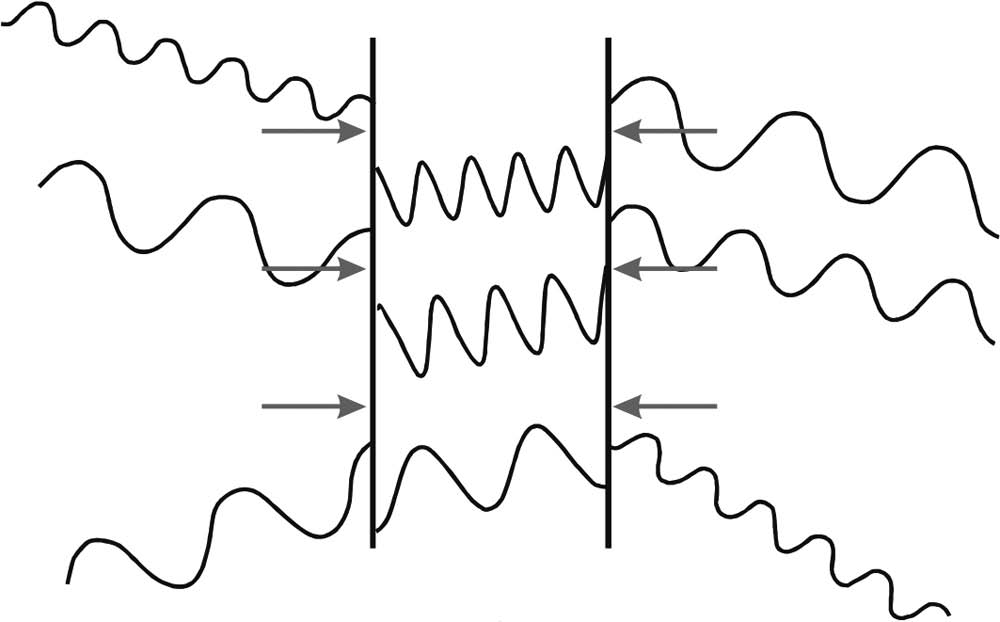
The difference between the scientific realist and the cognitive instrumentalist is therefore brought into perspective by the Casimir effect (e.g., that two parallel uncharged metallic plates in a vacuum experience an attractive force when in close proximity; see fig. 1), which has recently been demonstrated in a number of experiments (see Lamoreaux Reference Lamoreaux1997; Mohideen and Roy Reference Mill1998; Bressi et al. Reference Bressi, Carugno, Onofrio and Ruoso2002). A full-blooded scientific realist will take this as evidence for the existence of virtual particles (and accept the explanation that only virtual particles with wavelengths that fit a whole number of times into the gap between the two plates will appear there, whereas virtual particles with a broader range of wavelengths will appear outside). A cognitive instrumentalist will not because she does not take talk of virtual photons literally.
Casimir effect in terms of virtual particles.

Some physicists would agree with the cognitive instrumentalist stance on virtual particles.Footnote 10 For example, the Web site of the SLAC National Accelerator Laboratory (http://www2.slac.stanford.edu/vvc/theory/virtual.html), which is operated by Stanford University, states: “Virtual particles are a language invented by physicists in order to talk about processes in terms of the Feynman diagrams. … Particle physicists talk about these processes as if the particles exchanged in the intermediate stages of a diagram are actually there, but they are really only part of a quantum probability calculation.” I take virtual particles to be an interesting example because almost anyone adopting cognitive instrumentalism would agree that talk of these is not to be construed literally. And other examples from physics—such as tachyons (which possess imaginary mass)—are possible. Nonetheless, it should be reiterated that cognitive instrumentalists may legitimately disagree with one another about what is an observable property or object.
My aim in this article was to show that instrumentalism is not as obsolete as one might think by looking at the recent literature in philosophy of science. By learning from the failures of previous forms of instrumentalism and helping herself to tactics developed by constructive empiricists and others working in the empiricist tradition, the instrumentalist may adopt a more sophisticated and moderate position (i.e., cognitive instrumentalism).