It has been fifteen years since a national inquiry into rural and remote education by the Human Rights and Equal Opportunity Commission (HREOC) identified that while many Aboriginal parents wanted their children to experience the benefits of a secondary education, many who went to a secondary boarding school away from home struggled to last out the first year (HREOC, 2000a, 2000b). The inquiry reported that Indigenous parents often experienced undue stress and were uncertain about how best to support their children while they were away from home at boarding school. A submission to the inquiry by the Kimberley Land Council (KLC), for example, described how for many Aboriginal families sending a child to boarding school often culminated in a short-lasting and negative experience. The submission outlined that:
… [children] are away from their families and their culture. The language is different. At times, they are inclined to only stay down in Perth about three months or so and then they come back and they don't want to go back [to Perth] because they are away from their families. ( HREOC, 2000a, p. 54–55)
Since the HREOC inquiry in 2000, a growing number of boarding schools have made long-term commitments and undertaken significant efforts to better support Indigenous students from regional and remote communities (Australian Indigenous Education Foundation, [AIEF], 2015). However, concern still exists around the impact that having a child studying away from home has on Indigenous families (Mander & Fieldhouse, Reference Mander and Fieldhouse2009; Prout, Reference Prout2009; Stewart, Reference Stewart2015). At a policy level, the national Aboriginal and Torres Strait Islander Education Action Plan 2010–2014 (Ministerial Council for Education, Early Childhood Development and Youth Affairs, [MCEECDYA], 2011) and the Melbourne Declaration on Educational Goals for Young Australians (MCEECDYA, 2008), as well as more broadly the National Indigenous Reform Agreement – Closing the Gap (Council of Australian Governments, [COAG], 2011), collectively seek to encourage state and territory governments to improve school attendance and retention figures as well as academic outcomes and general access to education for Indigenous children living in regional and remote communities. Despite these policies being in place for several years now, the 2015 Prime Minister's Closing the Gap Report indicated that no progress had been made between the 2008 and 2014 period towards halving the gap in reading, writing and numeracy, as well as little progress to reducing the gap in school attendance rates, between Indigenous and non-Indigenous students (Commonwealth of Australia, 2015, p. 14). The report concluded that overall ‘most Closing the Gap targets are not on track to be met’ (Commonwealth of Australia, 2015, p. 1) and it identified that these gaps were ‘much wider in very remote areas than in metropolitan areas’ (Commonwealth of Australia, 2015, p. 14).
Successive federal governments have allocated significant funding to secondary boarding school initiatives such as the AIEF, for which the Prime Minister personally launched its Compendium of Best Practice for achieving successful outcomes with Indigenous students in Australian boarding schools (Ooi, Reference Ooi2015), and the Cape York Welfare Reform partnership (Stewart, Reference Stewart2015). The federal government also commissioned the Forrest Review which recommended secondary boarding schools as central to meeting the educational needs of Indigenous children and families living in regional and remote communities (Commonwealth of Australia, 2014). Similarly, the Northern Territory Government recently commissioned the Wilson Review of Indigenous education that recommended regional boarding schools as key to improving educational outcomes for Indigenous students living in remote communities (Wilson, Reference Wilson2014). It remains surprising then that no mention is made in the 2015 Prime Minister's Report about boarding schools, or even to the implications for Indigenous families living in remote communities, of sending a child away from home to complete his or her secondary education.
There remains little research that explores the meaning of secondary boarding schools to families living in regional and remote communities, or about the experience for parents of sending a child away to boarding school, and there is even less from the perspective of Indigenous parents (Mander, Reference Mander2012). This paucity in research was most recently emphasised by Stewart (Reference Stewart2015) who notes that even though the Wilson Review and the Forrest Review recommend Indigenous students living in regional and remote communities attend secondary boarding schools, no reference is made to any form of contemporary empirical research by either. Stewart states:
There has been very little in the way of detailed research in the literature around factors which are seen to influence the success or otherwise of the transition to boarding school. As well, there is little in the way of recent research which attempts to ‘go inside’ the experience of transition and understand the experience of those involved –– especially students and their parents and caregivers. (p. 12)
In examining a range of issues influencing Aboriginal children's experiences with education in WA, the Western Australian Aboriginal Child Health Survey (WAACHS) identified that for Aboriginal families living in remote areas of the state, engagement with education was foremost influenced by access to schools and the capacity of parents to get their children to school (Zubrick et al., Reference Zubrick, Silburn, De Maio, Shepherd, Griffin, Dalby and Cox2006). Centrelink figures in 2010 indicated that 793 Aboriginal students in WA received the Aboriginal and Torres Strait Islander Student Assistance Scheme (ABSTUDY) –– Schools Fees Allowance (Boarding) Supplement, so that they could attend a secondary boarding school away from home (A. Davila, personal communication, October 11, 2010). This suggests that each year many Aboriginal parents living in remote communities of WA are confronted by the highly challenging task of discerning between boarding schools that are not only unfamiliar but also distant from home, in an effort to access the best possible secondary education for their children (Prout, Reference Prout2009) –– a circumstance according to Stewart (Reference Stewart2015) that is unlikely to change in the near future. He asserts:
State, Territory and Commonwealth education policy and subsequent resource allocation mean that it will not be possible for young Indigenous men and women to participate in a quality comprehensive secondary education in many of their home communities. They will need to transition. (p. 13)
Stewart (Reference Stewart2015) goes on to argue that there is a pressing need to better understand how sending a child to a secondary boarding school impacts on Indigenous families, and how this experience not only shapes the goals and aspirations parents have for their children's future, but also on the functioning of Indigenous families as well as on their perceptions of themselves as parents.
Purpose of the Study
This paper is based on PhD research conducted by the author. The aim of the study on which this paper is based, is twofold. First, it is designed to explore how Aboriginal parents from regional and remote communities across WA construct meaning and understanding around the experience of having a child at a secondary boarding school. Second, it considers how Aboriginal parents’ lived experiences can inform policy and practice in boarding schools.
Method
This qualitative study used a phenomenological ontology, social constructionist epistemology and narrative methodology to explore how participants constructed meaning and understanding about sending their children to a secondary boarding school. Congruent with recommendations by the National Health and Medical Research Council (NHMRC, 2003) the design and conduct of this research was undertaken in collaboration with an Aboriginal advisory group.
Participants
Purposive sampling was used as it provided a powerful nonrandom sampling approach to identify and recruit information-rich cases (Patton, Reference Patton1990). The subjective accounts of 11 Aboriginal parents with children enrolled at five different boarding schools located in Perth, de-identified to School A, B, C, D and E, were investigated. They are eight mothers, two fathers, and one stepfather. Participants were recruited from regional and remote communities in WA including Broome, Dampier, Derby, Lombadina, Moora, Roebourne, and Wyndham. At the time of interview, eight participants had two or more children attending a secondary boarding school away from home in Perth. Similarly, all had one or more children that had been enrolled at a secondary boarding school for a minimum of two years and upwards to 5 years. Participants were recruited from a wide range of socioeconomic circumstances, family configurations (single parent, blended family, extended family units), and professional backgrounds.
Procedure
Given the aims of the study, a methodology was used that sought to emphasise the importance of Indigenous ways of knowing, doing and being (NHMRC, 2003). Hence, a narrative interviewing approach was used (Vicary, Tennant, Garvie, & Adupa, Reference Vicary, Tennant, Garvie and Adupa2006). Evidence shows that social inquiry structured around predetermined checklists, forced-choice responses or closed-ended questioning, only receive apprehensive and superficial responses from Aboriginal people (Westerman, Reference Westerman2004). Narrative inquiry has been described as exploring social phenomena in terms of the stories of individuals (Mankowski & Rappaport, Reference Mankowski and Rappaport2000). Personal narratives and storytelling hold linkages with valued communication and social conventions such as ‘yarning’ for Aboriginal people (Bessarab & Ng’andu, Reference Bessarab and Ng’andu2010; Westerman, Reference Westerman2004) and can play an important role in promoting rapport and building trust with Aboriginal people (Westerman, Reference Westerman2010).
Data analysis
Interviews were transcribed verbatim and systematically de-identified. Thematic analysis was used to analyse the data collected. Thematic analysis is commonly used in conjunction with narrative inquiry (Riessman, Reference Riessman2008) and has been described as a general but widely used strategy to identify, order, and analyse patterns of meaning within qualitative datasets (Braun & Clarke, Reference Braun and Clarke2006). Themes were discussed with members of the Aboriginal advisory group to ensure accurate interpretation of data (NHMRC, 2003).
Findings
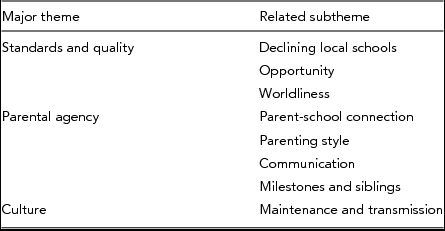
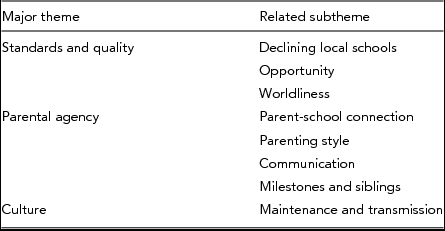
Three major themes emerged from the data: (a) Access, Standards and Quality; (b) Parental Agency; and (c) Cultural Heritage, see Table 1. In the following section, a description of each major-theme is provided along with evidence for each related subtheme.
Major Themes and Related Subthemes
Standards and Quality
Consistent with other research (Higgins & Morley, Reference Higgins and Morley2014; Prout, Reference Prout2009; Lea, Wegner, McRae-Williams, Chehall, & Holmes, Reference Lea, Wegner, McRae-Williams, Chehall and Holmes2011; Lette, D’Espaignet, Slack-Smith, Hunt, & Nannup, Reference Lette, D’Espaignet, Slack-Smith, Hunt and Nannup2009), securing the best possible education for their children was the overriding priority for all participants. All reported feeling disenchanted with local secondary school options available to them and many questioned whether the WA education system had the needs of their children at heart. Similar to research by Prout (Reference Prout2009), participants felt that boarding school was the only option for their children. Otherwise they would have to relocate their whole family to a larger urban town. One participant explained: ‘we realised that if we wanted him [son] to succeed in his education we need to send him away, which is a hard decision to make, otherwise it was move the whole family’ (Participant 9). Despite acknowledging the good intentions of staff at local schools, all participants perceived the standard and quality of education at boarding schools in Perth to be far superior. Subsequently, they felt they had to send their children away to ensure they would receive an optimal secondary education experience. For example, one participant asserted:
If we are serious about wanting to have Indigenous leaders and educated people, then I think you have to send your kids to boarding school. It's a shame that a good education is not available in the place that we live…but I do believe that if you want a good education they have to leave town. The education here isn't good and if you don't have the education, what are you? (Participant 1)
Declining Local Schools
Participants believed that both a lack of school resources (desks, chairs, computers, sports equipment and facilities) and disruption to the school environment by wider community problems, contributed to the disparity between local schools and their Perth counterparts. Negative social issues such as alcoholism, violence, family feuding and gang membership were seen as corroding the learning environment in local schools. One participant conveyed, ‘If he went to [name of school], all the kids there get caught up in other stuff, like fighting, drugs, drinking and they just don't finish school’ (Participant 11). Further, such issues were seen as diffusing uninterrupted into the local school setting, as one participant put it, ‘the academics are just so impacted upon by the social issues that exist up here’ (Participant 3). An equally important concern for participants was the difficulty for local schools to recruit and retain experienced teachers and school leaders, as they were aware this contrasted significantly with staffing at boarding schools in Perth. One explained:
A lot of the teachers are just out of teachers college. Then they come up here and they haven't got a clue what is going on, so a lot of them leave in tears just after the first six months because they haven't got a grasp on what's happening in the classroom. There just isn't that consistency compared to somewhere like [School B]. (Participant 4)
Opportunity
Participants viewed sending their child to boarding school as an opportunity. They believed that boarding school would provide the foundation from which their children could achieve positive social mobility. In particular, they perceived that boarding school would heighten the likelihood that their children would be able to access postschool destinations such as entry into university. Several participants described boarding school as a deliberate strategy to step beyond the educational boundaries of local secondary schools and place their children in direct contact with a wider range of opportunities. One participant explained:
We know that the only way for our kids to move up is to work up and the highest way of moving up is through education. Sport is a bonus, art is a bonus, drama is a bonus, but education is where our kids have got to succeed. If it means sending our kids away, well let it be. I’ve had the experience of sending three of my beautiful children away to the city [Perth], the opportunities were bigger and brighter and better in the city than in the country. (Participant 8)
Worldliness
Participants perceived that the learning environment at boarding school would provide their children with a more worldly education. It was common for participants to report drawing the attention of their children to the advantages of exposure to different cultures, lifestyles and social contexts beyond that of their own local community. Moreover, boarding school was seen as a supportive and safe context that would nurture in a meaningful way the ability of their children to navigate and integrate diverse worldviews, as one reported, ‘I want them to be who they can be. I wanted this to be a great learning curve for them. I wanted them to see that there is more outside of small [name of town]’ (Participant 6). Participants believed that exposure to different ways of being, knowing and doing, would also help their children to traverse what they perceived was a rapidly changing world. Several considered worldliness, a life skill that enabled their children to be successful in the future. For example, one participant commented, ‘It has opened up his whole world. He's got the best of both worlds. He's got the Pilbara and his mates up here and then he's got the city [Perth]’ (Participant 7).
Parental Agency
The initial experience of sending a child to boarding school brought about feelings of guilt, stress, loneliness and sadness for participants. For some, this emotional toll did not diminish for many years. One participant, for example, described how regardless that her son had been attending boarding school for four years, that, ‘I think for me it was always that in Year 8, he was so young and it felt like [started to cry softly] he had left home already. He wasn't there anymore’ (Participant 2). Several participants described this experience as handing over their authority as a parent. While others reported initially experiencing a sense of loss, disempowerment, and purposelessness and how these feelings caused them to reflect on their own self-worth as parents. One participant stated:
I felt really redundant. I thought that I no longer had a purpose when they weren't at home. I was lost, I could not function normally and I was just completely lost. I would go and seek friends out, I hated being on my own. Hated it, I could not even be in the house on my own, especially at night. (Participant 6)
It was evident that the challenge of supporting a child who was schooling away from home and the immediate family context raised uncertainty with participants about their own preparedness as parents, as one reported, ‘I just kept going to myself, am I doing this right or not?’ (Participant 11). It is important to acknowledge that disconnection between home and school can leave Indigenous parents feeling marginalised and ostracised from their child's educational journey (Beresford, Partington, & Gower, Reference Beresford, Partington and Gower2012; Hayes, Johnston, Morris, Power, & Roberts, Reference Hayes, Johnston, Morris, Power and Roberts2009; Lea et al., Reference Lea, Wegner, McRae-Williams, Chehall and Holmes2011). Without exception, all participants recognised the importance of being involved with their children's educational journey. Moreover, they were highly aware of the risks to their children's success at boarding school if they became disconnected. As one participant explained:
A lot of parents send their kids down there [boarding school in Perth] but they don't know how to support them while they’re down there or know how to get on the phone and talk to people down there. They don't know how to keep in touch, who to ring, what to say, when to ring…some parents they’ve lived their whole life in the bush, they do not understand what their kids are going into. (Participant 5)
Parent-School Connection
Participants coveted the opportunity to interact meaningfully with school staff and to participate in decision-making processes about their child's educational journey. Participants’ sense of connection with their child's boarding school was often evaluated in terms of personal relationships formed with members of staff at boarding schools. The opportunity to establish relationships with individual staff beyond orientation days and parent evenings, not only reassured participants that they had selected the right boarding school for their child but equally gave them comfort that the wellbeing of their child would be prioritised. Those staff that participants valued most were perceived as approachable, accessible, and as receptive to their advice as parents on how to best support their child. Participants valued the extra things that staff did for their children and constructed these efforts as striving to lessen the impact of boarding school on them as parents. One participant, for example, recalled her deep appreciation for a housemother who went to great lengths to ensure her son felt cared for while he was away from his family, she reported:
People like Mrs. [name] the housemother down there was fantastic. She just loves the boys. She takes care of the little things with [son] like a mother would do. She knows the things to look for in someone, so when they’re missing affection from their own mother they’re getting it from her. You want someone to do that for your children. (Participant 2)
However, some participants also reported there were moments when they believed they were unjustly subjected to judgment by school staff. These participants believed that some staff thought of them as lacking commitment to their child's education because they did not always attend school events. Participants explained that staff sometimes overlooked the fact that as a family living a long way from Perth, they had to negotiate multiple factors such as distance, time, employment and financial commitments, while simultaneously managing other responsibilities such as caring for extended family members at home. Several participants also reported that it had caused strain in their relationships with staff when they had queried the rules and practices at their child's boarding school. One participant, for example, relayed his frustration at what he perceived as poor school policy in resolving an incident of racism that involved his son. He recounted:
I’ve always told my kids … when they get racially abused, I say to them the first thing you should do is punch them in the mouth. Straight out, don't turn the other cheek and say well you have a problem. Fuck that, get stuck into them. So the only time they ever fight or get in trouble, is if someone says something bad about their race. I said to them [Boarding School], you have to control your school and the other students as well; because I know my kids will not tolerate that. I won't tolerate it. And then you find out that everything has been settled, the Headmaster and teacher then go and get stuck into those other kids for going on and saying those sorts of things. If one of my kids does something wrong and needs disciplining, I will punish them. If they break the law, or swear at a teacher I will punish them. But if they go to school and are racially abused, that is something that I will not punish them for. So teachers quickly learn what our stance is. (Participant 9)
A legacy of racism and exclusion by the education system in WA (Green, Reference Green1995; Hetherington, Reference Hetherington2002) has meant that Aboriginal parents are highly cognisant of how passive school policy and classroom practices not only perpetuate mistrust, but also puts at risk their child's sense of connection with education and belonging at school (Campbell, Kelly, & Harrison, 2012; Beresford et al., Reference Beresford, Partington and Gower2012). It is not surprising then, that several participants in this study were vigilant for racist attitudes and had in turn taught their children protective behaviours prior to sending them to boarding school.
Parenting Style
Participants reported feeling like they had to spend significant time honing their own parenting style and developing new parenting skills since their child's enrolment at boarding school. The data indicated that one of two parenting approaches tended to be used by participants. One group of six participants believed that it was better to take cues from their children as to when and what they needed help with. These participants entrusted staff to look after the day-to-day wellbeing of their children and equally believed that their children were capable of making their own decisions while at boarding school. As one explained, ‘you’ve got to give them some breathing space, you got to let him [son] walk alone at times, if he needs us he will call us, let him go a bit’ (Participant 5). By contrast, a second group of five participants perceived that boarding school demanded a higher level of involvement in their child's welfare. This group described making it their business to know all facets that comprised their child's boarding school community and placed significant emphasis on understanding all the roles of staff as well as operational systems and routines. It was evident that this group did not want to be perceived as overprotective, however it was also apparent that they identified strongly with being advocates for their children.
Communication
Despite using different parenting approaches to support their children while they were schooling away from home, all participants perceived establishing good communication routines and protocols with their children as essential. One emphasised, ‘Communication is the key to the success of my children living away’ (Participant 8). Participants reported using email, Skype and text messages to keep in touch and support their children. However, learning how to translate the tacit signals exhibited over the telephone was seen as crucial to evaluating the wellbeing of their children. This involved not only paying close attention to what their child actually said, but also attuning their parental senses to recognise and decipher unspoken patterns during telephone calls. One participant even described drawing upon visualisation techniques when talking to her son on the telephone. This participant explained:
The problem is if I had my son in front of me, the body language, I would pick it up immediately. I can't see him over the phone, so I’ve got to try harder. So when I’m on the phone to him, I imagine that he's right there in front of me. So I can feel and know what he's doing, and I tell him, you’re putting your shoes on, and he says how do you know? That's ok darling I’m your mum. That's what mums do, we’re magic. So when my child's talking, the tone of the voice will prompt me, so when he says something and I think I’ve never heard this tone before, I know something's happening. (Participant 8)
Several indicated they monitored the frequency, time, and duration of telephone calls and scrutinised the consistency of conversation content shared during calls with their children. For those participants with partners, cross-checking the content of conversations with each other was seen as a key coping strategy and in turn enabled them to present a united and supportive outlook to their children. For example, one participant recounted:
When he [son] goes away to school, for the first couple of days he rings three, four times a night, and then on the third day he would settle a bit…when he was away he would not talk to my husband about being homesick and stuff, but he would talk to me and I used to sometimes cry to my husband about it and say it's just getting too hard for him, and he [husband] would say how come he is telling you that and not telling me? (Participant 10)
Milestones and Siblings
Having a child away from the family unit instigated for many participants recognition of their own absence during a critical time in their children's development, as one reflected, ‘I felt ill, because I thought oh my god I’ve lost years with my kids’ (Participant 11). Several reported that not being able to fully share in and being present during the natural unfolding of their child's growth and maturation from childhood to adulthood was a significant regret. As one explained, ‘I think it's just so hard to make that emotional decision to be away from your kids and them growing up away from you. I just feel like I’ve missed out on a lot you know’ (Participant 2). Indeed, several grappled with feeling a sense of loss and decreased control in influencing the developmental trajectory of their child as they transitioned towards adulthood. One participant concisely stated, ‘It was very hard to have any sense of influencing those things you know’ (Participant 3).
An unanticipated outcome for several participants was that the remaining family had to learn how to adjust and cope while having one of its members away for an extended period of time. For example, one shared how prior to boarding school her family had lived vicariously through their son's sporting interests. When the son began boarding school the socialisation pattern within the family completely changed. She explained:
It was more of an adjustment for us than him [son]. During the first year he was away that was the worst. We didn't want to be in the north-west because we really missed him, our whole life revolved around him and his sports you know, taking him to training and taking him to sport. It wasn't just me taking him to sport; it was a whole family effort. We would pack up a picnic; pick up the grandma along the way, so yeah it was huge. And then socially you naturally socialised with other parents who had children in the same sports as him. We would see a lot of each other and then all of a sudden it was like boom, stopped. (Participant 7)
Similarly, several participants described feeling a sense of guilt, regret and sadness about the length of time their child spent away from siblings. In response, a number of participants described organising family activities for each school holiday period, so that siblings could reaffirm their sense of connection with each other and belonging within the family unit, including with extended members of family.
Culture
It was evident for several participants that securing an optimal secondary education for their children was closely linked with what they perceived as meeting the expectations of past generations. One participant articulated, ‘If those old people were alive today they would have been proud, they’re proud now you can tell, that's the aim for us you know, to fly their legacy’ (Participant 10). Notwithstanding this, participants wanted their children to retain a strong sense of connection with identity and culture. Similar to other research (Campbell et al., 2012; Gollan & Malin, Reference Gollan, Malin, Beresford, Partington and Gower2012; Penman, Reference Penman2006; Zubrick et al., Reference Zubrick, Silburn, De Maio, Shepherd, Griffin, Dalby and Cox2006), ensuring that culture was securely passed on to their children was perceived by participants to be an extremely important parental responsibility. However, several revealed that as their child increasingly focussed on meeting the academic and co-curricular demands of boarding school life and while steadily getting older and spending more time away from home, they worried that a sense of cultural disconnection may occur. As one participant explained, ‘I was worried that their culture would be lost in the mix of the school’ (Participant 6).
Maintenance and Transmission
A dilemma for participants was how to ensure their children maintained a strong sense of identity and connection with culture, while simultaneously supporting them to meet the demands of boarding school life. Indeed, it emerged that several participants believed it was necessary for them to organise family orientated cultural excursions during school holidays, so as to counterbalance the impact of schooling away from home. While participants viewed the transmission of cultural knowledge as a lifelong and continuous process, whole family activities organised during school holidays were perceived as the most powerful way in which they as parents could reaffirm their children's sense of identity and connection with culture. One participant, for example, reported how their family regularly went on ‘cultural field trips’ during school holidays and outlined how the focus of these trips was to ensure connectedness with the people, place and Dreaming. He explained:
Every time when they have holidays we make sure we plan a field trip so we take them out bush for a couple of days and we show them Country. We not only take them, but also take my extended family, like my mum, sisters and brothers and all the nieces and nephews, they all come. So we plan a big family trip, we take all the kids out, take them to Country they’ve never seen before, tell them the stories and the history about that place… Just because you go away to get educated, it doesn't mean you have to forget who you are, that's how we were taught, always going out bush with the old people. (Participant 10)
These family activities were viewed as providing the opportunity to engage in traditional practices such as storytelling, hunting and fishing, as well as an opportunity for children to interact in a meaningful way with country, language and spirituality. Planned cultural excursions not only served their parental need to affirm their children's bond with people and place, but equally their desire to facilitate the transmission of cultural knowledge from one generation to the next in their family. Others reported making alternative efforts to bridge the distance between home and boarding school. One participant in particular, revealed posting language books and other cultural texts to his son while he was away at boarding school. He also described how he utilised digital technologies and devices such as iPods to continue the transmission of traditional language and song to his son while he was away at boarding school. He reported:
The good thing about the iPod these days is that we put a lot of our songs and language on them. That's how come [son] learnt how to sing [traditional songs]. There is a picture at home of him going through Law with the iPod on, he's painted all black [ochre], you can't see his face, but you can see the white iPod hanging out … Our son goes away to boarding school in Perth somewhere and he can sit down in his leisure time, or walk, or jog, whatever it is he is doing while listening to our culture, our songs that we have here. When he comes back home, it's like he never left, so this is how we go about trying to develop our children. (Participant 9)
Implications and Summary
Students in WA begin their secondary education in Year 7, meaning that many Aboriginal families living in regional and remote communities are sending their children to a boarding school away from home at the age of 12 years. However, despite efforts in the nongovernment sector (Mander & Fieldhouse, Reference Mander and Fieldhouse2009), there is little evidence of dedicated supports and resources in WA for those Aboriginal parents that would like to know more about and prepare for the experience of sending children to boarding school. This is despite research examining the transition from primary to secondary school in WA emphasising the need for early communication between school and parents (Coffey, Berlach, & O’Neill, Reference Coffey, Berlach and O’Neill2011), the development by schools of dedicated Year 7 transition programs, and especially the provision of teacher development in transition issues (Hanewald, Reference Hanewald2013). Evidence exists highlighting that parent engagement is crucial to the success of Indigenous children at school (Campbell et al., 2012; Hancock, Shepherd, Lawrence, & Zubrick, Reference Hancock, Shepherd, Lawrence and Zubrick2013; Higgins & Morley, Reference Higgins and Morley2014; Zubrick et al., Reference Zubrick, Silburn, De Maio, Shepherd, Griffin, Dalby and Cox2006). The findings of this study suggest there are several key areas of practice in boarding schools that could be targeted to promote engagement and help reduce the emotional dissonance linked with sending a child away to boarding school.
Promote Early Awareness, Engagement and Communication
The development of a pretransition program focussed on the parents of prospective Aboriginal boarding students and delivered prior to the commencement of Year 7, would promote a sense of preparedness. Indeed, the findings here support the Parent and Community Engagement program (PaCE) piloted in 2013 by Boarding Australia in the Northern Territory, which specifically offers targeted support to Aboriginal families and parents living in seven Roper Gulf communities to prepare for having a child at boarding school (Boarding Australia, 2015). This recent initiative is designed to promote awareness and positive communication to develop early between parents and boarding schools and to maximise the likelihood that the transition experience to boarding school is a successful one for students. Boarding Australia has developed a website describing the PaCE program (http://www.boardingaustralia.edu.au/community-engagement) as well as a guide, DVDs, animated storybooks and other resources for Indigenous parents, and aims to address frequently asked questions prior to children commencing at boarding school (Boarding Australia, 2015). However, perhaps the most important aspect of the PaCE program is that it represents an important first step to supporting Indigenous parents living in regional and remote communities with the significant adjustment to having a child attend a boarding school away from home (Boarding Australia, 2015).
Parents and family are central to the wellbeing of Aboriginal students (Beresford et al., Reference Beresford, Partington and Gower2012) and effective transition programs involve the whole school community, including students, parents and teachers (Coffey et al., Reference Coffey, Berlach and O’Neill2011). The findings of this study suggest that any pretransition program would need to extend beyond practical advice and information, promoting familiarity with a new boarding school context and identifying the things parents can do to prepare their children for the personal and social changes associated with boarding school life. Rather, it would be important to raise awareness about the potential impact that boarding school may also have on family functioning and siblings at home, on Aboriginal parents’ feelings of self-worth and to the possible need to utilise alternative parenting skills. For example, one participant discussed the benefits of visualisation techniques to help pay close attention to the subtle behaviours her children exhibited during telephone conversations. Perhaps the most important aspect of any pretransition program however, would be to prioritise dialogue between Aboriginal parents and prospective boarding schools to specifically discuss strategies that positively support identity and opportunities for the transmission of cultural knowledge. Lastly, a pretransition program will assist boarding schools to better prepare staff and tailor strategies to meet the needs of incoming students.
Build Effective Partnerships with Parents
Research in Indigenous Education often emphasises how a positive sense of belonging with school is critical to Indigenous student success (Gower & Byrne, Reference Gower, Byrne, Beresford, Partington and Gower2012). However, it is equally important to recognise that Indigenous parents’ sense of connectedness with a school is also an important protective factor against early disengagement with education by Indigenous students (Campbell et al., 2012; Hayes et al., Reference Hayes, Johnston, Morris, Power and Roberts2009; Lette et al., Reference Lette, D’Espaignet, Slack-Smith, Hunt and Nannup2009; Zubrick et al., Reference Zubrick, Silburn, De Maio, Shepherd, Griffin, Dalby and Cox2006). While vast geographical distances often mediate parent-teacher and parent-school relationships in WA, a key finding of this study was that participants highly coveted the opportunity to forge meaningful relationships with individual staff at their child's boarding school. Moreover, it found that there are several simple but important things that boarding schools can do to build and consolidate effective partnerships with Aboriginal parents. For example, staff in boarding schools can be actively encouraged to: (1) Recognise and acknowledge that sending a child to boarding school can be a highly stressful experience for parents; (2) Talk with parents about their children to be interested, sensitive and responsive, and build these conversations into the natural foundation of communication with parents; (3) Discuss any concerns parents may have about boarding school decisions, routines and rules (for example Aboriginal parents expect accountability, consistency and transparency, particularly with respect to issues such as racism); (4) Use good listening skills and try not to give advice too quickly (for example, build parents capacity to talk through problems and to develop solutions); and, (5) Support Aboriginal parents to network and connect with the parents of other children at their boarding school (for example, share advice and coping strategies for similar problems).
It is important for boarding schools to also consider others ways in which school practices can be further maximised to consolidate parent-school partnerships. The cultural, historical, and professional knowledge of Aboriginal parents is one resource and form of social capital that is often overlooked by schools (Byrne & Munns, Reference Byrne, Munns, Beresford, Partington and Gower2012; Higgins & Morley, Reference Higgins and Morley2014). The organisation of meaningful activities both pre and post transition will help to promote a sense of belonging and connectedness with prospective Aboriginal parents, and would equally serve to enrich the learning environment in boarding schools (Mander, Reference Mander2012; Mander & Fieldhouse, Reference Mander and Fieldhouse2009). For example, in addition to participation in annual Reconciliation, National Aboriginal and Islander Day of Observance Committee (NAIDOC) week, and Sorry Day activities, Aboriginal parents want meaningful roles on school governance councils and opportunities to continuously contribute throughout their children's boarding school journey, such as during school literature and language weeks, science, health and environmental projects, history, political, social justice and economic policy debates, as well as with extracurricular activities such as drama and dance productions, sport and artist in residence programs (Higgins & Morley, Reference Higgins and Morley2014).
Support Parental Agency
Research into the impact that boarding school has on Aboriginal parents’ sense of parental agency is somewhat scarce. Recent studies suggest that parental involvement and guidance in the form of frequent support, monitoring and positive intervention contributes to a smoother transition experience to secondary school for students (Hanewald, Reference Hanewald2013). Further, Aboriginal students that experience high levels of teacher and parent connectedness are more likely to make a better transition to high school (Higgins & Morley, Reference Higgins and Morley2014). While participants in this study utilised different parenting styles, it was evident that all realised their ability to shape their child's growth and development was significantly diminished. Specifically, several reported feeling a sense of loss and decreased control in influencing their children as they transitioned towards adulthood. The findings of this study suggest there are things that staff in boarding schools can do to support Aboriginal parents with this feeling. Foremost, while parents and staff may hold differing beliefs about what is important for students, it was apparent that participants appreciated being consulted by staff and involved in decision-making processes about their children. That is, they wanted to still play an active role in influencing the support and care their children received while away at boarding school. Regular telephone conversations and emails from staff helped to comfort participants’ worries or anxieties, and promote parents’ sense of agency in the development of their children.
Prioritise an Inclusive School Environment
Effectively addressing issues like racism is crucial to Aboriginal parents’ sense of connectedness with a school (Gollan & Malin, Reference Gollan, Malin, Beresford, Partington and Gower2012). Further, research indicates that parental trust in school leaders is an essential element of a healthy school culture (Fullan, Reference Fullan2007). Nevertheless, school leaders have to drive professional development in cultural competency (Partington, Reference Partington, Beresford, Partington and Gower2012) and are pivotal to building an inclusive school culture (Gower & Byrne, Reference Gower, Byrne, Beresford, Partington and Gower2012). The AIEF should be commended for their recent publication of a compendium of best practice in boarding schools (AIEF, 2015). However, the lack of consultation with Indigenous parents during its development, or for that matter with Indigenous boarding students, combined with its highly boarding staff-centric focus, means that it is limited in scope. The Compendium acknowledges, ‘it does not present first-hand views and experiences of Indigenous students and their parents’ (AIEF, 2015, p. 15).
While the AIEF Compendium is a valuable resource, it only addresses one slice of a more complex issue in Indigenous education. This research suggests that individual boarding schools would benefit greatly from investing time in inclusive practices that respect the lived experiences and knowledge of Indigenous parents. Furthermore, it highlights the pivotal need for boarding schools to break down stereotypes, to embrace the strengths of diversity, and the importance of school-parent partnerships when developing, implementing and evaluating efforts to forge better futures for Aboriginal students. Examples of programs working closely with Indigenous parents and communities include the Stronger Smarter Leadership Program (http://www.strongersmarter.com.au) and the Solid Kids, Solid Schools, Solid Families program (http://www.solidkids.net.au).
Conclusions
In summary, this study found that Indigenous parents living in regional and remote communities of WA placed great importance on securing the best possible secondary education for their children. At the same time, secondary boarding schools were seen by these participants as their only option to achieve this goal. Participants not only believed their children were more likely to receive a better quality and standard of education at a boarding school, but equally that their children would be exposed to a more worldly education which they perceived was important to their long-term future. Most notably, however, all participants spoke about the heavy emotional toll that sending a child away to boarding school placed on them as parents (for example feelings of guilt, stress, sadness). Participants reported feeling unprepared and struggling with some of the challenges. Some questioned their self-worth as parents as a consequence. One participant's experience with their child's respective boarding school meant he felt the need to be vigilant towards racism. However, all participants worried about their ability as parents to ensure their children retained a strong sense of identity and connection with culture.
This study does not represent all Aboriginal parents. A gender imbalance (eight mothers and three fathers) as well as the cross-sectional nature of data collection, means that further research is required. It is possible that this participant sample was highly motivated as they had a vested interest in the research topic. Hence, it would be important for future research to consider the views and perceptions of those individuals less able, mobile and resourced to contribute to the topic of the present research. Future research should also consider the use of digital technologies to promote connectedness between boarding schools with Aboriginal families, culture, and language. The increasing development of smartphones, tablets, Skype, email and social media, for example, present readily available and cost-effective means of changing the way Aboriginal parents and boarding schools interact and connect. Evidence is emerging from the e-health domain, for example, that suggests communication via social media platforms such as Facebook, Twitter, SMARTapps and other interactive bulletin boards and blogs, can promote a positive sense of engagement and connection with individuals living in remote communities (Christensen, Reference Christensen2014; Hides, Reference Hides2014). Future research needs to assess the utility of the current findings in terms of other contexts, states and territories, and education systems across Australia.
About the Author
David J. Mander is a practicing psychologist at a large k-12 boarding school in Perth, Western Australia. He also holds the position of Adjunct Senior Research Fellow with the Health Promotion Evaluation Unit at The University of Western Australia. David has worked extensively in both the government and nongovernment education sectors in WA. While completing his PhD in Psychology, David developed and implemented a social and emotional support program for Aboriginal students at 16 boarding schools in WA.