



Independent inquiries into homicides perpetrated by patients in receipt of mental health services are an important part of learning from adverse events in psychiatry. 1 Inquiry reports form an important repository of information regarding homicides committed by those who received treatment from mental health services prior to the homicide, and provide an impression of the state of those services at that point in time. However, they remain controversial, Reference Eastman2–Reference Ng, Merry, Paterson and Merry7 as does the requirement that they use ‘root cause analysis’ (RCA) as the methodology, the validity of which in mental health has been questioned. Reference Deshpande, Sinclair and Baldwin8
National Health Service England (NHSE) has been responsible for commissioning independent mental health homicide inquiries since 2013, and for ensuring that all provider organisations in England have appropriate systems in place for learning from these inquiries, to improve the safety and quality of mental health services. These anonymised inquiries are published on its website. 1
Previous analyses of independent mental health homicide inquiries have found that they repeatedly identify the same themes, raising questions regarding the effectiveness of learning in mental health services. Reference Eastman2–Reference Szmukler4,Reference Pearson, Swinson and Shaw6 However, there has been far less focus on the methodology used by inquiries, or how they attribute causation. Despite these criticisms, inquiries have considerable influence on both government policy and the public’s perception of safety in mental health services.
A comprehensive analysis of mental health homicides was published in 2011, Reference Crichton9 and the National Confidential Inquiry into Suicide and Safety 10 (NCISH) provided an overview of key patient characteristics in its annual reports until 2018. NHSE published three thematic analyses of mental health homicide inquiries between 2013 and 2021, with a focus on reporting mechanisms and governance. 11 However, there has been no recent comparative analysis of the characteristics of mental health homicides with those in the general population, nor a review of the methodology used in inquiries.
This study aims to provide a comprehensive analysis of the methodology employed by these inquiries, whether they commented on causation of homicides, their findings and characteristics of perpetrators and their victims to examine similarities and differences.
Method
We carried out a retrospective document analysis of all independent mental health inquiries relating to homicides published by NHSE on its website. 1 This study was approved by the University of Southampton Research Ethics Committee (ERGO, no. 100030). Because only material available to the public on the NHSE website and already in the public domain was included, formal NHS ethics approval was not required.
NHSE has been responsible for commissioning independent mental health homicide inquiries since 2013, and for ensuring that all provider organisations have appropriate systems in place for learning from these inquiries, to improve the safety and quality of mental health services. NHSE defines ‘mental health homicide’ as an act of homicide committed by a person in receipt of mental health services by an NHS-funded provider in England, and requires this to be investigated by an organisation independent of the provider NHS organisation. 1 We therefore used these definitions.
In line with the above, inquiry reports were included if they were of a completed homicide (either full reports or executive summaries) and were conducted by a body independent of the provider NHS organisation. Reports were excluded if they were not related to a completed homicide or were related to a homicide but represented quality assurance, and desk-top reviews, because these are not investigations.
Document analysis is a systematic procedure for reviewing or evaluating documents, used to provide context, generate questions and track change over time; it can include both quantitative and qualitative components. We used a specific document analysis technique (‘READ’) recommended in health policy research. Reference Dalglish, Khalid and McMahon12 This includes the discrete steps of making the material ready, extracting and analysing data and distilling findings.
We examined characteristics of both the perpetrator and victim(s). We also identified the characteristics of the inquiries, with a focus on methodology, and undertook an analysis of recommendations made by independent inquiries and action plans developed in response, with reference to safety science and human factors. In analysing root causes, contributory factors and care and service delivery problems, we identified themes based on content similarities and unique relationships.
Root causes are factors expected to have directly caused the adverse event, and contributory causes as those that have made a substantial contribution to it. Reference Vincent, Taylor-Adams and Stanhope13,Reference Stavropoulou, Doherty and Tosey14 Care delivery problems are acts or omissions in the delivery of individual treatment that diverge from the standard expected, and service delivery problems relate to the organisation and delivery of services, such as procedures and systems. 15
We compared the characteristics of victims of mental health homicides described in independent inquiry reports with data on victims of homicides in the general population of England and Wales from the Home Office Homicide Index, published annually by the Office for National Statistics (ONS). 16 We compared characteristics of perpetrators with data from NCISH.
We identified 189 independent inquiry reports relating to homicides on the NHSE website published between 2013 and 2023. Of these, one duplicate (published in two places) was excluded, leaving 188 reports: a further 26 were excluded because they either did not relate to mental health homicides or were not full investigations but quality assurance or desk-top reviews. A total of 162 homicide inquiry reports were included in the final document analysis.
After analysing approximately 50% of the sample, a review of test–retest reliability was completed based on a sample of 15% of inquiry reports, to examine agreement on the characteristics of perpetrators, victims, homicides, recommendation and action plans; there was 98% agreement. Following analysis of the entire sample of 162 reports, an inter-rater reliability exercise was similarly undertaken based on a random sample of 15% of inquiry reports; this found 92.9% agreement.
In the following comparison and analysis, for brevity, data extracted from this study of mental health homicide inquiries are referred to as mental health homicide inquiries (MHHIs), those from ONS are referred to as such and data from NCISH are also referred to as such.
Results
Homicides
The 162 MHHIs described the deaths of 168 victims by 162 individual perpetrators in receipt of clinical care by NHS-funded mental health services. There were 156 single homicides and 6 double. Seven homicide investigations also involved other victims of severe violence, but survivors are not included in the analysis of victim characteristics.
ONS homicide trend analysis for England and Wales indicates that the number of homicides each year between 2012 and 2023 ranged between 488 and 661 (median 9.9 per million population, with a range of 8.8–11.9 per million population), with a mean of 565 and a median of 566. 16 The NCISH annual report 2018, which looks at data between 2006 and 2016, notes that 608 patient homicides had been reported in that period, a mean of 55 patient homicides per year.
Perpetrator demographic, diagnostic and treatment characteristics
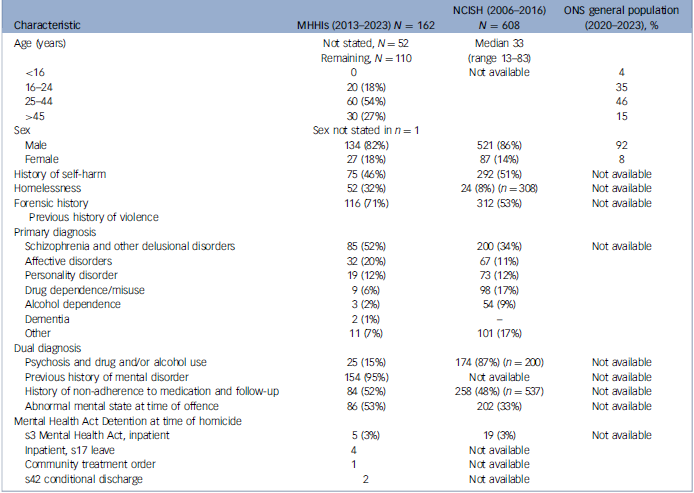
Demographic, diagnostic and treatment characteristics of perpetrators in the MHHI sample are shown in Table 1, alongside characteristics for perpetrators in the NCISH data-set (2006–2016) and those for homicides in the general population (2020–2023).
Perpetrator characteristics in MHHIs, NCISH and general populations

A breakdown by age of perpetrators is not available in the NCISH dataset; the 2018 report notes the median age of perpetrators as 33 years, with a range of 13–83 years. Across all samples, most perpetrators were male although 18% in MHHIs were female, compared with 8% in the general population. More perpetrators were older in MHHIs compared with those in the general population. Most MHHI reports did not state the ethnicity of the perpetrator. A total of 116 (71%) perpetrators in MHHIs had a previous history of violence, higher than in NCISH (312, 53%).
Seventy-five (46%) of the perpetrators in MHHIs had a history of self-harm, comparable to 292 (51%) in NCISH. However, 52 (32%) were homeless in MHHIs compared with 24/308 (8%) in NCISH. Eleven (7%) perpetrators in MHHIs were victims of domestic violence and three (2%) were perpetrators of domestic violence; six (4%) perpetrators had been in the care of the local authority as children, and three perpetrators (2%) were refugees.
In the MHHI sample, the single most frequent diagnosis was schizophrenia (N = 85, 52%, with primary diagnosis not stated in one inquiry). This is higher than in the NCISH cohort, where schizophrenia was the primary diagnosis in 200 (34%) cases. Eighty-four perpetrators in MHHIs (52%) had been non-adherent with contact and treatment prior to the homicide, comparable to 258 (48%) in NCISH. In the MHHI cohort, 86 perpetrators (53%) had an abnormal mental state at the time of the offence, 44 (51%) were acutely psychotic and 11 (13%) were severely depressed; use of illicit substances and/or alcohol was the primary reason for an abnormal mental state in 17 (20%). In the NCISH sample a total of 202 individuals (33%) had an abnormal mental state at the time of the homicide.
Victim characteristics
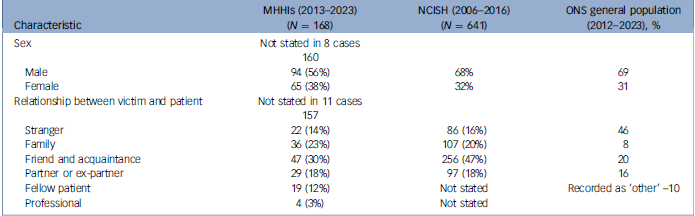
Table 2 shows the key characteristics of victims described in the MHHI cohort, which are compared, where relevant data are available, with characteristics of victims of homicide in the general population and with victims of mental health homicides in the NCISH sample.
Victim characteristics in MHHIs, NCISH and general populations

The age of victims is not stated in 110 (65%) of the MHHI cohort. Although there are similarities in the gender ratio of victims among the three cohorts, most homicides in the general population were ‘stranger’ homicides, which account for only 14% of mental health homicides. Proportions of victims who were partners or ex-partners were similar in all groups, whereas family members as victims were over-represented in mental health homicides.
Homicide characteristics and trial outcomes
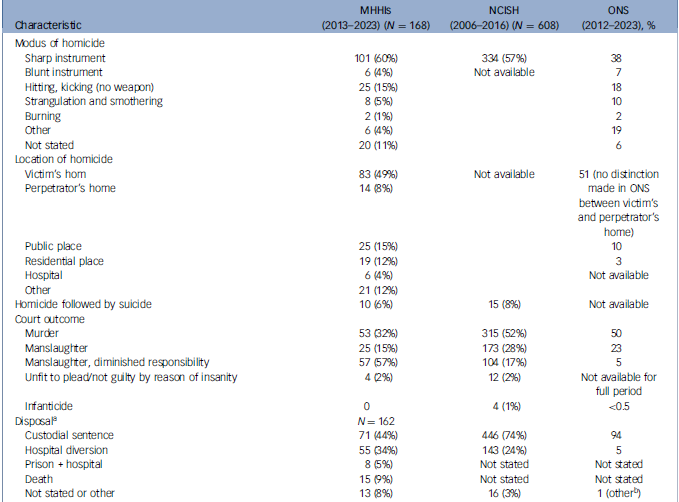
The key characteristics of homicides are shown in Table 3. The use of a sharp instrument is comparable across NCISH and MHHIs, and is higher than in the general population. Over half of all homicides in the general population were in a private dwelling, but ONS provides no breakdown of whether the homicide occurred in the perpetrator’s home or the victim’s; 83 (49%) of homicides in MHHI were in the victim’s home. These data are not available for the NCISH sample. Ten (6%) homicides in MHHIs were followed by suicide compared with 15 (8%) in NCISH.
Homicide characteristics and court outcomes

MHHIs, mental health homicide inquiries; NCISH, National Confidential Inquiry into Suicide and Safety; ONS, Office for National Statistics.
a. Under English law, there are several defences to a charge of murder. Murder may be reduced to manslaughter on the basis of diminished responsibility if the criteria set out in the Homicide Act 1957 s2, as substituted by s52 of the Coroners and Justice Act 2009, are satisfied. Murder carries a mandatory life sentence, whereas manslaughter attracts a range of sentences, including complete diversion to hospital under s37 of the Mental Health Act 1983. A Hybrid Order under s45A may be imposed when the court is satisfied that the person needs treatment in hospital, but must also serve a prison sentence. ‘Unfit to Plead’ may be a finding where the defendant is unable to meet the criteria set out in R v Pritchard, as described in the Criminal Procedure (Insanity and Unfitness to Plead) Act 1991. Not Guilty by Reason of Insanity, as defined in the same Act, refers to cases where at the time of the commission of the act, the defendant was suffering from such a defect of reason, from disease of the mind, that they were unable to appreciate the nature or quality of the act, or did not know that what they were doing was wrong.
b. Other here includes probation supervsion.
A comparison of ‘disposal’, referring to a sentence or outcome of a criminal case, shows some differences among groups. Fifty-five (34%) perpetrators in MHHIs were diverted to hospital by way of Section 37 of the Mental Health Act 1983 17 (MHA 1983), the so-called ‘Hospital Order’, compared with 143 (24%) in NCISH and 5% in the general population. Eight (5%) perpetrators in MHHI received a so-called ‘Hybrid Order’ under Section 45A of the MHA 1983. Seventy-one perpetrators (44%) in MHHIs received a custodial sentence, whereas 446 (74%) did so in NCISH and 94% in the general population.
Inquiry characteristics
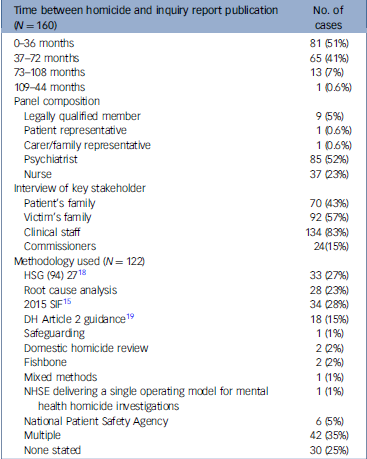
A comparison of inquiry characteristics is included in Table 4. There was wide variation in nearly all domains. The length of full investigation reports ranged from 35 to 228 pages and, in 11 cases, only an executive summary was published on the NHSE website (ranging from 10 to 71 pages). Ten commercial companies undertook 157 of these independent investigations, with two companies separately carrying out 68 (43%) and 32 (20%), respectively. Five investigations were carried out by individuals not affiliated with any commercial companies.
Inquiry characteristics

HSG, Health Service Guidance; SIF, Serious Incident Framework; DH, Department of Health; NHSE, National Health Service England.
There was no consistent format, and inquiry reports carried out by the same commercial firm varied in approach. Some reports included the terms of reference, others a summary, but many did not include either. No report had a statement regarding conflicts of interests of the inquiry panel. Two reports noted that the panel had been chaired ‘independently’ but did not explain what this meant. Eight reports (5%) contained a victim impact statement from the victim’s family members.
Inquiry panel composition varied. In nine reports a legally qualified individual was part of the inquiry panel, and seven reports referred to a lawyers’ firm that had provided legal oversight. Two panels included specific individuals for liaising with families of the perpetrator and victim(s). Thirty-four (21%) of the reports provided only the name of panel members. Information regarding the background and qualifications of panel members was variable in the remaining 128 (79%) reports, ranging from a single line to detailed biographies.
The date of the homicide was not stated in two inquiry reports. Of the remaining 160 inquiries, the average time between the homicide and publication of the inquiry was 40 months, with a range of 4–112 months.
Investigation methodology
In 40 of the 162 (25%) investigations, the methodology used was not stated. Of the remainder, 33 (27%) made reference to Department of Health and Social Care (DHSC) guidance, 19 which mandated independent investigations following adverse events such as homicides (although this document was archived in 2013). Thirty-four investigations (28%) referred to the 2015 Serious Incident Framework, 15 28 (23%) to RCA (usually in conjunction with DHSC guidance) and 18 (15%) referred to DHSC guidance on Article 2 Human Rights Act. 20 Forty-two (35%) reports referred to more than one of these documents.
RCA was not mentioned as the methodology used in 124 (77%) reports, but 49 of these 124 (40%) criticised the provider mental health organisation’s internal investigation reports for not using RCA. Of the 124 inquiries that did not list RCA as the methodology described, 44 reports (35%) described root causes and contributory factors. Conversely, of the 38 reports which stated that they used RCA as the methodology, 29 (76%) did not describe any root causes or contributory factors.
No inquiry described what model it used to attribute causation. No inquiry described how it chose certain factors – whether omission or commissions by clinical teams, or system factors – to be causative or contributory in nature.
Interview of key stakeholders
Seventy of 162 inquiries (43%) interviewed the perpetrator’s family, 92 (57%) interviewed the victim’s family, 134 (83%) interviewed clinical staff and 24 (15%) interviewed commissioners of the service. In the 28 inquiries where clinical staff were not interviewed, no reasons for their exclusion was provided, although all 28 inquiries criticised the clinical practice of clinical staff.
Thematic analysis of root causes and contributory factors
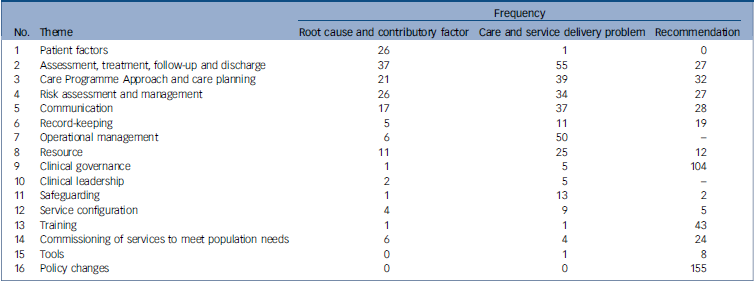
Our thematic analysis of root causes, contributory factors, care and service delivery problems and recommendations is shown in Table 5. No inquiry had a definition of root cause, or how particular findings were determined to be root causes. Therefore, it was unclear whether a root cause was the ultimate causal factor or the event most proximate to the index event, in this case homicide, where clinical services could have done something different that might have changed the course of events. Reference Card21–Reference Vincent23 Similarly, no inquiry included a definition of contributory factor. Of the 162 independent inquiry reports, 24 (15%) described root causes with 15 describing multiple root causes: 51 (31%) described contributory factors and 45/51 (88%) reports described multiple contributory factors.
Frequency of root causes, contributory factors, care and service delivery problems and recommendations

Altogether, 59 reports (36%) described root causes and/or contributory factors. We undertook a thematic analysis of root causes and contributory factors from these reports using the ‘READ’ technique. Reference Dalglish, Khalid and McMahon12 Fourteen final themes were identified, based on content similarities and unique relationships, which included perpetrator characteristics (such as illness), pathway (such as assessment and discharge), risk assessment and communication.
Most themes were identified in more than one report, with nearly all reports describing a combination of these themes. The most frequent theme identified in MHHIs was deficits in assessment, treatment, follow-up or discharge of the perpetrator (N = 37, 63%), followed by deficits in risk assessment and management (N = 26, 44%) and patient factors (N = 26, 44%). Deficits in Care Programme Approach and care planning was the theme in 21 (36%) reports. Communication with other agencies featured 17 times (29%), and inadequate resource 11 times (19%).
Only one inquiry of the 162 made a statement that there was a ‘direct causal link’ between the care and treatment of the perpetrator, the relapse of their mental illness and the homicide of the victim.
Care and service delivery problems were frequently described together in inquiry reports. No inquiry report included a definition of a care or service delivery problem. Of the 162 MHHI reports, 89 (55%) described either care or service delivery problems. Altogether, 291 individual items were described. We identified 15 themes based on content similarities and unique relationships.
Thematic analysis of recommendations
Of 162 MHHI reports, three made no recommendations; the remaining reports made between 1 and 29 recommendations: many recommendations were multifaceted. Altogether, 2562 individual recommendations were analysed and 18 themes identified. Fourteen of these overlap with themes from root causes, contributory factors and care and service delivery problems. The most frequent recommendations related to changing policy (n = 155) and improving clinical governance (n = 104), followed by changes to training (n = 43).
In most inquiries, there was no direct link between putative causes or problems and resulting recommendations. Assessment, treatment and follow-up were the most frequent problems identified, followed by risk assessment, but the most frequent recommendations were to change policy, change clinical governance and provide training to staff. If MHHIs assumed that the reason clinical staff did not assess or treat the perpetrator’s illness or risk adequately was insufficient policy, or inadequate training, they provided no evidence of this. No MHHI report acknowledged human factors and no inquiry provided evidence that it used systems thinking. Reference Holden and Carayon24
Predictability and preventability
‘Predictability’ and ‘preventability’ are required to be commented on by MHHIs. 19 However, DHSC provides no definition or description of these terms. Therefore, MHHI reports contained either no definition or variable definitions.
A total of 130 of the 162 inquiries (80%) commented on either predictability or preventability, or both; 32 inquiries (20%) did not mention predictability or preventability. Of the 130 reports commenting on predictability and/or preventability, 6 (0.5%) stated that the homicide was ‘maybe’ predictable while 20 (15%) stated that the homicide was ‘maybe’ preventable. Altogether, 105 (81%) provided a firm view on both predictability and preventability. Of these, 4 homicides (4%) were deemed to be both predictable and preventable, 10 (9%) were preventable but not predictable, 5 (5%) were predictable but not preventable and 86 (82%) were neither predictable nor preventable.
Action plan characteristics
For 84/162 (52%) reports, the NHSE website also listed action plans developed by the provider organisations. Several had more than one action plan, because a number of mental health organisations and other public service agencies had been involved in the inquiry. Altogether, we analysed 737 individual actions. Due to the wide variation in the way that actions were described and grouped, it was not possible to undertake a thematic analysis. An analysis of the relative strength of actions was undertaken instead using action hierarchy, 25,Reference Hibbert, Thomas, Deakin, Runciman, Braithwaite and Lomax26 which is based on a systems approach to bringing about sustainable organisational change.
Only 13 of the 84 inquiry action plans (15%) had evidence of ‘strong’ actions. Of the 737 actions, 34 (5%) were judged to be ‘strong’, 83 (11%) ‘intermediate’ and 620 (84%) ‘weak’, despite nearly all action plans declaring themselves to be specific, measurable, achievable, relevant and timely (SMART). 15,Reference Doran27 Few actions attempted to address systemic problems, and none acknowledged that clinical decision-making is heavily influenced by organisational and systemic problems. Reference Waterson and Catchpole28,Reference Horton29
Discussion
Our analysis of characteristics of perpetrators who committed homicides and their victims reveals similarities with the findings of NCISH and ONS, but also key differences.
These differences may have arisen because MHHIs are more likely to be commissioned for perpetrators with schizophrenia compared with perpetrators with other diagnoses, especially the use of illicit substances and alcohol – 15% of patients with a primary diagnosis of schizophrenia had a history of use of alcohol or illicit substances in our sample, compared with 87% in NCISH – whereas NCISH returns included all mental health patients convicted of homicide, irrespective of diagnosis. Another explanation is that the type of information captured in MHHIs is heavily influenced by the terms of reference set for each inquiry, which are highly variable, whereas NCISH had a standardised methodology. 30
The use of external commercial companies to conduct inquiries has the advantage that these are separate from provider organisations, and also therefore from the clinical teams involved in the care of the perpetrator, which may be important for bereaved families. However, the lack of consistency of approach is an important downside.
A troublesome aspect of the methodology of MHHIs is that none of the reports described how they had attributed causation. Reports appeared to assume that causality is linear, with a direct relationship between cause and effect, which is measurable and foreseeable and is also symmetrical, Reference Bhandari, Thomassen and Nathan31–Reference Stretton33 so that the cause–effect relationship will still hold when examined in retrospect. This has been explored in detail in literature regarding safety, Reference Svensson34–Reference Holden36 which describes ‘emergent causality’, where factors (many of which may be covert) interact with one another in foreseeable and understandable ways, but also in unforeseeable and ultimately unknowable ways.
In addition, the type of causation is obscure. Reference Gyekye37 MHHI reports do not specify whether they assume absolute causality, where the issue identified is both necessary and sufficient to have caused the homicide; conditional causality, where the issue identified is necessary but not sufficient to cause the homicide; or contributory causality, where the issue identified had an influence but was in itself neither necessary nor sufficient. This is important, because key stakeholders (including the families of victims, the patient and clinical staff) will probably assume that, where an issue is being identified by an inquiry as a root cause, a contributory factor or even a care and service delivery problem, the type or standard of causality was absolute.
The concepts of predictability and preventability in mental health homicide investigations have been criticised Reference Crichton9,11 as being subjective, adhering to neither the civil nor criminal burden of proof Reference Nance38 yet being influential in policy formation and the public perception of mental disorder and violence. Furthermore, these constructs, as with RCA, suggest that a causal link can be established between omissions in care and treatment, and the final act of homicide. We found that 86% of MHHI reports that commented on predictability and preventability said that the homicide was neither predictable nor preventable, yet these inquiries also identified root causes, contributory factors and care and service delivery problems.
There is a considerable delay between a homicide and publication of the final inquiry report, with half taking up to 3 years and a further 41% taking between 3 and 6 years for publication. This is an inordinately long time for bereaved families to discover the circumstances of their relative’s death, and also for the family of the patient, who may also feel let down by mental health services; and is arguably also too long for mental health services and clinicians.
A recurring criticism Reference Munro5,Reference Crichton9,Reference Horton29 of all mental health safety investigations, particularly of MHHIs, is that they repeatedly identify the same five themes: risk assessment, care planning, communication between professional agencies, communication with perpetrators’ families and record-keeping. While mental health services do need to improve in regard to quality and safety, it may be the case that MHHIs can only ever identify the same recurring themes because the methodology employed is unable to lead to different conclusions.
It is unclear whether victims’ families find the process and outcome useful, or whether they are persuaded by the findings of these inquiries. Reference Horton29,Reference Ng, Merry, Paterson and Merry39 Not all inquiries are published, with lack of clarity regarding the balance between the perpetrator’s confidentiality and public interest thought to be a reason. Clinical staff can find the process adversarial, Reference Mezey, Rowe and Adshead40–42 and involvement in such inquiries has been called ‘career-ending’. Clinical staff and services have no right of appeal. MHHIs adopt a quasi-legal approach and the burden of proof applied is unclear, but these inquiries are immensely influential in shaping public perception and mental health policy Reference Crichton9 . Recommendations made by MHHIs tend not to address systemic or structural problems but revert to matters such as change of policy, change in clinical governance and provision of training, which are undoubtedly easier, quicker and less expensive; these therefore result in weak actions. It is therefore not surprising that there is little evidence of sustained, systemic change as a result of these inquiries. They are not inexpensive: the NHSE review states that £1 170 629 was spent in 2019/20 on these in England, with an assumed average cost of £23 530 per investigation, and notes that costs are increasing due to increasing complexity. 11
The strengths of this study include the following. The last comprehensive evaluation of MHHIs was undertaken in 2011, and NCISH stopped collecting data on mental health homicides after 2016. Therefore, this study provides a detailed description of the characteristics of mental health patients who have committed homicides, and of their victims and the homicides, which are compared with NCISH and ONS. In addition, this study provides an analysis of the methodology used by MHHIs, their recommendations and action plans. We believe this is also the only thematic analysis of English mental health homicide inquiries that includes the period of the global coronavirus pandemic. Availability of such data for the periods of lockdown, which are thought to have had an impact on the mental health of the population, might help inform policy and planning of mental health delivery.
The limitations of this study include the following. MHHI reports in this study are those published for England between 2010 and 2023, whereas the NCISH report from 2018 included data on mental health homicides between 2006 and 2016, also for England. ONS data are for the period 2012–2023 for England and Wales.
We do not know how many MHHIs are not published. NCISH reports an average of 71 patient homicides per year and we found 162 MHHI published reports over a 13-year period, representing roughly around 12 homicides per year. Therefore, it appears probable that many mental health homicides do not lead to an independent inquiry and, of those that do, many are not published.
The implications of this study are as follows. There are significant shortcomings in almost every aspect of independent mental health inquiries, including methodology, attribution of causation, timeliness and effectiveness of recommendations and actions in bringing about improvement in safety.
The recommendations of this study are now listed. If independent inquiries of mental health homicides are to continue, we make some key recommendations, based on our analysis.
-
(a) Adoption of human factors and systems thinking as standard methodology. While the importance of this is stated in Patient Safety Incident Response Framework, MHHIs have continued to be carried out with no reference to human factors. This applies to the development of recommendations and action plans, which have not been helped by the insistence that they must be SMART. This leads to short-term recommendations and actions that are suited for assurance, but do not lead to lasting or systemic improvement. While system engineering and human factors methodologies, such as Human Factors Analysis and Classification System Reference Shappell and Wiegmann43 and Systems Engineering Initiative for Patient Safety, Reference Holden and Carayon24 are starting to be used in investigations, it remains far from clear how these can be operationalised to ensure consistency, and to address the issue of attribution of causation and counterfactuals. These may have most to offer in the development of recommendations and corrective actions, rather than in explaining why a homicide occurred.
-
(b) Development of a standardised template for reports, which will ensure that all MHHIs address a number of key areas. This will enable a thematic analysis to be undertaken regularly.
-
(c) NHSE should provide a definition of predictability and preventability, with a burden of proof specified, or otherwise abandon these concepts. The issue of attribution of causality needs to be addressed. If the standard of causality that operates is contributory causality, rather than absolute or conditional, this should be made explicit.
In addition, we recommend the following steps.
-
(a) Prompt completion of inquiries. For MHHIs to be useful in improving services, and for them to be useful for victims, they should be completed in a more timely fashion.
-
(b) Provision of guidance regarding terms of reference. This should be specific, but also include some issues as standard, to aid thematic analyses.
-
(c) Consistency in inquiry panel composition. We recommend that a patient or family or lay representative is considered for each inquiry.
-
(d) Avoidance of duplication. There is unlikely to be any value in duplicating processes, with the provider of mental health services undertaking an internal investigation and an independent panel undertaking an external inquiry. One well-considered inquiry is likely to be more beneficial.
-
(e) Reconsideration of the balance between patient–perpetrator confidentiality and public interest, as well as the rights of victims. Most organisations apply the Caldicott Guardian principles to decisions regarding whether to publish an MHHI; however, this risks ignoring the public interest issue. We recommend that NHSE provides clear guidance to the system on this issue.
-
(f) Renewed publication of data relating to homicides. NCISH has not, since 2018, published data on mental health homicides, meaning that there has not been an annual repository of information regarding mental health homicides. This is unfortunate, because NCISH has a standardised process that reduces gaps in data. However, NCISH homicide data collection is not an independent inquiry, and NCISH analysed themes rather than commenting on individual cases, which may not be sufficient for victims’ families. While independent mental health homicide inquiries do examine individual homicides in detail, they suffer from deficits detailed in this study. Therefore both are needed, or a process that brings both approaches together.
-
(g) Development and composition of a standardised template. We recommend that the following are included in a standardised template:
-
(i) acknowledgement of hindsight, availability and confirmation bias
-
(ii) declaration of conflicts of interest of inquiry panel members
-
(iii) information regarding the background of inquiry panel members
-
(iv) inclusion of a specific individual on the panel for liaising with the victim’s and patient’s families
-
(v) inclusion of terms of reference
-
(vi) description of methodology used, with evidence of validity of that methodology in MHHIs
-
(vii) acknowledgement of potential counterfactuals
-
(viii) mandated inclusion of specific perpetrator and victim characteristics, and characteristics of the homicide
-
(ix) use of human factors and systems thinking in development of recommendations and action plans.
-
Supplementary material
The supplementary material can be found at https://doi.org/10.1192/bjp.2025.65
Data availability
The data that support the findings of this study are available from the corresponding author, M.D., upon reasonable request.
Author contribution
M.D., J.M.A.S. and D.S.B. conceptualised the analysis. M.D. carried out extraction of data and completed the thematic analysis. M.D. drafted the manuscript. Z.T. carried out inter-rater reliability analysis. J.M.A.S. and D.S.B. provided critical feedback and suggested edits and additions to the text. All authors approved the final version of the manuscript.
Funding
This research received no specific grant from any funding agency, commercial or not-for-profit sectors.
Declaration of interest
None. D.S.B. is a member of the Editorial Board of the British Journal of Psychiatry but did not take part in the peer review or decision-making process of this paper.




eLetters
No eLetters have been published for this article.