INTRODUCTION
The cetacean fauna of the wider Caribbean region (WCR)Footnote 1 (Figure 1) is relatively poorly documented, with a scarcity of available data on the status, distribution, biology, ecology and behaviour of most species. The 58th annual meeting of the International Whaling Commission was held in St Kitts and Nevis during 2006, and the Caribbean focus of that meeting resulted in some new papers on small cetacean occurrence in parts of the WCR (e.g. Boisseau et al., Reference Boisseau, Leaper and Moscrop2006; Borobia & Barros, 2006; Gero & Whitehead, Reference Gero and Whitehead2006; Rinaldi et al., Reference Rinaldi, Rinaldi and Sahagian2006). However, little is known about cetaceans in other Caribbean areas, and the collection of information on their distribution and status is fundamental to developing future conservation measures.
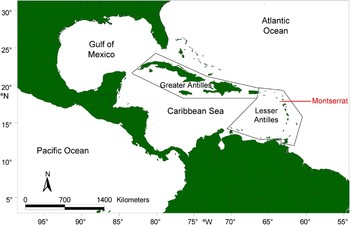
The wider Caribbean region (WCR) showing the locations of the Gulf of Mexico, the Caribbean Sea, the Greater and Lesser Antilles and Montserrat. The Pacific Ocean coast is not part of the WCR.

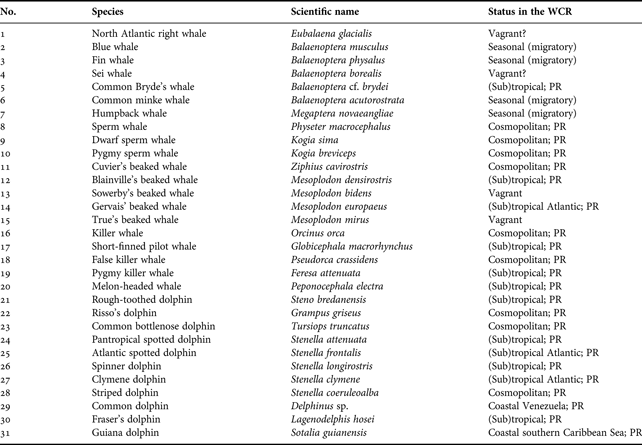
Thirty-one cetacean species have been recorded to date in the WCR (Table 1) (Jefferson & Lynn, Reference Jefferson, Fertl, Bolaños-Jiménez and Zerbini1994; Jefferson & Schiro, Reference Jefferson and Lynn1997; Debrot et al., Reference Debrot, De Meyer and Dezentjé1998; Mignucci-Giannoni, Reference Mignucci-Giannoni1998; Cardona-Maldonado & Mignucci-Giannoni, Reference Cardona-Maldonado and Mignucci-Giannoni1999; Roden & Mullin, Reference Roden and Mullin2000; Würsig et al., Reference Würsig, Jefferson and Schmidly2000; Ward et al., Reference Ward, Moscrop and Carlson2001; Boisseau et al., Reference Boisseau, Leaper and Moscrop2006; Yoshida et al., Reference Yoshida, Compton, Punnett, Lovell, Draper, Franklin, Norris, Phillip, Wilkins and Kato2010). At least four of these species are considered to be vagrants to the region (Table 1) (Jefferson & Schiro, Reference Jefferson and Lynn1997; Würsig et al., Reference Würsig, Jefferson and Schmidly2000; Ward et al., Reference Ward, Moscrop and Carlson2001). A further species, the Guiana dolphin (Sotalia guianensis), occurs only in the coastal waters of the Caribbean SeaFootnote 2 from Nicaragua southwards (Flores & da Silva, Reference Flores, da Silva, Perrin, Würsig and Thewissen2009). The status of the common dolphin (Delphinus spp.) in the western Atlantic was recently reviewed by Jefferson et al. (Reference Jefferson and Schiro2009) who concluded that there were no verified records for the Gulf of Mexico and that records for the Caribbean Sea were predominantly confined to a coastal area off the central/eastern coast of northern Venezuela. The remaining species are considered to be: (1) cosmopolitan (occur in a range of water temperatures and in most major oceans worldwide); (2) endemic to the Atlantic Ocean; (3) (sub)tropical species characteristic of warm water regions; and/or (4) migratory baleen whale species that are known or thought to inhabit the WCR on a seasonal basis (Table 1; Ward et al., Reference Ward, Moscrop and Carlson2001).
Cetacean species documented to date in the wider Caribbean region (WCR)1. Status is defined as: cosmopolitan (occur in a range of water temperatures and in most major oceans worldwide), Atlantic (endemic to the Atlantic), (sub)tropical (occur in warm water regions only), and/or seasonal (migratory inhabitants). PR, presumed residents, likely to inhabit the WCR on a year-round basis.
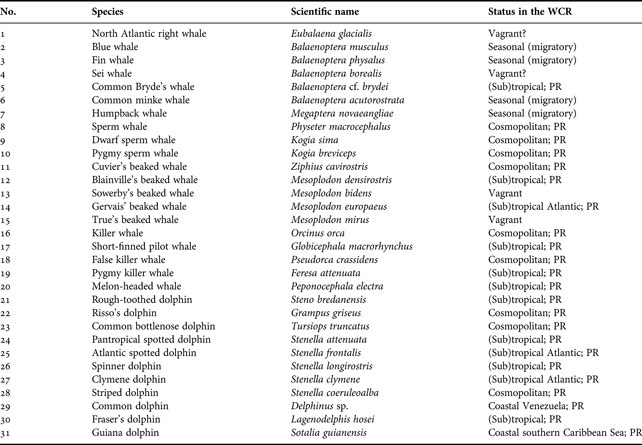
1 Sources: Jefferson & Lynn, Reference Jefferson, Fertl, Bolaños-Jiménez and Zerbini1994; Jefferson & Schiro, Reference Jefferson and Lynn1997; Debrot et al., Reference Debrot, De Meyer and Dezentjé1998; Mignucci-Giannoni, Reference Mignucci-Giannoni1998; Cardona-Maldonado & Mignucci-Giannoni, Reference Cardona-Maldonado and Mignucci-Giannoni1999; Roden & Mullin, Reference Roden and Mullin2000; Würsig et al., Reference Würsig, Jefferson and Schmidly2000; Ward et al., Reference Ward, Moscrop and Carlson2001; Boisseau et al., Reference Boisseau, Leaper and Moscrop2006; Flores & da Silva, Reference Flores, da Silva, Perrin, Würsig and Thewissen2009; Jefferson et al., Reference Jefferson and Schiro2009; Yoshida et al., Reference Yoshida, Compton, Punnett, Lovell, Draper, Franklin, Norris, Phillip, Wilkins and Kato2010.
The best-studied cetacean species within the WCR is the humpback whale (Megaptera novaeangliae), which migrates seasonally between summer high-latitude feeding areas in the North Atlantic and winter Caribbean breeding grounds, the largest of which are located in the shallow banks to the north of the Dominican Republic (Mattila et al., Reference Mattila, Clapham, Katona and Stone1989; Reeves et al., Reference Reeves, Swartz, Wetmore and Clapham2001; Swartz et al., Reference Swartz, Cole, McDonald, Hildebrand, Oleson, Martinez, Clapham, Barlow and Jones2003). The other baleen whale species in the WCR are also seasonal migrants, with the exception of the Bryde's whale (Balaenoptera cf. brydei) which occurs year-round. Most of the toothed whale species are likely to be resident in the WCR. Based on what is known of their wider geographical distributions, many of the cetacean species documented within the WCR are expected to occur around the volcanic island of Montserrat in the Lesser Antilles. However, there are almost no confirmed cetacean records for Montserrat waters.
During 2007 and 2010, two cetacean surveys were carried out concurrently with geophysical surveys in Montserrat waters. These surveys were aimed at mitigating any impacts of airgun sound on marine mammals and collecting distributional data using the seismic vessel as a platform of opportunity. This paper presents information on some new species records for Montserrat waters arising from this dedicated survey work and from opportunistic sightings by dive operators based on the island.
MATERIALS AND METHODS
Study area
Montserrat is a small (102 km2) island located approximately 48 km south-west of Antigua in the Lesser Antilles island chain in the eastern Caribbean Sea (Figure 1). It has a coastline of only 40 km, most of which comprises rock cliffs that drop steeply into the sea resulting in a narrow insular shelf and deep waters (>1000 m) within 5 km of shore.
The waters around Montserrat are principally influenced by two oceanic currents. The warm Caribbean Current travels along the coast of South America and flows into the Caribbean Sea from the east. It moves in a west or north-westwards direction through the Caribbean Sea (Gallegos, Reference Gallegos and Maul1996), and through the Yucatan Channel into the Gulf of Mexico. The warm Antilles Current flows in a northerly direction past the Greater and Lesser Antilles on their eastern, Atlantic Ocean side, to merge into the Florida Current (Gallegos, Reference Gallegos and Maul1996). The waters within the region are relatively oligotrophic and are stratified, with warm waters (25–30°C) at the surface and a colder, nutrient-rich layer below (Ward et al., Reference Ward, Moscrop and Carlson2001).
Montserrat has experienced volcanic activity since the most recent eruption of the Soufriere Hills volcano began in 1995. Exclusion zones restrict terrestrial access to the southern half of the island, and maritime exclusion zones extend to 4 km offshore along the southern half of the island on the east side, and to 2 km offshore along the south-west coast.
Dedicated cetacean surveys
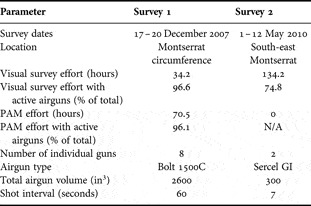
Cetacean data were collected in Montserrat waters during two survey periods: (1) Survey 1 from 17 to 20 December 2007; and (2) Survey 2 from 1 to 12 May 2010 (Table 2). The 89 m RRS 'James Cook' was carrying out an academic geophysical survey during both survey periods, with the geological work aimed at mapping the deposits from the Montserrat volcano on the seabed. Consequently, the vessel had permission to enter the maritime exclusion zones located around the island. To collect information on seabed volcanic deposits, the ‘James Cook’ was used as a seismic vessel and towed airguns during both geophysical surveys. These had volumes during the two surveys of 2600 and 300 in3 respectively (Table 2). Survey speed during the work was approximately 5 knots.
Survey parameters and the total visual survey effort and passive acoustic monitoring (PAM) effort during two surveys carried out from a geophysical platform of opportunity (the RRS 'James Cook') in the waters around Montserrat, Caribbean Sea.

The role of the cetacean observers on-board the platform was two-fold: (1) to implement marine mammal mitigation measures (based on JNCC, 2009) including ensuring that a soft start procedure was used for all airgun start-ups; and (2) to collect dedicated distributional data on cetacean occurrence in Montserrat waters using a team of trained cetacean observers. Both visual and acoustic cetacean data were collected. The distribution of the cetacean survey effort was determined by the focus of the geophysical survey work. During dedicated visual watches a single observer located on the bridge roof scanned 360° around the vessel using the naked eye and 10 × 42 binoculars (Survey 1), or two observers located on the bridge wings each scanned 180° on the port and starboard sides respectively (Survey 2). Effort logs (comprising position, time, and environmental data, including Beaufort sea state, swell height and visibility) were completed. For cetacean sightings, the species, group size, behaviour, position (latitude and longitude taken from the ship's GPS), distance from the vessel, bottom depth from the vessel's echosounder and associated environmental data were recorded. Where possible, cetaceans were photographed using a Canon SLR camera and a 100–400 mm Canon zoom lens to verify the species identification.
Passive acoustic monitoring of cetaceans was conducted throughout Survey 1 (day and night) using a towed hydrophone system supplied by Seiche Measurements Ltd. The 10 m hydrophone array comprised three hydrophone elements: (1) two broadband elements with a flat response from 2 to 200 kHz (–3 dB points) and an output sensitivity of –166 dB re. 1 µPa at 1 m; and (2) a single low frequency element with a flat response from 75 Hz to 30 kHz (–3 dB points) with an output channel sensitivity of –157 dB re: 1 µPa at 1 m. The array was deployed 200 m astern of the vessel and at a depth of approximately 20 m. The hydrophone signals were digitized and sampled at 48 kHz. Monitoring occurred for 24 hours, predominantly by single, experienced acoustic operators who completed standardized logs of effort and of marine mammal detections. Real-time analysis software consisted of ‘Whistle’ (v 4.0, IFAW), showing a spectrogram for the detection of tonal sounds, and ‘Rainbow Click—Porpoise Detector’ (v 4.0, IFAW), for the detection of cetacean clicks. While in theory the low frequency calls from baleen whales (≤1 kHz; Richardson et al., Reference Richardson, Greene, Malme and Thomson1995) might be detected using this equipment, in practice these sounds (with the exception of the singing of humpback whales, which have peak energy at frequencies of up to 4 kHz; Richardson et al., Reference Richardson, Greene, Malme and Thomson1995) were masked by engine and airgun noise and would have been very difficult to detect.
Opportunistic cetacean records
Dive tour operators on Montserrat were contacted and information on cetacean occurrence in the region was requested. Specific records were not accepted unless verifying information in the form of photographs was provided.
RESULTS
Dedicated cetacean surveys
VISUAL SURVEY EFFORT
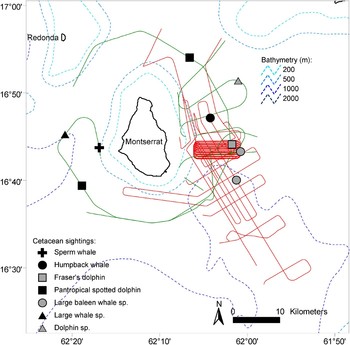
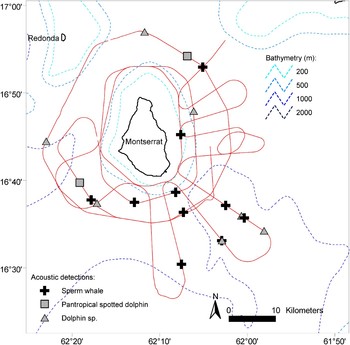
A combined total of 168.4 hours of visual survey effort was carried out during the two surveys, of which airguns were active for 79.2% of the combined time (Table 2). The total visual cetacean survey effort was much higher during Survey 2 than during Survey 1, due to the requirements of the geological work. Similarly, the spatial extent of the visual cetacean survey effort differed between the surveys. During Survey 1, the geologists mapped the entire circumference of Montserrat and cetacean survey effort (both visual and acoustic) was correspondingly widely-distributed (Figures 2 & 3). During Survey 2, visual cetacean survey effort was concentrated to the east and south-east of Montserrat in accordance with the geological focus (Figure 2). Most of the combined visual cetacean survey effort occurred over waters with a bottom depth ranging from 400 to 1200 m (Figure 2).
The location of cetacean survey effort during December 2007 (green) and May 2010 (red) and associated sightings during visual surveys in Montserrat waters. The sighting positions represent the ship's position when an animal was first seen.

Location of acoustic monitoring effort (red) and associated cetacean acoustic detections in Montserrat waters, December 2007. The detection positions represent the ship's position when an animal was first heard.

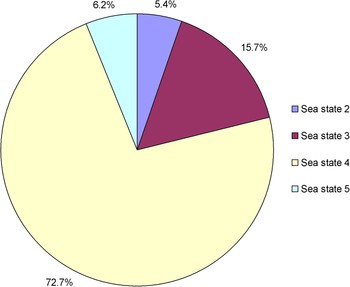
The majority (73%) of the combined survey visual cetacean effort was collected in Beaufort sea state 4 (Figure 4). The proportion of time spent surveying in sea states ≥4 was slightly higher during Survey 1 (96.2%) than Survey 2 (74.5%). Since cetacean detection rate is negatively influenced by the presence of whitecaps (e.g. Palka, Reference Palka1996), the Beaufort sea states experienced during both surveys were largely unfavourable for visually detecting cetaceans. This is indicated by the combined survey cetacean sighting rate, which decreased from 0.110 sightings/hour in Beaufort sea state 2, to 0.057 sightings/hr in Beaufort sea state 4. The airguns were firing for the majority of the visual survey effort during both surveys (Table 2). All sightings occurred while the airguns were active. The combined visual sighting rate was 0.053 sightings/hour. The sighting rate was higher during Survey 1 (0.146 sightings/hour) than Survey 2 (0.030 sightings/hour).
Percentage of visual cetacean survey effort collected off Montserrat in different Beaufort sea states during December 2007 and May 2010.

ACOUSTIC SURVEY EFFORT
A total of 73.3 hours of visual survey effort was carried out during Survey 1, of which airguns were active for 96.1% of the combined time (Table 2). All of the acoustic detections occurred while the airguns were actively firing, producing an overall acoustic detection rate of 2.59 detections/hour. The acoustic effort was more numerous, and covered a greater spatial extent, than the visual effort during Survey 1 (Figure 2 & 3), because it was collected for 24 hours throughout the survey rather than being restricted to daylight hours. The vessel maintained a steady survey speed throughout the survey and there were no other ships in the vicinity (due to the maritime exclusion zones). Consequently, the sounds impacting on the acoustic data were the survey platform's own engines and echosounders, and the airguns, all of which remained fairly constant throughout the survey.
CETACEAN RECORDS
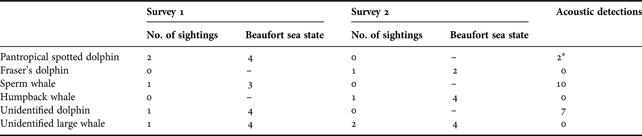
Nine visual cetacean sightings and 19 acoustic detections were recorded, comprising at least four cetacean species (Table 3). Due to the bias in spatial distribution of the data, the variation in the amount of effort collected between temporal periods, the high sea states experienced during the survey, and the unknown potential impacts from airgun sound on the dataset, it was not possible to compare intraspecific and interspecific sighting rates. However, since these records appear to represent the first verified sightings of the following toothed whale species in Montserrat waters, they are described in detail below.
Visual sightings (and associated sea state conditions) and acoustic detections of cetacean species recorded during two surveys off Montserrat during December 2007 and May 2010.
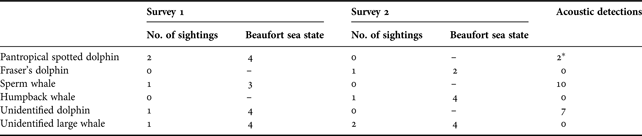
*Species identification confirmed from corresponding visual sightings.
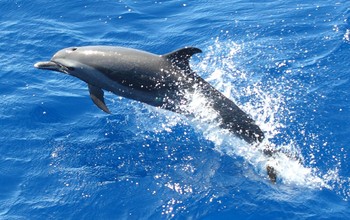
Pantropical spotted dolphin (Stenella attenuata)—groups of 12 and 4 pantropical spotted dolphins were sighted on 19 and 20 December 2007 respectively. The sightings were located approximately 12 km north-east and 11 km south-west of Montserrat, in waters with corresponding bottom depths of 743 and 925 m (Figure 2). Dolphins were identified from their prominent, slender, white-tipped beaks, narrow and falcate dorsal fins, fine white flank spotting and the distinctive darker dorsal cape which extended high above the eye and lower below the dorsal fin (Figure 5). Both visual sightings resulted in animals bow-riding, and had corresponding acoustic detections.
Part of a school of four pantropical spotted dolphins (Stenella attenuata) riding the bow-wave on 20 December 2007 (photograph by Caroline Weir).

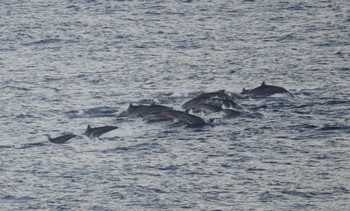
Fraser's dolphin (Lagenodelphis hosei)—a school of an estimated 50 Fraser's dolphins (including calves and juveniles) was observed at dawn on 7 May 2010, approximately 13 km east of Montserrat in waters with a bottom depth of 964 m (Figure 2). Although the light conditions were poor, photographs taken revealed the key features of Fraser's dolphins, which included a robust body shape, short but distinctive beaks, small, upright and pointed dorsal fins and the dark lateral band extending from the eye backwards to the genital area in some adult animals (Figure 6).
A group of 50 Fraser's dolphins (Lagenodelphis hosei) photographed at dawn on 7 May 2010 (photograph by Caroline Weir).

Sperm whale (Physeter macrocephalus)—a group of 2 to 3 sperm whales was observed 4 km west of Montserrat in waters with a bottom depth of 608 m, on 20 December 2007 (Figure 2). Although distant from the vessel, diagnostic features including frequent low bushy blows angled forwards and broad uniformly-dark tail flukes were seen as the whales spent several minutes logging and blowing at the surface and then fluked-up. In addition, there were 10 acoustic detections of sperm whale click trains during the hydrophone survey between 17 and 20 December 2007, located between 3 and 20 km from the coast of Montserrat (Figure 3). Sperm whale clicks were identified based on the long duration of individual click trains, the regular inter-click intervals (~0.5 seconds) and a lack of accompanying tonal sounds (Whitehead & Weilgart, Reference Whitehead and Weilgart1990). Sperm whale acoustic detections were separated from one another by periods of at least 50 minutes in which no clicks were audible.
Humpback whale—a humpback whale was observed on 10 May 2010, approximately 10 km east of Montserrat, in waters with a bottom depth of 944 m (Figure 2). The whale was travelling northwards, and making dives of around 10 minutes in duration interspersed with blow sequences. The animal breached numerous times revealing the long, white, pectoral flippers that are diagnostic of this species.
Opportunistic cetacean records
Existing literature was reviewed, and dive tour operators based on Montserrat and the Eastern Caribbean Cetacean Network (Nathalie Ward, ECCN, personal communication) were consulted, to identify previous records of cetaceans in Montserrat waters. Almost no cetacean data could be located for Montserrat waters. Anecdotal information (without verifying images or supporting data) included a sighting of an unidentified adult and calf whale approximately 1 km off Little Redonda (16°49.38′N 62°11.42′W) at the northern tip of Montserrat during February 2007 (Andrew Myers and Emmy Aston, Scuba Montserrat, personal communications). Whales, presumably humpback whales, are occasionally heard by divers during the winter and late spring (Andrew Myers, Scuba Montserrat, personal communication). Another diver reported that dolphins (unspecified species) were observed regularly on boat trips to the island of Redonda (David Graham, Montserrat diver, personal communication). The only opportunistic cetacean record where supporting photographs were available was a sighting of pygmy killer whales (Feresa attenuata).
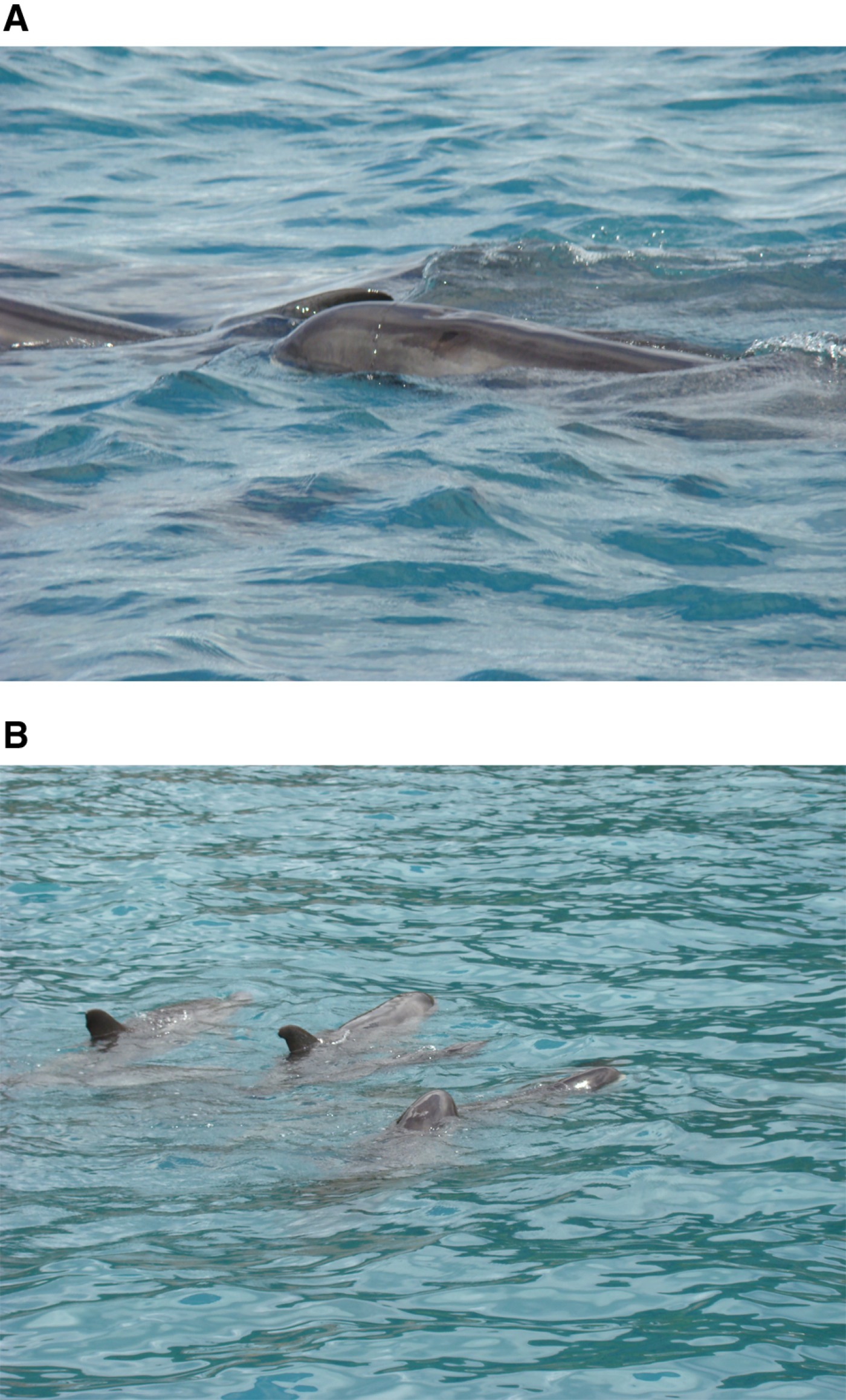
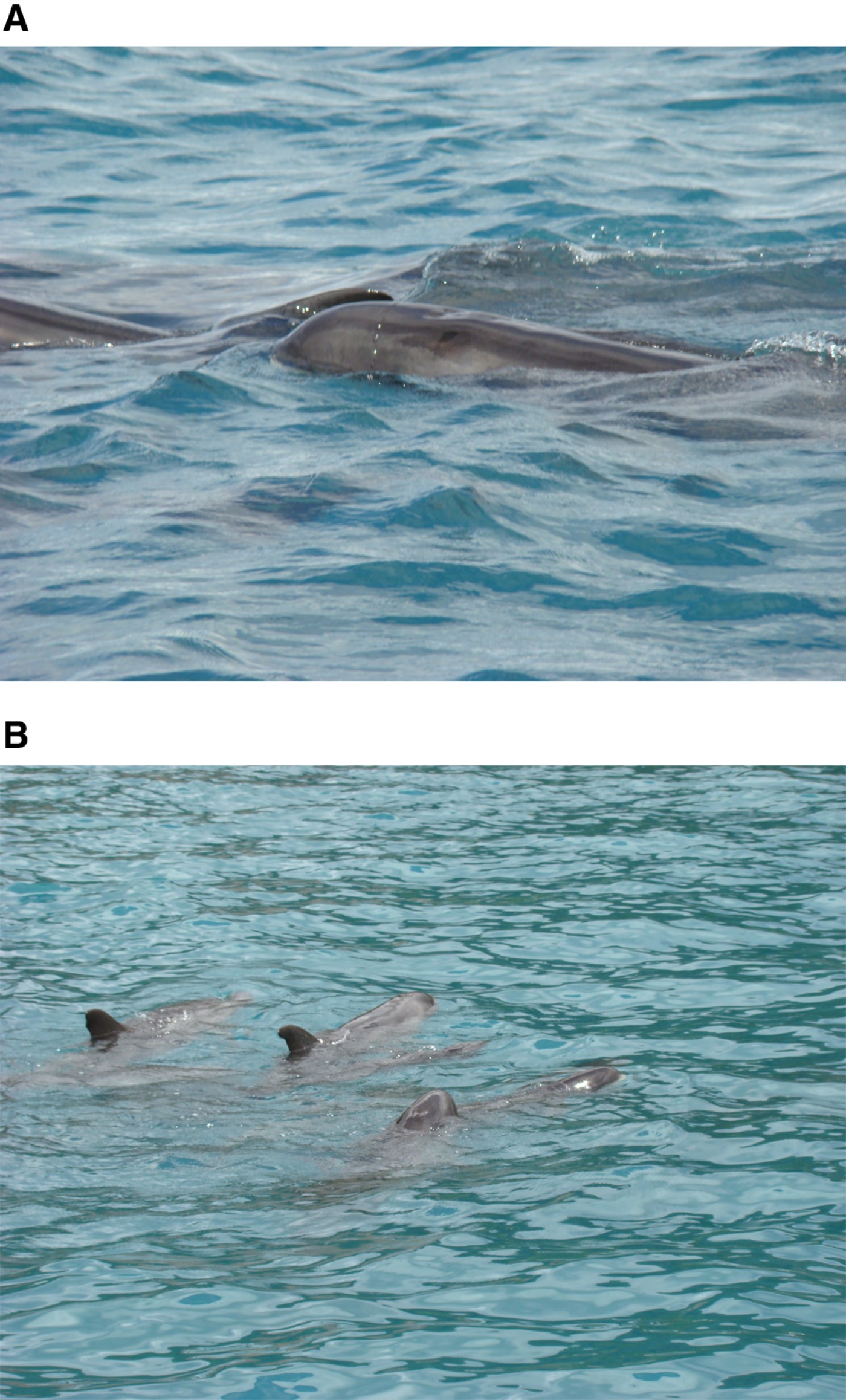
Pygmy killer whale—a group of 14 pygmy killer whales (including a small calf) was photographed when the animals approached to within 15 m of the jetty in Montserrat harbour, Little Bay (16°48.16′N 62°12.38′W), on the morning of 17 October 2008 (Andrew Myers and Emmy Aston, Scuba Montserrat, personal communications). Characteristic features of rounded foreheads, white lips and chin, tall and falcate dorsal fins and a narrow, high dark dorsal cape were observed and photographed (Figure 7). The sighting occurred a day after the passage of Hurricane Omar through the region on 16 October 2008.
Part of a group of 14 pygmy killer whales (Feresa attenuata) photographed in Little Bay on 17 October 2008 (photographs by Andrew Myers and Emmy Aston, Scuba Montserrat), showing (A) shape of the melon and white chin; and (B) dorsal profile.
DISCUSSION
Although cetaceans were not numerous in Montserrat waters during the period of the two dedicated surveys, four species were identified and a further species was opportunistically reported. The higher cetacean sighting rate during the December 2007 survey may be indicative of seasonal or annual variation in cetacean occurrence in the region. It may also be a result of differences between sea state or airgun activity between the two survey periods. However, the two survey periods both experienced unfavourable Beaufort sea states (≥4) for the majority of the time, and airgun activity was high during both surveys. In fact active airguns accounted for a higher proportion of the total visual survey effort, and a larger volume airgun array was used, during the December 2007 survey than during the May 2010 survey (Table 2). Therefore it seems unlikely that either of these factors is accountable for the marked differences in sighting rate recorded in the two survey periods.
The different species composition recorded during December compared to May might potentially reflect seasonal changes in the cetacean community. However, with the exception of baleen whales, particularly the humpback whale, most cetacean species occurring in the Caribbean Sea are likely to be resident year-round in the region (Ward et al., Reference Ward, Moscrop and Carlson2001). Consequently, the observed differences in the Montserrat cetacean fauna between the two study periods most likely represents spatio-temporal movements of species within the wider Caribbean Sea. Both the short survey durations and the limited spatial coverage during each survey (particularly Survey 2) limited the opportunities to record higher species richness.
Montserrat is situated between two known winter breeding grounds for humpback whales: (1) the Greater Antilles extending from the Dominican Republic to Anguilla where the greatest present-day concentrations of humpbacks aggregate in the Caribbean (Mattila et al., Reference Mattila, Clapham, Katona and Stone1989; Swartz et al., Reference Swartz, Cole, McDonald, Hildebrand, Oleson, Martinez, Clapham, Barlow and Jones2003); and (2) the Lesser Antilles from Guadeloupe south to Venezuela where historical concentrations of whales occurred but present density appears to be low (Townsend, Reference Townsend1935; Swartz et al., Reference Swartz, Cole, McDonald, Hildebrand, Oleson, Martinez, Clapham, Barlow and Jones2003). The waters around Montserrat may be less important for humpbacks than these two regions; Reeves et al. (Reference Reeves, Swartz, Wetmore and Clapham2001) reported the capture of 16 humpback whales between St Martin and Montserrat between 1823 and 1889, while 190 whales were captured around Guadeloupe in the same period. The timing of the Montserrat humpback whale record in May corresponds with the known former occurrence of humpbacks throughout the Lesser Antilles from January through May (Reeves et al., Reference Reeves, Swartz, Wetmore and Clapham2001). Roden & Mullin (Reference Roden and Mullin2000) recorded one humpback whale sighting near Montserrat, and recent sightings off Guadeloupe (Swartz et al., Reference Swartz, Cole, McDonald, Hildebrand, Oleson, Martinez, Clapham, Barlow and Jones2003) also support a regular occurrence of this species in the region. At least one of the two large baleen whale sightings during the May survey was also considered very likely to be a humpback whale, based on its tall, vertical bushy blow, breaching behaviour and apparently white flippers. However, it was too distant to be conclusive. The species identification of the other sighting was less certain. In the wider region around Montserrat, the Bryde's whale has been recorded off St Croix to the north-west (Mignucci-Giannoni, Reference Mignucci-Giannoni1996), and unidentified ‘finbacks’ (presumably fin Balaenoptera physalus, sei B. borealis or Bryde's whales) were recorded by whalers in the area between Antigua, Redonda and Montserrat during January 1937 (Reeves et al., Reference Reeves, Swartz, Wetmore and Clapham2001).
Sperm whales are known to occur regularly in the Caribbean, with approximately 200 animals thought to inhabit deep waters (500–2500 m bottom depth) between Guadeloupe and Grenada (Watkins & Moore, Reference Watkins and Moore1982). Photo-identification work around Dominica and Grenada found that individuals were re-sighted within and between years (Gordon et al., Reference Gordon, Gillespie, Potter, Frantzis, Simmonds, Swift and Thompson1998), suggesting residency within the lesser Antilles region. The whaling charts of Townsend (Reference Townsend1935) indicate catches of sperm whales in the vicinity of Antigua particularly during February and March. Based on acoustic detections, the sperm whale was the most frequently recorded species in Montserrat waters. The lack of acoustic survey effort during Survey 2 doubtless limited the potential for recording sperm whales, since conditions for visually observing cetaceans were poor given prevailing high sea states. However, re-sightings of individuals between Guadeloupe and Dominica (Boisseau et al., Reference Boisseau, Carlson and Seipt2000) suggest that sperm whales may range widely across the wider Caribbean area, and the occurrence of whales off Montserrat during December (but not in May) might reflect such movements.
There are fewer available Caribbean records for small cetaceans, which have received far less research focus than large whales. A full review of records for the WCR was provided by Ward et al. (Reference Ward, Moscrop and Carlson2001), and the following discussion refers predominantly to literature particularly relevant to Montserrat and surrounding waters in the northern part of the Lesser Antilles. Although the sighting reported here constitutes the first verified record for Montserrat waters, Fraser's dolphin was expected to occur in the region. Two sightings were recorded from Dominica, to the south of Montserrat, in 1991 (Watkins et al., Reference Watkins, Dahler, Fristrup and Notobartolo di Sciara1994), and it was the second most frequently sighted dolphin species during surveys off Dominica in 2005 (Gero & Whitehead, Reference Gero and Whitehead2006). It has been recorded in mixed schools with pantropical spotted dolphins off Guadeloupe (Rinaldi et al., Reference Rinaldi, Rinaldi and Sahagian2006). Fraser's dolphins have also been recorded (as strandings) at Puerto Rico to the north of Montserrat (Mignucci-Giannoni et al., Reference Mignucci-Giannoni, Montoya-Ospina, Perez-Zayas, Rodriguez-Lopez and Williams1999a).
In a review of pantropical spotted dolphin occurrence in the Caribbean, Mignucci-Giannoni et al. (Reference Mignucci-Giannoni, Swartz, Martínez, Burks and Watkins2003) located 96 sightings and strandings including records from west of Guadeloupe during 1987 and 2000. The species was the most frequently observed cetacean during surveys in Guadeloupe waters during 2000 (Boisseau et al., Reference Boisseau, Leaper and Moscrop2006) and from 1998 to 2005 (Rinaldi et al., Reference Rinaldi, Rinaldi and Sahagian2006). To the north of Montserrat, four sightings were reported from Puerto Rico in February 2001 (Mignucci-Giannoni et al., Reference Mignucci-Giannoni, Swartz, Martínez, Burks and Watkins2003). However, the sightings reported here appear to represent the first verified records for Montserrat waters.
Pygmy killer whales are not well-documented in the Caribbean or worldwide. However, Boisseau et al. (Reference Boisseau, Carlson and Seipt2000) observed pygmy killer whales on four occasions off Guadeloupe, and Rinaldi et al. (Reference Rinaldi, Rinaldi and Sahagian2006) reported a total of 62 encounters with this species in the waters off Guadeloupe between 1998 and 2005. Therefore, although the record here is the first for Montserrat, the species is apparently not uncommon around neighbouring islands. One interesting record from the Lesser Antilles related to a group of five pygmy killer whales that stranded in the British Virgin Islands during September 2005, the day after Hurricane Marilyn passed through the area (Mignucci-Giannoni et al., Reference Mignucci-Giannoni, Toyos-Gonzales, Pérez-Padilla, Rodríguez-López and Overing1999b). It was highly suspected that the stranding was associated with the meteorological and oceanographic disturbance caused by the hurricane (Mignucci-Giannoni et al., Reference Mignucci-Giannoni, Toyos-Gonzales, Pérez-Padilla, Rodríguez-López and Overing1999b), since pygmy killer whales are typically an offshore species that would not be expected to enter shallow water. The sighting reported off Montserrat during October 2008 occurred the day after Hurricane Omar passed through the region, and it seems plausible that this unusual inshore occurrence of the species was linked to the hurricane event.
The occurrence of killer whales (Orcinus orca) and false killer whales (Pseudorca crassidens) off nearby Antigua (Ward et al., Reference Ward, Moscrop and Carlson2001), and sightings of beaked whales, Kogia spp., killer whales, short-finned pilot whales (Globicephala macrorhynchus), false killer whales, rough-toothed dolphins (Steno bredanensis), common bottlenose dolphins (Tursiops truncatus), spinner dolphins (Stenella longirostris), Atlantic spotted dolphins (S. frontalis) and striped dolphins (S. coeruleoalba) off Guadeloupe (Boisseau et al., Reference Boisseau, Carlson and Seipt2000, Reference Boisseau, Leaper and Moscrop2006; Rinaldi et al., Reference Rinaldi, Rinaldi and Sahagian2006) suggest that the before-mentioned species may also be expected to occur in Montserrat waters. Although the common dolphin has also been reported from Antigua (Erdman, Reference Erdman1970), this record was likely to be a misidentification (Jefferson et al., Reference Jefferson and Schiro2009).
While these initial surveys suggested that Montserrat waters are not an area of particularly high cetacean occurrence, they were very short in duration and predominantly occurred in unfavourable sea conditions. During a previous survey in the Caribbean Sea, Jefferson & Lynn (Reference Jefferson, Fertl, Bolaños-Jiménez and Zerbini1994) noted that ‘the seas were rarely less than Beaufort 5 and few sightings were made that did not result from dolphins coming to ride the bow wave’. Similar was true during the visual surveys reported here, with bow-riding dolphins and breaching whales providing the majority of sighting cues. Cryptic species such as beaked whales and Kogia spp., and undemonstrative or small schools of dolphins, were highly unlikely to have been sighted. Other factors may also have limited the scope for observing cetaceans. A number of potential impacts on cetaceans from the airgun sound produced during seismic surveys have been highlighted, including displacement from the area of a seismic survey or behavioural changes (see reviews by Gordon et al., Reference Gordon, Moscrop, Carlson, Ingram, Leaper, Matthews and Young2004 and Nowacek et al., Reference Nowacek, Thorne, Johnston and Tyack2007). It was not possible to say whether this was the case during the survey work presented here. All cetacean sightings and acoustic detections during the surveys occurred while the airguns were actively-firing, including the approach of two dolphin schools to bow-ride the seismic vessel. Natural seismic noise, arising from tectonic or volcanic activity can also contribute significantly to ambient noise at low frequencies (peak energy ≤100 Hz; Wenz, Reference Wenz1962) in geologically active areas (Richardson et al., Reference Richardson, Greene, Malme and Thomson1995). It may therefore be speculated that cetaceans might avoid Montserrat waters as a result of regular natural seismic noise in the region arising from volcanic activity. However, the responses of cetaceans to natural seismic noise have not been studied and remain unknown.
The relatively high cetacean species richness amongst the small number of sightings recorded in Montserrat waters suggests that increased future survey effort throughout the year would likely result in the identification of a number of further species. Effort should be made to establish cetacean sighting reporting schemes, particularly amongst local dive and boat operators. Furthermore, the close proximity of deep water to the shore may facilitate shore-based observations (given appropriate high-magnification visual equipment), although most people inhabit the north-west of the island due to the volcanic exclusion zone. Information on the occurrence of cetaceans in the region is vital to assessing biodiversity and mitigating known and potential impacts from human activities in the Caribbean Sea such as by-catch in fishing gear, deliberate capture, habitat degradation, pollution, acoustic disturbance, vessel strikes and overfishing (Reeves, Reference Reeves2005; Borobia & Barros, Reference Borobia and Barros2006). In addition, the scope for Montserrat to develop whale and dolphin watching should be assessed, since whale-watching programmes have been successfully established in neighbouring Guadeloupe (Rinaldi et al., Reference Rinaldi, Rinaldi and Sahagian2006) and tourism provides the major source of local income on Montserrat.
ACKNOWLEDGEMENTS
We are grateful to the crew of the RRS ‘James Cook' for their hospitality and helpfulness throughout the dedicated cetacean surveys and to the principal scientists, Steve Sparks and Peter Talling, for supporting the production of this manuscript. Many thanks to Andrew Myers and Emmy Aston of Scuba Montserrat; Nathalie Ward of the Eastern Caribbean Cetacean Network, and to David Graham for providing information on incidental cetacean sightings from Montserrat. The comments from two anonymous referees greatly improved the manuscript.