Decades before the rise of the international megamusical, Franz Lehár's operetta Die lustige Witwe (The Merry Widow) traveled the world, becoming a franchise surrounded by a constellation of commodities. Within two years of its opening in Vienna on 30 December 1905, the romantic tale of Hanna Glawari's second chance at love was playing in theatres across Europe and in “virtually every city in the German-speaking world,” including colonial communities in Africa and Asia.Footnote 2 In Argentina, as many as five versions of the operetta opened simultaneously in Buenos Aires, each in a different language. By 1908, three Merry Widow road companies were touring the United States, and numerous burlesques of the piece were vying for the attention of theatregoers.Footnote 3
Many factors contributed to The Merry Widow's success, not least of which was Lehár's captivating score and what the New York Times called its “excessively interesting” comical plot.Footnote 4 As a writer for the New York Dramatic Mirror enthused:
Coming at the end of an epoch of inane musical comedy—grant that it is at an end!—the operetta is twice welcome, on account of its own excellence, and because it may start a new era in musical entertainment. The music is bright and original, the humor fresh and genuine; the story clear and vigorous, and the characters exaggerated only a trifle beyond probabilities.Footnote 5
In addition to the music and the libretto, what made The Merry Widow a uniquely modern phenomenon was the speed with which it crossed national and cultural borders, assisted by new advances in wireless telegraphy and the convenience of steam-powered ocean liners. Indeed, the “new era in musical entertainment” heralded by Lehár's operetta coincided with the rapid expansion of a transnational market in theatrical commodities, fueled by the feminization of commercial theatre audiences and increased demands for exciting, moving, or otherwise captivating entertainment.Footnote 6 Within such a competitive environment, non-Austrian theatre managers fought vigorously for the rights to produce The Merry Widow in their home countries. In May 1907, for example, Boston real estate agent turned manager Henry W. Savage sent a special cablegram from Vienna to the New York Times announcing that he had successfully acquired the American rights and would soon be opening his own lavish production in New York.Footnote 7
Although theatrical commodities are more often seen as by-products of a theatrical production than as a contributing factor in its success, they played a significant part in The Merry Widow's popularity, especially in the United States, where the operetta reached its commercial apotheosis. Throughout 1908, American newspapers and magazines advertised an impressive range of products that were associated with the operetta or otherwise bore its name, from sheet music, cigars, and lunches to cocktails, corsets, and hats.Footnote 8 While many of these products were not authorized by Savage or anyone else involved in the production, they nevertheless prepared American audiences for the operetta's eventual arrival. For those who were either too far away from an urban center or could not afford the price of admission, purchasing commodities inspired by the Merry Widow was one way to achieve cultural capital and gain membership in what historian Kristin Hoganson describes as a transnational “imagined community” rooted in shared consumer experiences.Footnote 9 Extending Benedict Anderson's provocative phrase, Hoganson argues that consuming foreign commodities was central to middle-class American women's performances of cosmopolitan sophistication in the late nineteenth and early twentieth centuries.Footnote 10 By demonstrating their awareness of and taste for foreign products and experiences, these women defied growing cries for economic nationalism and presented themselves as the educated counterparts of the European elite.Footnote 11
Of all the commodities to emerge from the Merry Widow, the Merry Widow hat undoubtedly attracted the most attention (much of it derisive) from church ministers, conservative critics, and members of the international press. Made of black straw and trimmed with a silver band and two pink roses, it first appeared in the 1907 English-language premiere of the operetta in London.Footnote 12 Yet while it was one of the most sensational fashion fads of the era, it was hardly the first to emerge from a theatrical production. By the early twentieth century, commercial theatres in Europe and North America had become major sites for displaying new styles in dress and millinery, as managers hoping to attract and retain respectable female audiences turned to prominent dressmakers for costuming assistance. Society dramas, musical comedies, and operettas set in the modern era proved to be ideal vehicles for fashion display, and audiences became so accustomed to taking fashion hints from the stage that they regularly attended the theatre with the express purpose of finding a new wardrobe.Footnote 13 Hoping to anticipate their customers' desires, less-established dressmakers and milliners visited the theatre on a regular basis, taking detailed notes of stage designs in order to reproduce them in their own salons. “[J]ournalists, middle-class householders, clergymen, and laborers” likewise came to see the fashion spectacle, explain Joel Kaplan and Sheila Stowell, creating a “dynamic familiar to those who attended Ascot, Henley, or the Derby, where a working- and middle-class public divided its time between scheduled events and the watching of well-heeled fellow spectators.”Footnote 14 This convergence of theatre and fashion positioned theatregoers of all classes as avid consumers and transformed actresses into glorious fashion mannequins. In many respects, then, the Merry Widow hat's movement from stage to shop was not unlike the movement of hundreds of other fashion commodities. What differentiated this fad from others, however, was how quickly the circumference of the broad-brimmed style increased as it crossed over the theatrical footlights into fashion salons in London and around the world.
The Merry Widow hat's transnational circulation and its rapid “expansion” from theatre to salon to street offer compelling evidence of its ability to at once fulfill and exceed its function as a theatrical commodity. Following Marx's definition of a commodity as “a product of labour”Footnote 15 that mediates social relations and acquires value through processes of exchange, I use the term “theatrical commodity” to denote objects that were either directly or indirectly associated with a theatrical production. Although, as its name attests, the Merry Widow hat remained closely tied to the Lehár operetta, it also took on a life of its own as crossed boundaries of class, race, and nation as well as theatrical boundaries. It is this “second life” away from the stage that interests me here.
This article demonstrates that the movement of the Merry Widow hat from theatre to salon to street and across local and national borders not only inspired the production and circulation of new commodities but also facilitated a range of consumer interactions and performances. To that end, I begin by considering the hat's initial appearance in the London production of The Merry Widow, taking into account the kinds of meaning that female audiences might have derived from its onstage “performance.” I then offer a brief discussion of the hat's movement off the stage and into the fashion salon, where it became a highly desirable commodity, before analyzing its circulation and representation in the United States. For while the style prompted a range of reactions worldwide, it was in the United States that the Merry Widow hat seems to have generated the largest and loudest response, if its frequent appearances in newspapers, postcards, song sheets, and Broadway revues are any indication. Indeed, the sheer noisiness of the American reaction to the Merry Widow hat illustrates just how quickly the meanings associated with a theatrical commodity can mutate as it moves from one geographic setting to another.
Recent scholarship on theatrical costumes and properties has demonstrated the importance of situating the objects used in theatrical productions within broader historical and cultural contexts to appreciate their potential as conveyors of meaning.Footnote 16 In his excellent book The Stage Life of Props, Andrew Sofer combines semiotics, phenomenology, and cultural materialism to offer a rich analysis of how props such as the Restoration fan came to achieve a “stage life” of their own. Yet while Sofer clearly positions his project in relation to work by sociologists and cultural historians on the “social life of things,” he purposefully limits his focus to the playhouse, insisting that “[b]efore we can hope to ascertain ‘the cultural project of [stage] things,’ we must first recover their trajectories within the unfolding spatiotemporal event in the playhouse—even while acknowledging that such a reconstruction will always be provisional.”Footnote 17 I hope to extend Sofer's analysis by considering what happens when an object animated within a stage setting leaves the theatre to enter the transnational marketplace—or, in the case of the Merry Widow hat, when a stage object inspires the proliferation of commodities that bear its name and associations, which are then dispersed to various markets around world.
In chronicling the offstage life of the Merry Widow hat, I draw inspiration from cultural geographers such as Peter Jackson, whose work tracks the performance and transformation of commodities as they move from one cultural/geographic context to another along a “global commodity chain” (GCC). Emerging from cultural geography and sociological studies of globalization, the concept of the global commodity chain has been a highly effective tool for analyzing the movement and transformation of specific commodities—for example, coffee, cotton, and tobacco—through the stages of production, transportation, distribution, and consumption across local, national, and international boundaries.Footnote 18 A GCC approach resists the problematic binaries of local–global, production–consumption, culture–commerce by instead focusing on the multiple connections and transformations that occur as people and objects move across borders, allowing for the “mutual entanglement” of the cultural and the economic.Footnote 19 Such an approach therefore presents exciting strategies for theatre scholars looking to trace the intersections among the local, the national, and the global.Footnote 20
By analyzing the dramatic offstage life of a costume item, I also hope to contribute to existing studies of the marketing phenomenon known as the tie-in or tie-up, a subject that has received considerable attention from film historians but has only recently entered the vocabulary of theatre scholars. In his now-classic 1978 article “The Carole Lombard in Macy's Window,” film historian Charles Eckert describes how Hollywood studios in the 1920s and 30s worked closely with “brand-name manufacturers, corporations, and industries” to maximize film's potential for “swathing” commodities “in a fetish-inducing ambiance of music and emotion.”Footnote 21 According to Eckert, the goal of the tie-in was to direct desire for consumer goods that was aroused within the darkened environment of the cinema toward real-world stores, where that desire could be consummated. Studios worked closely with manufacturers to sell goods associated with a specific film, such as a dress or a hat worn by a star, and thereby extend the film's influence and the studio's potential income.Footnote 22
Although a number of business-savvy theatre managers forged tie-in relationships with consumer goods manufacturers in this period,Footnote 23 George Edwardes (the producer of the London show that debuted the Merry Widow hat) and Henry Savage do not appear to have made such arrangements with the producers of Merry Widow commodities. Despite the fact that its status as a tie-in is unofficial, the Merry Widow hat stands as an important predecessor to later tie-in commodities. In fact, I would argue that it was partly the absence of a formalized relationship between theatrical managers and milliners that enabled—if not encouraged—the Merry Widow hat to balloon to epic proportions and take on a host of new (even contradictory) meanings outside the theatrical environment. Unlike the formal tie-ins associated with films or stage productions such as Disney's The Lion King, the Merry Widow hat seems to have traveled freely from market to market, unhampered by the threat of lawsuits for copyright infringement, encouraging a range of interpretations and appropriations as it moved from one performance space to another.
Questions of commodification and consumer agency have been central to the study of the filmic and theatrical tie-in. Following Eckert, feminist film scholars in the 1980s and 1990s expressed reservations about the way that tie-ins reinforced the relationship between female spectatorship and consumption, further positioning the already-commodified body of female performers as sites for displaying an endless series of consumable goods.Footnote 24 Other scholars (most notably Jane Gaines, Charlotte Herzog, and Jackie Stacey) acknowledged these concerns, yet argued that the meanings of filmic tie-ins varied wildly depending on the personal tastes and desires of individual audience members. Without denying the gendered implications of the tie-in as a marketing technique, they urged historians to pay closer attention to the range of responses that a single commodity might have elicited and to examine the particular ways that fans incorporated filmic tie-ins into their daily lives.Footnote 25 Jane Gaines, in particular, identified the need to study tie-ins as they moved from one context from another, insisting that rather than “freezing” culture, “commodification seems to facilitate circulation by multiplying the number of possible contexts” within which culture can develop.Footnote 26 In so doing, she argued, historians might arrive at a better understanding of how these commodities transform, transmit, and facilitate different kinds of cultural expression.
In recent years, theatre scholars have also offered important examinations of the tie-in's role within a theatrical context. In Performing Consumers, for example, Maurya Wickstrom moves away from the more celebratory view of the tie-in, questioning the average consumer's ability to depart from a preestablished corporate “script” in their interactions with commodities. Focusing specifically on tie-ins from Disney's 1997 Broadway production of The Lion King, she argues that the possible meanings that a child or adult might have derived from a stuffed toy, figurine, or costume were “already foreclosed” by the “fictions generated by the Disney brand.” In the act of playing with or even embodying Disney characters, consumers came to imitate the commodity form itself, associating this mimetic play with creativity and individual agency. As a result, Wickstrom argues, commodities take on the appearance of the “ineradicable source of ongoing life” while humans, by contrast seem “decisively unmagical.”Footnote 27
Wickstrom's analysis of tie-ins for The Lion King provides strong evidence to support her larger examination of brandscape environments, ranging from Niketown to Ralph Lauren, and the various ways they involve consumers in the production and performance of brand identity. Within such environments, consumers are invited to enact and embody the commodities they see around them, such that “[t]he brand becomes a full-body costume that opens itself for us to crawl inside.”Footnote 28 Using Michael Hardt's concept of “affective labor,” which “involves the production and manipulation of affects and requires (virtual or actual) human contact and proximity,”Footnote 29 she describes how consumer bodies and imaginations are conscripted to serve corporate interests. We might not think that we are working when we enter Niketown or visit the Disney Store, but Wickstrom insists that our affective engagement with commodities does, in fact, constitute a distressing new form of labor.
Wickstrom's argument is persuasive and her anticorporate stance is undeniably attractive in our current economic climate. Yet when it comes to the matter of the Disney tie-ins, I am hesitant to accept a reading that insists that anyone or anything—be it an individual or a corporation—can foreclose meaning to such an extent that it obviates the possibility of reading against the grain. Meaning might be circumscribed by certain set narratives that support a positive connection with a brand identity, but can it be foreclosed entirely? To answer yes, I fear, is to fall back into the old characterization of consumers as unwitting dupes and victims of so-called false consciousness, a position that limits, if not outright denies, the possibility of political movement and change. Therefore, while I share Wickstrom's concerns about the way that tie-ins transform “audiences as well as their purchases into commodities,”Footnote 30 I am more interested in thinking about how consumers can remake commodities to serve their own purposes in spite of or in the midst of commodification.Footnote 31
The Stage Life of the Merry Widow Hat
The original Merry Widow hat made its stage debut in June 1907 during the third act of George Edwardes's London production of the operetta. A skilled businessman with a sharp instinct for finding commercially viable properties, Edwardes was one of the first international managers to secure foreign rights to The Merry Widow from the Berlin-based musical agents Felix Bloch Erben (F.B.E.), who represented Lehár and his two librettists, Leon Stein and Victor Leon. According to the terms of the agreement he reached with F.B.E. on 27 February 1906, Edwardes received “the exclusive right to perform the play on stages in the English language in the United Kingdom, including the British colonies, in Ireland, the United States, and Canada.”Footnote 32 Such rights apparently gave the manager the freedom to translate and adapt the original libretto to accord more appropriately with British sensibilities and avoid any overt associations with the principality of Montenegro—named “Pontevedro” in the Lehár operetta.Footnote 33
The Merry Widow tells the story of Hanna Glawari (renamed Sonia Glawari in Edwardes's production), a wealthy widow from Pontevedro (renamed Marsovia), an impoverished Mediterranean country. When Hanna arrives in Paris after her husband's death, Baron Mirko Zeta (renamed Popoff), the Pontevedrian envoy, sets out to marry her off to one of her fellow countrymen to prevent a Frenchman from acquiring her vast resources. Zeta (Popoff) sets his hopes on the young legation secretary Danilo, who, unbeknown to him, was once Hanna's lover. The proud Danilo does not wish to compete for Hanna's love as part of a financial transaction and refuses. He is nevertheless captivated by the site of Hanna after so many years apart, and the two engage in flirtatious repartee before dancing a sensual waltz.
In the third act, Hanna hosts a theme party in a ballroom made over to look like Maxim's, complete with dancing grisettes (can-can girls) and waiters. The party is Hanna's strategy to reunite with Danilo, who had fled Hanna's home for the comforts of the real Maxim's at the end of the second act upon learning that she had become engaged to Camille de Rosillon (renamed Camille de Jolidon), a French aristocrat. After a series of plot twists and comical intrigues, Hanna finally reveals that the engagement was a ruse intended to save a friend's faltering marriage; now reconciled, the two confess their love for one another while reprising the famous “Merry Widow Waltz.”Footnote 34
In keeping with his reputation for producing spectacular “modern-dress” musical comedies with choruses of elegantly gowned “Gaiety Girls” (so named for the Gaiety Theatre where they performed), Edwardes hired Lucile (Lady Duff Gordon), one of London's most successful dressmakers, to create the gowns for Lily Elsie, the attractive ingénue he had cast as Hanna/Sonia.Footnote 35 Descriptions of Lily Elsie's Merry Widow costumes in fashion and society publications indicate that Edwardes's attempts to extend the fantastic consumer spectacle of his Gaiety musicals to the world of Lehár's operetta were successful. “In the first act she is gowned in what appears to be woven sunshine but it is in reality a shimmer of silver and gold embroidery over oyster-white satin,” enthused Louise Heilgers in her frocks-and-frills column in The Play Pictorial. Footnote 36 In the second act, Elsie wore a “Marsovian” folk costume that temporarily freed the actress from her role as fashion mannequin while preparing the audience for the sartorial finale to come. Most society dramas, musical comedies, and operettas in this period deliberately reserved the best or most unique costumes for the last act—a tactic used to punctuate the dramatic narrative and sustain audience attentionFootnote 37—but what distinguished Elsie's third-act ensemble from similar displays was the appearance of the Merry Widow hat. As Heilgers explained:
In the third act Miss Elsie returns to modern dress, and wears a clinging white chiffon Empire gown over pale pink satin… . With this gown she also wears an old-rose satin coat… , and an immense black crinoline hat, banded round the crown with silver and two huge pink silk roses nestling under the brim.”Footnote 38
Yet despite its sensational appeal, the Merry Widow hat Elsie wore onstage bore little resemblance to the huge hats it supposedly inspired. Why then were women so captivated with the original hat? And what could have motivated its rapid expansion once it left the stage?
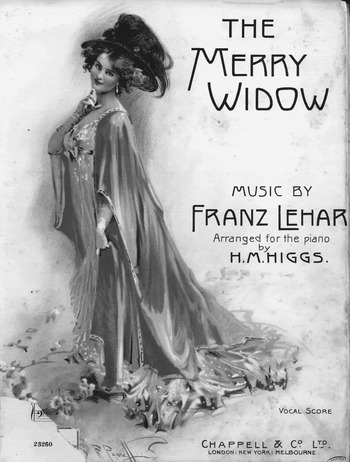
The illustration of Elsie in Fig. 1 offers a helpful starting place for considering the hat's appeal to female audiences. In this illustration, adapted from a promotional photograph and originally in full color, a flushed Elsie poses coyly, one finger gently touching her chin in a gesture of playful contemplation that directs the eye upward to her fluffy black Merry Widow hat. The juxtaposition of the rosy pink satin coat with the black feathers of the hat presents her as not only youthful, feminine, and innocent but also, paradoxically, mature, sophisticated, and sexually aware. Although the color of the hat signals Sonia Glawari's status as a widow, Elsie's flushed cheeks and flirtatious gaze convey a very different meaning, challenging traditional expectations of the bereaved wife. Although it is unclear whether the actress wore the Merry Widow hat for the entire third act—a situation that seems probable given the practical challenges of removing such an article of clothing onstage without ruining the hairstyle beneath—the semiotic equation of the hat, the waltz, and the lovers' final confession seems to have sent female audiences and fashion columnists into a state of rhapsodic consumer ecstasy.
British actress Lily Elsie, star of George Edwardes's 1907 production of The Merry Widow and the first woman to wear a Merry Widow hat, graces the cover of the vocal score published by Chappell & Co. Ltd., ca. 1907. Collection of the author.

Adding another layer to the complex semiotics of the Merry Widow hat was the reputation of the woman who designed Elsie's costumes. By 1907, Lucile was one of London's most celebrated if not most infamous dressmakers. Numerous factors—including the erotic undertones of many of her designs for lingerie and day dresses to which she gave such provocative names as “Passion's Thrall,” “Do You Love Me?” and “A Frenzied Song of Amorous Things”; her belief in the “psychology of dress,” whereby she insisted that women should express their personalities and inner desires through their clothing; her theatrical dress parades, precursors to the modern fashion show; and her celebrated knack for transforming working-class women into stylish mannequins—had made her a favorite with London's social elite and with commercial theatre managers looking to attract an elite audience.Footnote 39 Since first designing Charles Wyndham's production of The Liars in 1897, Lucile had worked for many successful West End productions and counted theatrical luminaries such as Ellen Terry among her clients.Footnote 40 Female audiences gathered at Daly's Theatre in 1907 to watch the premiere of The Merry Widow would therefore have been familiar with Lucile's name and previous design work and may even have been patrons of her Hanover Square salon. Educated in the designer's semiology, these women would likely have read beyond the surface effect of Elsie's costumes, interpreting her hat as a symbol of passion, redemption, and sexual desire.
Astute audience members might also have recognized Lucile's hand in Lily Elsie's performance as Sonia Glawari. For in addition to creating gowns that highlighted the actress's physical traits, the designer also spent hours coaching Elsie in the finer points of comportment and style (at Edwardes's request) until the novice had acquired the necessary grace and sophistication for the role and the clothes that went with it. “There was not a movement across the stage, not a single gesture of her part in The Merry Widow that we did not go through together,” Lucile claims in her memoirs, “and I realized that here was a girl who had both beauty and intelligence, but who had never learnt how to make the best of herself.”Footnote 41 Presenting herself as a benevolent Pygmalion, Lucile hints that with careful study and practice (and the proper commodities), any woman could acquire the graceful confidence and ease exhibited by Elsie onstage. Indeed, while Lucile attributes the longevity of the Merry Widow hat craze to the “charm of the play,” the story of Elsie's Cinderella-like transformation from relative unknown to glamorous star must also have played a part in the style's popularity.Footnote 42The London Times certainly did not withhold its praise in its description of the young ingénue: “Gentle, appealing, charming, a little strange and remote, she is everything delightful… . Not content with making an unusually beautiful picture in Parisian and Marsovian dresses, she puts meaning into what she does, and appears to have a personality to express.”Footnote 43 Elsie was much more than a clotheshorse, and she attracted a legion of fans who sought to emulate her charm and sense of style. Purchasing a variation of the Merry Widow hat therefore represented one way for female theatregoers to associate with the attractive star and express their desire for the same kind of romance and adventure that both she and her stage character appeared to enjoy.
The Merry Widow Hat Steps Offstage
In her memoirs, Lucile acknowledges that the Merry Widow hat helped launch her international career as the commodity moved from the onstage world of Marsovia across borders of class and nationality carrying the “name of ‘Lucile,’ its creator, all over Europe and the States.”Footnote 44 Although it would be another three years before the British dressmaker expanded her business operations to New York and another four before she set up shop in Paris, the Merry Widow hat craze not only brought her “thousands of pounds” but also positioned her to make the most of her theatrical connections and explore new opportunities for commercial success.Footnote 45 But Lucile was not the only designer to benefit from the Merry Widow hat craze; nor was she, in fact, responsible for its rapid expansion in size.
As noted above, dressmakers and milliners frequently attended the theatre for the express purpose of observing new fashion trends and sketching designs that they could replicate for their clients. It was also not uncommon for women to leave an afternoon matinee and go directly to their dressmakers or milliners to request a specific gown or hat they had just seen onstage.Footnote 46 Within the highly competitive world of London fashion in the 1890s and early 1900s, wearing a striking variation of an existing style was an effective strategy for attracting attention and raising one's social status. Although many women asked for exact copies of stage fashions, others seem to have asked for (or been convinced to order) exaggerated versions, presumably in an effort to outperform their peers. Indeed, as numerous fashion historians observe, the desire to demarcate boundaries of class, race, gender, and sex through dress often drives fashion to extremes.Footnote 47 This certainly seems to have been the case with the Merry Widow hat. In the spring and early summer of 1908, the style reached epic proportions, with one London milliner introducing a version of the hat that was reportedly eighteen inches in height and seven feet in circumference!Footnote 48 By April 1908, a writer in the London Magazine noted that even the “most unobservant” could not have failed to “notice how enormously widened the millinery sympathies of the fashionable world have become this season.”Footnote 49
Although milliners, dressmakers, fashion editors, and other members of the fashion industry led the way in popularizing the Merry Widow hat, other commercial industries, most notably publishers of newspapers, magazines, postcards, and sheet music, recognized its potential as an eroticized and easily replicated object. Reproducing hundreds if not thousands of sketches and photographs of the rapidly expanding Merry Widow hat, these publishers fueled interest in the production and the commodities associated with it.
Since the 1890s, developments in the halftone engraving process had made the reproduction of stage photographs in daily and weekly newspapers “both profitable and desirable.”Footnote 50 Hoping to appeal to a broad readership, illustrated newspapers published photos of leading British and American players and chorus girls, while other periodicals catered to a niche market by publishing only the latest stage photographs. These publications gave fans living outside urban centers an opportunity to see scenes from the season's most popular plays alongside photographs of actresses in their stage finery. Inexpensive postcards of star performers also gained popularity with young matinee girls, who exchanged them with friends or pasted them into scrapbooks.Footnote 51
Sheet music companies likewise acknowledged the appeal of the Merry Widow hat, referencing it either directly or indirectly on covers for single songs or musical scores. Although some companies used images of the Merry Widow hat to accompany music that had little if anything to do with the operetta,Footnote 52 others explicitly highlighted the connection between The Merry Widow music and the hat it had inspired. For example, the cover of the vocal arrangement for the Edwardes version of The Merry Widow, published by Chappel & Co. in 1907, features a full-color illustration of a flushed Lily Elsie dressed in her third-act costume (see Fig. 1). Functioning simultaneously as a visual accompaniment to the score and as an advertisement for the stage production, this illustration must have given female consumers living outside London or as far away as Melbourne, Australia, another point of entry into the romantic world of the operetta.Footnote 53 Sitting alone at their pianos or in the company of female friends, women could build erotic associations between the image of the large black hat adorned with feathers and silk flowers and Lehár's passionate story of love lost and regained.Footnote 54
The proliferation of Merry Widow images and commodities points to an important connection between the expanding international market in plays and operettas and the rapid circulation of consumer goods across national and international borders. Traveling ahead of international touring productions by several months or even years, these “mass-industrialized and … geographically penetrative instrument[s]” facilitated the expansion of theatrical networks by involving theatregoers in the imaginary world of the play or operetta long before the production arrived.Footnote 55 In addition to playing, dancing, or even singing along to Lehár's music, those who purchased sheet music, postcards, or photographs of Lily Elsie in costume as Sonia Glawari could observe the latest styles in hair, millinery, and dress and take pride in gaining membership within an international imagined community of spectator/consumers.
“The Battle of the Hats” and Other Publicity Stunts
As with many fashion fads originating in Europe, the Merry Widow hat did not arrive in the United States until spring 1908, almost a year after its London debut and seven months after Henry Savage's New York production had opened to great acclaim at the New Amsterdam Theatre, with Ethel Jackson in the title role.Footnote 56 Not surprisingly, given the heightened emphasis on projecting a fashionable appearance, actresses were some of the first women to wear the Merry Widow hat in public when it finally began appearing in department stores and milliners' shops. Years before her star turn in Peg o' My Heart, novice actress Laurette Taylor earned “the distinction of being the first American actress to adopt for street wear the Merry Widow Hat,” an accomplishment that firmly secured her reputation as a fashion adventurer.Footnote 57 While not the first to wear the Merry Widow hat, musical comedy star Valeska Suratt also drew notice for introducing “a French equivalent for the ‘Merry Widow’ hat, but much wider than the widest Merry Widow ever seen in Broadway.” This large hat “with a brim measuring three by four and a half feet in diameter” proved problematic, however, when the actress wore it onstage. According to a report in Variety, when Suratt tried to make her stage entrance, she got stuck in the narrow doorway and had to call for help. The stage hands grabbed fire axes and promptly “chopped out the chapeau,” much to the actress's chagrin.Footnote 58
Although actresses like Taylor and Suratt were among the first to adopt the Merry Widow hat, women in other cities who were brave enough to wear one in public, sometimes on a dare, also enjoyed a temporary taste of fame or notoriety. In June 1908, for example, eight months after Savage's Broadway production had opened, Miss I. N. Freedman won $25 in a wager with a male friend when she wore an “immense” version of the Merry Widow hat in Seattle, Washington. Surrounded by a crowd of young boys and men, she “sailed down Second avenue, earning $2 for every block she walked,” until she reached the security of the Butler Hotel.Footnote 59 As Freedman's stunt suggests, wearing a new or outlandish fashion in public was a risky endeavor for women because it not only called attention to their presence in the city but also attracted considerable notice from men. During a period when it was still dangerous for women to travel alone outside shopping districts and other feminized urban zones during the day (let alone at night), those who willingly made spectacles of themselves by wearing loud clothes and exhibiting other forms of bold behavior risked being seen as morally questionable and therefore sexually available.Footnote 60 Despite these obvious risks, however, those who dared to wear “look at me” styles like the Merry Widow hat also asserted their rights to occupy public space (a point I shall develop further in the following section).
A bizarre and viciously racist story from the Los Angeles Sunday Times offers possible insight into how some women may have used the Merry Widow hat to carve out a space for themselves in the modern city, challenging dominant ideologies of gender and (in some cases) race. In March 1908, the paper reported that Mrs. Lew Chew, a leader in the Los Angeles Chinese community, had “tried to ‘buck’ the ancient and time-honored form of dress held sacred to the Chinese” by purchasing a Merry Widow hat at a local department store. After selecting a hat with “several million flowers anchored on top,” Mrs. Chew apparently “toddled” down the street in a manner that mimicked “the mincing steps she had seen the women of the white race affect.” According to the news story, the woman's appearance in Chinatown aroused “a feeling of sudden death” in the Chinese male population unlike anything experienced “since the time back in the seventies, when indignant citizens hung a number of Chinese elite to telegraph poles.”Footnote 61 The association of the Merry Widow hat with the possibility of racialized murder may have been the presumably white reporter's attempt to shock the paper's white readers, but it also vividly demonstrates the potential for extreme fashions to disrupt traditional boundaries of gender and race. At a time when racial tensions between Chinese and white Californians remained high, a Chinese woman's public appearance in an extreme European fashion was bound to arouse critique and commentary from inside and outside her community. That such a story, complete with a stereotypically racist caricature of Mrs. Lew Chew's fashion promenade, should take up several columns in the Sunday edition of the Los Angeles Times indicates just how complicated the semiotics of the Merry Widow hat could become.
From a more prosaic perspective, the story of Mrs. Lew Chew offers further evidence of how quickly the Merry Widow hat moved across the country, crossing barriers of race and class. Actresses in New York and other eastern cities may have been the first to adopt the hat, but women elsewhere also seem to have embraced the style when it arrived. In fact, although many fashion fads in this period primarily circulated within urban environments, the Merry Widow hat seems to have been fairly ubiquitous, if the number of cartoons, jokes, songs, plays, and postcards parodying the style are any indication.Footnote 62
Although the accounts of Miss I. N. Freedman and Mrs. Lew Chew do not identify The Merry Widow as the inspiration behind their highly public acts of consumption, both women functioned as walking advertisements for the operetta, if for no other reason than that their acts kept the “Merry Widow” name in circulation. In May 1908, Merry Widow producer Henry Savage set out to make this implicit relationship between the fashion commodity and its source explicit. Anticipating the formalization of business partnerships between fashion manufacturers and theatre and film producers, he arranged to have one thousand Merry Widow hats shipped directly to New York from Paris for a special giveaway event celebrating the 275th performance of his New York production. In a 22 May announcement in the New York Times, he promised that all coupon-bearing women who attended the 13 June matinee performance would receive their own commemorative hat “of the most ample variety.”Footnote 63
As I discuss elsewhere, Savage's promotional scheme was hardly unique to early twentieth-century Broadway theatre. Like their British counterparts, American theatre managers were eager to attract female patronage, especially in the immediate aftermath of the 1907 economic crisis, and collaborated extensively with department stores, dressmakers, milliners, and other commercial organizations to transform their productions into elaborate consumer spectacles. As in Britain, fashionable items originally worn by actresses onstage regularly crossed the theatrical footlights, bringing with them an aura of glamour, sophistication, and elegance. But whereas female audiences in Britain enjoyed seeing theatrical fashions directly from the leading salons of London and Paris, American audiences had to wait for weeks or even months to see the latest styles on display. This continual process of waiting made many fashion-savvy women anxious, especially those who sought more than an associative membership in the transnational community of dress.Footnote 64
Savage was correct in assuming that his giveaway would attract a large matinee audience, but he apparently underestimated consumer desire for the Merry Widow hat. During the second intermission, dozens of women pushed into the cloakroom where the hatboxes were stored and demanded the hats from the unsuspecting attendants. When the house manager informed them that the giveaway would not commence until after the final curtain, a stalwart group of women remained just outside the cloakroom, ready to pounce. When the show finally ended, these women shoved their way into the cloakroom, seized their hats, and tried to exit. But by this point hundreds of other theatregoers—those who had complied with the management's requests to remain seated—were moving swiftly out of the auditorium and into the cloakroom, intent on receiving their hats. An unforeseen shortage in the number of available hats only made matters worse. Chaos ensued. For thirty minutes, the “Battle of the Hats” (as the New York Times dubbed it) waged, leaving many women bruised and battered and at least one hundred women empty-handed.Footnote 65
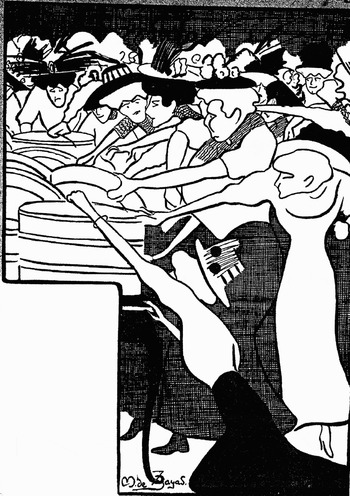
Despite Savage's failure to anticipate the chaos that would greet his publicity stunt, the “Battle of the Hats” succeeded in drawing more attention to the operetta and the extreme style it had helped to launch. It also—quite stunningly—challenged traditional representations of middle-class women as polite, respectable, and subservient, the ideal audience for operetta and other highbrow theatrical forms. This spectacle of women behaving badly was not lost on popular artists like Marius de Zayas, whose caricature for the New York Evening World depicts a group of grasping, middle-aged, presumably middle-class women vying to get their hands on the precious commodity (Fig. 2). The image is one of chaos bordering on anarchy—a stark representation of female consumer desire gone wild.
Caricaturist Marius de Zayas depicts the “battle of the hats” at the New Amsterdam Theatre. “Women in Hard Battle for Free ‘Merry Widows,’” New York Evening World, 14 June 1908, 1.

But the women who embraced the Merry Widow hat, especially those who ventured to wear one in public, were hardly victims of a fashion fad or dupes in a clever marketing scheme. Indeed, it is perhaps somewhat fitting that Henry Savage's Merry Widow giveaway drew out the worst behavior in women, for as the following analysis suggests, the Merry Widow hat further facilitated transgressive gender acts by disrupting the authority of the male gaze, enhancing the visibility of the public female body, and undermining assumptions about traditional feminine behavior, especially expressions of female sexuality.
“Darn That Merry Widow Hat”
It should come as no surprise that many of the most compelling—and humorous—sources about the Merry Widow hat craze were produced by men who were outraged, disgusted, or deeply dismayed by the huge style. Although it is difficult to extrapolate female experiences from these sources or gauge whether the opinions expressed within represented an individual or collective perspective, it is nevertheless possible to interpret male excitement (and panic) about the Merry Widow hat as evidence of the hat's transgressive potential. The following sections consider a range of responses to and representations of the Merry Widow hat in order to trace the commodity's movement into the imaginations and public consciousness of American consumers.
One of the most obvious and frequent critiques of the Merry Widow hat, echoed throughout Europe and the North America, was that it was simply too large, especially when worn in churches, theatres, and other sites of public assembly. American commentators made much of the hat's size, representing Merry Widow hat–wearing women as sexually available, vain, vulnerable, irrational, and obtrusive. Yet there is something about the sheer ridiculousness of the Merry Widow hat, about the obviousness of its excess that is worth probing further. For many contemporary observers, the enormity of the style seemed to confirm fears about the excesses of modern fashion and its disastrous effect on female spirituality, male pocketbooks, and public order. A May 1908 headline in the Chicago Record-Herald announced that riots had broken out in Paris theatres “All on Account of the Merry Widow Hats.”Footnote 66 According to special correspondent Sterling Heilig, the Chatelet Theatre had erupted into chaos when three outraged men decided to prove a point by wearing their own large “fort” hats into the auditorium. Their appearance was apparently so disruptive that the performance had to be halted temporarily until the police could restore order. In other Paris theatres, including some of the city's most respectable houses, hat-wearing women provoked duels between their detractors and those who defended their sartorial rights. Hoping to stem the tide of fashion violence, some Parisian managers took steps to require all women to remove their hats in order to gain entry to certain sections of the auditorium. Despite these measures, fights continued to break out as Parisian women insisted on their right to wear whatever they wanted wherever they wanted regardless of its size.Footnote 67
The situation was slightly less fraught in the United States, at least in the major commercial theatres. In June 1908, the New York Dramatic Mirror breathed a metaphorical sigh of relief that most female theatregoers in New York had refrained from wearing “this thing of magnificent circumference and elaborate superstructure” beyond the theatre lobby. “It might be worn in a sparsely seated audience,” the Mirror admitted, “and, in fact, in such a gathering it would give a fictitious aspect of large patronage. But in reality it is a dangerous thing, for aside from its view-obscuring quality to the man or woman behind, it threatens those sitting beside with casualty.”Footnote 68 Women's apparent willingness to remove their hats before entering the auditorium represented a major change from the previous decade, when many had adamantly refused to listen to such requests about their attire. The issue had come to a head in the mid-1890s when municipal and state politicians throughout the United States lobbied for “high hat bills” to prohibit women from wearing large hats in theatres and other commercial venues.Footnote 69 Although these bills eventually floundered, by the early 1900s most female theatregoers seem to have tacitly agreed to remove their hats.
But if American women refrained from wearing their Merry Widows in theatres, they seem to have been much less willing to remove them for church services. Throughout the spring of 1908, as the millinery celebrations of Easter approached, the New York Times published numerous stories of conflicts between fashionable churchgoers and frustrated ministers. At an Easter service in Burlington, New Jersey, for example, women wearing Merry Widow hats took up so much space that pews that normally seated six people could hold only four. Clearly disturbed by the situation, the Reverend M. H. Armor warned that if women continued to take up the front pews with their hats, they would “have to answer for more than one man starting on the downward path.”Footnote 70 Behind these words lay barely concealed fears that women were abandoning their traditional roles as moral and spiritual guardians of the home, tempting male churchgoers with their lavish displays, and usurping male privilege by occupying too much space in God's house. By visually and physically dominating the front of the church, these fashion-obsessed women blocked male passage to God's representative, distracting their husbands and fellow congregants from listening attentively to the minister's message.
Armor was hardly alone in lamenting the Merry Widow hat's dominance, but other ministers adopted a much less paternalistic attitude toward those who wore the style. In Patterson, New Jersey, for example, a pastor appealed to the female members of his congregation on the basis of reason, asking them to remove their hats to avoid obstructing others' view of the pulpit. The congregation apparently responded “good-naturedly” to the request, acknowledging the right of all to see the preacher.Footnote 71 Ironically, not being able to see the minister or the altar had its advantages as well. At an Easter service in St. Louis, a front row of women wearing Merry Widow hats helped avert mass panic when bouquets of paper lilies placed too near the altar burst into flame. Because so few members of the congregation could actually see what was happening at the front of the church, the fire was quickly extinguished without too much disruption to the service.Footnote 72
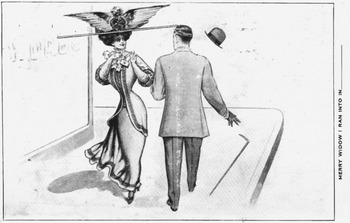
Although ministers were some of the loudest opponents of the Merry Widow hat, urban commuters also expressed frustration with the cumbersome and potentially dangerous style. In June 1908, the Brooklyn Board of Trade went so far as to ponder whether it should widen stairways in the city's elevated train system to accommodate the Merry Widow after numerous hats had become “jammed between the uprights” and impatient male commuters rushing to get ahead had “suffered injury to their throats from the saw-edged brims of the hats.”Footnote 73 Although the board inevitably rejected any changes to the railway system's infrastructure, insisting that the hats and not the stairways should be reduced, its apparent willingness to consider and potentially even yield to female interests can be taken as a tacit acknowledgment of women's right to occupy public space. Others, however, continued to argue that women who wore Merry Widow hats unfairly threatened male bodies and privileges, especially in high-traffic areas. As the New York Dramatic Mirror noted, the Merry Widow hat was “larger than the average buzz saw, and almost as deadly in its edge. It surely would disfigure any male companion of the otherwise fair one who might wear it.”Footnote 74 Certainly, as the postcard in Fig. 3 hints, the Merry Widow's expansive brim could do much more than knock a man's hat off his head.
“Merry Widow I Ran Into In______” One of many postcards lampooning the extreme size of the Merry Widow hat. Collection of the author.

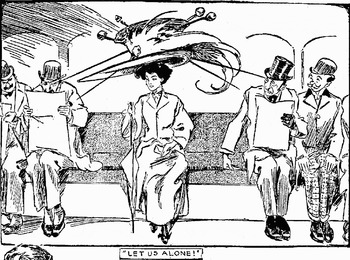
In May 1908, New York Times caricaturist Hy Mayer played up this image of the elegant yet potentially deadly Merry Widow in one of his weekly “Impressions of the Passing Show.”Footnote 75 In Fig. 4, a fashionably dressed young woman sits amid four men on what appears to be a streetcar or subway. Four huge hatpins extend from her hat, positioned dangerously close to the eyes of the two men seated closest to her. “Let Us Alone!” reads the caption, but the speaker is not identified. Although in positioning the caption beneath the foot of the young woman, Mayer seems to be attributing the phrase to her, he strongly implies that the men are the ones who most need to be “let alone.” Armed with her Merry Widow hat, the woman successfully maintains a safe distance from the men around her, her hatpins poised to puncture the eyes of those who might lean in too closely or stare for too long. She is a dangerous, spiderlike creature—a black (merry) widow ready to sting anyone who approaches.
Hy Mayer's caricature calls attention to the hat's transgressive potential, especially for women entering male-dominated public spaces. Hy Mayer, “Some Impressions of the Passing Show,” New York Times, 10 May 1908, 12.

Despite its rather obvious misogyny, Mayer's caricature also illustrates the hat's potential both as an extension of the female body and as distancing device that effectively kept men from encroaching upon that body. With her enormous hat perched upon her head, Mayer's female commuter occupies three times as much space as she (arguably) needs. She is excess personified, the epitome of Joan Riviere's notion of “womanliness as masquerade,” which holds that women are not inherently womanly or feminine but rather perform their “womanliness” as a kind of masquerade to meet societal expectations. It is through the very act of wearing the hat that Mayer's commuter embodies and performs femininity.Footnote 76 Indeed, rather than disguise what Judith Butler, following Riviere, describes as the performativity of gender, the ridiculously oversized, hyperfeminine Merry Widow hat calls attention to itself as a prop for enacting womanliness.Footnote 77 Seen in this light, the Merry Widow hat appears as a strategic tool that not only permitted women to insinuate themselves into spaces typically gendered as male but also destabilized perceived notions of women's inherent femininity.Footnote 78
Yet unlike other forms of female excess and grotesquerie, the excess associated with the Merry Widow hat was temporary and easily discarded. Jana Evans Braziel and Kathleen LeBesco point out that women who are told that they are “too fat,” “too skinny” “too old,” or simply “too freaky” perform their excess through their bodies;Footnote 79 the early twentieth-century women who wore the Merry Widow relied on the hat for their performances of female excess. Should the woman in Fig. 4 remove her hat, the hyperperformativity of her masquerade will fall away and the male commuters will once again comfortably occupy the space beside her. Rather than transforming the female body into something strong and impermeable, then, the hat's excessive span calls attention to the vulnerable body poised beneath it, a body that is appropriately feminine and sexually alluring. Indeed, it is perhaps no coincidence that the rapid expansion of the Merry Widow hat coincided with the introduction of the Directoire or sheath gown, a streamlined style that transformed the female body into a sleek, mobile, and undeniably sexualized modern object, in stark contrast to the prevailing female silhouette, which emphasized the waist and hips.Footnote 80 Juxtaposed with the form-fitting lines of the sheath gown, the Merry Widow hat functioned as a reverse pedestal, a platform that allowed women to challenge the prescriptive social codes and threats of violence that limited their movement in and through the modern city. Yet while this reverse pedestal with its “saw-edged brims” undoubtedly facilitated greater female mobility, it was hardly a practical addition to a woman's wardrobe; in fact, in certain situations it seems even to have inhibited a woman's ability to move freely down city streets or on public transportation. As the following section details, the paradoxical attributes of the Merry Widow hat are evident in the dozens if not hundreds of sketches, jokes, and songs that emerged in this period lampooning the craze.
Sex and the City and the Merry Widow Hat
American commercial industries made much of the way the Merry Widow hat allowed women to experiment with new forms of expressive behavior, especially when it came to romantic and/or sexual encounters with men. Indeed, if the Merry Widow hat's transgressive potential was limited by its status as an easily removable object, it nevertheless seems to have encouraged and facilitated the performance of risky if not-quite-deviant femininity. For example, in the popular and unblinkingly racist 1908 song “Under My Merry Widow Hat,” a sexually assertive young woman named Susie tells her suitor that he needn't romance her with “coon songs” about “jungle trysts” if he wants to get close to her:Footnote 81
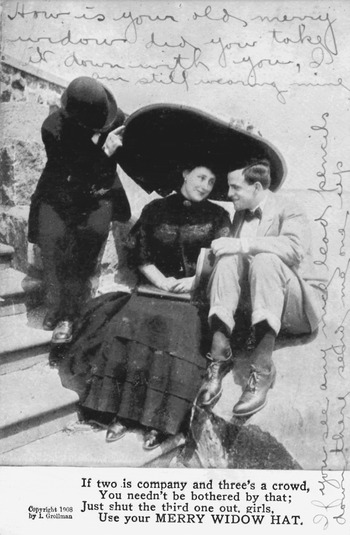
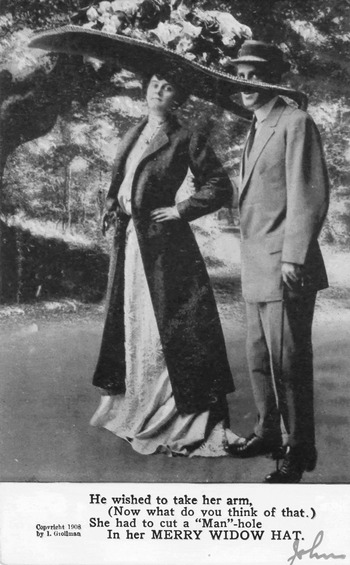
Several postcards produced in 1908 as part of a sixteen-card series similarly play up the Merry Widow hat's potential for facilitating romantic encounters, demonstrating how women might use their hats to assume a more active, even dominant, role in the courting process. Confronted by two potential suitors, the woman in Fig. 5 uses the broad brim of her hat to shut out the man who does not interest her so that she can focus exclusively on the one who does. Here the hat functions simultaneously as shelter and shield, protecting the woman from one man's touch while bringing her closer to the arms of another. A second postcard (Fig. 6) offers an even more suggestive scenario, depicting a self-confident young woman standing with her hands firmly planted at her waist as her beau grasps onto her arm and peers through a “‘Man’-hole” cut into her Merry Widow hat. As the four-line poem beneath the image informs readers, the “‘Man’-hole” was the woman's idea; she is clearly in charge of the situation and more than willing to allow male contact (the implication being that if she lets her beau into this hole, she will presumably allow him into others). At a time when women's access to birth control was extremely limited, these cards represent the Merry Widow hat as an ideal prophylactic. Whether used to keep undesirable suitors at a safe distance or to bring a lover closer and allow petting and other forms of sexual touch to occur unseen, these hats seem to have given women considerable control over courting rituals and any attendant sexual activities.Footnote 83
Three's a crowd. One of sixteen such cards copyrighted by I. Grollman. Collection of the author.

“‘Man’-hole.” A deliciously raunchy card from Grollman series. Collection of the author.

These postcards, copyrighted by I. Grollman,Footnote 84 offer a fascinating perspective on the Merry Widow hat and the kinds of meanings that came to be associated with it. Published during the so-called golden age of postcards, these cheap, accessible, amusing commodities traveled rapidly across North America, often between friends in small towns, inviting those who had not even seen or heard of The Merry Widow to weigh in on the fashion fad it had inspired … or to ignore it altogether.Footnote 85 Indeed, while the sexual innuendo in Figs. 5 and 6 seems entirely consistent with the loaded semiotics of the original costume item worn by Lily Elsie, there is little else to connect the cards to the Lehár operetta. Therefore, while they offer very little proof of actual consumer interactions with the Merry Widow hat, the Grollman postcards present an illuminating representation of shifting gender relations in the modern city. Indeed, a comparison of the sixteen cards in the series reveals a certain tension in the representation of the Merry Widow hat that reflects the complicated and paradoxical nature of this particular commodity.
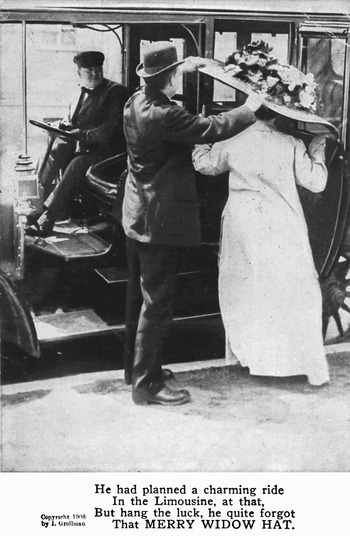
Whereas Figs. 5 and 6 highlight the hat's erotic potential when worn in more remote or rural settings, many of the other cards represent the fashionable item as a deterrent to women's mobility in the city and characterize women as fashion victims, unable to negotiate door entrances, sidewalks, or other narrow passages due to the unwieldy spans of their Merry Widow hats. Taken “on location” in recognizably urban locations—streets, bridges, streetcars, automobiles, apartment buildings, elevators—these cards depict everyday urban experiences, often using the same models in different poses and scenarios. Instead of voicing female interests and desires, however, the cards express the frustrations of the men forced to endure female trivialities. In Fig. 7, for example, the verse beneath the photograph of a woman climbing into an automobile informs readers that her male companion:
This card in the Grollman series voices male (sexual) frustration with the cumbersome style. Collection of the author.

The source of the man's frustration here appears to be sexual in nature. As cultural historians have noted, the introduction of new modes of transportation, ranging from the bicycle to the automobile, radically transformed romantic rituals in the early-twentieth century by making it possible for middle-class couples to retreat from the front porch or parlor, the traditional sites of courtship.Footnote 87 Miles away from home and free from the eyes of parents and guardians, unmarried couples had greater opportunities to engage in sexual activities ranging from spooning and petting to sexual intercourse. Streetcars, subways, and buses similarly facilitated romantic trysts to the seaside, amusement park, or dance hall for working-class couples.Footnote 88 Although, as noted above, the Merry Widow hat functioned as a prophylactic for women, allowing them to keep certain suitors at a distance while inviting others closer, it could also stand in the way of a couple's attempt to escape prying eyes, as the Grollman cards show, by quite literally preventing women from getting into a car or other mode of public transportation.
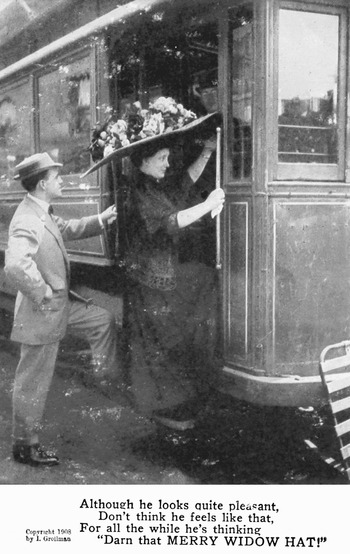
The poem accompanying Fig. 8 similarly voices the (sexual?) frustration of a young man waiting to board a streetcar while the woman in front of him (possibly his date) struggles to get through the door:
“Darn That Merry Widow Hat.” From Grollman series. Collection of the author.

If the woman is unable to board the streetcar, the poem hints, the man will be unable to seduce her. Like Fig. 7, this card makes an implicit connection between young men and women enjoying the delights of the modern city (and one another) and the various modes of transportation that facilitate their movement through its streets. Within such an environment, large, awkward hats like the Merry Widow are inappropriate and undesirable.
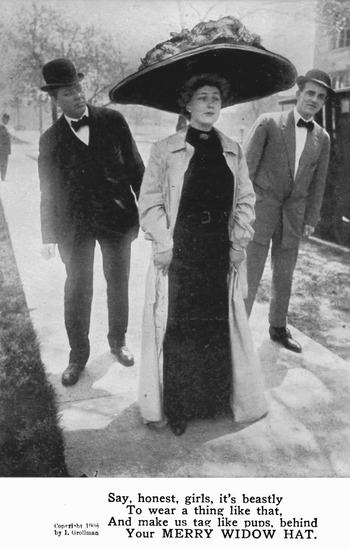
Yet if Figs. 7 and 8 represent the Merry Widow hat as an impediment to female mobility, others cards acknowledge that the hats gave women greater control over their bodies in public spaces. In the foreground of Fig. 9 a woman wearing a dark skirt and blouse and a full-length riding coat walks down a sidewalk, her Merry Widow hat poised delicately on her head. She seems at once completely oblivious and painfully aware of the two men behind her. Dressed almost identically in suits and bowler hats, the men peer anxiously around the woman's body, trying to catch her attention or find an appropriate moment to move past her. Once again, the verse below voices an aggressive male perspective, directing readers to sympathize with the presumably patient, put-upon men, forced to tag behind a woman who has blocked their (rightful) passage:
The reference to “pups” here—a slang term for a love-stricken young boy—hints that the Merry Widow hat has somehow infantilized the two men, forced them into the role of patient, subservient lovers. But the anxious look on the woman's face interrupts this “official narrative.” If we interpret her far-off gaze not as simpleminded ignorance but as an attempt to maintain composure in the midst of a threatening situation—two men surround her, after all—the Merry Widow hat's potential for facilitating (rather than inhibiting) female movement into male-dominated spaces becomes apparent. In preventing the two men from touching her body or otherwise encroaching upon her physical space, the Merry Widow hat has become the ideal shield, the perfect device for usurping male privilege and reworking gender norms.
But what did these postcards mean to the men and women who sent and received them? To what extent did these consumers participate in the Merry Widow hat craze? Were they fans or critics of the style? Certainly those who sent such postcards to their friends or lovers must have had something to say about the hat, right? The answer, perhaps surprisingly, is no. Of the sixteen Grollman cards in my collection, few make any direct reference to the Merry Widow images, perhaps because most senders assumed that the card spoke for itself. In fact, the relative absence of direct commentary might be interpreted as evidence of the hat's ubiquity between 1908 and 1910, the period when most of the cards were mailed.
Two cards, however, are noteworthy not only because they directly reference the hat or the scenario depicted but also because they provide some evidence of how Americans living outside of major urban centers viewed the style. On the front of the card in Fig. 5, H. H. writes to Miss. E. Craig of Havre-de-Grace, Maryland, “How is your old merry widow did you take it down with you, I am still wearing mine[.]” On the verso, the writer (who I assume is a woman based on the subject matter and the familiar tone with which she addresses Miss Craig) alludes to the flirting woman pictured on the front of the card, noting, “Although I think I would like duck shooting, I would rather be doing this[.]” This playful note, presumably written from one female friend to another, provides compelling evidence of the Merry Widow's popularity with women in smaller towns and further suggests that one of the more appealing aspects of the style was the way it (theoretically) facilitated romantic liaisons with men. As noted above, the woman in Fig. 8 is hardly a fashion victim but rather is using the large style to make her own courting decisions; in her note to Miss Craig, H. H. implies that she'd like to do the same. Men also seem to have used the I. Grollman postcards to communicate with female love interests. On the back of the postcard shown in Fig. 9, a man named Roy flirtatiously asks Miss Lily Hegetschweiler of Beaver Dam, Wisconsin, “Wouldn't you like to sit behind one as large as this[?]” Ignoring the context of the image—two men surrounding a woman on the street—Roy implies that he is willing to tolerate such an extreme style if it brings him closer to the woman he admires. Of course, Roy may also have been referring sarcastically to the women who wore such hats to church and the theatre, inviting Lily to share in his imagined frustration at being stuck behind such an obstruction. But to my mind, the simple question seems like more of a flirtatious exchange than a commentary on annoying fashion trends.
Tag-a-Long Pups. From Grollman series. Collection of the author.

Viewed collectively, the Grollman postcards offer a complicated and often contradictory representation of the Merry Widow hat craze, demonstrating the potential for theatrical commodities to take on a life of their own outside the theatrical context and influence individual lives in decidedly different ways. For theatre scholars interested in tracking more than the transnational movement and development of specific plays and performers, studying the “offstage” as well as the onstage life of theatrical costumes and properties promises to reveal new insights into the dissemination of theatre culture and its effect on the lives of not only those who attend the theatre regularly but also those who cannot afford or otherwise gain access to the theatre. The women who paraded down city streets or sat in the front pews at church wearing their Merry Widow hats may or may not have known anything about Lehár's Merry Widow, but their fashionable performances were nevertheless crucial factors in the creation and transmission of a transnational theatre phenomenon.
Perhaps more important, a global commodity chain analysis of the Merry Widow hat demonstrates how a commodity that originated in a stage production gave eager fans, especially women, the material resources for rehearsing new gestures and movement long after the theatrical event was over. As dress historian Carole Turbin writes, “Intimate dimensions of clothing not only reveal the meaning of the most personal of physical and tactile bodily sensations but also provide a window into national, even global shifts.”Footnote 91 The Merry Widow hat and the reaction it engendered opens up such a window, revealing deep anxieties within early twentieth-century American society about women's incursions into public life, their desire for greater sexual freedom, their use of fashion to challenge normative gender ideologies, and their developing skills as performing consumers. For as much as the hat obscured women's vision and urged them to consume a commodity that transformed them into walking billboards for male theatre managers, it also seems to have served as a powerful device for asserting physical presence at a time when women's public appearances still met with censure, sexual advances, or worse.Footnote 92 As an extension of the female body, the broad Merry Widow hat bestowed upon American women a kind of physical size they otherwise lacked and allowed them to take greater control of their bodies and assert their sexual desires in spite, or in the midst, of commodification.