Introduction
Neurocognitive deficits are an important aspect of the schizophrenic disorders. They may determine social and vocational outcomes even more than psychopathological symptoms. Environmental factors and social adjustment, such as the level of isolation or ability to function outside the nuclear family, are predictors of a first psychosis in subjects at ultra-high risk (Dragt et al. Reference Dragt, Nieman, Veltman, Becker, van de Fliert, de Haan and Linszen2011). Because the capacity to process socially relevant information also relies on basic neurocognitive abilities (i.e. attention and memory), deficits in these domains may strongly influence the social embedment and ability to cope with early psychotic symptoms (Green et al. Reference Green, Kern, Braff and Mintz2000). According to the neurodevelopmental hypothesis of pathogenesis in schizophrenia, along with recent findings, neurocognitive deficits are most likely to be present prior to the manifestation of full-blown schizophrenia (Giuliano et al. Reference Giuliano, Li, Mesholam-Gately, Sorenson, Woodberry and Seidman2012). This supposition is also supported by a recent large population study of young Swiss conscripts by Müller et al. (Reference Müller, Vetter, Weiser, Frey, Ajdacic-Gross, Stieglitz and Rössler2013), who found significantly frequent evidence of cognitive impairments early in life for individuals who were later diagnosed with schizophrenia. Therefore, an assessment of cognitive functioning should be taken into account in early detection of psychoses. Because impairments can be quantified before the onset of the illness, researchers have proposed using them as an additional indicator when optimizing the prediction of psychosis risk (Riecher-Rössler et al. Reference Riecher-Rössler, Pflueger, Aston, Borgwardt, Brewer, Gschwandtner and Stieglitz2009, Reference Riecher-Rössler, Aston, Borgwardt, Bugra, Fuhr, Gschwandtner, Koutsouleris, Pflueger, Tamagni, Radü, Rapp, Smieskova, Studerus, Walter and Zimmermann2013). Moreover, to create useful interventions in the pre-psychotic phase, it is essential that we learn more about deficits during this early stage of illness so that we can identify individuals truly in need of help and provide appropriate intervention.
This study applied the ultra-high-risk (UHR) criteria conceptualized by Yung & McGorry (Reference Yung and McGorry1996), which indicate an imminent transition to schizophrenia. These criteria include the manifestation of attenuated positive symptoms (APS), brief intermittent psychotic symptoms (BLIPS) or a state–trait component that combines vulnerability with a distinct reduction in global functioning within the past year. The literature shows that transition rates in UHR groups vary by 30% to 35% within 1 to 3 years (Cornblatt et al. Reference Cornblatt, Lencz, Smith, Correll, Auther and Nakayama2003; Yung et al. Reference Yung, Phillips, Yuen, Francey, McFarlane, Hallgren and McGorry2003; Cannon et al. Reference Cannon, Cadenhead, Cornblatt, Woods, Addington, Walker, Seidman, Perkins, Tsuang, McGlashan and Heinssen2008). According to previous theoretical considerations (Klosterkotter et al. Reference Klosterkotter, Schultze-Lutter, Bechdolf and Ruhrmann2011; Keshavan et al. Reference Keshavan, DeLisi and Seidman2011; Fusar-Poli et al. Reference Fusar-Poli, Borgwardt, Bechdolf, Addington, Riecher-Rossler, Schultze-Lutter, Keshavan, Wood, Ruhrmann, Seidman, Valmaggia, Cannon, Velthorst, De Haan, Cornblatt, Bonoldi, Birchwood, McGlashan, Carpenter, McGorry, Klosterkötter, McGuire and Yung2013), a putative earlier at-risk state may involve the basic symptom concept of Huber (Reference Huber1966). In this approach, defined here as a high-risk (HR) criterion, help-seeking individuals mainly describe the disturbing experience of subtle and self-reported alterations and deficits observed in cognition, thoughts and perception (Klosterkotter et al. Reference Klosterkotter, Hellmich, Steinmeyer and Schultze-Lutter2001). In the Cologne Early Recognition Study, the conversion rates to schizophrenia in individuals presenting cognitive–perceptual basic symptoms at baseline were reported to be less than 1% in 1 year but rose to 48% after 4 years (Klosterkotter et al. Reference Klosterkotter, Hellmich, Steinmeyer and Schultze-Lutter2001; Schultze-Lutter et al. Reference Schultze-Lutter, Ruhrmann, Berning, Maier and Klosterkotter2010).
The prospective identification of subjects at high risk of psychosis has received increasing interest from researchers (Fusar-Poli et al. Reference Fusar-Poli, Borgwardt, Bechdolf, Addington, Riecher-Rossler, Schultze-Lutter, Keshavan, Wood, Ruhrmann, Seidman, Valmaggia, Cannon, Velthorst, De Haan, Cornblatt, Bonoldi, Birchwood, McGlashan, Carpenter, McGorry, Klosterkötter, McGuire and Yung2013). However, it is also debated because individuals putatively suffering from prodromal symptoms may have outcomes other than psychosis (Ruhrmann et al. Reference Ruhrmann, Schultze-Lutter and Klosterkotter2010; Yung et al. Reference Yung, Nelson, Thompson and Wood2010; Fusar-Poli et al. Reference Fusar-Poli, Yung, McGorry and van Os2014). Moreover, the overlap and differences among various criteria have been criticized (Schultze-Lutter et al. Reference Schultze-Lutter, Schimmelmann and Ruhrmann2011). Nevertheless, individuals meeting at-risk criteria obviously have cognitive and functional deficits for which they seek help and are in need of the appropriate treatment (Ruhrmann et al. Reference Ruhrmann, Schultze-Lutter and Klosterkotter2010). Furthermore, studying the manifestation of symptoms in a putative at-risk state of psychosis is warranted because the confounding effects of ongoing illness, treatment and other complications may then possibly be avoided.
The continuum model of psychosis underlying these at-risk studies emphasizes the many similarities across different psychotic diagnostic categories. However, these disorders also have important differences. This is especially true for affective psychoses (depression with psychotic features or bipolar disorder with psychotic features) versus schizophrenic psychoses (schizophrenia, schizophreniform disorder or schizo-affective disorder). Efforts to create diagnostic tools for early detection of bipolar disorder are essential because, currently, correct diagnoses are often delayed by 8 to 10 years (Angst et al. Reference Angst, Adolfsson, Benazzi, Gamma, Hantouche, Meyer, Skeppar, Vieta and Scott2005). However, the development of at-risk criteria for bipolar disorder is still in an early stage. Based on findings from prospective studies, the presence of hypomanic symptoms in adolescence is strongly predictive of later bipolar disorders. As such, it has been hypothesized that applying an instrument for self-assessment of hypomanic symptoms might increase the detection of bipolar disorders (Angst et al. Reference Angst, Adolfsson, Benazzi, Gamma, Hantouche, Meyer, Skeppar, Vieta and Scott2005). Therefore, help-seeking individuals with prominent depressive and/or hypomanic symptoms, but who do not meet the HR or UHR criteria, have been classified as high-risk bipolar (HRBip).
Recent meta-analyses of the at-risk state for schizophrenic psychosis have confirmed that impairments in neuropsychological performance (Fusar-Poli et al. Reference Fusar-Poli, Deste, Smieskova, Barlati, Yung, Howes, Stieglitz, Vita, McGuire and Borgwardt2012b ; Giuliano et al. Reference Giuliano, Li, Mesholam-Gately, Sorenson, Woodberry and Seidman2012), along with alterations in brain structure (Mechelli et al. Reference Mechelli, Riecher-Rossler, Meisenzahl, Tognin, Wood, Borgwardt, Koutsouleris, Yung, Stone, Phillips, McGorry, Valli, Velakoulis, Woolley, Pantelis and McGuire2011; Fusar-Poli, Reference Fusar-Poli, Deste, Smieskova, Barlati, Yung, Howes, Stieglitz, Vita, McGuire and Borgwardt2012b ), social cognition (Fusar-Poli et al. Reference Fusar-Poli, Byrne, Valmaggia, Day, Tabraham, Johns and McGuire2010) and general functioning and neurochemistry (Smieskova et al. Reference Smieskova, Marmy, Schmidt, Bendfeldt, Riecher-Rossler, Walter, Lang and Borgwardt2013), are associated with a clinically high risk (Addington & Heinssen, Reference Addington and Heinssen2012; Fusar-Poli et al. Reference Fusar-Poli, Borgwardt, Bechdolf, Addington, Riecher-Rossler, Schultze-Lutter, Keshavan, Wood, Ruhrmann, Seidman, Valmaggia, Cannon, Velthorst, De Haan, Cornblatt, Bonoldi, Birchwood, McGlashan, Carpenter, McGorry, Klosterkötter, McGuire and Yung2013). Studies of cognition in such individuals have found small to medium impairments across most neurocognitive domains that are at an intermediate level between those of healthy individuals and subjects diagnosed with schizophrenia (Hawkins et al. Reference Hawkins, Addington, Keefe, Christensen, Perkins, Zipurksy, Perkins, Tohen, Breier and McGlashan2004; Brewer et al. Reference Brewer, Wood, Phillips, Francey, Pantelis, Yung, Cornblatt and McGorry2006; Pukrop et al. Reference Pukrop, Schultze-Lutter, Ruhrmann, Brockhaus-Dumke, Tendolkar and Bechdolf2006; Eastvold et al. Reference Eastvold, Heaton and Cadenhead2007; Fusar-Poli et al. Reference Fusar-Poli, Deste, Smieskova, Barlati, Yung, Howes, Stieglitz, Vita, McGuire and Borgwardt2012b ). Moreover, individuals at risk who later convert to psychosis show more severe baseline neurocognitive deficits in almost all domains when compared with non-converters, especially for processing speed, verbal fluency and memory (Pukrop & Klosterkotter, Reference Pukrop and Klosterkotter2010; Giuliano et al. Reference Giuliano, Li, Mesholam-Gately, Sorenson, Woodberry and Seidman2012). To our knowledge, only a few studies have directly compared putative HR (defined by basic symptoms) and UHR psychosis groups. For example, Frommann et al. (Reference Frommann, Pukrop, Brinkmeyer, Bechdolf, Ruhrmann, Berning, Decker, Riedel, Möller, Wölwer, Gaebel, Klosterkötter, Maier and Wagner2011) identified an executive control impairment in the early (HR) state but additional memory dysfunction in the late (UHR) prodromal state. Simon et al. (Reference Simon, Cattapan-Ludewig, Zmilacher, Arbach, Gruber, Dvorsky, Roth, Isler, Zimmer and Umbricht2007) reported equivalent neurocognitive performances in subjects meeting basic symptom or UHR criteria.
Research on clinical and neurobiological markers in help-seeking individuals at risk for progression to bipolar disorder is still limited and inconsistent (Bechdolf et al. Reference Bechdolf, Ratheesh, Wood, Tecic, Conus, Nelson, Cotton, Chanen, Amminger, Ruhrmann, Schultze-Lutter, Klosterkotter, Fusar-Poli, Yung, Berk and McGorry2012). An earlier prospective birth cohort study found early in the developmental course of the disorder impairments in tasks that involve psychomotor speed and also attentional and executive abilities (Cannon et al. Reference Cannon, Moffitt, Caspi, Murray, Harrington and Poulton2006). However, this was true only for subjects who later developed a schizophrenic disorder and not for individuals who subsequently developed an affective disorder. Therefore, the authors concluded that early motor and attentional or executive impairments may be specific to schizophrenia-related rather than affective disorder outcomes. Ratheesh et al. (Reference Ratheesh, Lin, Nelson, Wood, Brewer, Betts, Berk, McGorry, Yung and Bechdolf2013) reported lower global functioning in at-risk subjects who converted to bipolar disorder than in those who did not, although differences in neurocognitive characteristics could not be detected. Conversely, a literature review by Olvet et al. (Reference Olvet, Burdick and Cornblatt2013) suggested that deficits in specific neurocognitive domains, such as verbal memory and executive function, represented potential predictors of bipolar disorders. Therefore, investigating the nature of deficits and symptoms in individuals with an increased risk of developing an affective or schizophrenic disorder might provide further insight into the neuropathophysiological mechanisms underlying both illnesses.
Our study objectives were to explore the neurocognitive functioning in an at-risk population and to determine whether neurocognitive measures are sensitive enough to differentiate among HR, UHR and HRBip individuals. This examination expanded upon previous research by addressing the neurocognitive functions and clinical characteristics of persons at high and ultra-high risk of schizophrenic psychosis, subjects at risk for bipolar disorder, and a group of matched, healthy controls. Accordingly, we hypothesized that (1) HR and UHR subjects exhibit generalized neurocognitive deficits compared with the control group, (2) deficits in measures of learning and memory are associated with more severe psychopathological symptoms, and (3) persons within the HRBip group have fewer deficits in their psychomotor speed-dependent tasks than do those in either the HR or the UHR group.
Method
Subjects
Individuals were recruited within the context of a study on early recognition of psychosis, the Zurich Program for Sustainable Development of Mental Health Services (ZInEP, Zürcher Impulsprogramm zur nachhaltigen Entwicklung der Psychiatrie; www.zinep.ch) from the canton of Zurich, Switzerland. Potential participants had either learned about this study from a project website, flyers or newspaper advertisements, or were referred to our staff by general practitioners, school psychologists, counselling services, psychiatrists or psychologists. All subjects spoke standard German and had normal or corrected-to-normal vision, normal hearing, and normal motor limb function. Those aged ⩾18 years provided informed consent whereas minors (<18 years) gave assent in conjunction with parental informed consent. The study was approved by the Ethics Committee of the canton Zurich and was carried out in accordance with the Declaration of Helsinki.
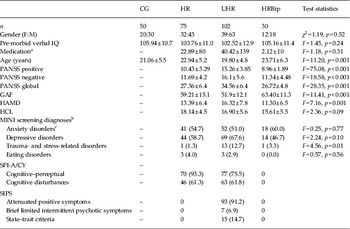
The ZInEP project included 221 subjects in total. Complete neuropsychological data were available from 207 participants who fulfilled the criteria (see psychopathological assessment below) for either HR (n = 75), UHR (n = 102) or HRBip (n = 30). For comparison, 50 healthy persons, comprising our control group (CG), were recruited by advertisements in the local newspaper or by word of mouth. Their qualifying data had suggested they were comparable in verbal intelligence, level of education and gender to persons in the other groups. Exclusion criteria for study participation were manifest schizophrenic, substance-induced or organic psychosis; current substance or alcohol dependence; or an estimated verbal IQ < 80. Controls were screened with the Mini International Neuropsychiatric Interview (MINI; Sheehan et al. Reference Sheehan, Lecrubier, Sheehan, Amorim, Janavs, Weiller, Hergueta, Baker and Dunbar1998) based on DSM-IV criteria to exclude persons with any past or present psychiatric, neurological or somatic disorder that might bias their cognition. None of the controls were using psychotropic medication or illicit drugs. Demographic and clinical data for the study groups are displayed in Table 1.
Demographic and clinical characteristics

CG, Control group; HR, high risk for psychosis; UHR, ultra-high risk for psychosis; HRBip, high risk for bipolar disorder; F, female; M, male; PANSS, Positive and Negative Syndrome Scale; GAF, Global Assessment of Functioning; HAMD, Hamilton Depression Rating Scale; HCL, Hypomania Checklist; MINI, Mini International Neuropsychiatric Interview; SPI-A/CY, Schizophrenia Proneness Instrument (Adult Version or Child and Youth Version); SIPS, Structured Interview for Prodromal Syndromes.
a Chlorpromazine equivalents.
b Co-morbid diagnoses were assessed with the diagnostic screening MINI (Sheehan et al. Reference Sheehan, Lecrubier, Sheehan, Amorim, Janavs, Weiller, Hergueta, Baker and Dunbar1998).
c The total number of individuals in each main diagnostic category can be smaller than the sum of the individual diagnoses because of co-morbidity.
Values given as mean ± standard deviation or number (percentage).
Psychopathological assessment
To qualify for inclusion, participants had to fulfill at least one of the following requirements.
-
(1) HR: high-risk status for psychosis, as assessed by the Schizophrenia Proneness Instrument, SPI-A (Adult Version) or SPI-CY (Child and Youth Version) (Schultze-Lutter et al. Reference Schultze-Lutter, Addington, Ruhrmann and Klosterkotter2007; Schultze-Lutter & Koch, Reference Schultze-Lutter and Koch2009), having at least one cognitive–perceptual basic symptom or at least two cognitive disturbances, and not meeting any of the UHR inclusion criteria listed below.
-
(2) UHR: ultra-high-risk status for psychosis, as rated by the Structured Interview for Prodromal Syndromes (SIPS; Miller et al. Reference Miller, McGlashan, Rosen, Cadenhead, Cannon, Ventura, McFarlane, Perkins, Pearlson and Woods2003), having at least one attenuated psychotic symptom or at least one brief limited intermittent psychotic symptom, or meeting the state–trait criterion of a reduction in Global Assessment of Functioning (GAF; Endicott et al. Reference Endicott, Spitzer, Fleiss and Cohen1976) score of > 30% in the past year, plus either a schizotypal personality disorder or a first-degree relative with psychosis.
-
(3) HRBip: high risk for bipolar disorder, as defined by a score of either ⩾14 on the Hypomania Checklist (HCL; Angst et al. Reference Angst, Adolfsson, Benazzi, Gamma, Hantouche, Meyer, Skeppar, Vieta and Scott2005), a self-report measure of lifetime hypomanic symptoms, or a score of ⩾12 on the Hamilton Depression Rating Scale (HAMD; Schutte & Malouff, Reference Schutte and Malouff1995), and not meeting any of the at-risk psychosis inclusion criteria listed above.
A transition to schizophrenia and bipolar disorder was diagnosed according to ICD-10. Quantitative measures of psychopathology were further obtained as follows: psychotic symptoms using the Positive and Negative Syndrome Scale (PANSS; Kay et al. Reference Kay, Fiszbein and Opler1987), current Axis-I co-morbidity using the MINI (Sheehan et al. Reference Sheehan, Lecrubier, Sheehan, Amorim, Janavs, Weiller, Hergueta, Baker and Dunbar1998), general functioning according to the GAF (Endicott et al. Reference Endicott, Spitzer, Fleiss and Cohen1976), and satisfaction with psychosocial domains of life using the Manchester Short Assessment of Quality of Life (MANSA; Priebe et al. Reference Priebe, Huxley, Knight and Evans1999). This assessment was conducted by trained, experienced psychiatrists or psychologists.
Neurocognitive assessment
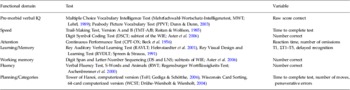
A set of well-established neuropsychological tests was administered in a fixed order. Testing and scoring were performed blind to diagnostic status. The tests were chosen on the basis of their demonstrated reliability and capacity to discriminate clinically high-risk subjects from healthy controls. Verbal IQ was estimated with a German word recognition test, the Multiple Choice Vocabulary Intelligence Test (Mehrfachwahl-Wortschatz-Intelligenztest, MWT-B; Lehrl, Reference Lehrl1989), for adults or a test of receptive vocabulary for minors, the Peabody Picture Vocabulary Test (PPVT; Dunn & Dunn, Reference Dunn and Dunn2003). For the purposes of data reduction and examining generalized and specific deficits across cognitive domains, we grouped the test variables according to neuropsychological conventions (Table 2).
Neurocognitive assessment
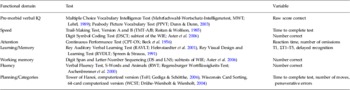
WIE, Wechsler Adult Intelligence Test (Wechsler Intelligenztest für Erwachsene).
Statistical analysis
Demographic and clinical characteristics were compared between groups, using χ 2 and Fisher's exact tests for categorical variables or one-way ANOVAs with a Bonferroni post-hoc test for continuous variables. Using Missing Value Analysis, we first identified subjects with more than three missing values on neurocognitive measures and excluded them from further analysis. Test scores were standardized by computing z scores based on the performance of the CG. Cognitive domain scores were calculated by averaging the z scores on contributing variables. We then applied a factor analysis with varimax rotation and an eigenvalue cut-off of ‘1’ to extract five factors that explained 69% of the total variance (see online Supplementary Table S1). Those factors represented the independent cognitive domains of speed, attention, learning and memory, working memory and fluency. Measures of the planning/categories domain were excluded from further analysis because they operationalized higher and more complex executive functions, with high cross-loadings on most factors. We then conducted a repeated-measures ANOVA to compare the cognitive profiles among groups. A univariate ANOVA was performed for individual domain scores. Chlorpromazine equivalents (Andreasen et al. Reference Andreasen, Pressler, Nopoulos, Miller and Ho2010) and age were added as covariates in all models. Subsequent logistic regression models were used to estimate the probability of group membership with variables that had proved to be significantly different in bivariate analysis, that is UHR versus HR and schizophrenia converters versus at-risk psychosis (HR and UHR), based on their given deficits in functional domains. We then calculated odds ratios (ORs) and 95% confidence intervals (CIs). Finally, to detect any associations between overall severity of positive/negative symptoms and cognitive domains, we determined the partial correlation coefficients by controlling for age and neuroleptic medication. To reduce the bias inherent to multiple testing, we restricted those correlations to cognitive domains, along with scores for the PANSS and the GAF and the total score for the MANSA. All analyses were conducted using SPSS version 20.0 (SPSS Inc., USA).
Results
Demographic and clinical characteristics
Based on their demographic and clinical characteristics, the participants within all groups were found to be comparable in their verbal/intellectual functioning, level of education and gender (Table 1). However, participants were significantly younger in the UHR group than in the HR and HRBip groups. Although basic symptoms were common in both schizophrenic at-risk states of HR and UHR, the three at-risk groups differed significantly in terms of the severity of their positive, negative and depressive symptoms and in their level of general functioning. By contrast, all had equivalent affective symptoms, based on HCL ratings, and equivalent neuroleptic medication. By 1 year after completing the initial assessment, 15 of the 177 HR or UHR subjects (8.4%) had converted to schizophrenic psychosis. In the UHR group, 13 (12.7%) individuals converted, and in the HR group, two (2.6%) converted.
Neurocognitive domains
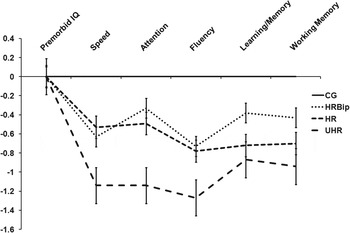
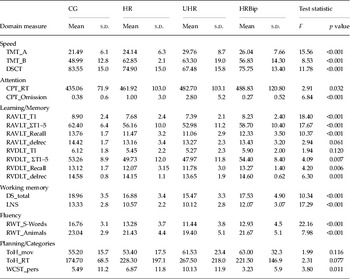
The neuropsychological profiles for the three at-risk groups are displayed in Fig. 1. Table 3 summarizes the results of the one-way ANOVAs, which contrasted the performances of individuals in those groups with healthy CG persons, based on z scores adjusted for age. Our comparison of cognitive domain factors between HR/UHR subjects and the CG revealed that subjects at risk for psychosis were impaired in all domains (all p > 0.01), with effect sizes (z scores) ranging from −0.87 to −1.27 for UHR and from −0.33 to −0.78 for HR. Scores for HRBip subjects were comparable to CG members in the domains of attention (F = 2.86, trend p value = 0.095) and learning/memory (F = 3.21, trend p value = 0.077). The UHR group performed markedly worse than HR in the domains for speed (F = 9.01, p < 0.001), attention (F = 5.99, p = 0.003), working memory (F = 3.66, p = 0.028) and fluency (F = 6.20, p = 0.003). The two at-risk groups (HR versus UHR) scored fairly low in the domains of learning and memory (F = 1.67, p = 0.19). When compared with the HRBip participants, those in the other two at-risk groups were markedly worse in the domains for speed (F = 12.05, p < 0.001), fluency (28.31, p < 0.001), attention (F = 13.50, p < 0.001) and working memory (F = 17.52, p < 0.001) but not for learning and memory (F = 0.60, p = 0.43). The direct comparison of HR versus HRBip produced no significant differences in any category (all p < 0.10). To control for depressive symptoms, we conducted a post-hoc series of ANOVAs, using that factor as an additional covariate but finding no significant change in the results (data not shown).
Mean scores in cognitive domains for the three at-risk groups [high risk (HR) or ultra-high risk (UHR) for schizophrenic and affective psychoses and high risk for bipolar disorder (HRBip)], presented as z-score deficits relative to the healthy control group (CG).

Test scores and results from one-way ANOVAs of neurocognitive measures

CG, Control group; HR, high risk for psychosis; UHR, ultra-high risk for psychosis; HRBip, high risk for bipolar disorder; TMT-A, Trail Making Test, Version A; TMT-B, Trail Making Test, Version B; DSCT, Digit Symbol Coding Test; CPT, Continuous Performance Test (RT, reaction time; Omission, number of omissions); RAVLT, Rey Auditory Verbal Learning Test (T1, Trial 1; ΣT1–5, Sum Trials 1–5; delrec, delayed recognition); DS, Digit Span; LNS, Letter-Number Sequencing; RWT, Verbal Fluency Test (Regensburger Wortflüssigkeits-Test); ToH, Tower of Hanoi; WCST, Wisconsin Card Sorting Test; s.d., standard deviation.
A one-way ANOVA was performed for each measure, using group (CG, HR, UHR and HRBip) as between-subject factor and age as covariate.
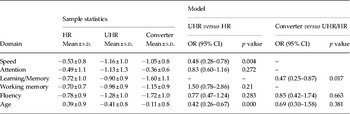
Logistic regression models demonstrated that the domain of speed was negatively associated with being classified as UHR (versus HR: OR 0.48, 95% CI 0.28–0.78) whereas the other domains did not predict group membership (Table 4). That is, a poor result in the speed domain was linked to an increased likelihood of being classified as UHR. A second analysis focusing on the subgroup of individuals who ultimately converted to psychosis indicated that it was possible to identify clearly those converters within the HR and UHR groups based on their scores in the domain of learning and memory. Accordingly, learning and memory were negatively associated with a conversion to psychosis (OR 0.47, 95% CI 0.25–0.87).
Results of logistic regression analysis

HR, High risk for psychosis; UHR, ultra-high risk for psychosis; s.d., standard deviation; OR odds ratio; CI, confidence interval.
Correlation with psychopathological symptoms
Among the subjects at risk for psychosis, scores along the PANSS positive symptom scale were negatively associated with speed (r = − 0.21, p < 0.001), learning/memory (r = − 0.32, p < 0.001) and working memory (r = − 0.21, p = 0.003). Scoring along the negative symptom scale was negatively associated with speed (r = − 0.16, p = 0.028), learning/memory (r = − 0.26, p < 0.001) and fluency (r = − 0.21, p = 0.003). GAF scores were positively associated with the domain of working memory (r = 0.20, p = 0.01). Measures of attention were significantly associated with the MANSA total score (0.24, p = 0.037). The HRBip group scores along the PANSS negative symptom scale were negatively associated with the learning and memory domain (F = − 0.51, p = 0.004). We also confirmed the correlation between working memory and general functioning for HRBip (r = 0.42, p = 0.021) and the association of attention with the MANSA total score (0.16, p = 0.036). No other association was proven significant, and depressive symptoms in particular were not correlated with any cognitive domain.
Discussion
We analyzed the neurocognitive performance of subjects at risk for schizophrenic or affective psychoses. Our aim was to determine whether our three psychopathologically defined risk groups could be distinguished based on their neuropsychological profiles. Three main findings emerged. First, for all domains, the three at-risk groups were impaired relative to the CG. Here, persons in the HR or HRBip group had comparable scores that were intermediate between the CG and UHR group. Second, among subjects at risk for psychosis, their performance in the speed domain predicted a group affiliation of UHR whereas learning/memory deficits predicted a transition to psychosis. Third, neuropsychological deficits had a profound effect on an individual's level of general functioning and satisfaction with life.
As we had hypothesized, all risk groups differed from the group of healthy controls in their neuropsychological functioning after controlling for age, gender, IQ and neuroleptic medication. This indicates that their impairments were not simply a general intellectual deficit. Our findings are consistent with those from previous studies that examined individuals equivalent to our UHR subjects (Hawkins et al. Reference Hawkins, Addington, Keefe, Christensen, Perkins, Zipurksy, Perkins, Tohen, Breier and McGlashan2004; Brewer et al. Reference Brewer, Francey, Wood, Jackson, Pantelis, Phillips, Yung, Anderson and McGorry2005; Lencz et al. Reference Lencz, Smith, McLaughlin, Auther, Nakayama, Hovey and Cornblatt2006; Eastvold et al. Reference Eastvold, Heaton and Cadenhead2007; Pflueger et al. Reference Pflueger, Gschwandtner, Stieglitz and Riecher-Rossler2007) and those involving persons with basic symptoms (Pukrop et al. Reference Pukrop, Schultze-Lutter, Ruhrmann, Brockhaus-Dumke, Tendolkar and Bechdolf2006; Simon et al. Reference Simon, Cattapan-Ludewig, Zmilacher, Arbach, Gruber, Dvorsky, Roth, Isler, Zimmer and Umbricht2007; Frommann et al. Reference Frommann, Pukrop, Brinkmeyer, Bechdolf, Ruhrmann, Berning, Decker, Riedel, Möller, Wölwer, Gaebel, Klosterkötter, Maier and Wagner2011). Profiles were quantitatively similar between our HRBip and HR subjects. However, in HRBip, deficits were less pronounced, albeit not significantly, in the domains of attention and learning/memory. Similar to the results reported by Thompson et al. (Reference Thompson, Conus, Ward, Phillips, Koutsogiannis, Leicester and McGorry2003), we found no putative prodrome features that clearly distinguished between HR and HRBip. Therefore, we could not prove our hypothesis that members of the HR psychosis group would show quantitatively more severe deficits in the speed domain when compared with those in the HRBip group.
Regression analysis revealed that, within the groups at risk for psychosis (HR and UHR), a poor result in the speed domain was the most reliable predictor of an affiliation to the late UHR state. Other researchers have also determined that psychomotor speed is more consistent (Seidman et al. Reference Seidman, Giuliano, Meyer, Addington, Cadenhead and Cannon2010; Kelleher et al. Reference Kelleher, Murtagh, Clarke, Murphy, Rawdon and Cannon2013) than reported (non-speed-dependent) deficits in working memory and executive functioning (Hawkins et al. Reference Hawkins, Addington, Keefe, Christensen, Perkins, Zipurksy, Perkins, Tohen, Breier and McGlashan2004; Gschwandtner et al. Reference Gschwandtner, Pfluger, Aston, Borgwardt, Drewe, Stieglitz and Riecher-Rössler2006; Keefe et al. Reference Keefe, Perkins, Gu, Zipursky, Christensen and Lieberman2006; Niendam et al. Reference Niendam, Bearden, Johnson, McKinley, Loewy, O'Brien, Nuechterlein, Green and Cannon2006; Pukrop et al. Reference Pukrop, Schultze-Lutter, Ruhrmann, Brockhaus-Dumke, Tendolkar and Bechdolf2006). The cognitive processes and variables loading on our factor ‘speed’ were the same as those used in the MATRICS Consensus Cognitive Battery ‘speed of processing’ (Green & Nuechterlein, Reference Green and Nuechterlein2004). These involved perceptual and motor components, all emphasizing speed of performance. In accord with results described by Kelleher et al. (Reference Kelleher, Murtagh, Clarke, Murphy, Rawdon and Cannon2013), our findings demonstrate that processing speed is a central deficit associated with risk. Moreover, from a multi-level assessment of subjects at risk for psychosis, Riecher-Rössler et al. (Reference Riecher-Rössler, Aston, Borgwardt, Bugra, Fuhr, Gschwandtner, Koutsouleris, Pflueger, Tamagni, Radü, Rapp, Smieskova, Studerus, Walter and Zimmermann2013) have shown that, in addition to psychotic (suspiciousness) and negative symptoms (anhedonia/asociality), a reduced speed in information processing can heighten an individual's overall prediction to transition by up to 80.9%.
The classification of HR versus UHR is based on the assumption that symptom severity increases more or less linearly as a person progresses through the prodromal phase (Klosterkotter et al. Reference Klosterkotter, Schultze-Lutter, Bechdolf and Ruhrmann2011; Fusar-Poli et al. Reference Fusar-Poli, Borgwardt, Bechdolf, Addington, Riecher-Rossler, Schultze-Lutter, Keshavan, Wood, Ruhrmann, Seidman, Valmaggia, Cannon, Velthorst, De Haan, Cornblatt, Bonoldi, Birchwood, McGlashan, Carpenter, McGorry, Klosterkötter, McGuire and Yung2013). Whether an individual's neuropsychological impairments develop along a similar trajectory is not clearly understood. Green et al. (Reference Green, Kern, Braff and Mintz2000) have suggested that those impairments might already be present at a very early age, manifested by neurodevelopmental abnormalities, and might increase with successive stages of prodromal symptomatology. Likewise, Frommann et al. (Reference Frommann, Pukrop, Brinkmeyer, Bechdolf, Ruhrmann, Berning, Decker, Riedel, Möller, Wölwer, Gaebel, Klosterkötter, Maier and Wagner2011) have compared members of HR and UHR groups and found executive deficits in subjects who had only basic symptoms in addition to memory deficits in subjects who fulfilled the UHR criteria. In our study, a general impairment was observed with rising degree from HR to UHR. This suggests a parallel and interconnected development of neuropsychological deficits and observed psychiatric symptomatology. Confirming this hypothesis, we note that the measures of speed and learning/memory were inversely associated with both positive and negative symptoms. Working memory performance was associated with positive symptoms whereas performance in fluency tasks was linked with the severity of negative symptoms. Regression analysis further revealed that, overall, the actual converters could clearly be distinguished from all other at-risk subjects because of diminished performance in their learning and memory domain. Accordingly, a meta-analysis by De Herdt et al. (Reference De Herdt, Wampers, Vancampfort, De Hert, Vanhees, Demunter, Van Bouwel, Brunner and Probst2013) has shown that performance in learning/memory can be differentiated between psychosis converters and non-converters. Hippocampal volume reduction has also been documented in HR and UHR groups (Fusar-Poli et al. Reference Fusar-Poli, Borgwardt, Crescini, Deste, Kempton, Lawrie, Mc Guire and Sacchetti2011), and has been connected to poor recall by UHR subjects (Hurlemann et al. Reference Hurlemann, Jessen, Wagner, Frommann, Ruhrmann, Brockhaus, Picker, Scheef, Block, Schild, Moller-Hartmann, Krug, Falkai, Klosterkotter and Maier2008). Taken together, these findings are evidence that levels of cognitive impairment increase through the prodromal stages of psychosis.
Neurocognitive functioning is assumed to influence occupational matters and employment status. It is highly probable that our finding of a strong association between neurocognitive performance and a person's level of general functioning is an expression of this. On that account, it has been argued that environmental factors assessed during the initial screening, such as being unemployed, should be included in any risk assessment (Koutsouleris et al. Reference Koutsouleris, Davatzikos, Bottlender, Patschurek-Kliche, Scheuerecker, Decker, Gaser, Möller and Meisenzahl2011). This would be particularly useful because the transition of vulnerability into prodrome, and ultimately to the point of psychotic crisis, may be triggered by relevant environmental factors (Falkai et al. Reference Falkai, Reich-Erkelenz, Malchow, Schmitt and Majtenyi2013).
A meta-analysis by Fusar-Poli et al. (Reference Fusar-Poli, Bonoldi, Yung, Borgwardt, Kempton, Valmaggia, Barale, Caverzasi and McGuire2012a ) revealed a modest effect toward reduced transition risks for the most recently published studies. It has been reported that the transition rate declines to 10–18% within 1 year (Yung & Nelson, Reference Yung and Nelson2013); our results fell within this range. This might be because individuals are referred earlier or their treatment may be more effective. According to the dilution effect (early detection of psychosis becomes well known, and clinicians are more likely to ask about psychotic-like symptoms), the number of individuals truly at risk may be diluted with ‘false positives’ (Yung & Nelson, Reference Yung and Nelson2013). Overall, for a substantial proportion of the subjects initially labeled as at risk, their conversion to psychosis may never happen. This is a debated issue, especially because a potentially unnecessary diagnosis might give rise to unintended consequences such as stigma and discrimination (Yung et al. Reference Yung, Nelson, Thompson and Wood2010). Nevertheless, individuals fulfilling at-risk criteria already show multiple mental and functional deficits for which they seek help (Ruhrmann et al. Reference Ruhrmann, Schultze-Lutter and Klosterkotter2010) and need monitoring independent of the outcome (Fusar-Poli et al. Reference Fusar-Poli, Yung, McGorry and van Os2014). The level of performance observed in at-risk individuals (who show no conversion during the follow-up period) is distinctly lower than in healthy individuals (Hambrecht et al. Reference Hambrecht, Lammertink, Klosterkotter, Matuschek and Pukrop2002; Brewer et al. Reference Brewer, Francey, Wood, Jackson, Pantelis, Phillips, Yung, Anderson and McGorry2005; Keefe et al. Reference Keefe, Perkins, Gu, Zipursky, Christensen and Lieberman2006; Niendam et al. Reference Niendam, Bearden, Johnson, McKinley, Loewy, O'Brien, Nuechterlein, Green and Cannon2006; Pukrop et al. Reference Pukrop, Schultze-Lutter, Ruhrmann, Brockhaus-Dumke, Tendolkar and Bechdolf2006). However, it remains an open question whether the deficits in these at-risk individuals and the intermediate deficits in ‘truly positive’ individuals lie along a continuum. That is, the pattern of cognitive deficits observed in at-risk compared to healthy individuals at baseline may reflect a temporary expression of psychiatric stress in general rather than a compelling degradation associated with the path to manifestation of a disorder. The at-risk psychosis state is further characterized by a marked impairment in psychosocial functioning (Velthorst et al. Reference Velthorst, Nieman, Linszen, Becker, de Haan, Dingemans, Birchwood, Patterson, Salokangas, Heinimaa, Heinz, Juckel, von Reventlow, French, Stevens, Schultze-Lutter, Klosterkotter and Ruhrmann2010), many co-morbidities (Yung et al. Reference Yung, Nelson, Stanford, Simmons, Cosgrave, Killackey, Phillips, Bechdolf, Buckby and McGorry2008) and fluctuations in psychiatric symptoms, such that neuropsychological performance may vary. The better performance of the at-risk group than the converter group may hypothetically be a result of a subset of ‘false positives’ within the sample (Bora & Murray, Reference Bora and Murray2013; Zipursky et al. Reference Zipursky, Reilly and Murray2013).
Limitations to our research include its cross-sectional nature. Notions of an ‘early’ HR and ‘late’ UHR state are based on theoretical considerations (Klosterkotter et al. Reference Klosterkotter, Schultze-Lutter, Bechdolf and Ruhrmann2011; Fusar-Poli et al. Reference Fusar-Poli, Borgwardt, Bechdolf, Addington, Riecher-Rossler, Schultze-Lutter, Keshavan, Wood, Ruhrmann, Seidman, Valmaggia, Cannon, Velthorst, De Haan, Cornblatt, Bonoldi, Birchwood, McGlashan, Carpenter, McGorry, Klosterkötter, McGuire and Yung2013). More longitudinal studies are needed to affirm this directly because different pathways to the disorder are possible. Furthermore, little is known about symptom expression in adolescents (Schimmelmann et al. Reference Schimmelmann, Walger and Schultze-Lutter2013). Differences in the predictive power of verbal versus visual learning have been discussed in the literature (De Herdt et al. Reference De Herdt, Wampers, Vancampfort, De Hert, Vanhees, Demunter, Van Bouwel, Brunner and Probst2013). In our study, a comparison of verbal versus visual learning and memory performance was not performed because the measurements were shown to be dependent in the factor analysis.
Neuropsychological performances differed among our three at-risk groups. Therefore, the previously defined risk classification on the basis of psychopathological symptoms alone is now reflected also at the neuropsychological level. Psychomotor deficits, which are primarily non-specific, may have subtly affected the performance of the more complex, higher cognitive functions. Above all, the social and vocational outcomes may have been more strongly influenced by neurocognitive deficits than by psychiatric symptoms. Together with prior evidence, our findings imply that subjects at risk for psychosis already have substantial cognitive deficits. Therefore, to prevent a downward spiral of neurocognitive deficits, educational or occupational crises, and loss of social embedment that may trigger a transition to psychosis, we suggest that practitioners should recognize cognition as a treatment target in itself.
Supplementary material
For supplementary material accompanying this paper visit http://dx.doi.org/10.1017/S0033291714001007.
Acknowledgments
This work was supported by the Zürich Impulse Program for the Sustainable Development of Mental Health Services (www.zinep.ch). We thank the ZInEP team and the participants for enrolling in this study.
Declaration of Interest
None.