Significant outcomes
• Patients with fully remitted major depression as a whole did not differed in cardiac autonomic function, as measured by frequency-domain indices of heart rate variability (HRV), from their controls.
• Cardiac autonomic dysregulation was limited to the subgroup of remitted major depressive disorder (MDD) patients with a history of suicidal ideation (SI).
• We found an inverse relation between HRV levels and the harm avoidance (HA) score, mainly driven by the robust association in the subgroup of remitted MDD patients with a history of SI.
Limitations
• We assessed a history of suicide ideation retrospectively and largely on the basis of self-reported information.
• We failed to assess reliably ultra-low frequency power measures because of short-term HRV recording.
• We did not to use nonlinear techniques, which may be more sensitive to depression than linear techniques, to measure HRV.
Introduction
Depressed patients have been shown to have an augmented risk of cardiovascular morbidity and mortality Reference Barth, Schumacher and Herrmann-Lingen1, Reference Nicholson, Kuper and Hemingway2. While definite mechanisms for this cardiac vulnerability are unknown, it is assumed that reduction of HRV is at least one important pathophysiological factor Reference Thayer and Lane3, Reference Agelink, Majewski and Wurthmann4. However, research on HRV and depression has generally been conducted in cardiac patients. Thus, factors concomitant with cardiovascular disease (CVD) might be influenced the observed relationship between depression and HRV. We focus on depressed patients without CVD, to avoid overestimation of the association between depression and HRV.
Investigations concerning HRV in depression have revealed inconsistent results. For example, some studies have found reduced HRV levels, as measured by high-frequency (HF) power in MDD patients without CVD in comparison with healthy control subjects Reference Udupa, Sathyaprabha and Thirthalli5, Reference Agelink, Boz, Ullrich and Andrich6, Reference Rechlin, Weis, Spitzer and Kaschka7, Reference Rottenberg8. However, other studies have reported no differences in HRV, as measured by time-domain measures Reference Agelink, Majewski and Wurthmann4, Reference Udupa, Sathyaprabha and Thirthalli5, respiratory sinus arrhythmia Reference Lehofer, Moser and Hoehn-Saric9 and HF power Reference Agelink, Majewski and Wurthmann4, Reference Agelink, Boz, Ullrich and Andrich6, Reference Dawood, Lambert and Barton10, Reference Volkers, Tulen, Van Den Broek, Bruijn, Passchier and Pepplinkhuizen11. The conflicting results might be due to heterogeneity in relatively small samples, confounds from medication, physical health, habitual physical activity, smoking, psychiatric comorbidities and reporting of different HRV measures Reference Rottenberg8. In a recent meta-analysis, Kemp et al. addressed these inconsistencies and concluded current MDD without CVD was associated with reduced HRV Reference Kemp, Quintana, Gray, Felmingham, Brown and Gatt12. However, it is noteworthy that most studies focused on cardiac autonomic function in current MDD Reference Udupa, Sathyaprabha and Thirthalli5, Reference Agelink, Boz, Ullrich and Andrich6, Reference Rechlin, Weis, Spitzer and Kaschka7, but scarce studies has investigated that in fully remitted MDD Reference Licht, De Geus, Zitman, Hoogendijk, Van Dyck and Penninx13, Reference Bar, Greiner, Jochum, Friedrich, Wagner and Sauer14. For instance, a critical study in a large sample size of participants revealed that lower HRV in remitted MDD is derived from the effect of antidepressants rather than the diagnosis itself Reference Licht, De Geus, Zitman, Hoogendijk, Van Dyck and Penninx13. However, the authors only used time-domain analysis of HRV. To our knowledge, no adequately powered study to date has compared the difference of tonic HRV between fully remitted MDD patients and healthy controls by using frequency-domain analysis of HRV. Power spectral analysis of HRV is a sophisticated tool for the detection of the cardiac autonomic regulation and can add information on quantification of parasympathetic and sympathetic nervous system function over time-domain analysis of HRV Reference Akselrod, Gordon, Ubel, Shannon, Berger and Cohen15. Thus, replication studies by analyses with larger sample sizes and frequency-domain analysis of HRV, and control over possible confounds are clearly warranted.
Accumulating evidence suggests a link between suicide symptom and cardiac autonomic dysregulaion in depressed patients. For example, Rottenberg et al. found that resting parasympathetic activity was inversely associated with suicide symptom Reference Rottenberg8 but was not associated with overall depression severity Reference Udupa, Sathyaprabha and Thirthalli5, Reference Rottenberg8. The authors therefore proposed the possibility that low parasympathetic activity is related more closely to individual symptoms of MDD (e.g. suicidality) than to the syndrome as a whole Reference Rottenberg8. Consistent with this theory, Booij et al. Reference Booij, Swenne, Brosschot, Haffmans, Thayer and Van Der Does16 reported that HRV reduction caused by high-dose acute tryptophan depletion was limited to fully remitted MDD patients with a history of SI. The authors used history of SI during past depression as an index for individual differences in impulse control and concluded that reduced HRV are more pronounced in a subtype of depression that is characterised by impulsive and aggressive behaviour Reference Booij, Swenne, Brosschot, Haffmans, Thayer and Van Der Does16. However, both studies did not include a group of non-psychiatric controls. Accordingly, case–control study design is needed to investigate whether a suicidal subtype of depression is more clearly associated with cardiac autonomic dysregulation.
We previously reported that MDD is associated with cardiac autonomic dysregulation, suggesting that reduction in HRV is a psychophysiological marker of current MDD Reference Chang, Chang and Chen17. However, the theoretical perspective that cardiac autonomic dysregulation in MDD is dependent on the phase of the illness is yet to be verified. For example, one might wonder whether fully remitted MDD patients have cardiac autonomic dysregulation. Moreover, our previous study showed greater cardiac vagal withdrawal in the suicidal subtype of MDD Reference Chang, Chang and Chen17. It is necessary to determine cardiac autonomic function of this subtype of MDD in its remitted phase. Taken together, the following hypotheses were tested:
1 Resting cardiac autonomic activity in patients with remitted MDD as a whole and that in age- and sex-matched healthy controls will be similar and
2 Cardiac autonomic dysregulation will be limited to the subgroup of remitted MDD patients with a history of SI.
Aims of the study
The aim of this study was to compare the difference of frequency-domain indices of HRV between healthy control subjects and patients with remitted MDD who were unmedicated, physically healthy and free of psychiatric comorbidity. We further examined the patient subgroups with/without a history SI. The obtained results were evaluated in association with personality traits.
Methods
Participants recruitment and study population
This study was approved by the Institutional Review Board for the Protection of Human Subjects at the Tri-Service General Hospital, a medical teaching hospital of the National Defence Medical Center in Taipei, Taiwan. We obtained written informed consent from all participants and fully explained the procedures of the study. Initial study entry criteria: age 18–65. After detailed questionnaire screening, clinical examination and chart review, we excluded subjects with pregnancy, smoking, diabetes, cancer, neuropathy, hypertension, cardiac arrhythmia or other CVDs that affect HRV or engaging in regular physical training exceeding 10 h a week. Subjects who used psychotropic medication or any medication that have been reported to affect the autonomic nervous system functioning for at least 2 weeks prior to beginning of the study evaluation were also excluded.
In total, we recruited 932 subjects. The patient group comprised 470 patients with fully remitted MDD, who were recruited from outpatient setting. On the basis of the same methodology in our previous study Reference Chang, Chang and Chen17, Reference Chang, Lu and Chen18, each patient was initially evaluated by an attending psychiatrist (H. A. C.) and then interviewed by a well-trained psychologist, using the Chinese version of the Modified Schedule of Affective Disorder and Schizophrenia-Lifetime (SADSL) Reference Endicott and Spitzer19 to reach the Diagnostic and Statistical Manual of Mental Disorders, Fourth Edition (DSM-IV) criteria for a primary diagnosis of MDDs in remission. The interrater reliability kappa values of the Chinese version of the Modified SADSL were as follows: major depression, 0.79; bipolar disorder, 0.71; anxiety disorder, 0.86; schizophrenia, 0.95 and substance abuse and dependence, 0.82 Reference Chang, Lu and Chen18, Reference Chang, Lu and Lin20. The depression severity was assessed with the 17-item version of the Hamilton Depression Rating Scale (HAM-D) Reference Hamilton21. Only subjects with HAM-D score lower than 15 entered the study Reference Frank, Prien and Jarrett22. Diagnoses of remitted MDD and demographic and clinical background variables, including history of SI during past depression, were assessed with interviews and a best-estimate procedure that used all available information including clinical observations, medical records and family information. Here, we further excluded individuals with a history of actual suicide attempt that caused any neurological damage, substance dependence, organic brain disease or any concomitant major psychiatric disorders. The patient group was further classified into two homogeneous clinical subgroups according to history of SI (serious suicidal thoughts or attempt vs. no serious suicidal thoughts) during past depression Reference Booij, Swenne, Brosschot, Haffmans, Thayer and Van Der Does16: remitted MDD with a history of SI during past depression (SI+ subgroup, n = 237) and that without (SI− subgroup, n = 233).
The normal control group included 462 healthy volunteers, recruited from the community. They were selected to match patient's gender and age. We used the modified Chinese version of SADSL Reference Endicott and Spitzer19 to exclude individuals with psychiatric conditions. Control subjects were considered free of past or present major or minor mental illnesses (affective disorder, schizophrenia, anxiety disorder, personality disorder, substance use disorders, etc.).
Assessment of severity of depression
All participants were interviewed by an attending psychiatrist (H. A. C.) using the 17-item HAM-D, an objective scale to assess severity of depression. In addition, we used the Beck depression inventory (BDI) Reference Kuo, Lin, Yang, Li, Chen and Chou23, a 21-item questionnaire, to assess subjects' self-reported severity of depression. A. T. Beck and R. A. Steer, Manual for the Revised Beck Depression Inventory, Psychological Corp., San Antonio (TX) (1987). The results are scored by summing the responses to each of the items in order to obtain a total depression score (range, 0–63). Both the HAM-D and the BDI provide global indices of depression severity. To avoid multiple testing of the same hypothesis, the analysis of the relationship between HRV parameters and global depression severity was based on only one measure of depression severity, the HAM-D (not surprisingly, the two measures of depression severity were significantly correlated with each other, r = 0.68, p < 0.001). The results were unchanged whether interviewer or self-reported measures of depression severity were used as an outcome.
Personality assessment
Personality traits were measured by the Tridimensional Personality Questionnaire (TPQ). The Chinese version of the TPQ used in this study was a 100-item, self-administered, true–false instrument. The Cronbach's α of novelty seeking (NS) was 0.70, and that of HA was 0.87 Reference Chen, Chen, Chen, Yu and Cheng24. Since the reward dependence dimension had no adequate reliability among Han Chinese in Taiwan Reference Chen, Chen, Chen, Yu and Cheng24, only NS and HA dimensions were analysed in our study. Each of the personality dimensions was postulated to be associated with a particular neurotransmitter system. Specifically, NS was mediated by the dopaminergic system and HA by the serotonergic system Reference Cloninger25.
Measurements of HRV
Detailed procedures for analysis of HRV have been reported previously Reference Kuo, Lin, Yang, Li, Chen and Chou23, Reference Liu, Kuo and Yang26. In short, after sitting quietly for 20 min, a lead I electrocardiogram was taken for 5 min while the subject lay quietly and breathed normally. An HRV analyser (SSIC; Enjoy Research Inc., Taipei, Taiwan) acquired, stored and processed electrocardiogram signals. Under a sampling rate of 512 Hz, signals were recorded using an 8-bit analogue-to-digital converter. Stationary RR-interval values were resampled and interpolated at a rate of 7.11 Hz to produce the continuity in a time domain. Power spectral analysis was performed using a nonparametric method of fast Fourier transformation. The direct current component was deleted and a Hamming window was used to attenuate the leakage effect Reference Kuo, Lin, Yang, Li, Chen and Chou23. The power spectrum was then quantified into standard frequency-domain measurements defined previously Reference Kuo, Lin, Yang, Li, Chen and Chou23, Reference Liu, Kuo and Yang26, 27, which consisted of variance (variance of RR-interval values), low frequency (LF: 0.04–0.15 Hz), HF (0.15–0.40 Hz) and the ratio of LF to HF (LF/HF). All of the measurements were logarithmically transformed to correct skewed distribution Reference Kuo, Lin, Yang, Li, Chen and Chou23, Reference Liu, Kuo and Yang26. Vagal control of HRV is represented by HF, whereas both vagal and sympathetic control of HRV is jointly represented by LF. The LF/HF ratio is considered by some investigators to mirror sympathovagal balance or sympathetic modulations, with a larger LF/HF ratio indicating a greater predominance of sympathetic activity over cardiac vagal control 27.
Statistical analyses
SPSS (version 13.0; SPSS, Taipei, Taiwan) statistical software was used for all analyses. Discrete variables in patients and controls were compared using chi-square test, and continuous variables were compared with an independent samples t-test. Analyses with variances with post hoc test were used to compare the HRV indices and other continuous variables in group comparisons among remitted MDD subgroups and control group. The associations between HRV measures and age, body mass index (BMI) and habitual physical activity were analysed with product-moment correlations, whereas point-biserial correlations were used to assess relationships with gender. Results of the point-biserial correlations were identical to those arising from comparisons using t-tests. To pick out the association of HRV parameters and personality traits, the Pearson's correlation analysis was established. Linear regression analyses were used to primarily assess associations of scores of personality traits with HRV. To control the effect of confounding, we used multiple regression on the HRV indices, with gender, age, BMI and habitual physical activity as covariables. All results are two-tailed and a probability value p < 0.05 was considered statistically significant.
Results
Demographics and clinical characteristics
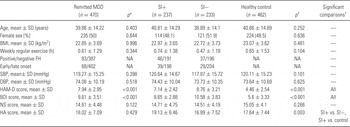
In the total sample, the remitted MDD group and controls were similar with respect to demographic data, BMI, resting systolic blood pressure, resting diastolic blood pressure and habitual physical activity (Table. 1). Remitted MDD patients had higher scores of HAM-D and BDI than controls. Group comparisons among the remitted MDD subgroups and controls showed significant differences in scores of HAM-D, BDI and HA. Post hoc test in scores of HAM-D and BDI consistently showed greatest scores in the SI− subgroup, lowest scores in controls and intermediate scores in the SI+ subgroup. However, we found higher HA in the SI+ subgroup than either the SI− subgroup or controls. There were no statistically significant differences in remaining demographic data and clinical characteristics in group comparisons among the remitted MDD subgroups and controls.
Sample characteristics

BMI, body mass index (calculated as weight in kilograms divided by height in meters squared); DBP, diastolic blood pressure; FH, family history; NA, not applicable; SBP, systolic blood pressure; SI+, remitted MDD with a history of SI; SI−, remitted MDD without a history of SI.
Positive family history indicates bipolar disorder or major depression in a first-degree relative. First depressive episode developed before age 18 defined as early onset, and the onset age 18 or later defined as late onset.
* Compared with the healthy control group.
† Analyses with variances used to compare continuous variables in group comparisons among remitted MDD subgroups and control group.
HRV parameters
There was no difference in mean RR intervals and all measures of HRV between the remitted MDD patients and controls (Table. 2). Group comparisons among the remitted MDD subgroups and controls showed significant differences in variance, LF and HF. Post hoc test revealed significantly lower variance and HF in the SI+ subgroup compared with either the SI− subgroup or controls. Post hoc test revealed significantly lower variance, LF and HF in the SI+ subgroup compared with either the SI− subgroup or controls. However, the difference for variance, LF and HF failed to attain statistical significance for the SI− subgroup versus controls.
Mean RR intervals and all measures of HRV for patients with remitted MDD, the SI+ subgroup, the SI− subgroup and controls

SI+, remitted MDD with a history of SI; SI−, remitted MDD without a history of SI; Var, total variance.
* Compared with the healthy control group.
† Analyses with variances used to compare continuous variables in group comparisons among remitted MDD subgroups and control group.
Factors associated with HRV
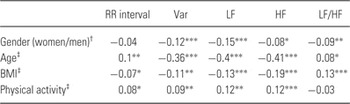
Associations between HRV measures and those potentially confounding variables are summarised in Table. 3. Men had significantly faster heart rates (shorter RR interval) and lower variance, LF and HF than women. Older participants had reduced variance, LF and HF, and greater LF/HF ratio. Participants with higher BMI had lower variance, LF and HF, and greater LF/HF ratio. Participants who were habitually more physically active had significantly slower heart rates (longer RR interval) and greater variance, LF and HF. However, there was no significant correlation between severity of depression and autonomic parameters (data not shown).
Factors associated with HRV indices among all participants

Var, total variance.
* p < 0.05;
** p < 0.01;
*** p < 0.001.
† Point-biserial correlations; first category in parenthesis is the reference group.
‡ Product-moment correlations.
Association between personality traits and HRV
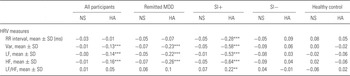
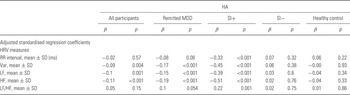
The results of Pearson's correlation analysis revealed that the NS score was not associated with any HRV index in all participants, patients with remitted MDD, the SI+ subgroup, the SI− subgroup and controls (Table. 4). With one accord the HA score was inversely associated with variance, LF and HF among all participants, remitted MDD group and the SI+ subgroup. In addition, the HA score related inversely to mean RR intervals but positively to LF/HF ratio among the SI+ subgroup. However, the SI− subgroup and healthy control group did not show any association between the HA score and HRV indices. Further adjustment for gender, age, BMI and physical activity did not alter the above-mentioned association in a meaningful way (Table. 5).
Pearson's correlation analysis of HRV indices and personality traits for all participants, patients with remitted MDD, the SI+ subgroup, the SI− subgroup and controls

SI+, remitted MDD with a history of SI; SI−, remitted MDD without a history of SI; Var, total variance.
* p < 0.05;
** p < 0.01;
*** p < 0.001 (Pearson's correlation coefficients).
Linear regression of HRV indices by scores of HA for all participants, patients with remitted MDD, the SI+ subgroup, the SI− subgroup and controls, adjusting for gender, age, BMI and weekly regular exercise factors

SI+, remitted MDD with a history of SI; SI−, remitted MDD without a history of SI; Var, total variance.
Discussion
As far as we know, this is the first adequately powered study that examines the relationship between cardiac autonomic regulation and fully remitted MDD in a large sample of unmedicated and physically healthy participants by using frequency-domain measurements of HRV. The main results of our study may be summed as follows.
First, as expected, unmedicated patients with fully remitted MDD did not have significantly lower HRV than controls. Consistent with our finding, Licht et al. reported that though patients with remitted MDD had lower time-domain indices of HRV compared with controls, accounting for psychoactive medication either removed or strongly attenuated the association with HRV Reference Licht, De Geus, Zitman, Hoogendijk, Van Dyck and Penninx13. We believe that this main result is reliable based on the following strengths of this study. We have excluded subjects with psychiatric and physical comorbidities that could potentially confound the association between depression and cardiac autonomic functions. The participants with fully remitted MDD and controls were interviewed with the modified Chinese version of SADSL Reference Endicott and Spitzer19 to rule out psychiatric comorbidity and psychiatric disorders, respectively. Thus, a false-negative result due to inclusion of anxiety disorders or substance use disorder in our control group is also presently unlikely. We have also controlled other confounding factors that may suppress or magnify the true effects of depression on HRV, including medication, smoking, BMI and physical activity levels Reference Rottenberg8. Moreover, since ethnic stratification among study samples may lead to resetting population HRV patterns Reference Li, Snieder and Su28, Reference Martin, Doster and Critelli29, it might produce a false-positive or false-negative result by chance rather than reveal a direct relation. However, all our subjects were unrelated Han Chinese subjects, matched for age and sex, and drawn from a population pool in Taiwan that is known to be genetically homogeneous Reference Chang, Lu and Chen18. All of the biological grandparents of our recruited subjects were of Han Chinese ancestry. Therefore, it is less likely that ethnic stratification bias produced a false-negative result in our study. Importantly, this main result in combination with our previous study result Reference Chang, Chang and Chen17 suggests that resting cardiac vagal control seems to be reflective of the phase of MDD (i.e. current or remitted phase). The following theoretical perspectives support our findings. First, Polyvagal theory proposed by Porges highlights the importance of the vagal pathway in attention, emotion expression, social bonding and flexible adjustment to environmental demands Reference Porges30, and all of these are compromised in patients with current MDD. Second, a recent systematic review suggests that vagus nerve stimulation is useful in treating depression Reference Daban, Martinez-Aran, Cruz and Vieta31 and therefore, it is conceivable that this novel treatment may be effective for correcting decreased parasympathetic activity in depression.
Second, the SI+ subgroup showed decreased variance, LF and HF power, cohering with what we would have expected from our previous study results Reference Chang, Chang and Chen17. We assumed that an overall reduction in HRV (variance) in the SI+ subgroup was mainly derived from their lower parasympathetic activity as compared with either the SI− subgroup or controls, based on the following two perspectives. First, the traditional interpretations of the HRV measures used in our study are that HF power estimate vagal tone, while LF power reflects both vagal and sympathetic influences Reference Kuo, Lin, Yang, Li, Chen and Chou23, Reference Liu, Kuo and Yang26, 27. However, it has also been reported that when LF power is assessed in the supine position, administration of atropine, a potent inhibitor of parasympathetic muscarinic receptors, eliminates most of the LF region of the power spectrum Reference Pomeranz, Macaulay and Caudill32. This does not occur when LF power is assessed in the sitting position, and suggests that resting LF power in our study may primarily reflect vagal influences Reference Sloan, Mccreath, Tracey, Sidney, Liu and Seeman33. Second, the reduced vagal modulation is not accompanied by a subsequent displacement of the sympathovagal balance (as indexed by LF/HF ratio) in favour of sympathetic modulation amongst patients of the SI+ subgroup compared to either patients of the SI− subgroup or controls. This finding warrants comment. The LF/HF ratio was calculated from the absolute values of the LF and HF power for each subject and was considered by some researchers as an indicator of the sympathetic/parasympathetic balance or sympathetic modulations 27. However, there is mounting evidence against LF/HF ratio representing sympathovagal balance. For example, Goedhart et al. reported that the LF/HF ratio did not show the expected correlation to the pre-ejection period, an established measure of cardiac sympathetic control Reference Goedhart, Willemsen, Houtveen, Boomsma and Geus34. More specifically, Goldstein et al. even considered LF power an index not of cardiac sympathetic tone but of baroreflex function during supine rest Reference Goldstein, Bentho, Park and Sharabi35.
With regard to decreased resting parasympathetic activity in the SI+ subgroup, much evidence suggests a link between reduced cardiac vagal control and difficulties in emotion regulation, in particular impulsivity Reference Allen, Matthews and Kenyon36, Reference Hansen, Johnsen and Thayer37. For example, parasuicidal adolescents, who are characterised by emotion dysregulation and impulsivity, exhibited reduced parasympathetic activity as compared with controls Reference Crowell, Beauchaine, Mccauley, Smith, Stevens and Sylvers38. As well, Rottenberg et al. Reference Rottenberg8 and Chang et al. Reference Chang, Chang and Chen17 consistently reported that resting parasympathetic activity was inversely associated with suicide symptom of depression. Taken together, the relationship between suicidality and parasympathetic activity may be, in part, mediated by other proximal factors for suicide-like impulsivity Reference Beauchaine39. As such, it is possible that the SI+ subgroup represents a subtype of depression that is characterised by impulsivity Reference Booij, Swenne, Brosschot, Haffmans, Thayer and Van Der Does16, Reference Du, Bakish, Lapierre, Ravindran and Hrdina40. A plausible scenario may be that the suicidal subtype of depression is more clearly related to autonomic dysregulation, putatively contributing to major depression Reference Rottenberg8, Reference Kemp, Quintana, Gray, Felmingham, Brown and Gatt12, and tends to have residual effects on neurophysiological systems in the remitted phase of depression Reference Post41. Overall, as judged by the statistical power, we realise that this positive result should be interpreted cautiously because the statistical power lowers when we analyses patient subgroups.
Third, what is unexpected and intriguing about our results is that the SI+ subgroup had reduced HAM-D score than the SI− subgroup. It is well known that higher level of SI is associated with more severe depression Reference Perroud, Uher and Hauser42, Reference Gensichen, Teising, Konig, Gerlach and Petersen43. However, most of the research on the association between depression severity and suicidality has been conducted in patients with current MDD. Previous studies focused on remitted MDD have shown lower Reference Booij, Swenne, Brosschot, Haffmans, Thayer and Van Der Does16 or similar Reference Booij, Van Der Does and Benkelfat44 baseline depression severity in remitted depressed patients with a history of SI, as compared with in patients without such history. In any case, our study revealed lack of association between depression severity and cardiac autonomic parameters. It is possible, therefore, that the lower depression severity in the SI+ subgroup as compared with in the SI− subgroup is not of clinical importance but of statistical significance.
Fourth, as for the association between HRV and personality traits, there was a negative correlation between HRV indices (variance, LF and HF) and the HA score in all participants, remitted MDD group and the SI+ subgroup. Our result has the support from the following theoretical perspectives. HA corresponds to an inhibitory response to signals of aversive stimuli that leads to avoidance of punishment, and it is theoretically associated with serotonergic activity Reference Chen, Chen, Chen, Yu and Cheng24, Reference Peirson, Heuchert, Thomala, Berk, Plein and Cloninger45. For example, evidence indicated that the HA score was positively associated with serotonin (5-HT) receptor sensitivity Reference Peirson, Heuchert, Thomala, Berk, Plein and Cloninger45 and negatively correlated with serotonin transporter (5-HTT) availability Reference Wu, Lee and Yeh46. Genetic studies further proved the relationship between the HA score and the serotonin transporter gene-linked polymorphic region (5-HTTLPR) Reference Lesch, Bengel and Heils47, Reference Osher, Hamer and Benjamin48. On the basis of previous findings, high HA score seems to reflect lowered 5-HT function. Then, a link between lowered 5-HT function and reduced HRV was established by recent evidence indicating that 5-HT depletion or 5-HT receptor blocking attenuated baroreflex gain Reference Kellett, Ramage and Jordan49, Reference Kellett, Stanford, Machado, Jordan and Ramage50, Reference Damaso, Bonagamba, Kellett, Jordan, Ramage and Machado51. The arterial baroreflex is the main mediator of HRV Reference Frederiks, Swenne and Tenvoorde52; therefore, lowered 5-HT function leads to diminished baroreflex function (e.g. LF power in our study) which in turn leads to reduced HRV (e.g. variance or HF power in our study). Furthermore, we found that the inverse relation between HRV levels and the HA score seemed to be mainly driven by the robust association in the SI+ subgroup (Table. 4, Table. 5). In a recent study Reference Yang, Chen and Tsai53, a weak but significantly negative correlation between the HA score and LF power in healthy subjects has been reported. One possible explanation for stronger association for the SI+ subgroup is that abnormalities of the 5-HT system may be pronounced in this subtype of depression that is characterised by impulsive and aggressive behaviour Reference Van Praag54. Indeed, the finding that the SI+ subgroup had a higher HA score compared with controls is in accordance with previous studies Reference Perroud, Uher and Hauser42, Reference Van Heeringen, Audenaert and Van Laere55, Reference Conrad, Walz, Geiser, Imbierowicz, Liedtke and Wegener56 and further complements above-mentioned explanation. Notably, Booij et al. Reference Booij, Swenne, Brosschot, Haffmans, Thayer and Van Der Does16 reported that remitted depressed patients with a history of SI might be more at risk for developing CVD, possibly related to increased vulnerability to impaired serotonin function, in part, supporting our findings. Finally, we found that the HA score related positively to LF/HF ratio among the SI+ subgroup. Previous studies have reported lack of association between the HA score and LF/HF ratio in a smaller sample size of healthy subjects Reference Yang, Chen and Tsai53, Reference Takahashi, Murata and Hamada57. One might wonder whether the link between serotonin function and sympathovagal balance (or sympathetic modulation) is restricted to the SI+ subgroup. However, a number of methodologically sound studies Reference Goedhart, Willemsen, Houtveen, Boomsma and Geus34, Reference Goldstein, Bentho, Park and Sharabi35 have not been able to find any relationship between sympathetic nerve activity and spectral estimates of sympathetic activity (e.g. LF or LF/HF ratio). It would be premature to make a conclusion based on the preliminary results reported herein. Accordingly, additional studies are recommended (e.g. cardiac noradrenaline spillover) for adequately assessing sympathetic nerve activity.
As suggested above, our findings highlight cardiac autonomic dysregulation in fully remitted MDD patients with a history of SI and should serve to remind clinicians to pay attention to their increased risk of CVDs. For example, an autonomic function examination such as HRV analysis can be done to provide a rapid screening of systemic autonomic disturbance. In this study, we assumed that cardiac autonomic dysregulation may be associated with pronounced impairment of serotonin function. However, there is much data showing that serotonin reuptake inhibitors fail to resolve reductions in HRV despite reduction in depressive symptoms Reference Kemp, Quintana, Gray, Felmingham, Brown and Gatt12. Thus, the alternative treatment to restore the autonomic function such as repetitive transcranial magnetic stimulation may be considered for the vulnerable patient population Reference Udupa, Sathyaprabha, Thirthalli, Kishore, Raju and Gangadhar58.
Several limitations should be considered in this study. First, we assessed suicide ideation retrospectively and largely on the basis of self-reported information, though information was obtained by standardised clinical interviews and checked in the medical records. Second, because of short-term HRV recording we were unable to assess reliably ultra-low frequency power measures for which strong links with depression have been reported Reference Carney, Blumenthal and Stein59, Reference Lampert, Bremner and Su60. Finally, we did not use nonlinear techniques to measure HRV, and nonlinear techniques may be more sensitive to depression than those used in our study Reference Kemp, Quintana, Gray, Felmingham, Brown and Gatt12.
Acknowledgement
This study was supported by Tri-Service General Hospital Grant TSGH-C98-91 (H. A. C).