Economic development and growth in the past two centuries have been facilitated by stable monetary and financial regimes. Good macroeconomic institutions encourage growth and financial development directly through financial innovation and indirectly by allowing private agents to make economic decisions in a stable environment (King and Levine Reference King and Levine1993; Rousseau and Sylla Reference Rousseau and Sylla2006). Macroeconomic stability comprises price level stability, limited volatility in the real economy, and financial stability. Traditionally, financial stability has meant preventing or managing financial crises, which can lead to and exacerbate recessions. More recently, it has come to mean heading off systemic risk especially credit-driven asset price booms and busts, which may trigger financial crises.
This article examines the evolution of macroeconomic institutions, focusing on the connection between the monetary regime, defined as both the exchange rate regime and the monetary policy regime, and financial stability in the past two centuries. I see this as primarily a story of central banks developing their policy tools to provide both macroeconomic and financial stability.
Central banks have been evolving since the founding of the Swedish Riksbank in 1668 and the Bank of England in 1694. Originally established to provide fiscal support to the governments of emerging nation states to finance wars, later in the eighteenth and nineteenth centuries, central banks evolved to maintain the convertibility of their notes into specie (gold) and to manage the gold standard.Footnote 1 In the twentieth century, they learned how to stabilize the business cycle and to provide price stability. The central requirement of these tasks was the establishment of credibility (Bordo and Siklos Reference Bordo, Siklos, Michael D., Oyvind, Marc and Jan F.2016). The evolution of central banks occurred within the context of international exchange rate regimes which encompassed the nineteenth-century specie standard (bimetallism and gold), the interwar gold exchange standard, the Bretton Woods adjustable peg regime, and the post Bretton Woods managed float fiat money regime.
In the international exchange rate regime, central banks (monetary authorities) adhere to a monetary policy regime, taken to mean the relationship between the tools of monetary policy and the goals or objectives of the policy maker. Monetary policy tools have been: the policy interest rate, in use since the nineteenth century; monetary aggregates, used in the twentieth century; and various qualitative and quantitative controls. Policy objectives or goals have been: stable exchange rates (gold convertibility pre–WWII), price level (inflation) stability, real output stability, low unemployment, and financial stability.Footnote 2
Learning to provide macroeconomic stability and to build credibility was long and difficult. Between the late nineteenth century and the twentieth century, credibility followed a pendulum process from relative success to deep failure and back to success (Bordo and Siklos Reference Bordo and Siklos2014). The Great Moderation from the mid-1980s to the mid-2000s is often viewed as the pinnacle of success for central banks in achieving their macroeconomic goals (Bernanke Reference Bernanke2004; Taylor Reference Taylor2011).
Learning to provide financial stability has also been long and painful. Some central banks learned how to be effective lenders of last resort by the third quarter of the nineteenth century (Bordo and Siklos Reference Bordo, Siklos, Rodney, Tor and Daniel2018), but for others, it was well into the twentieth century. Until the 1930s, banking crises were banking panics which required quick lender of last resort (LLR) actions to prevent a crisis. With the invention of the financial safety net and deposit insurance, banking panics evolved into fiscally resolved crises, whose resolution has become increasingly expensive (Bordo and Meissner Reference Bordo, Meissner, John and Harald2016). Along with crisis management, the regulatory and supervisory regime for the financial system went through a lengthy learning process (Toniolo and White Reference Toniolo, White, Michael D., Bordo, Oyvind, Marc and Jan F.2015).
Four key objectives emerged from this historical evolution prior to the Global Financial Crisis (GFC) of 2008: the importance of maintaining price stability (credibility for low inflation); maintaining real macroeconomic stability; providing a credible rules based LLR; and having a sound banking structure and effective supervision and regulation of the banking system. Since the GFC of 2008, central banks have focused increasingly on the financial stability mandate and especially on the link between credit-driven asset price booms and busts, referred to as the financial cycle, which many view as the key cause of financial crises (Borio Reference Borio2014; Taylor Reference Taylor, V. V., T., D. D., G. G. and R.2012).
In what follows, I survey the co-evolution of monetary policy and financial stability along with a narrative on some famous financial crises and historical evidence on the incidence, costs, and determinants of financial crises. I focus on some empirical historical evidence on the relationships between credit booms, asset price booms, and serious financial crises. My exploration suggests that financial crises have many causes, including but not limited to credit-driven asset price booms, and that in general financial crises are very heterogeneous and hard to categorize.
Two key historical examples stand out in the record of serious financial crises linked to credit-driven asset price booms and busts: the 1920s and 1930s, and the GFC. The question that arises is whether these two “perfect storms” should be grounds for permanent changes in the monetary and financial environment. I raise some doubts. The article concludes with lessons, both for policy makers and for future historians of financial crises.
The Historical Evolution of Monetary and Financial Stability Policy
Central banks have been evolving for close to four centuries. In the nineteenth century, central banks followed their key mandate to maintain the convertibility of their notes into specie and to follow the “rules of the game.”Footnote 3 During WWI, they became subservient to governments and were turned into engines of inflation. In the interwar period, they began to develop the tools of countercyclical stabilization policy and to insulate their economies from international shocks. In this period, observance of the flawed real bills doctrine (in the United States)Footnote 4 and adherence to the flawed gold exchange standardFootnote 5 led to serious policy errors. The Great Contraction of 1929–1933 was such that central banks were blamed by subsequent scholars and government officials at the time (e.g., President Franklin Delano Roosevelt) for the contraction. They lost their independence to Treasuries and were forced to follow an inflationary low interest policy. They became an integral part of a regime of, what I term, financial repression.Footnote 6
In WWII, central banks again became engines of inflation and beginning in the 1950s, central banks regained their independence. They returned to using their policy tools to stem inflation and stabilize the economy. In the 1960s, central banks, strongly influenced by Keynesian ideas, began following the Phillips Curve tradeoff favoring maintaining high employment at the expense of increasing inflation (Meltzer Reference Meltzer2010; Romer and Romer Reference Romer and Romer2002), which led to the Great Inflation of the 1970s.
After the debacle of the banking panics of the 1930s central banks also accepted their LLR role. However, by the 1970s they no longer followed Walter Bagehot’s (Reference Bagehot1873) strictures to lend freely at a penalty rate to solvent but illiquid banks but began to bail out insolvent banks believed to be “too big to fail.”
The Great Inflation ended in 1979 with the tight monetary policies of Federal Reserve Chairman Paul Volcker. This brought the advanced countries into the Great Moderation from the mid-1980s to the early 2000s, a period of rapid and stable growth and low inflation. Central banks achieved the apex of learning to follow credible rule-like behavior (Taylor Reference Taylor2006). This ended with the GFC 2007–2008. Although central banks handled it much better than the Great Contraction of the 1930s, they and other regulatory authorities were blamed for not heading off the imbalances that led to the crisis. As in the 1930s, these events have led to pressure for regime change to elevate the financial stability mandate to paramount importance and to a possible return to financial repression.
The Classical Gold Standard 1880–1914
The specie standard evolved in the nineteenth century from bimetallism to the classical gold standard which prevailed from 1880 to 1914 (Redish Reference Redish1992). The gold standard rule was a contingent rule where temporary suspension and the issue of fiat money was permitted in well-understood emergencies such as wars and financial crises. Once the emergency ended, the central bank was required to restore convertibility to gold at the official parity. Doing so would ensure its credibility (Bordo and Kydland Reference Bordo and Kydland1995). Credible adherence to the gold standard rule allowed central banks some leeway to conduct stabilization policies (smooth shocks to the price level, real output, and interest rates) within the gold points (Bordo and MacDonald Reference Bordo and MacDonald2012).Footnote 7 At the same time, minimal attention was attached to smoothing the business cycle or reducing unemployment. Wages and prices were relatively flexible, and the unemployed could migrate to the Americas or Australia.
The pre-1914 history of the gold standard shows how large economies, especially Britain, France, Germany, and the United States, had credible regimes. Western European countries like Italy, Spain, and Portugal tried to gain credibility but were less successful, as were all of the Latin American countries, reflecting their weaker institutional development (Bordo and Schwartz Reference Bordo, Schwartz, Barry and Jorge1996).
Credible adherence to the gold standard rule also allowed central banks to conduct LLR actions without engendering capital flight. Through the nineteenth century, advanced countries learned through repeated financial crises to follow Bagehot’s (Reference Bagehot1873) famous strictures “in the face of an internal drain (a banking panic) lend freely to solvent financial institutions on the basis of sound collateral. In the face of an external drain (currency crisis) raise the policy rate. In the face of both an internal and external drain, lend freely at a high rate” (paraphrased from Bagehot Reference Bagehot1873 in Bordo Reference Bordo, Michael D. and Anna J.1984, p. 56; Flandreau and Ugolini Reference Flandreau, Ugolini, Michael D. and William2013).
Before 1914, financial crises were caused by internal and external shocks including political upheaval, financial corporate malfeasance, and international lending booms and busts. Crises were transmitted between countries by the adjustment mechanism of the fixed exchange rate gold standard. Their incidence and severity were closely related to both the presence and absence of a LLR and banking structure. The United States, with unit banking, fared far worse than neighboring Canada, which had nationwide branch banking (Bordo, Redish and Rockoff, Reference Bordo, Redish and Rockoff2015). Country differences in banking structure and government responses to financial crises were clearly tied in with deep institutional and political factors, such as the nature and presence of property rights and rule of law and connection to the British Empire (Bordo and Meissner Reference Bordo, Meissner, Peter L. and Paul2015; Calomiris and Haber Reference Calomiris and Haber2014).Footnote 8
The Interwar and WWII: 1914–1945
The classical gold standard ended with WWI. With the outbreak of hostilities in 1914, most of the belligerents suspended convertibility and imposed exchange and capital controls as they attempted to liquidate their vast foreign holdings of securities (Silber Reference Silber2007; Roberts Reference Roberts2013). Each belligerent financed a considerable portion of its wartime expenditures by issuing paper currency, leading to high inflation. After the war, many countries tried to rebuild the prewar gold standard system, but restoring the prewar parity in the face of massive wartime inflation and changes in the political economy of the postwar order was difficult (Eichengreen Reference Eichengreen1992). What was established in 1926—the fragile gold exchange standard—had considerably less credibility (Bordo and Siklos Reference Bordo and Siklos2014). Its short-lived success depended upon the reputations of Benjamin Strong, Montagu Norman, Emile Moreau, and Hjalmar Schacht (Bordo and Schenk Reference Bordo, Schenk, Michael D. and John2016). Despite their efforts, the system collapsed during the Great Depression when it suffered from the fatal flaws of maladjustment, illiquidity, and lack of credibility. The key problem was adjustment: the United Kingdom had restored convertibility at an overvalued parity and faced continuous deflationary pressure while France restored convertibility at a greatly undervalued parity. Both France and the United States sterilized gold inflows, aggravating the deflationary pressure on sterling, which since WWI was a declining reserve currency.
During the interwar period, many central banks began following macro stabilization policies to offset fluctuations in the price level and real output. To do so required sterilizing gold flows and preventing the classical adjustment mechanism from working.Footnote 9 This was different from the pre-war gold standard and these sterilization policies ultimately led to the breakdown of the international monetary system (Meltzer Reference Meltzer2003). Financial stability also suffered in the interwar period as most European countries, in the face of deflation and readjustment of competitiveness, suffered banking crises, most not resolved by effective LLR policies (Feinstein, Temin, and Toniolo Reference Feinstein, Temin and Toniolo1997). A number of countries resorted to fiscal bailouts of banks deemed “too big to fail” during this period (Toniolo and White Reference Toniolo, White, Michael D., Bordo, Oyvind, Marc and Jan F.2015).
The Federal Reserve’s policy actions in the late 1920s, while unsuccessful in deflating the stock market boom, led to a serious recession in the summer of 1929. An even more egregious error was the System’s failure to follow its LLR mandate and offset a series of ever worsening liquidity-driven banking panics from 1930 to 1933 (Bordo and Wheelock Reference Bordo, Wheelock, Michael D. and William2011; Bordo and Landon-Lane Reference Bordo and Landon-Lane2010) causing the money supply to collapse by one-third with a similar collapse in real output and prices and a rise in unemployment to 25 percent (Friedman and Schwartz Reference Friedman and Schwartz1963).
The U.S. Great Contraction spread to the rest of the world through the fixed exchange rate gold standard. The loss of credibility in the interwar period aggravated matters for most European countries which, faced with “golden fetters,” were unable to follow successful LLR policies to prevent banking panics and deflation (Eichengreen Reference Eichengreen1992; Bernanke and James Reference Bernanke, James and Glenn1991). They escaped depression by cutting the link with gold and devaluing their currencies (Choudhri and Kochin Reference Choudhri and Kochin1980; Eichengreen and Sachs Reference Eichengreen and Sachs1985).
Country after country raised tariffs, imposed exchange, and capital controls in an effort to protect their economies from foreign competition (Kindleberger Reference Kindleberger1973; Irwin Reference Irwin2011). They also followed beggar-thyneighbor competitive devaluations (currency wars) (Nurske Reference Nurske1944). The outcome was the complete collapse of the global trade and international financial system by the eve of WWII.
In the United States and other advanced countries, the Great Contraction was blamed on the central bank and the commercial banks. This led to the subservience of the Fed to the U.S. Treasury from the mid-1930s until the Federal Reserve Treasury Accord of 1951. During this period the Fed followed a low interest rate policy to accommodate the Treasury’s fiscal policy (Meltzer Reference Meltzer2003). During WWII, the Fed fueled inflation as it had done in WWI by accommodating expansionary fiscal policy. The story was similar in the United Kingdom, Canada, and many other countries. Thus, in these decades central banks lost their independence to the fiscal authorities. They also administered controls over the financial system and became part of the general machinery of government directing credit allocation and financial repression.
Bretton Woods 1944 to 1973
The Bretton Woods System (BWS), inaugurated at the Bretton Woods conference in 1944, was created to restore both macroeconomic and financial stability (Bordo Reference Bordo, Michael D. and Barry1993). The BWS was rule based and in many ways similar to the gold standard. Each member was required to peg their currencies to dollars at $35 per ounce of gold. As the key anchor currency, the United States was to use its financial policies to maintain the dollar peg. It was an adjustable peg whereby member countries could change their parities in the face of a “fundamental disequilibrium” (a change in the real exchange rate). In addition, the member countries were to institute capital controls.Footnote 10 Unlike the gold standard, members were expected to use their monetary and fiscal policies to maintain full employment. Additionally, the International Monetary Fund (IMF) was established to provide temporary relief for current account imbalances.
The BWS became fully operational in late 1958 when the Western European economies declared current account convertibility. The convertible BWS was associated with remarkable macroeconomic stability (Bordo Reference Bordo, Michael D. and Barry1993) but was short-lived (1959 to 1971), as it quickly evolved into the gold dollar standard, which had the fatal flaws of the interwar gold exchange standard.
The key problem, as in the 1920s, was adjustment. The United Kingdom, with an overvalued parity and slower growth than its competitors and an unwillingness to accept deflation, had continuous balance of payments deficits, currency crises, and rescues by the G10 ( group of industrial countries), the IMF, and the United States. On the other hand, Germany had rapid productivity growth and ran continuous surpluses, but as in the interwar, was unwilling to let prices rise and sterilized the inflows. The United States, as the anchor country, ran continuous balance of payments deficits. However, because the dollar was used as international reserves to finance the growth of world trade, it did not have to adjust to its deficits.Footnote 11 After 1960, as outstanding dollar balances increased relative to the U.S. monetary gold stock, the threat of a run on gold (Fort Knox) loomed. In reaction in 1961, the U.S. authorities created an elaborate set of policies and controls, the most important of which were the swap lines, to preserve the monetary gold stock (Bordo, Humpage, and Schwartz Reference Bordo, Humpage and Schwartz2015).Footnote 12 However, as long as the U.S. monetary authorities followed credible low inflation policies, the system would continue because the dollar had emerged as the key international currency. The BWS collapsed in 1971 with U.S. inflationary monetary and fiscal policies after 1965 to finance the Vietnam War and Lyndon B. Johnson’s Great Society.Footnote 13
Within this international background, the Federal Reserve slowly regained its independence from the Treasury. This was achieved in the Federal Reserve Treasury Accord of 1951. In other countries it took much longer for central banks to regain their independence, often into the 1980s and early 1990s.
The Federal Reserve tightened policy in the early 1950s and restored price stability. Under Chairman William McChesney Martin, it followed a policy of low inflation, and the U.S. economy (and other advanced economies) performed well in terms of low and stable inflation and rapid and stable real growth through much of the 1950s and early 1960s. The return to monetary orthodoxy (low inflation) rested on the reputation of Chairman Martin. The Bundesbank and the Swiss National Bank also followed credible monetary policies dedicated to maintaining price stability.
This period saw financial stability. The controls on the financial industry and the regime of financial repression continued into the 1950s and 1960s. In the United States, the Federal Reserve System administered Regulation Q, which imposed a ceiling on time deposit interest rates and prohibited the payment of interest on demand deposits. Another important regulation was the Glass Steagall separation of commercial from investment banking.Footnote 14 In the face of those regulations, and with the extension of Federal Deposit Insurance Corporation (FDIC) insurance, there were no financial crises, although there were speculative attacks on pegged exchange rates. Similar policies and institutions prevailed in the United Kingdom and virtually every other advanced economy (Toniolo and White Reference Toniolo, White, Michael D., Bordo, Oyvind, Marc and Jan F.2015).
The Managed Float Regime 1973 to 2006
The era of macro stability and financial stability began to unravel in the mid-1970s. In the 1960s, central banks, with the exceptions of the Bundesbank and the Swiss National Bank, began following Keynesian policies of full employment at the expense of higher inflation. With the collapse of Bretton Woods and the indirect link to gold, the last constraint on monetary policy was removed. The subsequent Great Inflation destroyed credibility, as well as the reputations of central bankers especially Chairman of the Federal Reserve Arthur Burns (Bordo and Orphanides Reference Bordo and Orphanides2013; Bordo and Siklos Reference Bordo, Siklos, Michael D., Oyvind, Marc and Jan F.2016).
As inflation mounted in the 1970s, several attempts by Burns and the Federal Open Market Committee (FOMC) to reduce inflation faltered (Bordo and Orphanides Reference Bordo and Orphanides2013). Accommodation for two oil price shocks also contributed to the run up in inflation culminating in a run on the dollar in 1978. President Carter’s appointment of Paul Volcker as chairman of the Federal Reserve with a mandate to end inflation and Volcker’s adoption of monetarist-style tight monetary policy in 1979 broke inflationary expectations by 1982 at the end of a deep recession (Bordo et al. Reference Bordo, Erceg and Levin2017).
Similar strategies were followed in the United Kingdom, Japan, Canada, and other countries so that by the mid-1980s, the Great Moderation restored price stability along with the credibility of central bankers (Bordo and Siklos Reference Bordo, Siklos, Michael D., Oyvind, Marc and Jan F.2016). During this period, central banks developed new strategies that enhanced credibility (Bordo and Siklos Reference Bordo and Siklos2014, Reference Bordo, Siklos, Rodney, Tor and Daniel2018). Chief among these is inflation targeting (IT), developed in the late 1980s and early 1990s by New Zealand, Canada, Australia, the United Kingdom, and Sweden but not the United States.
As it was practiced, it became flexible IT. Under flexible IT, the policy interest rate is used to hit the explicit inflation target (e.g., 2 percent). But since changes in the policy stance influence inflation with long and variable lags, there is usually a tolerance range around the mid-point of the target. Flexible IT allows the central bank to influence its other main macroeconomic goal of low unemployment at the same time as achieving its mandated inflation target (King Reference King1997; Svensson Reference Svensson2009).
The end of the BWS also led to the breakdown of financial stability. Bretton Woods failed because it became increasingly difficult to maintain capital controls in the face of financial innovations such as Eurodollars in 1950s by London based U.S. banks. Once capital controls ended, private capital flows, in addition to contributing to a return to financial globalization, increased the likelihood of both currency crises and banking crises driven by lending booms and sudden stops. Second, the Great Inflation made it more difficult for price controls in the financial sector to be maintained. With inflation came increasing financial innovation and competition between new institutions, designed to evade the domestic financial controls, and the older protected ones. Political pressure in the 1980s and 1990s led to the complete liberalization of the financial sector in the United States by 1999, with the elimination of Glass Steagall and the end of the prohibition on interstate branch banking in 1997. However, the supervision and regulation regime failed to keep up with the rapid changes under financial liberalization. The same process unfolded across the world, albeit under different institutional frameworks.
Banking crises, which had virtually disappeared since the mid-1930s, came back in the 1970s. After the debacle of the Great Depression, the Fed acknowledged its LLR role. With the return of banking crises in the 1970s, the Fed began following activist crisis management policies (Bordo Reference Bordo2014; Carlson and Wheelock Reference Carlson, Wheelock and Owen F.2015). Banking crises in this period were very different from those in the 1930s and earlier. With the advent of deposit insurance, old-fashioned banking panics disappeared and were replaced by expensive fiscal bailouts of insolvent firms (Bordo and Meissner Reference Bordo, Meissner, John and Harald2016). Additionally, the Fed expanded its reach beyond the traditional “line in the sand” of protecting only the deposit-taking institutions and the payments system, and began to allay turmoil in the non-banking sector (beginning in 1970 with the rescue of the commercial paper market in the Penn Central crisis, the rescue of the hedge fund Long Term Capital Management (LTCM) in 1998 and investment banks in 2008).
A key event in the progression towards fiscal bailouts and what became known as the “Too Big to Fail” doctrine was the bailout of Franklin National bank in 1974, which had made risky bets in the foreign exchange market. The justification for this violation of Bagehot’s (Reference Bagehot1873) strictures was to prevent contagion to other banks.
Bagehot (Reference Bagehot1873) was criticized by Charles Goodhart (Reference Goodhart1985), Robert Solow (Reference Solow, Charles P. and Jean-Pierre1982), and others on the grounds that it was not possible to distinguish illiquidity from insolvency during a crisis and that the failure of a large bank would disrupt financial intermediation and lead to contagion. In response to the concern over moral hazard, Corrigan (Reference Corrigan1990), Giannini (Reference Giannini1999), and others suggested that the Fed follow a strategy of “constructive ambiguity” by not declaring in advance which banks would be deemed too large to fail. Similar processes took place in the United Kingdom (Capie Reference Capie2010; James Reference James2017), and in other countries. These developments set the stage for the return of serious financial instability in advanced countries with the 2007–2008 subprime mortgage crisis.
The Global Financial Crisis: 2007–2008
The Great Moderation of 1985 to 2005 was associated with macroeconomic and financial stability. The prevalent view was that monetary and price stability fostered financial stability because inflation volatility weakened bank balance sheets (Bordo Reference Bordo2000; Bordo, Dueker, and Wheelock Reference Bordo, Dueker and Wheelock2002). An alternative view was that extended periods of low inflation and low interest rates created growing imbalances (Borio and Lowe Reference Borio and Lowe2002); that is, low interest rates and low inflation were conducive to creating bank-credit-fueled asset price booms and busts because low interest rates created the seeds for credit-financed asset price booms in an environment of price stability. At the end of the Tech boom of the 1990s and early 2000s, when the Bank for International Settlements (BIS) officials suggested the conditions under which the Fed should raise its policy rates to defuse an incipient bubble (BIS 2000, Chapter 1), Federal Reserve officials and some prominent economists (Greenspan Reference Greenspan2002; Bernanke and Gertler Reference Bernanke and Gertler1999) argued that the proper way to treat an asset price boom was to leave it alone, and if it burst, to clean up the mess afterwards (“cleaning,” Brunnermeier and Schnabel Reference Brunnermeier, Schnabel, Michael D., Oyvind, Marc and Jan F.2016).Footnote 15 As it turned out, when the Tech boom burst in 2000, it did little damage to the real economy, justifying the Fed’s view. The 2007–2008 subprime mortgage crisis, by contrast, did have serious effects on the global financial system, reminiscent of 1931, and led to a very serious recession.
Debate over the causes of the 2007–2008 crisis continues. Many factors were at work, including major regulatory failure in the U.S. housing sector (Fanny Mae and Freddie Mac) encouraging risky mortgage borrowing (Rajan Reference Rajan2010; Poole Reference Poole2017); the Fed (and other central banks) leaving its policy rate well below the Taylor Rule rate (2002–2005) for fear of a Japan-style deflation (Taylor Reference Taylor2007);Footnote 16 financial innovation that created derivatives; the failure of the United States and other regulators to comprehend that their regulations of the global banking system were being evaded by the creation of off balance sheet entities (Gorton Reference Gorton2010; Calomiris Reference Calomiris2017); a global savings glut (Bernanke Reference Bernanke2005); and greed and malfeasance by many financial sector players (Gorton Reference Gorton2012; Blinder 2015).
Policy actions by the Fed and other central banks and international policy coordination eventually managed the crisis and the macro economy was stabilized. The central banks pursued classic Bagehot liquidity policies (expansionary open market operations and discount lending) but extended their discount window mandate from providing liquidity to deposit taking institutions to encompassing non-bank financial intermediaries (shadow banks).Footnote 17 The monetary and fiscal authorities bailed out insolvent banks and investment banks deemed “too important to fail.” Central banks’ independence from the fiscal authorities was violated by the use of credit policy (e.g., extending credit to non-bank entities), which is a form of fiscal policy (Goodfriend Reference Goodfriend2014). Because they engaged in credit policy and bailed out insolvent banks—actions not included in the Federal Reserve Act—their future independence is threatened by congressional reaction.Footnote 18
Indeed, as in the 1930s, the GFC was blamed on the banks and the financial sector in general, leading to an increase in financial regulation (Dodd–Frank 2010). At the global level, the Financial Stability Board and Basel III recommended new regulations for national financial regulatory agencies.Footnote 19 In addition, central banks have been urged by academics and policy makers to use their policy tools to head off incipient systemic risk, especially credit booms and entrusted with the use of the policy tools of macro prudential policy to deal with potential financial instability.Footnote 20 This increased emphasis on financial stability has created a sense of déjà vu from the 1930s when a regime of financial repression led to rent seeking and distorted resource allocation in the financial sector (Calomiris Reference Calomiris2000; White Reference White2000), which in subsequent decades had serious unintended consequences.
Financial Crises in Historical Perspective: Narratives
To understand more clearly the link between monetary policy and financial stability regimes, we must understand the record of the most extreme form of financial instability. I define a financial crisis as a banking crisis. Before the 1930s, they were banking panics—a scramble by the public for means of payment (an illiquidity event). Since the Great Depression, these have become fiscally resolved banking crises driven by insolvency.Footnote 21
In what follows, I present narratives on several important financial crises in the past two centuries.Footnote 22 They are drawn from 12 narratives discussed in Michael Bordo (Reference Bordo2017).Footnote 23 I first present some famous British crises, then crises from the United States, and then other countries. This set of narratives illustrates successes and failures in attaining financial stability and the importance of institutions.
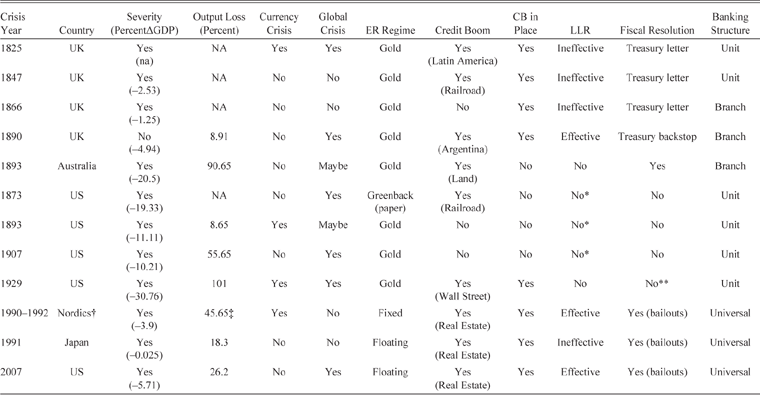
Table 1 summarizes all 12 narratives and provides some salient characteristics for each episode: the severity of each crisis, whether it was part of a global crisis, the exchange rate regime, whether it was accompanied by a currency crisis, whether it was associated with a credit boom, whether a central bank was in place, whether it was allayed by LLR actions, whether it was fiscally resolved, and the type of banking structure in place.
Major Banking Crises 1825–2008

Notes: † Finland, Norway and Sweden; ‡ Finland and Sweden; * Clearing houses; ** Reconstruction Finance Corporation.
Sources: Bordo (Reference Bordo2003); Bordo and Landon-Lane (Reference Bordo, Landon-Lane, Maurice, Dongchul and Andrew2012); Bordo and Meissner (Reference Bordo, Meissner, John and Harald2016).
The United Kingdom: Overend Gurney 1866 and Barings 1890
From the early years of financial capitalism in the seventeenth century, the United Kingdom had a series of major banking crises (Hoppit Reference Hoppit1986). After the Napoleonic wars, there was one almost every decade (1825, 1839, 1847, 1857, 1866, and 1890). All of these episodes were global in scope, and some involved credit booms. The progression of crises ended when, by 1890, the Bank of England had learned to be a LLR. Overend Gurney was a discount house that in the 1860s had taken on risky investments. It was the largest discount house and according to Batchelor (Reference Batchelor, Forrest and Geoffrey E.1986), the Directors of the Bank of England viewed it as a rival so when it became insolvent in 1866 the Bank refused to rescue it. Its failure led to the failure of a number of associated country banks and the English Joint Stock bank, followed by a run on London banks and finance houses by the country banks, which in turn led to a classic banking panic as the public tried to convert its deposits into Bank of England notes. The run spread to the Bank of England itself. The Bank hesitated in requesting a Treasury Letter, releasing it from the convertibility constraint of the 1844 Bank Charter Act, but the Chancellor of the Exchequer suspended the Act which ended the panic. Bagehot (Reference Bagehot1873, p. 67) criticized the Bank for hesitating in providing liquidity to allay the panic: “To lend a great deal, and yet not give the public confidence that you will lend sufficiently and effectually, is the worst of all policies, but it is the policy now pursued.” Thus, the Overend Gurney panic began with bad business decisions by its directors and became a panic when the Bank of England failed to act as a LLR.
The 1890 crisis in London also resulted from unwise investment decisions by Barings directors (investing in securities financing a land boom in Argentina), which turned to bust in the face of financial mis-management and the external shock of a harvest failure. Like Overend Gurney in 1866, when insolvency loomed the Barings directors turned to the Bank of England for a rescue. The Bank complied and arranged what became known as a lifeboat rescue. The Bank arranged a rescue of Barings by a syndicate of banks, led by the Bank of England itself, to share in any losses from Barings liquidation. The Bank then split the old firm into a good bank, which was recapitalized, and a bad bank, which held the toxic securities—a technique used a century later in Sweden (White Reference White2016) and in several cases in the GFC. The syndicate and the bad bank were guaranteed from loss by the British Treasury. Announcement of the rescue allayed the markets, and a panic was avoided. In addition, gold loans to the Bank by the Banque de France and the Russian Government (central bank cooperation) also helped backstop the Bank of England (Bordo and Schenk Reference Bordo, Schenk, Michael D. and John2016). According to Hautcoeur, Riva, and White (Reference Hautcoeur, Riva and White2014), the model for the lifeboat came from a rescue the year before of a major financial institution, the Comptoir d’Escompte by the Banque de France. Unlike the other events that I discuss, this is one of the few potentially serious crises that was avoided by wise LLR actions.
The United States 1907 and 1929–1933
The United States, compared to other advanced economies, had the largest number of banking crises in the late nineteenth century. Much of this instability can be explained by the political economy of the federal system that came out of the 1787 Constitution which gave control over the currency to Congress without control over banking. Consequently, the U.S. banking system was based on often small state-chartered unit banks. Two attempts to establish a central bank—the First and Second Banks of the United States—failed through the forces of populism and states’ rights.
In the pre-Civil War period without a LLR, several banking panics occurred, often brought about by a combination of speculation in infrastructure stocks, malfeasance, political shocks, and sudden stops in capital flows from England (1792, 1817, 1837, 1839, 1857, 1861). Frequent bank failures as well as panics created an unstable and inefficient payments system.
During the Civil War, the National Banking System was established to provide a ready market for U.S. securities and to provide a safe and uniform currency—national bank notes—to be issued by Federal government chartered national banks. The national banking system was successful in creating a uniform and safe currency, but it was still hit by a series of major banking crises. The continued high incidence of banking panics reflected major flaws in the system: the inverted pyramid of credit which led to a connection between New York stock market crashes and banking panics, the absence of a LLR, and the unit banking system. The private sector substitute of clearing house loan certificates did succeed in preventing two minor crises (1884 and 1890) but did not prevent major panics in 1873, 1893, and 1907 (Gorton and Tallman Reference Gorton and Tallman2016). The big panics of the national banking era were not driven by credit-fueled asset price booms, with the possible exception of 1873.
The 1907–1908 banking panic is considered the most important financial crisis in the U.S. before the Great Depression. It led to the successful movement towards monetary reform that created the Federal Reserve System (Bordo and Wheelock Reference Bordo, Wheelock, Michael D. and William2011). Although gold had been flowing into the U.S. preceding 1906, the San Francisco earthquake of 1906 led to major remittances to the United States by British insurance companies. The Bank of England became alarmed by these capital flows and gold drains from its reserves. Consequently, it raised its Bank rate and rationed credit to the merchant banks engaged in U.S. trade finance. In a sense, it was a sudden stop (Odell and Weidenmier Reference Odell and Weidenmier2004).Footnote 24 In the fall of 1906, European investors reduced their holdings of U.S. securities leading to a large gold outflow. This disinvestment was associated with a sharp drop in U.S. stock prices from March to August 1907 and a recession beginning in May. The crisis began on 14 October, when five member banks of the New York Clearinghouse and three others requested assistance from other clearing house banks.Footnote 25 Order was restored when requests were granted.
However, on 21 October, a run on the Knickerbocker Trust Company, the third largest trust company in New York, occurred because its President had had dealings with one of the affected banks. Not being a member of the Clearing House, it received no aid. It suspended payments the next day, whereupon a run started on the second largest Trust company on 23 October and another big trust company the day following. The New York Clearing House granted assistance to the trust companies but not fast enough to avoid precipitating a general alarm outside New York City. Pressure on New York banks reserves from other cities was initially allayed when the Treasury deposited $25 million in key New York banks on 24 October as well as funds extended to the banks by a syndicate headed by JP Morgan. The New York Clearing House began issuing loan certificates on 26 October, but faced with increasing demands from interior banks on their reserves, the New York banks restricted convertibility of their deposits into currency, quickly followed by the rest of the country ending the panic. Like 1893, the 1907 crisis resulted from a sudden stop in an environment without an effective LLR.
The main event of the 1920s was the Wall Street stock market boom from 1926 to 1929 and the crash in October 1929. The United States experienced a housing boom from 1922 to 1925 which did not lead to a serious bust or a financial crisis (White Reference White, Eugene N., Kenneth and Price2014). Following the sharp recession of 1920–1921, the economy of the 1920s was characterized by rapid real growth, rapid productivity advance, and slightly declining prices, punctuated by two minor recessions. Irving Fisher and other contemporaries believed that the stock market boom reflected the fundamentals of future profits from the new high growth industries. Ellen McGrattan and Edward Prescott (Reference McGrattan and Prescott2003) concur with this view, although many others regard it as a bubble (Galbraith Reference Galbraith1955; White and Rappoport Reference White and Rappoport1993).
Regardless, the market crashed in October 1929 and the crash is usually blamed on tight Federal Reserve policy. Beginning in 1927, the Fed, following its adherence to the real bills doctrine was increasingly concerned over stock market speculation. Policy tightened through 1928 and early 1929 and a recession began in July 1929. This, according to White (Reference White1990), led to a revision of the prevailing optimism and the crash in equities.
The consensus view by economists is that the 1929 crash was not the pivot of the Great Contraction (Friedman and Schwartz Reference Friedman and Schwartz1963; Romer Reference Romer1993), but that it had a major effect on the first year of the recession. It reduced output via wealth effects on consumption, reduced investment, and reduced velocity. The consensus view is that the recession became a “Great Depression” in 1930 after the Fed failed to act as a LLR to prevent a series of (liquidity driven) banking panics in the subsequent three years (Bordo and Landon-Lane Reference Bordo and Landon-Lane2010). The banking panics in turn impacted the real economy through the collapse in money supply, which produced massive deflation (Friedman and Schwartz Reference Friedman and Schwartz1963) and financial disintermediation (Bernanke Reference Bernanke1983). The depression spread abroad through the fixed exchange rates of the gold standard.
Summary
As can be seen from the narratives, the environment in which crises occurred evolved from the classical gold standard to the interwar gold exchange standard to Bretton Woods and the post-WWII Managed Float. Key causes involved both domestic and external shocks (sudden stops), weak banking structure and supervision and regulation, lending booms and busts, some driven by bank credit, others by foreign bond and equity capital inflows and financial innovation. Above all, the key ingredient in how a crisis played out and was resolved was the presence or absence or failure of the monetary authorities’ provision of the LLR. In the past two decades, a key player has been the fiscal authorities because with the advent of the financial sector safety net and government guarantees, banking panics have morphed into fiscal crises.
Credit-driven asset price booms as the cause of financial crises, emphasized since the 2007–2008 crisis, were important in a few big crises before WWII, but not the majority. Even when credit booms were present, structural variables in the banking and financial system and the presence of significant adverse shocks also mattered. Since the collapse of Bretton Woods and the return of financial globalization and the liberalization of the domestic financial sector in every country, financial instability has returned. Since the 1970s, major financial innovation has allowed banks to fund themselves in the financial markets rather than rely on their deposit bases (Schularick and Taylor Reference Schularick and Taylor2012). This has allowed bank credit to grow faster than the money supply, has increased leverage, and may have been a key factor triggering asset price booms and possible financial crises since the 1980s.
In addition, financial innovation, made possible by the growth of financial theory and financial innovation, has led to the growth of non-bank financial intermediaries (shadow banks), which lie outside the traditional supervisory and regulatory networks. These innovations both in the traditional banking sector and the shadow banking sector have increased leverage and liquidity in the financial system and has created a new source of systemic risk that can increase financial instability.
Financial Crises in Historical Perspective: Incidence, Output Losses, and Determinants
Incidence of Financial Crises
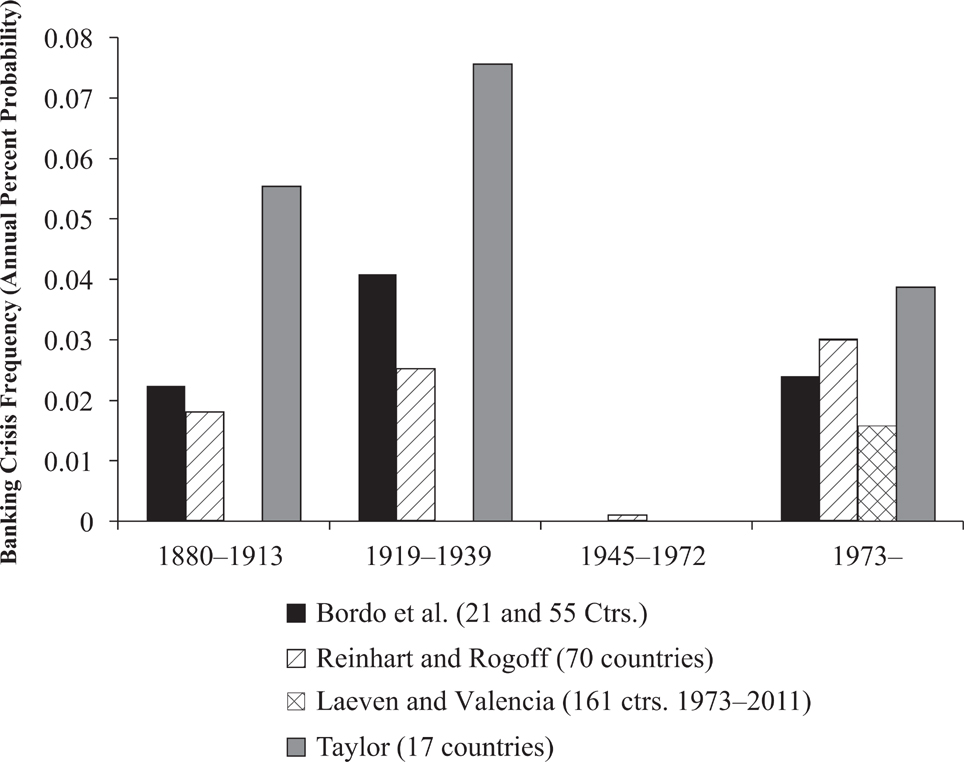
There has been considerable research on measuring the incidence of financial crises from the nineteenth century to the present (Bordo and Meissner Reference Bordo, Meissner, John and Harald2016). Figure 1 shows the frequencies of banking crises using four different databases.Footnote 26 Bordo and Christopher Meissner (Reference Bordo, Meissner, John and Harald2016) discuss some of the measurement issues involved in comparing crises measured over different databases using different definitions of crises and different samples of countries.Footnote 27
Frequency of Banking Crises with Different Databases
Notes: Frequencies are calculated as the ratio of the number of years in which the set of countries in the sample is in the first year of a banking crisis (with no currency or debt crises) to the total number of country years.

I calculate crisis frequencies as the ratio of years in which the set of countries in the sample is in the first year of a banking crisis to the total number of country years. I compare outcomes across four different time periods: the classical gold standard 1880–1913; the interwar period 1919–1939; Bretton Woods 1945–1972; and the current period of managed floating from 1973 to the present. Adjusting for the differences in the sample sizes for the different databases, the incidence of banking crises is quite similar in the pre-1914 gold standard era to the post-1973 period (the second era of globalization). Of course, the incidence of banking crises is much higher in the unstable interwar period and is almost nonexistent in the Bretton Woods era of financial repression.Footnote 28
Output Losses
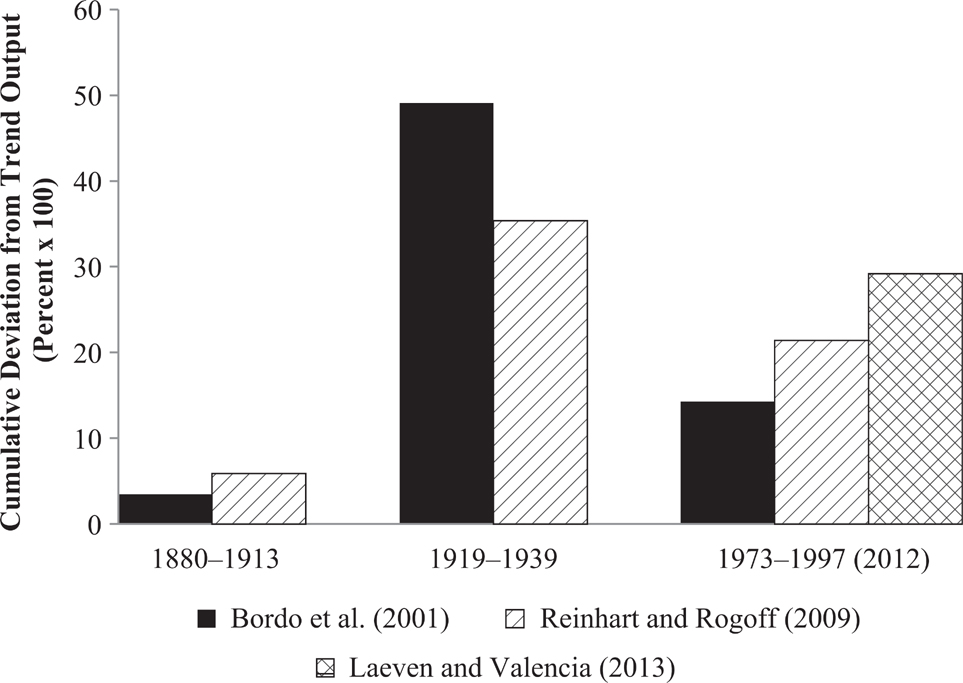
A key reason why financial crises are deemed so important is that they often lead to large output losses. An extensive literature, surveyed by Bordo and Meissner (Reference Bordo, Meissner, John and Harald2016), is devoted to measuring the output losses of financial crises. Issues of measurement and endogeneity dominated the debate. Bordo and Meissner (Reference Bordo, Meissner, John and Harald2016) calculated unconditional output losses in different periods using the crisis dates from the various data sets that they surveyed. Their metric is the cumulative percentage deviation of GDP per capita from the pre-crisis trend level of per capita GDP. They use a window from the year of the crisis to three years after it starts. Pre-crisis trends are based on the average annual change of the log of per capita GDP up to 10 years prior to the crisis.
Figure 2 shows the output losses for banking crises for the four historical periods. In the pre-1914 era, the losses ranged from 3 to 6 percent of GDP. For the interwar period, driven by the Great Depression, the deviations from trend are much larger—minus 40 percent. In the post-Bretton Woods period, losses are smaller than the interwar but larger than under the gold standard.
Output Losses
Notes: Output losses for the different samples and periods are calculated using the crisis dates from the various data sets mentioned in the text. The bars describe the cumulative percentage deviation of GDP per capita from the pre-crisis trend level of GDP per capita. The window used to calculate these deviations goes from the year of the crisis to three years after the crisis starts. Pre-crisis trends are given by the average annual change of the logarithm of GDP per capita up to 10 years prior to a crisis.
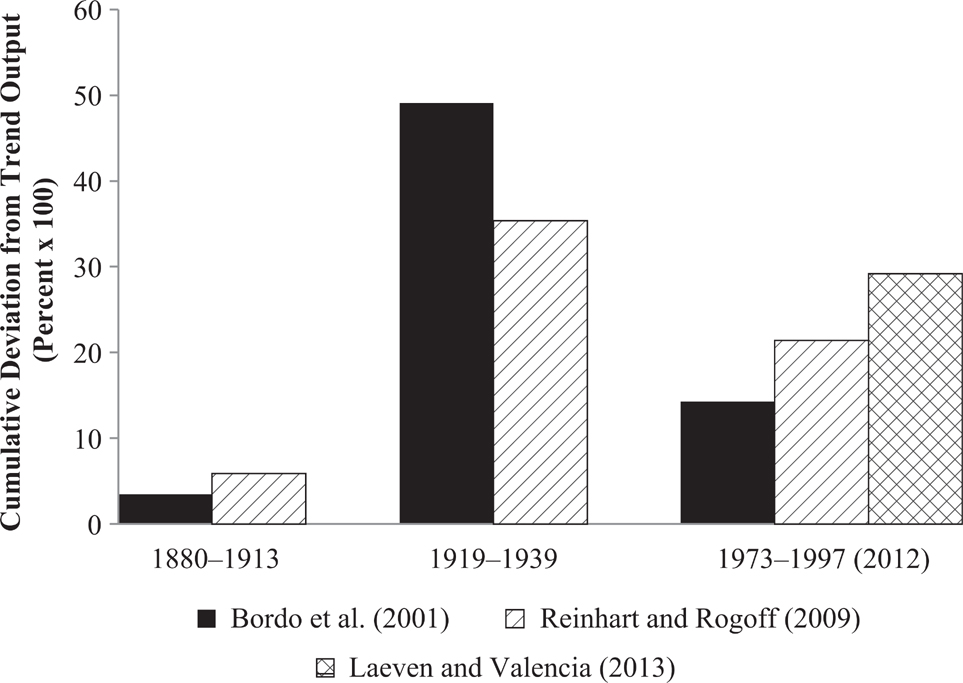
An interesting phenomenon is that output losses between 1997 and 2010 are much larger than in the pre-1914 period, despite today’s greater reliance on LLR policies and other policies designed to remedy the market failures associated with financial shocks. This may be because in recent years banking crises in a regime with government guarantees are associated with ever higher fiscal resolution costs (Bordo and Meissner Reference Bordo, Meissner, John and Harald2016).Footnote 29 The evidence suggests that the stakes associated with financial crises in the past two decades have been rising and hence the imperative for monetary authorities to prevent them has increased.
The Determinants of Financial Crises and the Role of Credit-Driven Asset Price Booms
The evidence on the determinants of banking crises does not point to any one single factor as paramount. Bordo and Meissner (Reference Bordo, Meissner, John and Harald2016) points to the conclusion that not all banking crises are driven by credit booms as is emphasized today (Jordà, Schularick, and Taylor Reference Jordà, Schularick and Taylor2016; Brunnermeier and Schnabel Reference Brunnermeier, Schnabel, Michael D., Oyvind, Marc and Jan F.2016), nor have all housing and equity booms ending in busts contributed to crises as is also recently posited (see Bordo and Landon-Lane Reference Bordo, Landon-Lane, Sofía, Lawrence and Claudio2014a, Reference Bordo, Landon-Lane, Georgios and Athanasios P.2014b; Mishkin and White Reference Mishkin, White, Michael D. and Mark A.2014).
Using varied techniques to predict banking crises, many studies find that financial sector liberalization in environments with weak regulatory capacity play an important role (Demirgüç-Kunt and Detragiache Reference Demirgüç-Kunt and Detragiache1998; Kaminsky and Reinhart Reference Kaminsky and Reinhart1999). Other studies emphasize current account deficits and capital inflows, which contribute to twin crises (Caballero Reference Caballero2016). Still others, focusing primarily on the past three decades, emphasize the growth of the ratio of credit to GDP (Jordà, Schularick, and Taylor Reference Jordà, Schularick and Taylor2011). A number of studies of banking crises emphasize the absence of a central bank, weak bank structure (unit versus branch banking), financial innovation, poor regulation and supervision, weak property rights and failure to follow the rule of law, and more volatile emerging economies subject to shocks (Bordo Reference Bordo1990; Bordo and Meissner Reference Bordo, Meissner, Peter L. and Paul2015). Of key importance across time is the role of the LLR. Absent that function financial crises became much worse.
In sum, the determinants of banking crises are varied. No one factor dominates across all countries and time. The fact that some of the recent crises have been associated with credit-driven asset price booms does not necessarily imply that all future crises will be.
Credit Booms, Asset Price Booms, and Financial Crises
As my historical narratives has shown, there were major credit booms that led to financial crises before WWII, but most crises were not driven by them. They have become more important with the post Bretton Woods liberalization of the domestic and global financial systems. To provide some empirical perspective on the issue of the relationship between credit booms, asset price booms, and financial crises associated with deep recessions, I examined, using a business cycle methodology and a sample of 15 advanced countries, the evidence from 1880 to the present.Footnote 30 Answers to several questions are of interest. What is the incidence of credit booms associated with banking crises? More specifically, do they peak slightly before or are they coincident with banking crises? What is the incidence of equity boom busts and housing price boom busts associated with banking crises; more specifically, do they occur shortly before or coincident with banking crises? What is the relationship between these types of events and banking crises associated with severe recessions? These questions relate to a key motivation for why central banks today are so keen on using financial stability policy to prevent these events before they happen.
To identify a credit boom, I use the approach taken by Gary Gorton and Guillermo Ordoñez (Reference Gorton and Ordoñez2016) who define a good credit boom as one that is related to the growth of total productivity such as occurred with the adoption of railroads in the nineteenth century, electricity in the early twentieth century, and the internet in the late twentieth century tech boom. A bad credit boom is one that ends in a banking crisis and in which the underlying technical innovation did not pan out.Footnote 31
To measure the ratio of credit to nominal GDP I use two annual databases: (1) total loans divided by GDP for the period 1880 to 2010 for 15 advanced countries, which comes from the Jordà, Schularick, and Taylor web data base (2017); and (2) the annual data used by Gorton and Ordoñez (Reference Gorton and Ordoñez2016), domestic credit to the private sector divided by GDP, which comes from the World Bank Macro data set for the same group of countries. This variable is defined as the financial resources provided to the private sector, such as loans, purchases of non-equity securities, trade credit and other accounts receivables that establish a claim for repayment.Footnote 32
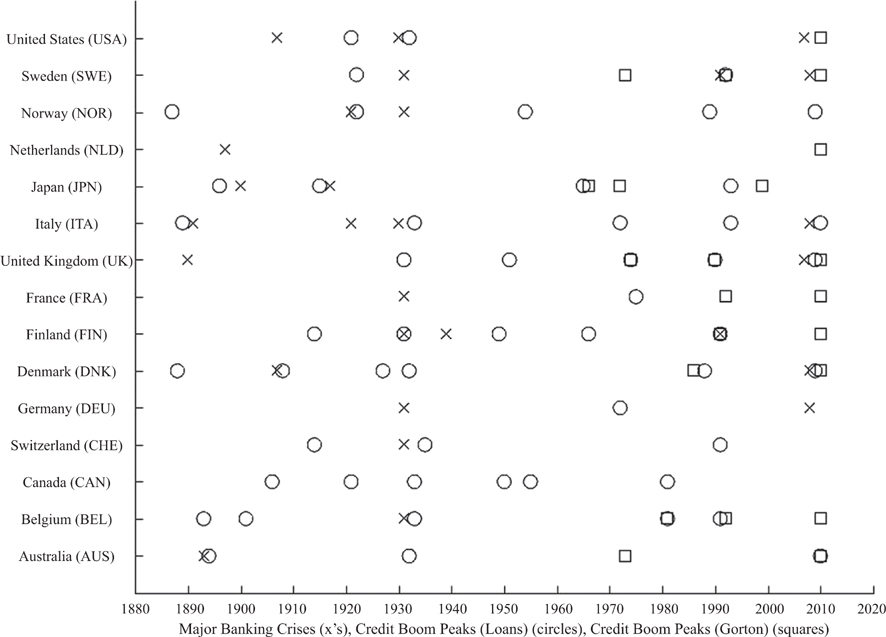
Figure 3 compares credit booms to major financial crises defined as crises associated with a 5 percent drop in real GDP. The percentage of credit boom peaks associated with crises at 3.7 percent is much lower than in the previous figures, and the percentage of credit booms that precede or occur in the same year is even lower at 2.6 percent.Footnote 33 These results are quite dramatic. They suggest that credit-boom-induced big crises like the Great Contraction or the GFC are very rare—about once in every 50 years raising the question whether there should be a major financial stability policy regime change if these events are so rare.
Major Banking Crises and Credit Booms (Loans and Credit)

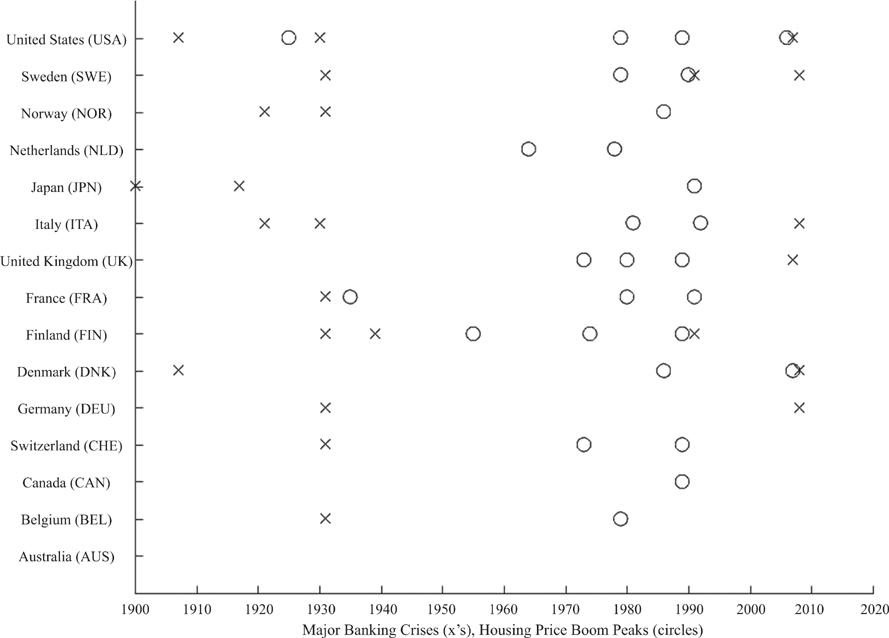
I next compare asset price boom busts (house prices and equities) with major banking crises.Footnote 34 My measures of asset-price booms and busts come from Bordo and Landon-Lane (Reference Bordo, Landon-Lane, Sofía, Lawrence and Claudio2014a, Reference Bordo, Landon-Lane, Georgios and Athanasios P.2014b) and cover the period 1900 to 2010. Figure 4 compares housing boom busts with major banking crises. Only 11 percent of house price busts occur within one year of a major banking crisis. Also, 11 percent of house price boom peaks occur one year before or coincident with a major crisis.
Major Banking Crises and House Price Booms

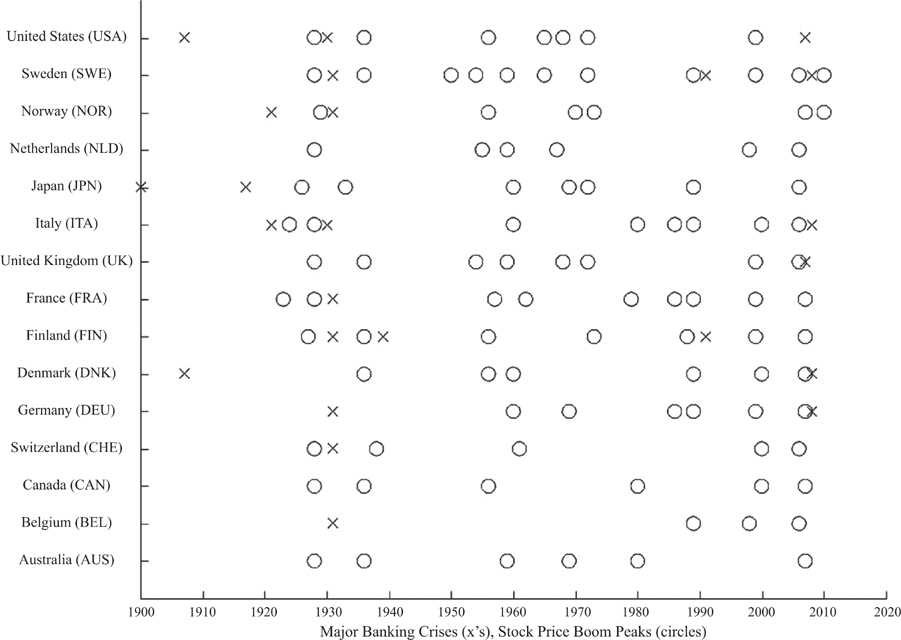
Figure 5 compares stock market boom busts with major banking crises. Only 3 percent of stock market boom peaks occur within one year of a banking crisis. Also, 3 percent of stock market peaks occur one year before or coincident with a crisis. These findings are similar to those of many studies (e.g., Reinhart and Rogoff Reference Reinhart and Rogoff2009) showing housing busts tend to be more associated with major financial crises than stock market boom busts.
Major Banking Crises and Stock Price Booms

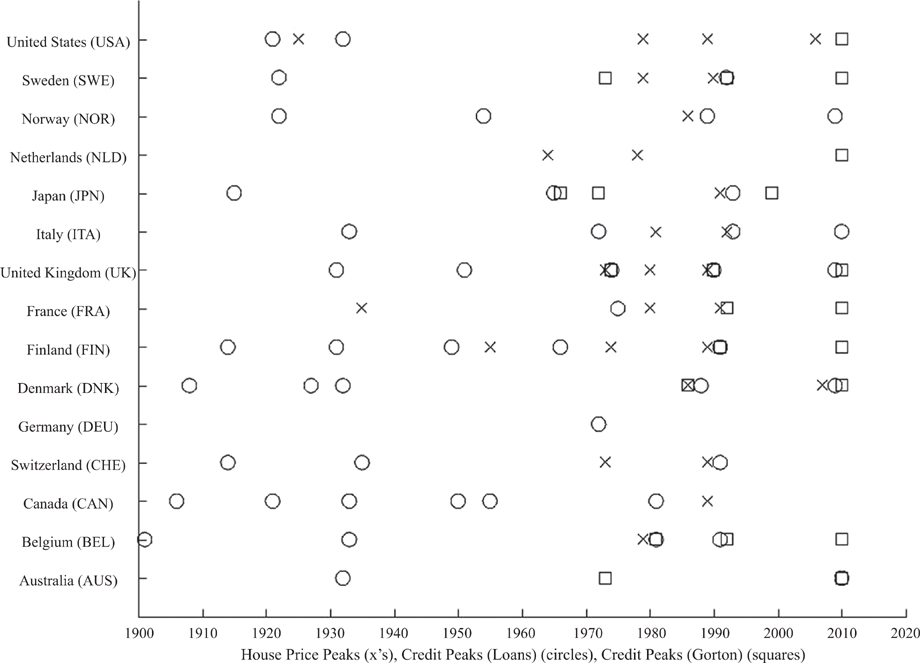
Finally, I compare asset price boom busts with credit booms. Figure 6 compares house price boom busts with credit boom peaks. I do this for both the loan data and total credit. For loans, 6.3 percent of credit booms occur within one year of a housing price boom bust. For total credit it is 7.2 percent. I find that no credit boom peaks occur one year before or coincident to a housing bust for loans. For total credit, it is 1.4 percent.
House Price Booms and Credit Booms (Loans and Credit)

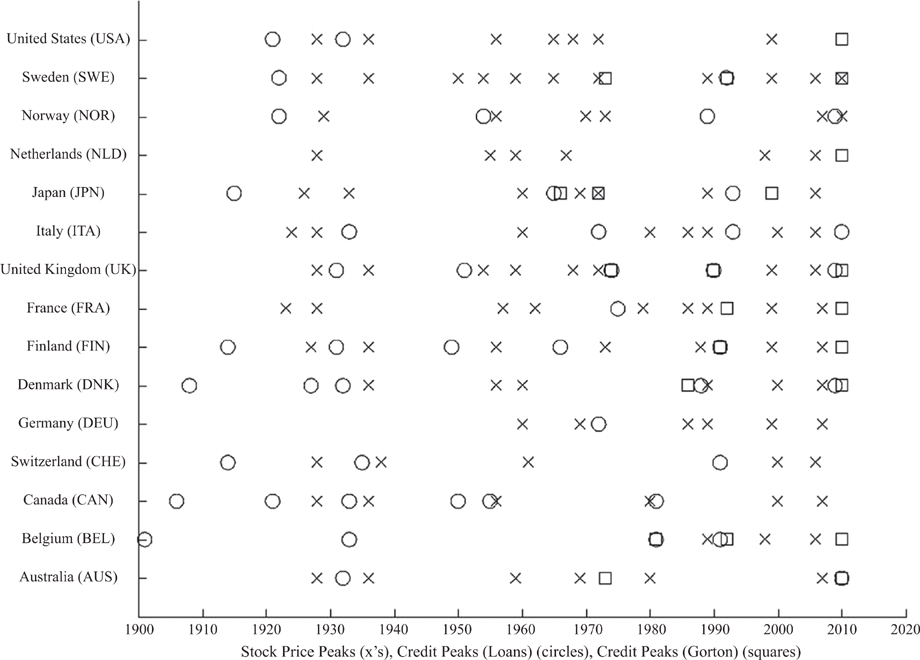
Figure 7 shows the connection between credit booms and stock price busts. Using the loan data I find that 8.5 percent of credit booms occur within one year of a stock market crash. For total credit it is 10.5 percent. Using the loans measure, 6.3 percent of credit booms occur within one year before or coincident with a stock market crash while 7.2 percent occur using total credit.
Stock Price Booms and Credit Booms (Loans and Credit)

In sum, the results comparing credit booms with asset price booms suggest that credit booms have only a limited connection with asset price busts. My evidence suggests that the coincidence between credit boom peaks and serious financial crises is quite rare. It also suggests that credit booms are not closely connected to asset price booms.Footnote 35 Indeed, a look at when most of the coincidence occurs was in two episodes: the Great Contraction 1929–1933 and the GFC. This leads to the question whether such rare events should lead to a sea change in monetary policy and financial stability policy. After the Great Contraction, the world’s monetary authorities believed that it should, and repressed both the domestic and international financial system for 40 years. That strategy led to unintended consequences driven by the dynamics of financial innovation and may in turn have possibly set the seeds for the GFC 80 years later (Gordon Reference Gordon2014; Bordo and Haubrich Reference Bordo and Haubrich2010).
The current obsession with financial stability (and the increased use of the tools of macro prudential policy and Leaning Against the Wind (LAW)) raises the risk of repeating the experience of the 1930s and creating a new regime of financial repression which may have unintended consequences.Footnote 36 It may head off a few minor financial crises in the next few decades but much later in the future may precipitate an even bigger financial crisis than 2007–2008.
The analogy between policies designed to suppress natural disasters should be kept in mind. Myron Scholes (Reference Scholes, John D. and John B.2009, p. 105) gives the analogy of when “fire fighters put out every small fire in Yellowstone National Park…The underbrush grew, setting the stage for multiple lightning strikes to cause fires to destroy much greater areas in the park than if fires initially had been left to burn of their own accord.” He further argues that “financial regulators do the same thing when they dampen volatility: they put out small fires but encourage risk-taking and thus increase the likelihood of a major conflagration.”Footnote 37 Hyosong Kim et al. (Reference Kim, Newman and Park2017) apply this analogy to attempts to smooth recessions, which they show are not serially correlated events. They argue from physics that eventually power law dynamics will set in leading to a much worse depression.
Lessons from History
My survey of the link between monetary regimes and financial stability in advanced countries in the past two centuries shows a varying evolution between monetary stability and financial stability which involved a slow learning process by the advanced countries’ central banks.
The process of evolution of both monetary and financial stability across regimes swung like a pendulum. Under the gold standard, the convertibility rule and Bagehot’s rule provided some stability for advanced economies, which was disturbed by WWI. The interwar period was characterized by monetary and financial instability reflecting both a decline in credibility and serious policy errors. Under the BWS, monetary stability was largely restored until the Great Inflation beginning in 1965, and under the thumb of financial repression the financial system was remarkably stable. Under the Managed Float, the Volcker shock produced the Great Moderation from the mid 1980s to the early 2000s—the most stable period in macroeconomic history.Footnote 38 However, liberalization of the financial system in reaction to the earlier era of repression as well as the advent of the “too big to fail” doctrine led to a resurgence of the financial crisis problem.
A key lesson from the historical record through the Great Moderation period is that if four key principles are followed, a stable monetary policy regime can be compatible with financial stability: (1) price stability (credibility for low inflation); (2) real macro stability (via, for example, flexible IT); (3) a credible rules based LLR; and (4) sound financial supervision and regulation and banking structure.
Indeed, one country that has avoided banking crises altogether is Canada, which pretty closely followed these principles.Footnote 39 A key difference between Canada and its southern neighbor has been its sound bank structure and prudent financial regulation (Bordo, Redish, and Rockoff Reference Bordo, Redish and Rockoff2015). The Canadian experience may offer lessons to other countries.
The GFC of 2007–2008 began with the Subprime Mortgage crisis. It was caused by flawed U.S. housing policy, aggravated by loose monetary policy in a departure from the rule-like behavior of the Great Moderation. Other forces were the failure of the financial regulatory and supervisory authorities to contain the growth of credit derivatives, the growth of leverage and the evolution of the shadow banking system, and the proliferation of global imbalances.
The GFC and the Great Recession were contained by effective monetary and fiscal policies and an unorthodox extension of the LLR by the Fed and other authorities who had learned the lessons of the 1930s. However, like the 1930s, the GFC was blamed on the banks and the financial system which led to the creation of a new regime of financial regulation and the elevation of the financial stability mandate to primary importance.
The current case for elevation of the financial stability mandate to paramount importance is based on the assumption that serious financial crises are largely driven by credit-driven asset price booms and the failure of the monetary (and regulatory) authorities to head them off. Along these lines central banks have been encouraged to use their monetary policy tools (LAW policy) as well as new tools of macro prudential policy.
My empirical evidence casts doubt on this assumption. Financial crises are very heterogeneous. Moreover, the record suggests that these events are very rare. Indeed, the recent GFC may have been a one-off event, a perfect storm (with multiple causes) possibly like the Great Contraction of 1929–1933. This raises the question whether such rare events should lead to a sea change in monetary policy and financial stability policy as occurred after the Great Contraction. That strategy created an environment of financial repression which did provide financial stability but which may also have set in place forces which led to unforeseen and eventually serious threats to financial stability and may have sown the seeds for the GFC 80 years later. An alternative might have been to create an incentive compatible regulatory regime which would provide the advantages of a safety net without the disadvantages of a regime of financial repression (White Reference White2000).
The current obsession with financial stability risks recreating some of the mistakes of the 1930s, 1940s, 1950s and 1960s. In addition to financial repression, adoption of many of the tools of macro prudential regulation that have been proposed may recreate many of the problems with the use of the tools in the past.Footnote 40 Many of these macro prudential policies were actually credit or fiscal policies which involved monetary authorities inefficiently picking winners and losers and influencing the allocation of resources.Footnote 41 They also impinged on central bank independence because these policies strayed from their mandates and opened central banks up to scrutiny and criticism by their legislaturesFootnote 42 (Goodfriend Reference Goodfriend2014). Pursuit of an enhanced financial stability strategy may head off a few minor crises in the next few decades but much later precipitate an even bigger crisis than we saw a decade ago.
My survey of the historical record of the connection between the monetary regime and financial stability teaches us that a knowledge of history matters. Basing important regime-changing decisions on the record of the last crisis ignores the heterogeneity of the crisis problem. History teaches us the importance of relearning the details of the events of the past which often contain important and long forgotten clues to aid in our understanding of the “crise du jour.”